This guide is independent and contains no paid placement. If affiliate links are added later, they will be clearly marked and will not change our editorial checks.
Dogs are allowed on the DLR and travel free, on a short lead and under control at all times. Use lifts rather than escalators, keep your dog behind the yellow line and away from platform edges, avoid the busiest peak trains, and choose a middle carriage away from the front window on a driverless train.
What the DLR is and where it runs
The journey that explains the DLR best starts at Bank, deep under the City of London, and ends beside the river at Greenwich. You change from the Underground to a smaller, lighter train, climb out of the tunnel into daylight, and within minutes you are gliding past tower blocks, over water and through Canary Wharf, with the Thames appearing and disappearing between the buildings. For a dog, that change matters: the first part is enclosed, warm and crowded, while the second is brighter, breezier and full of movement outside the windows. Understanding that shape — a short underground start, then a long elevated run — helps you plan where your dog will need reassurance and where it can simply settle.
The Docklands Light Railway, usually shortened to the DLR, is part of Transport for London, or TfL. It opened in 1987 to serve the redeveloped Docklands of east London, and it has grown into a network of about 45 stations across several branches. The western ends are Bank and Tower Gateway in central London. From there the lines run east through Limehouse, Canary Wharf and Canning Town, then split towards Stratford and Stratford International in the north-east, Beckton in the east, Woolwich Arsenal across the river in the south-east, and Lewisham in the south-east. Trains run frequently, typically every few minutes on the central sections during the day, and the whole network sits inside the London fare zones, mostly Zones 2 and 3, with Bank and Tower Gateway in Zone 1.
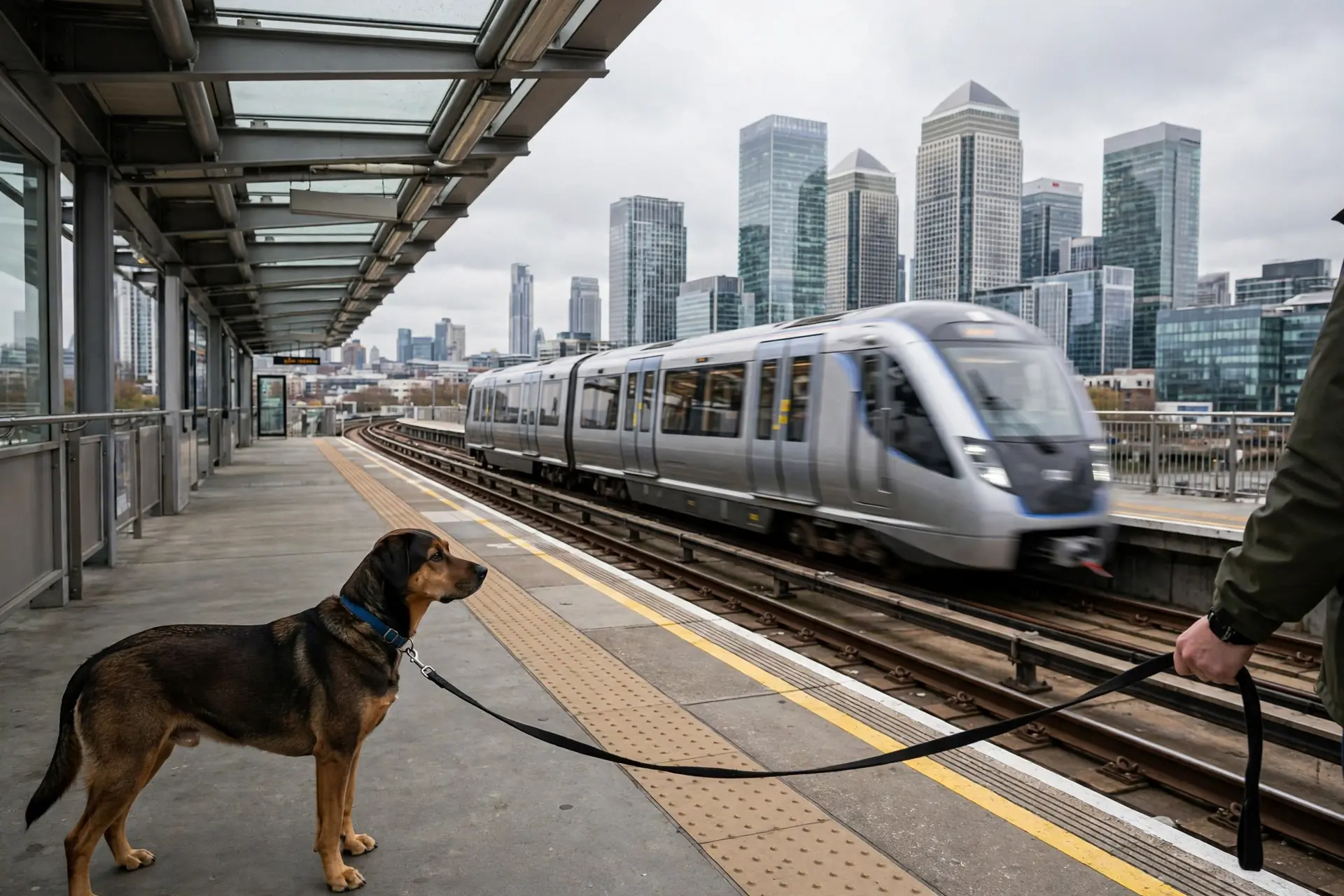
Unlike the Underground, most DLR stations are above ground, on viaducts or at street level, and the trains are driverless. There is no driver at the front; a member of staff known as a passenger service agent travels on board and can drive the train manually if needed. That design is the reason many visitors remember the DLR so fondly — you can sit at the very front and watch the track unfold ahead of you — but it is also the reason dog owners need to think about seating, as explained below. The trains themselves are smaller and lighter than Tube trains, with wide doors, low floors and level boarding at most stations, which makes getting a dog on and off relatively straightforward when the platform is not crowded.
For a day out, the DLR is at its most useful as a link between central London and the riverside districts of east and south-east London. It connects the City with Canary Wharf, the Olympic Park around Stratford, the ExCeL exhibition centre near Custom House, London City Airport, the historic streets of Greenwich, and the Woolwich riverside. It also connects with the Underground, the Elizabeth line, London Overground, National Rail and, at some stations, river boats and buses. If you are staying in central London and want a dog-friendly riverside walk without a long train journey, the Bank to Greenwich run is often the simplest first DLR trip: one direct train, about twenty minutes, and a rewarding walk at the far end.
Are dogs allowed on the DLR?
Yes — dogs are allowed on the DLR, and they travel free. TfL permits dogs on its services, including the DLR, the Underground and London buses, provided the dog is kept under control. There is no size limit in the published conditions, no requirement to use a carrier for a large dog, and no dog ticket to buy. That simple position is one of the reasons London is a practical city to explore with a dog, but it comes with a clear expectation: the owner is responsible for the dog at every stage, from the ticket hall to the platform and on board the train. If a dog is out of control, aggressive, or causing a genuine problem for other passengers, staff can ask the owner to leave the station or the train.
The core rule is the lead. Keep your dog on a short lead at all times inside stations and on trains, and keep the lead short enough that the dog cannot wander across a platform, approach another passenger uninvited, or step towards the platform edge. A retractable lead left extended is a hazard on a busy platform: it can trip other passengers, tangle around luggage wheels, or let a dog reach the yellow line before you can react. Lock a retractable lead short, or better still use a fixed lead of about one metre for the whole DLR journey. A harness gives you more control than a collar alone, especially for a strong dog that may pull when a train arrives, and it is easier to hold a dog steady in a lift with a harness handle or a short grip.
Dogs should stay on the floor, not on the seats. That applies even on a quiet train with empty seats, and even if you have a blanket with you. Other passengers may have allergies, may not want dog hair on their clothes, or may simply not want to share a seat with an animal they did not expect. A small dog in a carrier can sit on your lap or on the floor by your feet; a larger dog should lie or sit on the floor, ideally in the space between your feet or against the side of the carriage where it is out of the aisle. Keep the dog clear of the doors so that boarding and alighting passengers can move freely, and be ready to move the dog if a wheelchair user or a passenger with a pushchair needs the space.
Behaviour matters as much as paperwork. A dog that barks at every train, lunges at other dogs, or is frightened by crowds will find the DLR stressful, and other passengers will notice. If your dog is reactive, choose a quiet time for a first trip, keep the journey short, and consider a muzzle if your dog is trained to wear one comfortably — a muzzle is not required by TfL for ordinary dogs, but it can be a sensible precaution for a dog that may snap when startled in a crowd. Assistance dogs travel under the same free-travel rule and are exempt from any restrictions that might otherwise apply to pets, and staff should be aware of that distinction. For anything unusual — a very large dog, several dogs travelling together, or a dog that needs special handling — check the official guidance before you travel, because station staff apply the TfL conditions on the day and their decision is final.
Fares and tickets for owners
Dogs travel free, so the only fares to work out are your own. The DLR uses the same TfL fare system as the Underground and buses: you can pay with a contactless bank card, a phone or watch using Apple Pay or Google Pay, an Oyster card, or a paper ticket. Contactless and Oyster are the simplest options for most visitors, because the fare is calculated automatically and capped at the daily limit for the zones you travel in. Remember to touch in at the start and touch out at the end, even at open DLR stations where there are no ticket gates, because the yellow card readers on the platform or in the ticket hall are how the system knows where your journey began and ended. If you forget to touch out, you may be charged the maximum fare, so build that step into your routine before you start walking the dog.
Many DLR stations have no ticket gates at all. Instead they have freestanding yellow readers, often called validators, near the entrance and on the platform. This is convenient when you have a dog, because there is no narrow gate to negotiate with a lead, a bag and a nervous animal, but it also means you have to remember the step yourself. Make it a habit: arrive, find the reader, touch in, then move to the platform. At Bank and at the larger interchange stations there are gates, so you will need to pass through with your dog close beside you. Use the wide gate if one is available — it is designed for luggage, pushchairs and wheelchairs, and it gives you and the dog more room than a standard gate. Hold the lead short, step through together, and do not let the dog dart ahead while the gate is still open.
Children and concessions follow the usual TfL rules, and dogs do not change them. Children under eleven travel free on the DLR when accompanied by a paying adult, and older children and students may qualify for discounted fares with the right card, but those details change from time to time, so check the official guidance before you travel if you are relying on a concession. Visitors from outside London should note that the DLR is inside the TfL system, so a National Rail ticket to a London terminus does not automatically cover a DLR journey unless the ticket specifically includes Underground or DLR travel. If you are combining a mainline train with the DLR, check whether your ticket covers the whole journey or whether you need to touch in separately.
Budget for the day rather than for a single ride. A return journey from central London to Greenwich or Canary Wharf is inexpensive by London standards, and the daily cap means that further DLR and Tube journeys later in the day may cost nothing extra once you have reached the limit for the zones you have used. That makes it easy to add a second stop — for example, Greenwich in the morning and Canary Wharf in the afternoon — without worrying about each individual fare. Keep your payment card or Oyster card somewhere you can reach it without putting the lead down, such as a jacket pocket or a card holder on a lanyard, and keep a little cash or a second payment method in reserve in case a reader fails or a card is declined at a gate.
Station layout, platforms and the yellow line
Most DLR stations are small, open and easy to read, which is good news for dog owners. A typical station has a street-level entrance, a short flight of stairs or a lift up to a single island platform or a pair of side platforms, and a simple canopy overhead. There are no long subterranean corridors, no maze of tunnels, and usually only one or two platforms to choose from. That simplicity means you can see the whole station at a glance, which helps you keep track of your dog and spot the lift, the exit and the right platform without a long search. It also means the platforms are exposed to the weather, so wind, rain and cold are part of the experience, especially on the elevated sections.
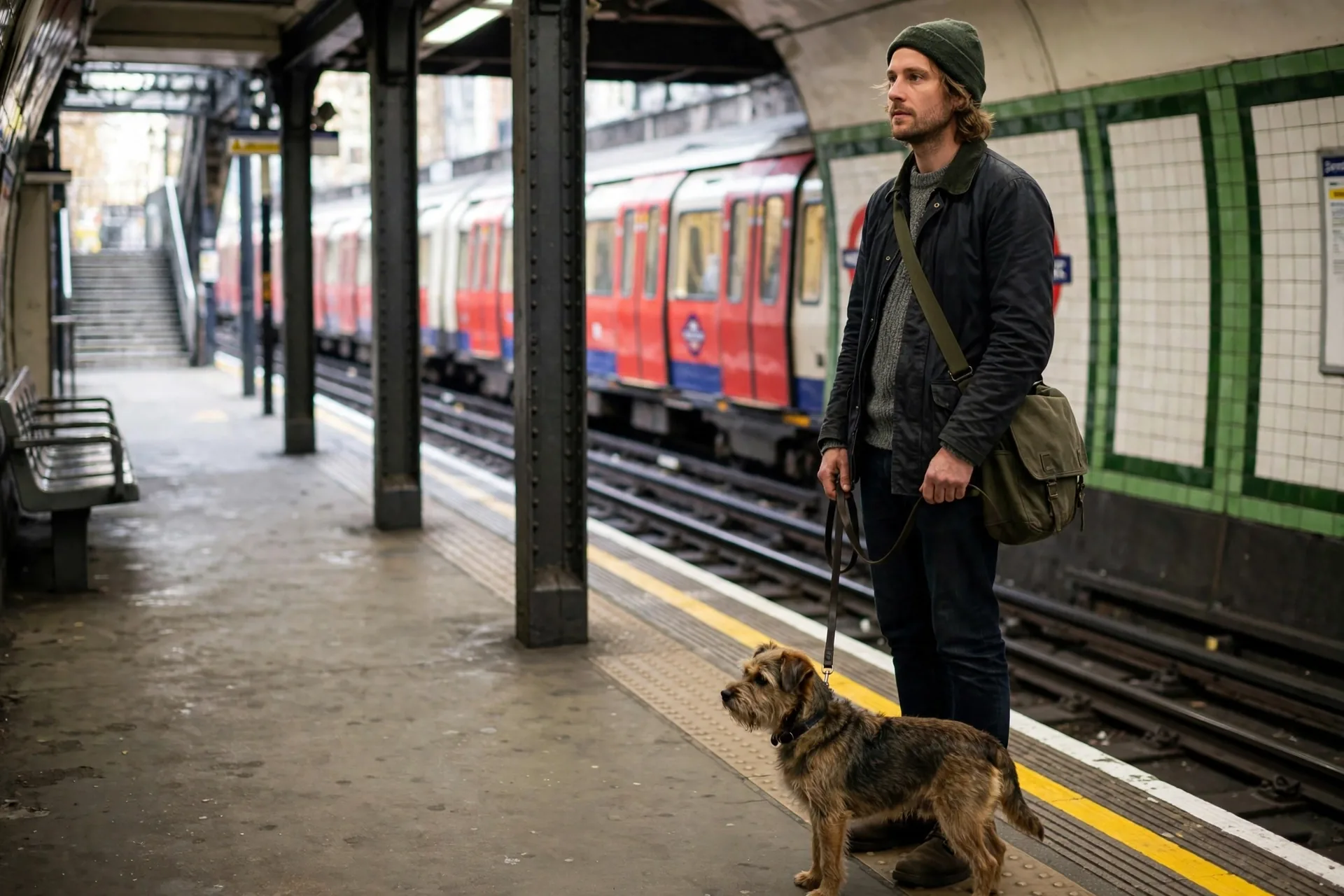
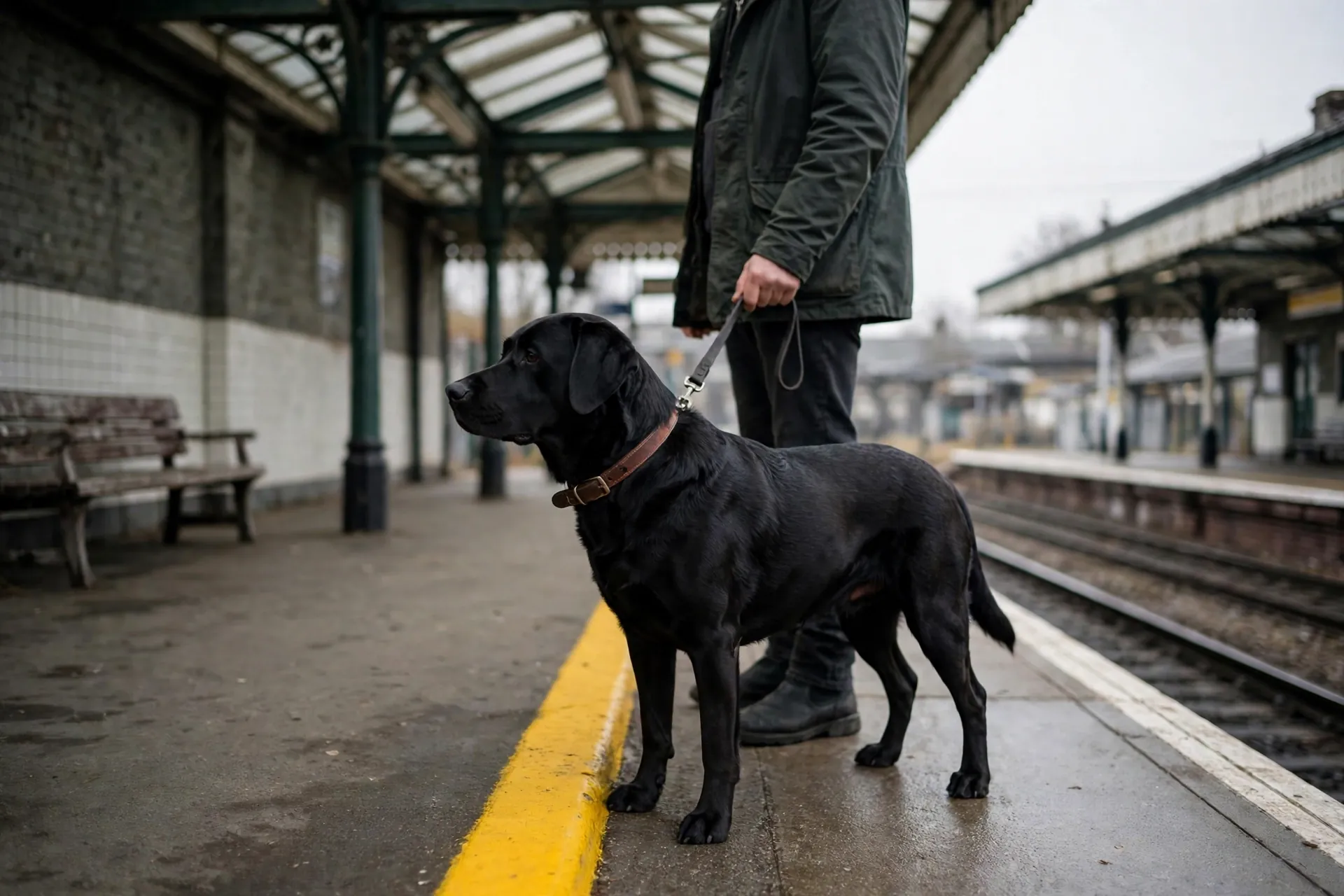
The yellow line is the most important safety feature on a DLR platform, and it deserves the same respect as on any railway. Stand behind the yellow line while you wait, and keep your dog behind it too, on a short lead, with its body fully clear of the edge. DLR trains arrive quietly and quickly, and a dog that is standing at the edge, sniffing over the side or lying with its paws over the line is at real risk. Teach the dog a simple wait position a step back from the line, and reward it for staying there while trains pass on the other platform. Our guide to UK train platform safety covers the same habits in more detail, and they apply just as much on a small DLR platform as on a busy mainline station. If your dog is a puller, stand with the dog on the side away from the platform edge, so that any sudden lunge pulls it towards the wall or the shelter rather than towards the track.
Platform surfaces vary. Many DLR platforms are concrete or paved, with tactile paving — a strip of raised bumps — near the edge to warn visually impaired passengers. Dogs generally cope with tactile paving without difficulty, but some dogs dislike the texture under their paws, and a nervous dog may hesitate or try to step around it. Let the dog choose its footing a little further back from the edge, where the surface is smoother, rather than forcing it to stand on the tactile strip. In wet weather the platform can be slippery, particularly on painted surfaces and metal thresholds at the top of stairs, so walk slowly and keep the lead short until you are on level ground. In hot weather the platform and the train floor can be warm, but the elevated, open-air design usually keeps the air moving better than a deep Underground station.
Waiting areas are limited. Most DLR stations have a small shelter, a bench or two, and a help point — a button you can press to speak to staff — but there is no staffed ticket office at many smaller stations, and there may be no indoor waiting room. That matters if you need to wait for a less crowded train: you will be waiting on the platform, in whatever weather is happening. Bring a small mat or a folded blanket for the dog to lie on if you expect to wait, and stand in the sheltered section near the middle of the platform, where the wind is usually less strong and the train doors will open close by. Check the departure board or the TfL app before you leave home, so that you arrive close to the train time and do not spend longer on the platform than you need to.
Driverless trains: where to sit and stand with a dog
The driverless design is the DLR's most distinctive feature, and it changes the experience for a dog in two ways: there is no cab at the front, so the first row of seats looks straight out over the track, and there is no driver to watch the platform as the train leaves. The front seats are popular with children and first-time visitors, who enjoy the view as the train crosses bridges and curves between towers, but for a dog they are usually the worst place to sit. The moving track, the approaching bridges and the sudden changes of light can be unsettling, especially for a dog that is already nervous about the noise and vibration of a train. If your dog is sensitive to movement or to visual stimulation, avoid the front carriage and the front-facing seats altogether.
The best place for a dog is usually in the middle of the train, on a side-facing seat or in the standing area near the doors, with plenty of floor space. Side-facing seats let the dog lie with its back against the wall of the carriage, facing into the train rather than out of the window, and the dog can rest its head on your feet without blocking the aisle. The middle carriages are also further from the doors at the ends of the train, so there is less foot traffic past the dog, and the ride tends to feel smoother there than at the very front or back. If the train is quiet, choose a bay with an empty seat beside you and let the dog settle on the floor; if the train is busy, stand in the doorway area with the dog tucked between your feet and the wall, and be ready to move aside for passengers getting on and off.
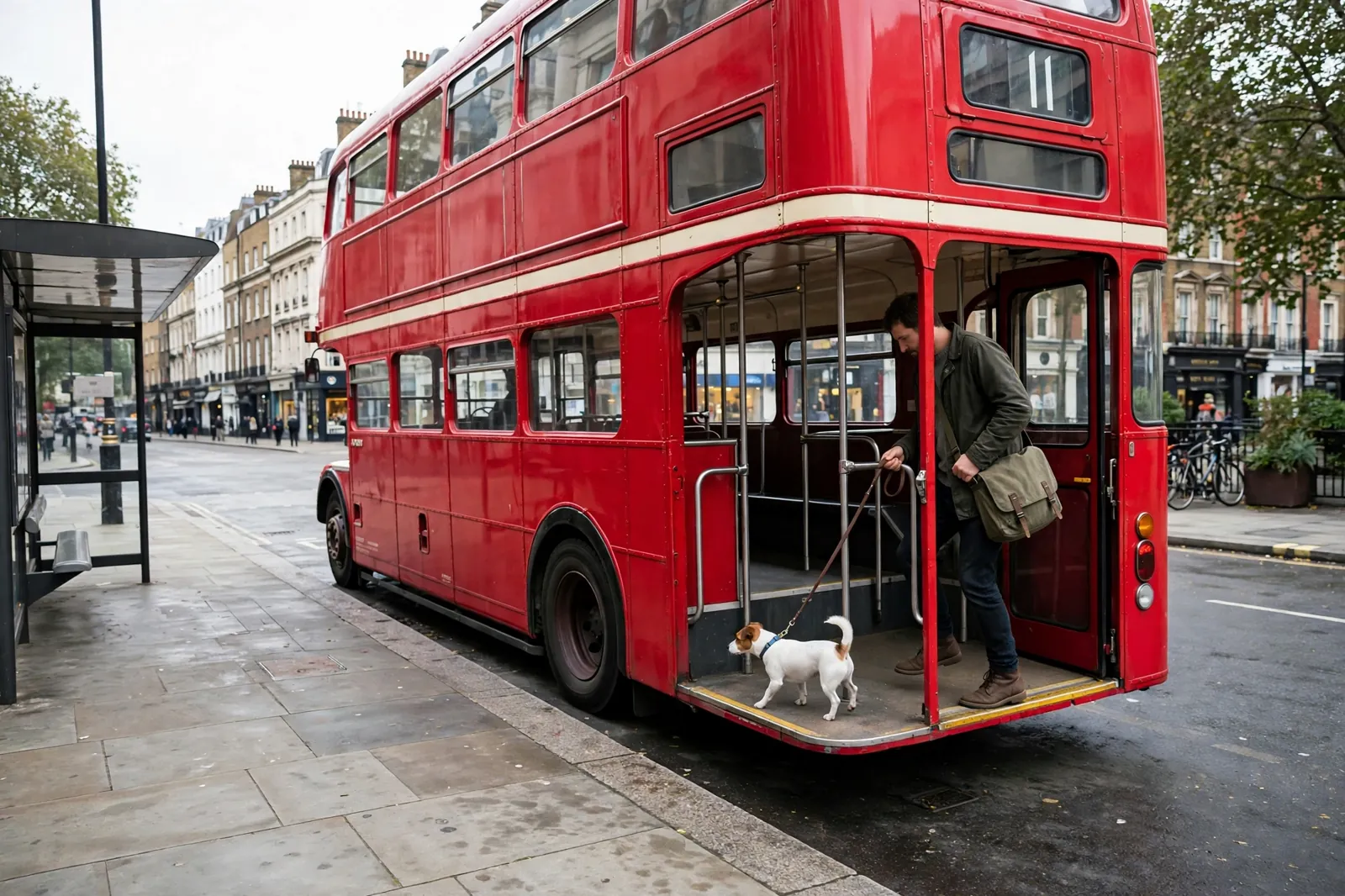
Boarding and alighting need a little care because the doors open and close automatically and the gap between the train and the platform is small but real. Wait for passengers to get off first, then step on with the dog close beside you, on a short lead. Do not let the dog step on while you are still on the platform, or step off while the dog is still on the train — a lead caught in closing doors is a serious hazard. If your dog hesitates at the threshold, step on first, keep the lead short, and encourage the dog with a calm voice rather than pulling it. The level boarding at most DLR stations means there is usually no step up, which helps older or smaller dogs, but the floor of the train and the platform can be at slightly different heights at some stations, so watch the dog's footing.
Inside the train, the noise is a low hum with announcements, the beeping of the doors, and the sound of the train curving over viaducts. Some dogs settle quickly once they have a spot on the floor and a familiar smell, such as a small blanket from home; others stay alert for the whole journey and need a chew or a lick mat to occupy them. A lick mat or a stuffed chew is useful only if your dog can enjoy it without making a mess or dropping it in the aisle, and it should be something the dog already knows at home, not a new treat tried for the first time on a moving train. If the dog is panting, pacing or trying to climb onto your lap, it is telling you the journey is too much — get off at the next station, let the dog walk and settle, and continue later or take a bus instead. The London Underground rules for dogs cover similar seating and settling advice, and much of it transfers directly to the DLR.
Key interchanges: Bank, Canning Town, Stratford, Lewisham, Woolwich Arsenal
Bank is the busiest and most complicated DLR interchange, and it is the one to plan most carefully. The DLR platforms at Bank are deep underground, reached by escalators and lifts from the Underground station, and the walk between the DLR and the Central, Northern and Waterloo and City lines can be long, crowded and confusing. The station has been rebuilt in recent years to improve the interchange, but at peak times it is still a fast-moving river of commuters. If you are starting a day out with a dog, consider whether you need Bank at all: Tower Gateway, a short walk away, is a smaller, quieter DLR terminus at street level, with a simpler layout and an easier start. If you do use Bank, use the lift, keep the dog on a very short lead, and avoid the morning and evening peaks if you can.
Canning Town is the DLR's great east London crossroads. Here the DLR meets the Jubilee line and, a short walk away, the Elizabeth line, and the station serves the ExCeL centre, London City Airport and the growing neighbourhoods around the Royal Docks. The DLR platforms are elevated and open, while the Jubilee line is underground, so changing between them involves lifts or escalators and a walk through a busy ticket hall. The station is staffed, the signage is clear, and the lifts are large, but the sheer number of passengers at event times — when ExCeL is hosting a large show — can be overwhelming for a dog. If you are heading to the Royal Docks for a walk, check the event calendar first and choose a quieter time, or use a nearby station such as Royal Victoria or Custom House instead.
Stratford is the other major interchange, and it is a different kind of busy. The DLR station sits beside the mainline and Underground station, close to the Westfield shopping centre and the Queen Elizabeth Olympic Park. The area is spacious and modern, with wide concourses and good lifts, but the crowds around the shopping centre, especially at weekends and in the Christmas period, can be intense. For a dog, Stratford works best as a starting point for the Olympic Park, where there are wide paths, waterways and open green spaces, rather than as a shopping destination. Enter the park from the station side, give the dog a proper walk before you head back, and avoid the shopping centre itself unless you have checked that the dog is welcome in the specific shops you want to visit.
Lewisham and Woolwich Arsenal are the southern and south-eastern ends of the network, and both are more relaxed than the central interchanges. Lewisham connects the DLR with National Rail services to central London and Kent, and the station is a useful starting point for walks along the Ravensbourne river and into the quieter streets of south-east London. Woolwich Arsenal connects the DLR with the Elizabeth line and National Rail, and it is the gateway to the Woolwich riverside, the Royal Arsenal, and the Thames Path. Both stations have lifts, both are staffed at busy times, and both are easier to navigate with a dog than Bank or Stratford. Woolwich is particularly useful if you want a longer riverside walk without the crowds of Greenwich, and the Thames Path from Woolwich towards the Thames Barrier is wide, flat and well suited to a steady walk on a lead.
Greenwich with a dog: Cutty Sark, riverside walks
Back on our Bank to Greenwich journey, the train leaves Canary Wharf, crosses the river in a tunnel under the Thames, and emerges at Island Gardens, where the view across the water to the Old Royal Naval College is one of the best in London. The next stop is Cutty Sark, and this is where most dog owners should get off. The station exit brings you out beside the Cutty Sark ship itself, a few steps from the riverside, Greenwich Market and the cluster of streets that make the town centre so walkable. Give the dog a few minutes to stretch its legs on the riverside path before you do anything else — after twenty minutes on a train, a sniff and a toilet break are more important than a photograph.
The riverside walk from Cutty Sark towards the Greenwich Peninsula is flat, paved and easy on a lead, with wide views across the Thames to the Isle of Dogs. You can walk east past the Old Royal Naval College, the National Maritime Museum and the Queen's House, then continue along the river towards the O2 arena, or you can turn back west towards Deptford and the quieter stretches of the Thames Path. Dogs must be kept on a lead along the riverside in the busiest sections, and you should keep them away from the water's edge at low tide, where the mud is deep and the river current is strong. The Thames is tidal here, and the foreshore is not a safe place for a dog to run free. If your dog likes to swim, save that for a proper dog-friendly beach or a secure swimming venue, not the Thames.
Greenwich Park is the other great draw, and it is one of the best large parks in London for a dog walk. The park rises from the town centre up to the Royal Observatory and the Prime Meridian, with wide paths, open grass and views back across the river to Canary Wharf and the City. Dogs are welcome in most of the park, but they must be kept on a lead in some areas, including around the deer enclosure and the flower garden, and you should check the official guidance before you travel if you plan to let your dog off the lead anywhere in the park. The climb to the Observatory is steep in places, so older dogs and puppies may prefer the flatter paths at the bottom of the park, around the lake and the boating pond, where there is shade in summer and shelter in winter.
Greenwich Market and the town centre streets are busy, especially at weekends, and many of the cafés and pubs have outdoor seating where a well-behaved dog is welcome. Check before you sit down, and choose a table at the edge of the terrace rather than in the middle of the foot traffic, so the dog is not stepped on or startled by passing shoppers. The market itself can be crowded and noisy, with food smells that will excite any dog, so keep the lead short and the visit brief if your dog is food-motivated or reactive. Water is available at many cafés if you ask, but it is safer to carry your own bottle and a collapsible bowl, especially in summer. If you need a longer break, the riverside steps and the gardens beside the Old Royal Naval College offer quieter places to sit with a dog and watch the river traffic.
Canary Wharf with a dog: squares, cafés, Jubilee Place
Canary Wharf is a surprise for many dog owners: for all its glass towers and suited commuters, it is also one of the most open and walkable parts of east London, with squares, gardens and a waterside that are well suited to a dog on a lead. The DLR station at Canary Wharf is directly under the main shopping and office complex, and the exit brings you into a network of covered malls, open squares and dockside paths. The first thing to notice is the scale: the buildings are tall, the spaces are wide, and the wind can funnel between the towers, so a small dog may find the open squares breezy and a nervous dog may find the height of the buildings unsettling at first. Give the dog time to adjust in a quieter corner before you set off across the main square.
Canada Square, Cabot Square and Jubilee Place are the three main public spaces, and each has a different character. Canada Square is the largest, with a lawn in summer, a large screen, and events that can draw crowds; Cabot Square is smaller and more sheltered, with fountains and planting that dogs seem to enjoy sniffing around; Jubilee Place is the covered shopping mall, where dogs are generally welcome on a lead in the public areas but individual shops set their own rules, so check before you enter a shop with a dog. The docks themselves — the water that gives Canary Wharf its name — are bordered by wide, flat paths that are ideal for a steady walk, but keep the dog on a lead and away from the water's edge, because the dock walls are sheer and there is no easy way out if a dog falls in.
Cafés and restaurants at Canary Wharf are used to dogs, and many have outdoor seating on the squares where a dog is welcome. The usual rule applies: ask first, choose a table at the edge, and keep the dog on a short lead under the table or beside your chair. Some of the larger chain cafés allow dogs inside as well, but this varies by branch and by time of day, so do not assume that a dog-friendly policy at one branch applies to another. If you want a proper sit-down meal, look for a restaurant with a terrace and call ahead to confirm the dog is welcome; if you only want a coffee, a takeaway cup and a bench by the water is often the simplest and most enjoyable option.
Beyond the main squares, the walk east from Canary Wharf towards West India Quay and the Museum of London Docklands is quieter and more interesting for a dog. The old dock buildings, the narrow streets and the waterside paths have a very different feel from the modern towers, and there are fewer crowds and more smells to investigate. Heron Quays station, one stop south on the DLR, is a good alternative exit if Canary Wharf station itself is busy, because it brings you out on the southern side of the estate, closer to the quieter docks and the paths towards South Quay. Whatever route you choose, remember that Canary Wharf is a working business district first and a leisure destination second: at weekday lunchtimes the squares fill with office workers, and at weekends they are calmer, which makes a weekend morning the best time for a relaxed dog walk.
Peak hours, crowds and etiquette
Peak hours on the DLR are the weekday mornings and evenings when commuters are travelling to and from work, roughly from 7.30 to 9.30 in the morning and from 5.00 to 7.00 in the evening, although the exact pattern varies by branch and by station. At these times the trains are full, the platforms are crowded, and the atmosphere is hurried and focused. A dog adds friction to that flow: it takes up floor space, it needs a moment to board and alight, and it may be stepped on or jostled by passengers who are not expecting an animal at ankle height. For the dog's sake and for the sake of other passengers, avoid peak hours if you possibly can. A mid-morning, early-afternoon or late-evening journey is calmer, cooler and far more enjoyable, and you will have more space to settle the dog properly.
If you must travel at a busy time, a few habits make the journey easier for everyone. Wait for the next train if the first one is already full, rather than squeezing a dog into a crowded carriage. Stand near the doors but out of the flow, with the dog tucked against the wall and the lead short. Do not let the dog greet other passengers or other dogs on the train, even if it is friendly — not everyone wants to be greeted, and a dog that leans into a stranger's legs on a crowded train can cause a trip or a startled reaction. If another dog is on the same carriage, keep yours facing away or at a distance, and do not let the leads tangle. A short, calm word to the other owner — a nod and a smile — is usually enough to agree on space without a conversation.
Etiquette on the platform is just as important as etiquette on the train. Keep the dog on a short lead while you wait, do not let it approach other passengers, and clean up after it immediately if it toilets on the station. DLR stations have bins, and you should carry poo bags at all times, even on a short journey. If your dog is barking, whining or pulling, move away from the crowd and give it space, rather than trying to correct it in the middle of a busy platform. Other passengers are generally tolerant of a dog that is clearly under control, even if it is a little nervous, but they are much less tolerant of a dog that is lunging, barking at strangers or blocking the platform. A calm owner makes a calm dog more likely, so keep your own movements slow and your voice low.
Events change the pattern. Football matches, concerts at the O2, large exhibitions at ExCeL, and the Christmas markets at Greenwich and Canary Wharf all bring extra passengers to the DLR at unusual times, including weekends. Check the event calendar before you travel, and if a major event is happening near your destination, consider travelling earlier or later, or choosing a different station. The TfL website and app carry service updates and event information, and a quick check before you leave home can save you a crowded train and a stressed dog. If you do find yourself on a unexpectedly crowded train, get off at the next station, let the dog walk and settle, and wait for a quieter service — a ten-minute delay is a small price for a calm dog.
Escalators, lifts and step-free access
Step-free access is one of the DLR's strengths. Because most stations were built in the last forty years, they were designed with lifts from the start, and the majority of DLR stations are step-free from street to platform. That is good news for dog owners with older dogs, puppies, dogs recovering from injury, or dogs that simply struggle with stairs, because you can usually travel from the entrance to the platform and back again without a single step. It is also good news for owners who are carrying a small dog in a carrier, or who are pushing a pushchair as well as holding a lead. Check the step-free status of the specific stations you plan to use before you travel, because a small number of stations have restrictions, and lifts can be out of service for maintenance.
Escalators are the part of the journey to treat with most caution. Dogs should not ride escalators unless they are carried, because the moving steps, the gaps at the sides, and the comb at the top and bottom can catch paws, claws and leads. TfL's guidance for the Underground, which applies in spirit to the DLR as well, is to use the lift or the stairs with a dog, and to carry a small dog on an escalator if there is no other option. Our guide to London Underground rules explains the escalator position in more detail, and the same advice holds on the DLR: if a station has both a lift and an escalator, choose the lift every time. If the lift is out of order, use the stairs if your dog can manage them, or choose another station with a working lift.
Lifts on the DLR are generally large enough for a person, a dog and a pushchair or a wheelchair, but they are also used by everyone else at the station, so you may have to wait at busy times. When you enter a lift with a dog, keep the lead short, keep the dog close to your side, and be ready to step out if another passenger with a dog or a wheelchair needs the space. Do not let the lead trail across the lift doorway, where it can be caught when the doors close. If your dog is nervous in a lift — the enclosed space, the movement, the beeping and the doors can all be unsettling — let the dog enter first with a treat, or carry a small dog in your arms, and keep the journey short by using the lift only for the floor change you actually need.
Stairs are the fallback at most stations, and they are usually short, straight flights with handrails. An older dog may need encouragement and a slow pace, and a small dog may need to be carried down a steep flight. Watch for metal nosings on the stair treads, which can be slippery when wet, and for the transition from the stairs to the platform, where the surface changes and the dog may hesitate. If you are travelling with a dog that cannot manage stairs at all, plan your route around the lift at each station and have a backup station in mind in case the lift is out of service. The TfL step-free map and the station pages on the TfL website list which stations are step-free and whether the lift is currently working, and it is worth checking both before you set out, especially if you are travelling to a station you have not used before.
Wet weather, events and delays
London weather is changeable, and the DLR, with its open platforms and elevated sections, leaves you more exposed to it than a deep Underground station. Rain, wind and cold are all part of the DLR experience, and a dog that is comfortable on a dry day may be miserable on a wet and windy one. A waterproof coat for the dog is worth packing if rain is forecast, especially for short-coated breeds, older dogs and puppies, and a towel in your bag lets you dry the dog off before you go into a café or onto a crowded train. Wet dogs on trains are generally tolerated, but a soaking dog shaking water over other passengers will not make friends, so dry the dog as well as you can at the station before you board.
Wind is the other factor to plan for. The elevated sections of the DLR, particularly around Canary Wharf, the Royal Docks and the approaches to the Thames, can be very windy, and the wind can be strong enough to startle a small dog or to blow litter and leaves across the platform. Hold the lead firmly, keep the dog on the sheltered side of the platform, and stand behind the windbreak of the shelter if there is one. In very strong winds, TfL may run trains more slowly or suspend services on exposed sections, so check for service updates before you travel on a stormy day. If the weather is severe, consider postponing the trip or taking a bus instead — London buses are enclosed, warm and often a better choice in heavy rain, and dogs travel free on them too.
Delays and service changes happen on the DLR, as on any railway. Engineering works, signal failures, a passenger taken ill, or a security alert can all cause delays or part-closures, and the DLR is sometimes closed on parts of the network at weekends for maintenance. Check the TfL service status before you leave, and again before you set off home, because a closure on your return route can leave you with a long walk or a crowded replacement bus. If your train is delayed, the platform can become crowded quickly, so move the dog to a quieter spot, give it water if you have it, and be prepared to wait. If the delay is long, it is often better to leave the station, walk the dog, and return later, rather than standing on a crowded platform with a bored and restless animal.
Events and seasonal closures add another layer. The DLR can be very busy during the London Marathon, when the route passes through Greenwich and the Isle of Dogs, and during the New Year period, when the Greenwich fireworks draw large crowds to the riverside. Christmas markets, summer festivals and large concerts at the O2 all affect the DLR at specific times, and the stations nearest the event may have queuing systems or one-way flows that are difficult to navigate with a dog. Check the event calendar and the TfL website for any special arrangements before you travel, and if an event is likely to make your destination very crowded, choose a different day or a different destination. A quiet Tuesday in February can be a better dog day out than a sunny Saturday in December, even if the weather is worse.
Practical checklist before you travel
Start with the dog, not the timetable. Is your dog comfortable on trains, or is this a first trip? A dog that has never been on a train will cope better if it has first been settled in a busy place, walked past a station, and heard trains from a distance. Is your dog up to date with vaccinations, and does it have an identification tag with your phone number? Is it in good health, with no injury or illness that would make a train journey uncomfortable? If the answer to any of these is no, postpone the DLR trip and work on the basics first. A short, calm first journey — one or two stops at a quiet time — is a far better introduction than a long, crowded journey to a busy destination.
Pack for the dog as you would for a child. The essentials are a short fixed lead, a harness, poo bags, a collapsible water bowl and a bottle of water, a few treats, and a towel or a small mat for the dog to lie on. A muzzle is optional but sensible for a reactive dog, and a coat is useful in rain or cold. Keep your phone charged, because you will need it for service updates and for maps, and keep your payment card or Oyster card somewhere you can reach it without putting the lead down. If you are travelling with a small dog, a carrier can be useful, but make sure the dog is comfortable in it at home first — a dog that is stressed in a carrier will be more stressed on a train, not less.
Plan the route in detail before you leave home. Which station will you start from, and is it step-free? Which platform do you need, and which direction is the train going? Where will you get off, and is there a toilet area for the dog near the exit? Where is the nearest vet, in case of an emergency? What is your plan if the lift is out of service, if the train is delayed, or if the dog becomes distressed and you need to get off early? Writing these answers down, even briefly, takes five minutes and saves a lot of stress on the day. Check the TfL service status and the weather forecast, and check the official guidance before you travel if any part of your plan is uncertain.
Finally, keep the day flexible. The best DLR days with a dog are the ones where the train is a means to a walk, not an end in itself. Plan one main destination — Greenwich or Canary Wharf, for example — and leave the rest of the day open. If the dog is tired, head home early. If the dog is enjoying itself, add a second stop. If the weather turns, go for a coffee and wait it out. The DLR will still be there tomorrow, and a dog that has had a calm, enjoyable first trip is far more likely to enjoy the second one. That is the real measure of a successful day out: not how many stations you visited, but whether the dog would happily do it again.
Practical questions
Before you go
Are dogs allowed on the DLR?
Yes — dogs are allowed on the Docklands Light Railway and travel free. Keep your dog on a short lead at all times, keep it off the seats, and keep it under control on platforms, in ticket halls and on trains. TfL staff can ask you to move or leave if a dog is causing a problem, so check the official guidance before you travel if your plans are unusual.
Do dogs need a ticket on the DLR?
No — dogs do not need a ticket, an Oyster card or a contactless payment on the DLR. Only the human passengers pay. You still need to touch in and out with your own ticket or payment method, so keep your dog close while you use the gates or the card readers at open stations.
Can dogs use escalators at DLR stations?
Dogs should not ride escalators unless they are carried. Use the lift wherever one is available, which is the case at most DLR stations, or use the stairs if your dog is able to manage them safely. If there is no lift and your dog cannot be carried, choose another station or route and check the official guidance before you travel.
Which DLR stations are best for Greenwich and Canary Wharf?
For Greenwich, use Cutty Sark for the riverside, the Cutty Sark ship and Greenwich Market, or Greenwich station for the park and the Royal Observatory. For Canary Wharf, use Canary Wharf station for the main squares and Jubilee Place, or Heron Quays for the quieter southern side. Both areas are best explored on foot once you leave the station.
What should I do if my dog is nervous on a driverless train?
Sit or stand away from the front window, where the moving track can be unsettling, and choose a middle carriage with more floor space. Keep your dog on a short lead between your feet, speak calmly, and offer a familiar mat or a chew if your dog settles with one. If your dog is very anxious, travel at a quiet time first, keep the journey short, and check the official guidance before you travel.