This guide is independent and contains no paid placement. If affiliate links are added later, they will be clearly marked and will not change our editorial checks.
Dogs normally travel free on East Midlands Railway, up to two per passenger, on a lead or in a carrier and on the floor, not on a seat. The rule is the same on Intercity and Regional trains, but the space, the crowds and the best place to sit change a lot between a London to Sheffield Intercity train and a two-carriage Nottingham to Skegness service, so plan by route, not by the headline rule alone.
The EMR dog rule in one paragraph
East Midlands Railway, usually shortened to EMR, follows the National Rail conditions for animals. Dogs normally travel free, with a maximum of two dogs per passenger. A dog must be kept on a lead or in a suitable carrier, must not occupy a seat, and must not block an aisle, a doorway or a wheelchair space. Small animals in an enclosed carrier also travel free, and assistance dogs travel free with their owner and are not counted against the pet limit. Staff can ask an owner to move a dog that is causing a nuisance, and a dog that is out of control can be refused travel, so the rule is generous but not unconditional. If anything in this paragraph has changed since this guide was checked, check the official guidance before you travel, because a third-party booking site can show an old fare or an old limit.
That short rule hides one practical complication. Some ticket-selling websites still list a charge for dogs on EMR, often shown as a day ticket, and that figure is sometimes repeated on travel forums as if it were the current EMR fare. The National Rail position is that dogs travel free, and EMR's own published guidance follows that position, but a stale listing does not disappear just because it is wrong. Do not buy a dog ticket because a search result told you to. Check the EMR website or the National Rail conditions first, and keep a note of what you found, because a conductor will work from the current conditions, not from a reseller's help page. If a member of staff ever asks for something different, stay polite, ask what condition they are applying, and move the dog to the place they suggest rather than arguing the point on a crowded platform.
The two-dog limit deserves the same care. Two dogs per passenger sounds generous until you picture two large dogs, two leads, a bag and a coat on a two-carriage Regional train between Derby and Crewe on a wet weekday. The limit is a maximum, not a promise that two large dogs will fit comfortably everywhere. A single traveller with two calm medium-sized dogs will manage most EMR services. A single traveller with two large, excitable dogs will find the vestibule of a Class 170 or a Class 158 very tight, and will do better travelling with another adult, choosing a quieter train, or splitting the dogs between two passengers. Puppies, nervous rescues and dogs that have never ridden a train before add another layer: the first journey should be short, quiet and familiar, not a two-hour Intercity run to London at Friday peak time.
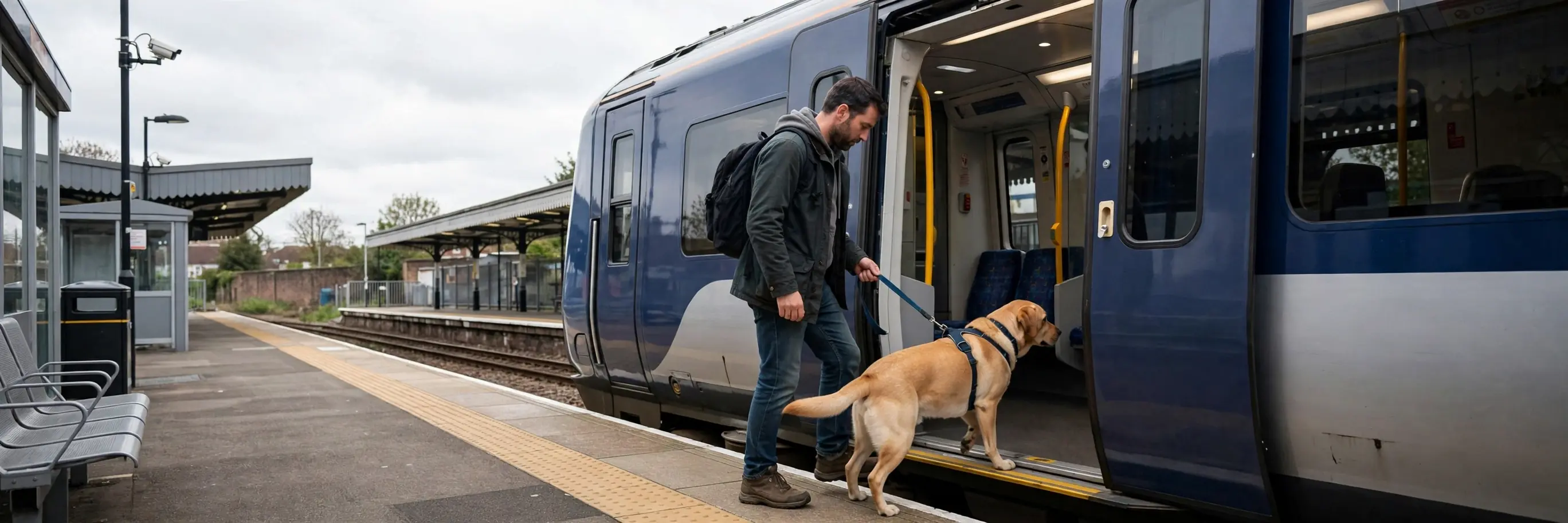
There is no dog booking to make, no pet form to fill in and no carrier size to declare in advance on EMR. That simplicity is the point of the policy, and it is also why preparation matters more than paperwork. The dog needs a short lead, a collar or harness that cannot slip, a mat or blanket for the floor, water for a longer journey, and a plan for the toilet break before boarding and after arrival. A retractable lead is a poor choice on a train: it lets the dog wander into the aisle, around a luggage rack or towards another passenger's food. A fixed lead of about a metre, held short, keeps the dog beside you from the platform to the seat. A muzzle is not required by the general EMR rule, but if your dog is reactive, a muzzle and a quiet corner seat are sensible precautions, and they show other passengers and staff that you have thought about the journey.
Intercity, Connect and Regional: three different trains
EMR is really three operations under one name, and the dog experience changes with each one. EMR Intercity runs the long-distance Midland Main Line services from London St Pancras to Leicester, Nottingham, Derby and Sheffield, with some services extending towards Lincoln. EMR Connect, formerly EMR Electrics, runs the electric service between London St Pancras and Corby, calling at Luton Airport Parkway, Bedford, Wellingborough and Kettering. EMR Regional runs the local and cross-country services across the East Midlands and beyond, from Liverpool to Norwich, from Nottingham to Skegness, from Derby to Crewe and Matlock, and from Cleethorpes to Leicester. The dog rule does not change between the three, but the train, the space and the crowd do, and a dog that settles happily on one can struggle on another.
Intercity trains are the longest and most comfortable EMR services. The established fleet is the Class 222 Meridian, a five- or seven-carriage diesel train with a buffet area, luggage racks, table seats and a quieter first-class section at one end. New Class 810 Aurora trains have been entering service on the Midland Main Line, and their layout, door positions and luggage space differ in detail from the Meridian, so do not assume that the carriage you used last year has the same floor plan this year. On an Intercity train, a dog does best at a table seat with floor space, or at the end of a row near a luggage rack, where the dog can lie on a mat without blocking the aisle. The vestibule by the doors is not a good place to settle for two hours: every stop brings a wave of passengers, luggage and draughts, and a nervous dog will stand up at every station. First class does not give a dog a seat, and it does not change the rule, so do not pay for an upgrade expecting the dog to be treated differently.
EMR Connect trains are Class 360 electric units running between Corby and London St Pancras. They are frequent, usually every thirty minutes, and they stop at Luton Airport Parkway, Bedford, Wellingborough and Kettering. The journey is shorter than a full Intercity run, the trains are busy with commuters and airport passengers, and luggage space is tighter, especially at Luton Airport Parkway where suitcases pile up by the doors. A dog on a Connect service needs the same short lead and floor mat, but the owner needs a different mindset: this is a commuter train, not a leisure train, and a large dog sprawled across the aisle at 8am will draw complaints faster than the same dog on a mid-morning Nottingham to Skegness train. Travel outside the commuter peaks where you can, keep the dog tight to your feet, and avoid the door area at airport stops.
Regional trains are where most dog owners actually meet EMR, and they are the most varied. A Class 170 Turbostar, a Class 158 and a Class 156 all appear on Regional routes, and a service can be two carriages on a quiet weekday and four carriages on a busy Saturday. There is less luggage space, fewer table seats, narrower aisles and more frequent stops, which means more door noise, more passengers stepping past, and more chances for a dog to be trodden on or to trip someone. The advantage is that Regional journeys are often shorter, the stations are smaller and quieter, and the dog can usually be walked on the platform before boarding. The disadvantage is that a short formation leaves no spare vestibule to retreat to if the carriage is full. If the train arrives with only two carriages and the platform is crowded, wait for the next service rather than squeezing a large dog into a standing-room-only carriage.
London St Pancras to Nottingham and Sheffield
The Midland Main Line is EMR's flagship route, and it is the journey most dog owners ask about first. Intercity trains run from London St Pancras to Nottingham in about one hour and thirty-one minutes and to Sheffield in about two hours and one minute, calling at Leicester and, depending on the service, at Loughborough, East Midlands Parkway, Long Eaton, Derby and Chesterfield. The Nottingham service and the Sheffield service split the pattern between them, so check the departure board rather than assuming every London train serves both cities. A dog travelling from London to Nottingham will usually pass Leicester, Loughborough and East Midlands Parkway; a dog travelling to Sheffield will usually pass Leicester, Derby and Chesterfield. Both routes are fast, frequent and well suited to a dog that can settle for ninety minutes to two hours.
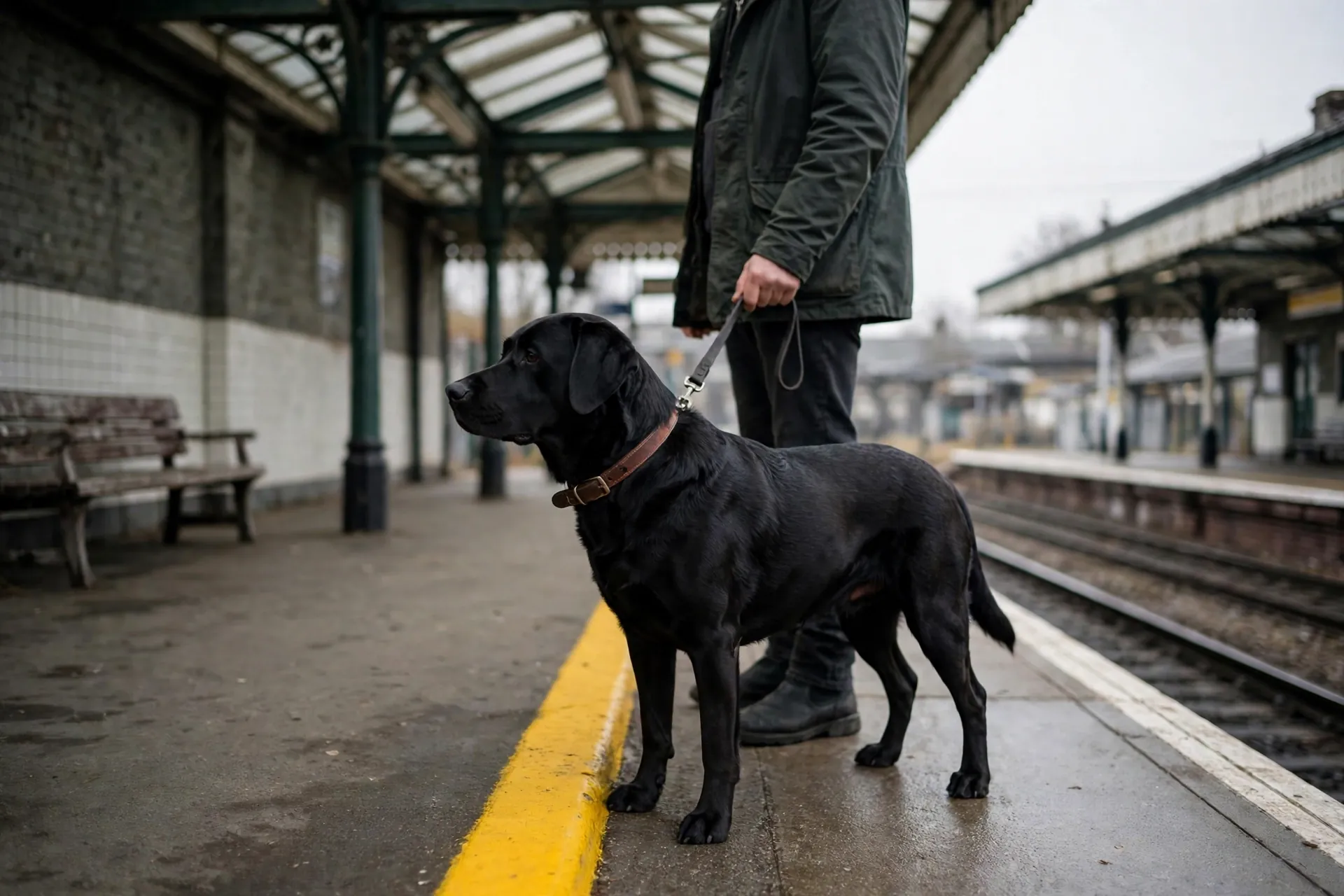
London St Pancras itself is a good station for a dog, provided you arrive with time to spare. The EMR platforms are at the far end of the station, past the shops and the Eurostar check-in, and the walk from the Underground is long, busy and full of smells, trolleys and echoing announcements. Give the dog a toilet break before you enter the station, because there is no dog toilet area inside St Pancras and the nearest green space is a walk away. Keep the dog on a short lead through the concourse, stay clear of the Eurostar queues, and use the lift rather than the escalator if the dog is nervous: escalators are a common cause of paw injuries, and a dog that balks at the top of an escalator can cause a queue behind it. Our guide to dogs on UK train platforms and in stations covers the yellow line, escalators and lifts in more detail, and it is worth reading before a first St Pancras departure.
On the train, the Nottingham and Sheffield services reward a little planning. Book a table seat if you can, because the floor space under a table gives a medium or large dog room to lie down without blocking the aisle, and the table gives you somewhere to put water and a chew. A window seat at the end of a row is the next best choice. Avoid the seats nearest the buffet or the doors, where the footfall never stops, and avoid the first-class end if you have a standard ticket, because a conductor will move you. The buffet on a Meridian sells hot drinks and snacks, so keep the dog's lead short and the dog's nose away from the trolley when it passes. If the train is a Class 810 Aurora, look for the luggage area near the doors and settle the dog on the opposite side, away from the draught and the standing passengers.
At the other end, Nottingham, Derby and Sheffield all reward a dog that arrives calm. Nottingham station has a tram stop outside and a short walk to the city centre, but the station forecourt is busy with taxis and buses, so keep the lead short until you are clear of the traffic. Derby station is a short walk from the city centre and from the Derbyshire countryside routes, but the walk crosses busy roads, so do not let the dog off the lead at the station exit. Sheffield station is built into a hillside with a steep walk up to the city centre, and the tram stop outside is useful if the dog is tired after two hours on the train. In all three cities, the first thing to do after arrival is a proper toilet walk, not a rush to the next connection, because a dog that has held on for two hours will be restless and more likely to pull.
Liverpool to Norwich, via Nottingham and Sheffield
The Liverpool to Norwich service is EMR Regional's longest cross-country route, and it is the one that catches dog owners out most often. It runs from Liverpool Lime Street through Manchester Oxford Road, Stockport, Sheffield, Chesterfield, Nottingham, Grantham, Peterborough and Ely to Norwich, with a Liverpool to Nottingham section that many dog owners use as a standalone journey. The full route takes several hours, so very few dogs travel end to end, but the sections matter: Liverpool to Manchester, Manchester to Sheffield, Sheffield to Nottingham, and Nottingham to Peterborough are all useful dog journeys in their own right. The train is usually a Class 158 or a Class 170, and it can be busy at the Manchester and Sheffield sections, where commuters and students fill the carriages.
The Liverpool to Nottingham section is the most practical part of the route for a dog. From Liverpool Lime Street, the train calls at Liverpool South Parkway, Widnes, Warrington Central, Manchester Oxford Road, Manchester Piccadilly, Stockport, Sheffield, Chesterfield and Nottingham, although the exact stopping pattern varies by service, so check the official guidance before you travel. The Manchester to Sheffield section crosses the Pennines, and the train can be delayed by weather or by congestion at Manchester Piccadilly, so allow a generous connection if you are changing at Sheffield or Nottingham. A dog that is fine for an hour from Manchester to Sheffield may be restless after two hours from Liverpool to Nottingham, so plan a break at Sheffield if you can: the station has a concourse where the dog can stretch its legs, and the walk to the tram stop gives a short change of scene.
Sheffield to Nottingham is a short, useful hop on this route, usually under an hour, and it is a good first Regional journey for a dog that has only ridden Intercity trains before. The train calls at Chesterfield on the way, and the scenery changes quickly from city to former coalfield to the Erewash valley. The Nottingham to Grantham and Peterborough section is quieter, with fewer passengers and more space for a dog to lie down, but it is also the section where a short formation hurts most: a two-carriage train with a school group or a football crowd can leave no floor space at all. If the train is full at Nottingham, wait for the next Liverpool to Norwich service or take a Nottingham to Peterborough local instead, and do not try to fit a large dog into a carriage where passengers are already standing in the vestibule.
Changing at Sheffield or Nottingham on this route needs a plan. Sheffield station has multiple platforms, and the Liverpool to Norwich train can arrive on a different platform from the connecting Intercity service to London or the Regional service to Lincoln. Check the departure board as soon as you arrive, and do not assume the connection is on the next platform. Nottingham station is easier to navigate, but the walk between platforms is longer than it looks, and the station can be crowded at peak times. In both cases, keep the dog on a short lead, keep to the side of the concourse, and use the lift if you have luggage and a dog together. A dog that is tired after a cross-country journey is more likely to pull towards another dog, so keep distance from other dogs on the platform until you know how your dog will react.
Derby to Crewe, and Derby to Matlock
The Derby to Crewe service is a quieter Regional route that runs from Newark Castle through Nottingham and Derby to Stoke-on-Trent and Crewe, and it is a useful link for dog owners in Derbyshire and Staffordshire who want to reach the West Coast Main Line without driving to Birmingham. The service calls at Nottingham, Beeston, Derby, Uttoxeter, Stoke-on-Trent and Crewe, among other stops, and the trains are usually Class 170 units. The journey from Derby to Crewe takes about an hour, and the dog will usually find a quiet carriage, especially outside peak times. The risk on this route is not crowding but connection time: Crewe is a large, busy interchange with many platforms, and a dog that has travelled calmly from Derby can become unsettled in the noise and the crowds at Crewe. Allow at least twenty minutes for a change at Crewe, and use the lift rather than the stairs if you have a bag and a dog.
Derby to Matlock is a different kind of journey altogether. The Derwent Valley Line runs from Derby through Duffield, Belper, Ambergate, Whatstandwell, Cromford and Matlock Bath to Matlock, and it is one of the prettiest short railway journeys in the East Midlands. The train is usually a single Class 170 or a similar Regional unit, and the service is hourly, so missing one train is not a disaster. The route is popular with walkers, and dogs are a common sight on the train, especially on weekends when walkers head for the Peak District. The dog will enjoy the views, but the owner should remember that Matlock Bath is a steep, busy village with narrow pavements and a lot of visitors in summer, so keep the lead short on arrival and do not let the dog off the lead near the river or the road.
Belper and Duffield are good stops for a dog walk from the train. Belper has a riverside path and a short walk to the town centre, and Duffield has a quieter station with a walk to the village. Ambergate is a useful change for the Matlock line, but the station is small and unstaffed at some times, so check the departure board and the help point if you are unsure of the platform. Matlock itself is the terminus, and the station is a short walk from the town and from the Peak District trails, but the walk is uphill in places, so a tired or older dog may need a rest before a long walk. The Derwent Valley Line is also a good training route for a nervous dog: the trains are short, the stations are quiet, and the journey is only about thirty-five minutes from Derby to Matlock, which is long enough to learn that trains are safe but short enough not to be exhausting.
Both of these Derby routes share a practical point about luggage and dogs. A Class 170 has limited luggage space, and a dog's mat, water bowl and bag can fill the space by the doors quickly. Pack light, put the dog's things in one bag, and keep the mat rolled up until you are seated. If the train is busy, the dog can lie on the mat at your feet, but the bag should go on the luggage rack, not on the floor beside the dog, where it blocks the aisle. At Derby station, the walk between the Regional platforms and the Intercity platforms is short, but the station can be busy at peak times, so keep the dog close and avoid the taxi rank outside the main entrance.
Leicester, Lincoln and Nottingham to Skegness
Leicester is the hub for the eastern side of the EMR network, and it is where several Regional routes meet. The Cleethorpes to Leicester service runs through Lincoln and Nottingham, and it is a useful route for dog owners in Lincolnshire who want to reach Leicester or Nottingham without driving. The service calls at Lincoln Central, Newark Castle, Nottingham, Loughborough and Leicester, and the trains are usually Class 170 units. The journey from Lincoln to Leicester takes about an hour and a half, and the dog will usually find space, especially on a weekday. Lincoln Central station is a short walk from the city centre and the cathedral quarter, but the walk is uphill, so allow time for a tired dog. Leicester station is closer to the city centre, but the forecourt is busy with buses, so keep the lead short on arrival.
The Nottingham to Lincoln service is a shorter hop that runs through Newark Castle, and it is a good journey for a dog that is new to trains. The train calls at Nottingham, Newark Castle and Lincoln Central, and the journey takes under an hour. Newark Castle station is a useful stop for a walk along the River Trent, and Lincoln Central is a good starting point for a walk to the Brayford Pool and the waterfront. The Peterborough to Doncaster service via Lincoln is another useful link, running from Peterborough through Spalding, Sleaford, Lincoln and Gainsborough to Doncaster, and it gives dog owners in Lincolnshire a way to reach the East Coast Main Line without going through Nottingham. Check the stopping pattern before you travel, because some services skip smaller stations, and some smaller stations are request stops where you must tell the conductor you want to get off.
Nottingham to Skegness is the most seasonal EMR route, and it is the one that needs the most planning. The service runs from Nottingham through Grantham, Sleaford and Boston to Skegness, calling at Netherfield, Bingham, Aslockton, Bottesford, Ancaster, Rauceby, Heckington, Wainfleet and Havenhouse at some times, although many smaller stops are request stops or are served only by some trains. The journey takes about two hours, and the train is usually a Class 170, although summer Saturday services have sometimes used longer formations. In winter, the train is quiet and the dog will have space. In summer, especially on a Saturday, the train can be full of families heading for the coast, with buckets, spades, cool boxes and pushchairs filling the vestibule. A large dog on a summer Saturday Skegness train needs a seat at the end of a row, a mat, water, and a willingness to wait for the next train if the first one is full.
Skegness station is a short walk from the seafront, but the walk crosses a busy road and passes amusement arcades and food stalls, so keep the dog on a lead and do not let it snatch food from the ground. The beach at Skegness has seasonal dog restrictions, and the rules change by section and by time of year, so check the official guidance before you travel and do not assume that a dog that can ride the train can also run on every part of the beach. The same point applies to the smaller stations on the way: Boston has a riverside walk, Sleaford has a quieter town centre, and Grantham is a useful change for London, but none of them has a dog toilet area on the platform, so plan the toilet break before boarding at Nottingham or after arrival. If the dog is hot after two hours on a summer train, find shade and water before a long walk on the seafront, because a hot dog that has been in a crowded carriage is more likely to be stressed and less likely to settle.
Nottingham, Derby, Leicester and Sheffield stations
Nottingham station is the busiest EMR hub for dogs, and it is worth knowing its layout before you arrive. The station has a large concourse, a tram stop outside, and platforms that are reached by a footbridge and lifts. The platforms are long, and the Liverpool to Norwich and London Intercity services can arrive at opposite ends, so check the departure board and allow time to walk the length of the platform with a dog. The station has a waiting room and a cafe, but dogs are not always welcome inside the cafe, so do not assume the dog can sit with you while you wait. The forecourt outside is busy with taxis and buses, and the tram stop is a short walk away, so keep the lead short until you are clear of the traffic. If you are changing at Nottingham, the lift is the safest way to move between platforms with a dog and luggage, because the stairs are steep and crowded at peak times.
Derby station is smaller and easier to navigate, but it has its own quirks. The station is a short walk from the city centre, and the platforms are reached by a footbridge and lifts. The Intercity services to London and Sheffield use the main platforms, and the Regional services to Crewe, Matlock and Nottingham use the bay platforms, so check the board rather than assuming the next train is on the platform in front of you. Derby station has a waiting room and a small cafe, and the forecourt is quieter than Nottingham, but the walk to the city centre crosses a busy road, so keep the dog on a lead. If you are changing at Derby, allow ten minutes for the walk between platforms, and do not try to rush a nervous dog across the footbridge at peak time.
Leicester station is a compact city-centre station with a long, curved platform and a busy forecourt. The Intercity services to London and Sheffield use the main platforms, and the Regional services to Lincoln, Nottingham and Cleethorpes use the same platforms, so the departure board is the only reliable guide. The station has a waiting room, but the concourse is small and can become crowded quickly, especially when two trains arrive at the same time. Keep the dog close to the wall, away from the main flow of passengers, and use the lift if you have luggage. The walk from Leicester station to the city centre is short and flat, which suits a tired dog, but the roads around the station are busy, so do not let the dog off the lead until you are in a park or a quiet street.
Sheffield station is the largest and most complex of the four, built into a hillside with a steep walk up to the city centre and a tram stop outside the main entrance. The station has multiple platforms, a large concourse, and a waiting area, but the platforms are long and the Liverpool to Norwich service can arrive on a different platform from the Intercity service to London. Check the departure board as soon as you arrive, and allow fifteen minutes for a change, because the walk between platforms is longer than it looks. The station has a lift to all platforms, and it is worth using if you have a dog and a bag, because the stairs are busy and the dog can be jostled. Outside the station, the tram stop is useful for a tired dog, but the trams can be busy, so check the official guidance before you travel if you plan to take the dog on a tram, because tram rules differ from train rules.
Tickets, fares and seat reservations with a dog
The dog travels free, but your ticket still matters, and the cheapest ticket is usually the one you book earliest. Advance tickets on the London to Nottingham and London to Sheffield Intercity routes are sold in limited numbers and are tied to a specific train, so they are cheap if you know your travel time and expensive if you miss the train. Off-Peak and Anytime tickets cost more but let you take any train at the permitted time, which is useful if the dog needs a toilet break and you miss your planned departure. A Railcard can cut the fare by a third, and the saving on a return to London can pay for the card in one trip, but the Railcard discount applies to your ticket, not to a dog fare, because there is no dog fare to discount. Check the official guidance before you travel if you are using a Railcard with a group, because the minimum fare and the time restrictions vary by card.
Seat reservations are free on most EMR Intercity services, and they are worth making when you travel with a dog, even though the reservation only covers you. A reserved table seat gives the dog floor space and gives you a fixed place to aim for, rather than wandering the train looking for a gap. On Regional services, seat reservations are not usually available, so the dog's space depends on the time of day and the length of the train. If you travel on a Regional service at peak time, expect to stand in the vestibule with the dog, and consider travelling an hour later. On a summer Saturday to Skegness, a reservation does not exist, so the only strategy is to travel early, before the crowds, or to travel on a Sunday when the train is quieter.
Split ticketing and Advance tickets need a word of caution for dog owners. A split ticket can save money on a long journey, but it can also mean a tight connection that a dog cannot make if the first train is late. A dog that needs a toilet break cannot be rushed across a station in three minutes, and a missed connection can mean an hour's wait with a restless dog. If you split tickets, allow at least twenty minutes for a change, and do not split at a small unstaffed station where there is no waiting room. A flexible ticket costs more, but it buys the freedom to wait for the next train if the dog is unsettled, and that freedom is worth more on a dog journey than on a solo journey.
Buying a ticket at the station is still possible, but the ticket office at smaller EMR stations may be closed at some times, and the ticket machine may not sell every fare. Buy online before you travel where you can, and download the ticket to your phone, because a paper ticket is one more thing to hold while you hold a lead. If you need to buy at the station, arrive early, keep the dog on a short lead in the queue, and do not let the dog wander into the ticket hall. If the ticket office is closed and the machine is out of order, you can usually buy on the train, but tell the conductor as soon as you board, and do not wait for the conductor to find you.
Where the dog goes on board
The best place for a dog on an EMR train is on the floor at your feet, on a mat or blanket, with the lead short and the dog facing you. A table seat gives the most floor space, because the dog can lie under the table, out of the aisle and out of the way of the trolley. A window seat at the end of a row is the next best choice, because the dog can lie against the wall, away from the aisle. An aisle seat is the worst choice for a dog, because every passenger who passes will step over the dog, and the dog will stand up, bark or snap. If you have an aisle seat and the train is full, ask a fellow passenger if you can swap to a window seat, and explain that the dog will be quieter there. Most passengers will agree, especially if the dog is calm.
The vestibule is not a seat, and it is not a good place for a dog to spend a long journey. It is draughty, noisy and full of passengers at every stop, and a dog that lies in the vestibule will be stepped on or will block the doors. Use the vestibule only to board and alight, and only for a short time if the carriage is full and you are waiting for a seat. If the train is a two-carriage Regional service and there is no seat, it is better to wait for the next train than to stand in the vestibule with a large dog for an hour. The luggage rack is for bags, not for dogs, and a dog in a carrier should be on the floor, not on the rack, because the carrier can slide off when the train brakes.
Food and water on board need a little thought. A dog that is fed just before a train journey is more likely to be sick, so feed the dog at least an hour before boarding, and give a small snack on the train if the journey is long. Water is more important than food: carry a collapsible bowl and a bottle of water, and offer the dog a drink at every stop, especially on a hot day or on a crowded Intercity train. Do not let the dog drink from a station tap that is not clearly for drinking water, and do not let the dog eat food dropped on the train floor, because it may contain chocolate, onions or other foods that are harmful to dogs. If the dog is sick on the train, tell the conductor, clean up what you can, and do not be embarrassed: it happens, and staff would rather know than find it later.
Other passengers matter as much as the dog. Some people are allergic to dogs, some are afraid of dogs, and some simply do not want a dog near their food. Keep the dog away from other passengers' seats, keep the lead short, and do not let the dog sniff another passenger's bag or coat. If a passenger asks you to move the dog, move it if you can, and do not argue. If a passenger is allergic, the conductor may ask you to move to another carriage, and that is a reasonable request. Children are a particular risk: a child may run up to a dog without warning, and a nervous dog may snap. Keep the dog close, warn the parent if the dog is nervous, and do not let a stranger feed the dog. A calm dog that lies quietly on a mat will win over most passengers, and a dog that barks at every stop will not.
Busy times, summer Saturdays and the coast
EMR trains are busiest at the times you would expect: Friday afternoons, Sunday evenings, school holidays and summer Saturdays to the coast. The London to Nottingham and London to Sheffield Intercity services are busiest on Friday afternoons, when Londoners head north for the weekend, and on Sunday evenings, when they return. The Liverpool to Norwich service is busiest at the Manchester and Sheffield sections on weekday mornings, and the Nottingham to Skegness service is busiest on summer Saturdays, when families head for the coast. A dog that travels happily at 10am on a Tuesday may be miserable at 5pm on a Friday, so the time of day matters as much as the route.
Summer Saturdays to Skegness deserve a section of their own, because they are the hardest EMR journey for a dog. The train is full, the weather is hot, the carriage is noisy, and the dog has to cope with buckets, spades, pushchairs and excited children. Travel early in the day, before 9am if you can, and travel back after the peak, after 6pm if you can. Carry water, a mat, a fan if the dog is prone to overheating, and a towel to wet the dog's paws if it gets too hot. Do not leave the dog in a car at Skegness station, and do not leave the dog alone on the train while you buy a ticket. If the train is full at Nottingham, wait for the next one, even if it means arriving an hour later: a hot, crowded train is a risk for a dog, and a delayed arrival is better than a distressed dog.
Football, concerts and events can also fill EMR trains without warning. A Nottingham Forest home game, a Sheffield United home game, a concert at the Motorpoint Arena in Nottingham or a festival in the Peak District can fill a Regional train with supporters who are loud, excited and carrying food and drink. Check the local events calendar before you travel, and avoid the trains that coincide with a big match or a concert. If you do find yourself on a train with a football crowd, keep the dog close, keep the lead short, and move to a quieter carriage if you can. A dog that is used to quiet trains may bark at a crowd, and a barking dog on a crowded train will draw attention from staff and passengers.
Winter has its own busy times, and they are quieter but not without risk. Christmas shopping, the January sales and the February half-term can fill the London to Nottingham and London to Sheffield services, and the trains can be delayed by weather, leaves on the line or engineering work. A dog that travels in winter needs a coat if it is short-haired or older, and it needs a mat to lie on, because the floor of a train can be cold. Do not let the dog lie on a wet floor, and do not let the dog drink from a puddle on the platform, because it may contain de-icing salt or other chemicals. If the train is delayed in winter, keep the dog warm, keep it watered, and do not let it lie on a cold platform for a long time.
Delays, cancellations and Delay Repay
EMR has had a difficult period for punctuality, and in October 2026 the Department for Transport told the company to take immediate action to improve its performance, with delays, cancellations and overcrowding linked in part to the new Class 810 trains. That context matters for a dog owner, because a delay is not just an inconvenience: it is an extra hour on a train, an extra hour without a proper toilet break, and an extra hour in a crowded carriage. Check the live departure board before you leave home, and do not set out for the station if the train is already cancelled. If the train is delayed, give the dog a toilet break before you board, and carry extra water, because a delayed train can become a long train.
If your train is cancelled, your ticket is normally accepted on the next available EMR service on the same route, and you do not need to buy a new ticket. Ask station staff which train to take next, and do not assume that the next train is the one on the departure board: a cancelled train can be followed by a train that is already full, and a dog that is squeezed into a full train will be stressed. If the next train is a different operator's service, ask staff whether your ticket is valid, because ticket acceptance between operators is not automatic. If you are travelling from London to Nottingham or Sheffield, the next Intercity service is usually within an hour, but if you are travelling on a Regional route, the next service can be two hours away, so plan for a wait.
Delay Repay is the compensation scheme that applies if you arrive late by a qualifying amount, and it is worth claiming, even for a small delay. EMR pays Delay Repay for delays of fifteen minutes or more, with the amount depending on the length of the delay and the cost of the ticket. Keep your ticket, note the scheduled and actual arrival times, and claim online within twenty-eight days. The claim is for your ticket, not for the dog, because the dog travels free, but the money can cover the cost of a taxi from the station if the dog is tired and you do not want to walk. If the delay was caused by a cancellation, keep a note of the cancelled train and the replacement service, because the claim form will ask for it.
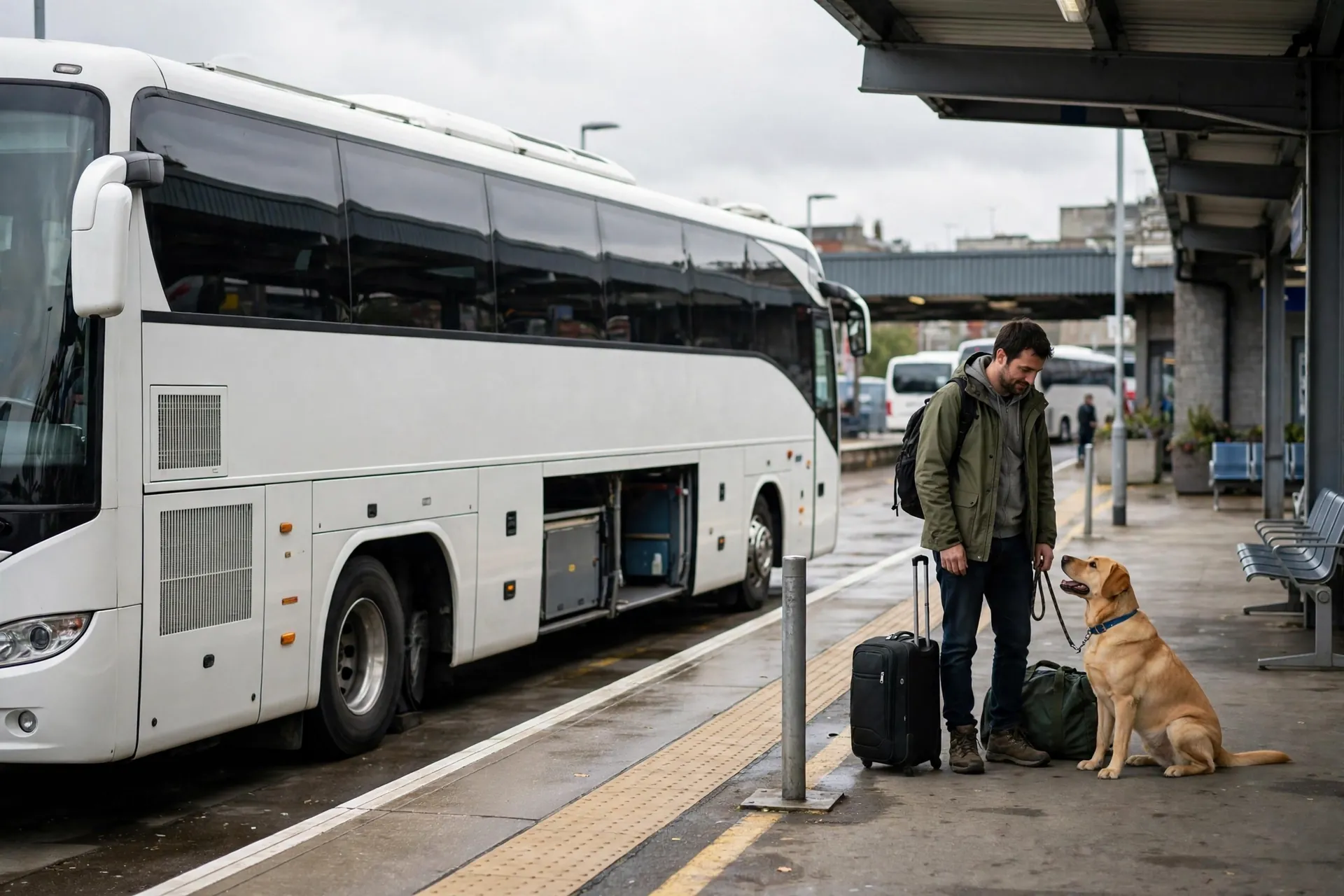
Replacement buses are the hardest part of a delay for a dog owner. When a train is cancelled and a bus is provided, the bus is usually a coach or a local bus, and the dog rule for the bus is not the same as the dog rule for the train. Many rail replacement buses do not take pet dogs, and the driver can refuse a dog, especially a large dog. Do not put the dog on a replacement bus unless staff confirm that dogs are allowed, because a refusal at the bus door can leave you stranded with a dog and luggage. Ask station staff for an alternative: a later train, a taxi, or a lift to the next staffed station. If you must take a bus, keep the dog on a short lead, keep it on the floor, and do not let it occupy a seat. For a longer look at what happens when dogs cannot ride a coach at all, see our guide to dogs on sleeper trains in the UK, which covers the overnight rules and the booking steps that also matter when a daytime journey is disrupted.
EMR is a good operator for dogs when the journey is planned by route and by time of day. The free-travel rule, the two-dog limit and the lead requirement are simple, but the space on a Class 222, a Class 360 and a Class 170 is not the same, and the crowd on a Friday Intercity train is not the same as the crowd on a Tuesday Regional train to Matlock. Choose the quieter train, book a table seat on the Intercity, travel early to Skegness, allow a generous connection at Sheffield, Nottingham and Crewe, and carry water and a mat. If the train is full, wait for the next one. If the train is cancelled, ask staff before boarding a replacement bus. And if anything about the fare, the limit or the route has changed, check the official guidance before you travel.
Practical questions
Before you go
Can dogs travel free on East Midlands Railway?
Yes, under the National Rail conditions that EMR follows, dogs normally travel free, with a maximum of two dogs per passenger. Keep the dog on a lead or in a carrier, keep it off the seats, and keep it out of the aisle. If anything about the fare or the limit has changed, check the official guidance before you travel.
How many dogs can I take on an EMR train?
The usual limit is two dogs per passenger. That limit matters most on short Regional trains, where two large dogs and their luggage can fill a vestibule quickly. If you travel with three dogs, travel with another adult so each passenger stays within the two-dog limit, and check the official guidance before you travel.
Can my dog sit on a seat on an EMR train?
No. Dogs should stay on the floor, on a blanket or mat at your feet, or in a carrier on the floor. Seats are for passengers, and a dog on a seat can be moved by staff and can cause a problem for the next passenger, especially someone with an allergy. On a busy Intercity train from London St Pancras, a floor space by a table or at the end of a row works far better than a seat.
Do I need to book a ticket for my dog on EMR?
No ticket is needed for the dog itself under the usual free-travel rule, but you still need a valid ticket for yourself, and a seat reservation only covers you, not the dog. Book your own ticket early for the cheapest Advance fares on the London to Nottingham and London to Sheffield routes, and check the official guidance before you travel if a third-party site suggests a dog fare.
What happens if my EMR train is cancelled and I am travelling with a dog?
Your ticket is normally accepted on the next available EMR service on the same route, and you can claim Delay Repay if you arrive late by the qualifying amount. Do not put the dog on a replacement bus unless staff confirm dogs are allowed, because many rail replacement buses do not take pet dogs. Ask station staff which train to take next, keep the dog watered, and check the official guidance before you travel.
Can I take my dog on the Nottingham to Skegness train in summer?
Yes, the same EMR dog rule applies on the Nottingham to Skegness service, but summer Saturday trains to the coast are often crowded and hot, so travel early in the day and carry water. The service calls at Grantham, Sleaford and Boston on the way to Skegness, and some smaller stops are request stops, so tell the conductor where you want to get off and check the official guidance before you travel.