This guide is independent and contains no paid placement. If affiliate links are added later, they will be clearly marked and will not change our editorial checks.
Dogs travel free on Edinburgh Trams, on a lead and off the seats, on the single line from Edinburgh Airport to Newhaven. Animals are carried at staff discretion, so a calm, well-controlled dog on a short lead is the safest way to travel. Buy or tap your own fare before you board, keep clear of doors and aisles, and avoid the busiest festival and matchday trams if your dog dislikes crowds.
The dog rule, in plain English
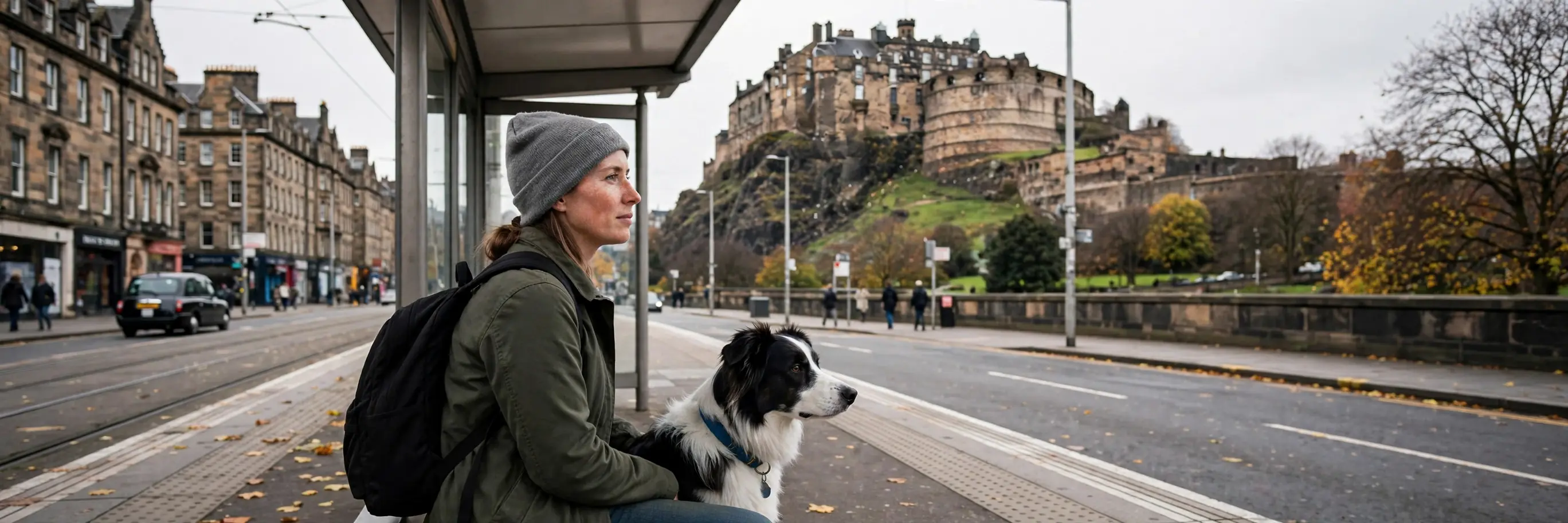
Stand at Princes Street tram stop on a clear morning and the whole proposition is in front of you. A tram glides in almost silently along the gardens, the Castle rock rises directly above it, and a dog on a lead can step aboard without a ticket, a carrier or a negotiation at the door. That is the first thing to understand about Edinburgh Trams: for dog owners, this is the most predictable piece of public transport in the city. The published rule is short and worth quoting in full in spirit, because everything else in this guide is built on it. Dogs can travel free of charge. Keep your dog on a lead at all times. Keep your dog off the seats. Animals are carried at staff discretion, and staff can ask you to take an animal off the tram at any time. Owners are responsible for any cleaning or repairs their animal causes.
Free travel is the headline, but the discretion clause is the part that shapes real journeys. It does not mean that staff turn dogs away as a matter of routine. It means that a tram is a shared, enclosed space and that the person in charge of it can act when a dog is unsafe, uncontrolled, blocking the way or making the journey difficult for other passengers. A calm dog that settles at its owner's feet is very unlikely to draw attention. A dog that lunges at other dogs, barks continuously, strains at a long lead across the aisle or tries to climb onto a seat is a different matter. The practical test is simple: if you would be embarrassed to describe your dog's behaviour to the member of staff at the door, do not put that dog on a crowded tram and hope for the best.
The lead rule deserves more attention than it usually gets. On a lead at all times means on the platform as well as on board, and it means a short lead, not a flexi-lead extended to its full length. A tram platform is a narrow strip with a live edge, moving vehicles, luggage, pushchairs and people who are not watching where they step. A dog on a long lead can wander into the path of a boarding passenger, wrap a lead around a pole or a stranger's legs, or step too close to the platform edge while its owner is looking at a departure board. Shorten the lead before the tram arrives, keep the dog on the side away from the track, and hold the lead in the hand nearest the dog so that a sudden pull does not drag the lead across your body. If your dog wears a harness, use the harness for control and keep the lead attached to it; a collar alone is fine for a steady dog, but a harness gives you a better hold when a tram brakes or a crowd surges.
Off the seats is not a suggestion about manners. It is a hygiene rule, a space rule and a safety rule at the same time. Tram seats are for passengers, and a dog on a seat takes a place that someone else may need, leaves hair and mud where the next passenger will sit, and puts the dog at head height in a moving vehicle. The floor is the dog's place. Choose a spot where the dog can lie down without blocking the aisle, ideally against a wall or a partition, with your feet or your bag forming a low barrier on the open side. Small dogs can sit on your lap or in a carrier on your lap, which is usually the calmest arrangement for a nervous small dog, but a carrier on a seat is still a seat taken, so keep it on your lap or on the floor between your feet. If the tram is busy and there is no floor space where the dog can lie without being stepped on, wait for the next one. Trams run every few minutes for most of the day, and a seven-minute wait is a small price for a safe ride.
There is no published size limit, breed restriction or carrier requirement for dogs on Edinburgh Trams in the operator's frequently asked questions, and no separate dog ticket to buy. That does not mean that every dog is suitable for every tram. A very large dog that cannot lie down in the available floor space, a dog in season, a dog that has just come off a long walk covered in mud, or a dog that is unwell should be thought about honestly before boarding. If your dog is large, travel outside peak hours, use the middle section of the tram where the floor is more open, and avoid the wheelchair and buggy spaces unless they are empty and you can move instantly if someone needs them. If your dog is reactive to other dogs, the tram is a risk because you cannot control who boards at the next stop; a muzzle, if your dog is trained to wear one comfortably, is a sensible precaution on a busy service, even though it is not a published requirement for trams.
Assistance dogs are carried without restriction in the usual way for public transport, and they should not be confused with the general discretion rule. If you travel with an assistance dog, the dog works in harness, stays close to you and is trained for crowded vehicles, so the ordinary advice about settling at your feet still applies. The rest of this guide is written for pet dogs, and the distinction matters when you are planning: a pet dog's journey should be planned around the dog's tolerance, not around the assumption that the rules will bend for it.
Finally, remember that the dog rule is a transport rule, not a destination rule. A free tram ride does not make the Castle, a restaurant, a shop or a beach dog-friendly. Each stop in this guide is described with the walk and the area around it in mind, because the tram is only useful if the place you get off is somewhere your dog can actually enjoy. Check the official guidance before you travel for the current dog rules, fares and service updates, because conditions of carriage and timetables change, and a guide checked in November 2026 cannot promise that a rule will be identical next summer.
The line at a glance
Edinburgh has one tram line, and that simplicity is its greatest strength for a visitor with a dog. There are no branches to memorise, no interchange inside the tram system itself and no wrong-direction trap that strands you on the far side of the city. The line runs 18.5 kilometres, about 11.5 miles, from Edinburgh Airport in the west to Newhaven in the east, with 23 stops. The full journey takes around 55 minutes end to end. Trams run every seven minutes for most of the day, seven days a week, with slightly longer gaps early in the morning and late in the evening. That frequency changes how you should plan: missing a tram is a minor inconvenience, not a ruined morning, and waiting for a quieter one is almost always an option.
The line opened on 31 May 2014 between the airport and York Place, in the city centre. The stop that replaced York Place is now Picardy Place, at the top of Leith Walk, and the extension from there to Newhaven opened in June 2023, completing the route to the sea. Edinburgh Gateway, a rail interchange in the west of the city, opened in December 2016. Knowing that history helps you read older maps and older advice: anything that talks about York Place as the terminus, or describes Leith as unserved by trams, is out of date. The current line is a single, continuous run from the airport, through the western suburbs, along Princes Street, down Leith Walk and on to the harbour at Newhaven.
The 23 stops, in order from west to east, are: Edinburgh Airport, Ingliston Park and Ride, Gogarburn, Edinburgh Gateway, Gyle Centre, Edinburgh Park Central, Edinburgh Park Station, Bankhead, Saughton, Balgreen, Murrayfield Stadium, Haymarket, West End, Princes Street, St Andrew Square, Picardy Place, McDonald Road, Balfour Street, Foot of the Walk, The Shore, Port of Leith, Ocean Terminal and Newhaven. You do not need to memorise the whole list. What matters is the shape of it: a long western stretch through business parks and suburbs, a short, dense city-centre section where the stops are only a few minutes apart, and then a steady run down Leith Walk to the coast. Most dog-friendly days will use only a handful of these stops, and this guide is organised in that order so that you can read it as a journey from the airport to the sea.
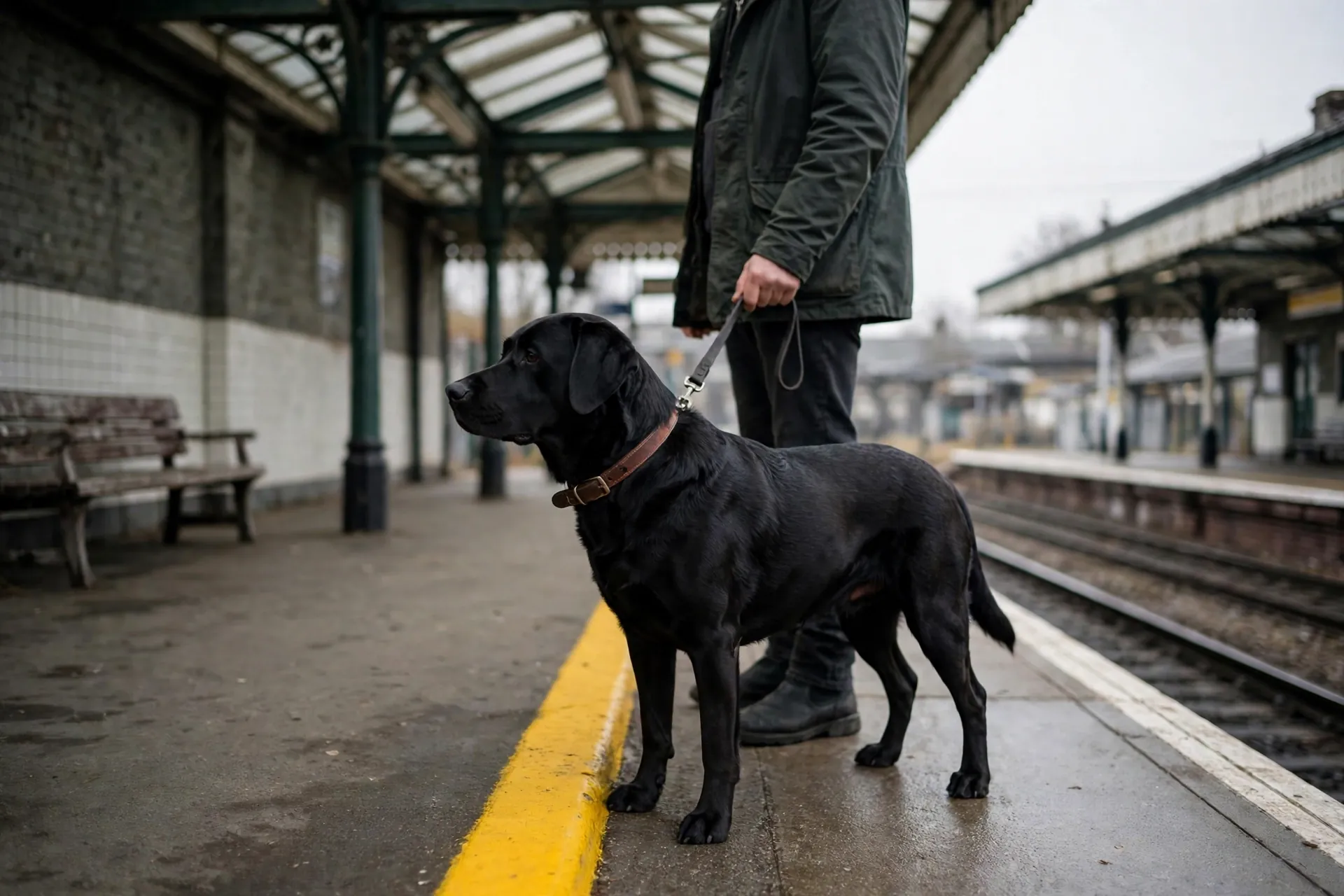
Every tram is low-floor, with level boarding from the platform, and Edinburgh Trams describes every stop as reached by a gentle ramp or a lift. Each tram has two dedicated spaces for wheelchairs and mobility scooters in the middle carriage, plus priority seating and luggage racks. For a dog owner, the practical meaning is that there are no stairs to negotiate with a dog, a suitcase and a lead at the same time, and that a dog with stiff joints, a dog recovering from an operation, or an older dog that cannot jump can walk straight on. The platform edge still demands respect. Keep the dog back from the edge, keep the lead short, and do not let the dog sniff at the gap between the platform and the tram while people are boarding. The same care that applies on a railway platform applies here, even though the vehicles are slower and the platforms are lower. Our guide to dogs on UK train platforms and in stations covers the yellow-line habit, escalator and lift choices and waiting-room rules that transfer directly to a tram stop, even though the tram itself is a much gentler vehicle than a train.
Trams are operated by Edinburgh Trams Ltd, and fares and ticketing are integrated with Lothian Buses, so the same city-zone fares and the same Ridacard season ticket work on both systems, with the airport as the one major exception. That integration is the key to planning a day: you can ride a tram into the centre, walk, and catch a bus back without buying a second kind of ticket, provided you understand the tap-on and tap-off rules and the airport zone. The ticket section later in this guide works through the options in detail, because the airport fare is the single most common surprise for visitors.
Journey times are short enough that the tram works as a shuttle between walks rather than as a day out in itself. Airport to Haymarket is roughly half an hour, Haymarket to Princes Street is a few minutes, Princes Street to St Andrew Square is a couple of minutes, and St Andrew Square to Newhaven is around half an hour, with the Leith Walk section feeling longer than the distance suggests because the stops come thick and fast. That means you can base yourself in one part of the city, ride to another for a walk, and ride back without the journey eating the day. It also means that walking is often faster than waiting for a tram in the city centre: Princes Street to St Andrew Square is a walk of a few minutes, and a dog that needs to move will usually prefer the walk to another boarding and alighting.
Service patterns change for Christmas, New Year and major events, and there is no service on Christmas Day in a normal year. Early-morning and late-night services are thinner, and engineering work can close parts of the line, so check the official guidance before you travel on the day itself, not just when you plan the trip. The habit that saves the most trouble is a quick check of live departures before you leave your accommodation, and again before you set out for the last tram home. A dog that has had a long day does not need an unexpected wait on a cold platform at midnight.
Airport to Edinburgh Park: arriving, parking and the western suburbs
Edinburgh Airport tram stop sits at the end of a covered walkway from the terminal, and it is the natural starting point for a dog-friendly arrival in Scotland's capital. If you fly in with a dog in the cabin or collect a dog from a pet courier, the tram is the smoothest way into the city: no taxi negotiation, no bus step, no car hire desk, just a level walk to the platform and a direct ride. The airport is in a separate fare zone, so your own fare is higher than a city single, and the dog still travels free. Buy or tap your fare before you board, because tickets must be bought, validated or activated before you get on, and anyone without one can be charged an on-board fare. The covered walkway gives you a moment to settle the dog, shorten the lead, check that the harness is secure and sort your luggage before the platform, which is worth doing properly rather than in a rush as a tram pulls in.
Arriving by air with a dog needs more than a tram ticket. Dogs travelling by air are subject to airline, airport and animal-health rules that have nothing to do with the tram operator, and a dog that has just flown may be tired, thirsty, disoriented and in need of a toilet break before a 55-minute ride. Give the dog water, a short walk on grass if you can find it, and a few minutes to settle before you head for the platform. The airport stop has ticket machines and validators, and the platform is open to the weather, so a waterproof coat for the dog and a towel in your bag are worth carrying in Scottish weather at any time of year. If your flight lands late, check the time of the last tram before you leave the terminal; a missed last tram with a tired dog and luggage is a problem that a taxi can solve, but only if you have the number and the fare ready.
Ingliston Park and Ride is the next stop east, and it is useful in a very specific way. It serves the Royal Highland Centre, the showground beside the airport, and it is a park-and-ride site, so drivers can leave a car here and ride into the city. For a dog owner driving to Edinburgh for the day, that is a genuinely practical option: park outside the congested centre, let the dog stretch its legs in the open ground around the site, and ride the tram in. The Royal Highland Centre hosts large shows and events, including the Royal Highland Show in June, and those days transform the stop. A show day means crowds, livestock smells, noise and a tram full of visitors, which is a lot for a nervous dog. If you are driving in for a show, think about whether the dog needs to come at all; if you are driving in for a quiet day in the city, a non-event day at Ingliston is a calm start.
Gogarburn is a small, quiet stop between Ingliston and Edinburgh Gateway, serving offices and the Gogarburn area. Few visitors will use it as a destination, but it matters as a marker of the line's character: the western section is open, green and spacious, with fields and business parks rather than streets. That openness is useful for a dog that needs a pause. If you are riding in from the airport and your dog is unsettled, you can get off at a quiet western stop, walk on a pavement away from the platform, let the dog settle, and catch the next tram. You are not committed to a 55-minute ride once you board. The same trick works in reverse at the end of a long day: if the dog is tired and the city-centre tram is packed, ride west for a few stops until the crowd thins, then walk or change your plan.
Edinburgh Gateway is the first major interchange on the line, and it is the stop that connects the tram to trains for Fife, including the Fife Circle line and services towards Aberdeen. The station is modern, step-free and spacious, and the interchange is level and straightforward. For a dog owner, the value is that you can arrive by train from the north and change to the tram without a taxi or a bus, or you can ride the tram west and pick up a train for a day trip out of the city. The platforms are open and exposed, so keep the dog close in wind and rain, and remember that railway rules apply on the railway side of the interchange. Our guide to dogs on UK train platforms and in stations is worth reading before a combined tram-and-train day, because the platform habits that keep a dog safe beside a tram matter even more beside a fast main-line train.
Gyle Centre, Edinburgh Park Central and Edinburgh Park Station form a cluster of western stops that serve shopping, offices and a second rail interchange. Gyle Centre is a shopping centre with the usual mix of high-street shops, cafes and a supermarket, and it is the kind of stop that is useful for supplies rather than for sightseeing. Dogs are not generally welcome inside a shopping centre, so plan a Gyle stop as a human errand with the dog waiting outside in suitable weather, or as a place to buy supplies before a walk, not as a destination in itself. Edinburgh Park Station is the rail interchange for the Edinburgh to Dunblane and North Clyde lines, and Edinburgh Park Central serves the business park around it. Bankhead and Saughton, the next two stops, are residential and light-industrial areas with little for a visitor, but they are also quiet, and quiet stops are useful when you need to break a journey.
Saughton deserves a mention for one reason: Saughton Park is nearby, and it is a proper green space with paths, a winter garden and open grass. It is not a tram-stop attraction in the sense that you step off and are in the park, but it is a realistic walk from the stop for a dog that needs a run after a journey. Balgreen, the next stop, is similarly residential, and both stops illustrate the rhythm of the western line: long gaps between stops, open skies, and a sense of leaving the city behind even though you are still inside it. If you are staying in the west of Edinburgh, these stops are your local service; if you are visiting, they are the part of the line you will ride through rather than get off at, and that is fine. The tram is doing its job when it simply carries you, quietly and without fuss, towards the centre.
Murrayfield, Haymarket and the West End
Murrayfield Stadium tram stop is the one stop on the line where the calendar matters more than the map. On an ordinary weekday it is a quiet, spacious stop serving the stadium, the ice rink and the surrounding streets. On a rugby international day, a concert day or a major event day it becomes one of the busiest places in Edinburgh, with tens of thousands of people moving in the same direction at the same time. The advice for a dog owner is blunt: do not take a dog to Murrayfield on a matchday unless you have a specific reason and a dog that is genuinely comfortable in a dense crowd. The crowds are not just large; they are loud, excited, often drinking, and moving in waves that a dog cannot read. The trams themselves are packed, the platforms are crowded, and the walk from the stop to the stadium is a crush. If you are staying near Murrayfield and need to travel on a matchday, walk the dog early, keep the dog at home or with a sitter during the peak, and use the tram only after the crowds have cleared.
On a non-event day, Murrayfield is a useful stop for a different reason. The area around the stadium has wide pavements, open ground and a sense of space that the city centre does not offer, and the Water of Leith runs nearby, offering a longer, greener walk for a dog that needs to stretch after a journey. The Water of Leith Walkway is a riverside path that runs for miles through the city, and the section near Murrayfield and Roseburn is a good place to let a dog sniff and wander on a lead. Check the local access rules before you set off, because parts of the walkway are narrow, shared with cyclists and close to water, and a dog that is unreliable near water or cyclists needs a short lead and close attention. The point is that the tram can deliver you to the start of a proper walk, not just to a pavement in the centre.
Haymarket is the next stop east, and it is one of the most useful interchanges in the city. Haymarket railway station sits beside the tram stop, with trains to Glasgow, the north and the Borders, and the area around it is a busy junction of offices, hotels and shops. For a dog owner, Haymarket is a practical base: it is close enough to the centre to walk in, far enough out that the streets are less crowded than Princes Street, and well served by both tram and train. If you are staying in the Haymarket or West End area, you can walk the dog in the morning, catch the tram one stop to Princes Street, and be in the heart of the city in minutes. If you are arriving by train from Glasgow or the west, Haymarket is often a calmer place to change to the tram than Waverley, which is larger, busier and more confusing for a first-time visitor with a dog and luggage.
The West End tram stop, at the western end of Princes Street, is where the city centre begins in earnest. It is also the stop that many dog-friendly hotels and guesthouses in the West End use as their local stop, and it is a good place to get off if you want to approach Princes Street on foot rather than ride through the busiest stretch. From West End, you can walk east along Princes Street with the gardens on your right and the Castle ahead, or you can turn into the quieter streets of the New Town, where the pavements are wider, the traffic is lighter and the dog has more room to walk without being jostled. The West End has cafes and shops that welcome dogs on the pavement and, in some cases, inside, but policies vary from place to place and change with the seasons, so ask at the door rather than assuming.
Between Haymarket and the West End, the tram runs through a stretch of the city that rewards a slow approach. The streets here are a mix of tenements, offices and small shops, and the pavements are generally wide enough for a dog to walk comfortably. That matters more than it sounds: a dog that has spent a morning in a tram, a cafe and a crowded street needs space to walk normally, to sniff and to relieve itself without being hurried. If your dog is a pavement sniffer, give it time here before you push on into the densest part of Princes Street. A ten-minute sniffing walk in the West End can be the difference between a settled dog and a dog that spends the next hour pulling towards every smell.
One practical note for this section: the stops from Murrayfield to the West End are close together, and the tram journey between them is short. That makes it tempting to ride one stop at a time, but for a dog, repeated boarding and alighting is more stressful than a single longer ride or a walk. Board once, ride to the stop that suits your plan, and then walk. If you are only going one stop, walking is almost always quicker and kinder to the dog, and it gives the dog a chance to move, sniff and settle before the next part of the day. The tram is best used for the longer jumps: airport to centre, centre to Leith, Leith to airport.
Princes Street and the Castle: the walk every visitor wants
Princes Street tram stop is the heart of the line and the reason many visitors ride the tram at all. Step off here and you are on Edinburgh's most famous street, with Princes Street Gardens on one side and the Castle rock rising directly above them on the other. The gardens are the green heart of the city centre, and the Castle is the view that every photograph tries to capture. For a dog owner, Princes Street is both a joy and a test. The joy is the walk itself: a broad, level street with a famous view, plenty of space to walk, and a sense that you are in the middle of a capital city. The test is the crowd. Princes Street is busy for most of the day, busier still in summer and at Christmas, and a dog that is not used to crowds, traffic, buses and trams moving in both directions will find it a lot to take in.
The Castle itself does not admit pet dogs inside the castle buildings, and dogs are not allowed on the Castle Esplanade as a visitor attraction in the usual way. That is the rule for most historic sites in the city, and it is worth knowing before you promise a child or a partner a castle visit with the dog. What you can do, and what most dog owners actually do, is enjoy the Castle from the outside: walk along Princes Street, cross into the gardens, climb the steps to the Mound or walk up to the Esplanade from the Royal Mile side for the view, and take the photographs that matter. The Castle rock, the gardens and the street are the experience; the interior is a separate visit that needs a plan for the dog. That plan might be a split visit, with one person going inside while the other walks the dog, or a dog sitter, or a morning when the dog stays at the accommodation. Our Edinburgh city guide covers the Castle split-visit rules, Arthur's Seat and the Water of Leith in detail, and it is the right companion to this tram guide when you are planning the city-centre day itself.
Princes Street Gardens are divided into East and West gardens by the Mound, and they are a green refuge in the middle of the city. Dogs are welcome on a lead in the gardens, and the paths, lawns and trees give a dog a chance to relax after the street. The gardens are also a place to sit, to eat a sandwich, to let the dog drink and to plan the next move. In summer, the gardens host events and concerts, and in winter they host the Christmas market and the ice rink, so the character of the gardens changes with the season. Check what is on before you go, because an event day can mean fenced-off areas, crowds and noise, while a quiet weekday morning can feel like a village green. Keep the dog on a lead in the gardens, keep to the paths where they are signed, and clean up after the dog; the gardens are used by families, picnickers and other dog owners, and the shared space only works if everyone respects it.
Walking from Princes Street tram stop to the Castle is a short but steep undertaking. The most direct route for a dog is not up the rock itself, which is a fortress, but along Princes Street to the Mound, up the Mound to the Royal Mile, and then along the Mile towards the Castle. The Mound is a steady climb, and the Royal Mile is cobbled in places, busy with visitors, street performers and shops, and narrower than Princes Street. A dog with stiff joints will find the climb and the cobbles hard work, and a dog that is sensitive to noise will find the Mile overwhelming at peak times. Go early, before the crowds build, or go late, when the shops are closing and the street is quieter. If the dog is struggling, turn back and enjoy the view from the gardens instead; the view from Princes Street is the view that matters, and it does not require a climb.
The area around Princes Street also includes the Scott Monument, the National Gallery, the Royal Scottish Academy and the shops along the street itself. Dogs are not generally welcome inside galleries and museums, and shops vary, so treat Princes Street as an outdoor experience with the dog, and plan indoor visits for a time when the dog is settled elsewhere. The pavement cafes along Princes Street and in the side streets are a better bet: many welcome dogs at outside tables, and some welcome dogs inside, but always ask. A dog that can lie quietly under a table while you have a coffee is a dog that has had a good morning; a dog that is still buzzing from the tram, the street and the gardens needs a walk first.
Boarding and alighting at Princes Street needs care. This is the busiest tram stop on the line, and the platform can be crowded, especially when a tram arrives and a crowd tries to board while another crowd tries to get off. Stand back from the doors, let passengers off first, and board only when there is clear space for you and the dog. If the tram is already full, do not squeeze the dog in; wait for the next one. The same rule applies in reverse when you get off: step off first, bring the dog with you on a short lead, and move clear of the platform edge before you stop to get your bearings. A dog that hesitates on the threshold, with a lead trailing behind it, is a trip hazard for everyone behind you.
For a first tram ride with a dog, Princes Street is a good test precisely because it is the busiest stop. If your dog copes here, it will cope anywhere on the line. If your dog does not cope here, you have learned something useful without committing to a long journey. Ride one stop, from West End to Princes Street or from Princes Street to St Andrew Square, and see how the dog reacts to the sound, the movement and the crowd. A short, successful ride builds confidence for both of you; a long, miserable ride teaches the dog that trams are something to fear.
St Andrew Square down Leith Walk
St Andrew Square tram stop is the city-centre interchange for Waverley station, the bus station and the New Town, and it is the stop to use if you are arriving by train or coach and want to pick up the tram. Waverley station is a short walk away, through the square and down the steps or ramps to the station concourse, and the walk is straightforward, though the station itself is large, busy and confusing for a first-time visitor with a dog. Give yourself time, keep the dog on a short lead, and use the lifts rather than the escalators if the dog is nervous of moving stairs. Dogs on escalators are a risk: paws, claws and leads can catch, and a dog that panics on an escalator is difficult to help. Lifts are slower but safer, and they are the right choice for a dog.
St Andrew Square itself is a formal garden square in the New Town, with lawns, paths and a statue of Lord Melville in the centre. It is a pleasant place to pause, and it is a good meeting point if you are joining friends. The square is enclosed and relatively quiet compared with Princes Street, and a dog can walk around it on a lead without the pressure of the main street. The streets around the square, including George Street, are the shopping and dining heart of the New Town, and they are worth a walk with the dog. George Street is broad, with wide pavements and a mix of shops, bars and restaurants, and it is generally calmer than Princes Street. The New Town as a whole, with its grid of streets, Georgian buildings and garden squares, is one of the best parts of Edinburgh to walk a dog, because the pavements are wide, the traffic is slower and the dog has room to walk normally.
Picardy Place, the next stop, is the top of Leith Walk and the gateway to Leith. The stop replaced York Place when the line was extended, and it sits at a busy junction where Leith Walk meets the New Town. For a dog owner, Picardy Place is a useful place to get off if you want to walk down Leith Walk, but it is also a junction with a lot of traffic, so keep the dog close and cross only at the lights. The area around Picardy Place includes the Omni Centre, with its cinema and restaurants, and the streets leading towards the Playhouse Theatre. The Playhouse hosts large shows and concerts, and on a show night the area fills with people, so check what is on if you are travelling in the evening.
Leith Walk is the long, straight street that runs from Picardy Place down to the Shore, and the tram runs the whole length of it. The stops along Leith Walk are McDonald Road, Balfour Street and Foot of the Walk, and they are close together, which makes the tram a shuttle along a single street rather than a way to cover distance. Leith Walk is a working street, not a tourist street: it has shops, cafes, takeaways, supermarkets, flats and a constant flow of people. It is also a street in transition, with new buildings, new shops and a changing character as you walk down it. For a dog, Leith Walk is a street of smells and sounds, and it is a good place to walk if your dog likes a busy pavement. For a visitor, the best way to experience Leith Walk is to ride to Picardy Place, walk down it, and then ride or walk the rest of the way to the Shore. The walk is about a mile, it is mostly downhill, and it gives you a sense of the city that the tram alone cannot.
McDonald Road and Balfour Street are local stops serving the streets around Leith Walk, and they are useful if you are staying in the area. Foot of the Walk is the stop at the bottom of Leith Walk, where the street meets the Shore and the old town of Leith begins. The name is literal: this is the foot of the walk, the place where the long walk down from the New Town ends and Leith proper begins. Get off here and you are a few minutes from the Shore, the Water of Leith and the harbour. The area around Foot of the Walk has shops, cafes and a market feel, and it is a good place to stop for a coffee and a pause before the final stretch to the water.
Walking Leith Walk with a dog needs the same care as any busy city street. Keep the dog on the side away from the road, keep the lead short, and watch for cyclists, delivery bikes and people stepping out of shops. The pavements are wide enough in most places, but they narrow at junctions and around street furniture, and a dog that wanders can block the way. The tram tracks run down the middle of the street, and the tracks themselves are a hazard for a dog's paws and for a lead that trails across them. Keep the dog on the pavement, cross the tracks only at crossings, and do not let the dog walk on the tracks. The same advice applies to the tram stops themselves: the platforms are beside the tracks, and the dog should stay on the platform, away from the edge, until the tram arrives.
Leith, Ocean Terminal and Newhaven: the sea at the end of the line
The Shore is the first stop in Leith proper, and it is the most rewarding stop on the whole line for a dog owner who likes water, boats and a slower pace. The Shore is the historic waterfront of Leith, with the Water of Leith flowing into the harbour, old warehouses converted into flats and restaurants, and a quayside where you can walk beside the water. Dogs are welcome on the quayside on a lead, and the walk along the Shore is one of the most pleasant in Edinburgh. The water, the boats, the gulls and the smell of the sea make it a different world from Princes Street, and a dog that has spent the morning in the city centre will visibly relax here.
Leith has a distinct character from the rest of Edinburgh. It was a separate town and port until 1920, and it still feels like a place with its own identity, its own pubs, its own market and its own pace. The Shore and the streets around it have a concentration of restaurants, cafes and pubs that are worth a visit, and many of them welcome dogs, especially at outside tables and in quieter corners. Policies vary, so ask, but the general feel of Leith is dog-friendly, and the staff in the Shore's cafes and pubs are used to dogs. The Water of Leith Walkway continues from here, and the walk upstream from the Shore is a green, riverside route that takes you away from the traffic and into a quieter, more natural landscape. Keep the dog on a lead near the water, watch for swans and other wildlife, and be ready for mud after rain.
Port of Leith is the next stop, serving the newer housing and the working port area. It is a quieter stop than the Shore, and it is useful as a marker of how quickly Leith changes from historic waterfront to modern housing and industry. Few visitors will get off here, but it is a reminder that the tram serves a living port as well as a tourist destination. The port itself is a working area, with ships, cranes and restricted areas, and dogs should be kept on a lead and away from any operational areas. The walk from Port of Leith to Ocean Terminal is short and takes you along the waterfront, with views across the Firth of Forth.
Ocean Terminal is the stop for the shopping centre of the same name and for the Royal Yacht Britannia, which is berthed beside it. The Britannia is one of Edinburgh's most popular visitor attractions, and it is a ship, which means that pet dogs are not allowed on board. That is a firm rule for a historic vessel, and it is not something to test. What you can do is walk around the outside, look at the ship from the quayside, and enjoy the views across the water. Ocean Terminal shopping centre is a large, indoor centre, and dogs are not generally welcome inside, so treat it as a place for human shopping and a toilet stop, not as a dog destination. The area around Ocean Terminal has open ground, a promenade and views across the Firth, and it is a good place for a dog to walk on a lead and to look at the water.
Newhaven is the terminus, the end of the line, and it is the most evocative stop of all. Newhaven is an old fishing harbour, with a harbour wall, a lighthouse, fishing boats and a village feel that has survived the development around it. Step off the tram here and you are beside the sea, with the Firth of Forth in front of you and the hills of Fife in the distance. The harbour is a working harbour, with boats, ropes, nets and fishermen, and dogs should be kept on a lead and away from the water's edge, the harbour wall and any working boats. The walk around the harbour is short but satisfying, and the views are the reward for riding the whole line. Newhaven is also a good place to sit, to eat fish and chips, to watch the boats and to let the dog rest after a long day.
The journey from Princes Street to Newhaven takes around half an hour, and it is a journey that changes character as it goes. It starts in the grand, formal city centre, runs down a busy working street, and ends at a fishing harbour. That arc is the reason to ride the whole line at least once with your dog: it is a tour of Edinburgh in miniature, and it costs no more than a city single for you and nothing for the dog. If you are planning a day, the best version of this journey is to ride to Newhaven in the morning, walk the harbour and the Shore, have lunch in Leith, and then ride back, or walk back up Leith Walk if the dog still has energy. The tram gives you the freedom to do the walk in either direction, and to bail out at any stop if the dog is tired.
One practical note for the Leith and Newhaven section: the weather at the coast is different from the weather in the city centre. It is windier, colder and more changeable, and a dog that was comfortable on Princes Street may need a coat or a sheltered spot at Newhaven. Bring a waterproof coat for the dog, a towel, and a layer for yourself. The wind off the Firth can be sharp even on a sunny day, and a wet dog in a sea wind cools quickly. Plan a warm stop after the harbour walk, whether that is a cafe in Leith, a pub on the Shore or the tram back to the centre.
Tickets, fares and Ridacard
Your dog travels free, but you do not, and the fare system is the part of the tram that most visitors get wrong. The rule that matters most is that tickets must be bought, validated or activated before you board. There is no ticket machine on the tram, and no conductor selling tickets on board in the usual way. You buy at the platform ticket machine, you tap a contactless card or device on the platform validator, or you use a Ridacard or another valid pass. If you board without a valid ticket, you can be charged an on-board fare, and that fare is higher than the ordinary single. Sort the ticket on the platform, with the dog settled and the lead short, before you think about boarding.
Contactless is the easiest option for most visitors. Tap a Visa, Mastercard or Maestro card, or Apple Pay or Google Pay, on the validator on the platform before you board, and tap the same card or device again on the validator on the platform where you get off. That tap-on, tap-off pair is what completes the journey and calculates the fare. If you forget to tap off, the system treats the journey as unfinished and charges the airport single fare, and that trip does not count towards your daily or weekly cap. If you forget to tap on, you have no ticket at all. American Express is not accepted on the validators, though it works at ticket machines, so check your card before you rely on it. Use the same card or device for every tap in a day, because the cap is calculated per card, not per person.
Fares are integrated with Lothian Buses, so a city-zone single costs the same on the tram as on the bus. At the time this guide was checked, the published city single was £2.40 for an adult and £1.20 for a child aged 5 to 15, with a day cap of £5.70 for contactless journeys in the city zone and a week cap of £26.50. An adult day return in the city zone was £4.60, an adult city day ticket was £6.00, and a family day ticket was £10.50 for up to two adults and three children. Fares change, and the figures in this paragraph are a snapshot, not a promise. Check the official guidance before you travel for the current fares, and treat any fare you read in a guide, including this one, as a starting point to verify on the operator's site or at the ticket machine.
The airport is the exception, and it is a large one. The airport sits in a fare zone of its own, and the airport single is much higher than a city single: at the time of checking it was £7.90, more than three times the city single of £2.40. The ordinary day cap does not cover the airport, so a day of city travel plus an airport journey costs more than the cap alone. That is not a trick; it is a published zone fare, and it is the reason that some visitors are surprised at the ticket machine. If you are travelling from the airport to the city, or from the city to the airport, budget for the airport fare, and check the current figure before you travel. If you are travelling only within the city zone, the airport fare does not affect you, and the day cap is a good deal for a day of hopping on and off with a dog.
Ridacard is the smartcard season ticket issued by Lothian, and it is valid on both Edinburgh Trams and Lothian Buses. It is available for one week, four weeks or a year, and it is the best option if you are staying in Edinburgh for several days and using trams and buses regularly. A weekly Ridacard can pay for itself quickly if you are making two or more journeys a day, and it removes the need to tap on and tap off for every journey, which is a small but real benefit when you are handling a dog, a lead and luggage. You can buy a Ridacard online, at the Lothian travel shop or at other outlets, and you will need a photograph for some versions. If you are visiting for a weekend, contactless with the day cap is usually simpler; if you are staying for a week or more, compare the Ridacard price with the weekly contactless cap before you decide.
Other tickets and passes are also valid, including the Scottish National Entitlement Card, also known as the Saltire card, for holders who are entitled to free travel. If the City of Edinburgh Council issued your card, you are entitled to free travel on the tram in any zone, including the airport zone, but the rules for cards issued by other councils are different, so check before you travel. Children under five travel free on trams, and child fares apply from age five to fifteen. Students, jobseekers and other groups may have their own concessions, and the operator's site is the place to check the current list. Whatever ticket you use, carry it with you, keep it valid for the whole journey, and be ready to show it to a Ticketing Services Assistant, who may check tickets on board or on the platform.
A practical tip for dog owners is to buy a return or a day ticket when you know you will be coming back the same way, rather than buying singles one at a time. It saves a stop at the ticket machine with a dog on a wet platform, and it means you are not fumbling for a card while the dog is pulling towards a smell. If you are using contactless, the day cap does the same job automatically, provided you tap on and tap off correctly every time. The one mistake to avoid is mixing payment methods: if you tap on with a phone and tap off with a card, the system sees two incomplete journeys, not one complete one, and you will be charged more. Pick one card or device for the day and stick to it.
Tram or Lothian bus? Choosing with a dog
Edinburgh has two main ways to get around without a car: the tram and the Lothian bus network. The tram is a single line, the bus network is a web of routes that covers the whole city and beyond, and the choice between them depends on where you are going and what your dog can cope with. The tram is the more predictable option for a dog, and the bus is the more flexible option for a route. Understanding the difference saves you from a refused boarding or a long, stressful ride.
The tram rule is clear: dogs travel free, on a lead and off the seats, carried at staff discretion. The bus rule is different: small animals are carried entirely at the driver's discretion, and the conditions of carriage for Lothian Buses say that all dogs must be on a lead and muzzled if required by relevant legislation, while other animals must be secured in a suitable cage or carrying case, and in both cases kept off seats. In practice, many dogs do travel on Lothian Buses without difficulty, and many drivers are happy to carry a well-behaved dog, but the decision is made at the door, by the driver, on the day, and it can depend on how full the bus is, whether there is already a dog on board, and how the dog behaves. That makes a bus journey less predictable than a tram journey, and it means that you should have a backup plan if you are relying on a bus.
The vehicles themselves are different, too. A tram is low-floor throughout, with level boarding, a smooth ride and a spacious middle section. A bus has a step up, a narrower aisle, a tighter turning circle and a ride that stops and starts more often. For a dog that is nervous of steps, a dog with mobility problems, a dog that gets travel-sick or a dog that is simply large, the tram is the easier vehicle. For a dog that is calm, small and used to buses, the bus is perfectly manageable, and the bus has the advantage of going to places the tram does not: Portobello beach, Cramond, the Pentland Hills, the zoo and the suburbs beyond the tram line. The right question is not which is better in general, but which is better for this journey, with this dog, at this time of day.
Boarding a bus with a dog needs a different technique from boarding a tram. Wait for the bus to stop, let passengers off, and ask the driver if the dog can board if there is any doubt. Keep the dog on a short lead, lift a small dog on if the step is high, and sit or stand where the dog can lie down without blocking the aisle. On a double-decker bus, the lower deck is the place for a dog; the stairs to the upper deck are not suitable for a dog, and a dog should not be taken upstairs. If the bus is full, do not push the dog into a crowded aisle; wait for the next bus. The same rule about waiting for a quieter vehicle that applies to trams applies even more to buses, because a bus has less space and more stops, which means more people getting on and off around the dog.
Our guide to dogs on London buses covers driver discretion, lead rules and boarding in detail, and although London's TfL rules are not Edinburgh's Lothian rules, the habits are the same: a short lead, a calm dog, a clear space on the floor, and a willingness to wait for the next vehicle. Reading that guide before a bus day in Edinburgh will help you even though the operator is different, because the dog's experience of a bus is similar in both cities, and the human skills of boarding, settling and alighting are transferable.
The practical way to use both systems is to let the tram do the long, straight journeys and let the bus do the journeys the tram cannot. Ride the tram from the airport to Princes Street, walk the city centre, and catch a bus to Portobello or Cramond for a beach walk. Ride the tram to Newhaven, walk the harbour, and catch a bus back to the centre if the dog is tired. Use a day ticket or a Ridacard that covers both systems, so that you are not buying a new ticket every time you change vehicles, and check the bus stop before you commit to a bus journey, because a bus stop with no shelter, no seat and a busy road is a poor place to wait with a dog. The tram and the bus are not rivals; they are two tools, and the tram is the tool to reach for first when your journey is on its line.
Festivals, Hogmanay and matchdays: when to ride and when to walk
Edinburgh in August is a different city from Edinburgh in February. The Edinburgh Festival Fringe, the International Festival, the Book Festival, the Art Festival and the Tattoo all run in August, and the city fills with visitors, performers, street shows and crowds that spill onto every pavement and every tram. For a dog owner, August is the most rewarding and the most demanding month to visit. The reward is the atmosphere: the city is alive, the streets are full of music and performance, and there is always something to see. The demand is the crowd. Princes Street, the Royal Mile, the Mound and the tram stops in the centre are packed, the trams are full, and a dog that is not used to crowds will find it overwhelming.
The festival strategy for a dog is to ride early, walk late, and avoid the peak. Ride the tram before 10am, when the city is still waking up, and walk the dog in the morning while the streets are quieter. Use the tram for the longer journeys, but walk the short ones, because a walk gives the dog a chance to move and sniff, while a packed tram gives the dog a chance to be stepped on. Avoid the Royal Mile at midday and in the early evening, when the crowds are at their worst, and avoid Princes Street tram stop at the same times if you can. If you must travel at a busy time, choose a quieter stop: West End or St Andrew Square instead of Princes Street, Haymarket instead of the centre, and a stop further down Leith Walk instead of Picardy Place. A five-minute walk to a quieter stop can save a twenty-minute wait for a tram with space.
Bikes are not permitted on trams in August, which coincides with the festivals and the busiest period of the year. That rule does not affect dogs directly, but it is a sign of how crowded the trams are in August: the operator removes bikes because there is no room for them, and the same crowding affects dogs. If you are travelling with a dog in August, assume that the tram will be busy, that you may have to wait for a second or third tram, and that the dog will need to be settled and calm to travel safely. A muzzle, if the dog is trained to wear one, is a sensible precaution in August, not because it is required, but because it gives you and other passengers confidence in a crowded vehicle.
Hogmanay, Edinburgh's New Year celebration, is the other great crowd event. The street party on 31 December fills Princes Street and the surrounding streets, and the city centre is closed to traffic, fenced off and ticketed. Dogs do not belong in the street party, and the noise, fireworks, crowds and late-night atmosphere are a poor fit for almost any dog. If you are in Edinburgh for Hogmanay, plan the dog's day separately: a long walk in the morning, a quiet afternoon, and a settled evening at home or in the accommodation while you go out. Trams run on Hogmanay, and in some years they have been free after midnight and have run into the early hours, but the service pattern changes every year, so check the official guidance before you travel. The fireworks at midnight are audible across the city, and a noise-sensitive dog will need a safe, quiet place indoors, with the curtains closed, the television or radio on, and a familiar bed.
Christmas in Edinburgh brings the Christmas market in East Princes Street Gardens, the ice rink and the festive crowds. The market is a busy, noisy place with food stalls, rides and a lot of people, and a dog will find it a lot to take in. The gardens themselves are still walkable, but the market area is fenced and crowded, and the dog is better walked in the West Gardens or along the Water of Leith than through the market itself. The tram is a good way to get to the Christmas market if you are staying outside the centre, but get off at West End or St Andrew Square and walk in, rather than getting off at Princes Street in the middle of the crowd.
Matchdays at Murrayfield have already been covered, but they deserve a second mention here because they affect the whole line, not just the Murrayfield stop. On a rugby international day, the trams west of Haymarket are packed with supporters travelling to and from the stadium, and the platforms at Murrayfield, Haymarket and Princes Street are crowded. If you are travelling in the opposite direction, from the city to Leith or the airport, you will still be affected, because the trams are full. The best advice is to avoid travelling west of Haymarket on a matchday if you can, and to travel before the match or after the crowds have cleared if you must. Check the fixture list before you plan a trip: Scotland's home Six Nations matches, autumn internationals and club games all affect the tram, and the dates are published well in advance.
Concerts and other large events at Murrayfield, the Royal Highland Centre and the city centre have the same effect on a smaller scale. A concert at the stadium, a show at the Playhouse or a large event at the Royal Highland Centre can fill the trams for an hour before and after the event. The habit that protects a dog is to check what is on, to travel outside the event window, and to have a walking alternative ready. Edinburgh is a walkable city, and a walk that takes twenty minutes is often a better choice than a tram that takes five minutes but involves a crowded platform, a packed vehicle and a stressed dog.
Planning a dog-friendly city break by tram
A tram-based city break works best when the tram is the spine of the plan and the walks are the flesh on it. Choose accommodation near a tram stop, and the whole city opens up without a car. The best bases for a dog owner are the West End and Haymarket, which are close to the centre but quieter, Leith and the Shore, which are close to the sea and the harbour, and the area around St Andrew Square, which is central and well connected. Each of these areas has dog-friendly accommodation, from hotels that welcome dogs to flats and guesthouses that are happy to have a well-behaved dog. Ask about the dog policy before you book, including any fee, any size limit, any rule about leaving the dog alone in the room, and where the nearest toilet walk is after dark.
A two-day plan that uses the tram well might look like this. On day one, arrive at the airport, ride the tram to Haymarket or the West End, check in, and walk the dog in the West End and the New Town. Ride one stop to Princes Street, walk the gardens, and take the Castle view from the street. In the afternoon, ride to St Andrew Square, walk George Street, and then ride or walk down to Leith for dinner. On day two, ride the tram to Newhaven in the morning, walk the harbour and the Shore, have lunch in Leith, and then ride back to the centre for a final walk in the gardens before the tram back to the airport. That plan uses the tram for the long jumps, the feet for the short ones, and the dog's energy wisely: a morning walk, a midday rest, an afternoon walk, and a settled evening.
A longer stay can add the walks that the tram makes possible. Arthur's Seat and Holyrood Park are a walk from St Andrew Square or a bus ride away, and they are the best hill walk in the city, with views that repay the climb. The Water of Leith Walkway runs from the Shore upstream through the city, and it is a green, riverside walk that feels a world away from the streets. Portobello beach, to the east of the city, is a bus ride from the centre, and Cramond, to the west, is a bus ride or a walk from Edinburgh Gateway. The Meadows, Bruntsfield Links and Inverleith Park are all green spaces in the city that are good for a dog walk, and they are all reachable by tram and a short walk or a bus. Our Edinburgh city guide covers Arthur's Seat, Holyrood Park, the Water of Leith and dog-friendly stays, cafes and festival strategy in detail, and it is the right place to plan the walks that the tram delivers you to.
Packing for a tram-based break is different from packing for a car-based break, because you will be carrying everything you need on foot and on the tram. Pack light, but pack for the dog: a short lead and a spare lead, a harness, poo bags, a water bottle and a collapsible bowl, a towel, a waterproof coat for the dog, a blanket or mat for the dog to lie on in a cafe or on the tram floor, and any medication the dog needs. A small rucksack that holds the dog's kit and your own essentials is better than a large suitcase that you have to drag onto a tram. If you are flying in, put the dog's essentials in your hand luggage, not in the hold, so that you have them as soon as you land.
Wet weather is a fact of life in Edinburgh, and a tram-based break needs a wet-weather plan. The tram itself is a shelter: you can ride it to a museum or a gallery, leave the dog with a sitter or at the accommodation, and then ride back. The cafes and pubs that welcome dogs are a shelter, too, and a dog that can lie quietly under a table while you have a coffee is a dog that has a good wet-weather routine. The gardens and the parks are still walkable in the rain, provided the dog has a coat and you have a towel, and the Water of Leith Walkway is a good wet-weather walk because it is sheltered by trees. The worst wet-weather choice is to try to do too much: a dog that is wet, cold and tired is a dog that will not enjoy the next tram ride, so build in a rest, a drying-off and a warm stop.
Leaving the dog alone in the accommodation is a question that every dog owner faces on a city break, and the answer is to plan as if you cannot do it. Many hotels and flats do not allow dogs to be left alone in the room, and even where it is allowed, a dog that is unsettled in a new place may bark, scratch a door or be distressed. The better plan is to do things together, to use a split visit for indoor attractions, and to use a local dog sitter or day care if you need a few hours for a museum, a gallery or a meal that does not welcome dogs. Ask your accommodation for a recommendation, and book a sitter in advance in August and at Christmas, when demand is high.
Finally, remember that the tram is a means to an end, not the end itself. The end is a good day with your dog in a beautiful city, and the tram is useful only insofar as it helps you have that day. If the tram is crowded, walk. If the dog is tired, rest. If the weather is bad, find a cafe. If the dog is happy, you are doing it right. Edinburgh is a city that rewards a slow pace, a curious walk and a willingness to stop and look, and a dog is the best companion for that kind of day, because a dog notices the smells, the sounds and the small things that a hurried visitor misses. Ride the tram, walk the streets, and let the dog set the pace.
For the walks, stays and split-visit planning that sit around the tram journeys above, our Edinburgh with a dog guide is the companion to read next, and the platform habits in our train platform guide will help on any combined tram-and-train day.
Practical questions
Before you go
Can dogs travel free on Edinburgh Trams?
Yes. Dogs travel free of charge on Edinburgh Trams. Keep your dog on a lead at all times, keep your dog off the seats, and be ready to move if staff ask you to. You still need to pay your own fare and tap on and tap off if you use contactless.
Do dogs need a ticket or a carrier on Edinburgh Trams?
No. Dogs do not need a ticket, and there is no published rule that every dog must travel in a carrier. A carrier can still be the calmest option for a small or nervous dog, especially at busy times, but a well-controlled dog on a short lead is the normal arrangement. Check the official guidance before you travel if your dog is very large or reactive.
Can staff ask me to take my dog off a tram?
Yes. Animals are carried at staff discretion, and staff can ask you to take an animal off the tram at any time. That is most likely when a tram is very crowded, when a dog is unsettled or blocking an aisle or doorway, or when another passenger's safety or comfort is affected. If you are asked to leave, do so calmly and wait for the next tram rather than arguing on the platform.
Is every Edinburgh tram stop step-free for dogs and owners?
Edinburgh Trams describes every tram as low-floor and every stop as reached by a gentle ramp or a lift, which makes the system one of the easiest in Britain for dogs that struggle with steps, owners with luggage and anyone using a wheelchair. Platform edges and the gap between platform and tram still need care: keep your dog on a short lead, do not let the lead trail, and board through the doors nearest the middle section if your dog needs more floor space.
Should I take the tram or a Lothian bus with my dog?
Take the tram when your start and end points are on the single Airport to Newhaven line, because the dog rule is clear, the ride is smooth and step-free, and the stops are easy to find. Take a Lothian bus when the tram does not go where you need it, but remember that small animals on buses are carried entirely at the driver's discretion, so a bus journey is less predictable than a tram journey. For airport trips and Princes Street, the tram is usually the simpler choice.
Can I take my dog on the tram to Edinburgh Airport?
Yes, dogs can travel on the airport tram free of charge, on a lead and off the seats, just as on the rest of the line. The airport is in a separate fare zone, so your own fare is higher than a city single: check the official guidance before you travel for the current airport fare, allow extra time for the covered walkway from the terminal to the tram stop, and keep your dog close while you handle luggage and tickets.