This guide is independent and contains no paid placement. If affiliate links are added later, they will be clearly marked and will not change our editorial checks.
Dogs travel free on the Glasgow Subway. Keep your dog on a lead, travel outside the commuter rush where you can, and choose step-free stations such as Govan, St Enoch or Buchanan Street if stairs are a problem. The trains are small, so a large dog needs a quiet carriage and a small footprint.
The Clockwork Orange, in one loop
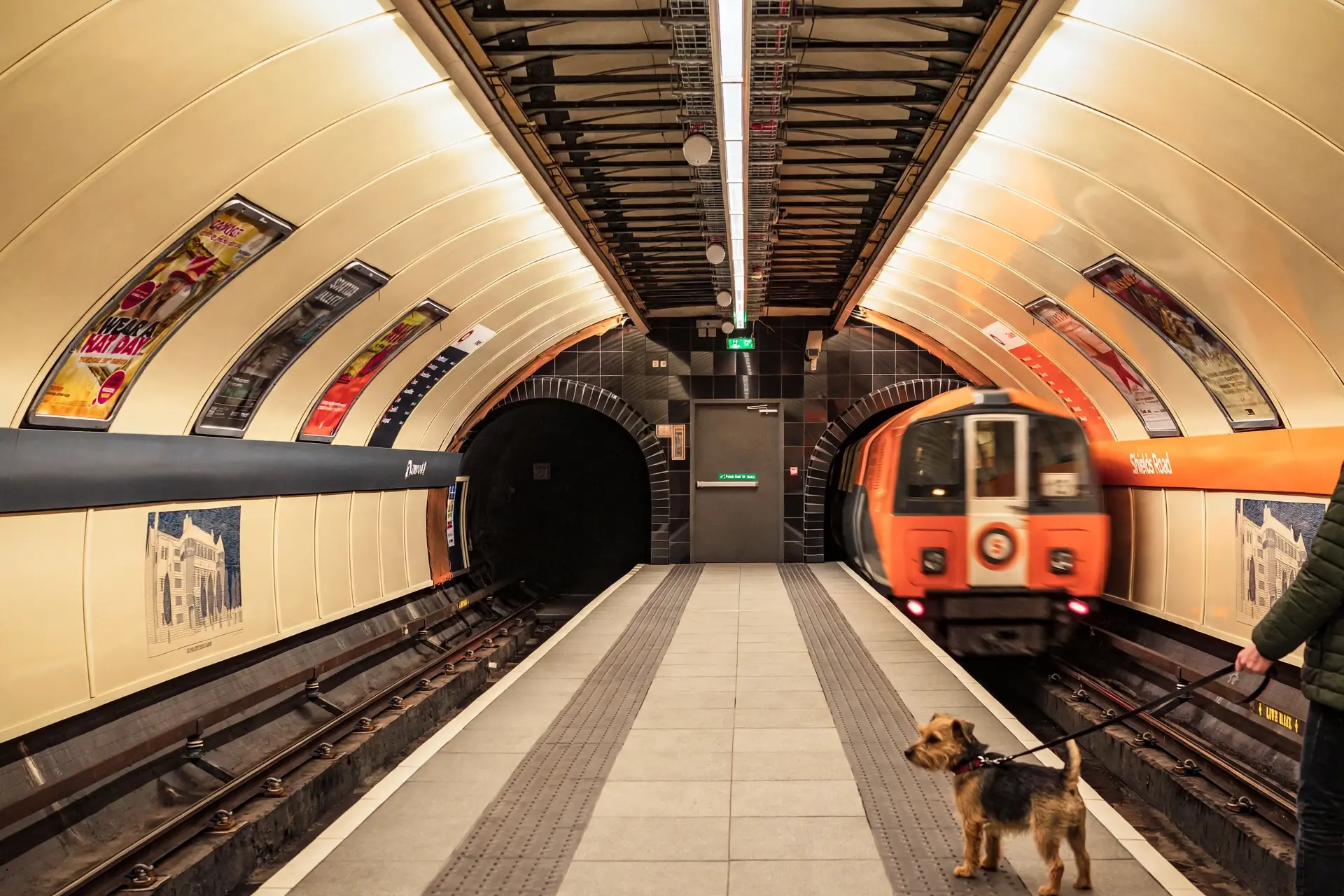
The first thing you notice about the Glasgow Subway is the colour. An orange train slides into a small underground station, doors open with a soft chime, and a few minutes later it is gone, already curving away towards the next stop. The second thing you notice is the scale. Everything feels compact: the platforms are short, the tunnels are narrow, and the carriages are lower and smaller than the trains most visitors expect from a city underground system. That is not a flaw in the design. It is the whole character of the place, and it shapes every decision you make when you travel with a dog.
The Subway opened in 1896, which makes it one of the oldest underground railways in the world, older than the Paris Metro and older than the New York Subway. It was built as a circle, and it has stayed a circle ever since. There are 15 stations on a single loop of about six and a half miles, running under the city centre, the West End and the south side of the River Clyde. Trains run in both directions around that loop: the Inner Circle runs clockwise, and the Outer Circle runs anticlockwise. If you miss your stop, you do not need a new ticket or a complicated change. You simply stay on, ride around, and come back to it a few minutes later, which is a forgiving arrangement when a dog needs a moment to settle or you have misjudged a platform.
The nickname Clockwork Orange came later, and it fits the system in two ways. The trains are painted a bright, unmistakable orange, and the service runs with the regularity of a clock: trains arrive every few minutes through most of the day, so you rarely wait long on a platform. For a dog owner, that frequency is genuinely useful. If a train arrives crowded, you can let it go without worrying that you have lost your only connection. Another will be along shortly, and the next one may be much quieter. It also means you do not need to plan your day around a timetable in the way you would for a rural bus or a long-distance train. You turn up, you wait a few minutes, and you ride.
The 15 stations, in order around the loop, are St Enoch, Buchanan Street, Cowcaddens, St George's Cross, Kelvinbridge, Hillhead, Kelvinhall, Partick, Govan, Ibrox, Cessnock, Kinning Park, Shields Road, West Street and Bridge Street, before the circle returns to St Enoch. Most visitors will use only a handful of them, but it helps to know the shape of the whole loop before you start. The city-centre stations, St Enoch and Buchanan Street, sit close together and serve the shopping streets and the mainline stations nearby. The West End stations, Kelvinbridge, Hillhead and Kelvinhall, serve the university, the museums and the parks. Partick and Govan sit on either side of the Clyde and connect the Subway to the wider rail network and the river. The south-side stations, from Ibrox through Cessnock, Kinning Park, Shields Road and West Street to Bridge Street, serve residential neighbourhoods, football crowds and the walk back into the centre. A full loop takes around 24 minutes, so even a complete circuit with a calm dog is a short, manageable outing rather than a long expedition.
Because the system is a single circle with no branches, navigation is unusually simple, and that simplicity is a gift when you are also managing a lead, a bag and a dog that would rather sniff everything. You need to know only two things: which direction you are travelling, and how many stops you have left. The signs on the platform tell you the direction, Inner or Outer, and the next station is announced and displayed inside the train. If you are unsure, ask a member of staff before you board, or ride one stop and check. The cost of a mistake is a few minutes, not a missed connection or a long walk back. That low-stakes quality makes the Subway a good first underground trip for a dog that has never travelled on a metro before, provided you choose a quiet time and a short journey for the first attempt.
Dogs ride free: the rules that matter
The headline rule is simple and generous: dogs travel free on the Glasgow Subway. There is no dog ticket, no extra fare and no need to buy anything for your dog at the ticket machine. You pay your own fare, and your dog rides with you. That puts Glasgow in the same friendly company as many other British transport networks, and it removes the most common source of confusion at the gateline: nobody will ask you for a dog ticket, because there is not one to buy. Small dogs do not need to be in a carrier, and large dogs do not need a special pass. The rule is the same for a terrier and a retriever, which is why the practical questions that follow are about space, behaviour and timing rather than about paperwork.
Free travel does not mean unregulated travel. Your dog must be on a lead and under your control at all times, on the platform, in the ticket hall and in the carriage. Staff can refuse travel to a dog that is out of control, aggressive or causing a danger or a serious nuisance to other passengers, and that discretion exists for good reason in a small, enclosed space. A dog that lunges at other dogs, barks continuously or blocks a doorway is a problem in a carriage the size of a large living room. The standard to aim for is modest: a dog that can sit or lie quietly beside you, ignore strangers, and wait calmly while doors open and close. If your dog cannot yet do that reliably, the Subway is a training goal rather than a starting point, and a short, quiet, off-peak ride is the right way to build up to it.
Assistance dogs travel as a matter of course, and the usual guidance for assistance animals applies throughout the network. For other dogs, the most important unwritten rule is to keep the lead short. A long lead on a platform is a hazard: it can tangle around another passenger's legs, catch in a closing door, or let a dog wander towards the platform edge. On the escalator, in the ticket hall and while boarding, hold the lead close and keep your dog beside you, not ahead of you. The same applies inside the carriage. A dog that lies across the aisle forces everyone to step over it, and a dog that stands in the doorway slows boarding for the whole train. The best spot is usually on the floor between your feet, or tucked against the side of the carriage where your dog is out of the main flow of people.
There is no published rule that says a dog must wear a muzzle on the Subway, and most dogs will never be asked to wear one. A muzzle can still be a sensible precaution for a dog that is nervous around strangers or reactive to other dogs, especially on a first trip, because it protects both your dog and the people around it in a space where nobody can move far away. If you use one, introduce it at home first, so the dog associates it with treats and calm, rather than with the stress of a first underground journey. A carrier is a similar judgement call. It is not required, but a small dog that feels safer in a carrier, or a puppy that is still learning, may travel better enclosed, provided the carrier fits in the limited floor space and does not block a seat or a doorway.
One more rule is easy to overlook because it feels obvious: you are responsible for your dog throughout the journey, including the parts that happen before you reach the train. That means cleaning up after your dog if there is an accident, keeping your dog off the seats, and not letting your dog approach other passengers, children or other dogs without an invitation. Most Glasgow passengers are relaxed about dogs, and many will smile or ask to say hello, but a dog that jumps up or begs for attention in a crowded carriage is not charming for long. A short lead, a calm dog and a little distance from other passengers will earn you far more goodwill than any amount of apologising afterwards. If you are unsure about any current condition, check the official guidance before you travel, because rules and station facilities can change during works and upgrades.
Small trains, big dogs: the space problem
The Glasgow Subway is famous for the small size of its trains, and that is the single most important fact for a dog owner to understand before travelling. The system was built in the 1890s to a narrow tunnel gauge, and its trains have stayed small ever since. The carriages are lower than a standard underground train, the doors are narrower, the seats are close together, and the floor space between the seats is limited. A person of average height can stand comfortably enough, but a tall person will notice the low ceiling, and a large dog will notice the lack of floor space. This is not a reason to avoid the Subway. It is a reason to plan your journey around it, in the same way you would plan around a small lift or a narrow doorway.
For a small dog, the Subway is usually straightforward. A terrier, a dachshund or a spaniel can sit or lie between your feet, under a seat or on your lap if the carriage is quiet, and the journey will pass without much fuss. For a medium dog, such as a collie or a springer, you will need to think about where the dog's body goes when it lies down. A dog that stretches out across the aisle will block other passengers, so train your dog to curl up or to lie along the side of the carriage, with its head towards you and its body out of the walkway. A non-slip mat, a familiar blanket or a travel bed can help here, because it gives the dog a defined place to settle and a surface that does not slide on a smooth carriage floor.
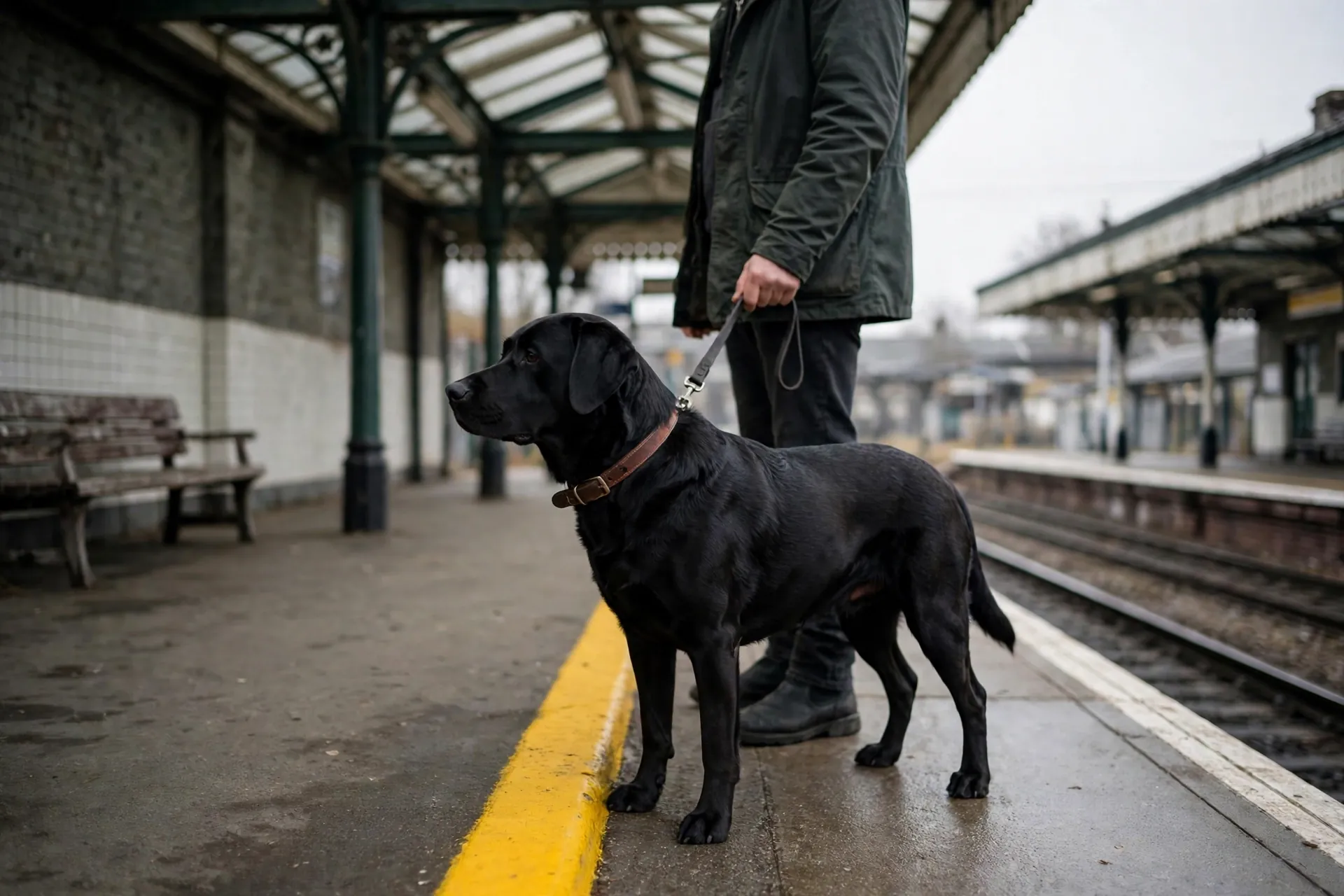
For a large dog, the Subway is possible but it demands more care. A Labrador, a German shepherd or a greyhound takes up a substantial part of the available floor space in a small carriage, and on a busy train there may simply not be room for the dog to lie down without touching another passenger. The honest test is whether your dog can sit or lie in a footprint roughly the size of a large rucksack without blocking a doorway or an aisle. If it can, travel outside peak hours and you will usually find a carriage with enough space. If it cannot, or if your dog is anxious and needs room to move away from strangers, consider walking the shorter distances instead, or using a bus or a taxi for that particular journey. There is no shame in that choice. It is the difference between a calm dog and a stressed one, and the dog will tell you which it is.
Boarding and alighting deserve the same attention as the ride itself. The gap between the platform and the train can vary from station to station, and the doors are narrower than on a mainline train, so a large or stiff dog may need a moment to step across. Let other passengers board first if the platform is busy, then walk your dog calmly through the doorway and straight to a seat, rather than letting the dog hesitate in the doorway while the doors are about to close. When you alight, stand up a stop early, gather the lead, and move towards the door in good time. A dog that is still settling when the doors open will be rushed, and a dog that is rushed is more likely to slip, panic or catch a paw. If the train is very crowded, it is often kinder to stay on for one more stop and walk back than to force your way out through a packed doorway.
The low ceiling and the enclosed tunnel also affect the sensory experience for a dog. The Subway is louder than a street, with the rumble of the train, the squeal of wheels on a curve and the echo of announcements in a tiled station. Some dogs barely notice; others find the noise and the vibration unsettling, especially on their first trip. You can help by choosing a seat away from the wheels if you can, by keeping your dog close to you so it can feel your calm, and by avoiding the first and last carriages if they feel louder. A short first journey, perhaps one or two stops on a quiet afternoon, lets your dog learn that the noise ends quickly and that the train is not a threat. If your dog is noise-sensitive, build up gradually, and do not be surprised if the first trip is harder than the second. Dogs learn the pattern quickly when the pattern is short, calm and followed by a good walk.
Step-free access and stairs
Step-free access is the weakest part of the Glasgow Subway for dog owners, and it is the part you should check most carefully before you travel. Only a small number of stations have step-free access from the street to the platform, and the rest rely on stairs and escalators. The stations most often listed as step-free are Govan, St Enoch and Buchanan Street, where lifts or level routes are provided, but the exact facilities can change during maintenance and improvement works, so check the official guidance before you travel if step-free access is essential for you or your dog. Do not assume that a station you used last year still offers the same access today, and do not assume that a station with a lift in one direction offers the same in the other.
For most dogs, stairs are not a problem. A fit, healthy dog will walk up and down a flight of station stairs without difficulty, and many dogs actually prefer stairs to escalators, which can be frightening or dangerous for paws. Escalators deserve particular care. A dog's claws, paws and long fur can catch in the moving steps, and a nervous dog can panic when the steps disappear at the top. If you must use an escalator, keep the lead very short, keep your dog close to the centre of the step, and lift a small dog if you can. Better still, look for the stairs beside the escalator and use those instead. Many Subway stations have both, and the stairs are often quieter and less crowded than the escalator queue.
Older dogs, very small dogs, dogs recovering from surgery and dogs with arthritis or hip problems need a different plan. For them, a station with many steep steps is a genuine obstacle, and a long climb at the end of a walk can turn a pleasant day into a painful one. If your dog struggles with steps, plan your route around the step-free stations, even if that means a slightly longer walk at the other end. Govan, St Enoch and Buchanan Street are useful anchors for this kind of planning, because they let you enter and leave the system without a climb. Partick is also worth checking, because its interchange with the mainline station and its modern facilities may offer a better route for some journeys, but again, check the official guidance before you travel, since lift availability and station layouts change.
When you arrive at a station, take a moment to read the signs before you commit to a route. The ticket hall, the gateline and the platform may be on different levels, and the lift, if there is one, may be at the far end of the hall. If you are travelling with a dog that cannot manage stairs, do not follow the crowd through the gateline and hope for the best. Ask a member of staff where the lift is, and whether it is working that day. Staff at Glasgow Subway stations are used to helping passengers with mobility needs, and they can tell you quickly whether a lift is out of service or whether a different station would be a better choice. That short conversation can save you a long, difficult climb with a dog that is already tired.
It is also worth thinking about the return journey, not just the outward one. A dog that managed the stairs down to the platform in the morning may be tired, stiff or sore by the afternoon, especially after a long walk in Kelvingrove Park or along the Clyde. If your return station has no lift, consider ending your walk at a step-free station instead, or taking a bus or a taxi for the last leg. A portable ramp is unlikely to help in a Subway station, because the stairs are long and the ramps are designed for wheelchairs rather than dogs, so the practical solution is route choice rather than equipment. Plan the easy exit first, then build the rest of the day around it, and your dog will thank you at the end of a long afternoon.
Tickets, Smartcards and fares
Paying for the Glasgow Subway is straightforward, and the system is designed around a small number of ticket types rather than a complicated zone map. Because there is only one loop, there are no zones to work out and no penalty for travelling further around the circle. You buy a ticket for a single journey, a return, or a day ticket, and you use it to pass through the gateline at your starting station and again at your destination. Your dog, as noted above, travels free and needs no ticket at all, which means the whole transaction at the ticket machine is about your fare only. That simplicity is a relief when you are holding a lead in one hand and trying to work a machine with the other.
The most convenient way to pay for regular travel is the Subway Smartcard, a reusable card that you load with credit or with a season ticket and tap at the gateline. If you live in Glasgow or you are staying for several days and plan to use the Subway often, a Smartcard saves you from queuing at the machine on every journey, which matters when you have a dog waiting beside you. You can also buy a paper ticket from the machine or the ticket office at the station, and contactless payment is available at many stations, but the exact payment options can change, so check the official guidance before you travel if you are relying on a particular method. Fares change from time to time, so this guide does not quote a price that may be out of date by the time you read it. Check the current fare on the official Subway website or at the station before you travel, and budget for a day ticket if you plan to hop on and off several times, because it is often better value than buying single tickets for each leg.
Concessionary travel is available for eligible passengers, including older people and people with disabilities who hold the appropriate card, and children travel at a reduced fare. If you qualify for a concession, bring the card with you and check the conditions, because the rules for concessionary travel can differ from the standard fare and may not apply at all times. Students and young people may also be eligible for discounted travel through national schemes, but again, the details change, and the station staff or the official website will have the current position. The point for a dog owner is simple: sort out your own fare before you reach the station, so you are not standing at a machine with a dog, a queue behind you and a decision to make.
The gateline itself deserves a word of warning. The gates at Subway stations are narrower than the gates at a mainline station, and they close quickly after you pass through. A dog on a long lead can easily be caught on the wrong side of the gate, or worse, can try to follow you through a closing gate and get trapped. The safe method is to keep the lead very short, walk through the gate with your dog close beside you, and make sure the dog is fully through before the gate closes. If your dog is large, nervous or slow, ask a member of staff to open the wide gate or the accessible gate, which gives you both more room and more time. Do not try to carry a dog through a standard gate while holding a ticket and a bag. Put the bag down, sort the ticket, and then walk through together, calmly and without rushing.
One more practical tip: keep your ticket or Smartcard somewhere you can reach it without letting go of the lead. A pocket, a lanyard or a card holder on the lead itself works better than a bag buried under a coat. You will need the ticket twice, once to enter and once to exit, and fumbling for it at the exit gate with a tired dog is a small frustration that is easy to avoid. If you lose your ticket, speak to a member of staff rather than trying to jump the gate or tailgate another passenger. The staff deal with lost tickets every day, and they will help you exit safely with your dog. The same applies if the gate does not accept your ticket: step aside, keep your dog out of the way of other passengers, and ask for help, rather than blocking the gateline while you try again.
Peak hours and carriage etiquette
There is no published ban on dogs travelling at peak times on the Glasgow Subway, but that does not mean peak travel is a good idea. The morning rush, roughly from 7.30 to 9.30 on weekdays, and the evening rush, roughly from 4.30 to 6.30, fill the small carriages with commuters who are standing close together, carrying bags and trying to get to work or home. In that environment, a dog has nowhere to lie down, nowhere to move away from a stranger, and no space to settle. The dog will be stepped on, jostled and stared at, and the passengers around it will be irritated, however well behaved the dog is. The kindest choice, for the dog and for everyone else, is to avoid those hours if you can.
The quietest times are usually mid-morning, from about 10am to noon, and early afternoon, from about 2pm to 4pm, when the commuters have gone and the shoppers and visitors have not yet filled the trains. Late evening, after about 7pm, is often quiet too, though the service becomes less frequent and the last trains are something to plan around, as the later section on hours explains. Weekends are generally easier than weekdays, with a more relaxed crowd and more space in the carriages, though Saturday afternoons in the city centre can be busy with shoppers, and matchdays around Ibrox bring a different kind of crowd altogether. If you are planning a day out, aim for a midweek morning or a Sunday afternoon, and you will find the Subway at its most dog-friendly.
Carriage etiquette on the Subway is mostly common sense, but it is worth spelling out because the carriages are so small. Keep your dog on the floor, not on a seat, even if the seat beside you is empty. Other passengers may need that seat, and a dog on a seat leaves fur and mud where someone else will sit. Keep the lead short and the dog close, so it does not wander into the aisle or under another passenger's feet. Do not let your dog sniff or approach other passengers, children or other dogs without being invited to. Some people are frightened of dogs, some are allergic, and some simply do not want a wet nose on their trousers on the way to work. A dog that ignores strangers is a dog that will be welcome again.
If another dog boards the same carriage, give it space. Do not let your dog rush over to greet it, however friendly your dog is, because a small carriage leaves no room for a proper greeting and no escape route if either dog takes offence. Keep your dog beside you, keep the lead short, and if the other dog is reactive or anxious, move to the far end of the carriage or wait for the next train. The same applies to children. Many children love dogs and will want to stroke yours, but a carriage is not the place for an introduction. A polite smile and a short explanation, that your dog is travelling and needs to stay calm, is enough. If you are happy for a child to say hello, do it on the platform after you have alighted, where there is space and you can control the interaction.
Finally, be ready to get off and wait. If a train arrives and it is already full, do not squeeze your dog into the last available space. Let it go. Another train will arrive in a few minutes, and the next one may be half empty. If you are already on a train and it becomes uncomfortably crowded at the next station, consider getting off, letting the crowd clear, and boarding the following train. That flexibility is one of the advantages of a frequent circular service. You are never stranded, and a five-minute wait is a small price for a calm dog and a pleasant journey. The passengers who remember you will be the ones who saw a calm dog lying quietly at its owner's feet, not the ones who were stepped on by a stressed animal in a packed carriage.
Changing trains and walking between stations
The Glasgow Subway does not connect directly to the mainline railway inside the station, but it connects well if you are prepared to walk a short distance between stations. The two most useful interchanges are Partick and the city-centre pair of Buchanan Street and St Enoch, and understanding them before you travel will save you a lot of confusion with a dog in tow. Partick is the only station where the Subway and the mainline railway share a station complex, and it is the easiest interchange of all. You leave the Subway platform, follow the signs through the station, and you are at the mainline platforms for trains to the west, including services towards Helensburgh, Balloch and the Loch Lomond area. The walk is short, covered and signposted, and it is the natural starting point for a day trip out of the city with your dog.
Buchanan Street is the interchange for Glasgow Queen Street station, which serves trains to Edinburgh, the north and the Highlands. The two stations are not joined, but they are a short walk apart through the city centre, roughly five minutes on foot, and the route is well signposted. With a dog, that walk is easy enough on a quiet day, but it involves crossing busy streets and navigating pavements full of shoppers, so allow extra time and keep the lead short. Queen Street itself is a busy mainline station, and the guidance in our companion piece on dogs on UK train platforms covers the lead rules, the yellow line and the escalator advice that apply there. If you are changing from the Subway to a mainline train at Queen Street, give yourself at least 20 minutes between the two, so you are not rushing a dog through a crowded station.
St Enoch is the interchange for Glasgow Central station, which serves trains to the south, to Edinburgh by a different route, and to London and the rest of Britain. Again, the two stations are a short walk apart, about five minutes through the city centre, and the route takes you past St Enoch Square and along Argyle Street. Central is a large, busy station with a long concourse, and it can be overwhelming for a dog that has never been in a mainline terminus. If you are starting a longer journey from Central, arrive early, find a quiet corner of the concourse, and let your dog settle before you head for the platform. The same advice applies in reverse: if you are arriving at Central with a dog and want to continue on the Subway, walk calmly to St Enoch, buy your ticket, and board at a quiet time if you can.
There are other useful walks between Subway stations and other places, and they are worth knowing because the Subway is a circle, not a straight line. Buchanan Street and St Enoch are only a few minutes apart on foot, so if you are in the city centre and one station is crowded or closed for works, you can walk to the other. Hillhead and Kelvinbridge are a short walk apart through the West End, and Kelvinhall and Partick are close enough that you can walk between them along Dumbarton Road if you prefer. These short walks are often pleasanter than staying on the train for one more stop, especially if your dog needs a toilet break or a sniff around a new street. Glasgow is a walkable city at its centre, and the Subway is best used for the longer jumps, not for every single stop.
When you are changing trains, remember that your dog's needs do not pause at the interchange. A dog that has been travelling for 20 minutes may need water, a toilet break or simply a few minutes outside before the next leg. Build those pauses into your plan. At Partick, there is open space outside the station and a short walk to the river. At Buchanan Street and St Enoch, there are small squares and side streets where a dog can pause, though the city centre is busy and you should keep the dog close. Do not try to change trains in two minutes with a dog that needs a break. Allow 15 to 20 minutes for a comfortable interchange, and you will arrive at your next train with a calm dog rather than a stressed one. If you are unsure about the walking route between two stations, check the official guidance before you travel, and ask a member of staff at the station for the step-free or quieter route if you need it.
A West End day out by Subway
The West End is where the Glasgow Subway earns its keep for dog owners, because three stations in a row serve the parks, the museums and the university quarter, and the distances between them are short enough to walk or ride as you please. Hillhead is the station for the University of Glasgow and for Byres Road, the West End's main shopping and cafe street. Kelvinbridge is the station for the River Kelvin walkway and for the quieter streets towards the Botanic Gardens. Kelvinhall is the station for Kelvingrove Park, the Kelvingrove Art Gallery and Museum, and the walk down to the Riverside Museum. Together, they make a day out that you can shape around your dog's energy, rather than around a timetable.
Start at Hillhead if you want cafes and bookshops. Byres Road and the streets around it have a good number of dog-friendly cafes, and many will welcome a well-behaved dog inside or on a terrace, though policies change, so it is worth checking before you sit down. The University of Glasgow campus, a short walk uphill from the station, is worth a look from the outside, with its grand main building and its views over the city, but the climb is steep and the cobbles can be hard on small paws, so take it slowly and carry a small dog if it struggles. From Hillhead, you can walk down to the River Kelvin in a few minutes, and the riverside walkway is one of the best dog walks in the city: shaded, traffic-free in parts, and full of smells for a curious nose.
Kelvinbridge is the quieter West End station, and it suits a slower morning. The Kelvin walkway runs south from here towards Kelvingrove Park, following the river under bridges and past weirs, and it is a lovely, level walk for a dog that likes water and woodland. The Botanic Gardens are a short walk north from Kelvinbridge, and while dogs are welcome in parts of the gardens, the glasshouses and some indoor areas are not suitable for dogs, so check the current rules before you go and plan to enjoy the outdoor paths and lawns instead. The streets around Kelvinbridge are residential and calm, which makes them a good place to let a nervous dog settle after the train, before you head for the busier park.
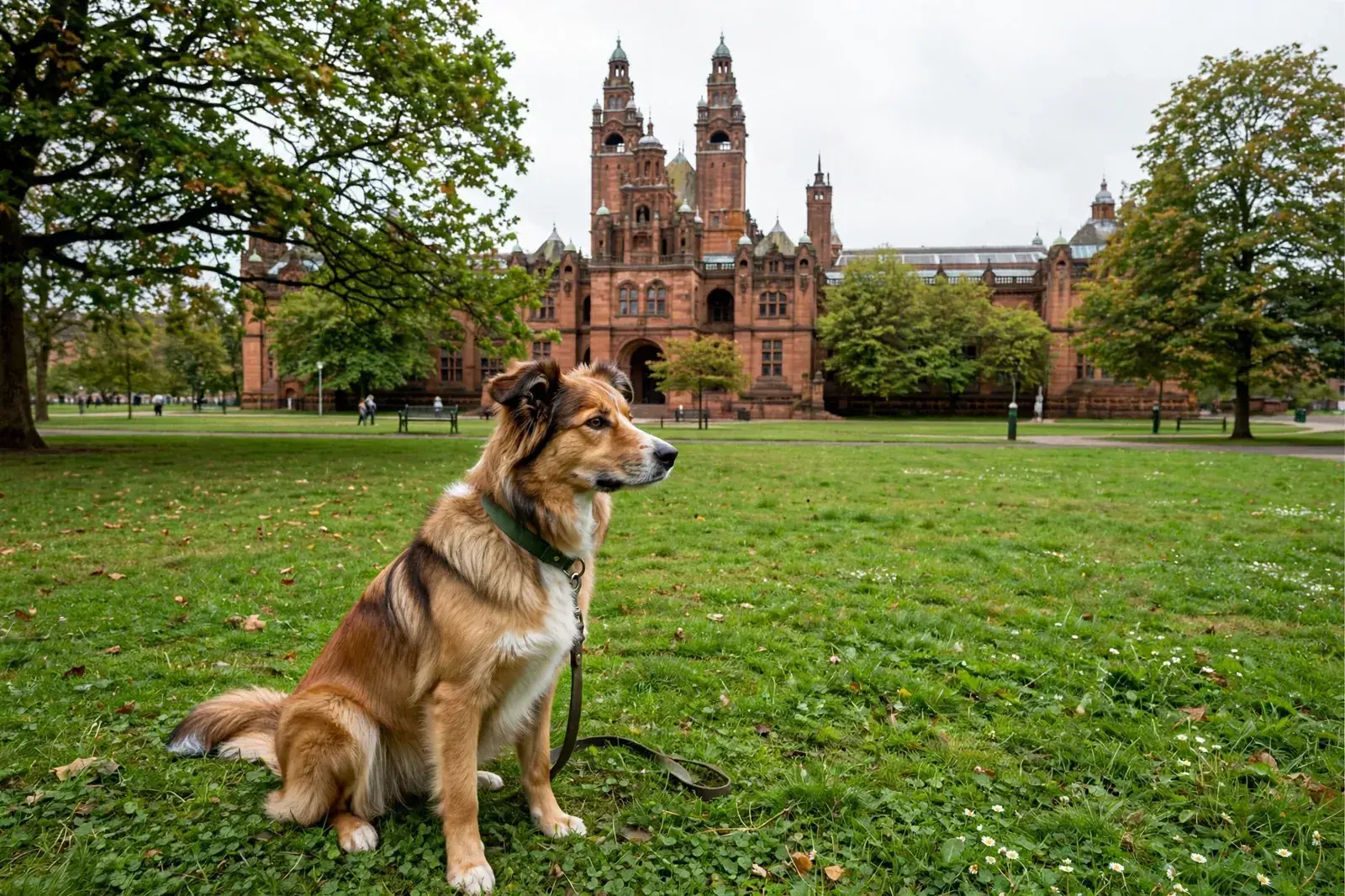
Kelvinhall is the station for the big green spaces. Kelvingrove Park is one of Glasgow's great parks, with wide lawns, tree-lined paths, a skate park, tennis courts and a bandstand, and it is a natural place for a dog to stretch its legs after a train ride. The park is large enough that you can find a quiet corner even on a busy weekend, and the paths are mostly level and well surfaced. The Kelvingrove Art Gallery and Museum sits at the edge of the park, but dogs are not allowed inside the museum itself, so plan to admire the building from the outside and enjoy the park instead. From Kelvingrove, you can walk west towards the Riverside Museum and the tall ship on the Clyde, a longer walk that suits a fit dog, or you can walk back to Kelvinhall station and ride one stop to Partick for the next part of your day. For a fuller West End plan, including parks, riverside walks and where to stay, our guide to Glasgow with a dog covers Kelvingrove, the Clyde and Pollok Park in detail.
A West End day works best as a loop rather than a straight line. Ride to Hillhead, walk down to the Kelvin, follow the river to Kelvingrove Park, and then ride back from Kelvinhall or walk to Partick, depending on how much energy your dog has left. That way, you use the Subway for the longer jumps and your feet for the interesting parts, and your dog gets a mix of train, pavement and park. Take water for the dog, because the West End has fewer drinking fountains than you might expect, and bring a towel if it has been raining, because the Kelvin walkway can be muddy after wet weather. And remember that the West End is busiest on Saturday afternoons, when Byres Road fills with shoppers, so a weekday morning or a Sunday will give your dog more space and a calmer introduction to the area.
Riverside, the south side and matchdays
South of the Clyde, the Subway serves a different Glasgow: the riverfront at Govan, the football crowds at Ibrox, and the residential streets of Cessnock, Kinning Park, Shields Road and West Street. Govan is the most interesting of these stations for a visitor with a dog, because it is step-free, it sits close to the river, and it is the starting point for the walk along the Clyde towards the city centre or towards the Riverside Museum. The Govan ferry, when it is running, once connected the south bank to the north, but the Subway is the reliable link, and the walk from Govan station to the river takes only a few minutes. The riverside path here is wide, flat and relatively quiet outside matchdays, which makes it a good place for a dog that needs space after a train ride.
Cessnock is the station for the south side's quieter streets and for the walk towards Pollok Park, though the park itself is a longer walk or a short bus ride away. The area around Cessnock is residential, with tenements and small shops, and it is a useful station if you are staying on the south side and want to reach the West End or the city centre without a car. Kinning Park and Shields Road serve similar neighbourhoods, and they are the stations most visitors will pass through without stopping, which is a shame, because the south side has some of Glasgow's best independent cafes and its most relaxed streets. If you are staying south of the river, take the time to explore on foot from one of these stations, rather than riding straight through to the centre. Your dog will enjoy the quieter pavements, and you will see a Glasgow that many visitors miss.
Ibrox is a different story, and it needs a clear warning. Ibrox is the station for Ibrox Stadium, the home of Rangers Football Club, and on matchdays the station and the trains around it fill with thousands of supporters. The atmosphere is loud, crowded and, for a dog, overwhelming. The trains before and after a match are packed, the platforms are full, and the streets around the stadium are closed or congested. If you are travelling with a dog on a matchday, avoid Ibrox station entirely, and avoid the Subway in the hour before and the hour after a match if you can. The club publishes its fixture list well in advance, so check the dates before you plan a south-side trip, and if you find yourself caught in a matchday crowd, get off at Cessnock or Govan and walk, rather than staying on a train that is filling with supporters. The same advice applies, to a lesser extent, to Celtic matches at the other end of the city, though those supporters travel mainly by mainline train and bus rather than by Subway.
Outside matchdays, the south side is one of the calmest parts of the Subway network, and it is a good place for a first trip with a nervous dog. The trains are quieter south of the river, the stations are less busy, and the walks from the stations are short and level. A gentle first loop might be to ride from St Enoch to Govan, walk along the river for half an hour, and ride back, all in the middle of a weekday morning. That gives your dog a short train ride, a riverside walk and a second short train ride, without the crowds of the city centre or the West End. If that goes well, you can build up to longer journeys and busier stations. If it does not, you have learned something useful about your dog without committing to a long day out.
The Clyde itself is the thread that ties the south side to the rest of the city, and the riverside walks are worth planning around. From Govan, you can walk east along the Clyde towards the city centre, passing the Riverside Museum and the tall ship, though the full walk to the centre is long and better suited to a fit dog. From Partick, on the north bank, you can walk west along the river towards the same museum, or east towards the city. The river paths are mostly flat, well surfaced and traffic-free, which makes them ideal for a dog that has just come off a train and needs to stretch. Take care near the water's edge, especially with a dog that likes to swim, because the Clyde is deep, fast and cold, and the banks are not fenced in every place. Keep the dog on a lead near the river, and save the off-lead running for a park.
The city centre and Buchanan Street
Buchanan Street station sits at the heart of Glasgow's shopping district, and it is the station most visitors will use first. Buchanan Street itself is a broad, pedestrianised street lined with shops, from high-street names to independent boutiques, and it is one of the busiest pavements in Scotland. For a dog, that means crowds, noise, buskers, street performers and a constant flow of people, which can be exciting or overwhelming depending on the dog. If your dog is confident in crowds, Buchanan Street is a fun place to walk, with plenty to see and smell. If your dog is nervous, it is a place to pass through quickly on the way to somewhere quieter, rather than a destination in itself.
The station has the advantage of being step-free, which makes it a useful anchor for a city-centre day, especially if you are travelling with an older dog or a dog that struggles with stairs. From Buchanan Street, you can walk to George Square in a few minutes, to the Gallery of Modern Art, to the shops on Sauchiehall Street, or to Queen Street station for a mainline train. George Square is the city's main civic square, with lawns, statues and benches, and it is a good place to sit with a dog and watch the city go by, though dogs should be kept on a lead and off the flower beds. The streets around the square are busy with buses and taxis, so keep your dog close to the pavement and away from the road.
St Enoch, the other city-centre station, serves a different part of the centre. St Enoch Square is smaller and quieter than George Square, and the station sits close to the St Enoch Centre shopping mall, to Argyle Street, and to the walk down to the Clyde. The station is also step-free, which makes it a useful alternative to Buchanan Street if one is crowded or closed. From St Enoch, you can walk to Glasgow Green, the city's oldest park, in about 15 minutes, following the Clyde eastwards. Glasgow Green is a large, open park with wide paths, a play area and the People's Palace museum, and it is a much better place for a dog to run and relax than the shopping streets. If you arrive in the city centre by Subway and your dog needs a proper walk, head for Glasgow Green rather than trying to exercise a dog on Buchanan Street.
Shopping with a dog in the city centre takes a little planning. Most large shops do not allow dogs inside, except for assistance dogs, and the same applies to most shopping malls. That does not mean you cannot shop, but it does mean you should plan your shopping around your dog, rather than expecting the dog to wait outside a shop for an hour. If you are travelling as a pair, take turns to go inside while the other waits with the dog. If you are travelling alone, choose shops that welcome dogs, of which there are a growing number in the city centre, or keep your shopping to a short list and a quick visit. Many of the independent shops on the streets around Buchanan Street are dog-friendly, and a polite question at the door will usually get a friendly answer. The same applies to cafes: many city-centre cafes welcome dogs inside or on a terrace, but policies change, so check before you sit down, and do not assume that a cafe that welcomed dogs last year still does.
The city centre is also where you will find the most useful facilities for a dog owner: pet shops, vets, water fountains and, in the larger department stores, accessible toilets. If your dog needs water, most cafes will provide a bowl if you ask, and many shops keep a bowl by the door. If your dog needs a toilet break, the nearest green space is Glasgow Green to the east or Kelvingrove Park to the west, both a walk or a short Subway ride away, so plan your route accordingly. And if the city centre feels too busy, remember that the Subway can take you out of it in minutes. Two stops west and you are in the West End, two stops south and you are on the quieter south side, and the contrast is immediate. The Subway's greatest gift to a dog owner in the city centre is not the ride itself, but the quick escape it offers to somewhere greener and calmer.
Opening hours and the last train
The Glasgow Subway does not run all night, and the last train is the one detail you must get right, because missing it with a tired dog is a miserable end to a day out. The service runs from early morning until late evening, seven days a week, but the exact hours vary by day, and Sunday has a later start and an earlier finish than the rest of the week. As a rough guide, trains start around 6.30am on weekdays, a little later on Saturdays, and later still on Sundays, and the last trains leave the terminus stations in the late evening, usually around 11pm or midnight depending on the day. Those times are approximate, and they change for public holidays, for engineering works and for special events, so check the official guidance before you travel, especially if you are planning an evening out. Do not rely on a time you remember from a previous visit.
The practical rule is to plan your return journey before you leave the station in the morning. Note the time of the last train from the station you will be returning from, and work backwards from there, allowing time for the walk to the station, the ticket purchase and the wait on the platform. If you are in the West End and the last train from Hillhead is at 11pm, you should be leaving the park or the cafe by 10.30pm at the latest, not starting a final drink. If you are at a restaurant in the city centre, check the last train from Buchanan Street or St Enoch before you order dessert. A dog that has had a long day will be tired and may be reluctant to walk quickly, so allow more time than you would for yourself alone. A taxi is a fallback if you miss the last train, but not every taxi will take a large dog, and the fare late at night will be higher than a Subway ticket.
Engineering works and closures are a regular part of the Subway's calendar, and they can affect your journey without much notice. The system closes for maintenance on some Sundays, and individual stations can close for improvement works for weeks at a time. When that happens, a replacement bus service may run, but buses have their own rules for dogs, and a replacement bus is not the same as a Subway train. If you are planning a trip on a Sunday or during a holiday period, check the official Subway website or social media for closures before you set out, and have a backup plan. The bus network in Glasgow is extensive, and our guide to dogs on London buses is a useful reminder of how bus travel with a dog works in general, though Glasgow's buses have their own local rules, so check those too before you board.
Frequency also changes through the day. At peak times, trains run every few minutes, which means you rarely wait long. Late in the evening, the gap between trains grows, and a missed train can mean a 10-minute wait on a quiet platform, which is not a problem for a calm dog but can feel long if the station is cold or the dog is tired. On Sundays, the service is less frequent throughout the day, so allow extra time and do not assume that a train will arrive in four minutes just because it did on a weekday. The displays on the platform show the next train and its direction, and the announcements will tell you if a train is delayed. If the platform is empty and no train is due for a while, it is often better to wait in the ticket hall, where it is warmer, than on the platform itself.
One more timing tip: the Subway is busiest at predictable moments, and you can plan around them even without a timetable. The morning rush ends by about 9.30am, the lunchtime crowd is brief, the afternoon school run fills the trains for a short period, and the evening rush ends by about 6.30pm. Football matches, concerts at the nearby arenas and large events in the city centre can fill the trains at other times, so check what is happening in the city on the day you travel. A quiet Tuesday morning is a very different experience from a Saturday afternoon before a concert, and your dog will notice the difference long before you do. Choose the quiet time, and the Subway will feel like a friendly, manageable part of your day, rather than a crowded ordeal to be endured.
A first loop with your dog
If you have never taken your dog on the Glasgow Subway, the best first trip is a short, simple loop that you can abandon at any point without a long walk home. Start at a step-free station, such as St Enoch or Buchanan Street, on a weekday mid-morning, when the trains are quiet and the platforms are calm. Buy your ticket, walk through the gate with your dog close beside you, and wait on the platform for the next train. Let one train go past if it looks crowded, and board the next one. Ride for two or three stops, perhaps to Kelvinbridge or Hillhead, and then get off, walk in the park or along the river, and ride back. The whole outing should take no more than an hour, and your dog should come home tired but happy, not stressed or frightened.
Before that first trip, do a little preparation at home. Make sure your dog is comfortable on a short lead in a busy place, and that it can sit or lie down on command. Practise walking through a narrow doorway and waiting while a door opens and closes, because that is what the train doors will feel like. Bring treats, water, a collapsible bowl, poo bags and a towel, and wear shoes you can walk in, because you may end up walking further than you planned. Feed your dog a light meal a few hours before you travel, not immediately before, so the dog is settled but not hungry, and make sure the dog has had a toilet break before you enter the station. A dog that needs the toilet on a platform is a problem for everyone, and a short walk before you travel prevents it.
On the day, watch your dog closely and be ready to change your plan. Signs that your dog is coping well include a relaxed body, a loose lead, an interest in the surroundings and an ability to settle on the floor of the carriage. Signs of stress include panting when it is not hot, yawning, lip licking, pacing, whining, trying to hide behind you, or refusing to board the train. If you see those signs, do not force the issue. Get off at the next station, go outside, let the dog sniff and settle, and either try again later or walk home. A single bad experience can make a dog fearful of trains for a long time, while a single good experience can make the next trip much easier. Your job on the first trip is not to complete a loop, but to teach your dog that the Subway is safe, short and followed by a good walk.
After the trip, think about what worked and what did not. Did your dog settle quickly, or did it need the whole ride to calm down? Did the station stairs cause a problem, or were the escalators the issue? Was the carriage too crowded, or was the timing right? Did your dog prefer to lie between your feet, or did it want to look out of the window? Those answers will shape your next trip, and they are more valuable than any guide, because they are about your dog, not about dogs in general. Keep a note of the stations that worked, the times that were quiet, and the walks that followed the ride, so you can repeat the good parts and avoid the difficult ones. Over time, you will build a small library of routes that suit your dog, and the Subway will become a normal part of how you explore Glasgow together.
The Glasgow Subway is a small system with a big personality, and it rewards the dog owner who plans around its quirks rather than fighting them. Travel free, travel light, travel outside the rush, choose the step-free stations when you need them, and let the orange train do what it has done since 1896: carry you in a neat little circle around a city that is best explored on foot, with a dog beside you, one station at a time. The loop will always be there, the next train will always be a few minutes away, and the best journeys are the ones where the dog comes home as happy as you are. Check the official guidance before you travel for the latest times, fares and access information, and then enjoy the ride.
For wider Glasgow planning, our guide to Glasgow with a dog covers parks, riverside walks and Loch Lomond day trips, and the platform safety advice in our guide to dogs on UK train platforms is worth reading before any mainline change at Queen Street or Central.
Practical questions
Before you go
Can dogs travel free on the Glasgow Subway?
Yes. Dogs travel free on the Glasgow Subway, and there is no dog ticket to buy. You pay only your own fare. Keep your dog on a lead, under control and clear of doors and other passengers, and be ready to wait for a quieter train if the first one is crowded.
Are large dogs allowed on the Glasgow Subway?
Yes, there is no published size limit, but the trains are unusually small, with low ceilings, narrow doors and limited floor space. A large dog can travel if it can sit or lie in a small footprint without blocking the aisle or a doorway. Travel outside peak hours and choose a step-free station where you can board calmly.
Which Glasgow Subway stations are step-free?
Only a small number of stations have step-free access from street to platform, including Govan, St Enoch and Buchanan Street, and the exact facilities can change during works. Most other stations rely on stairs and escalators. Check the official guidance before you travel if your dog cannot manage stairs.
Can I take my dog on the Subway at peak times?
There is no published peak-time ban on dogs, but morning and evening commuter trains are often too crowded for a dog to travel comfortably or safely. If you can, travel mid-morning, early afternoon or later in the evening. If a train arrives full, let it go and wait for the next one.
Do dogs need a ticket or a carrier on the Glasgow Subway?
No. Dogs do not need a ticket, a Smartcard or a carrier on the Glasgow Subway. A lead is essential, and a carrier or a muzzle can help a small, nervous or reactive dog, but neither is a published requirement for every dog. Keep the lead short on platforms, escalators and in the carriage.
What should I do if a train is too crowded for my dog?
Wait for the next train. Services run every few minutes at busy times, so a short wait usually brings a quieter carriage. Move to a less busy part of the platform, keep your dog close to the wall and away from the platform edge, and consider walking one stop or changing your route rather than squeezing into a full train.