This guide is independent and contains no paid placement. If affiliate links are added later, they will be clearly marked and will not change our editorial checks.
Dogs travel free on every Greater Anglia train, with up to two dogs per passenger, on a lead or in a carrier, and never on a seat. The network is built for day trips: fast Intercity trains from London Liverpool Street to Norwich, commuter lines to Cambridge and Southend, and slow rural branches to the Suffolk and Norfolk coasts. Pick the right train for your dog, travel outside the commuter peaks where you can, and check the official guidance before you travel if anything about your journey is unusual.
The free-travel rule, in plain terms
Greater Anglia follows the National Rail conditions of travel, and the headline is simple: dogs travel free. There is no dog ticket to buy, no booking to make for your dog, and no size surcharge. Up to two dogs per passenger can travel without charge, which covers most households and most two-dog trips to the coast. If you are travelling with more than two dogs, the position is less straightforward, so check the official guidance before you travel rather than assuming the same free allowance stretches to a third dog.
The free ride comes with conditions that are easy to meet and worth taking seriously. Your dog must be kept on a lead or in a suitable carrier for the whole journey, must not occupy a seat, and must not be dangerous or cause a nuisance to other passengers. That last point is judged in practice by the staff on the train, so a dog that barks continuously at strangers or lunges at passing legs is a genuine risk to the journey, not just a social embarrassment. If your dog is excitable in crowded places, travel outside the peaks and choose a quieter service; the rule is the same on every train, but the pressure on it is very different at 8am on a Monday than at 11am on a Tuesday.
Small dogs in carriers are treated the same way: free, welcome, and expected to stay in the carrier. A carrier counts as luggage for practical purposes, so it needs to fit on your lap, under a table or in the luggage area without blocking the aisle. Large dogs travel on the floor at your feet. Bring a mat or a familiar blanket for the floor, both for your dog's comfort and because the floor of a busy train is not the cleanest place for a dog to lie for two hours. Assistance dogs are a separate category entirely: they travel free, are not counted against the two-dog limit, and are not subject to the restrictions that apply to pet dogs.
One responsibility sits squarely with the owner. If your dog makes a mess on the train or on a station, you are expected to clear it up, so pack waste bags where you can reach them without unpacking a rucksack in a crowded vestibule. Keep water in a small bottle and a collapsible bowl for longer journeys, particularly on the Norwich Intercity in summer, when a two-hour run with no break can leave a dog thirsty. None of this is complicated, and that is the point: the Greater Anglia dog rules are among the most generous in Britain, and they work best when owners treat the freedom as something to protect by travelling considerately.
Inside the FLIRT fleet: where to sit with a dog
Almost every Greater Anglia train you will board is a Stadler FLIRT, and the fleet shape decides where your dog fits. The Class 745 units run the Intercity services between London Liverpool Street and Norwich and the Stansted Express, while the Class 755 bi-mode units run the regional routes across Norfolk, Suffolk and Essex. Both types share the same useful feature for dog owners: a low floor with wide doors and level or near-level boarding at most stations, which means a stiff older dog or a nervous rescue steps on board without the steep climb that older trains demanded. The step is not perfectly flush everywhere, so check the official guidance before you travel if your dog cannot manage a small step at all.
On a Class 745, the best seats for a dog are the table seats in standard class, where there is floor space under the table for a medium dog to curl up out of the aisle. Airline-style rows give a dog less room and put the animal's head closer to the legs of the passenger in front, which is a poor arrangement for a dog that watches feet. First class on the 745 has wider seats and more space, but the same rule applies: the dog stays on the floor, never on the seat, and the extra ticket price buys your comfort rather than your dog's. The 745 also has a catering offer on some services and at-seat service in first class; if you order food, keep it away from a hopeful nose and keep your dog's lead short while the trolley passes.
On a Class 755 regional unit, the layout is more open, with large vestibule areas beside the doors and open floor space around the cycle and luggage areas. This is where a large dog travels best on the rural lines: settle in a bay near the doors rather than threading a big dog down a narrow aisle to a seat at the far end. The cycle spaces are the obvious temptation, and on a quiet midweek train to Sheringham they often sit empty, but they are reserved for cycles and a cyclist boarding at the next station has priority. Treat the cycle area as a fallback, not a right, and move if a cyclist needs it.
Toilets on both fleets are accessible toilets with room for a person and a dog, which matters on the longer runs where a dog may need you to stay close. Luggage racks at the ends of coaches take a rucksack and a dog bag, and the overhead racks take a small day pack. The practical test is the same on every unit: board, turn immediately into the nearest open space, and settle the dog before the train moves. A dog that is settled in the first thirty seconds is a dog that will sleep for the next hour; a dog dragged through two coaches looking for the perfect seat is a dog that has already decided the train is stressful.
London to Norwich: the Intercity run
The London Liverpool Street to Norwich Intercity is the backbone of the Greater Anglia network and the most useful dog train in East Anglia. The journey takes around one hour and fifty minutes, calling at Stratford, Colchester, Ipswich and Diss on most services, and it runs frequently enough through the day that missing one train is rarely a disaster. For a dog, it is a long sit with no toilet break, so walk your dog properly at Liverpool Street or at Norwich before boarding, and choose a mid-morning or early-afternoon departure when the train is quieter and the table seats are free.
Norwich station is a good arrival point for a dog day out. The station sits on the River Wensum, and a riverside path runs from the station area towards the city centre, giving a dog a proper walk within minutes of arrival. The city itself is compact, with the cathedral close, the market and the lanes within a short walk, and the riverside at Whitlingham and the open ground of Mousehold Heath are both reachable for a longer leg-stretch. If your dog is better with open space than with city pavements, head for the river first and the shops second; a dog that has had a good walk behaves better in a busy market square than a dog that has been cooped up for two hours and then marched straight into a crowd.
Colchester and Ipswich make useful shorter hops on the same line. Colchester is Britain's oldest recorded town and the station is a short walk from the town centre and Castle Park, where a dog can stretch its legs on the grass before you carry on. Ipswich station sits close to the waterfront, and the quayside walk gives a dog water to look at and space to sniff without the crowds of a seafront. Both are good first-train journeys for a puppy or a dog new to rail travel: forty to sixty minutes on board, a real walk at the other end, and a train home before the dog gets tired.
Diss, the smallest of the regular Intercity stops, is worth knowing about precisely because it is small. The station is quiet, the town is a short walk away, and the mere and the surrounding lanes give a dog a calm arrival that a big city station never will. If your dog finds Liverpool Street overwhelming, starting a journey from the country end — boarding at Diss or Norwich and travelling towards London — is often easier than starting in the capital, because the dog boards a quieter train and arrives at a station where you can walk straight out to a park.
West Anglia: London, Cambridge and Stansted
The West Anglia lines run north from London Liverpool Street through Tottenham Hale, Harlow, Bishop's Stortford and Audley End to Cambridge, with a branch on to King's Lynn via Ely and Downham Market. For dog owners, this is the most practical route to Cambridge, and the journey of around an hour and twenty minutes from Liverpool Street to Cambridge is short enough for most dogs to manage comfortably. Cambridge station is a fifteen-minute walk from the city centre, and the walk itself — past the university botanic garden and along the backs — is a pleasant introduction for a dog that has just spent an hour on a train.
Cambridge rewards a dog that can settle in a pub garden or a riverside walk. The paths along the Cam, the open ground of Jesus Green and Midsummer Common, and the quieter streets beyond the market square all suit a dog that has been exercised before arrival. What Cambridge does not suit is a dog that pulls hard on the lead in crowds, because the city centre pavements are narrow and busy on Saturdays. Travel on a weekday if you can, and keep the dog on a short lead through the market area; the open spaces are the payoff, not the shopping streets.
The Stansted Express runs on the same corridor, from Liverpool Street to Stansted Airport in under fifty minutes. Dogs travel free on it under exactly the same rules as the rest of the network, and the trains are the same Class 745 units as the Norwich Intercity. The train is the easy part. The airport terminal is the complication: pet dogs are not generally welcome inside the terminal building, and there is no reason for a pet dog to be there unless you are meeting someone or collecting a car. If you are using the Stansted Express with a dog, plan your onward journey from Stansted Airport station itself, and check the official guidance before you travel if your plan involves entering the terminal.
North of Cambridge, the line to King's Lynn opens up the Fens, and Ely is the stop to remember. Ely station is a short walk from the cathedral and the riverside, and the flat fenland paths suit an older dog that cannot manage hills. The trains on this stretch are less frequent than the Cambridge services, so check the timetable before you set out and allow for the wait at Ely if you miss a connection. The same advice applies at Audley End, where the walk to Saffron Walden is a pleasant country lane route for a dog that is happy with a couple of miles on foot.
Southend, Clacton and the Essex coast
The Great Eastern lines to the Essex coast are where Greater Anglia earns its keep as a dog-trip railway. Trains from London Liverpool Street to Southend Victoria run via Shenfield, Chelmsford and Wickford, taking around an hour, and Southend Victoria station is a short walk from the seafront. The pier, the esplanade and the cliff gardens give a dog a proper seaside walk, and the beach itself is the place to check before you go: seasonal dog restrictions apply on parts of Southend's beaches during the summer months, and the restricted stretches change, so check the official guidance before you travel rather than assuming the whole beach is open.
Clacton-on-Sea is reached via Colchester, and the branch line from Colchester to Clacton is a gentle introduction to rural rail travel: short trains, small stations, and a seafront at the end of it. Clacton's beach has dog-friendly stretches, and the promenade walk towards Holland-on-Sea and Frinton gives a dog a long, flat route with the sea on one side. Walton-on-the-Naze, on the same stretch of coast, has a pier, a long beach and the Naze cliffs, and it is quieter than Clacton on a summer Saturday, which makes it a better choice for a dog that finds crowds stressful.
Chelmsford and Colchester are the two towns that make the Essex lines useful beyond the seaside. Chelmsford station is in the city centre, and the riverside paths along the Chelmer give a dog a walk without leaving town. Colchester, as on the Intercity line, offers Castle Park and the Roman walls within a short walk of the station. If the weather turns on a coastal day, both towns give you a plan B that does not involve standing on a wet pier with a shivering dog: a short train ride inland, a café with a dog-friendly corner, and a train home.
One practical point about the Essex coast lines is the return journey. Seaside trains on a sunny Sunday afternoon fill up fast, and a dog that boarded a quiet train in the morning can find itself on a packed train home. Leave earlier than you think you need to, or stay for an early supper and catch a later, quieter train. The same applies to bank holidays: the coast is the obvious destination for everyone in London, and the trains show it. A dog that has had a full day on the beach does not need a standing-room-only train home to finish it.
Suffolk branch lines: Felixstowe, Sudbury and the East Suffolk Line
Suffolk's branch lines are the quiet heart of the Greater Anglia network, and they suit dogs better than any other part of it. The Ipswich to Felixstowe line is a short hop of around twenty-five minutes, and Felixstowe's seafront is a gentle, old-fashioned resort: a promenade, gardens, a pier, and a long beach where dogs are welcome on the stretches away from the main summer bathing areas. Felixstowe is also a working port town, so the walk around Landguard Point, with the fort and the nature reserve, gives a dog open ground and sea views without the crowds of a bigger resort. Check the local beach rules before you go, because the restricted areas are signposted locally and change with the season.
The East Suffolk Line runs from Ipswich to Lowestoft, calling at Westerfield, Woodbridge, Melton, Wickham Market, Saxmundham, Darsham, Halesworth, Brampton, Beccles and Oulton Broad. It is a single-track rural railway for much of its length, with small stations, short platforms and a pace that feels a world away from Liverpool Street. Woodbridge is the stop for a riverside walk along the Deben, with the tide mill and the Sutton Hoo burial ground a short distance away for owners who like history with their dog walk. Saxmundham is the stop for Aldeburgh: the bus connection from Saxmundham to the coast is short, and Aldeburgh's shingle beach, the Scallop sculpture and the marsh walks beyond the town make it one of the best dog days out in Suffolk.
Lowestoft, at the far end of the East Suffolk Line, is Britain's most easterly town and a proper seaside destination in its own right, with a long beach, a promenade and the harbour. The train from Ipswich takes around an hour and twenty minutes, which is a long sit for a small dog, so break the journey at Woodbridge or Beccles if your dog needs a leg-stretch. Beccles is a pretty market town on the Waveney, and the riverside walk from the station is a good halfway stop. Oulton Broad, one stop before Lowestoft, gives access to the Broads, and the waterside paths there are flat and easy for an older dog.
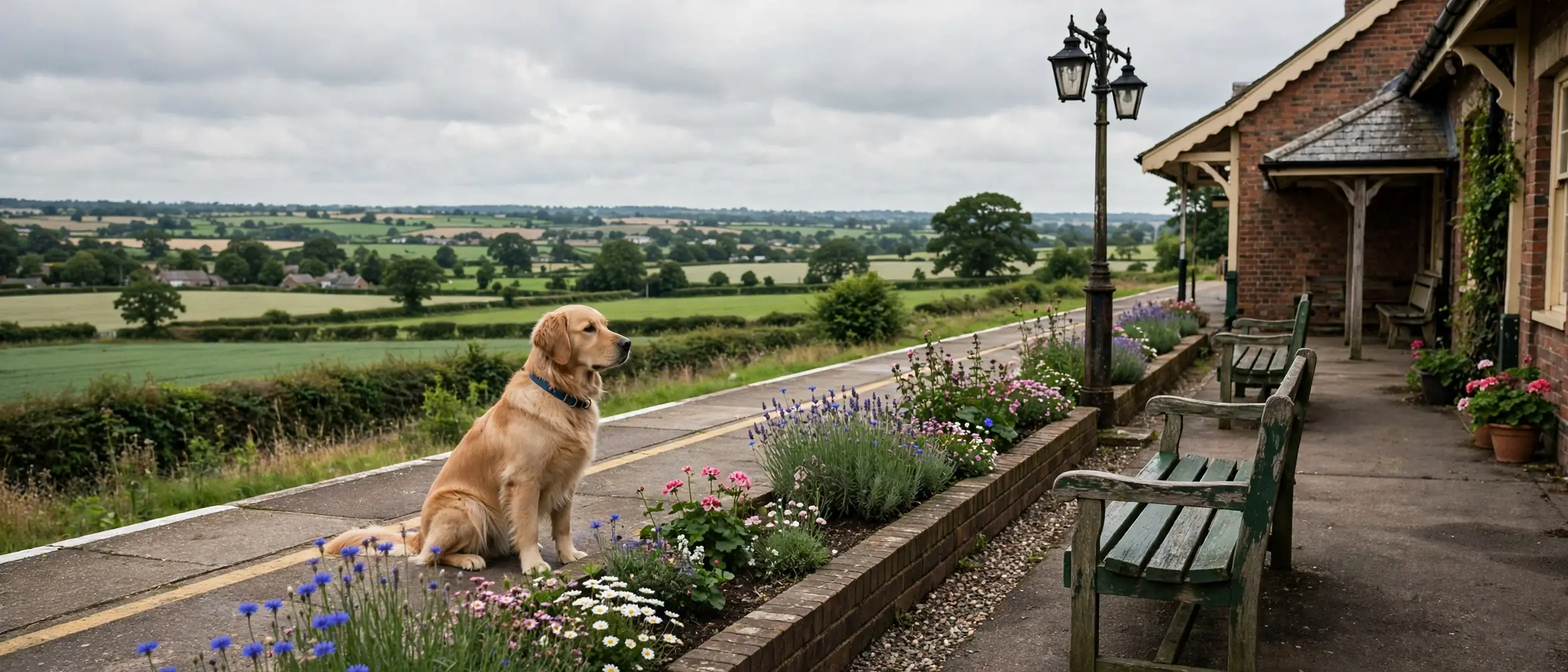
The Gainsborough Line, from Marks Tey to Sudbury, is the shortest branch on the network and one of the prettiest. Marks Tey is a junction on the main line from London, and the branch runs through Chappel and Wakes Colne — where the East Anglian Railway Museum sits beside the station — to Sudbury, a market town on the River Stour. The Stour valley walks from Sudbury are flat, riverside and dog-friendly, and the town itself is small enough to explore on foot in an afternoon. This is a good line for a first rural journey with a nervous dog: the trains are short, the stations are quiet, and the whole trip feels unhurried.
Norfolk: the Bittern Line and the Broads
The Bittern Line runs from Norwich to Sheringham, and it is the single best dog railway in East Anglia. The line calls at Salhouse, Hoveton and Wroxham, Worstead, North Walsham, Gunton, Roughton Road, Cromer and West Runton before reaching Sheringham, and almost every stop is the start of a walk. Hoveton and Wroxham is the gateway to the Norfolk Broads, where the riverside paths and the boat hire give a dog water, open space and a change of scene. Worstead and North Walsham are quiet village stations where a dog can step off the train into lanes and fields within minutes.
Cromer is the Bittern Line's seaside star. The station is a short walk from the clifftop and the pier, and the beach below the cliffs is one of the most dog-friendly stretches in Norfolk outside the summer restrictions. The clifftop walk from Cromer to Sheringham, along the Norfolk Coast Path, is about four miles of open, bracing walking with the sea on one side and fields on the other, and it is best done in one direction with the train back from the other end. That is the Bittern Line's great trick: walk one way, ride back. The same works in reverse from Sheringham, where the beach, the steam railway and the town's dog-friendly cafés make a good starting point.
Sheringham itself deserves a slower look. The town has a long shingle beach, a promenade and the North Norfolk Railway's steam trains to Holt, and the coastal path east to Cromer and west towards Weybourne and the National Trust land at Sheringham Park gives a dog a full day of walking. The park's wooded slopes and viewpoints are worth the climb, and the rhododendrons in late spring are famous, though the paths are steep in places and an older dog may prefer the flat promenade. Check the beach restrictions before you go: parts of Sheringham beach have seasonal rules, and the signs at the access points are the authority.
The Wherry Lines complete the Norfolk picture. From Norwich, trains run to Great Yarmouth via Acle and via Reedham, and to Lowestoft via Reedham, crossing the Broads on low bridges and past reed beds and windmills. Great Yarmouth is a traditional resort with a long sandy beach, a promenade and a pier, and the dog restrictions on the main beach in summer mean you should check the local rules before you travel and head for the quieter stretches north or south of the central seafront. Berney Arms, on the line to Great Yarmouth via Reedham, is one of the most unusual stations in Britain: it has no road access, serves a pub and a windmill, and is a request stop, so you must tell the conductor you want to get off. It is a walker's station, not a family day out, and the marsh paths from it are for confident walkers with a dog that is happy on a lead among grazing cattle and water.
Tickets that make dog trips cheaper
Your dog travels free, so the only fare to think about is your own, and Greater Anglia's ticket range rewards a little planning. Advance tickets are the cheapest way to do the London to Norwich Intercity, but they tie you to a specific train, which is a poor fit for a dog day out that depends on the weather and on how long the dog wants to stay on the beach. Off-Peak and Super Off-Peak tickets cost more but let you choose your train, and for a dog trip that flexibility is usually worth the difference. Anytime tickets are the most flexible and the most expensive, and they are rarely the right choice for a leisure day out.
For two adults travelling together, the Greater Anglia Duo ticket is worth checking: it covers two people travelling together on the same trains for less than two separate fares on many routes. GroupSave works in a similar way for three or four people. Both are route- and time-specific, so check the official guidance before you travel to confirm the Duo or GroupSave is valid on the trains you plan to catch. Railcards cut the fare further: a Two Together railcard suits couples who travel together regularly, a Family and Friends railcard helps with children, and a Senior or Disabled Persons railcard can make a real difference on the longer runs to Norwich or Cambridge.
For a day of hopping between branch lines, the Anglia Plus Day Ranger is the ticket to know about. It gives a day of unlimited travel across much of the Greater Anglia network, and it turns a day of Norwich to Sheringham to Cromer and back into a single ticket rather than a handful of singles. Prices and validity change, so check the official guidance before you travel for the current price and the exact area covered, and confirm that it is valid on the day you want it — some ranger tickets have restrictions on the days they can be used.
Seat reservations are free on the Intercity services and worth making on a busy Saturday, because a reserved table seat guarantees the floor space your dog needs. Regional trains have no reservations, so the strategy there is timing: travel mid-morning, avoid the school-run and commuter peaks, and be ready to move to a quieter coach if the one you boarded fills up. Buy your ticket before you travel where you can, because the queues at Liverpool Street ticket machines on a Saturday morning are no place to hold a dog, a lead and a phone at the same time. Keep your ticket accessible, because inspectors on Greater Anglia services check tickets on board and you do not want to be rummaging through a dog bag while the train is moving.
Stations, interchanges and the gaps between trains
London Liverpool Street is the gateway to the whole network and the hardest station on it for a dog. It is large, busy and loud, with long concourses, ticket gates and a constant flow of commuters. The practical approach is to treat it as a corridor, not a destination: know your platform in advance, use the lifts rather than the escalators — dogs should not use escalators, and the moving steps are a genuine hazard to paws — and walk straight through to the train. If you are changing at Liverpool Street from the Underground or the Elizabeth line, allow extra time, because the interchange involves long walks and crowded passages, and a dog that is already tired from a day at the coast does not need a sprint through a terminus.
Stratford is the other London interchange to know. It connects Greater Anglia services with the Elizabeth line, the Central line and the Docklands Light Railway, and it is a useful place to change if you are travelling from east London rather than the City. The station is modern, with lifts and wide concourses, but it is also very busy at peak times, so the same advice applies: keep the dog on a short lead, avoid the escalators, and use the lifts.
Outside London, the picture is calmer. Norwich, Ipswich, Colchester and Cambridge are all staffed stations with waiting rooms, toilets, cafés and step-free access to most platforms, and staff can help with ramps if your dog cannot manage a step. Smaller stations on the branch lines are often unstaffed, with a shelter, a help point and a ticket machine, and some have short platforms where you must board through the doors nearest the front of the train — listen for the announcement, because the conductor will tell you which doors to use. If you are travelling to a request stop such as Berney Arms, tell the conductor when you board; if you are waiting at a request stop, signal clearly to the driver as the train approaches.
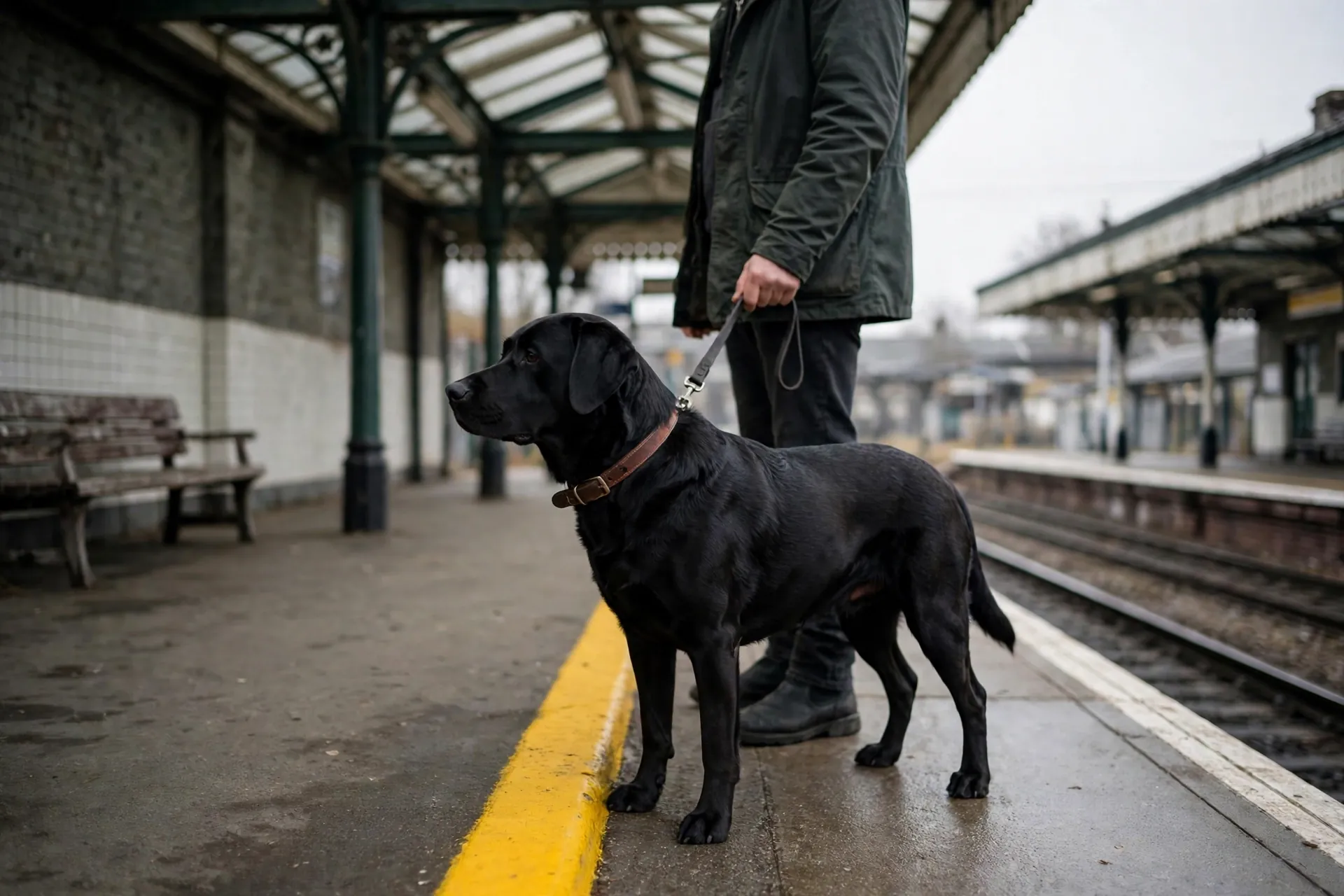
Toilet breaks between trains need planning on the rural lines, because the gap between trains can be an hour or more. Most branch-line stations have no public toilet and no café, so use the facilities at the junction station before you change, and give your dog a proper walk at any station where you have a long wait. Keep a bottle of water and a bowl in your bag for these waits, especially in summer, when a small shelter in full sun is no place for a dog. Our guide to dogs on UK train platforms and in stations covers lead rules, yellow-line safety and unstaffed station tips in more detail, and it is worth reading before your first rural journey.
Busy trains, bikes and luggage: sharing the space
The hardest part of taking a dog on Greater Anglia is not the rules but the other passengers, and the answer is timing. The commuter peaks into London run roughly from 7am to 9.30am and out of London from 4.30pm to 7pm, and a dog on a packed commuter train is miserable for the dog, for you and for everyone standing around you. Travel between 10am and 3pm on weekdays and you will usually find space, quieter coaches and staff with time to help. Saturdays are busy on the coastal lines in summer, and the first sunny Saturday of the year can fill a Southend train by Shenfield, so set off early or travel late.
Bikes and dogs share the same floor space on regional trains, and the etiquette is simple: cyclists have priority in the cycle areas, and dogs belong in the open space by the doors or under a table. If a cyclist boards with a bike at Colchester and the cycle area is the only space your dog is using, move the dog. It is a small courtesy that keeps the peace, and it is easier to move a settled dog once than to argue about it with a tired cyclist. Luggage is the same story: large suitcases, pushchairs and dogs all compete for the vestibule, so keep your bags small on a dog trip and keep your dog's lead short enough that it cannot tangle a stranger's legs.
School holidays change the network. The trains to Southend, Clacton and Great Yarmouth fill with families, and the noise and excitement that children bring can unsettle a nervous dog. If your dog is sound-sensitive or reactive, choose a weekday in term time for the coast, or pick a quieter destination such as Walton-on-the-Naze or the Gainsborough Line instead of the busiest resort. Fireworks season in early November and the Christmas markets in December have a similar effect: the trains are busy, the stations are loud, and a dog that copes fine in February may struggle in November.
Muzzles are not required for dogs on Greater Anglia trains, and most dogs will never need one. If your dog is reactive to other dogs or to strangers in close quarters, a muzzle is still worth considering as a safety net, and a basket muzzle fitted properly does not distress a dog that has been introduced to it gradually. The honest test is whether your dog can settle and sleep on a moving train; if it can, you have no problem. If it paces, whines and watches every passenger, the train is too busy for that dog on that day, and a quieter service or a different destination is the kinder choice.
When things go wrong: delays, cancellations and Delay Repay
Greater Anglia's rural lines are vulnerable to the things that delay trains everywhere in Britain: leaves on the line in autumn, flooding on the Broads in winter, signal failures and the occasional broken-down unit on a single-track branch where there is nowhere to pass. The Intercity line is more resilient, with more frequent services and more room to recover, but even there a delay of half an hour is not unusual. The first rule when a delay happens is to stay calm and keep the dog calm: a stressed owner makes a stressed dog, and the dog will pick up on your frustration long before you notice it.
If your train is cancelled, your dog can travel on the next available Greater Anglia service under the same free-travel rules, and your ticket remains valid for that service. Check the departure boards or the Greater Anglia app for the next train, and ask staff if you are unsure whether your ticket is valid on a different route — for example, if you are diverted via a different line to reach Norwich. If the next train is an hour away, which is common on the branch lines, take the dog for a walk around the station area rather than waiting on a cold platform. Keep the dog on the lead, stay behind the yellow line, and use the waiting room if there is one.
Delay Repay is the compensation scheme that applies across the network. If your journey is delayed by 15 minutes or more, you can claim a proportion of your fare back, and the amount rises with the length of the delay. Claims are made online, and you will need your ticket and the details of the train you intended to catch, so keep your ticket and note the time. The claim time limit is set by Greater Anglia, so check the official guidance before you travel for the current limit — it is commonly 28 days, but do not rely on memory for a deadline. If you are delayed overnight or stranded at a rural station, speak to staff before you make your own arrangements, because the railway's obligations and the alternatives available to you depend on the circumstances, and check the official guidance before you travel so you know what to ask for.
Engineering works are the other disruption to plan for, and they are announced well in advance. Weekend closures on the lines to Norwich or Cambridge usually mean a rail replacement bus, and dogs are not generally carried on replacement buses unless they are assistance dogs — a point that catches people out. Check for engineering works before you travel, especially on a Sunday, and if a replacement bus is running on your route, choose a different day or a different destination. The same applies to the Stansted Express on engineering weekends: the train service may be replaced or diverted, and the dog rules for the replacement are not the same as for the train.
Five coastal days out by Greater Anglia
Southend from London is the classic first coastal trip. Take a mid-morning train from Liverpool Street to Southend Victoria, walk down to the seafront, and follow the esplanade east towards the pier and the cliff gardens. Give the dog a long walk before lunch, find a dog-friendly café or pub for a rest, and catch a late-afternoon train home before the evening crowds build. Check the beach restrictions before you go, because the dog-friendly stretches are the ones away from the main bathing areas, and the signs at the access points are the authority.
Clacton and Walton-on-the-Naze make a good second trip, and the branch line from Colchester is part of the pleasure. Change at Colchester, ride the short branch to Clacton, and walk the promenade towards Holland-on-Sea and Frinton. The beach at Walton is quieter and longer, and the Naze cliffs give a dog a proper walk with views. Both towns have dog-friendly cafés and pubs, and the train home from Clacton or Walton is usually quieter than the Southend line on the same day.
Felixstowe is the Suffolk answer to a seaside day. The train from Ipswich takes under half an hour, and the seafront walk from the station to the pier, the gardens and Landguard Point is flat and easy. The nature reserve at Landguard is a good place for a dog that likes open ground and birds, and the town's cafés are used to dogs. If you have time, walk the promenade to the far end of the beach and back; it is a proper leg-stretch without ever leaving the sea.
Cromer and Sheringham on the Bittern Line is the best full-day trip in this guide. Take the train from Norwich to Cromer, walk the clifftop path to Sheringham, and catch the train back from Sheringham to Norwich. The walk is about four miles, the views are open, and the dog gets a beach at each end. Stop in Sheringham for lunch and a rest before the train home, and check the beach rules at both towns before you go. If the weather turns, ride the train between the two towns instead of walking, and spend the time in the towns themselves.
Great Yarmouth is the big-resort option, reached on the Wherry Lines from Norwich via Acle or Reedham. The beach is long and sandy, the promenade is wide, and the town has the full seaside range of cafés, arcades and gardens. The dog restrictions on the central beach in summer mean you should check the local rules before you travel and head for the quieter stretches to the north or south. For a quieter Norfolk day, take the same line to Reedham and walk the riverside, or stay on the train to Lowestoft and finish the day on the East Suffolk Line back through Beccles.
Overnight trips are worth considering once your dog is confident on the train. Our guide to dogs on sleeper trains in the UK covers cabins, fees and the overnight rules if you are thinking of going further afield, and the same settling routine — a good walk before boarding, a familiar blanket on the floor, and a quiet word rather than a fuss — works just as well on a Greater Anglia service as it does on a sleeper.
Practical questions
Before you go
Do dogs travel free on Greater Anglia trains?
Yes. Dogs travel free on Greater Anglia services, and there is no ticket to buy for your dog. The dog must be kept on a lead or in a suitable carrier, must not occupy a seat, and must not cause a nuisance to other passengers. Assistance dogs travel free and are not subject to the usual restrictions.
How many dogs can I take on a Greater Anglia train?
The National Rail conditions allow up to two dogs per passenger free of charge. If you are travelling with more than two dogs, or with a large dog that is difficult to control on a busy train, check the official guidance before you travel, and consider travelling outside peak hours when there is more floor space.
Can my dog sit on the seat next to me on Greater Anglia?
No. Dogs are not allowed on seats on Greater Anglia trains, even on a blanket. Your dog should settle on the floor at your feet, ideally under a table on the Intercity services or in the open floor space by a luggage rack on the regional trains. Bring a mat or blanket for the floor if your dog is used to one.
Are dogs allowed on the Stansted Express?
Yes, dogs travel free on the Stansted Express under the same rules as the rest of the Greater Anglia network. The train itself is no problem, but the airport terminal is a different place: pet dogs are not generally welcome inside the terminal building, so plan your onward journey from Stansted Airport station and check the official guidance before you travel.
What happens if my Greater Anglia train is cancelled and my dog is with me?
Your dog can travel on the next available Greater Anglia service under the same free-travel rules, and your ticket remains valid for that service. If the delay reaches 15 minutes or more you can claim Delay Repay for the fare you paid, and you should keep your ticket and note the train you intended to catch. Check the official guidance before you travel for the current claim time limit.
Can I take my dog on the Bittern Line to Sheringham and Cromer?
Yes. The Bittern Line from Norwich to Sheringham, via Hoveton and Wroxham and Cromer, is a Greater Anglia regional service, so dogs travel free on a lead. Both Sheringham and Cromer have beaches and clifftop walks, but seasonal dog restrictions apply on parts of the beach, so check the local rules and the official guidance before you travel.