This guide is independent and contains no paid placement. If affiliate links are added later, they will be clearly marked and will not change our editorial checks.
On Northern, up to two dogs per adult travel free, on a lead and under control, with all four paws on the floor — never on a seat. There is no dog ticket to buy and no booking to make. The network suits dogs best on its quieter rural lines, especially Settle to Carlisle and the Hope Valley, and worst on packed peak-time commuter trains into Leeds and Manchester.
The Northern dog rules, in plain English
Northern is the operator for most local trains across the North of England, from Newcastle and Carlisle in the north to Stoke, Nottingham and Chester in the south, with Leeds, York, Sheffield, Manchester, Liverpool, Preston and Hull at its centre. Its dog policy is one of the simplest on the British railway: well-behaved dogs are welcome on all Northern services, free of charge, and the company says so plainly on its own advice pages. That simplicity is the reason so many dog owners in Yorkshire, Lancashire, Cumbria and Greater Manchester plan days out around Northern rather than driving — but simple does not mean unconditional, and the conditions matter most exactly when a train is busy, a dog is unsettled, or another passenger is unhappy.
The headline rule is the number. Each adult passenger may bring up to two dogs, free of charge. Two adults travelling together may therefore bring four dogs between them, but the limit is per adult, not per booking, so a single adult with three dogs is over the limit even if the third dog is small and quiet. Northern also welcomes cats, birds and other small animals, but those must travel in a safe, secure, rigid carrier of an appropriate size, kept on the floor or carried if small enough. Dogs have the extra option of travelling on a lead instead of in a carrier, which is how most owners use the service. A carrier, when used, must also stay on the floor rather than on a seat, and the animal inside must be able to stand or sit comfortably.
The second rule is control. Your dog must be under control at all times and on a lead unless it is in a secure, suitably sized pet carrier. That wording matters on a Northern train because the carriages are small and the aisles are narrow: a lead trailing across the aisle, a dog wandering to sniff the passenger opposite, or a dog lunging at a cyclist wheeling a bike through the vestibule all count as not under control, even if the dog is friendly. Use a short lead inside the carriage, keep the dog at your feet, and treat the lead as part of the seat you have chosen, not as something to be managed after you sit down. If your dog is reactive to other dogs, the honest choice is a quieter train, not a busier one with a longer lead.
The third rule is the one other passengers can trigger. If someone objects to your dog, Northern asks you to move to another carriage. Staff can also refuse to carry an animal under the railway byelaws if it is disturbing other passengers. That is not a theoretical power on Northern: its trains are often two-car units with no buffet car or quiet coach to retreat to, so a barking dog in a packed two-car train on a Saturday has nowhere to hide. The practical answer is to pick your carriage and your departure with that in mind. Sit near a door vestibule where you can step aside, avoid the first train after a football match or a festival, and be ready to move without argument if asked. A calm move to the next carriage costs you a minute; a dispute costs you the trip.
Assistance dogs are always allowed on Northern services and are not counted against the two-dog limit or subject to the same conditions. That distinction is worth stating clearly, because it also explains why the rules for pet dogs are framed as a permission that can be withdrawn rather than a right. Northern reserves the right to refuse a pet under the byelaws, and the company repeats that point on its own pages. If you are unsure whether a particular dog, a particular train or a particular day fits the rules, check the official guidance before you travel rather than assuming the answer will be yes at the door.
Where your dog sits on a Northern train
Northern does not run long-distance intercity trains with a buffet car, a quiet coach and a first-class section to choose between. Its fleet is built for short and medium local journeys, and the carriage you board shapes the whole experience for your dog. The newest trains on the network, the Class 195 diesel units and the Class 331 electric units, are airy, level-boarding in many places, and have wide vestibules where a medium or large dog can lie flat without blocking the aisle. The older workhorses — Class 150, Class 156 and Class 158 units — are narrower, have steps up from low rural platforms, and have less floor space between the seats. None of this is a reason to avoid a route, but it is a reason to look at the train when it arrives and choose your spot deliberately instead of taking the first free seat.
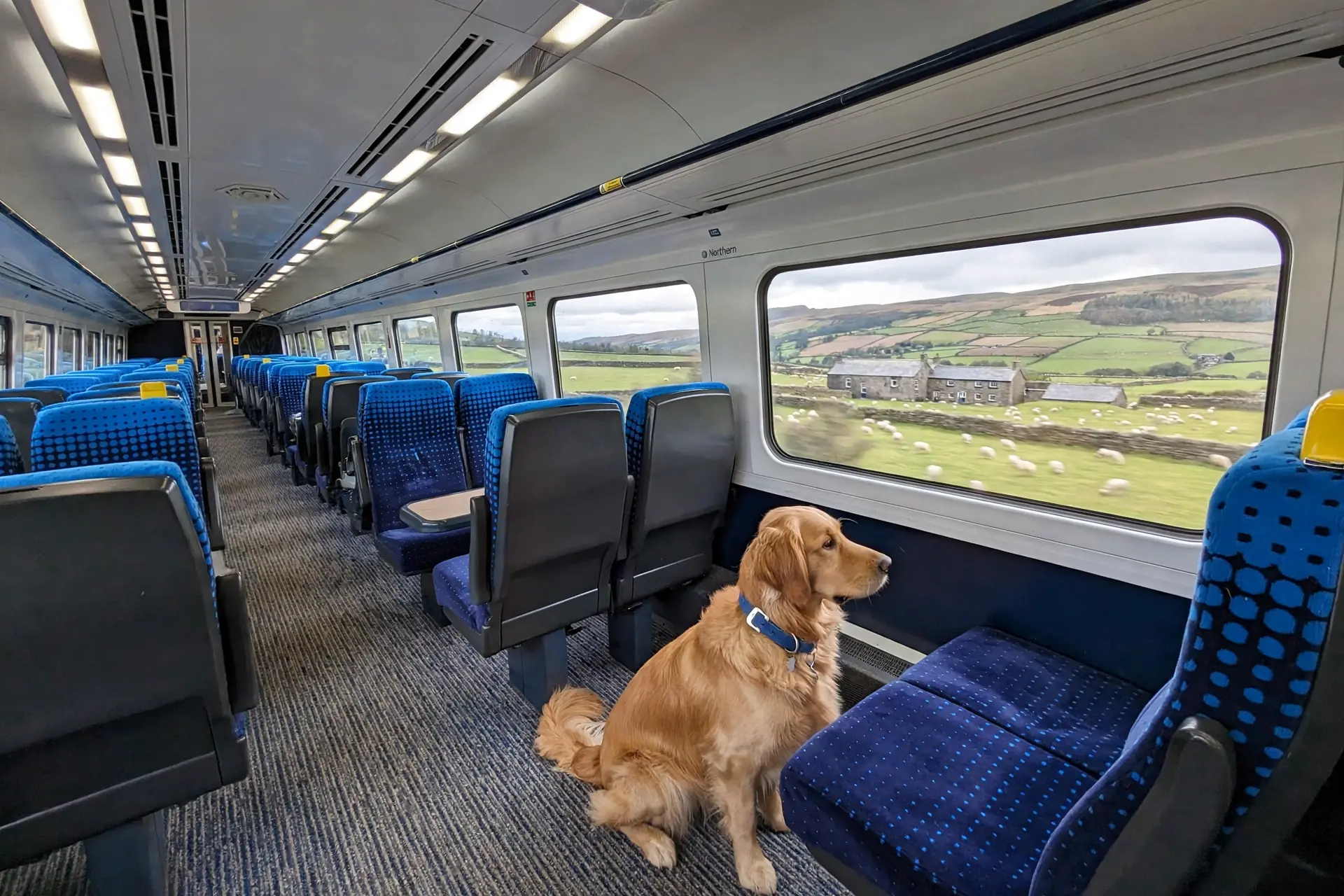
The rule that decides the spot is simple: dogs are not allowed on seats, for the comfort and safety of other passengers. Northern puts it bluntly on its own pages — keep all four paws on the ground. A small dog on your lap is the grey area owners ask about most, and Northern's published guidance does not grant a lap exception for pet dogs in the way some other operators describe it; the safe reading is floor, not seat and not lap, unless a member of staff tells you otherwise on the day. Bring a blanket or a familiar mat so the floor is a place your dog recognises. On a Class 195, the floor beside a table seat gives a large dog room to stretch; on a Class 150, the floor at the end of a bay, by the luggage rack, is often the only space where a large dog is not in the walkway.
Think about doors before you think about views. On a two-car Northern train, the vestibule between the carriages and the area beside the doors are the two places where a dog can be moved quickly, where a nervous dog can watch people come and go without being stepped over, and where you can get off fast at a short rural platform. The trade-off is draughts, luggage and bicycles: bikes are carried on many Northern services, and a dog lying across the cycle space will be asked to move. The bay seats at the carriage ends, with the dog tucked against the wall under the window, are usually the calmest compromise on a longer ride such as Leeds to Carlisle, while the priority seats near the doors suit a short hop where you will be standing for part of the journey anyway.
Toilets and water are the two practical limits on a Northern journey. Most Northern units have a toilet, but some short local services run with limited facilities and there is no buffet or at-seat service to buy water from, so do not board assuming you can top up a bowl on the train. Give your dog water before you board and carry a bottle and a collapsible bowl for the journey, especially on the Settle to Carlisle line, where the ride from Leeds takes roughly two and three-quarter hours end to end and the stops are short. If your dog needs a toilet break, plan it at the station before you board, not on the train, and choose a change of trains with a long enough gap to get outside at the interchange rather than a five-minute dash across a concourse.
Finally, watch the floor, not just the seat. Northern carriages are cleaned between services, but a wet dog after a Dales walk, a muddy paw on a light-coloured floor, and a dog that sheds heavily all draw attention in a small carriage. A drying coat put on before boarding, a towel over the blanket, and a quick brush-down on the platform keep the dog comfortable and keep other passengers relaxed. If your dog is wet, sit near a door where the draught helps it dry and where you are not dripping across three rows of seats to reach your place.
City commutes: Leeds, York and Manchester
Northern's city services are a different proposition from its rural lines, and the dog rules do not change — the crowds do. Leeds to York via Harrogate is the most useful short city-to-city hop for a dog owner: a direct Northern service through Horsforth, Harrogate, Knaresborough and Cattal, arriving in York with the city walls, the riverside paths and the Minster within a short walk of the station. It is also a commuter line in the morning and a shopping line on Saturdays, so the dog-friendly version of this journey is the mid-morning train out and the mid-afternoon train back, not the 8am departure packed with commuters standing in the vestibule. Harrogate itself makes a good halfway stop if York feels too far for a first trip: the Valley Gardens and the Stray are a short walk from the station, and a dog that has had a proper run there will settle far better on the train home.
Leeds to Skipton and Ilkley, on the Airedale and Wharfedale lines, are the other two city-edge escapes that Northern does best. Both are frequent, electric, and short enough that a nervous dog is only on the train for half an hour or so before it is out in the Dales fringe. Skipton is the stronger dog day out of the two: the castle, the canal towpath and the market town streets are all close to the station, and the town is used to dogs. Ilkley is quieter and greener, with the Moor rising directly from the town and the riverside walk along the Wharfe giving a dog a proper off-lead stretch after the train. On both lines, the return train in the late afternoon fills with walkers, so board early, sit near the doors, and expect to share the vestibule with boots, rucksacks and at least one other dog.
Manchester is Northern's busiest hub for dogs, and also its most demanding. Manchester Victoria and Manchester Piccadilly both handle Northern services to Blackburn and Clitheroe on the Ribble Valley line, to Hadfield and Glossop, to New Mills Central and Rose Hill Marple, and to Sheffield through the Hope Valley. The platforms at Victoria are long and exposed, the concourse at Piccadilly is crowded at peak times, and the escalators and lifts are shared with luggage trolleys and commuters in a hurry. Keep your dog on a short lead through both stations, use the lift rather than the escalator — dogs should not ride escalators, and Northern stations follow the same safety advice as the rest of the network — and give yourself an extra ten minutes over the time you would allow without a dog. Our guide to dogs on UK train platforms and in stations covers yellow-line safety, waiting rooms and unstaffed stations in more detail, and it is worth reading before a first Manchester change.
The Leeds to Sheffield service via Wakefield Kirkgate and Barnsley, on the Hallam line, and the Sheffield to Leeds service via Moorthorpe, are the commuter backbone of South Yorkshire, and they are useful for dogs mainly as a way of reaching the Peak District fringe without a car. They are not scenic rides in themselves: the value is in the connection at Sheffield for the Hope Valley line, or at Barnsley for the Penistone line towards Huddersfield and the moors. If you are using them as a commuter with a dog — taking a dog to a sitter, to the vet, or to a family member — the same rule applies as in Manchester: avoid the peak, sit at the carriage end, and keep the dog on the floor where it cannot be stepped on when the train empties at a busy stop.
One more city pattern is worth knowing. Northern runs the stopping services that intercity operators skip, so a Leeds to York or Manchester to Liverpool journey on Northern takes longer and stops more often than the fast train. That is a drawback if you are in a hurry and an advantage if your dog is new to trains: more stops mean more chances to get off early if the dog is struggling, and a slower train means a calmer ride with fewer sudden movements. If the dog copes well on a Northern stopping service, it will cope with almost any local train; if it does not, you have learned that on a short, cheap journey close to home rather than on a long rural line with a two-hour gap to the next train.
The Settle to Carlisle line
If Northern has one line that justifies the whole network for dog owners, it is the Settle to Carlisle line. The service runs from Leeds through Shipley, Keighley and Skipton, then through Gargrave, Hellifield, Long Preston and Settle, and on through Horton-in-Ribblesdale, Ribblehead, Dent, Garsdale, Kirkby Stephen, Appleby, Langwathby, Lazonby and Kirkoswald, and Armathwaite to Carlisle. Monday to Saturday there are generally eight or nine trains a day in each direction, roughly every two hours, with a smaller Sunday service; the full ride from Leeds to Carlisle takes roughly two and three-quarter hours. That frequency is the first thing to understand, because it sets the rhythm of the day: miss a train on this line and you are not waiting ten minutes, you are waiting two hours, often in a village with one cafe and no taxi rank.
The scenery is the reason the line is famous, and it is also the reason to plan the dog's side of the day carefully. Ribblehead Viaduct, the highest station at Dent, the fells above Horton-in-Ribblesdale and the Eden Valley below Appleby are all visible from the train, and they are all exposed to wind, rain and sudden weather changes. A dog that is comfortable on a summer train can be cold and wet on a winter platform at Dent, where the station sits high and open and the wind comes straight off the fell. Dress for the destination, not the departure: a waterproof coat for the dog, a windproof layer for you, and a plan to get inside somewhere warm at the far end, whether that is a cafe in Settle, a pub in Kirkby Stephen, or the waiting room at Carlisle.
Choose your stop by the walk, not by the photograph. Settle is the easiest first stop: a market town with cafes, a short riverside walk, and trains back to Leeds every couple of hours. Horton-in-Ribblesdale is the walker's stop, at the foot of Pen-y-ghent, one of the Yorkshire Three Peaks — a serious fell walk, not a gentle stroll, and only for a fit dog with a fit owner. Ribblehead is the photograph stop, with the viaduct and the Station Inn close to the platform, but there is little shelter if the weather turns, so it suits a short visit and a quick train onward rather than a long wait. Dent is the quiet stop, the highest mainline station in England, with a walk down into Dentdale village that is beautiful and steep in equal measure; the station itself is isolated, so do not get off there without knowing the time of the next train back. Kirkby Stephen and Appleby are the town stops, with shops, pubs and a proper walk along the Eden, and they are the best choices if you want a full day out with lunch and a toilet stop that does not depend on the weather.
The practical details on this line are different from the city services. Many of the stations are unstaffed, with a shelter, a help point, a ticket machine or none of those, and a platform that may be short — check where the train stops and stand in the right place before it arrives, because a two-car train will not open every door at every halt. Buy your ticket in advance where you can, or from the conductor on the train if you boarded at a station with no ticket facilities. Keep your dog close on the platform: the edges are open, the wind is strong, and a dog that pulls towards a passing train on a narrow rural platform is a genuine risk. The same short-lead discipline that works in a carriage matters even more here, because there is no barrier between the platform and the track at most of these stations.
Finally, respect the timetable. The Settle to Carlisle line is a working railway, not a heritage ride, and the trains that carry walkers on a Saturday also carry schoolchildren, shoppers and commuters on a weekday. The morning train from Leeds fills with walkers heading for the fells, the midday train is quieter, and the last train back is the one nobody wants to miss. Build your walk around the timetable, not the other way round: pick a walk that finishes at least half an hour before the train you need, allow time for a muddy dog to be towelled down on the platform, and have a fallback stop in mind — if the weather closes in at Ribblehead, ride on to Appleby rather than waiting two hours in the rain.
Sheffield to Manchester through the Hope Valley
The Hope Valley line is Northern's other great dog route, and it is the most useful one for a Peak District day out without a car. Trains run from Sheffield through Dore and Totley, Grindleford, Hathersage, Bamford, Hope and Edale, then through Chinley and New Mills Central to Manchester Piccadilly. The eastern half of the line is the prize: Edale is the start of the Pennine Way and the gateway to Kinder Scout, Hope sits below Win Hill and Lose Hill, Hathersage is the village of Little John's grave and the outdoor swimming pool, and Grindleford is the stop for the Padley Gorge walk and the Longshaw Estate. Each of those stations is a walk in itself, and each is small enough that a dog can be off the train and onto a footpath within minutes.
Edale deserves a paragraph of its own, because it is where most dog owners get the Hope Valley wrong. The village is small, the car park fills early, and the train is the sensible way in — but the walk from Edale station to Kinder Scout is a long, exposed moorland climb, and the plateau is a maze of peat groughs where a dog can disappear from sight in seconds. Take the shorter valley walk to the Nag's Head and back on a first visit, or the riverside path towards Barber Booth, and save Kinder for a day when the weather is settled, the dog is fit, and you have a map and a lead long enough for open moorland. The same caution applies at Hope and Bamford: the hills look gentle from the train window and feel very different on foot, especially in wind, and a dog that is tired on the way up will be slower and colder on the way down.
Hathersage is the most forgiving Hope Valley stop for a dog. The village has cafes, a shop, and the outdoor pool, and the walk up to Stanage Edge from the village is a steady climb on a good path with views that repay the effort. Bamford is quieter, with the walk to Ladybower Reservoir and the Derwent Valley, and it suits a dog that prefers water and woodland to open moor. Grindleford is the stop for Padley Gorge, where the Burbage Brook runs through oak woodland and the stepping stones are a delight for a confident dog and a hazard for a nervous one — keep the lead on through the gorge, where the path is narrow and the drop to the stream is real. Dore and Totley, at the Sheffield end, is a suburban stop with a walk into Ecclesall Woods, useful for a short evening trip rather than a full day out.
The Hope Valley line is also the busiest of Northern's rural routes on a fine weekend, and that changes the dog arithmetic. The trains are often two cars, the walkers fill them by mid-morning, and the return trains from Edale and Hope in the late afternoon can be standing room only. If your dog is not comfortable in a crowd, take the earliest train out and the latest train back, or pick a weekday. If your dog is comfortable, the crowd is actually an advantage: the other passengers are mostly walkers, most of them have dogs of their own, and the atmosphere on the train is relaxed in a way a commuter train never is. Either way, sit near the doors, keep the dog on the floor, and be ready to move carriages if another passenger objects — the rule is the same here as everywhere on Northern, but the chance of it being invoked is lower when everyone on the train has mud on their boots.
Connections matter on this line because the service is shared with other operators and the timetable is not clockface. Check the departure board at Sheffield or Manchester before you travel, allow a generous change at Piccadilly if you are connecting to or from another service, and remember that a delay on the Hope Valley line can mean a missed connection at the far end. The stations themselves are mostly unstaffed or part-time staffed, with shelters and help points rather than ticket offices, so buy your ticket in advance or from the conductor, and check the official guidance before you travel if you are planning a tight connection with a dog in tow.
Leeds to Morecambe on the Bentham line
The Bentham line is the quieter cousin of the Settle to Carlisle line, and it is the better choice for a dog owner who wants the same Dales and Lune Valley scenery without the crowds. Trains run from Leeds through Shipley, Keighley and Skipton, then diverge at Hellifield through Long Preston, Giggleswick, Clapham, Bentham and Wennington, then through Carnforth and Bare Lane to Lancaster and Morecambe, with a branch to Heysham Port. The service is roughly every two hours on weekdays, with a smaller Sunday service, and the stations are small, rural and largely unstaffed. Morecambe itself is the destination: a seaside town with a long promenade, a sandy bay at low tide, and a station a short walk from the front.
Clapham and Bentham are the two stops that repay a dog walker's attention. Clapham is a pretty Dales village with a walk to Ingleborough Cave and the Ingleborough Nature Trail, a managed path through woodland and limestone pavement that suits a dog on a lead and an owner who wants a walk without a map. Bentham is a small market town with shops, a cafe and the walk along the Lune, and it is the stop to choose if you want lunch and a toilet break before the train onward. Giggleswick, a mile from Settle, is the station for the village and the school, and it is useful mainly as a quieter alternative to Settle station if you are walking into the town from the south. Wennington is the junction for the line to Carnforth and the place where the service divides, so check the destination board before you board — a train for Morecambe and a train for Carlisle can look identical on the platform at Leeds.
Lancaster is the interchange that makes the Bentham line work as a day out. The city has a castle, a riverside walk along the Lune, and a station with a proper waiting room and a cafe, which matters on a wet day when the rural stations offer only a shelter. Morecambe, at the end of the line, is a different kind of day out: the promenade is long and flat, the bay is wide and tidal, and the dog can run on the sand at low tide. Check the tide times before you travel, because the bay at Morecambe is famously fast-moving and a dog that chases the outgoing tide can be in trouble quickly. The same caution applies to the walk from the station to the front: the roads are busy near the station, so keep the lead short until you are on the promenade.
The Bentham line is also the line where the unstaffed-station rules matter most. Clapham, Bentham, Wennington and the smaller halts have limited facilities, no ticket office, and in some cases no ticket machine, so the conductor on the train is your ticket office. Board, find a seat, and buy your ticket from the conductor as soon as they come through — do not wait until they reach you, and do not assume a ticket bought at Lancaster or Leeds covers a journey that started at an unstaffed halt. The platforms are short and the trains are short, so stand where the train will stop and be ready to board quickly; a dog that hesitates at the step up from a low platform can hold up the whole train, and the driver will not wait long at a rural halt.
Manchester to the Lakes and the Cumbrian coast
Northern's western routes are the ones that take a dog from a city to the Lake District and the Cumbrian coast without a car, and they work because the changes are simple. Manchester to Windermere runs via Preston and Oxenholme, where you change onto the Northern branch line to Kendal, Burneside, Staveley and Windermere. The branch is a short, single-track ride through the Kent valley, and it is one of the prettiest twenty minutes on the Northern network. Windermere station is a short walk from the lake, Bowness and the ferry piers, and the town is thoroughly used to dogs. The catch is the change at Oxenholme: the station is exposed, the platforms are long, and the connection can be tight, so allow a generous gap, keep the dog on a short lead on the footbridge or lift, and check the official guidance before you travel if you need step-free access at the interchange.
The Cumbrian Coast line, from Carlisle through Maryport, Workington and Whitehaven to Barrow-in-Furness, then on through Ulverston and Grange-over-Sands to Lancaster, is the longest and slowest of Northern's scenic routes, and the least crowded. The trains run along the coast with the Irish Sea on one side and the fells on the other, stopping at small stations that serve villages, beaches and caravan parks. It is a line for a full day, not a quick trip: the service is infrequent, the journey from Carlisle to Barrow takes the best part of three hours, and the stations are mostly unstaffed with little shelter. Choose one stop and stay there — Ravenglass for the estuary and the Ratty railway, St Bees for the beach and the coastal path, or Grange-over-Sands for the promenade — rather than trying to hop between three stops on a timetable that will not forgive a missed train.
Manchester to Barrow and Carlisle via Preston, Lancaster and the Furness line is the faster western route, and it is the one to use if you are heading for the southern Lakes. Ulverston is the stop for the town and the walk to the Hoad Monument, Grange-over-Sands is the stop for the promenade and the birdwatching on the sands, and Arnside, on the branch from Carnforth, is the stop for the estuary walk and the Knott viewpoint. All three are small, dog-friendly towns where a dog on a lead is an ordinary sight, and all three have cafes and pubs that welcome dogs. The trains on this route are longer and more comfortable than the two-car rural units, with more floor space and a toilet, which makes the journey easier for a large dog — but they are also busier, especially on a summer Saturday, so the same advice about boarding early and sitting near the doors applies.
The Tyne Valley line, from Newcastle to Carlisle through Hexham and Haltwhistle, and the Esk Valley line, from Middlesbrough to Whitby through the North York Moors, are Northern's north-eastern rural routes, and they deserve a mention even though they are not the lines most visitors start with. The Tyne Valley line gives a dog owner the walk along Hadrian's Wall from Haltwhistle and the riverside paths at Hexham, while the Esk Valley line gives the walk from Whitby station to the abbey and the beach, and the moorland villages of Grosmont, Goathland and Lealholm. Both lines are infrequent, both are largely unstaffed outside the main towns, and both reward the same planning as the Settle to Carlisle line: pick one stop, check the return time before you get off, and do not rely on a taxi at a village station.
One practical note covers all of these western and north-eastern routes: the weather changes faster on the coast and in the Lakes than it does in Leeds or Manchester. A bright morning at Oxenholme can be rain at Windermere, and a calm day at Carlisle can be a gale at St Bees. Pack a waterproof coat for the dog, a towel for the train home, and a plan B that is indoors — a cafe, a pub, a museum — so a change in the weather does not turn a good day out into a cold wait on an exposed platform. Northern's trains are heated and dry, which is a comfort on the way home, but they are not a substitute for a proper coat on a dog that has been in the rain for three hours.
Unstaffed stations and rural halts
A large share of Northern's stations are unstaffed, and that fact shapes a dog day out more than any other single feature of the network. An unstaffed station usually means a platform, a shelter, a help point, a departure board or a poster timetable, and sometimes a ticket machine — and sometimes none of those. It does not mean the station is closed or unsafe, but it does mean you are on your own for tickets, information and help, and your dog is on its own for a toilet break, water and shelter. The stations to know are the ones on the Settle to Carlisle, Bentham, Hope Valley, Esk Valley, Tyne Valley and Cumbrian Coast lines, where the pattern repeats: a small village, a short platform, a shelter that keeps the rain off if the wind is in the right direction, and a help point that connects to a control room rather than a person on the platform.
Tickets at unstaffed stations follow a clear rule. If there is a ticket machine and it is working, buy your ticket before you board. If there is no machine, or it is out of order, buy your ticket from the conductor on the train. Northern's own guidance is that you should not be penalised for boarding at a station where you could not buy a ticket, but that protection depends on you being able to show where you boarded and on you seeking out the conductor rather than waiting to be challenged. Keep your phone charged so you can show a mobile ticket, keep the receipt if you buy on the train, and check the official guidance before you travel if your station is one of the few where the ticket arrangements are unusual. A small number of rural halts work as request stops, where the train only stops if you signal clearly from the platform or tell the conductor in good time before the stop — check the timetable for your station, because a train that sails past a request stop you were standing on is a long wait for the next one.
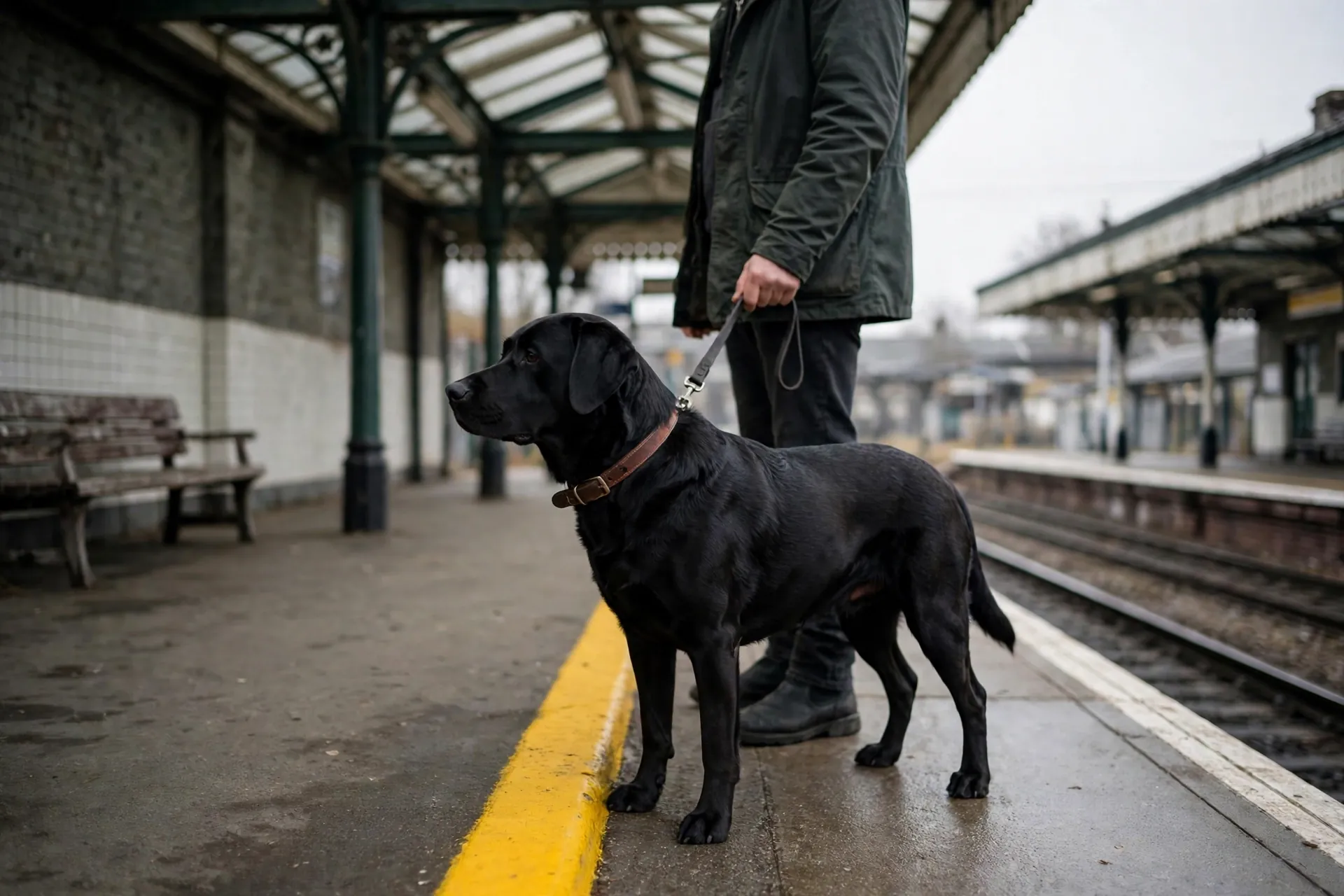
Platform safety at a rural halt is different from platform safety at Leeds or Manchester Piccadilly. There is often no yellow line painted on the platform, no barrier, no staff member to warn you, and a freight train or a fast service can pass through at speed while you are waiting for your stopping train. Keep your dog on a short lead, well back from the edge, and do not let it sniff the platform edge or chase a bird along the trackside. At night, the lighting at a rural halt can be poor and the shelter can be the only lit spot, so carry a torch on a winter afternoon trip and keep the dog's lead short and visible. If your dog is nervous of trains, stand at the far end of the platform, away from the direction the train will come from, and let the train arrive and stop before you walk towards it.
Step-free access is the other question to settle before you travel to a rural station. Many Northern rural stations have stepped access to one or both platforms, a footbridge with no lift, or a barrow crossing that requires staff assistance to use safely. If you or your dog has limited mobility — an older dog that cannot climb steep steps, a dog recovering from surgery, or an owner with a pushchair — check the station's access information in advance and choose a station with level access or a staffed interchange where help is available. Northern offers passenger assistance for those who need it, but it must be booked in advance, and it is not available at every rural halt at short notice. Our guide to dogs on UK train platforms and in stations explains the lift, escalator and waiting-room points that matter most when you are changing trains with a dog, and it is worth a read before a first rural trip.
Finally, think about what happens if you get off at the wrong stop. On a city service, the next train is ten minutes away and the station has staff, a cafe and a taxi rank. On a rural Northern line, the next train is two hours away, the station has a shelter and a help point, and the village may have no taxi and no mobile signal in the valley. That is not a reason to avoid rural lines — it is a reason to check the station name on the platform sign before you get off, to keep the timetable on your phone, and to have a charged phone and a paper backup of the return times. If you do get off at the wrong stop, stay on the platform, use the help point, and do not start walking along the track or the road to the next station with a dog unless you know the route is safe and the distance is short.
Tickets: Advance, Northern Only, Rangers and Rovers
Dogs travel free on Northern, so the ticket question is entirely about your own fare — and Northern's fare structure rewards the dog owner who plans ahead and punishes the one who buys at the last minute on a busy route. The cheapest way to travel on a fixed day is an Advance ticket, which Northern sells up to twelve weeks ahead and which the company says can save up to sixty per cent on the standard fare. Advance tickets are single tickets for a specific train, they are not flexible, and they are not refundable if you change your mind — so buy them only when the day is fixed, the dog is fit to travel, and the weather is not going to cancel the walk. A dog that is unwell on the morning of an Advance ticket is a wasted fare, and a walk cancelled by rain is the same, so keep the Advance for the trips you would take in any weather and buy a flexible ticket for the trips that depend on a dry day.
For the spontaneous trip, Northern's Save on the Day ticket lets you buy up to fifteen minutes before departure, and a Northern Only ticket — available as a single, return, Duo or season ticket — is valid only on Northern services and is cheaper than an any-operator fare on the same route. The distinction matters on routes where Northern shares the line with another operator, such as Leeds to York or Manchester to Liverpool: a Northern Only ticket is a bargain if you are happy to take the slower stopping service, and a waste of money if you board the fast train by mistake and have to buy a new ticket. Check the operator on the departure board before you board, not after the conductor asks for your ticket, and keep your dog's lead short while you are reading the board.
Rangers and Rovers are the tickets that make a Northern dog day out genuinely cheap, because they give unlimited travel for a day or for several days across a defined area, and the dog still travels free. The Yorkshire Coast Day Ranger covers the coast from Hull to Scarborough and Whitby and includes the bus between Scarborough, Robin Hood's Bay and Whitby, which is the link that makes a coast walk work without a car. The South Pennines Day Ranger covers the routes around Huddersfield, Halifax, Bradford and Leeds, and the East Yorkshire Round Robin covers a loop through Hull, Scarborough and York. The Dales Rambler Day Ranger is the one built for walkers: it covers Northern trains between Leeds or Bradford and Ilkley or Skipton, plus the DalesBus services to Grassington, Malham and Buckden, which is the combination that gets a dog from a city station to a Dales walk without a car. Prices for Rangers and Rovers change over time, and time restrictions apply on weekdays — typically not valid before 09:00 or 08:45 on Monday to Friday, and valid at any time at weekends — so check the official guidance before you travel for the current price and the current time restriction on the Ranger you want.
For a longer break, Northern's Rover tickets cover a large part of the North for either seven consecutive days or any four days within eight consecutive days, and they are the ticket to buy if you are staying in the Dales or the Lakes for a week and want to ride a different line each day. The Northern Explorer and the Northern Day Ranger work in a similar way for a single day across the whole Northern network, and they are worth comparing with a Rover if you are only travelling for two or three days. Railcards reduce the price of most of these tickets by a third, and a Family and Friends Railcard, a Two Together Railcard or a Senior Railcard can make a Ranger cheaper than two separate singles — but the dog does not need a Railcard, a ticket or a reservation, so do not buy anything for the dog at all.
One more ticket point is worth stating plainly. Northern does not charge a booking fee on its own website or app, and buying direct is the simplest way to be sure the ticket you have is the ticket you need. Third-party retailers can sell the same tickets, but they can also sell a ticket for the wrong operator, the wrong route or the wrong day, and the conductor on a Northern train will not accept a ticket that is not valid on that service. Buy direct, download the ticket to your phone, and screenshot the return times as well, because the mobile signal in the Dales and on the Cumbrian coast is patchy and the app may not load when you need it most.
Three weekend day trips that actually work
The best Northern day trip for a first-time dog train traveller is Leeds to York via Harrogate, out in the mid-morning and back in the mid-afternoon. The ride is under an hour, the trains are frequent, and York station is staffed, with a waiting room, a cafe and a taxi rank if the dog needs a lift. From the station, the riverside walk along the Ouse to the Millennium Bridge is flat, short and dog-friendly, and the city walls walk is a longer option for a fit dog on a lead. Harrogate on the way back makes a natural halfway stop: the Stray is a large open green where a dog can run, and the Valley Gardens are a short walk from the station. The whole day is low-risk — if the dog is unhappy on the train, the next train is soon, and if the weather turns, York has cafes and shops to shelter in.
The best Northern day trip for a walker is Manchester Piccadilly to Edale on the Hope Valley line, out on the first train and back on the late afternoon train. The ride takes about forty minutes, the station at Edale is a two-minute walk from the village, and the valley walk to the Nag's Head and back is a proper Peak District walk without the exposure of Kinder Scout. Take a packed lunch and water for the dog, because Edale has one pub and one cafe and both fill up on a fine Saturday, and take a towel for the train home, because the valley path is muddy after rain. If the dog is still full of energy after the valley walk, the riverside path towards Barber Booth is a gentle extension; if the dog is tired, the train back to Manchester is a rest, not a chore.
The best Northern day trip for scenery is Leeds to Settle, out on the mid-morning train and back on the late afternoon train, with a walk in Settle and a look at the town before the return. The ride to Settle takes about an hour and a quarter, the town is a short walk from the station, and the riverside walk along the Ribble and the walk up to the castle earthworks are both suitable for a dog on a lead. Settle has cafes, a market on Tuesdays, and a proper dog-friendly welcome, and the train back to Leeds is quieter than the morning train out. If you want to go further, stay on the train to Horton-in-Ribblesdale or Ribblehead, but do not try to do Settle and Ribblehead in the same day on a first visit — the two-hour gap between trains will punish a plan that tries to fit too much in, and a tired dog on a cold platform at Ribblehead is a miserable end to a good day.
Whichever of the three you choose, the planning pattern is the same. Pick the outward train and the return train before you leave home, and write both times down. Walk the dog before you board so it has already had a toilet break and a stretch. Carry water, a bowl, a lead, a towel and a blanket, and carry them in a bag you can lift onto the train in one go — a dog on a lead in one hand and a rucksack in the other is the right load, and a dog in one hand and three bags in the other is the wrong one. Check the weather for the destination, not just for home, and check the Northern app for delays before you set off, because a delay on a rural line is a different problem from a delay on a city service.
Delays, cancellations and rail replacement
Northern's rural lines are more vulnerable to delay and cancellation than its city services, and the reasons are specific to the network. A two-car train that fails at Skipton cannot be swapped for a spare unit the way a city train can, a landslip on the Settle to Carlisle line or the Cumbrian Coast line can close the route for hours, and a shortage of train crew on a Sunday can cancel a whole diagram of rural services. The result is that a dog owner on a Northern rural line needs a delay plan in a way a city commuter does not. The first part of that plan is information: check the Northern app and the departure boards before you leave home, again at the station, and again before you set off for the return train. Do not rely on a timetable printed weeks ago, and do not assume the train that ran yesterday will run today.
If your train is delayed, stay on the platform, keep your dog on a short lead, and do not rush for the next train without checking that it is going where you need it to go. On a rural line, the next train may be the same service running late, or it may be a different service that terminates short of your destination — a Leeds to Carlisle train that terminates at Skipton is no help if you need Settle. Ask the conductor or use the help point if you are unsure, and keep your ticket: Northern operates Delay Repay, and a delay of fifteen minutes or more may entitle you to compensation, but the claim depends on the ticket you hold and the length of the delay, so check the official guidance before you travel for the current threshold and how to claim. Keep the ticket, note the train you were on, and claim promptly rather than weeks later when the details have faded.
Cancellations are the harder case, and the dog makes them harder still. If your train is cancelled, the next service may be two hours away, and the station may have no staff, no cafe and no shelter beyond a waiting room. Do not leave the station to walk to the next village with a dog unless you know the route and the distance, and do not accept a lift from a stranger on a rural road. Use the help point, check the app for the next service, and consider whether the day out is still worth doing on a later train or whether the sensible choice is to go home and try another day. A cancelled train is not a personal failure, and a dog that has waited two hours on a cold platform is not going to enjoy the walk at the far end anyway.
Rail replacement buses are the point where the dog rules change completely. Dogs on rail replacement services are at the discretion of the transport provider, not Northern, and many bus operators will not carry a dog that is not an assistance dog, or will carry a dog only in a carrier, or will refuse a large dog outright. That means a cancelled Northern train replaced by a bus can leave you stranded with a dog at a rural station, even though the same dog was welcome on the train. Ask before you board a replacement bus, do not assume the driver will say yes, and have a fallback: a later train, a taxi that takes dogs, or a lift from a friend. If you are planning a trip on a day when engineering works are advertised, check whether the replacement is a bus or a train, and check the official guidance before you travel on whether dogs are carried on that particular replacement service.
Finally, know what to do if you are refused travel. If a member of staff refuses to carry your dog, ask politely why, and ask whether moving to another carriage would resolve the problem — the usual answer on Northern is to move, not to leave the train. If the dog is barking, lunging or causing a disturbance, the refusal is likely to stand, and the right response is to get off at the next station, calm the dog, and take a later, quieter train. Arguing on a crowded two-car train helps nobody, and it will not change the byelaw. The better outcome is to learn from the refusal: a quieter departure, a shorter journey, or a training session before the next trip will do more for the dog than a complaint on the day.
Packing for a Northern day out
Pack for a Northern day out as if the train is a walk, not a car: everything you need has to be carried, and everything you carry has to be lifted onto a train with a dog on a lead. The essentials are a short lead and a spare lead, a collapsible water bowl and a bottle of water, a blanket or mat for the carriage floor, a towel for a wet dog, poo bags, and a small bag of treats for settling the dog on the train. Add a drying coat if the weather is wet, a waterproof coat for the dog if the walk is exposed, and a torch if you are travelling in the afternoon in winter. Leave the bulky items at home: a large dog bed will not fit on a Northern carriage floor, a long extending lead is a hazard in a narrow aisle, and a bag of toys will be ignored in favour of the window.
Food is the item owners most often get wrong on a Northern day out. Do not feed a large meal just before boarding — a dog that has just eaten is more likely to be sick on a moving train, especially on the winding Settle to Carlisle line or the Hope Valley line. Feed a light meal at least an hour before the train, carry a small snack for the far end, and feed the main meal after you are home. Water is the opposite: offer water before you board, offer it again at the destination, and carry enough for the return journey as well, because there is no shop on a Northern train and no guarantee of a shop at a rural station. A dog that is dehydrated after a long walk will be restless on the train home, and a restless dog in a crowded carriage is the one that draws complaints.
Identification and paperwork are worth a line too. Your dog should wear a collar with an identification tag, and the tag should have your mobile number on it, because a dog that slips its lead at a rural station can be a long way from help before you notice. A microchip is a legal requirement, and it is worth checking that the details are up to date before a trip to a place where the dog will be off the lead. You do not need to carry a pet passport, a vaccination record or a ticket for the dog on a Northern train, but a photograph of the dog on your phone is useful if you need to describe it to staff or to another passenger, and a copy of your train ticket on your phone is essential if the mobile signal fails in the Dales.
For an overnight trip, the packing list grows, and the sleeper question arises. Northern does not run sleeper trains, so an overnight stay in the Dales, the Lakes or the Peak District means a hotel, a guesthouse or a holiday cottage at the far end, and the train is only the way there and back. Our guide to dogs on sleeper trains in the UK covers the Caledonian Sleeper and the Night Riviera for the longer overnight journeys, and the cabin rules, pet fees and booking steps that apply there are very different from Northern's free, no-booking local service. If you are staying overnight after a Northern journey, book accommodation that welcomes dogs in advance, confirm the dog is welcome in the room and not just in the grounds, and check the check-in time against the train timetable — a cottage that checks in at 4pm is no help if your train arrives at noon.
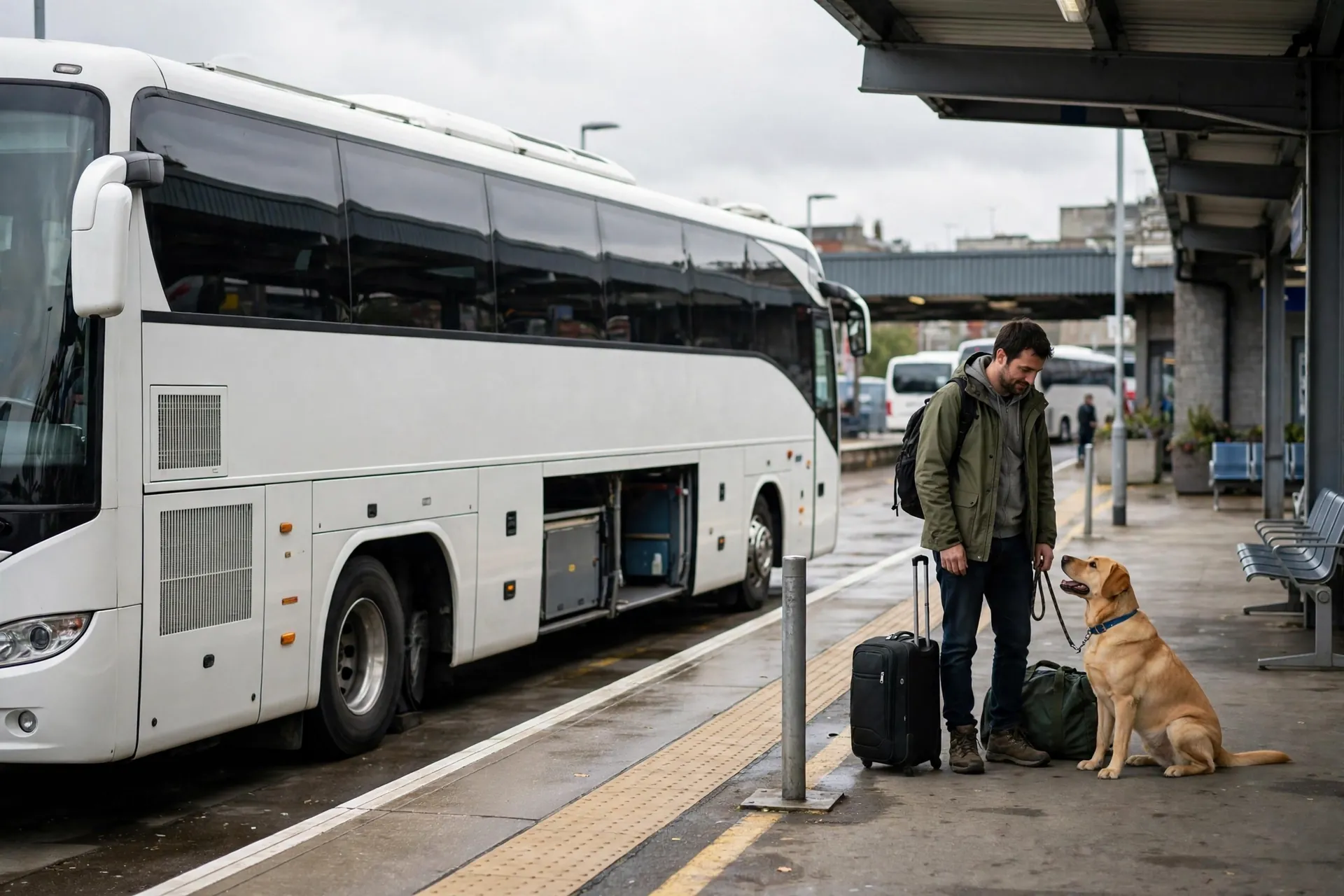
If you are travelling by coach for part of the journey, be aware that the rules are not the same as on Northern. National Express coaches do not carry pet dogs in any form, not even in a carrier, and only assistance dogs travel free — our guide to dogs on National Express coaches explains the alternatives. That contrast is worth remembering when you are planning a mixed journey: a dog that can ride a Northern train from Leeds to Carlisle cannot ride a coach from Carlisle to the Lakes, and a day out that depends on a coach link needs a taxi, a bus that takes dogs, or a different route altogether.
Practical questions
Before you go
Can dogs travel free on Northern Rail?
Yes. Northern allows up to two dogs per adult passenger free of charge. Each dog must be on a lead and under control, or in a secure, suitably sized carrier kept on the floor. Dogs are not allowed on seats, and cats, birds and other small animals must travel in a rigid carrier.
Do I need to book a ticket for my dog on Northern?
No, there is no ticket or reservation to buy for a dog on Northern. You only buy your own ticket. Because Northern services have no seat reservations for dogs and many trains are two-car units, choose a quieter departure when you can and check the official guidance before you travel if your train is likely to be crowded.
What happens if another passenger objects to my dog on Northern?
Northern asks you to move to another carriage if another passenger objects to your dog. Staff can also refuse to carry an animal under the railway byelaws if it is causing a disturbance. Keeping your dog settled on the floor at your feet, on a short lead, makes that outcome far less likely.
Can I buy a ticket on the train if my station is unstaffed?
Yes, if you board at a station with no ticket office or working ticket machine, buy your ticket from the conductor on the train. Tell the conductor where you boarded. Do not wait to be asked, and check the official guidance before you travel if you are unsure whether your station sells tickets.
Which Northern route is best for a first day trip with a dog?
The Settle to Carlisle line is the classic first choice: a slow, scenic ride with stations at Settle, Horton-in-Ribblesdale, Ribblehead, Dent, Kirkby Stephen and Appleby, each close to a walk. For a shorter first trip, try Leeds to York via Harrogate, or Manchester to Edale on the Hope Valley line.
What should I do if my Northern train is cancelled with a dog?
Stay on the platform, check the departure boards and the Northern app for the next service, and do not rush for a replacement bus without asking first, because dogs on rail replacement services are at the discretion of the transport provider. If you are delayed, keep your ticket and check the official guidance before you travel on Delay Repay and your right to take a later train.