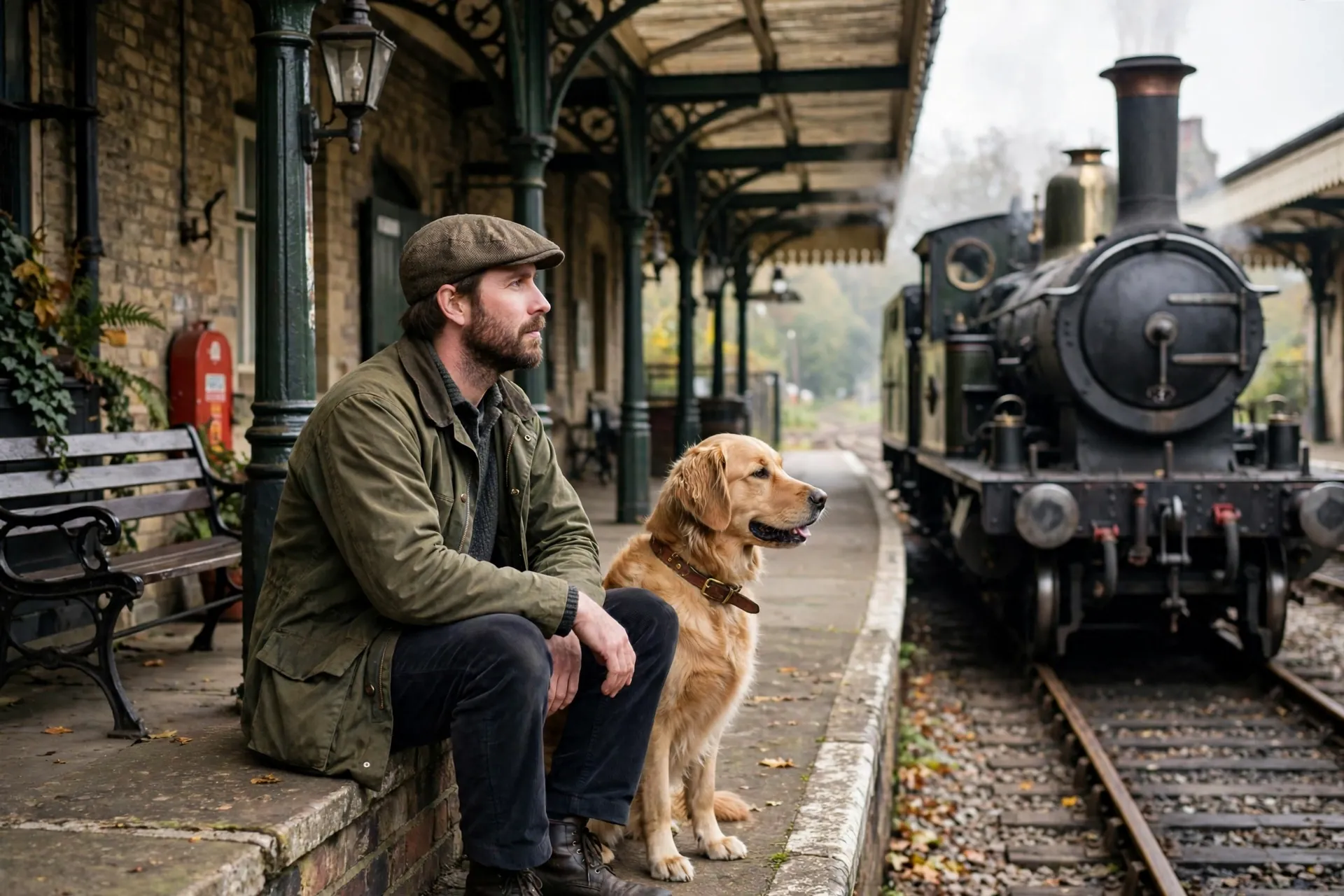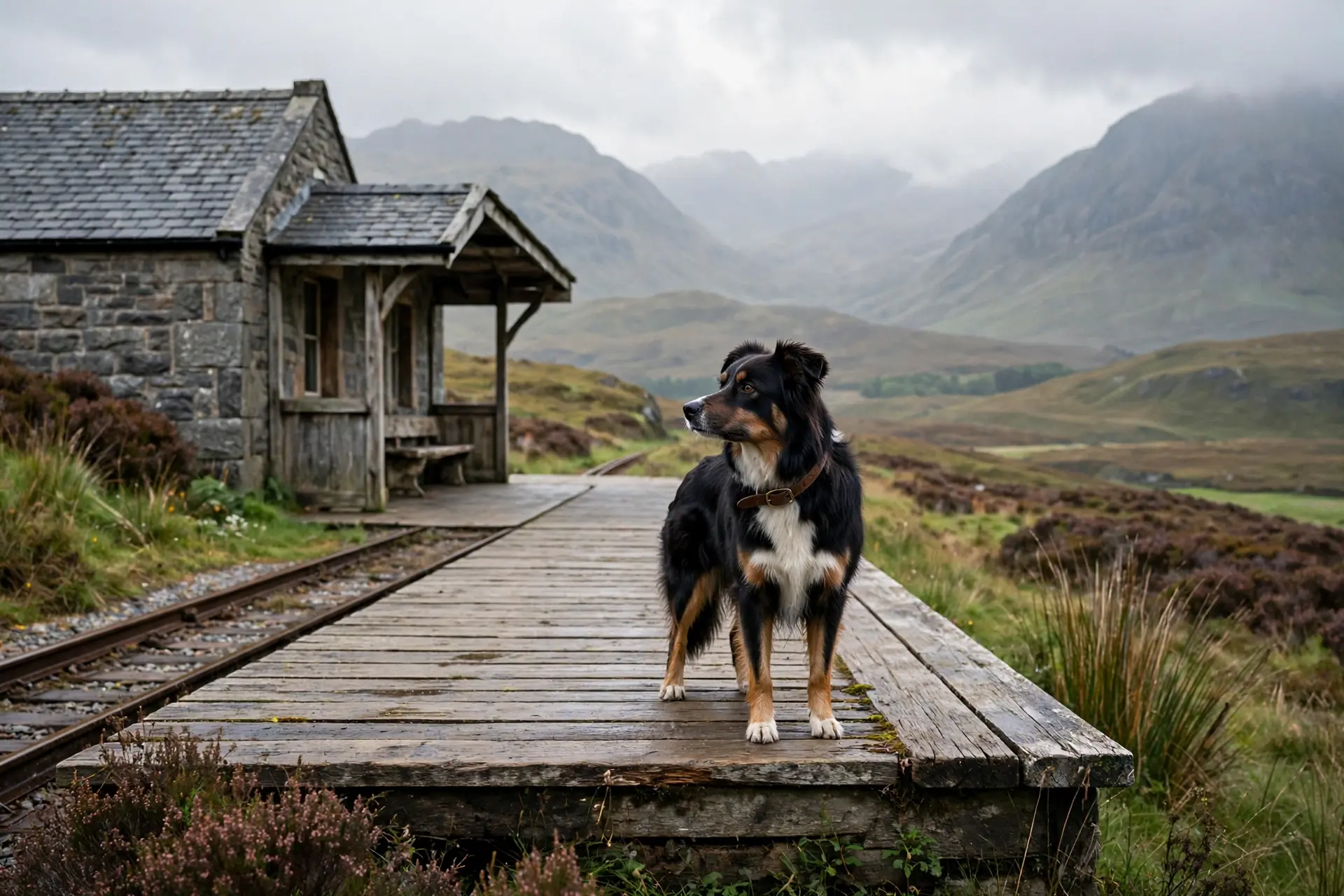
This guide is independent and contains no paid placement. If affiliate links are added later, they will be clearly marked and will not change our editorial checks.
Dogs travel free on ScotRail, up to two per passenger, on a lead or in a carrier and off the seats. The Highland lines are slow, infrequent and wonderful — but many stations are request stops with short platforms, so plan around the timetable, signal clearly, and be ready to board and alight quickly with your dog.
The rules: dogs travel free on ScotRail
The headline rule is the good news, and it is simple: dogs travel free on ScotRail services. Under the National Rail conditions of travel, each passenger may take up to two dogs without buying a ticket for them. There is no dog fare to calculate, no pet supplement to add at the booking stage and no form to fill in. The same free-travel rule applies across the network, from a ten-minute commuter hop in Glasgow to a four-hour run up the West Highland Line to Mallaig. Assistance dogs travel free as well, and they are not subject to the same restrictions as pet dogs, which is worth knowing if you travel with one.
Free does not mean unregulated. Your dog must be kept on a lead or in a suitable carrier for the whole journey, must not occupy a seat, and must not cause a nuisance to other passengers or staff. In practice, that means the dog sits or lies on the floor at your feet, ideally on a mat or blanket brought from home, and stays under your control when other people and dogs pass through the carriage. Staff can ask you to move your dog, and in extreme cases can refuse travel if a dog is aggressive, uncontrolled or causing a genuine problem. That power is rarely used, but it is the reason the lead rule is not optional: a loose dog in a moving carriage is a risk to everyone, including the dog.
There is no size limit in the published rules, which is good news for owners of large breeds, but size still shapes the journey. A small dog in a carrier can travel almost anywhere without drawing attention; a large dog needs floor space, and on a busy commuter train that space may simply not exist. Very large or strong dogs should travel on a short lead with a harness rather than a long line, because the gap between seats and the aisle is narrow and a dog that lunges at a passing trolley can cause a real problem. If your dog is reactive to other dogs, the honest assessment matters more than the rulebook: a quiet off-peak Highland service is a different proposition from a standing-room-only train out of Glasgow Queen Street at half past five.
Clean up after your dog, and plan as if there will be nowhere to do it on board. Most ScotRail trains have no dedicated dog facilities, and many Highland services have no catering at all, let alone a toilet suitable for a dog emergency. Carry poo bags in your pocket rather than buried in your rucksack, and if your dog is unwell on the day, postpone the trip. A dog that has an accident in a carriage with no cleaning kit and no easy way to air the space will make the rest of the journey miserable for everyone, and the memory of it will outlast the trip. If your dog does have an accident, tell the conductor straight away rather than hoping nobody notices — staff would much rather know.
One more rule is easy to miss: dogs should not be left unattended on a train, and they should not be left in a car at a station car park while you go for a walk. It sounds obvious, but it happens when someone drives to a rural station, leaves the dog in the car, and catches a train to the next village. Station car parks in the Highlands are often unstaffed, exposed to sun and wind, and a long way from help if something goes wrong. If the dog is coming on the trip, the dog rides on the train. If the dog is not coming, the dog stays at home. Check the official guidance before you travel if you are unsure about any of these rules, because conditions of travel do change and the current version is the one that counts.
Which trains and carriages suit a dog
ScotRail runs several very different kinds of train, and the one that turns up on your route changes the experience for your dog. The busiest city services around Glasgow and Edinburgh use modern electric units with wide aisles, level boarding and plenty of standing room, but also plenty of people, luggage and noise. The Highland lines use diesel multiple units, usually two or four carriages, with narrower aisles, a mix of airline-style seats and table seats, and luggage racks that fill quickly with rucksacks and walking gear. Neither is better in the abstract; the question is which one suits your particular dog on that particular day.
Table seats are usually the best choice for a dog owner. A table gives you a defined patch of floor, a place to put the dog's mat, and a natural barrier between your dog and the aisle. Airline-style seats leave the dog in the aisle-side footwell, where every passing passenger steps close to them, and where a nervous dog has no refuge. If you can choose your seat, take a table seat at the end of a carriage, away from the doors, where foot traffic is lowest. On Highland services the carriages are often quiet enough that you can move to a better seat after boarding, but do it early, before the train fills at the next town.
Door areas deserve a mention because they are the most stressful part of the train for many dogs. Every stop brings a rush of people, luggage wheels, bicycles and other dogs, all funnelled through the same narrow doorway. A dog sitting near the doors will be stepped over, sniffed at and bumped into at every station. Sit further into the carriage if you can, and keep the lead short and the dog on the side away from the aisle. If your dog is large, a window-side table seat with the dog between you and the window is the calmest arrangement available. If your dog is small, a carrier on the floor or on your lap, with the opening facing you, gives them a den to retreat into.
The Highland Explorer carriages on the West Highland Line deserve a paragraph of their own, and they are covered in more detail later in this guide. In short, these are converted Class 153 single-carriage units with large windows, extra space and dedicated bike storage, attached to selected West Highland services. They are popular with cyclists and walkers, which means they can be busy with equipment, but they also offer more floor space and a better view than a standard carriage. If you are travelling with a dog and a bike, or simply want the best seat in the house, they are worth seeking out — but check the official guidance before you travel, because which services carry them can change with the timetable.
Finally, think about the direction of travel and the time of day. A morning train out of Glasgow towards the Highlands fills with walkers and their dogs; an evening train back fills with tired people and tired dogs. A dog that copes well in the morning may be less patient at the end of a long day. If your dog is new to trains, start with a short, quiet, off-peak journey on a familiar local line before attempting a four-hour Highland run. Our general guide to taking a dog on UK trains covers the basics of first journeys, settling routines and what to do if your dog is unsettled, and it pairs well with the Scotland-specific detail here.
West Highland Line: Glasgow to Mallaig and Oban
The West Highland Line is the journey most people picture when they think of Scottish rail travel with a dog: Glasgow Queen Street to Fort William, then on to Mallaig, with a branch to Oban splitting off at Crianlarich. The full run to Mallaig takes around five and a half hours, crosses Rannoch Moor, passes the Glenfinnan Viaduct and ends at a small fishing port where the ferry to Skye leaves from the pier beside the station. It is one of the most scenic rail journeys in Europe, and it is also slow, single-track for much of its length, and served by only a handful of trains a day. That combination is exactly what makes it wonderful and exactly what makes it demanding with a dog.
The timetable is the first thing to respect. On the stretch between Crianlarich and Fort William there are typically three or four trains a day in each direction, and missing one can mean a wait of several hours with no alternative. Services divide at Crianlarich: part of the train goes to Fort William and Mallaig, part to Oban. Make sure you are in the right portion before the train splits, because the conductor will announce it, but announcements on a busy train are easy to miss when you are settling a dog. Check the departure boards, check the destination on the side of the train, and ask the conductor if you are unsure. Boarding the wrong portion with a dog and a rucksack at a remote junction is an avoidable mistake.
Rannoch Moor is the heart of the line and the part that catches people out. The moor is a vast, roadless wilderness, and the railway crosses it on a floating trackbed. The stations here — Corrour, Rannoch and Bridge of Orchy — are remote in the truest sense. Corrour is famous as one of the highest stations in Britain and has no public road access at all; the only ways in and out are the train and the footpath. That is magical for a walk, and it is also a place where a missed train is a serious problem, not an inconvenience. Do not plan to alight at Corrour with a dog unless you have checked the return times, the weather, the length of the walk you intend, and what you will do if the next train is cancelled. The station building has a small restaurant, but it does not keep Highland winter hours, so check the official guidance before you travel.
Glenfinnan is the other landmark, and it needs honest handling. The viaduct is famous, the village is busy in summer, and the steam-hauled Jacobite service that runs in the tourist season draws crowds to the viewpoint. Your dog is welcome on the regular ScotRail service to Glenfinnan, and the walk from the station to the viewpoint is short, but the viewpoint itself can be packed shoulder to shoulder on a fine summer day. A dog that is comfortable on a quiet moorland path may not enjoy a crowded viewpoint with drones, tripods and children running around. Go early, go on a weekday, or enjoy the viaduct from the train window and keep walking from the station instead of joining the crowd. The dog will thank you for the quieter choice.
Fort William is the practical hub of the line. It has shops, vets, places to eat and accommodation, and it is the sensible place to break the journey if you are travelling with a dog that needs a proper walk and a toilet stop. The walk from the station into town is short and level, and there are green spaces nearby. Mallaig, at the end of the line, is smaller but still has cafes, a harbour walk and the ferry terminal. The Oban branch is a different flavour again: a shorter, gentler run from Crianlarich through lochside villages to a busy harbour town with excellent fish and chips and a good dog-friendly atmosphere. If you only have a day, the Oban branch is often the easier choice with a dog, because the trains are more frequent and the town is compact enough to explore on foot from the station.
One practical note covers the whole line: there is no catering trolley on most West Highland services, and some trains have no catering at all. Bring water for the dog, a collapsible bowl, food for yourself and something to keep the dog occupied during the long stretches between stations. A bored dog on a five-hour journey will find its own entertainment, and it rarely involves sitting quietly. A long-lasting chew, a familiar blanket and a settle routine learned at home will do more for the journey than any amount of scenery.
Far North and Kyle lines: the slow north
If the West Highland Line is the famous one, the Far North Line and the Kyle Line are the quiet ones, and for many dog owners they are the better trips. The Far North Line runs from Inverness to Wick and Thurso, the most northerly stations on the British mainland, through Dingwall, Lairg, Helmsdale and a string of tiny halts with names that sound like the start of a folk song. The Kyle Line runs from Inverness to Kyle of Lochalsh, on the west coast opposite Skye, through Dingwall, Garve, Achnasheen and Plockton. Both lines are slow, single-track, lightly used and deeply scenic, and both are the kind of railway where the journey is the point.
The Far North Line takes around four hours from Inverness to Wick, and the service pattern is thin: typically four trains a day each way, fewer on Sundays. The line serves communities that have no other public transport, which means it carries schoolchildren, shoppers, hospital visitors and the occasional walker with a dog. Dogs are welcome, and on these quiet services there is usually plenty of room, but the infrequency of the trains matters more here than anywhere else in Scotland. Miss the last train from Thurso and you are staying the night, because there is no later service and no bus to catch instead. Plan the return journey first, then plan the day around it, and always have a fallback: a phone number for a taxi, the address of somewhere to stay, and enough dog food for an extra night.
The stations along the Far North Line are a lesson in Highland geography. Lairg is the railhead for the north-west, with buses onward to the coast. Helmsdale is a fishing village with a harbour walk. Forsinard is a tiny halt in the middle of the Flow Country, one of the largest blanket bogs in Europe, where the RSPB has a reserve and a viewing tower. Alight at Forsinard with a dog and you can walk straight into a landscape that feels like the edge of the world — but there is no shop, no cafe and no shelter, so bring everything you need and check the return time before you set off. The same applies at most of the smaller halts: the railway gives you access, and it does not give you facilities.
The Kyle Line is shorter and, for many dog owners, more manageable. The run from Inverness to Kyle of Lochalsh takes around two and a half hours, and the line threads along lochs and through glens to the coast. Plockton is the star stop: a palm-tree village on a sheltered bay, with a station a short walk from the waterfront, and a place where dogs are part of the scenery. Stromeferry, the next stop along, is a request stop with a single platform and a view across Loch Carron that stops conversation. The end of the line, Kyle of Lochalsh, is a short walk from the Skye Bridge, and from there you can cross to Skye on foot or by bus. If you are planning a Skye trip with a dog, the train to Kyle followed by the bus across the bridge is a genuinely practical alternative to driving, and it avoids the parking pressure at the bridge.
Both northern lines share a practical feature that dog owners should know about: the trains are short, usually two carriages, and the platforms at many stations are shorter still. That means not every door opens at every station. Listen to the announcements, watch which doors the conductor opens, and be ready to move through the train to the right carriage before your stop. If you are sitting at the far end of a two-carriage train and your station has a short platform, you may need to walk through to the front carriage. Do that early, with the dog on a short lead and your bags in your hand, rather than scrambling when the train is already slowing. The conductors on these lines are used to helping passengers and dogs, and they will tell you where to sit if you ask when you board.
Weather deserves a paragraph because it shapes these journeys more than the timetable does. The northern lines run through exposed country, and in winter they are vulnerable to high winds, snow and flooding. Services can be delayed or cancelled at short notice, and a cancelled train in the far north is not a minor inconvenience. Check the service updates on the morning of travel, and again before you leave for the return journey. Pack as if you might be delayed: extra water, extra food, a warm layer for the dog if they are short-coated or elderly, and a charged phone. The scenery that makes these lines beautiful is the same weather that can stop them, and a dog owner who plans for that is a dog owner who enjoys the trip either way.
Observation cars and slow scenic journeys
Scotland's scenic railways have a particular pleasure that is easy to miss if you treat the train as transport: the view from the window is the attraction, and the slower the train, the better it is. The Highland lines are slow by design. Single track, passing loops, request stops and gradients that would defeat a faster service all conspire to keep the speed down, and the result is a journey where you can actually watch the landscape change — from city to suburb to farmland to moor to mountain — instead of seeing it as a blur. For a dog, slow is good: fewer jolts, gentler braking, and time to settle into the rhythm of the train.
The Highland Explorer carriages are the most deliberate attempt to make the view part of the service. These converted Class 153 units run on selected West Highland Line services and offer large windows, extra legroom, dedicated bike storage and a more spacious layout than a standard carriage. They were designed for cyclists and walkers, but dog owners benefit from the same features: more floor space, better sightlines and a carriage where people expect outdoor gear, muddy boots and dogs. The carriages are not on every service, and the pattern changes with the timetable, so check the official guidance before you travel if the Explorer is part of your plan. If it is running on your service, it is worth the small effort to find it.
Heritage railways offer a different kind of scenic journey, and they are worth mentioning here because many visitors combine a ScotRail trip with a steam day out. The Jacobite steam service between Fort William and Mallaig is the famous one, but it is a separate commercial operation with its own booking system and its own dog policy, and dogs are not automatically welcome in the same way as on ScotRail. The same applies to the smaller heritage lines across Scotland, from the Bo'ness and Kinneil Railway to the Strathspey Railway. Our guide to dogs on heritage railways in the UK explains the fares, carriage rules and platform safety for steam lines in detail, and it is worth reading before you book a heritage ticket on the assumption that the ScotRail rules carry over. They do not.
The slow journey has its own etiquette, and it is worth learning. On a scenic line, people move around the carriage to take photographs, lean across seats to point things out, and stand in the vestibule at the famous spots. That movement is part of the fun, but it is also the moment when a dog gets stepped on or startled. Keep your dog on the window side, away from the aisle, during the scenic stretches, and keep the lead short when the train approaches a viewpoint. If your dog is the kind that barks at sudden movement, the Glenfinnan approach is the moment to have a chew ready. A dog that is settled and chewing is a dog that is not barking at a photographer.
There is also a quieter pleasure to the slow lines that no timetable can capture: the sound. A diesel unit on a Highland line has a rhythm — the engine note, the click of the joints, the conductor's announcements, the wind across the moor — and dogs settle to it. Many owners report that their dog sleeps better on a slow Highland train than on a fast city service, because the noise is steady rather than stop-start. If your dog is a nervous traveller, the slow lines are paradoxically the easier introduction: fewer people, fewer stops, a steadier sound, and a view that keeps you calm too. A calm owner makes a calm dog, and the Highlands are good at calming owners.
Rural halts: boarding and alighting safely
Most of the stations on the Highland lines are not stations in the city sense. They are halts: a short platform, a shelter, a sign, and sometimes not even that. There may be no ticket office, no staff, no toilet, no shop and no mobile signal. The platform may be gravel rather than tarmac, the lighting may be minimal, and the gap between the train and the platform edge may be larger than you expect. Boarding and alighting at these places with a dog is a skill, and it is one worth practising on a quiet day before you need it at a remote halt in the rain.
Request stops are the first thing to understand. Many Highland stations are request stops, which means the train will not stop unless someone asks it to. To board, you must be visible on the platform as the train approaches and signal clearly to the driver — a raised arm is the usual signal, and standing at the end of the platform nearest the approaching train helps. To alight, you must tell the conductor or guard in good time, or press the request-stop button if the train is fitted with one. Do not assume the train will stop because you are standing on the platform, and do not assume it will stop because it stopped there last week. If nobody requests the stop, the train passes through, and the next service may be hours away.
Short platforms are the second thing. At many Highland halts the platform is shorter than the train, which means only some doors open. The conductor will announce which carriage to use, and will usually walk through the train to check. If you are unsure, ask when you board: "Which carriage do I need for Corrour?" is a question conductors hear every day, and they would rather answer it at Glasgow than help you climb down from the wrong carriage in the dark. When the train stops, move promptly. Dwell times at small halts can be under a minute, and the train will not wait while you fumble with a lead, a rucksack and a dog that has decided to sniff the platform edge.
The platform edge itself deserves respect. Keep your dog on a short lead and well back from the edge, especially at stations where the platform is narrow or the surface is uneven. The gap between the train and the platform can be wide at older stations, and a small dog can be startled by it. Lift a small dog on and off if the step is high, and guide a large dog with a steady hand on the harness. At night, use your phone torch to check the platform surface before you step off, because gravel, ice and wet leaves are all hazards that are invisible in the dark. If you are alighting at a station you have never visited, look it up beforehand: a quick check of the station layout, the platform length and whether there is a footpath to the road will save you standing in the rain working it out.
Buying a ticket at a rural halt is usually done on the train. Most Highland stations have no ticket machine, and the conductor will sell you a ticket on board. Have your payment method ready, and know your destination. If you are using a railcard or a concession, have it ready to show. There is no penalty for buying on board at a station with no facilities, but there is a delay, and a conductor selling tickets to a carriage full of walkers is a conductor who is not helping you find the right carriage for your stop. Buy early, then settle the dog, then enjoy the view.
Finally, think about what happens after you alight. Many Highland halts are a walk from anywhere: a mile down a single-track road to a village, or a footpath across a moor to a bothy. Check the onward route before you travel, and be honest about whether your dog can manage it. A station with no road access, like Corrour, is a destination in itself, but it is not a place to arrive unprepared. Carry water, carry a map or a downloaded offline map, and tell someone where you are going. The Highlands are safe and welcoming, but they are also remote, and a dog owner who plans the walk after the train is a dog owner who gets home on time.
Tickets, reservations and peak times
The dog travels free, but you still need a ticket, and the Highland lines reward a little forward planning. Advance tickets are available on many ScotRail routes and can be significantly cheaper than buying on the day, especially for longer journeys like Glasgow to Mallaig or Inverness to Wick. Off-Peak tickets offer flexibility for a lower price than Anytime, and if you are travelling with a dog and a flexible schedule, the Off-Peak ticket is usually the sensible choice. Check the restrictions before you buy, because Off-Peak tickets have time limits that can catch you out if your walk runs long and you catch a later train than planned.
Seat reservations are free on most ScotRail services and are worth making on busy routes, especially in summer and at weekends. A reservation gives you a defined seat and, just as importantly, a defined patch of floor for the dog. On the West Highland Line in July, an unreserved train can fill at Fort William with walkers, and a dog owner without a reservation can end up standing in the vestibule with a dog, a rucksack and no floor space. Reserve a table seat if you can, and reserve early for summer Saturdays. On the quiet northern lines, reservations matter less, because the trains rarely fill, but they cost nothing and they remove one uncertainty from the day.
Peak times on ScotRail are mostly a city problem, but they matter for the start and end of a Highland journey. The morning and evening commuter peaks around Glasgow and Edinburgh are the busiest times on the network, and a dog on a packed commuter train is a dog under stress. If your Highland journey starts in Glasgow, aim for a mid-morning departure, after the commuter rush has passed and before the lunchtime walkers arrive. If you are returning to Glasgow in the evening, aim to arrive before the evening peak, or accept that the last leg of the journey will be busy and plan for it: a short lead, a settled dog, and a seat near the door so you can get off quickly.
Railcards can make a real difference to the cost of a Highland trip. The Two Together Railcard, the Family and Friends Railcard, the Senior Railcard and the 16–25 Railcard all offer a third off most fares, and on a long journey like Glasgow to Mallaig that saving is substantial. If you are planning several trips, the Highland Rover and other ranger tickets are worth a look: they offer unlimited travel in a region for a fixed price, and they can turn a week of Highland train travel with a dog into a surprisingly affordable holiday. Check the official guidance before you travel, because rover validity and prices change with the timetable, and not every rover covers every line.
One more ticket point is worth making because it catches people out: split ticketing. On long Highland journeys, buying separate tickets for each leg can sometimes be cheaper than a single through ticket, but it can also create problems if a connection is missed, because the conditions of each ticket apply separately. If you split tickets, leave a generous margin at the connection, and remember that a missed connection on a line with four trains a day is not a ten-minute delay. For most dog owners, the simplicity of a through ticket is worth more than the few pounds a split might save, especially when a dog and a rucksack are involved.
A calm journey day: packing and routine
A good train day with a dog starts the night before. Pack the dog's bag as carefully as your own: a collapsible water bowl and a bottle of water, enough food for the day plus a spare meal, poo bags, a familiar blanket or mat, a long-lasting chew, a towel, and any medication your dog needs. Add a spare lead, because leads break at the worst moments, and a muzzle if your dog ever needs one, because having it and not using it is better than the alternative. If your dog is elderly or short-coated, add a coat for the walk at the other end, because Highland weather changes fast and a wet, cold dog is a miserable travelling companion.
The morning routine matters more than the packing. Give your dog a good walk before you leave, with a chance to toilet properly, and feed them a little earlier than usual so they are not travelling on a full stomach. A dog that has had a proper walk and a settled breakfast is a dog that can sleep through a long train journey. A dog that has been rushed from the house to the station with no toilet break is a dog that will be restless within the first hour. If you are staying overnight before the journey, find a morning walk near your accommodation and keep the routine as close to home as possible.
On the train, settle the dog early and then leave them alone. Put the mat down, let the dog circle and lie down, give them the chew, and then sit still. Dogs read their owners, and an owner who fusses, rearranges and worries every five minutes has a dog that never settles. The first twenty minutes are the hardest; after that, most dogs sleep. If your dog is restless, a short walk to the vestibule and back can help, but do it once and then settle again. Constant movement keeps the dog aroused, and arousal is the enemy of a calm journey.
Toilet stops need planning, because Highland trains do not stop for dogs. Look at the timetable and identify the stations where the train waits for a few minutes, usually at passing loops or at Fort William, Crianlarich or Dingwall. These are your toilet opportunities, and they are short — often two or three minutes. If you need one, be ready at the door with the lead and the poo bag before the train stops, and be back on board before it leaves. Do not assume you can take the dog off at every stop: at a request stop with a thirty-second dwell, there is no time. If your dog cannot hold on for the whole journey, break the trip with a longer stop at a town, or choose a shorter leg. A dog that is desperate for a toilet is a dog that will have an accident, and nobody wants that.
Food and water on the train deserve a practical note. Offer water at regular intervals, especially on warm days or in heated carriages, but do not overfeed. A small snack or a chew is enough; a full meal on a moving train is a recipe for travel sickness in a susceptible dog. If your dog is prone to sickness, travel on an empty stomach, sit them where they can see out of the window, and keep the carriage cool by opening a vent if you can. If your dog is sick, clean up as best you can, tell the conductor, and do not be embarrassed — it happens to dogs and to people, and staff have seen it before.
The end of the journey deserves the same care as the start. When you alight, give the dog a proper walk before you do anything else: a toilet break, a stretch, a sniff around the new place. Do not go straight into a cafe or a shop with a dog that has been sitting for four hours. A ten-minute walk at the destination resets the dog and resets you, and it makes the rest of the day better. If you are staying overnight, settle the dog in the accommodation before you explore, with the same bed, the same bowl and the same routine as home. The train journey is only the middle of the day; the walk at either end is what the dog will remember.
When things go wrong
Things go wrong on Highland railways, and the honest guide says so. Trains are delayed by weather, by livestock on the line, by signalling problems and by the simple fact that a single-track railway has very little slack. A delay of an hour is not unusual; a cancellation is not rare in winter. The difference between a ruined day and a good story is preparation. Check the service updates before you leave, keep the ScotRail app or website open on your phone, and have a plan for the delay: a cafe that welcomes dogs, a walk you can do from the station, or simply a bench and a book. A dog that is warm, fed and watered can wait out a delay; a dog that is cold, hungry and desperate for a toilet cannot, so carry the supplies that make waiting possible.
If your train is cancelled, talk to staff before you improvise. Station staff and conductors can advise on the next service, on replacement transport, and on whether your ticket is valid on the alternative. At unstaffed stations there may be no one to ask, which is why a charged phone and the ScotRail contact details matter. Do not set off walking along the track or across the moor to the next station unless you know the route and the distance — the railway is not a footpath, and the Highlands are not a place to improvise a cross-country walk with a tired dog.
Other dogs are the most common problem on a train, and they are usually a small one. Most dogs on Highland trains are well behaved, but you will meet the occasional dog that barks, lunges or stares, and your dog's reaction is your responsibility. Keep your dog close, keep the lead short, and move seats if you need to. Do not let your dog greet another dog in the aisle, because the aisle is narrow, the dogs cannot move away from each other, and a greeting that would be fine in a park can turn tense in a carriage. If another owner lets their dog approach yours, a polite "please keep your dog back, mine is nervous" is enough. Most owners understand immediately.
If your dog becomes distressed — panting, shaking, whining, trying to hide — do not try to push through it. Get off at the next station if you can, give the dog a walk and some air, and catch a later train. There is no prize for completing a journey with a terrified dog, and a bad experience on a train can make the next journey much harder. Build back up with short, easy trips, and consider whether your dog needs a different approach: a carrier, a calming aid recommended by your vet, or a different mode of transport altogether. Some dogs simply do not enjoy trains, and that is a fact about the dog, not a failure of the owner.
Finally, know what to do if your dog is lost at a station. It happens more often than people think: a lead slips, a dog bolts at a loud noise, and suddenly your dog is running across a car park or along a platform. Stay calm, call the dog, and ask staff and other passengers for help immediately. Most station dogs are found within minutes, because stations are enclosed spaces and people notice a loose dog. Make sure your dog's collar and tag are secure before you travel, and that your phone number is on the tag. A microchip is essential, but a tag with a phone number is what gets a dog back to you in the first ten minutes. Check the official guidance before you travel if you want the current rules on travelling with dogs in any detail, and keep a copy of your ticket and your plans on your phone, so that if anything goes wrong you can show staff exactly where you were going.
Overnight journeys deserve a final note, because they are the one place where the ScotRail rules do not apply. The Caledonian Sleeper, which runs overnight between London and the Highlands, is operated separately, and its dog policy is different and much more restrictive. If your trip involves an overnight train, read our guide to dogs on sleeper trains in the UK before you book, because the rules there are about cabins, not carriages, and the answer is not the same as the one in this guide.
Practical questions
Before you go
Do dogs travel free on ScotRail trains?
Yes. Dogs travel free on ScotRail services, with up to two dogs per passenger under the National Rail conditions of travel. No ticket is needed for the dog, but the dog must be kept on a lead or in a carrier, must not occupy a seat, and must not cause a nuisance to other passengers. Assistance dogs travel free as well and are not subject to the same restrictions.
Can my dog sit on the seat next to me on a ScotRail train?
No. Dogs are not allowed on seats on ScotRail trains. Your dog should sit or lie on the floor at your feet, ideally on a mat or blanket you bring from home. On quieter Highland services there is often floor space beside a table seat, but the dog still belongs on the floor, not on the upholstery.
Are dogs allowed on the West Highland Line?
Yes. Dogs are welcome on the West Highland Line, including the Glasgow to Fort William and Mallaig services and the Oban branch, under the same free-travel rules as the rest of the ScotRail network. The line is single track for much of its length, services are infrequent, and many stations are request stops, so plan the day around the timetable rather than assuming another train will come soon.
How do request stops work when I am travelling with a dog?
At a request stop, the train only stops if someone asks. To board, stand where the driver can see you and signal clearly as the train approaches. To get off, tell the conductor or guard well before your station, or use the request-stop button if the train has one. Keep your dog close on a short lead, have your bags and lead ready before the train slows, and be ready to move quickly, because stops at small halts can be very brief.
Can I take my dog on the Caledonian Sleeper from Scotland?
The Caledonian Sleeper is a separate operator from ScotRail and has different rules. Dogs are generally not carried in sleeper cabins, with assistance dogs as the usual exception, so do not assume the ScotRail rules apply. Check the official guidance before you travel if an overnight journey is part of your plan.
What should I do if my dog is nervous on a busy train?
Travel outside the morning and evening commuter peaks, choose a quieter midweek service, and sit near a door with floor space rather than in the middle of a crowded carriage. A familiar blanket, a chew, and a short settle routine help many dogs. If your dog is very anxious, build up with short local journeys first, and consider a seat reservation on busier routes so you are not standing in an aisle with a stressed dog.