This guide is independent and contains no paid placement. If affiliate links are added later, they will be clearly marked and will not change our editorial checks.
Dogs travel free on South Western Railway, with no ticket and no size limit, kept on a lead or in a carrier and off the seats. The hard part is not the rule but the journey itself: Waterloo at rush hour, a busy commuter carriage, a long intercity run to Weymouth or Exeter, and the last walk from a small station to the beach. Plan around quieter trains, give your dog floor space at your feet, and check the official guidance before you travel.
Before you travel: the rules in one place
South Western Railway is a heavy-rail train operating company, not a metro or light-rail system, and its dog rules follow the National Rail conditions that apply across most British train operators. The headline is simple and generous: dogs travel free. You do not buy a ticket for your dog, you do not book a dog place in advance, and there is no published size or weight limit. That is the rule that makes a day trip from London to the Dorset coast or the New Forest feel easy on paper, and it is worth stating plainly before any of the caveats that follow, because the caveats are about comfort, safety and courtesy rather than permission. Check the official guidance before you travel, because conditions can change and because a single journey can involve more than one operator if you change trains beyond the South Western Railway network.
The usual allowance is up to two dogs per person, travelling free, and staff have discretion about additional dogs. Keep the dog on a lead or in a carrier while you are in the station and on the train, keep it off the seats, and keep it from blocking aisles, doorways and the space other passengers need to reach their seats. Those three expectations cover almost every awkward moment on a South Western Railway journey: the lead keeps the dog close in a crowd, the no-seats rule keeps the carriage clean and avoids a dispute with the passenger who has booked or paid for the seat beside you, and the clear-aisle rule is a safety matter as much as a courtesy, because a dog stretched across a gangway is a trip hazard in a moving carriage and an obstruction if the train has to be evacuated. Assistance dogs are a separate category with their own legal protections and travel free with their owner; the practical advice in this guide still applies to keeping them safe and settled, but the rules about limits and charges do not apply to them in the same way.
There is no general requirement for a muzzle or a carrier. A muzzle is not a standard condition of travel on South Western Railway, and a carrier is a choice rather than a rule, although both can be the right call for a particular dog. A small dog in a carrier is easier to manage on a packed commuter train, and a soft-sided carrier that fits under a table or on your lap keeps the dog out of the flow of feet. A reactive dog, a dog that lunges at other dogs, or a dog that has never travelled on a train before may be calmer with a familiar muzzle it has been trained to wear at home, but the muzzle should be introduced well before the journey rather than fitted for the first time on the platform. If you are unsure whether your dog needs one for a specific journey, check the official guidance before you travel and ask staff at the station; they deal with dogs every day and can tell you what to expect on the service you are about to catch.
Preparation starts the day before, not on the platform. Walk the dog well before you leave so the first part of the journey is not also the first chance to empty a full bladder, and give water at home rather than relying on finding a tap at a busy station. Feed a normal meal at the usual time but not immediately before departure, because a train journey on a full stomach is a common cause of travel sickness, especially in puppies and in dogs that have not travelled by rail before. Pack a small dog bag the way you would pack a child's bag: lead and spare lead, poo bags, a collapsible water bowl and a bottle of water, a few treats, a familiar blanket or mat, and any medication the dog needs. A mat matters more than it sounds: it gives the dog a defined place to lie down on a carriage floor, it protects the dog from a cold or dirty floor, and it signals to the dog that this unfamiliar place has a familiar job, which is to settle. Add a towel in wet weather, because a dog that has been rained on at the destination station will drip all the way home, and a drying coat in winter keeps a wet dog warm on a draughty platform.
Choose the train before you choose the destination. A fast service with few stops is usually kinder to a dog than a stopping service that brakes and accelerates every few minutes, and a train that starts at Waterloo is usually easier to board than one that arrives already full from further up the line. Off-peak services are quieter, roomier and cheaper, and they give a nervous dog a far better first experience than a standing-room-only commuter train. If the journey matters — a first train ride, a puppy's first long trip, a rescue dog's first outing — treat the outward journey as a rehearsal rather than a test: pick a short, quiet run first, such as Waterloo to Richmond or Waterloo to Kingston, and save the two-hour run to Weymouth or Exeter for a dog that already knows what a train feels like. The rest of this guide follows that same logic, taking the journey in order: the station, the train, the route, the destination, the ticket and what happens when the plan changes.
London Waterloo: the hub every journey starts from
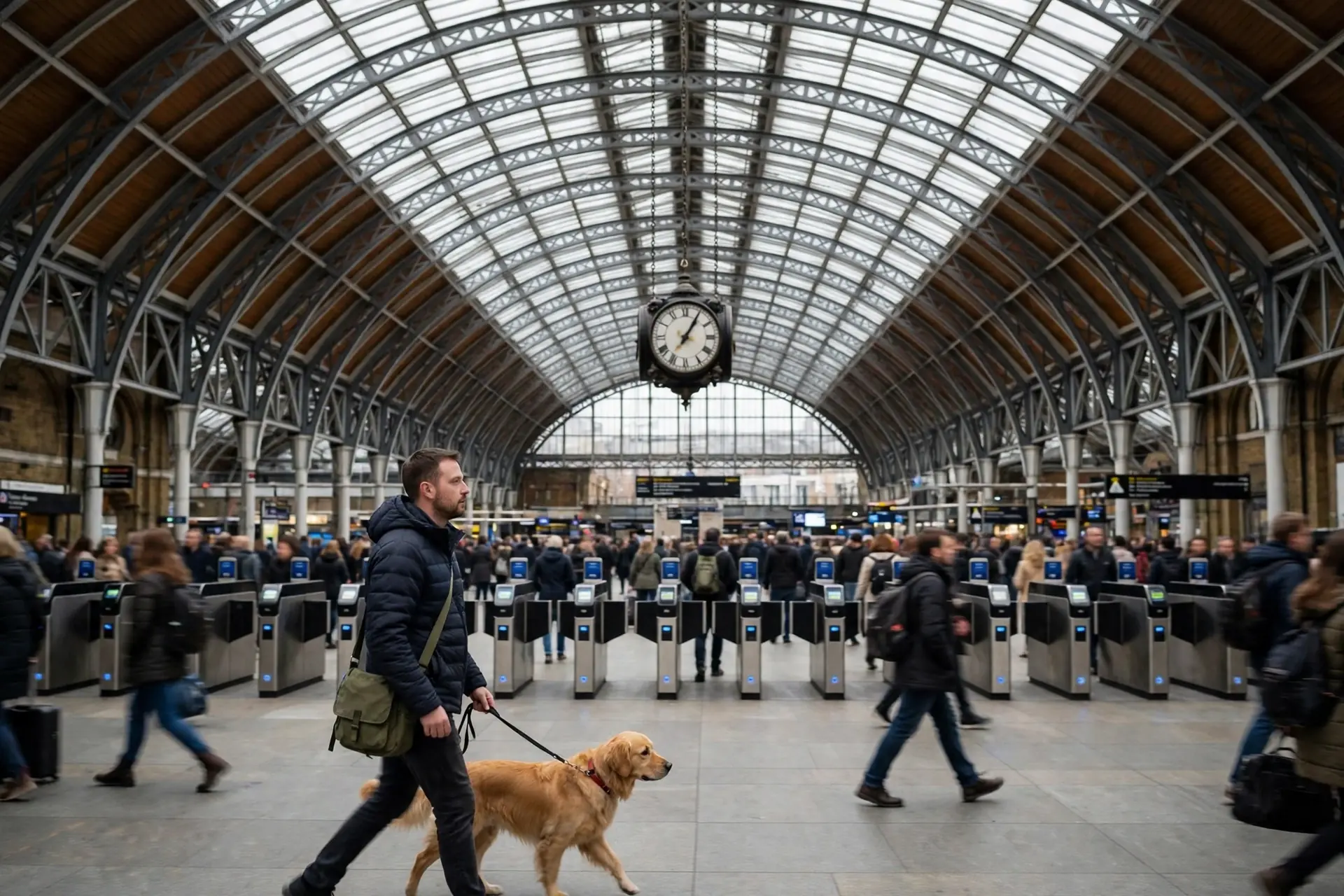
London Waterloo is where most South Western Railway journeys begin, and it is worth arriving with a clear picture of the place in your head, because it is one of the busiest stations in Britain and the scale of it can unsettle a dog that has only ever used a small local halt. The main concourse is a vast open space under a high arched roof, with the big departure board hanging in the middle, ticket gates in a long line at the far end, and twenty-four platforms fanning out beyond them. The sound is part of the experience: announcements echoing off the roof, trolleys and suitcases rolling across hard flooring, coffee machines and conversation layered over the rumble of trains arriving and departing. A dog that is comfortable on a busy high street will usually cope, but a dog that has never heard a station announcement or felt a crowd moving in every direction at once may freeze, pull or try to bolt for the exit, so the first visit should be unhurried and the dog should be kept on a short lead, close to your leg, with you between the dog and the busiest flow of people.
Give yourself more time than the journey planner suggests. Arrive at least twenty to thirty minutes before departure for a straightforward journey, and longer if you need to buy a ticket, find a lift, use a toilet or settle a nervous dog before boarding. The reason is not the distance — Waterloo is flat and the platforms are a short walk from the concourse once you are through the gates — but the queues and the decisions. Ticket machines and the ticket office sit on the concourse, and both can have queues at peak times; the departure board may show your platform only ten or fifteen minutes before departure, which means a crowd forms and moves together when the platform number appears; and the gates themselves are a pinch point where people hurry, bags swing and dogs get stepped on. Walk at the edge of the concourse rather than through the middle, keep the dog on the side away from the main flow, and stand to one side of the departure board while you check it rather than stopping in the middle of a stream of commuters.
Waterloo has lifts and step-free routes to the platforms, and the station is staffed, with a ticket office, waiting rooms, toilets and a range of shops and cafes on the concourse and on the upper balcony. If your dog needs a toilet break before boarding, do it before you enter the station, because there is no dog toilet area inside Waterloo and the nearest green space is a walk away across a busy road junction. The streets immediately around the station — Waterloo Road, York Road and the approach to the South Bank — are busy with traffic, so use a short lead and keep the dog on the pavement, and allow time to get back through the station afterwards. Inside the station, the practical facilities for a dog owner are the lifts, which avoid the stairs and escalators that many dogs find frightening, and the waiting rooms on the platforms, which offer a quieter place to sit if your train is delayed. Escalators deserve a warning of their own: many dogs are frightened by the moving steps, and a dog's claws, paws and long fur can catch in the mechanism, so use the lift or the stairs instead whenever you can, and never carry a large dog on an escalator. Our guide to dogs on UK train platforms and in stations covers escalator, lift and yellow-line safety in more detail, and it is worth reading before a first Waterloo visit.
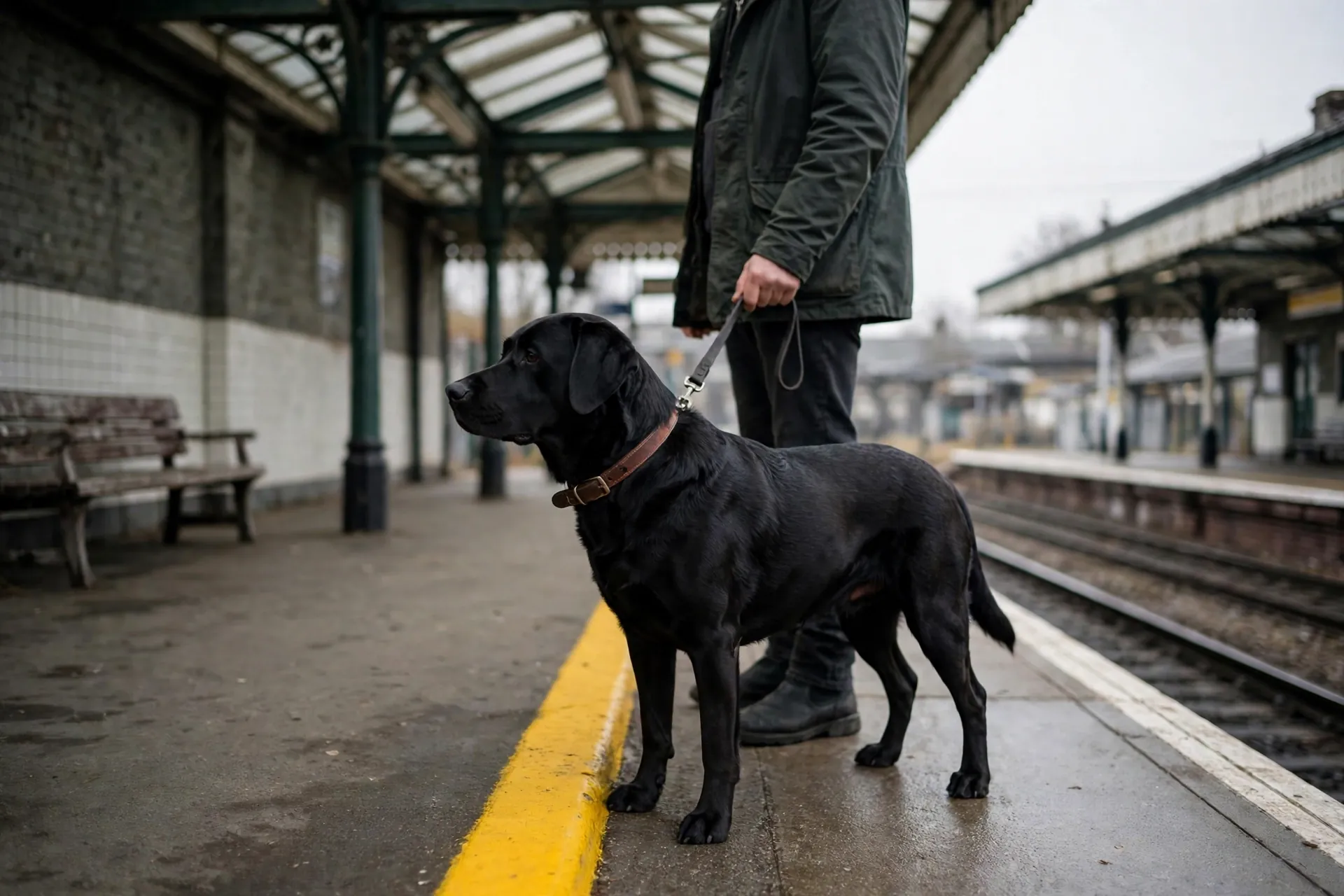
Boarding at Waterloo has one advantage that smaller stations cannot offer: many services start here, so the train is usually empty when the doors open and you can choose your seat rather than squeezing into whatever space is left. Use that advantage. Walk to the far end of the platform if the first carriages are already filling up, because passengers tend to board at the first doors they reach and the rear carriages are often quieter. Stand behind the yellow line while you wait, keep the dog behind it too, and keep the lead short so the dog cannot step forward as the train arrives. When the doors open, let the arriving passengers off first, then board with the dog close beside you and move straight to a seat, rather than standing in the vestibule while you decide. If the platform is crowded and the dog is struggling, wait for the next train: Waterloo has frequent services on most routes, and a ten-minute wait for a quieter train is a better start to the day than forcing a frightened dog onto a train that is already full.
Waterloo also matters as a place to change trains. South Western Railway services from the south and west terminate here, and onward connections to the London Underground, to buses and to the South Bank are all within the station complex or just outside it. The Underground is a separate journey with its own rules and its own crowds, and a dog that has just travelled calmly for two hours from the coast may still find the Tube overwhelming, so plan the onward leg as carefully as the main journey and allow a generous connection time. If you are meeting someone at Waterloo, agree a meeting point away from the gates — the top of the escalators to the balcony, or a named cafe on the concourse — because the area immediately inside the gates is the busiest part of the station and the worst place to stand with a dog while you look for a familiar face.
On board: Class 444 and 450 trains, seats and space
Most long-distance South Western Railway services are worked by Class 444 and Class 450 Desiro electric multiple units, and knowing what those trains feel like inside helps you choose a seat and settle a dog before the doors close. The Class 444 is a five-car train used on the longer routes to Portsmouth, Weymouth, Exeter and Salisbury, with a higher proportion of table seats, luggage racks and a quieter, more intercity feel; the Class 450 is a four-car train used on many outer-suburban and medium-distance services, with more standing room and a layout that feels closer to a commuter train. Both have wide vestibules at the ends of each carriage, overhead luggage racks, space between the seat backs, and toilets in most units. Neither has a dedicated dog area, a dog carriage or a place to book for a pet, so the dog's space is the floor at your feet, and the choice that matters is which seat gives that floor space the best shape.
A table seat is usually the best choice for a medium or large dog, because the floor under the table is a defined rectangle that the dog can lie in without spreading into the aisle, and the table itself gives you somewhere to put the water bowl, the treats and the book you will read while the dog sleeps. A window seat in a row of airline-style seats is the next best option, because the dog can lie along the wall of the carriage with you between it and the aisle, and the passenger flow passes on your side rather than over the dog. An aisle seat is the worst choice for a dog, because every passenger walking to the toilet, the doors or the buffet passes within inches of the dog's head, and a dog that is stepped on or startled in a narrow aisle may snap or bolt. If you are travelling as a pair, take the window seat and the seat beside it so the dog has the window side and your companion has the aisle side; if you are travelling alone and the train is busy, be ready to move if a passenger needs the seat beside you and the dog's space has to shrink.
Luggage is part of the dog's comfort. The overhead racks take a small bag, and the large luggage racks at the ends of the carriages take suitcases, but a dog bed, a blanket and a bag of dog kit should stay with you rather than being stacked out of reach, because you will want the blanket within the first minute of sitting down. Keep your own bag on the overhead rack or under the seat in front of you, not on the seat beside the dog, and keep the lead looped around your wrist or held in your hand rather than trailing on the floor where another passenger can trip on it. If the dog is small enough for a carrier, the carrier can go on your lap or on the floor between your feet, but not on a seat and not in the aisle; if the dog is in a carrier on a table seat, make sure the carrier does not block the table for the passenger opposite. First Class exists on some Class 444 services, and the same dog rules apply there — free travel, floor space, off the seats — but the quieter atmosphere and the wider seats can suit a calm dog, and the extra cost is a matter for your own budget rather than a dog requirement.
The ride itself is generally smooth, but a dog's first train journey has a few sensations to get used to: the acceleration out of Waterloo, the braking into each station, the sway on curves, the noise of the doors and the announcements, and the vibration through the floor. Most dogs settle within ten minutes, especially if they have a blanket to lie on and something to chew, and a long run to the coast is often easier than a short hop, because the dog has time to sleep through the middle of the journey. A chew, a stuffed Kong or a lick mat can help a puppy or a young dog settle, but avoid anything that smells strongly or crumbles onto the seat, because the passenger opposite did not agree to share it. Water should be offered little and often rather than in one large bowlful, especially on a warm day, and a toilet break should be planned at a station where the train stops for a few minutes rather than assumed at every stop — a two-minute stop at a small halt is not enough time to get a dog off, find grass and get back on, and the doors may close while you are still on the platform.
Toilets on board are at the ends of the carriages and are small, so they are not a place to take a dog; plan around station toilets and station breaks instead. If the dog is sick, clean up quickly and quietly with the bags and wipes you packed, and tell staff if the mess needs more than you can handle — they have dealt with it before and will not judge you for it. If the dog barks, do not shout over it; move the dog's attention to a treat, change seats if the cause is a dog in the next row, and consider a quieter carriage at the next stop. The general standard is the one other passengers will judge you by: a dog that lies quietly at its owner's feet is welcome on every train, and a dog that blocks the aisle, climbs on seats or barks at every station is not, even though the ticket for the dog was free.
London to Portsmouth: the Direct Line and the coast
The Portsmouth Direct Line is the classic South Western Railway dog day trip, and it is easy to see why: fast trains from Waterloo to Portsmouth Harbour take around an hour and forty minutes, the route runs through Guildford, Haslemere and Petersfield, and the destination is a working harbour city with ferries, a seafront and a beach within walking distance of the station. Fast services usually run twice an hour in each direction, with a stopping service alongside them that calls at more stations and takes longer, so the choice between them matters for a dog. The fast train is better for most dogs, because it has fewer stops, less braking and a longer stretch of uninterrupted running in which the dog can sleep; the stopping service is better if you are joining at a smaller station such as Haslemere or Liphook, or if you want to break the journey at Guildford for a walk along the River Wey before continuing to the coast.
Guildford is the natural halfway point and the first place where the journey changes character. The line leaves the London suburbs behind, crosses the North Downs and follows a greener, hillier landscape into Surrey and Hampshire, and the train often empties a little as commuters get off. Guildford station itself is a useful stop for a dog: it is staffed, it has a waiting room and toilets, and the town centre and the riverside walks are a short walk away, although the walk from the station into town involves a hill and busy roads, so keep the dog on a short lead. Haslemere, the next main stop, is smaller and quieter, and it is the gateway to the Surrey Hills and to walks on Black Down and Hindhead Common, which are worth knowing about if you want a walk before the coast rather than a walk at the coast. Petersfield is another useful stop, a small market town with a heath and a pond within walking distance of the station, and a good place to break a long journey with a dog that needs to stretch its legs.
Portsmouth has three stations that matter for a dog owner, and choosing the wrong one adds a walk you did not plan. Portsmouth Harbour is the terminus, right on the water beside the ferry port and Gunwharf Quays, and it is the best choice if you are catching a ferry or walking straight to the waterfront. Portsmouth and Southsea is the city-centre station, a short walk from the shops and from Southsea Common and the seafront, and it is usually the best choice for a beach day. Fratton is a smaller station on the eastern side of the city, useful if you are staying nearby but otherwise the least convenient of the three for a day trip. Check the departure board at Waterloo and the stopping pattern of your train before you board, because not every fast train calls at all three Portsmouth stations, and a train that terminates at Portsmouth Harbour will not stop at Portsmouth and Southsea after it has passed through it — it stops there first, so you need to be ready to get off at the right station rather than riding to the end of the line.
Southsea beach is the obvious destination, and the walk from Portsmouth and Southsea station to the seafront takes around fifteen to twenty minutes on foot, along city streets and then across Southsea Common, which is a large open green space where dogs are commonly walked and where your dog can have a proper run before the beach itself. The beach at Southsea is a shingle beach with a promenade, and the dog rules on the beach vary by season, so check the local signs and the official guidance before you travel rather than assuming the summer position applies in November. In the colder months the beach is usually quieter and the restrictions are lighter, which is one reason a winter Portsmouth day trip can be better for a dog than a crowded August Saturday. The seafront has cafes and kiosks, some of which welcome dogs outside, and the common itself is the place to let a dog off the lead if the local rules allow it and the dog's recall is reliable. Keep the dog on a lead on the promenade and near the road, because the seafront road is busy and the beach huts and groynes create blind corners where a dog can run into a cyclist.
The return journey deserves as much planning as the outward one. Portsmouth Harbour and Portsmouth and Southsea both have waiting rooms and toilets, but the evening peak back to London can be busy, especially on a sunny day when half the beach has had the same idea, and a dog that travelled happily in the morning may be tired, sandy and less tolerant of a crowded carriage in the evening. Buy your return ticket before you leave the beach if you can, use the station toilets and the waiting room while you wait, and choose a later, quieter train over the first one that arrives if the platform is crowded. If you are catching a ferry from Portsmouth Harbour to the Isle of Wight or to Gosport, check the ferry operator's dog rules separately, because the ferry is not a South Western Railway service and the conditions for dogs on board, including whether they can stay on the car deck or must stay on the passenger deck, are set by the ferry company.
London to Southampton, Bournemouth and Weymouth
The South Western main line from Waterloo to Weymouth is the longest South Western Railway route, and it is the one where the difference between a good dog journey and a tiring one is most obvious. Fast trains run from Waterloo through Clapham Junction, Woking, Basingstoke and Winchester to Southampton Central, then on through Brockenhurst in the New Forest, Bournemouth, Poole and Wareham to Weymouth, with a typical journey time of around two and a half hours to Weymouth and around an hour and twenty minutes to Southampton. The route is worked mainly by Class 444 trains, which suit a long journey because they have table seats, luggage space and a smoother ride, and the train often has a buffet or trolley service on the longer runs, although the availability of on-board catering varies and should not be relied on for the dog's water or your own lunch. Plan the journey as a long sit rather than a short hop: settle the dog with a blanket, offer water after the first half hour, and expect the dog to sleep for most of the middle of the run.
Winchester is the first station on this route where a break feels like a destination in itself. The cathedral city is a short walk from the station, the River Itchen runs through water meadows on the edge of town, and the walk along the river is a calm, flat route that suits an older dog or a dog that needs a gentle stretch after an hour on the train. Winchester station is staffed, has a waiting room and toilets, and the walk into town is level and straightforward, although the city centre streets are busy and the dog should stay on a lead. Southampton Central is a bigger, busier station and the main interchange on the route, with services to Portsmouth, to Salisbury and to the West Country, and it is the station where many passengers change trains. If you are changing at Southampton, allow at least fifteen minutes between trains with a dog, because the station has several platforms, the lifts can be slow at busy times, and a tight connection that a solo traveller could run for is not a connection to attempt with a dog on a lead and a bag in each hand.
Brockenhurst is the New Forest station, and it is worth treating as a destination rather than a place the train happens to pass through. The village is a short walk from the station, the forest is on the doorstep, and the station itself is small, quiet and easy to manage with a dog — a contrast to Waterloo that a nervous dog will appreciate. From Brockenhurst you can walk straight onto the open forest, where ponies, donkeys and cattle roam freely and where a dog must be kept under close control, on a lead near livestock and near roads, and with reliable recall before it is let off at all. The Lymington branch leaves the main line at Brockenhurst and runs down to Lymington Pier, where the ferry to the Isle of Wight departs; the branch trains are shorter, usually two or four cars, and they can be busy in summer, so a dog travelling on the branch should be settled before boarding and kept close in the smaller vestibule. Ashurst New Forest and Beaulieu Road are even smaller halts on the main line, with limited facilities and no ticket office, and they are best used by a dog owner who already knows the forest walks from that stop and does not need station help.
Bournemouth and Poole are the seaside towns on this route, and they suit different dogs. Bournemouth has a long sandy beach, a promenade and a town centre close to the station, but the walk from Bournemouth station to the beach is around twenty minutes and involves busy roads, so a dog that pulls will need a short lead and a firm hand. Poole is quieter, with a harbour, a quay and the walk out to Sandbanks, and Poole station is a shorter walk from the water. Both towns have seasonal dog restrictions on parts of their beaches in summer, with designated dog-friendly stretches and clearer access in the winter months, so the time of year changes the trip more than the train does. Check the local beach rules before you travel, because a beach that welcomes dogs in November may restrict them in July, and the signs on the promenade are the authority on the day. Weymouth, at the end of the line, is a classic dog day out: a sandy bay, a harbour and a promenade within a short walk of the station, and a town that is used to dogs arriving by train. The station at Weymouth is a terminus, so the train empties completely and you can take your time getting off, which is a kindness to a tired dog after a long journey.
The return from Weymouth or Bournemouth is a long sit, and a tired dog will usually sleep most of it, but the practical details still matter. Buy the return ticket before you leave the seafront if the station has a ticket office or a machine, because Weymouth and Bournemouth can have queues on a sunny evening and a dog that is wet and sandy is not a patient queueing companion. If the train is a five-car Class 444, walk to the middle carriages for the best chance of a table seat; if it is a ten-car formation of two units coupled together, either half will do, but check that the part of the train you board is going to your destination, because some services split en route and the front and rear portions can go to different places. The announcement and the information screens will say so, and the guard will confirm it if you ask. A dog that has had a long beach walk will be thirsty, so offer water at the station before boarding rather than waiting until the train is moving.
London to Exeter: the West of England line
The West of England line from Waterloo to Exeter St Davids is the most rural long-distance route on the South Western Railway network, and it feels different from the main line to Weymouth from the moment the train leaves the London suburbs. The route runs through Woking, Basingstoke and Andover, then on through Salisbury, Tisbury, Gillingham, Templecombe, Sherborne, Yeovil Junction, Crewkerne, Axminster and Honiton to Exeter, with a typical journey time of around three hours to Exeter and around an hour and a half to Salisbury. Services are usually hourly, and they are worked by diesel trains on the section west of Salisbury, because the line is not electrified beyond Basingstoke. The trains are shorter than the main-line electrics, often three or five cars, and they can be busy on a Friday afternoon or a summer Saturday, so a dog travelling this route should be booked — in the sense of the human ticket — on a quieter service if possible, and the owner should be ready for a train that fills up at Salisbury as passengers join for the West Country.
Salisbury is the natural break point and the station where the character of the journey changes. The city is a short walk from the station, the cathedral close is a calm, green space that suits a dog on a lead, and the station itself is staffed with a waiting room and toilets. Salisbury is also the interchange for services to Bristol, to Bath and to the south coast, so if you are changing trains here, allow a generous connection time and check the platform for the onward service before you leave the waiting room. West of Salisbury the line becomes single track in places, the stations become smaller, and the journey becomes slower and more scenic, with views across the Wiltshire and Dorset countryside that make the long run feel like part of the day out rather than just the transport to it. The smaller stations — Tisbury, Gillingham, Templecombe, Sherborne and Crewkerne — have limited facilities, often no ticket office and sometimes no staff at all, so a dog owner using one of them should have a ticket already, should know the platform layout in advance, and should have a plan for the walk from the station, because there may be no taxi rank and no shop to ask for directions.
Yeovil Junction is a station that catches first-time travellers out, because it is several miles outside Yeovil itself and the onward journey into town needs a bus or a taxi. If your destination is Yeovil, check the connection before you travel rather than assuming a station with Yeovil in its name is in the town. Axminster is a better example of a small station that works well for a dog day out: the town is a short walk away, the River Axe runs nearby, and the station is a useful starting point for walks into the East Devon countryside. Honiton is similar, a market town a short walk from the station, with the added advantage of being on the edge of the Blackdown Hills. Exeter St Davids, at the end of the line, is a larger station with a waiting room, toilets and a ticket office, and it is an interchange for services to Plymouth, to Barnstaple and to the Exmouth branch. The walk from Exeter St Davids into the city centre takes around fifteen minutes and involves a hill, so a dog that has been sitting for three hours will welcome the stretch, but an older dog may need a slower pace.
The West of England line suits a dog that can settle for a long time and a owner who has planned the day around the hourly service pattern. Missing a train here matters more than missing one on the Portsmouth line, because the next one is an hour away rather than fifteen minutes away, and a missed connection at Salisbury can add an hour to the journey. Keep the timetable on your phone, set an alarm for the return train, and be at the station ten minutes before departure rather than arriving as the train is pulling in. The diesel trains on this route can be noisier and can vibrate more than the electric Desiros, and the doors and vestibules are narrower, so a large dog should be settled before boarding and kept clear of the doorway while other passengers board and alight. If the dog has never travelled on a diesel train, a shorter first run — Waterloo to Salisbury and back — is a better introduction than the full three hours to Exeter.
London to Windsor and Reading
The Windsor and Reading services from Waterloo are the most local of the long-distance routes in this guide, and they are the best place to start if your dog has never travelled on South Western Railway before. The Windsor service runs from Waterloo through Clapham Junction, Richmond, Twickenham, Feltham and Staines to Windsor and Eton Riverside, with a typical journey time of around an hour, and the Reading service runs from Waterloo through the same stations as far as Staines, then on through Egham, Virginia Water, Ascot and Bracknell to Reading, with a typical journey time of around an hour and twenty minutes. Both services are worked by suburban electric trains, usually four or five cars, and both are frequent, with two trains an hour on each route for most of the day. The frequency is the point: if the first train is crowded, the next one is half an hour away, and a dog owner can afford to wait for a quieter service in a way that is not possible on the hourly Exeter line.
Richmond is the first station on both routes where a dog day out begins to feel like a destination rather than a stop. Richmond station is a busy interchange with the District line and with London Overground, and it can be crowded at peak times, but the walk from the station to Richmond Park is short and the park itself is one of the best dog walks in London, with open grassland, deer that must be given a wide berth, and a network of paths that suit a long, calm walk. Dogs must be kept under control in Richmond Park and kept away from the deer, especially during the rut in autumn and when deer have young, so the park is a place for a dog with reliable recall and an owner who keeps the dog on a lead near the deer. Twickenham, the next stop, is quieter and is the gateway to the Thames towpath, which is a flat, riverside walk that suits an older dog or a dog that needs a gentle outing after a short train ride.
Staines is the junction where the two routes divide, and it is a useful station to know because it is the change point for the branch to Windsor if you are coming from Reading, and for the branch to Weybridge if you are heading for the Thames. Staines station is staffed, has a waiting room and toilets, and the town centre and the river are a short walk away. Windsor and Eton Riverside, at the end of the Windsor branch, is a small terminus a short walk from Windsor Castle, the River Thames and the Long Walk, and it is a station that suits a dog day out because the town is compact and the riverside walks start almost immediately. The castle itself does not admit pet dogs, but the town, the river and the Great Park are all dog-friendly in the usual sense, with dogs on leads and under control, and the walk along the Thames from Windsor to Eton is a flat, easy route for a dog of any age. Reading, at the end of the other branch, is a larger station and a major interchange, with services to Oxford, to Bristol and to the West Country, and the town centre is a short walk away. Reading station is busy and has several platforms, so allow time to find the right one with a dog, and use the lifts rather than the stairs if you have a bag and a dog to manage together.
Ascot and Virginia Water are two stations on the Reading line that are worth knowing for a different reason: they are gateways to open heathland and woodland walks that are far quieter than the town-centre destinations. Virginia Water is a short walk from Windsor Great Park, and Ascot is close to heathland walks that are popular with local dog owners. Both stations are smaller than Reading and easier to manage with a dog, but both have limited facilities, so a dog owner using them should have water and poo bags already packed and should not rely on finding a shop at the station. The general lesson of the Windsor and Reading routes is that the train is the easy part and the destination is the choice that matters: pick a walk that fits the dog you have, keep the dog on a lead near deer, livestock and busy roads, and treat the frequent service as a safety net that lets you leave early if the dog is tired.
Suburban lines: Kingston, Hounslow, Shepperton and beyond
The suburban network around south-west London is where most South Western Railway dogs actually travel, and it is the part of the network that is easiest to underestimate. The Kingston loop runs from Waterloo through Clapham Junction, Putney, Richmond and Twickenham to Kingston, then back through Norbiton, New Malden, Raynes Park and Wimbledon to Waterloo, with trains in both directions so a dog owner can choose the shorter way round the loop for a particular destination. The Hounslow loop runs from Waterloo through Barnes, Brentford and Hounslow to Feltham, then back through Twickenham and Richmond, and it serves the Thames-side suburbs that are popular with dog owners who want a riverside walk without leaving London. The Shepperton branch runs from Waterloo through Richmond and Twickenham to Shepperton, the Hampton Court branch runs to Hampton Court Palace, and the Chessington branch runs to Chessington South, with the Chessington World of Adventures theme park nearby — a destination that does not admit pet dogs, so the branch is a walkers' line rather than a theme-park line for a dog owner.
Suburban trains are shorter and more frequent than the long-distance services, and they are worked by a mix of older and newer electric units, including the Class 455 and Class 458 fleets and the newer Class 701 Arterio trains that are being introduced across the suburban network. The newer trains have wider doors, more standing room and a more open layout, which can be easier for a dog because there is more floor space near the doors, but they can also be busier because they carry more passengers. The older trains have more clearly defined seating bays and luggage racks, which can suit a dog that likes a defined space. Either way, the suburban journey is short — usually twenty to forty minutes — and the dog's job is to settle for a short sit rather than to sleep for two hours, so a chew or a treat at the start of the journey is often enough to carry the dog through to the destination.
Kingston is the hub of the loop and the best example of a suburban destination that works for a dog. The station is staffed, has a waiting room and toilets, and the town centre and the Thames riverside are a short walk away. The riverside walk from Kingston to Hampton Court is flat, popular with dog walkers and easy to follow, and the market square and the shops are dog-friendly in the usual high-street sense, with many cafes welcoming dogs outside. Wimbledon is the other hub on the loop, a busy interchange with the District line, the Tramlink and National Rail services to the south, and the gateway to Wimbledon Common, which is a large open space with woodland, ponds and a network of paths that suit a long dog walk. Wimbledon Common is a place where a dog can be let off the lead if the local rules allow it and the dog's recall is reliable, but it is also a place where horses are ridden and where other dogs are common, so keep the dog under control and on a lead near the horse rides and the roads that cross the common.
The Dorking and Guildford via Epsom services, the Leatherhead and Effingham Junction services, and the Epsom branch are the suburban routes that lead out of London into Surrey, and they suit a dog owner who wants a countryside walk without a long train ride. Epsom station is a short walk from Epsom Downs, where the Derby is run and where the open downland is a popular dog-walking area, and Dorking station is a gateway to the Surrey Hills, with Box Hill and the North Downs Way within walking distance for a fit dog and a fit owner. Leatherhead is a smaller station with a riverside walk along the River Mole, and Effingham Junction is a quiet interchange where the line to Guildford meets the line to Leatherhead. The stations on these routes are smaller than Waterloo or Clapham Junction, often with a single ticket office or a machine, and the trains are usually four cars, so a dog owner should board early, choose a seat near the doors, and be ready to get off promptly at a small station where the train may stop for only a minute.
Clapham Junction deserves a paragraph of its own, because it is the busiest interchange on the South Western Railway network and the place where a suburban journey can go wrong for a dog. The station has many platforms, frequent announcements, crowds changing trains in every direction, and a concourse that can feel like a rush-hour street. If you have to change at Clapham Junction with a dog, allow at least fifteen minutes, check the platform for your onward train before you leave the platform you arrived on, and use the lifts rather than the stairs or the footbridge if you have luggage. If you can avoid changing at Clapham Junction by staying on a direct train or by changing at a quieter station such as Richmond or Wimbledon, do so: the direct train may take a few minutes longer, but it is a far calmer journey for the dog. The same logic applies to Vauxhall, which is a busy station on the approach to Waterloo and is best used as a destination rather than a change point with a dog.
Beach and New Forest day trips by train
A beach day and a forest day are the two classic South Western Railway dog trips, and they need different planning, because the train is only the middle of the day and the destination has its own rules, its own hazards and its own facilities. A beach trip starts with the season. In summer, many of the most popular beaches on the South Western Railway network — Bournemouth, Poole, Weymouth, Southsea and the beaches around Portsmouth — restrict dogs on the main bathing beaches during the daytime, usually from May to September, and provide designated dog-friendly stretches nearby. In winter, the restrictions lift and the beach becomes a dog's playground, with miles of sand and far fewer people. The practical consequence is that a winter beach trip is often the better dog trip, and a summer beach trip needs more research: check the local council's dog rules for the specific beach, check the signs on the promenade when you arrive, and have a backup beach in mind if the one you wanted is restricted. Check the official guidance before you travel if you are unsure, and remember that the train operator's rules and the beach's rules are separate — the train will carry the dog, but the beach may not admit it at that time of year.
Pack for the beach as if the dog will get wet, sandy and thirsty, because it will. A towel, a drying coat, a bottle of fresh water and a collapsible bowl are essential, because seawater is not drinking water and a dog that drinks it will be sick. A long line is more useful than a short lead on a beach, because it lets the dog run and swim while you keep control, and a spare lead is worth packing in case the first one gets soaked or tangled. Sand gets everywhere: in the dog's coat, in the carrier, in your bag and on the train seat, so a quick brush and a towel-down at the station before boarding makes the return journey more pleasant for everyone. Keep the dog away from fishing lines, fish hooks and discarded food on the beach, and keep the dog on a lead near the groynes and the sea defences, where the rocks are slippery and the gaps can trap a paw. If the dog swims, watch the tide and the currents, and do not let the dog swim near a harbour entrance or a pier, where boats and strong currents are a risk.
A New Forest day trip starts at Brockenhurst, Ashurst New Forest or Beaulieu Road, and it starts with a rule that is easy to state and hard to keep: the forest is a working landscape where ponies, donkeys, cattle and pigs roam freely, and a dog must be kept under close control at all times. That means on a lead near livestock and near roads, and off the lead only where the dog's recall is reliable and there are no animals in sight. A dog that chases ponies is a danger to the ponies, to itself and to its owner, and the forest keepers and the local community take the rule seriously. The forest also has adders in the warmer months, especially on sunny banks and in bracken, so keep the dog on the path in adder season, keep the dog from sniffing in dense undergrowth, and know the signs of an adder bite and the location of the nearest vet before you set off. Ticks are common in the forest too, so check the dog after the walk, carry a tick remover, and use the tick prevention your vet recommends.
The New Forest has no single dog toilet area or dog water tap, so the planning is about what you carry and where you walk. Bring water, bring poo bags, and bring a map or a phone with the forest walks downloaded, because mobile signal can be patchy in the forest and the paths are not always signposted in the way a town walk is. The walks from Brockenhurst are the easiest to follow: the village has a station, a shop and a pub, and the forest starts at the edge of the village, so a dog can be walked straight from the train without a bus or a taxi. Ashurst New Forest is closer to the open forest and to the campsite, but it has fewer facilities, so a dog owner using it should arrive with everything already packed. Beaulieu Road is the quietest of the three, a small halt in the middle of the forest, and it suits a dog owner who already knows the walk from that stop and wants a quiet start rather than a village start.
Both kinds of day trip share a return-journey rule: leave the destination with enough time to get to the station, buy a ticket if you need one, and board a train that is not the last one of the day. The last train from Weymouth or Portsmouth to Waterloo leaves in the evening, and missing it means a night in a town you did not plan to stay in, with a dog that needs feeding and a bed. Set an alarm for the return train, be at the station ten minutes early, and check the departure board for cancellations before you leave the beach or the forest. If the return train is cancelled, ask staff at the station for the next service and for the alternative route, rather than assuming the next train will be the same one an hour later. A beach or forest day that ends with a calm, on-time train home is a day the dog will remember as a good one, and the planning that makes it calm is the same planning that made the outward journey calm: a quieter train, a settled dog, and a timetable that leaves room for the unexpected.
Fares and tickets: Advance, Off-Peak and Railcards
The dog travels free, but the human still needs a ticket, and the ticket is where the money is saved or wasted on a South Western Railway journey. The three ticket types that matter most are Advance, Off-Peak and Anytime, and they behave differently in ways that affect a dog owner directly. An Advance ticket is the cheapest option on many long-distance routes, but it is valid only on the specific train named on the ticket, it cannot be changed to an earlier or later train without paying a fee and the difference in fare, and it is usually non-refundable. That rigidity is a problem for a dog owner, because a dog that needs an extra toilet break, a train that is too crowded to board, or a beach day that runs long can all make the booked train the wrong train. An Off-Peak ticket costs more than an Advance ticket but it is valid on any off-peak train on the route, which means you can wait for a quieter service, catch an earlier train if the dog is ready, or stay an extra hour at the beach without buying a new ticket. An Anytime ticket is the most expensive and the most flexible, valid on any train, and it is rarely the right choice for a leisure trip with a dog, because the Off-Peak ticket gives the same flexibility for most of the day at a lower price.
Off-peak hours are the key to both the price and the comfort of the journey. On most South Western Railway routes, the morning peak is the period when commuters are travelling into London, roughly before 9.30am on weekdays, and the evening peak is the period when they are travelling out, roughly from late afternoon to early evening, although the exact times vary by route and by ticket, so check the official guidance before you travel rather than relying on a general rule. A dog owner who can travel after 9.30am on a weekday, or at any time on a Saturday or Sunday, will usually find a cheaper ticket and a quieter train, and the combination is worth planning the whole day around. A Saturday is often the best day for a dog trip, because the trains are frequent, the off-peak fares apply all day, and the beach or forest is quieter than on a Sunday, when the day-trippers are out in force. A weekday after the morning peak is the next best option, because the trains are at their quietest and the destinations are at their emptiest.
Railcards can cut the cost of the human ticket by a third, and the saving on a return to Weymouth or Exeter can be more than the cost of the card itself. The Network Railcard is the most relevant card for South Western Railway journeys, because it covers the London and south-east area, gives a third off most off-peak fares for the holder and up to three accompanying adults, and costs a modest annual fee that pays for itself in two or three long trips, although it has a minimum fare in the morning peak and it is not valid before a certain time on weekdays, so check the official guidance before you travel. The Two Together Railcard gives a third off for two named people travelling together, which suits a couple who travel with a dog and who always travel together, and the Family and Friends Railcard gives a third off adult fares and a larger discount for children, which suits a family with a dog and children. The 16-25 Railcard, the 26-30 Railcard, the Senior Railcard and the Disabled Persons Railcard each have their own conditions and their own area of validity, and the right one depends on who is travelling rather than on the dog. Buy the Railcard before the journey, because it cannot be applied retrospectively to a ticket you have already bought, and carry it with you on the train, because the guard may ask to see it alongside the ticket.
Buying the ticket is straightforward, but the method matters for a dog owner. Buying online or in the South Western Railway app before you leave home is the calmest option, because it lets you choose the train, check the price and avoid the ticket queue at Waterloo with a dog on a lead. Buying at the station from a machine or the ticket office is fine if you arrive early, but the queues at Waterloo and at the destination station can be long on a sunny day, and a dog that is already tired from a beach walk is not a patient queueing companion. Buying on the train is possible on some services, but it is not guaranteed, it can cost more, and it is not a good plan for a dog owner who is already managing a dog, a bag and a seat. If you buy a ticket that needs to be collected from a machine, collect it before you board, because the guard will ask to see it and a collection reference on your phone is not always accepted as a ticket. Keep the ticket and the Railcard together in a pocket or a wallet you can reach without putting the lead down, and keep the dog's lead looped around your wrist while you show them.
Split tickets, group tickets and rover tickets are worth knowing about, but they are not a shortcut for a dog owner. A split ticket — buying two tickets for two parts of the same journey — can sometimes be cheaper than a single through ticket, but it adds complexity, it can be invalid if the train does not stop at the split point, and it is a distraction when the priority should be the dog. A GroupSave ticket gives a discount for three or four people travelling together, which can help a family or a group of friends travelling with a dog, but it is only valid on certain services and it requires the group to travel together. A rover or ranger ticket, which gives unlimited travel in an area for a day, can suit a dog owner who wants to hop on and off the train at several stations, but it is rarely cheaper than a return ticket for a single destination. The practical advice is to keep the ticket simple: a return ticket on a quieter train, bought in advance, with a Railcard if you have one, and the flexibility to wait for the next train if the first one is too crowded for the dog.
Delays, cancellations and changing trains
Delays happen on every railway, and a delay with a dog is a different problem from a delay without one, because the dog needs water, a toilet break and a place to settle, and none of those are easy on a crowded platform or in a stationary carriage. The first rule is to stay calm and to stay informed: check the departure board, listen to the announcements, and check the South Western Railway app or the National Rail app for the latest information, because the reason for the delay and the expected wait affect what you should do next. A ten-minute delay is a chance to give the dog water and a short walk on the platform; a one-hour delay is a reason to find the waiting room, to buy water and to consider whether the day trip is still worth making; a cancellation is a reason to ask staff for the next service and for the alternative route, rather than assuming the next train will be the same one an hour later.
Delay Repay is the compensation scheme that applies when a South Western Railway train is delayed, and it is worth knowing about because it can refund part or all of the human ticket. The scheme normally pays compensation for delays of fifteen minutes or more, with the amount increasing for longer delays, and it applies to the ticket holder rather than to the dog, because the dog travels free and has no fare to refund. Keep the ticket, note the scheduled and actual arrival times, and claim through the South Western Railway website or app after the journey, because the claim needs the ticket details and the journey details, and it is easier to submit them on the day than to reconstruct them a week later. Check the official guidance before you travel for the current Delay Repay thresholds, because the scheme can change and because the compensation for a delay on a journey that involves another operator may be claimed from a different company. A delay that makes you miss a connection is also covered by the scheme in the usual way, and the staff at the interchange station can advise on the next available service and on whether your ticket is valid on it.
Changing trains with a dog is a skill that improves with practice, and the skill is mostly about time. Allow at least fifteen minutes between trains at a large station such as Clapham Junction, Southampton Central or Salisbury, and at least ten minutes at a smaller station, because the time is not just the walk between platforms — it is the lift, the crowd, the dog's pace and the time to check the departure board. If the connection is tight, ask the guard on the first train whether the connection will be held or whether the next service is a better option; guards know the timetable and the delays, and they can advise on the spot. If you miss a connection, do not run: a dog on a lead cannot run safely through a crowded station, and a missed train is a delay, not an emergency. Find the departure board, find the next service, and use the waiting time to give the dog water and a toilet break if there is grass or a suitable area near the station.
Cancellations are the hardest case, because the next train may be an hour away on the Exeter line or the next fast train may be full on the Portsmouth line. If your train is cancelled, ask staff whether your ticket is valid on the next service, on a slower service or on a service run by another operator, because the answer varies and a ticket that is valid on one route may not be valid on another. If the last train of the day is cancelled, ask staff for the alternative transport or for overnight advice, because the operator has a duty to get you to your destination or to provide alternative transport in certain circumstances, and the staff at the station are the people who can arrange it. Keep the dog close and calm during a cancellation, because the platform will be crowded with passengers who are also trying to work out what to do next, and a dog that is already stressed by the delay is more likely to react to another dog or to a hurried passenger.
Engineering works and planned closures are the delays you can predict, and they are the ones a dog owner should check for before the day of travel. South Western Railway publishes engineering work in advance, and the works often affect weekends, when dog day trips are most popular, with buses replacing trains on part of the route or with a reduced service. A rail replacement bus is a different journey for a dog: dogs are not always carried on replacement buses, and the conditions vary, so check the official guidance before you travel if your route involves a bus, and consider travelling on a different day if the bus is the only option. A planned closure that closes the line to Weymouth or to Portsmouth for a weekend is a reason to choose a different destination that week, rather than to force a journey that will involve a bus, a longer wait and a dog that is out of its routine. Check the engineering calendar when you plan the trip, not when you arrive at Waterloo to find the departure board full of bus times.
Large dogs and multi-dog households
A large dog travels under the same rules as a small dog — free, no ticket, no size limit — but the practical journey is different, because the dog takes up more floor space, needs more room to turn around, and is more noticeable in a crowded carriage. The first choice is the train: a five-car Class 444 to Weymouth or Portsmouth gives a large dog a better chance of a table seat with floor space than a four-car suburban train, and a quieter off-peak service gives a large dog a better chance of settling than a peak commuter train. The second choice is the seat: a table seat is the best option, because the floor under the table is the largest defined space in the carriage, and a window seat in a row of airline seats is the next best, because the dog can lie along the wall with you between it and the aisle. An aisle seat should be avoided, because a large dog in the aisle is a trip hazard and a source of friction with every passenger who needs to pass.
A large dog also needs a different approach to the station. Waterloo at peak time is a crowd, and a large dog in a crowd is a dog that other people will step on, push past or try to stroke without asking, so keep the dog close, keep the lead short, and walk at the edge of the concourse rather than through the middle. Use the lift rather than the escalator, because a large dog on an escalator is a risk to the dog and to the people behind it, and use the waiting room on the platform if the train is delayed, because the waiting room is calmer than the platform and gives the dog a place to lie down. At a small station, the platform may be narrow and the train may stop for only a minute, so be ready to board promptly, with the dog close beside you and the bag already on your shoulder, rather than fumbling for a ticket at the door. If the dog is a breed that other people react to — a large, dark or muscular dog, for example — a brightly coloured lead or harness, a calm manner and a dog that lies quietly at your feet will do more to reassure other passengers than any explanation.
Multi-dog households face a different arithmetic: the usual allowance is two dogs per person, and a household with three or four dogs needs either two people travelling or a check with the operator before travelling. The practical problem is not the rule but the space: two large dogs need two floor spaces, and a single table seat will not hold them both. Travelling as a pair, with each person taking a dog and a seat, is the simplest solution, and it gives each dog a person to settle with and a floor space to lie in. Travelling alone with two dogs is possible on a quiet train, but it needs a table seat, a short lead for each dog, and a dog that will settle without tangling the leads, and it is not a good idea on a busy commuter train. Travelling alone with three or more dogs is a journey to discuss with the operator in advance, because the guard has discretion and the carriage has limited space, and the answer may depend on the time of day and the service you choose. Check the official guidance before you travel if you are planning a journey with three or more dogs, and consider splitting the group across two trains or travelling outside peak hours.
Two dogs that travel together need to be managed as a pair, not as two separate dogs. Keep the leads short and untangled, keep the dogs on the same side of you, and settle them both before the train moves, because a dog that is still standing when the train accelerates is a dog that will fall into the aisle. A familiar blanket for each dog, or a single large blanket they can share, gives them a defined place to lie and reduces the chance that one dog will spread into the aisle while the other takes the floor under the table. If the dogs do not settle together — if one is restless and the other is anxious, or if they compete for the same space — consider travelling with them in separate seats, with a person between them, or consider a shorter first journey to see how they travel together before committing to a long run to the coast. The same logic applies to a dog and a child travelling together: the child and the dog both need a seat and a space, and the adult's job is to manage both, so a table seat with the dog under the table and the child opposite is usually the calmest arrangement.
Finally, a word about the dog that is not ready for the train. A puppy that has not been socialised to crowds, a rescue dog that is still settling into a new home, a dog that is in pain, a dog that is in season, or a dog that has recently had surgery is a dog that should not be taken on a long train journey until it is ready. A short, quiet run to a nearby station and back is a better test than a two-hour journey to the coast, and a dog that is not ready for the train will tell you so by freezing, panting, drooling, shaking or trying to escape — all signs that the journey should be cut short and tried again another day. The train will still be there, the beach will still be there, and a dog that has a good first experience is a dog that will travel happily for years. A dog that has a bad first experience may need weeks of careful work to travel again, so the kindest and most practical choice is to start small, to travel at a quiet time, and to build up to the long journey rather than starting with it. For a longer overnight stay, the rules change again, and our guide to dogs on sleeper trains in the UK covers cabins, fees and the overnight rules; for a journey that cannot be made by train at all, our guide to dogs on National Express coaches explains why pet dogs cannot ride coaches and what to do instead.
Practical questions
Before you go
Do dogs travel free on South Western Railway?
Yes, dogs normally travel free on South Western Railway and do not need a ticket. Keep your dog on a lead or in a carrier, keep it off seats, and keep aisles and doorways clear. Check the official guidance before you travel, because conditions can change.
Is there a size limit for dogs on South Western Railway trains?
There is no published size or weight limit for dogs on South Western Railway, and large dogs can travel in the same way as small ones. The practical limit is space: a large dog needs floor room at your feet without blocking the aisle, so avoid the busiest peak trains and choose a quieter service or a seat near a door vestibule.
Can I take my dog on a South Western Railway train at peak time?
Yes, dogs are allowed at peak time, but the busiest commuter trains into and out of London Waterloo are often the hardest journeys for a dog. If you can, travel after the morning peak or before the evening peak, use a longer train where one is available, and wait for the next service if the first one is already standing room only.
Do I need a carrier or muzzle for my dog on South Western Railway?
No carrier or muzzle is normally required. A lead is the usual expectation, and a carrier is a sensible choice for a small dog on a crowded train. A muzzle is not a standard requirement, so check the official guidance before you travel if your dog is reactive or you are unsure.
Where should my dog sit on a South Western Railway train?
Your dog should stay on the floor at your feet, not on a seat, and should not block the aisle or a doorway. A window seat in a quieter carriage, an end seat near a vestibule, or a table seat with floor space underneath usually works best. Move if another passenger needs the space or your dog is unsettled.
Can I take two or more dogs on South Western Railway?
Two dogs per person is the usual National Rail allowance, and dogs travel free. For three or more dogs, or for a large group travelling together, check the official guidance before you travel and consider splitting across seats or travelling outside peak hours so each dog has floor space.