This guide is independent and contains no paid placement. If affiliate links are added later, they will be clearly marked and will not change our editorial checks.
Put a well-fitted life jacket on your dog, choose a wide stable board, and train in shallow calm water before you go anywhere ambitious. Most dogs learn to ride happily in a few short sessions — the secret is keeping every first outing boring, brief and close to shore.
Why paddleboarding works so well with dogs
Stand-up paddleboarding, usually shortened to SUP, has become one of the most dog-friendly water sports in Britain, and the reasons are easy to see once you are on the water. The board sits low and flat, the dog can stand, sit or lie down on an open deck with no cockpit to climb into, and the pace is slow enough that a nervous dog can watch the bank go by without the speed or noise of a motorboat. For the owner, the dog becomes a companion rather than cargo: they are right there in front of you, in sight the whole time, instead of hidden behind you in a kayak or a canoe. That visibility matters, because you can read your dog's body language — ears, tail, weight shifting — and respond before worry turns into a leap overboard.
The exercise suits dogs too, in a quieter way than a long run. Balancing on a gently moving board works the small stabilising muscles in the legs and core, and the mental work of staying steady is genuinely tiring for many dogs. Owners of high-energy breeds often find that an hour on the water settles a dog better than the same time spent charging around a field, because the dog has to concentrate the whole time. Older dogs benefit as well: a calm paddle lets them enjoy the outdoors without the joint impact of running, and the board can be a comfortable platform for a dog that likes to watch the world rather than chase it. Swimming between short rides adds fitness without pounding paws on hard ground, which is useful for dogs that need low-impact exercise after an injury or in old age.
There are limits, and being honest about them keeps the whole thing safe. Paddleboarding is a fair-weather, calm-water activity for most dogs, not an all-conditions sport. Wind, chop, fast rivers and cold water all change the risk quickly, and a dog that loves a lake in July may hate the same water in November. Dogs that are very anxious, very reactive to other dogs, or unable to swim should not be pushed onto a board in the hope that they will get used to it — some dogs simply do not enjoy it, and a miserable dog on a board is a safety problem for both of you. The best first test costs nothing: watch how your dog behaves at the water's edge, in a shallow stream or at a lake shore. A dog that wades in happily and swims with confidence is a good candidate; a dog that freezes at the sight of a puddle needs a much slower introduction, or a different activity altogether.
The dog life jacket comes first
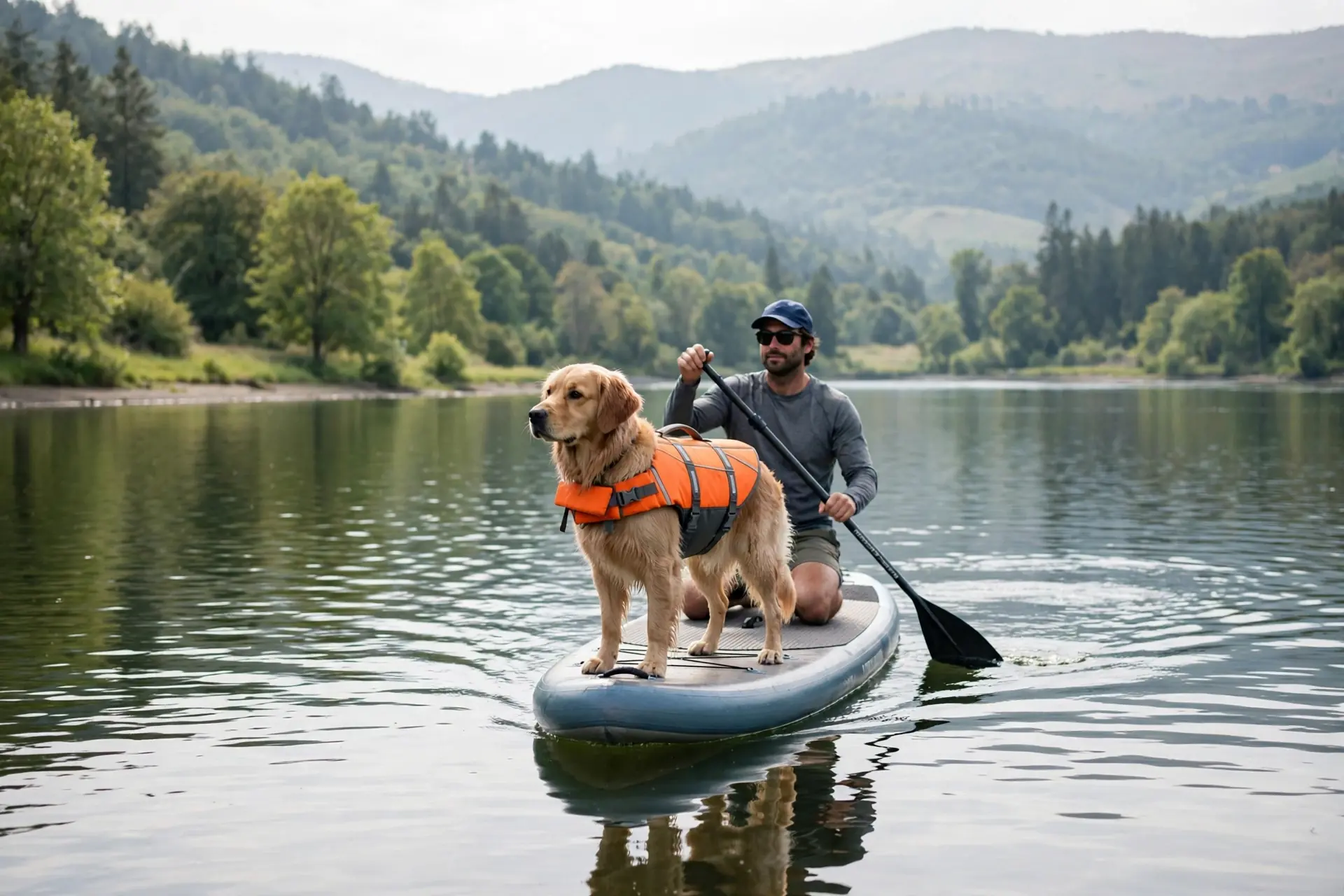
Before you think about boards, paddles or destinations, buy or hire a proper dog life jacket, and treat it as non-negotiable kit. Even strong swimmers get tired, get cold or panic after a surprise fall, and a jacket does two jobs at once: it keeps the dog buoyant with less effort, and it gives you a sturdy handle to lift the dog back onto the board. That handle is the single most useful feature on the water. Without it, hauling a wet 25-kilogram dog out of a lake while you balance on a board is a genuine struggle, and the dog will often scratch and climb, which is how owners end up in the water too. Look for a jacket with a wide, padded grab handle across the back, a strong D-ring for a lead, and bright colours that make the dog easy to spot from a distance.
Fitting matters more than brand. Measure your dog's chest girth at the widest point, just behind the front legs, and weigh them, then check both numbers against the manufacturer's size chart — never guess from breed alone, because a deep-chested spaniel and a barrel-chested bulldog of the same weight need different sizes. The jacket should sit snugly enough that you can fit two fingers under the straps but not slide it around the dog's body, and it should not ride up over the ears when you lift the dog by the handle. Test the fit at home first: let the dog wear it around the house and garden for short periods with treats, so the jacket becomes familiar before it is ever associated with water. Then test it in shallow water where the dog can stand, so you can see how it floats and whether the straps stay put when the dog swims.
A few details separate a good jacket from a poor one. Full belly coverage protects the chest and stomach from cold water and from knocks against the board, while a jacket that is mostly foam on the back and thin underneath will tip a dog sideways. Reflective trim is worth having for early-morning or evening paddles, and quick-release buckles make it easy to get the jacket off a wet, wriggling dog back on shore. Check the stitching and the handle before every outing, because a handle that tears under load is worse than no handle at all — it fails at the exact moment you need it. Keep the jacket clean and dry between trips, rinse off lake water and mud, and replace it if the foam becomes compressed, torn or waterlogged, since a damaged jacket floats less well. And remember that a life jacket is a safety aid, not a substitute for supervision: it buys you time in the water, but it does not make a non-swimmer safe alone.
Choosing a board your dog can stand on
The board you would choose for solo paddling is rarely the right board for paddling with a dog. Stability is everything, and stability comes from width, length and volume. As a starting point, look for an all-round inflatable board around 11 feet long and 33 to 34 inches wide, with a weight capacity comfortably above your combined weight plus kit. A heavier dog needs more volume, so add the dog's weight, your weight, the paddle, the life jackets, water and a dry bag, then choose a board rated at least 20 kilograms above that total. A board that sits too low in the water is twitchy, slow and hard to steer, and a dog that feels the board wobble under every step will lose confidence fast. Wider boards are also easier to climb back onto from the water, which matters more than most people expect.
Deck space and surface are the next things to check. Your dog needs a clear area at the front of the board to stand, sit and turn around without stepping on your feet or the paddle. A full-length deck pad gives the dog grip in wet conditions and protects their paws from a hot or rough board surface, while a smooth bare deck becomes slippery the moment it gets wet. Some boards sold specifically for dog paddling have an extended deck pad and extra D-rings for attaching a lead or a small anchor, which are genuinely useful rather than marketing extras. Avoid narrow touring or racing boards for dog trips: they are fast and tippy, and a dog shifting its weight by a few centimetres can send the whole board sideways. A wide, flat all-round board is slower and steadier, which is exactly what you want when your passenger has four legs and no paddle.
Inflatable boards suit most dog owners better than hard boards, for practical reasons. They are lighter to carry from the car park to the water, they bounce rather than crack if a dog's claws catch them, and they are far easier to store in a flat or a small car. The trade-off is that a soft inflatable deck flexes slightly under a heavy dog, so pump the board to the top of its recommended pressure range — usually around 15 to 18 PSI — for maximum stiffness. If you prefer a hard board, choose one with a durable deck and accept that claw marks are part of the deal; a deck pad protects both the board and the dog. Whatever you choose, check the board's fins before each trip: a single large centre fin gives the best straight-line stability for dog paddling, while small side fins add drag and snag weed in shallow water. Keep a spare fin and a repair kit in the car, because a broken fin on a remote lake ends the day early.
Teaching your dog to ride, step by step
The training that makes a calm paddle dog starts on dry land, days before you reach the water. Inflate the board in the garden or the living room and let the dog investigate it at their own pace, rewarding every step onto the deck with a treat and a calm word. Practise the two positions that matter most: standing still at the front of the board, and sitting or lying down on command in the same spot. Keep these sessions short — five minutes is plenty — and end while the dog is still interested, so the board stays associated with good things. Once the dog will step on, stand and settle on command, add gentle rocking: press the board down slowly at one side, reward calm behaviour, and stop the moment the dog gets worried. This dry-land work is the foundation of everything that follows, and rushing past it is the most common reason first water sessions go badly.
For the first water session, choose a warm day, a shallow sheltered spot with a gently sloping bank, and a time when the water is quiet. Put the life jacket on the dog before you leave the car, walk to the water's edge, and let the dog wade in from the bank so the board is not the first thing they meet. Float the board in ankle-deep water, hold it steady, and invite the dog on with a treat, just as you did at home. Then, with the board still in very shallow water, kneel on it yourself and paddle gently along the bank for a few minutes. Kneeling lowers your centre of gravity and keeps the board stable, which gives the dog time to find their balance without a tall human swaying above them. Keep the first session to ten minutes at most, finish with a swim or a game on the bank, and go home while the dog is still happy — that is how you build a dog that wants to come back.
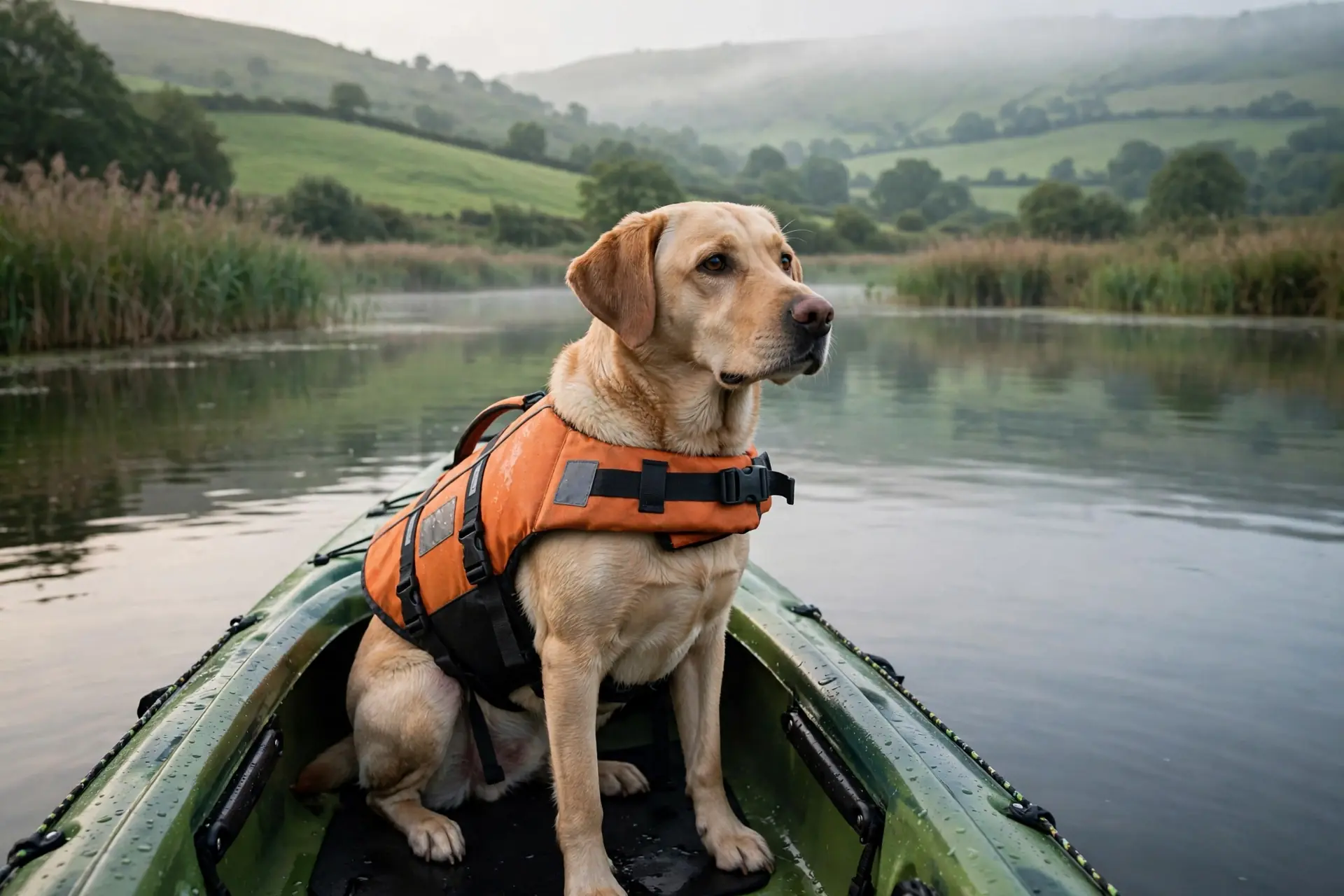
Over the next three to five short sessions, build up gradually. Stand up for short stretches once the dog is relaxed with you kneeling, then stay standing for longer as their confidence grows. Paddle a little further from the bank each time, but always stay within easy swimming distance of shore until the dog is steady. Teach a clear cue for getting on and off the board, and a settle cue for lying down, because a dog that knows where to be is a dog that does not wander to the tail of the board and tip you both in. If the dog jumps off, do not chase or scold — let them swim, call them back calmly, and lift them aboard again with the jacket handle. Most dogs have one or two wobbles in their first sessions and then settle; a dog that is still panicking after four or five careful sessions is telling you that paddleboarding is not their activity, and it is better to accept that than to keep pushing. Our guide to dogs on kayak trips in the UK covers similar calm-water training ideas, and the same slow-first-session approach applies whatever craft you choose.
When your dog falls in: stay calm and lift, don't chase
Dogs fall off paddleboards. Even experienced paddle dogs slip when a wake hits the board, step off to chase a duck, or simply misjudge a turn. The fall itself is rarely dangerous in calm water — the life jacket keeps the dog afloat, and most dogs swim perfectly well. What matters is what you do in the next thirty seconds. The instinct is to lunge, grab and haul, but sudden movements tip the board and put you in the water too, which doubles the problem. Instead, stay low, keep hold of your paddle, and let the dog swim towards you or towards the board. Talk in the calm voice you use at home, not a panicked shout, because your dog takes its cue from you. In most cases the dog will swim straight to the board, and you can use the jacket handle to lift them back aboard in one smooth movement.
Lifting a wet dog onto a board is a skill worth practising in shallow water before you need it for real. Kneel low on the board to keep it stable, slide one hand under the handle of the life jacket, and lift with a steady upward pull while the dog's front paws find the deck. Larger dogs may need you to lift the front half first, let them get their paws on, and then help the back end up. Never pull a dog up by a collar or a lead, which can choke them, and never drag them over the side rail, which can injure their legs. If the dog is panicking and thrashing, do not wrestle them onto the board in open water — guide them towards the nearest bank instead, swim or paddle alongside them, and let them climb out on the shore where you can both recover. A panicking dog near a board can knock you off balance, and two swimmers in the water are harder to help than one.
After any fall, take a pause before carrying on. Let the dog shake off, check that the life jacket is still fitted correctly, and watch for signs of cold or shock: shivering, reluctance to move, or unusual quietness. A short swim in cold water can chill a small or short-coated dog surprisingly fast, so keep a towel and a drying coat in your dry bag and cut the session short if the dog is cold. Also check yourself: wet clothes and a cold wind make the paddle back harder than you expect. If the dog falls in more than once in a session, treat that as information rather than bad luck — it usually means the board is too narrow, the water is too choppy, or the dog is tired. Head back, dry off, and try again on a calmer day rather than pushing through. And always carry a phone in a waterproof case, because a fall that injures a paw or a leg on a submerged branch is much easier to deal with when you can call for help from the bank.
Where to paddle: calm water across the UK
The best first venues for dogs on paddleboards are calm, enclosed waters where the bank is always close and the exit is easy. Large lakes with gentle, sloping shores are ideal: the water stays flat on a still day, there is no current to fight, and the dog can swim to the bank from anywhere. Many country parks, sailing clubs and outdoor centres around Britain run dog-friendly paddle sessions on lakes and reservoirs, and some allow dogs on the water outside sailing hours. Canals are another good option for steady paddling: they are flat, slow and predictable, with towpaths running alongside so the dog always has an exit. Look for wide, quiet stretches away from locks and moored boats, and keep the dog on the board rather than swimming beside it where narrowboats pass, because a dog in the water near a boat propeller is a risk nobody needs.
Slow rivers can work for confident pairs, but they demand more judgement than a lake. Check the flow before you launch — after heavy rain, even a gentle river can run fast and carry a fallen dog downstream — and avoid weirs, locks, bridges with strong currents and any stretch where the bank is steep or fenced. Estuaries and sheltered harbours offer beautiful paddling on a calm day, but tides, mud and boat traffic make them a poor choice for a first trip, and the water is colder and saltier than a lake. The open sea is for experienced paddlers with confident dogs only: waves, wind and swell tip boards easily, and a dog that falls in off a beach can be carried away from shore faster than you can paddle after them. Build up to sea paddling over a season, if at all, and never take a dog onto the sea in an offshore wind, which pushes everything away from the land.
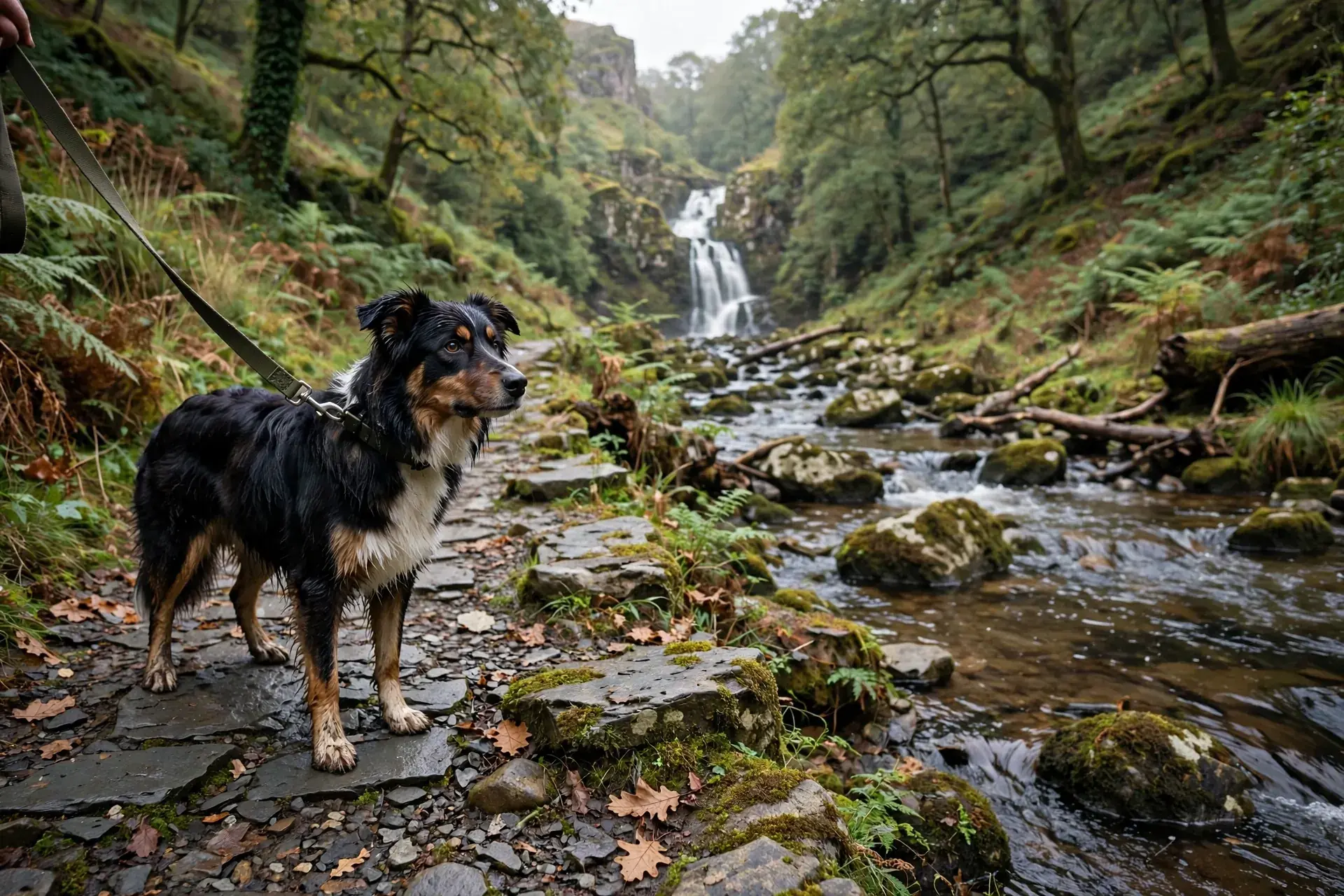
Access rules vary more than most newcomers expect, so check before you travel. Some reservoirs ban swimming and paddleboarding outright, some canals require a licence from the waterway authority, and some lakes allow paddleboards only at certain times or from a specific launch point. Dogs may be welcome on the water but restricted on the surrounding paths during bird nesting season, or banned from a beach area in summer. The safest approach is to look up the venue's own website and the waterway authority's guidance before you set off, and to check the official guidance before you travel if anything is unclear. Local paddleboard schools are also a good source of advice: they know which nearby waters are dog-friendly, where the launch points are, and which spots to avoid at weekends when the water gets busy. Our guide to dogs at waterfalls in the UK explains how to read water hazards such as slippery banks and rising levels, and the same caution applies on any river or lake.
Renting a board and kit: what to ask before you book
Hiring is the smartest way to start, because it lets you find out whether your dog actually enjoys paddleboarding before you spend several hundred pounds on a board, a pump and a life jacket. Most UK paddleboard schools, outdoor centres and lakeside hire points offer hourly or half-day hire, and a growing number actively welcome dogs. Book ahead rather than turning up and hoping, and when you book, say clearly that you are bringing a dog: give the dog's weight and chest measurement, ask whether the hire boards are wide enough for two, and ask whether dog life jackets are available in the right size. Some centres include a dog jacket in the hire price; others charge a small extra fee; a few expect you to bring your own. Knowing this before you arrive avoids a wasted journey.
Ask about the water as well as the kit. A good hire centre will tell you where dogs are allowed to launch, whether there is a shallow training area, and what the conditions are like on the day. Ask whether there is a sheltered bay for first sessions, whether the centre has a dog-friendly changing area, and whether there is somewhere to rinse the dog afterwards — lake water and mud in the car are nobody's idea of a good ending. Some centres run dedicated dog-and-owner taster sessions with an instructor, which are worth the extra cost for a first trip: an instructor can check the jacket fit, show you the safest way to lift your dog aboard, and read the conditions for you. If the centre offers a short safety briefing, take it even if you have paddled before, because local hazards such as submerged branches, shallow rocks or a busy sailing lane are rarely obvious from the bank.
Compare hire prices honestly before you commit to buying. A typical half-day board hire in the UK costs around £25 to £40, with a dog life jacket adding £5 to £10, while a decent wide inflatable board package costs £400 to £700. That means you can hire ten or more times before buying becomes cheaper, which is plenty of time to learn whether your dog loves the water or merely tolerates it. If you do decide to buy, consider buying the life jacket first and hiring boards for a while longer: the jacket is the safety-critical item and the one that must fit your dog exactly, while boards are easier to hire in different sizes until you know what suits you both. Check what the hire price includes — buoyancy aid for you, paddle, leash, dry bag and pump are usually included, but confirm the leash type, because a coiled ankle leash is safer for dog paddling than a straight one that can tangle around a dog's legs.
The full kit list: what to pack for a dog paddle day
A well-packed dry bag turns a good paddle day into a great one, and a forgotten item can end the trip early. Start with the safety essentials: a life jacket for the dog and a buoyancy aid for you, a leash for the board, a paddle, and a phone in a waterproof case. Add a lead for the bank, a spare lead in case the first one gets wet and muddy, and poo bags — dogs still need them on the water's edge, and leaving waste on a lakeside path is the fastest way to get dogs banned from a venue. Pack drinking water and a collapsible bowl for the dog, because lake water is not safe to drink: it can carry blue-green algae, farm run-off and bacteria, and a thirsty dog will drink whatever is in front of them. Bring water for yourself too, plus sun cream and a hat, because the sun reflects off the water and burns faster than you expect.
Comfort kit matters just as much. A large microfibre towel dries a wet dog quickly, a drying coat keeps a short-coated dog warm on the drive home, and a non-slip mat on the board gives the dog secure footing and protects the deck from claws. Pack a few high-value treats in a waterproof pouch — small pieces of chicken or cheese work well — and a favourite toy for the bank afterwards, because a reward at the right moment is what builds a confident paddle dog. A first-aid kit should include antiseptic wipes, a bandage, tick tweezers and any medication your dog needs, plus a spare towel for yourself, since you will almost certainly get wet at some point. If you are driving, bring a waterproof seat cover or an old blanket for the car, and a change of clothes for the journey home: nobody enjoys a two-hour drive in damp trousers.
For longer trips, add a few extras that earn their space. A small anchor or a stake-out line lets you hold the board steady at a quiet bay while the dog swims or rests, and a dry bag keeps the car keys, phone and treats safe even if the board tips. A pair of dog booties can help on rough launch points with sharp stones, although many dogs dislike them, so test them at home first. A portable water bowl that clips to the board is useful on hot days, and a brightly coloured bandana or a second reflective strip on the life jacket makes the dog easy to spot from the shore. Check the weather forecast before you load the car, and pack a windproof layer even on a warm day: wind chill on open water is much stronger than on land, and a cold owner is a distracted owner. Keep a printed list in the car for the first few trips until packing becomes habit, and check the board, pump, fin and valve the night before, not at the water's edge.
Seasons, water temperature and when to stay ashore
British water is cold far longer than most people realise, and cold water is the biggest seasonal risk for dogs on paddleboards. In spring, lakes and rivers can still be below 10 degrees Celsius even when the air feels warm, and a dog that falls in can chill quickly. Small dogs, short-coated breeds, puppies and older dogs lose heat fastest, and a wet dog in a breeze cools far quicker than a wet dog in still air. As a rough guide, water below 10 degrees calls for short sessions, a well-fitted life jacket, a drying coat ready on the bank and a quick exit if the dog starts shivering. Water below 5 degrees is best avoided with dogs altogether unless you are very experienced and the session is brief and close to shore. Check the official guidance before you travel if you are unsure about local conditions, and remember that air temperature is a poor guide to water temperature in spring and autumn.
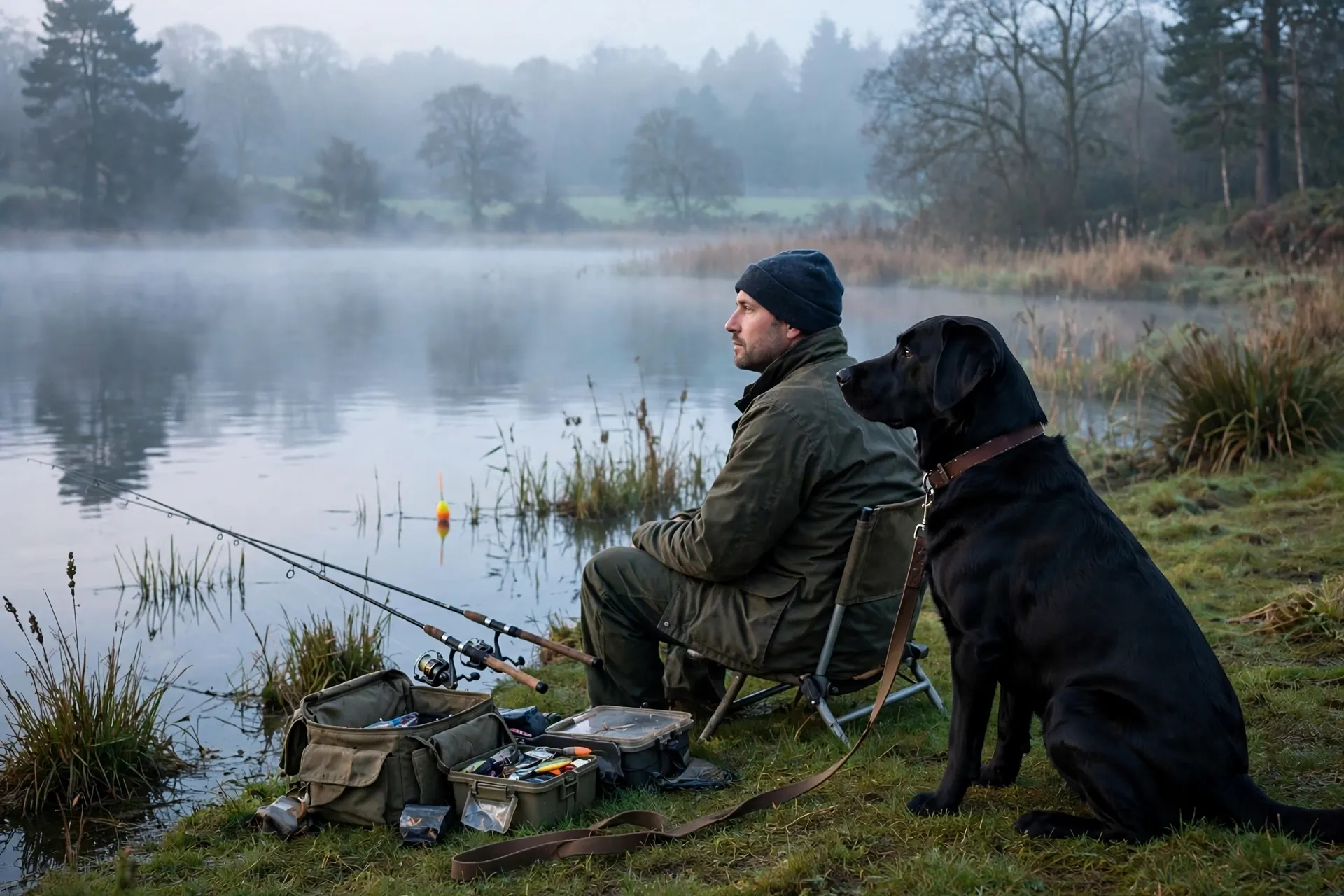
Summer brings the opposite problem: heat, sun and algae. On a hot day, the deck of a dark-coloured board can burn a dog's paws, so check the surface with your hand before the dog steps on, and use a light-coloured deck pad or a damp towel to cool it. Dogs overheat faster than people because they cannot sweat, so offer water regularly, watch for heavy panting or reluctance to move, and cut the session short if the dog seems too hot. Blue-green algae is the summer hazard that deserves the most attention: it appears as a green scum or paint-like film on the surface of lakes and slow rivers, usually from late June to September, and it can be toxic to dogs that drink it or lick it off their coats. If you see green scum, keep the dog out of the water entirely, rinse them off if they have already been in, and report the bloom to the venue or the Environment Agency. Our guide to dogs at fishing lakes in the UK explains algae risks in more detail, including the signs to watch for on the bank.
Autumn is often the best season for dog paddleboarding in Britain: the water is still warm from summer, the crowds have gone, and the light is beautiful. Shorter days mean you need to plan around daylight, and a windproof layer becomes essential as the evenings cool. Winter paddling is for experienced pairs only: the water is cold, the days are short, and a fall means a fast trip back to a warm car. If you do paddle in winter, keep sessions very short, stay within a few metres of the bank, carry a drying coat and a warm blanket, and never paddle alone with a dog in cold water. Whatever the season, check the wind forecast as well as the rain: a forecast of 15 miles per hour or more on open water makes paddling with a dog hard work and risky, because the wind pushes the board sideways and a tired dog cannot help you steer. A calm, overcast morning in September will almost always beat a windy, sunny afternoon in July.
Rules, etiquette and sharing the water
Paddleboarding with a dog means sharing the water with other people, and good manners keep venues open to dogs. Keep the dog on the board or on a short lead near other water users, and never let a dog swim up to anglers, swimmers or other paddleboarders uninvited — a wet dog shaking itself over someone's picnic is funny only for the dog's owner. Give way to larger craft and to swimmers, keep to the right-hand side of a canal or a river channel where a channel exists, and pass other boards with plenty of space, because a dog that lunges at a passing board can tip you both. On busy days, choose the quieter end of the lake rather than the main beach, and avoid the sailing club's racing area entirely. If a venue has a dog code of conduct, read it and follow it: the venues that welcome dogs today are the ones whose dog owners behaved well yesterday.
Licences and permits catch many newcomers out. Some rivers and canals in England and Wales require a waterway licence, which is often available as a day pass from the relevant navigation authority, and some lakes require a launch permit or a day ticket. These rules exist to fund maintenance and to manage congestion, and rangers do check, so sort the paperwork before you launch rather than arguing about it on the bank. Dogs themselves are usually covered by the same access rules as their owners, but some nature reserves restrict dogs during nesting season, and some Sites of Special Scientific Interest have their own bylaws. If you are unsure, check the official guidance before you travel: the venue's website, the waterway authority and the local council are the reliable sources, and a five-minute check saves an awkward conversation with a ranger. Keep your licence or permit in the dry bag with your phone so you can show it if asked.
Finally, think about the water itself. Rinse the dog after every paddle, because lake and river water can carry bacteria and parasites, and check ears, paws and coat for ticks, cuts and weed afterwards. Dry the board and the life jacket before storing them, so mould and mildew do not build up, and check the board for damage after each trip — a small puncture in an inflatable board becomes a big problem mid-lake. Leave the venue as you found it: take all litter and dog waste home, report any hazards such as broken glass or submerged branches to the venue staff, and thank the staff if dogs are welcome, because a friendly word makes it more likely they stay welcome. Paddleboarding with a dog is a privilege that depends on access, and access depends on dog owners behaving as though they want to be invited back. The best paddle days are the quiet ones: a calm lake, a steady dog at the front of the board, and a slow paddle home while the dog dries in the sun.
Practical questions
Before you go
Does my dog need a life jacket on a paddleboard?
Yes, every time. Even strong swimmers tire, get cold or panic after an unexpected fall, and a jacket with a grab handle lets you lift your dog back onto the board quickly. Choose one sized by chest girth and weight, with a snug fit that does not ride up over the ears, and test it in shallow water before your first proper paddle.
What size paddleboard do I need for a dog?
Go wider and longer than you would paddle alone. A board around 11 feet long and 33 to 34 inches wide gives most medium and large dogs room to stand, sit and turn around without tipping you both in. Heavier dogs need more volume, so check the board's weight limit and add your combined weight plus kit before you buy or hire.
How do I teach my dog to ride a paddleboard?
Start on dry land: let your dog sniff the board, reward standing and sitting on it, then practise in very shallow water close to shore. Keep the first sessions to ten minutes, kneel rather than stand, and end while your dog is still happy. Most dogs need three to five short sessions before they relax on a moving board.
What should I do if my dog falls off the paddleboard?
Stay calm, keep hold of your paddle, and let your dog swim to you or to the board. Use the handle on the life jacket to lift them back aboard, then kneel low and let them shake off before you stand again. If your dog is panicking, guide them to the nearest bank instead of wrestling them back onto the board in open water.
Where can I paddleboard with a dog in the UK?
Calm lakes, reservoirs with public access, slow canals and sheltered estuaries are the best starting points. Avoid fast rivers, weirs, busy boat channels and the open sea until you are both confident. Always check the official guidance before you travel, because access rules, seasonal closures and dog restrictions vary by venue and by waterway authority.
Can I hire a paddleboard and dog life jacket?
Many UK paddleboard schools and hire centres offer dog-friendly sessions and rent dog life jackets in a range of sizes. Book ahead, tell them your dog's weight and chest measurement, and ask whether the board is wide enough for two. Hiring first is the cheapest way to find out whether your dog enjoys it before you spend money on your own kit.