This guide is independent and contains no paid placement. If affiliate links are added later, they will be clearly marked and will not change our editorial checks.
Dogs travel free on TransPennine Express, up to two per passenger, on a lead at all times and off the seats. No ticket or booking is needed for the dog. The operator runs three route groups across the Pennines and into Scotland, mostly on five-car Nova trains, so pick a quieter service, a floor space at the end of a coach, and a station change with lifts and time to spare.
The TPE dog rule in one minute
TransPennine Express, usually shortened to TPE, is the intercity operator that carries passengers across the Pennines between Liverpool and Manchester in the west and Leeds, York, Hull, Newcastle and the Yorkshire coast in the east, with a separate set of services running north from Manchester and Liverpool through Preston and Carlisle to Glasgow and Edinburgh. It has been in public ownership since May 2023, and its network covers three core route groups and more than fifty stations. For a dog owner, the starting point is refreshingly simple: dogs are welcome on board, they travel free of charge, and there is no ticket to buy for them and no reservation to make on their behalf.
The rule, as the operator states it, is that a passenger may bring up to two dogs, and each dog must be kept on a lead for the duration of the journey. Smaller pets travel in carriers, and they travel free too. Dogs should not sit on seats or tables, for the comfort of other passengers, and a dog that becomes a nuisance can be asked to leave the train, so the practical test is not whether your dog is allowed on board but whether your dog can settle quietly at your feet for the length of the trip. Guide dogs and hearing dogs travel as assistance dogs, as on every UK train operator, and they are not counted against the two-dog limit.
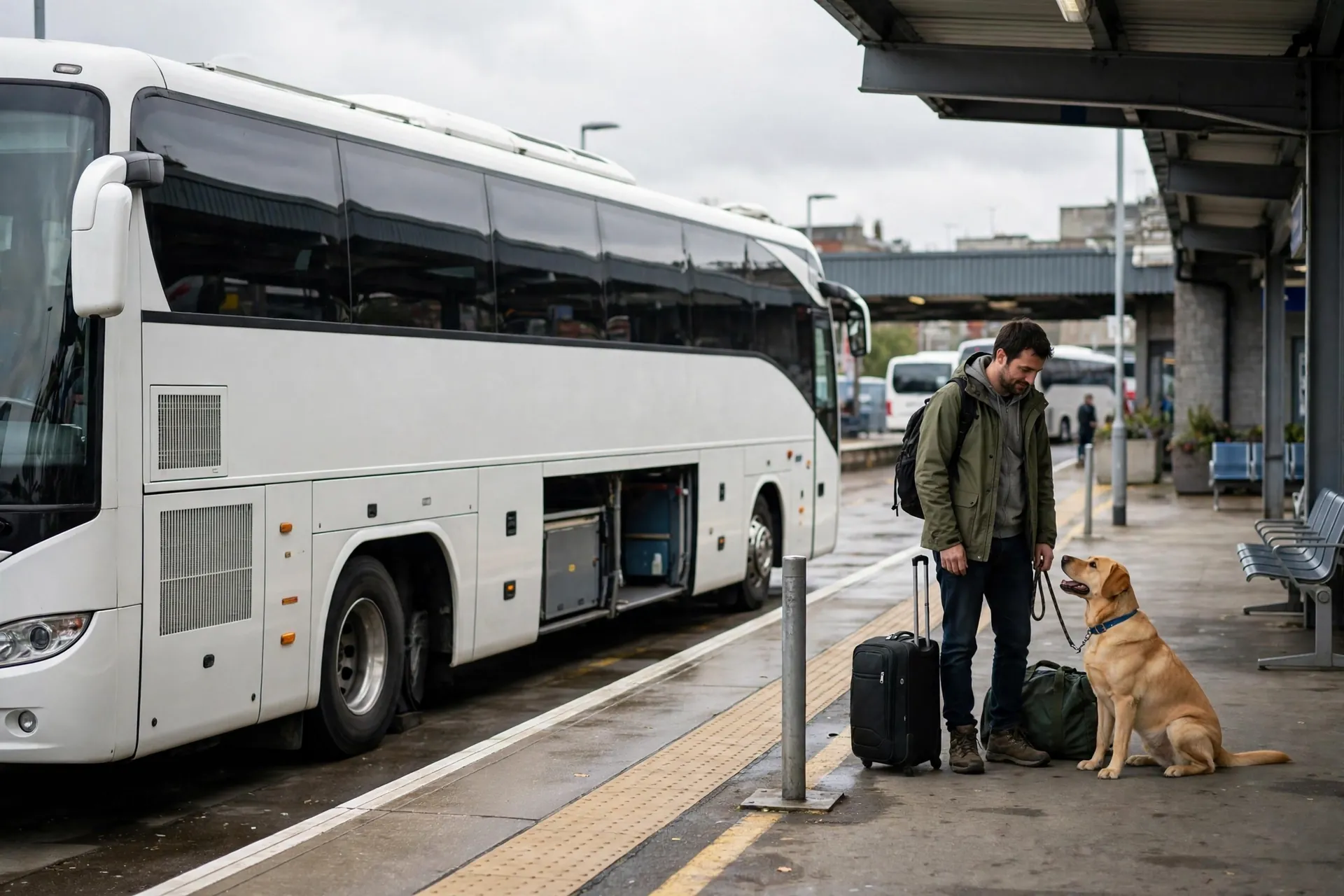
That free-travel rule is the same on every TPE service, whether it is a twenty-minute hop from Leeds to York or a three-and-a-half-hour run from Manchester Piccadilly to Glasgow Central. There is no dog fare, no pet supplement and no size band, which makes TPE noticeably simpler than the coach operators, where pet dogs cannot travel at all. If you are comparing modes for a northern trip, our guide to dogs on National Express coaches explains why the train is the realistic option for most dog owners heading across the Pennines. The one thing TPE does ask in return is control: a short lead, a dog under your feet rather than wandering the aisle, and a bit of thought about which service you board.
Before the day itself, check the official guidance before you travel for any change to the rules, and check the timetable for the specific service you plan to catch, because TPE timetables can change at short notice and engineering work can replace trains with buses on some stretches. Dogs cannot travel on rail replacement buses in the way they can on trains, so a bus leg changes the plan completely. A quick check the evening before, and again on the morning of travel, is worth more than any amount of packing.
Inside the Nova fleet: where a dog fits
TPE runs three types of train that a dog owner is likely to meet, and they are not equally comfortable for a dog. The flagship fleet is the Nova family. Nova 1 is the Hitachi Class 802 bi-mode unit: nineteen five-car trains, each seating 342 passengers, 24 of them in first class, running between Liverpool, Manchester, Newcastle and Edinburgh. Nova 2 is the CAF Class 397 electric unit: twelve five-car trains, each seating 264 passengers, 22 in first class, running between Manchester Airport and Liverpool and Glasgow and Edinburgh via Preston. Alongside them run the Siemens Class 185 diesel units, three-car trains that have served the operator since 2006 and still cover much of the network, including the South Route. The Nova 3 loco-hauled trains were withdrawn from TPE service in December 2023, so if an older guide mentions them, treat it as out of date and check the official guidance before you travel.
For a dog, the difference between a five-car Nova and a three-car Class 185 matters. A Nova coach is longer, with more floor space at the coach ends, wider vestibules by the doors, and more places where a medium or large dog can lie flat without blocking the aisle. The Class 185 is a capable train, but its coaches are shorter, its vestibules fill faster at busy stations, and a big dog at the feet of an airline-style seat can end up with paws in the aisle every time someone passes. If you have a choice of services and a large dog, the longer Nova service is usually the calmer bet, and the first-class section at one end of a Nova set is not where a pet dog belongs: dogs travel in standard class, and first class is best left to passengers who have paid for the quieter cabin.
Inside any TPE coach, the best spot for a dog is a table seat or a seat at the end of a coach, where the dog can lie on the floor beside you rather than in the gangway. A blanket or mat gives the dog a defined patch of floor, keeps fur off the carpet, and signals to other passengers that the space is taken. Bring a short lead rather than a long line, and keep it looped around your wrist or under your foot so the dog cannot drift. The luggage racks at the coach ends are useful for a bag, but do not put a dog carrier on an overhead rack, and do not leave a dog unattended in a vestibule while you go to the buffet or the toilet. There is no separate pet area and no dog compartment on TPE, so the dog's space is the floor at your seat, and that is why the seat you choose matters as much as the train you board.
Power sockets and Wi-Fi are fitted across the Nova fleet, which is handy for a long Scottish run, but they do not change the dog's experience. What changes it is air, noise and movement. Sit away from the doors if your dog startles at the beep and rush of every station stop, and away from the buffet counter if your dog begs. On a Class 185, the engine note under the floor is louder than on a Nova, and a noise-sensitive dog may settle better on a Nova service or with a familiar blanket to burrow into. If your dog has never ridden a train, a short TPE hop first, such as Huddersfield to Manchester Piccadilly at about forty-five minutes, is a far kinder trial than a first trip all the way to Edinburgh.
The North Route: Liverpool to Newcastle and the coast
The North Route is the heart of TPE and the one most dog owners will use first. It runs from Liverpool Lime Street and Manchester Airport through Manchester, Huddersfield and Leeds, then on to York and Newcastle, with branches to Hull, Scarborough, Middlesbrough and Saltburn, and a shuttle between Newcastle and Edinburgh on the East Coast Main Line. The classic leg is Manchester Piccadilly to Leeds, the fast Pennine crossing that links two of England's most dog-friendly cities, and from Leeds the line fans out to York in about thirty minutes, to Hull across the Wolds, and to Scarborough on the coast.
Each branch suits a different kind of dog day out. York is a compact, walkable city where a dog can cover the walls, the riverside and the Museum Gardens on foot from the station, though the medieval streets get crowded at weekends and a nervous dog is better taken early in the morning. Scarborough is the seaside option: the train from York via Malton and Seamer drops you close to the South Bay, and the beach rules change with the season, so check the local dog restrictions before you travel rather than assuming a summer beach is open to dogs. Hull is the quieter city break, with the marina and the Humber waterfront a short walk from the station, and Middlesbrough and Saltburn offer the North Yorkshire coast without the Scarborough crowds, with Saltburn's cliff lift and beach a genuine dog-friendly draw.
The North Route also carries the longest TPE journeys a dog owner is likely to attempt in England: Liverpool Lime Street to Newcastle, and Manchester Airport to Newcastle, both of which cross the Pennines and then run up the East Coast Main Line through Durham. These are two-to-three-hour journeys, and they need a different plan from a city hop. Walk the dog properly before boarding at Lime Street or the Airport, carry water and a collapsible bowl, and plan a toilet break at the far end rather than hoping for a long station stop in the middle. Intermediate stops such as Leeds and York are usually only a few minutes, which is not enough to take a dog off the train and back on safely, so treat the journey as a single stretch and settle the dog for the duration.
Stopping patterns vary a lot on this route, which is why the departure board matters more than the route name. Some Manchester to Newcastle trains run fast with few stops, while others call at Huddersfield, Leeds, York, Northallerton, Darlington and Durham. The stopping trains between Manchester and Huddersfield and between Huddersfield and Leeds are slower but emptier, and an empty stopping train can be a better choice for a reactive dog than a packed fast train, even though it takes longer. Check the calling pattern when you book, not just the departure time, and if your dog struggles with crowds, the slower train that leaves ten minutes later is often the kinder option.
The South Route: Sheffield, Doncaster and Cleethorpes
The South Route runs from Liverpool Lime Street through Manchester to Sheffield, Doncaster and Cleethorpes, and it is the TPE line that most dog owners underestimate. It is worked largely by Class 185 units, so the trains are shorter and busier at peak times, but the destinations are among the most rewarding for a dog. Sheffield is a city of parks and hills, with the station at the edge of the city centre and the Peak District a short hop away by other services. Doncaster is a change point rather than a destination for most dog owners, and Cleethorpes is the seaside end of the line, with a long sandy beach that draws dog owners from across South Yorkshire and Lincolnshire.
The Sheffield leg is the one to plan most carefully. Manchester to Sheffield crosses the Pennines by a different route from the North Route, through the Hope Valley or via Stockport depending on the service, and the trains can be crowded with commuters in both directions at peak times. A dog travelling at 8am on a weekday will meet a very different train from the same service at 11am. If your journey can wait until after the morning peak, the same train becomes a different experience: seats free, vestibules clear, and room for a dog to lie down properly. The same applies in reverse in the evening, when Sheffield to Manchester trains fill with people heading home.
Cleethorpes deserves a note of its own because it is a genuine TPE seaside terminus rather than a branch. The town's beach is wide and flat, the promenade is easy walking for older dogs, and the station is close enough to the seafront that a dog can be on sand within minutes of stepping off the train. TPE has made a point of welcoming dogs at Cleethorpes station itself, where a Pets as Therapy dog has worked with staff to support passengers, and the station sits in the group of TPE stations that have added dog water bowls. Check the beach's seasonal dog rules before you travel, carry water for the walk back, and remember that the last trains back towards Sheffield and Manchester leave well before the evening, so plan the return leg before you settle on the sand.
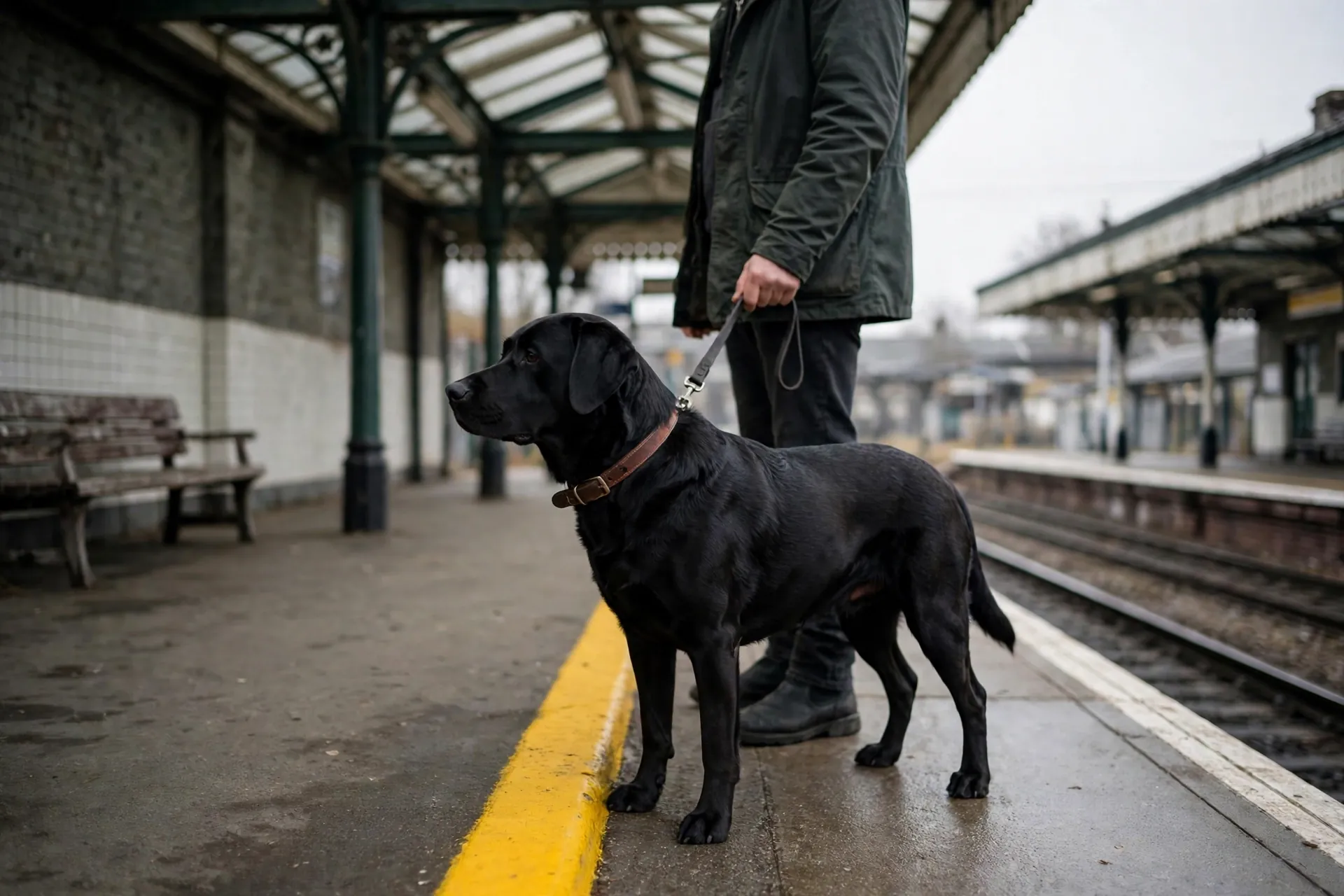
Between Sheffield and Cleethorpes, Doncaster is the practical interchange. It is a large station with long platforms, and changing there with a dog means allowing time for the walk between platforms and for the lifts if your dog does not do escalators. Dogs should not use escalators: use the lift or the stairs, keep the lead short, and keep the dog behind the yellow line while you wait. Our guide to dogs on UK train platforms and in stations covers the yellow-line rules, lift etiquette and unstaffed station tips that apply at every TPE interchange, including Doncaster and Sheffield.
The Scottish Route: Preston, Carlisle and beyond
The Anglo-Scottish route is the longest TPE journey and the most ambitious one to attempt with a dog, but it is also the most rewarding. Services run from Manchester Airport and Liverpool Lime Street through Preston, Lancaster and Carlisle to Glasgow Central and Edinburgh, mostly on Nova 2 Class 397 electric units, with Nova 1 Class 802 units on the Liverpool to Edinburgh service via Newcastle. Manchester Piccadilly to Glasgow Central takes about three and a half hours, which is a long time for a dog to lie still, so this route needs a proper plan rather than a spontaneous decision at the ticket machine.
Preston is the first major change point on the Scottish route, and it is where the railway changes character. South of Preston the line is busy with commuter traffic; north of Preston it opens out towards Lancaster, the Lune valley and the Lake District fells, and the trains thin out. Oxenholme Lake District and Penrith North Lakes are both TPE stops, and they are the gateway for dog owners heading to the Lakes without a car, though the onward connections from those small stations need planning, because the stations themselves are quiet and the walks from them are long. If the Lakes are the goal, build the trip around the train times rather than assuming a frequent onward bus.
Carlisle is the key city on the route and the natural break point for a dog. It is a historic border city with a castle, a cathedral and the riverside walks along the Eden, and it is also where the Glasgow and Edinburgh portions of the service divide. If you are travelling with a dog that needs a break, Carlisle is the place to take it: step off, walk the dog properly, and catch a later train north rather than sitting through the whole run in one go. The station has lifts and step-free routes between platforms, which matters with a dog and luggage, and the city centre is close enough for a proper leg-stretch between trains.
North of Carlisle the line splits for Glasgow and Edinburgh, and the two cities offer very different dog days. Glasgow Central drops you in the middle of a large, busy city where a dog needs a confident handler and a short lead, but the Clyde riverside and the city's parks are close at hand. Edinburgh Waverley is smaller in feel but steeper, with the station set in a valley between the Old Town and the New Town, and the climb out of the station with a dog and a bag is a real consideration for older dogs. Both cities reward an early arrival, before the crowds build, and both are better explored on foot from the station than by trying to fit a dog onto a crowded city bus.
One practical point about the Scottish route is the weather. A dog that travels happily from Manchester to Leeds in summer may find the same journey in a January northerly a different proposition, with cold platforms at Carlisle and wind at the exposed stations north of Preston. Pack a drying coat and a towel even on a dry forecast, because a wet dog on a three-hour train is miserable for the dog and for everyone sitting nearby. And if the forecast is severe, check the official guidance before you travel: the West Coast Main Line is one of the first routes to be disrupted by high winds, and a cancelled Scottish service leaves you a long way from home with a dog.
City hops: short jumps that suit dogs
Not every TPE journey needs to be a grand cross-country expedition. The operator's network is unusually good for short hops between northern cities, and these are the journeys that suit dogs best, because the dog is only on the train for half an hour or so and the destination is walkable from the station. The best-known is Leeds to York, about thirty minutes, which turns two distinct cities into a single day out: Leeds for the shops and the riverside, York for the walls and the Minster, and the dog gets two cities for the price of one train ride, with a proper walk in each.
Manchester to Huddersfield is another natural hop, about forty-five minutes, and it suits a dog that is still learning the train, because the journey is long enough to settle but short enough to abandon if it goes wrong. Huddersfield itself is compact, with the station at the heart of the town and the canal towpaths offering a flat, easy walk for a first trip. Manchester to Liverpool is a similar length in the other direction, and it pairs two cities with very different characters: Liverpool Lime Street is a grand terminus with a wide concourse where a dog can be walked and watered before the return, and the waterfront is a short walk away.
The hop that dog owners use most without thinking about it is Manchester Piccadilly to Manchester Airport, a short run that connects the city with the airport station and its onward links. It is also a useful rehearsal: a nervous dog can ride one stop, get off, and be home again within the hour. The same logic applies to Leeds to Huddersfield, York to Scarborough, and Newcastle to Durham, each of which is short, frequent and easy to cut short if the dog is unhappy. Build confidence on these hops before attempting the three-hour Scottish run, and the long journeys will go far better.
City hops also change the ticket maths. On a short hop, the difference between an Advance ticket and an Off-Peak ticket is often only a few pounds, and the flexibility of the Off-Peak ticket is worth more than the saving when a dog is involved, because a dog that refuses to settle or a train that is too crowded is a reason to wait for the next one. On a hop you can afford to let a packed train go and catch the following service; on a long-distance Advance ticket you cannot. That flexibility is the single most useful thing a dog owner can buy on TPE, and it is cheapest on the short routes.
Tickets, fares and seat reservations
Your dog travels free, so the fare question is entirely about your own ticket, and TPE sells the usual three kinds. Advance tickets are the cheapest, tied to a specific train, and sold in limited numbers; they suit a dog owner who knows exactly which service they will catch and has a dog that will board without fuss. Off-Peak tickets cost more but allow travel on any off-peak service on the chosen route, which is the flexibility a dog owner usually needs. Anytime tickets are the most expensive and the most flexible, valid on any train including peak services, and they are the right choice only when the timing genuinely cannot be fixed in advance.
Seat reservations are free on TPE and are included automatically with most Advance tickets, and they can be added to flexible tickets too. There is no reservation for the dog, because the dog has no seat, but the reservation still matters: it fixes your seat, which fixes where the dog will lie. A reserved table seat gives a large dog floor space under the table; a reserved airline-style seat in the middle of a coach gives the dog almost none. When you book, look at the seat map if one is offered, and choose a table seat or an end-of-coach seat rather than taking whatever the system assigns. If you are travelling in a group, reserve seats together so the dog is not split between two people on opposite sides of the aisle.
First class on TPE is a real cabin on the Nova trains, with 24 first-class seats on a Nova 1 and 22 on a Nova 2, and it is worth knowing that dogs are not the intended passengers there. The standard-class dog rule applies across the train, but first class is sold as a quieter working environment, and a dog that barks or paces will draw complaints faster there than in standard class. Save the money, sit in standard, and spend the difference on a better hotel at the far end. Railcards work on TPE in the usual way, with the usual time restrictions, and a Railcard discount applies to your ticket, not to the dog, because the dog is already free.
Buy your ticket before you travel when you can, either online or at the station, because the cheapest Advance fares sell out and the onboard fare is higher. TPE offers mobile tickets and smartcard options, and the ticket gates at the big stations accept them, but keep the dog on a short lead at the gates and use the wide gate rather than squeezing through a standard barrier with a dog underfoot. If you need to change a ticket, do it before the train leaves if possible: Advance tickets cannot usually be moved to another service, while Off-Peak and Anytime tickets can, which is another reason the flexible ticket is the dog owner's friend. If any of this is unclear for your specific journey, check the official guidance before you travel rather than guessing at the ticket machine with a dog pulling at the lead.
Changing trains at Piccadilly and Leeds
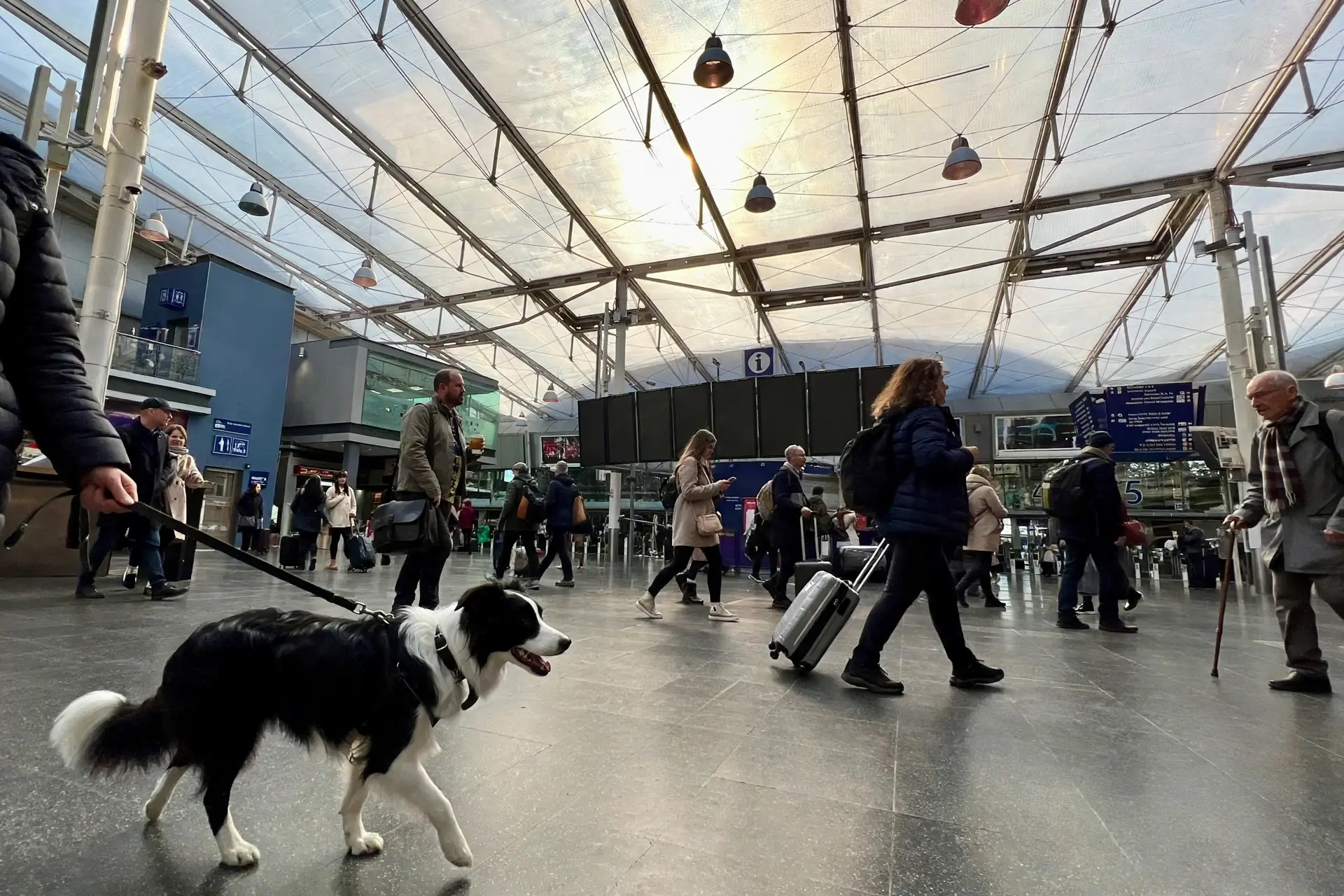
Most TPE journeys with a dog are direct, but the network's two great interchanges are Manchester Piccadilly and Leeds, and both deserve a plan. Manchester Piccadilly is the operator's hub, a large station with a high, airy concourse, thirteen through platforms and a separate set of bay platforms, and it is where the North, South and Scottish routes meet. Changing there means crossing the concourse, finding the departure board, and walking to a platform that may be at the far end of the station. Allow at least twenty minutes between trains with a dog, even if the timetable says ten will do, because a dog that needs a toilet break, a drink and a moment to settle cannot be hurried across a crowded concourse.
Piccadilly's layout has one advantage for dog owners: the concourse is wide and level, with step-free access throughout and lifts to every platform, so there is no need to use escalators with a dog. The station also has waiting rooms and cafes where a dog can rest between trains, though dogs are not welcome everywhere indoors, so check the signs at each cafe rather than assuming. The busiest pinch points are the ticket gates and the foot of the escalators, where crowds compress, so keep the dog on a short lead, walk on the quieter side of the concourse, and give the dog a few minutes on the platform to sniff and settle before boarding. If your connection is tight, ask station staff for the quickest step-free route rather than following the crowd.
Leeds is the other interchange that matters, and it is busier in a different way. Leeds station is a single large concourse with platforms fanning out on both sides, and TPE services to York, Newcastle, Hull, Scarborough and Manchester all pass through it. Changing at Leeds often means crossing from one side of the station to the other, and the station's footbridges and lifts can be crowded at peak times. The same twenty-minute rule applies, and it applies doubly at Leeds in the evening peak, when commuters pour through the station and a dog on a long lead becomes a trip hazard. Shorten the lead, keep the dog close to your leg, and wait behind the yellow line until the platform clears.
Smaller interchanges have their own character. Preston is a long, straight station where the platforms are a walk apart and the lifts are at the far end; Carlisle is compact and easy to change at, with a single main concourse; Doncaster is wide and open, with long platforms that reward an early arrival. At any interchange, the rule is the same: check the platform on the departure board before you move, use the lift, and do not try to change trains with a dog in under ten minutes. A missed connection with a dog is an inconvenience; a rushed connection with a dog is how leads get tangled and dogs get stressed.
Stations, water bowls and waiting
TPE manages nineteen of the stations on its network, and it has made a visible effort to welcome dogs at them. In 2025 the operator rolled out dog water stations at eleven stations: Brough, Grimsby, Hull, Malton, Manchester Airport, Middlesbrough, Northallerton, Scarborough, Selby, Thornaby and Thirsk, with dog biscuits handed out alongside the bowls at the launch. The water stations are a genuine help on a hot day, but they are not everywhere, and they do not replace your own kit. Carry a collapsible bowl and a bottle of water on every TPE journey, because a station without a bowl, or a bowl that is empty, is the normal case rather than the exception.
Waiting with a dog is a skill in itself. The waiting rooms at TPE stations vary: some are warm and quiet, others are little more than a shelter on the platform, and dogs are welcome in most of them as long as they are on a lead and under control. On a cold day, the waiting room is worth using; on a warm day, the platform is often better, because a dog overheats faster than a person and a crowded waiting room with no air can be worse than the open air. At unstaffed stations, which TPE serves on the quieter branches, there may be no waiting room at all, so check the station facilities before you travel and plan the wait around the weather.
Toilet breaks at stations need the same planning. Most TPE stations have a patch of grass or a quiet corner outside the main entrance where a dog can relieve itself before boarding, but the big city stations do not: Piccadilly, Leeds and Liverpool Lime Street are surrounded by roads and paving, and the nearest green space may be a ten-minute walk away. Walk the dog before you reach the station, not after, and arrive with the dog already settled. Carry bags, because the station bins are the right place for them and the platform is not, and if your dog does have an accident on a platform or a train, tell staff straight away rather than hoping nobody notices.
One more station habit is worth building: check the departure board twice. TPE services can change platform at short notice, especially at Piccadilly and Leeds, and a platform change with a dog means a walk across the concourse at exactly the moment everyone else is moving too. Listen for announcements, watch the board, and when the platform is confirmed, walk there promptly rather than waiting until the last minute. A dog that boards calmly from a platform it has had five minutes to sniff is a different animal from one that is rushed onto a train as the doors are closing.
Delays, cancellations and Delay Repay
TPE has had a difficult few years for reliability, and any honest guide has to say so. The operator's services have been disrupted by staffing, infrastructure and timetable problems, and a dog owner planning a TPE journey should assume that a delay is possible rather than exceptional. That does not mean you should not travel; it means you should build slack into the plan, carry water and a snack for the dog, and know what to do when the board turns red. The single most important habit is to check the live departure board before you leave home, and again at the station, rather than trusting the printed timetable.
If your train is cancelled, your dog can travel with you on the next available TPE service on the same route, and on any alternative service the operator directs you to, under the same free-travel rule. Go to the station help point or ask a member of staff which train to take, rather than boarding the first train that arrives, because a cancelled Manchester to Leeds service may be followed by a stopping train to Huddersfield that does not go where you need. On a busy platform after a cancellation, shorten the lead, keep the dog behind the yellow line, and move away from the platform edge while you work out the new plan. A crowded platform is the one place a dog is most likely to be stepped on or to panic, and a few minutes of calm at the back of the platform is worth more than a rush to the front.
If the delay is long, the station is usually a better place to wait with a dog than the train. A train held at a platform with the doors open can be hot, crowded and noisy, while the station concourse offers space, water and a chance to walk the dog. If the train is held between stations, stay where you are, keep the dog settled, and wait for the crew's instructions rather than trying to move through the train. Staff will advise whether the train is going forward, going back, or being evacuated, and a dog that is calm at your feet is far easier to move in an evacuation than one that is loose in the aisle.
Delay Repay is the compensation scheme that applies when a TPE train is delayed. If you arrive at your destination fifteen minutes or more late, you can claim a proportion of the fare back, and the claim is made online with your ticket details. Keep your ticket, note the train you actually caught and the time you arrived, and submit the claim within the deadline the operator sets. The dog does not change the claim, because the dog travelled free, but the claim is still worth making: it is the operator's own scheme, it costs nothing to submit, and it is the one part of a disrupted journey that is entirely in your control. Check the official guidance before you travel for the current Delay Repay thresholds and deadlines, because the details can change.
Busy trains, luggage and the dog's space
The hardest TPE journeys for a dog are not the longest ones but the busiest ones. A Friday evening train from Manchester Piccadilly to Leeds, a Saturday morning train to Scarborough in summer, and a Monday morning commuter service from Huddersfield to Leeds are all trains where the aisles fill, the vestibules fill, and a dog at your feet becomes an obstacle that tired passengers trip over. The answer is not to avoid TPE but to choose the service with the same care you would choose the seat. Travel after the morning peak and before the evening peak when you can, avoid the last train on a Friday, and if the platform is heaving before the train arrives, let that train go and wait for the next one.
Luggage is part of the same calculation. TPE's Nova trains have luggage racks at the ends of coaches and overhead racks above the seats, and the Class 185 has smaller racks that fill quickly. A dog owner with a large bag, a dog bed and a coat has more to carry than a commuter with a laptop, so travel light: one bag that fits on the overhead rack, a blanket that folds small, and a lead that clips to your belt when the dog is settled. Do not block the aisle with bags, and do not put luggage on the seat next to you when the train is busy, because that seat is someone else's and the dog cannot sit on it either. If the train is full, the dog's floor space shrinks to the patch directly under your feet, and that is the moment a large dog becomes uncomfortable.
Other passengers are part of the journey too, and most of them like dogs. A dog that is calm, clean and on a short lead will be greeted warmly on most TPE services, and a brief chat with a neighbouring passenger can make a long journey pass pleasantly. But not everyone wants a dog near them, and some passengers have allergies or a fear of dogs, so read the carriage. If someone moves away, let them. If a child reaches for the dog, ask the parent first and keep the dog still. If your dog barks at another dog boarding at the next station, apologise, move the dog's head away, and settle them again rather than letting the barking run. A little courtesy on a TPE train goes a long way, because you will meet the same fellow passengers again on the return leg.
Finally, think about the return journey before you leave. A dog that has had a long walk at the far end, a swim at Scarborough or a run in a Leeds park, will be tired and may sleep the whole way home, which is the ideal outcome. A dog that has been cooped up in a cafe or a waiting room all afternoon will be restless on the way back, so give the dog a proper walk before the return train, offer water, and settle them with the same blanket they travelled out on. The return leg is where most dog journeys go wrong, not because the train is different but because the dog is tired, the owner is tired, and the patience that was plentiful in the morning has run out. Plan the return with the same care as the outward journey, and the day ends well.
Practical questions
Before you go
Do dogs need a ticket on TransPennine Express?
No. Dogs travel free on TransPennine Express, with no ticket or reservation needed for the dog itself. You only buy your own ticket. The limit is two dogs per passenger, and each dog must be kept on a lead for the whole journey.
Can my dog sit on a seat on a TransPennine Express train?
No. Dogs should not sit on seats or tables on TransPennine Express trains. A small dog may sit on your lap, but a larger dog should settle on the floor at your feet, on a blanket or mat, clear of the aisle and the doors.
Which TransPennine Express trains are best for a large dog?
The five-car Nova 1 and Nova 2 trains give a large dog more room than the three-car Class 185 units, with wider vestibules and more floor space at the ends of coaches. On any train, choose a table seat or an end-of-coach seat where the dog can lie flat without blocking the aisle.
Can I take my dog on a TransPennine Express train to Edinburgh or Glasgow?
Yes. Dogs travel free on TransPennine Express services to Edinburgh and Glasgow, including the Anglo-Scottish route via Preston and Carlisle and the Liverpool to Edinburgh service via Newcastle. The same rules apply: two dogs per passenger, on a lead, off the seats.
What happens to my dog if my TransPennine Express train is cancelled?
Your dog can travel with you on the next available TransPennine Express service on the same route, and on any alternative service the operator directs you to. Keep your dog on a short lead on a busy platform, use the station help point if you are unsure which train to take, and keep your ticket for a Delay Repay claim.
Are there dog water bowls at TransPennine Express stations?
TransPennine Express has installed dog water stations at eleven of its stations, including Hull, Malton, Scarborough, Middlesbrough, Grimsby, Selby, Thirsk, Brough, Northallerton, Thornaby and Manchester Airport. Carry your own water and a collapsible bowl as well, because not every station on the network has one.