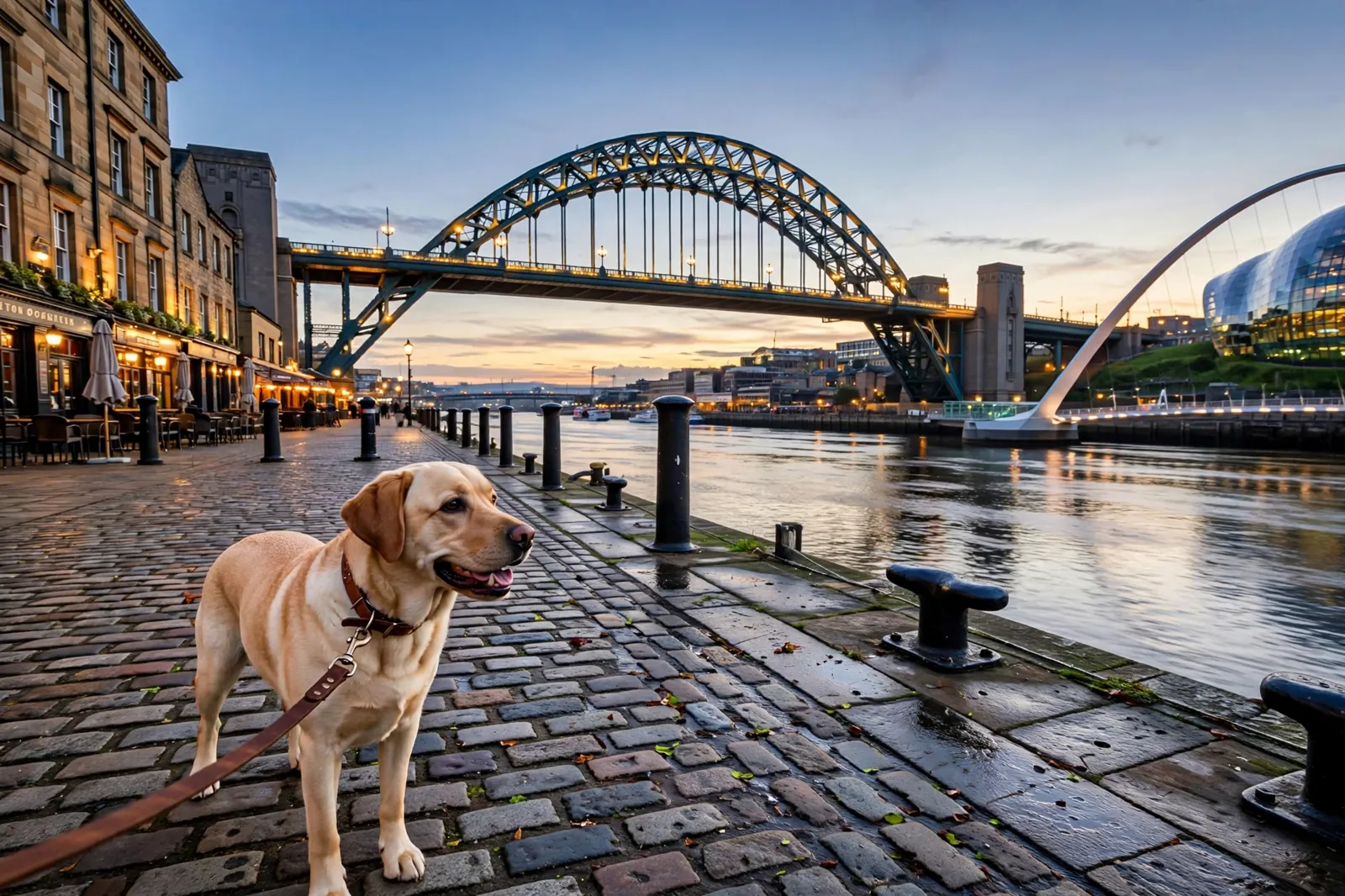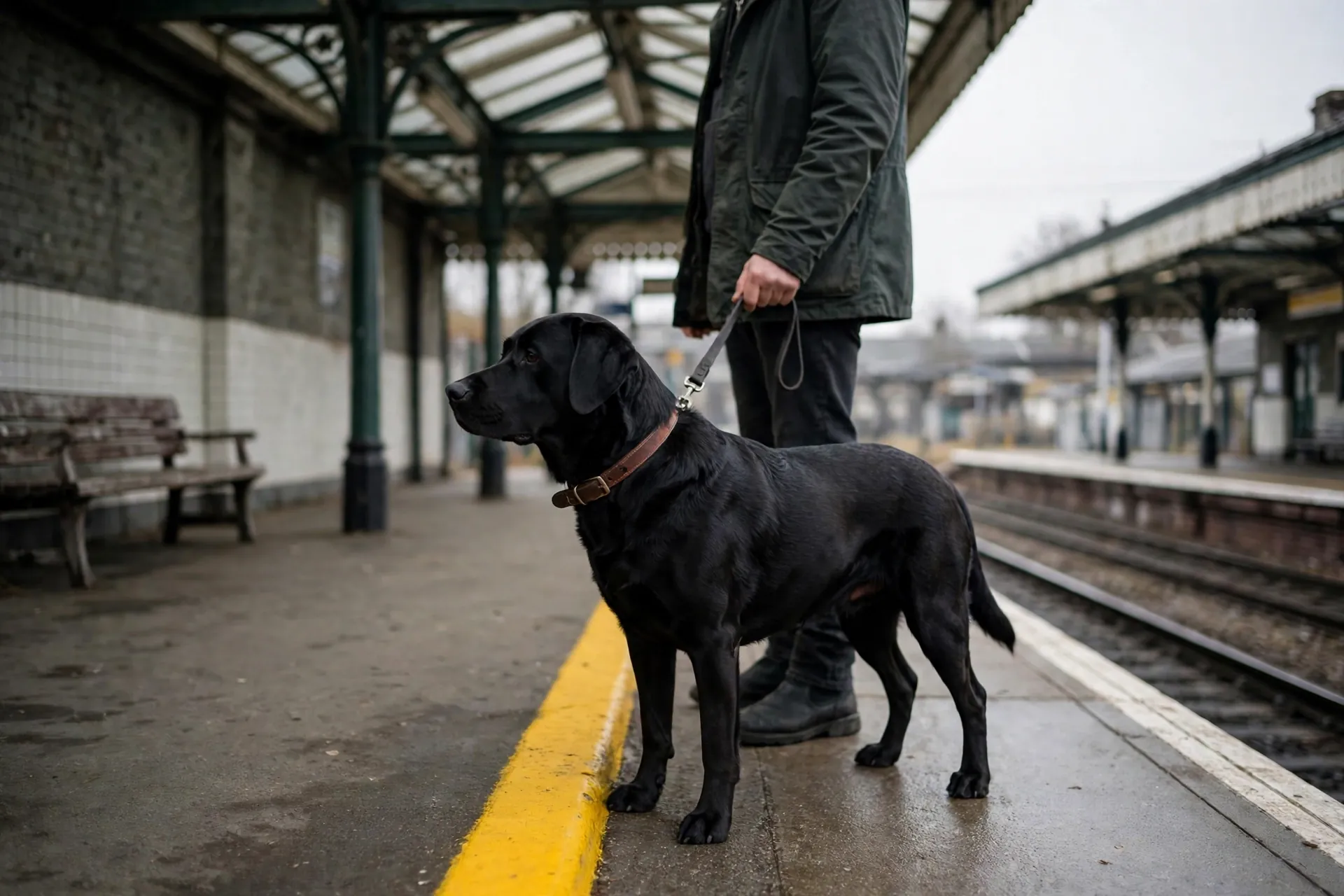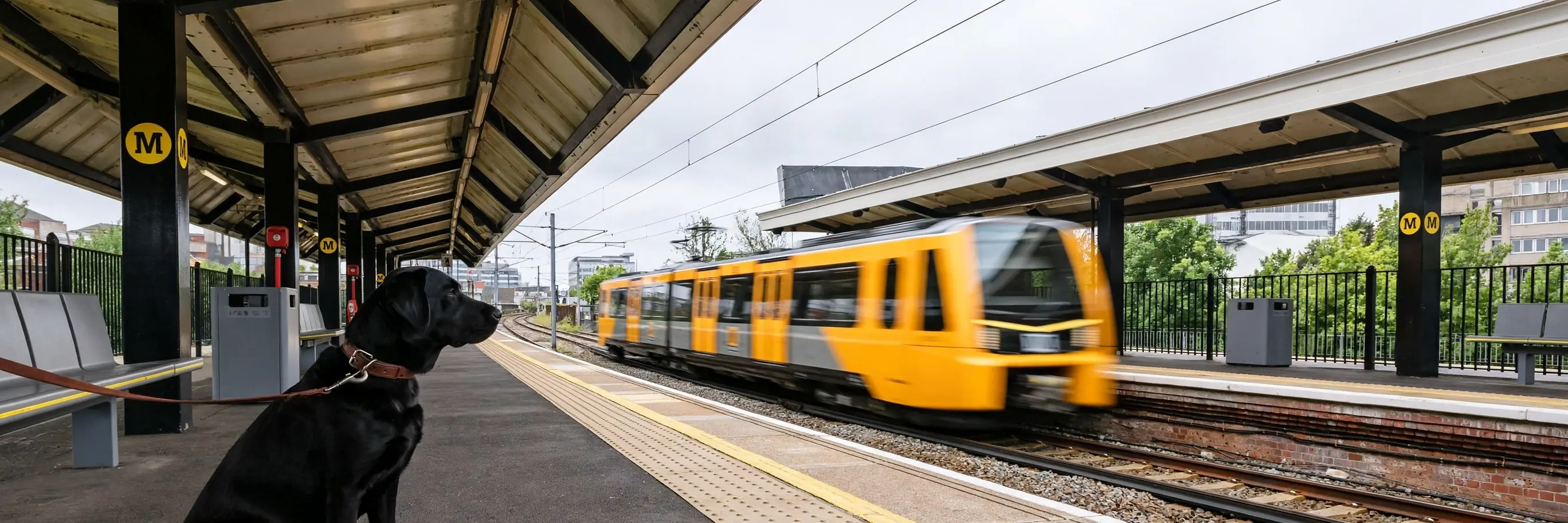
This guide is independent and contains no paid placement. If affiliate links are added later, they will be clearly marked and will not change our editorial checks.
Dogs travel free on the Tyne and Wear Metro. Keep your dog on a lead, under control and off the seats, and use the lift or stairs instead of the escalator. The Green line runs from Newcastle Airport to South Hylton via central Newcastle and Sunderland; the Yellow line loops from St James around the coast through Tynemouth and Whitley Bay to South Shields. Buy your own ticket with a Pop card or at a station machine, and check the official guidance before you travel, because fares, timetables and beach dog rules change.
How the Metro works
The first thing to picture is not a single line but a pair of lines that share one busy spine. The Tyne and Wear Metro is a light rail system with 60 stations and about 77.5 kilometres of track, run by Nexus, the Tyne and Wear Passenger Transport Executive. It serves Newcastle upon Tyne, Gateshead, North Tyneside, South Tyneside and Sunderland, and it has been running since August 1980, which makes it one of the oldest modern light rail systems in Britain. For a dog owner the useful fact is simpler: from almost anywhere in the conurbation you can reach the city centre, the airport, the coast or Sunderland without a car, and your dog rides free.
The Green line runs from Airport in the north-west to South Hylton in the south-east, through South Gosforth, central Newcastle, Gateshead and Sunderland. The Yellow line runs from St James in central Newcastle out through Wallsend, around the North Tyneside coast through North Shields, Tynemouth, Cullercoats and Whitley Bay, back inland through South Gosforth, then through central Newcastle a second time and south through Gateshead to South Shields. That loop is what makes the Yellow line special for dog owners: a single line takes you from the city to the beach, and the same line brings you home by a different route. Yellow line trains call at Monument twice on a full loop, once on the way out towards the coast and once on the way back towards South Shields, which catches first-time riders out — always check the destination shown on the front of the train and on the platform display, not just the line colour.
The two lines share the central corridor between South Gosforth and Pelaw. That shared stretch includes Jesmond, Haymarket, Monument, Central, Gateshead, Gateshead Stadium, Felling, Heworth and Pelaw, so for most city journeys either line will do, and the next train is usually only a few minutes away. North of South Gosforth the lines split: Green line trains head north-west to the airport, Yellow line trains head north-east to the coast. South of Pelaw they split again: Green line trains continue to Sunderland and South Hylton, Yellow line trains turn towards Jarrow and South Shields. If you are travelling with a dog, the split matters because a wrong-line train is not a disaster — you can change at South Gosforth, Monument or Pelaw — but it is much easier to avoid by reading the destination board before you board.
Most stations are at ground level and open to the air, which suits dogs far better than a deep underground railway. The underground stations are concentrated in the centre: St James, Monument, Manors, Haymarket, Jesmond, Central and Gateshead are below ground, along with Park Lane in Sunderland. Those stations are staffed, while many surface stations are unstaffed, with ticket machines, shelters, information displays, next-train indicators and help points. The open-air stations also mean that a dog waiting for a train gets fresh air and a view rather than a hot, crowded tunnel, although the exposed coastal stations can be very windy — hold the lead firmly at Whitley Bay or Tynemouth on a blustery day, and keep a nervous dog away from the platform edge.
Trains cross two great rivers, and both crossings are part of the pleasure of the ride. South of Central station the Metro crosses the Tyne on the Queen Elizabeth II Bridge, with the river, the quayside and the famous bridges spread out below. Further south, between St Peter's and Sunderland, the Green line crosses the Wear on the Monkwearmouth Bridge. A dog that is uneasy on bridges will not notice much — the crossings are short and the train is steady — but a dog that startles at sudden noise may react to the change in sound as the train leaves a tunnel or crosses a bridge, so a reassuring hand and a short lead help at those moments.
The Metro Flow project, a programme of works costing about £103 million, was designed to raise the frequency on the shared central section from five to six trains an hour and to improve reliability and journey times. It involved new track and signalling, including a doubled section between Pelaw and Bede on the South Shields branch. The practical result for dog owners is a more frequent service on the busiest part of the network, which means less time standing on a platform with a restless dog and a better chance of catching a quieter train if the first one arrives full. Frequencies and first and last trains still vary by line, day and direction, so check the official guidance before you travel rather than relying on a remembered timetable.
The dog rules in plain English
Dogs are welcome on the Tyne and Wear Metro, and they travel free of charge. There is no dog ticket, no dog fare and no need to book a place for your dog. The operator's guidance is short and clear: keep your dog on a lead, keep it under control at all times, do not let it on the Metro seats, and do not take it on the escalator — use the lift or the stairs instead. Those four rules cover almost everything, and they are worth following to the letter, because they are the reason the free-travel arrangement works: a well-behaved dog on a short lead is easy for staff and fellow passengers to accept, while a loose dog on a long lead in a crowded carriage is not.
A short lead is the single most useful piece of kit for a Metro journey. On a platform, a short lead keeps your dog close to your legs and well back from the edge, where trains arrive with little warning and the draught can startle a small dog. In a carriage, a short lead stops the lead trailing across the aisle, where it can trip another passenger or tangle in a closing door. A retractable lead is a poor choice on the Metro: locked short it is acceptable, but extended it gives a dog enough range to wander into another passenger's space, sniff a stranger's shopping or step into the doorway as the doors close. If you normally walk on a long line, swap it for a fixed lead of about a metre before you reach the station, and keep a treat pouch in your pocket so you can reward calm settling rather than wrestling the dog into position.
Where your dog sits or stands in the carriage matters more than most people expect. Dogs should stay on the floor, not on the seats, and the floor by the doors is usually the worst spot: every stop brings a wave of boarding and alighting passengers stepping over and around your dog. A better place is against a side wall or in the space beside a fixed seat, where the dog can lie down with its back to something solid and watch the carriage without being in the flow of people. On the new Class 555 trains there is more open floor space and a level step at the doors, which makes boarding easier; on older trains the step up could be awkward for a small or stiff dog, so a little lift or a ramp of encouragement helps. If the carriage is full, the kindest choice is often to wait for the next train, which on the shared central section is only minutes away.
Platform safety deserves the same attention you would give at a mainline station. Keep your dog behind the platform edge at all times, and never let it investigate the gap between the train and the platform. Some Metro platforms are curved, and the gap can be wider than it looks. At island platforms, where trains arrive on both sides, keep the dog on the side away from the arriving train until you know which train is yours. If your dog is the sort that lunges at trains, bicycles or other dogs, stand at the far end of the platform, away from the main entrance and the busiest waiting area, and board last rather than first, so you can choose the quietest carriage.
Other dogs are the most common surprise on the Metro. Because dogs travel free, you will meet other dogs, especially on fine weekends when half of Tyneside seems to be heading for the beach. Most are calm and well controlled, but not all are, and a head-on meeting in a narrow carriage doorway can escalate quickly. If you see another dog boarding, turn your own dog away, create distance, and use your body as a barrier. Do not let dogs greet nose to nose on a train: there is no room to retreat if it goes wrong, and a scuffle in a moving carriage is frightening for everyone. A muzzle is not required on the Metro, but if your dog is reactive, a well-fitted muzzle worn for the journey is a sensible precaution and a visible sign to other passengers that you are taking responsibility.
Toilet breaks need planning, because there are no toilets for dogs — or reliably for people — at most Metro stations. Give your dog a proper toilet walk before you travel, and plan a toilet stop at the other end before you head home. The coastal stations are well placed for this: Tynemouth, Whitley Bay, Cullercoats and South Shields all have grass, promenade and beach within a short walk. City centre stations are harder: the nearest green space from Monument or Haymarket is a walk away, so build in time. Carry poo bags, as always, and a small towel: a dog that has rolled on a wet beach will make the carriage damp and sandy, and a quick towel-down on the platform is courteous to the next passengers.
Tickets, Pop cards and fare zones
Your dog travels free, but you still need a ticket, and the Metro's ticket system is worth understanding before you travel. Fares are based on zones: the network is divided into zones A, B and C for Metro journeys, with central Newcastle in zone A, the airport and Sunderland in zone C, and the coastal stations spread across the zones in between. You pay according to how many zones you cross, and a ticket that covers all three zones covers the whole Metro network. A separate zone D exists for the Northumberland Line, which is a National Rail service rather than a Metro service, and it only matters if your journey combines the two.
The Pop card is the smartcard for Tyne and Wear public transport, and for most visitors it is the cheapest and easiest way to pay. Pop Pay As You Go lets you touch in and touch out at station gates or validators, and the fare is capped each day, so you never pay more than the daily cap no matter how many journeys you make. There is also a Pop app for Android, and a physical Pop card can be bought and topped up at stations and shops. Paper tickets are sold from machines at every station: singles, day tickets and season tickets in one, two and three zones. Paper tickets cost more than the equivalent Pop fare, so if you are making more than one journey in a day, Pop usually wins — but check the official guidance before you travel, because fares are revised, usually in the spring, and the figures in any guide can go out of date.
Touching in and out is the part visitors most often get wrong. You must touch your Pop card on a validator or gate at the start and at the end of every journey, even when the gates are open. If you forget to touch out, the system cannot tell how far you travelled, and you may be charged the maximum fare. At gated stations such as Monument, Haymarket, Central and Gateshead, the gates are part of the routine: touch in, walk through, and do the same on the way out. At ungated stations, look for the yellow validator on the platform or near the entrance. Keep your dog on a short lead while you do this, because the moment you are fumbling for a card is exactly the moment a dog wanders towards the platform edge or another passenger's legs.
Contactless bank cards are also accepted on the Metro, and for a one-off visitor they can be simpler than buying a Pop card. The capping behaviour can differ slightly from Pop, so if you are travelling for several days, compare the two before you commit. Children travel under their own rules: children under five travel free, and up to three children aged 11 and under travel free with a fare-paying adult under the Kids Go Free arrangement. Under-16 Pop cards and concessionary passes have their own conditions, and assistance dogs travel free and are not counted as pets — they are working dogs, and the pet rules about seats and leads still apply in the sense that the dog should be under control, but an assistance dog is welcome everywhere its owner goes.
Do not travel without a valid ticket. The Metro operates a penalty fare, currently £100 for travelling without a ticket, and inspectors do check, particularly on the busy central and coastal sections. A dog does not need a ticket, but you do, and "my dog was distracting me" is not a defence. Buy your ticket before you board, keep it until you have left the destination station, and if you are using Pop, make sure the card has enough credit before you set out — topping up at a quiet suburban station is easy, but doing it at a crowded city centre gate with a dog is not.
For a day out with a dog, the day ticket or the Pop daily cap is usually the right choice. A single to the coast and a single back can cost nearly as much as a day ticket, and a day ticket gives you the freedom to hop off at Cullercoats, walk to Tynemouth, and catch the next train home without buying another ticket. If you are staying for a week, look at weekly season tickets, which cover unlimited travel in your chosen zones. Whatever you choose, keep the maths simple: one all-zone day ticket or a Pop card with the daily cap covers every journey in this guide, from the airport to South Hylton and from St James to South Shields.
Green line: Airport to South Gosforth
The north-western end of the Green line is the quietest and most practical part of the network for a dog owner, and it starts at Newcastle International Airport. Airport station is directly connected to the terminal by a covered walkway, so a dog arriving by air — or, more commonly, a dog owner meeting someone at the airport — can step off a flight and onto a Metro train in minutes. The station is at ground level with an island platform, step-free access and a ticket machine, and the trains run directly into the city centre. For a dog, the airport leg is straightforward: the train is usually quiet at this end of the line, there is space to settle, and the journey into Newcastle takes about 25 minutes.
Callerton Parkway is the next station and the main park-and-ride for the airport end of the line. It has a large car park, which makes it a useful starting point if you are driving in from Northumberland or the north-west and want to leave the car and ride the Metro into the city or out to the coast. The station is open-air and step-free, with a straightforward platform layout, and the trains towards the city are frequent. Bank Foot follows, serving the Kingston Park area, and then Kingston Park itself, a suburban station beside a large retail park. These stations are not destinations in themselves for a visitor, but they are the reason the Green line works as a commuter railway: they connect housing, shops and offices to the city without a car.
Fawdon and Wansbeck Road are quiet residential stations, the sort where a dog can wait on the platform without much fuss and where the train pulls in with seats to spare. Regent Centre is different: it is a major interchange with a bus station and a large office and retail complex, and it is one of the busiest stations outside the city centre. The station has been modernised, with step-free access, lifts and clear signage, and it is the point where many bus passengers change onto the Metro. For a dog owner, Regent Centre is worth knowing about rather than visiting: if you are travelling from the north-west into the city with a nervous dog, the crowds here can be the first pinch point, so consider boarding at a quieter station or travelling outside the morning peak.
South Gosforth is where the Green line meets the Yellow line, and it is the key junction for the northern half of the network. Green line trains from the airport and Yellow line trains from the coast both pass through here, and it is the natural changing point if you are heading from the airport to the beach: change at South Gosforth onto a Yellow line train towards St James via the coast, and you are on your way to Whitley Bay or Tynemouth without going into the city centre at all. The station is at ground level with step-free access, and the change is a simple cross-platform or short walk. It is also the home of the Metro depot, so you may see trains stabled nearby — a sight that interests some dogs not at all and others a great deal.
From South Gosforth the Green line continues through Ilford Road, West Jesmond and Jesmond into the city centre. Jesmond is a pleasant, leafy suburb, and the station is underground, so remember the escalator rule and use the lift or stairs with your dog. West Jesmond and Ilford Road are quieter residential stations, useful if you are staying in Jesmond with a dog and want to avoid the city centre crowds. The whole north-western section is a good introduction to the Metro for a first-time dog traveller: the trains are frequent, the stations are mostly open-air and step-free, and the journey into the centre is short enough that a dog that is unsure about trains does not have to endure a long ride to find out whether it can cope.
Green line: Newcastle to Sunderland
South of the city centre, the Green line crosses the Tyne and runs through Gateshead, then east through Felling, Heworth and Pelaw before turning south to Sunderland. Gateshead station is underground and busy, serving the town centre and the Sage Gateshead and the Baltic Centre for Contemporary Art across the river. Gateshead Stadium is the next stop, beside the Gateshead International Stadium, and it is worth remembering on event days, when crowds can be heavy. Felling and Heworth are suburban stations; Heworth is an interchange with National Rail services on the Durham Coast Line, and it has a bus station as well, making it a useful changing point if you are arriving by train from Durham or Middlesbrough with a dog.
Pelaw is the junction where the Green and Yellow lines part company. Green line trains continue south towards Sunderland, while Yellow line trains turn east towards Jarrow and South Shields. Pelaw is also the point where the Metro joins Network Rail track for the run to Sunderland, sharing the line with mainline trains. The station is at ground level and step-free, and the change here is straightforward. For a dog owner heading to Sunderland, the important thing is to check the destination board: a train to South Shields will not take you to Sunderland, and the two leave from the same shared corridor, so it is easy to board the wrong one if you are distracted by your dog.
Beyond Pelaw, the Green line runs through Brockley Whins, Fellgate and East Boldon, then to Seaburn, Stadium of Light, St Peter's, Sunderland, Park Lane, University, Millfield, Pallion and finally South Hylton. This is the Wearside section, opened in 2002, and it feels different from the rest of the network: the stations are newer, the line runs through suburbs and beside the coast, and the trains share track with heavy rail. Seaburn station is the stop for Seaburn beach, a wide sandy beach that is popular with dog walkers outside the summer restrictions, and it is a short walk from the station to the seafront. Stadium of Light serves Sunderland's football ground and is extremely busy on matchdays, while St Peter's serves the university campus and the riverside.
Sunderland station itself is an interchange with National Rail, with services to Newcastle, Middlesbrough, Hartlepool and beyond, and it is the main gateway to the city centre. The station has been redeveloped, with step-free access and a modern concourse, and from here you can walk to the city centre, the museums and the riverside. Park Lane is underground and serves the bus station and the city centre from the south, while University station serves the university and the hospital. Millfield, Pallion and South Hylton are quiet residential stations at the southern end of the line; South Hylton has a single platform and is the terminus, a peaceful place to end a journey and a reminder of how far the Metro reaches — from the airport in the north-west to a quiet Wearside suburb in the south-east, all on one line.
For a dog day out, the Sunderland leg offers two distinct trips. One is the beach: take the Green line to Seaburn, walk the seafront, and check the seasonal dog rules for Roker and Seaburn beaches before you go, because parts of both are closed to dogs in the summer months. The other is the city: Sunderland's museums, the winter gardens and the riverside walks are within easy reach of the station, and the city centre is compact enough to explore on foot with a dog. Either way, allow time for the journey: Newcastle to Sunderland by Metro takes around 35 to 40 minutes, and the trains are less frequent on this section than on the shared central corridor, so a missed train matters more.
Yellow line: the coastal loop
The Yellow line's coastal section is the reason this guide exists. Starting at St James in central Newcastle, the line runs east through Manors, Byker, Chillingham Road, Walkergate and Wallsend, then turns north along the coast through Hadrian Road, Howdon, Percy Main, Meadow Well and North Shields, before reaching Tynemouth, Cullercoats, Whitley Bay and the inland stations beyond. It is the longest scenic stretch on the Metro, and on a clear day the train gives you glimpses of the river, the shipyards, the coast and the North Sea, all with a dog at your feet.
Wallsend is the first station with a real story to tell. The town grew around the shipyards and the Roman fort of Segedunum, at the eastern end of Hadrian's Wall, and the station is a short walk from the fort and museum. It is not a beach station, but it is a useful stop for a dog walk along the riverside, and the area around the station is quieter than the city centre. Hadrian Road and Howdon are small suburban stations, and Percy Main and Meadow Well serve residential North Shields. These are the stations where the Metro feels most like a local railway: short platforms, open air, a handful of passengers, and a dog that can wait in peace.
North Shields is the gateway to the Fish Quay and the ferry. The station is a short walk from the town centre, and downhill from there to the Fish Quay, where fishing boats land their catch and the cafes and fish restaurants cluster around the harbour. Fish Quay Sands, the small beach beside the quay, is open to dogs all year, which makes North Shields a useful fallback when the bigger beaches are under summer restrictions. The ferry landing is about ten minutes' walk from the station, downhill via Borough Road, and from there the Shields Ferry crosses to South Shields in seven minutes — a short, dog-friendly crossing that turns a coastal walk into a loop.
Tynemouth station is one of the most beautiful on the network. The station itself is a Victorian building with a long, elegant canopy, and at weekends it hosts a market in the station concourse, which can be busy and exciting for a dog — or overwhelming, depending on the dog. From the station it is a short walk to the village, with its pubs, cafes and shops, and then downhill to the priory, the castle headland, King Edward's Bay and Longsands beach. The walk from the station to the beach takes about ten minutes, and it is mostly downhill on the way there, which means it is uphill on the way back — a consideration for an older dog or a tired one at the end of a beach day.
Cullercoats is the next station north, and it is the quiet alternative to Tynemouth and Whitley Bay. The village sits around a small, sheltered bay with a harbour, a lifeboat station and a crescent of sand that is popular with families and paddleboarders. Cullercoats Bay itself is closed to dogs from 1 May to 30 September, so in summer the bay is not the place for a dog, but the coastal path and the village are still worth a visit, and the walk south to Tynemouth or north to Whitley Bay is one of the best on this coast. The station is small and open-air, with step-free access, and the trains are usually quiet here outside the summer weekends.
Whitley Bay station is a short walk from the town centre, the promenade and the beach. The town has a long seafront, a Spanish City dome that now houses restaurants and cafes, a promenade that runs for miles, and a beach that stretches from the town centre north towards St Mary's Island. The southern end of the beach is closed to dogs from 1 May to 30 September, but the northern end is open to dogs all year, so a summer visit means walking north rather than settling by the main promenade. In winter, when the restrictions lift, the whole beach opens up, and a long, empty stretch of sand with a dog off the lead — where the beach rules allow — is one of the best winter walks in the North East. Check the signs at the beach before you let your dog off, because the boundary between the restricted and open sections is marked on the ground, not on the Metro map.
Beyond Whitley Bay, the Yellow line turns inland through West Monkseaton, Monkseaton, Shiremoor, Northumberland Park, Palmersville, Benton, Four Lane Ends and Longbenton, before rejoining the Green line at South Gosforth. These are suburban stations serving housing estates and business parks, and they are not tourist destinations, but they matter for dog owners who live in the area or are staying nearby: they connect the coast to the city without a car, and they are the stations where a dog can board a quiet train and be in Newcastle in twenty minutes. Northumberland Park is also an interchange with the Northumberland Line, the National Rail service to Ashington and Blyth, which opens up the Northumberland coast for a longer day out.
Yellow line: South Shields and the ferry
South of Pelaw, the Yellow line runs through Hebburn, Jarrow and Bede, then Tyne Dock, Simonside and Chichester to South Shields. This is the South Tyneside section, and it has its own character: former shipbuilding and mining towns, riverside industry giving way to housing, and then the seafront at South Shields. Hebburn and Jarrow are small, quiet stations, and Jarrow is worth a stop for the monastery and the Bede museum, though the walk from the station is not short. Bede station serves the Jarrow area and the riverside, and Tyne Dock and Simonside serve industrial and residential South Shields.
South Shields station is the terminus, and it is now part of the South Shields Transport Interchange, a modern building that brings Metro, bus and ferry connections together. From the interchange it is a short walk to the town centre, the market square and the seafront, and a five-minute walk to the ferry landing. The town has a long beach, Sandhaven, a smaller beach, Littlehaven, and the long, open sweep of Marsden Bay to the south. The interchange itself is step-free and staffed, with clear signage and a waiting area, which makes it a comfortable place to arrive with a dog.
The Shields Ferry is the natural companion to a Yellow line day out, and it deserves a section of its own. The ferry crosses the Tyne between North Shields and South Shields in about seven minutes, sailing roughly every 30 minutes, seven days a week, with later sailings on Thursday, Friday and Saturday evenings and an earlier finish on Sundays. Dogs are welcome on board and travel free, on a lead and under control, just as on the Metro. Tickets are bought from the crew on board or by Pop Pay As You Go, and some Metro tickets are valid on the ferry — check the official guidance before you travel, because the ferry is not part of the Pop Pay As You Go network in the same way as the Metro, and the ticket that covers your train may not cover your crossing.
The ferry turns a one-way coastal walk into a loop. Ride the Yellow line to North Shields, walk down to the Fish Quay, take the ferry across to South Shields, walk the seafront at Sandhaven and Littlehaven, and catch the Metro home from South Shields station — or do it in reverse. The crossing itself is short and sheltered, and most dogs take it in their stride, but a dog that is nervous on boats may prefer the Metro route via Newcastle, which is longer but on dry land. The ferry landings are step-free, and the boats are accessible, but the walk down to the North Shields landing is steep, so an older dog may need a slow pace and a rest on the way.
South Shields also has a practical advantage for dog owners: the beaches here have a different pattern of restrictions from the North Tyneside coast. Sandhaven, the main beach, is closed to dogs between 8am and 6pm from 1 May to 30 September, but early mornings and evenings are fine all summer, and Littlehaven next door is open to dogs all year. Marsden Bay, further south along the coast, is also open to dogs all year. That means a summer evening visit to South Shields — a late train down, a walk on Littlehaven as the sun sets, and a quiet train home — is one of the easiest beach trips on the network, and it avoids the midday crowds that make the Metro unpleasant for dogs.
City centre hubs
Four stations carry most of the city centre traffic, and a dog owner should know each of them by feel. Monument is the busiest and the most confusing, because it has two levels and four platforms: the upper level serves the Green and Yellow lines through the city, and the lower level serves the Yellow line loop. The station is underground, staffed, and often crowded, with passengers changing between lines and heading for the shops on Northumberland Street and the Eldon Square centre. For a dog, Monument is best used as a through station rather than a meeting point: change trains here if you must, but keep the dog close, use the lift, and do not linger in the main concourse at peak times.
Central Station, listed on Metro maps as Central, is the interchange with National Rail at Newcastle Central Station, one of the great railway stations of Britain. The Metro station is underground, directly below the mainline station, and the connection is by lift, escalator or stairs — with a dog, take the lift. The mainline station above has its own rules for dogs on platforms, and the concourse is busy and echoing, so allow time and keep the dog on a short lead. Central is the natural station if you are arriving in Newcastle by train from London, Edinburgh or York with a dog and want to continue by Metro to the coast or the airport. Our guide to dogs on UK train platforms and in stations covers the mainline side of this journey in more detail, including lead rules, escalators and waiting rooms.
Haymarket is the station for the universities, the Civic Centre and the northern end of Northumberland Street. It is underground, staffed and busy, particularly during term time, when students pour through the station at all hours. The station has been modernised, with step-free access and lifts, and it is the closest Metro station to the Hancock Museum, now the Great North Museum, and to the city library. For a dog owner, Haymarket is useful as a starting point for a walk north into Jesmond Dene, a wooded valley park that is one of the best dog walks in the city — but the walk from the station to the Dene is through busy streets, so keep the dog on a short lead until you reach the park.
St James is the terminus of the Yellow line and the station for St James' Park, the home of Newcastle United. The station is underground, at the western end of the city centre, and on non-matchdays it is one of the quieter city centre stations — a useful place to start a Yellow line journey to the coast, because you can board an empty train at the terminus and settle your dog before the crowds join at Monument and Haymarket. On matchdays it is a different place entirely, and the section on matchdays below explains why you should avoid it then. Manors, the next station east, is a quieter alternative: a small underground station serving the eastern edge of the city centre and the Quayside, and a good place to board if Monument feels too busy.
The city centre stations share one practical feature: they are all staffed, all have lifts, and all have ticket gates. The gates are the pinch point for a dog owner: a dog on a lead and a passenger with a ticket and a bag can be a clumsy combination at a narrow gate. The trick is to go through the wide gate, usually marked for luggage and wheelchairs, where there is room for you and the dog together. If the wide gate is closed, ask a member of staff — the underground stations are staffed by law, and staff are used to helping passengers with dogs, luggage and pushchairs. Do not try to carry a large dog through a standard gate, and never let the dog go through the gate ahead of you on a long lead, where the barrier can close on the lead or the dog.
Step-free access and the new trains
The Metro was designed from the start to be step-free, and the claim that every station has step-free access is one of the system's proudest boasts. In practice, that means lifts at the underground stations, ramps or level access at the surface stations, and a network that is far more accessible than most British railways. For a dog owner, step-free access matters in two ways: it gives you a route that avoids the escalator, which dogs must not use, and it gives an older, arthritic or very small dog a way in and out of the station without a climb. Check the official guidance before you travel if a lift is essential to your journey, because lifts do break down, and a station that is normally step-free can be temporarily inaccessible.
The escalator rule is worth repeating, because it catches visitors out. Dogs must not be taken on Metro escalators, full stop. The reason is the risk to paws and claws on the moving steps, and the risk of a lead tangling in the mechanism. Use the lift or the stairs instead. At the underground stations the lift is usually near the main entrance, and it is signed. At busy times there may be a queue for the lift, particularly at Monument and Haymarket, where passengers with luggage, pushchairs and wheelchairs are all waiting for the same lift — allow a few extra minutes, and be patient. If your dog is small enough to carry, you may carry it on the escalator, but only if the dog is calm and secure in your arms; a wriggling dog on an escalator is dangerous, and the lift is still the safer choice.
The new Class 555 trains are the biggest change to the Metro in a generation. The fleet of 46 five-carriage trains, built by Stadler, began entering service in December 2024, and by late 2026 the new trains had taken over from the old Metrocars, which had run since the system opened in 1980. The new trains have air conditioning, charging points, better lighting, extensive CCTV and, most importantly for dog owners, an automatic sliding step at every door that bridges the gap between the train and the platform for near-level boarding. That step makes a real difference for a small dog, an older dog or a dog that hesitates at a gap: the dog can walk on and off the train without a jump or a lift.
Inside the new trains there is more open floor space than on the old Metrocars, which gives a dog room to lie down without blocking the aisle. There are also four wheelchair bays on each train, which are not for dogs — do not settle your dog in a wheelchair bay — but the open areas near the doors are useful, provided you keep the dog out of the flow of boarding passengers. The trains are also quieter and smoother than the old fleet, which helps a nervous dog, although the automatic announcements and the door chimes are still loud enough to startle a sensitive animal on its first journey. Sit near a window if your dog likes to watch the world go by, and near a door if your dog prefers to be able to see the way out.
Assistance dogs travel on the Metro like any other dog, except that they are working and their owner relies on them, so other passengers should give them space. If you are travelling with a pet dog, do not let it approach or distract an assistance dog: a guide dog that is distracted from its work can put its owner at risk. Keep your dog on a short lead, keep it away from working dogs, and if you are unsure whether a dog is working, look for the harness and the handler's focus — and give them a wide berth. The same courtesy applies to other passengers: not everyone likes dogs, and a dog that is calm, quiet and on the floor will be accepted far more readily than one that is jumping up, barking or taking a seat.
Beach day trips by Metro
The classic Metro beach day starts at Tynemouth, and it is worth doing properly. Catch a Yellow line train from St James or Monument towards the coast, get off at Tynemouth, and walk through the village to the priory headland. The priory and castle stand on a headland above the mouth of the Tyne, with views across to South Shields, and the headland walk is on a lead, with cliffs and a sheer drop in places — keep a firm hold. From the priory, walk down to King Edward's Bay, a small, sheltered cove that is closed to dogs from 1 May to 30 September, then on to Longsands, the long, wide beach that is the main draw. In summer, the southern end of Longsands is closed to dogs, but the northern end, towards Cullercoats, is open all year. In winter, the whole beach is yours.
Longsands is a working beach as well as a leisure beach: surfers use it year-round, the RNLI patrols in the summer season, and the surf can be strong, with rip currents on some days. Keep your dog out of the water unless you know the conditions, and never let a dog swim after a ball into a surf zone. The sand is clean and firm, good for running, and the dunes at the back of the beach are a good place for a sniff and a rest. There are cafes and toilets at the southern end of the beach and in the village, and the walk back to the station is uphill, so save some energy for the climb. If you are planning a longer walk, follow the coastal path north to Cullercoats and Whitley Bay, a walk of about 9 kilometres from Whitley Bay to Tynemouth and back, with the Metro at both ends.
Whitley Bay makes a different kind of day out: less village, more resort. The promenade runs the length of the town, the Spanish City dome is a landmark, and the beach is long and flat, ideal for a dog that likes to run in a straight line. The summer dog rules are the same pattern as Tynemouth: the southern end is closed to dogs from 1 May to 30 September, the northern end is open all year. Walk north from the town centre towards St Mary's Island, a small tidal island with a lighthouse that is cut off at high tide — check the tide times before you walk out, and do not let your dog chase the birds that nest on the island. The island itself is a nature reserve, and dogs should be on a lead there. The town centre has cafes, pubs and shops, and several of them welcome dogs, though policies change, so check before you settle in.
South Shields offers a third beach day, and it is the easiest to combine with the ferry. Ride the Yellow line to South Shields, walk to Littlehaven beach, which is open to dogs all year, and then along the seafront to Sandhaven. In summer, Sandhaven is closed to dogs between 8am and 6pm, but before 8am and after 6pm it is open, which makes an early-morning or evening visit the best time for a dog. The town also has a park, South Marine Park, with a lake, a miniature railway and open grass, and a long promenade that runs south to Marsden Bay, where the sea stacks and the Marsden Grotto pub sit beneath the cliffs. Marsden Bay is open to dogs all year, and the coastal walk from South Shields to Marsden is one of the most dramatic on this coast, though the cliffs mean dogs should be on a lead throughout.
Seaburn and Roker, on the Green line, are the Sunderland beaches, and they complete the set. Seaburn station is a short walk from Seaburn beach, a wide, sandy beach with a promenade, cafes and a seafront that is popular with families. Roker, a stop or a walk further south, has a pier, a lighthouse and a beach that is partly closed to dogs in summer. The pattern is the same as elsewhere: check the signs, respect the seasonal closures, and use the northern or quieter ends of the beaches in summer. A Green line day to Seaburn pairs well with a walk along the seafront to Roker and back, and the Metro home from Sunderland station if you walk far enough south.
Whatever beach you choose, the same practical rules apply. Take water for your dog: beach cafes may not always be open, and seawater is not a substitute for fresh water. Take a towel and a drying coat, because a wet dog on a Metro train is uncomfortable for everyone, and the wind on the coast can chill a wet dog quickly. Check the tide times, because several of these beaches narrow sharply at high tide and the coastal path can be cut off. And check the seasonal dog rules on the day, not just in this guide: the orders that set the summer closures are made by three different councils, they are renewed periodically, and the signs on the beach are the final authority. If a sign says no dogs, respect it, even if this guide says the beach is open — the sign is newer than the guide.
Matchdays, peaks and busy times
Newcastle United home matches transform the Metro. St James' Park holds more than 52,000 people, and on a matchday a large proportion of them arrive by Metro, filling the trains and the stations for an hour or two before kick-off and again for an hour after the final whistle. St James, Monument, Haymarket and Central stations are the worst affected, with queues, closed entrances, very full trains and a noise level that can frighten even a confident dog. If you can avoid travelling on the Metro at those times with a dog, do so. If you cannot, use a quieter station such as Manors or Jesmond, travel earlier or later than the main crowd, and wait for a later, emptier train rather than squeezing onto a full one.
The same advice applies to the morning and evening peaks on weekdays, roughly 7.30am to 9.30am and 4.30pm to 6.30pm, when commuters fill the trains between the suburbs and the city centre. A dog on a peak-time train is not forbidden, but it is uncomfortable: there is no room to lie down, the dog is stepped over and around, and the noise and crowding can be stressful. Travel outside the peaks if you can, and if you must travel at peak times, choose the quieter end of the line — the airport end of the Green line, the coastal end of the Yellow line — and board at a station where the train is still empty. The school holidays and fine summer weekends are the other busy times, particularly on the coastal Yellow line, when the trains to Tynemouth and Whitley Bay can be full of beachgoers by late morning.
Disruption is the other thing to plan for. The Metro is an ageing system undergoing major renewal, and engineering works, signal failures and overhead line problems do cause delays and part-closures, particularly at weekends. When the Metro is closed between two stations, replacement buses usually run, and the rules for dogs on replacement buses are not the same as on the Metro: bus operators have their own policies, and a dog that is welcome on a train may not be welcome on a bus, or may be carried only at the driver's discretion. Check the official guidance before you travel on a day when engineering works are planned, and have a backup plan — a different route, a later train, or a day out that does not depend on the Metro at all.
Weather matters on the Metro more than on an underground railway, because most stations are open to the sky. In heavy rain, the platforms are wet and slippery, and a dog can slip on a metal platform edge or a wet ramp. In high winds, the coastal stations are exposed, and a small dog can be buffeted by the wind as a train arrives. In hot weather, the trains can be warm, particularly the older trains without air conditioning, and a dog in a crowded carriage can overheat quickly — carry water, watch for panting, and get off at the next station if your dog is struggling. In snow and ice, the Metro can be disrupted, and the walk to and from the station can be treacherous for a dog as well as for you. The North East weather changes fast, so check the forecast as well as the timetable.
Planning a trip, start to finish
A good Metro day out with a dog starts the night before. Check the timetable and the engineering works, check the beach dog rules for your destination, and check the weather. Charge your phone, pack a lead, poo bags, water, a bowl, a towel and treats, and put your Pop card or ticket somewhere you can reach it without fumbling. Give your dog a good walk and a toilet break before you leave, and feed at the usual time — a dog that is fed and settled travels better than one that is hungry and restless. If this is your dog's first Metro journey, start small: a single stop, or a short ride to Jesmond and back, rather than a full journey to the coast.
On the day, arrive at the station with time to spare. Buy or top up your ticket before you reach the gate, keep your dog on a short lead, and stand back from the platform edge. Read the destination board before you board, and if you are unsure, ask a member of staff or another passenger — Metro passengers are used to helping visitors, and a dog is a good conversation starter. Board last, choose a quiet carriage, and settle your dog on the floor beside you, with its back to a wall if possible. Reward calm behaviour, ignore the inevitable interest from other passengers, and do not let strangers feed your dog without asking — a well-meaning passenger with a sandwich can cause a stomach upset that ruins the day.
At the other end, give your dog a toilet break and a sniff around the station area before you set off for the beach or the town. Dogs that have been cooped up on a train need a few minutes to stretch and sniff, and a dog that is allowed to do that is far more relaxed for the rest of the day. Keep the lead on until you are somewhere safe and the local rules allow off-lead exercise, and remember that the beach rules are different from the park rules: a beach that allows dogs may still require them to be on a lead near the promenade, the cafes or the nesting birds. Read the signs, watch the other dog owners, and follow the local pattern.
For the journey home, allow extra time. The walk back from the beach to the station is uphill at Tynemouth, the train may be busy at the end of a fine day, and a tired dog may need a rest before the journey. Give your dog water and a towel-down on the platform, check that you have everything — lead, bags, phone, ticket — and board a train that has room. If the first train is full, wait for the next one: on the shared central section the next train is only minutes away, and a quiet carriage is worth a short wait. When you get home, give your dog fresh water, a check for sand, salt and sore paws, and a quiet evening. A good Metro day out is not about how far you travelled, but about how calmly your dog travelled — and the Metro, with its free dog travel, its coastal loop and its step-free stations, is one of the easiest ways in Britain to give a dog a day by the sea without a car.
Newcastle itself rewards a slower look once the Metro has done the travelling for you. Our Newcastle with a dog guide covers the Quayside bridges, Ouseburn and Jesmond Dene in detail, with dog-friendly pubs and places to stay, and it pairs naturally with this guide: use the Metro to reach the coast in the morning and the city in the afternoon, or the other way round. And if your journey to Newcastle began on a mainline train, the platform advice in our guide to dogs on UK train platforms will help you through the busiest part of the trip. Compared with the capital, the Metro is a gentler introduction to city transport with a dog — our guide to dogs on London buses shows how different the rules and the crowds can be when you travel further south.
Practical questions
Before you go
Do dogs travel free on the Tyne and Wear Metro?
Yes. Dogs travel free of charge on the Tyne and Wear Metro, and there is no dog ticket to buy. You only pay your own fare, using a Pop card, a paper ticket or another valid ticket. Keep your dog on a lead and under control at all times, keep it off the seats, and use the lift or the stairs rather than the escalator.
Does my dog need to be on a lead on the Metro?
Yes. Dogs must be kept on a lead and under control at all times on Metro stations and trains. A short lead works best on platforms and in busy carriages, where a long lead can tangle around other passengers, luggage and doors. If your dog is nervous around crowds, travel outside the morning and evening peaks and choose a quieter carriage.
Can I take my dog on the escalator at a Metro station?
No. Dogs must not be taken on Metro escalators. Use the lift or the stairs instead. This matters most at the underground stations in central Newcastle and Gateshead, so allow a few extra minutes for the lift, especially at busy times when other passengers are also waiting for it.
Which Metro stations are best for a beach day with a dog?
Tynemouth is the best all-round choice, with Longsands beach a short walk from the station and the village, priory and harbour close by. Whitley Bay is the next stop up the coast and suits a promenade walk, while Cullercoats is smaller and quieter. South Shields, reached on the Yellow line, gives access to Sandhaven and Littlehaven beaches. Check the seasonal dog rules for each beach before you travel, because parts of the busiest beaches are closed to dogs from 1 May to 30 September.
Can dogs travel on the Shields Ferry?
Yes. Dogs are welcome on the Shields Ferry between North Shields and South Shields, and they travel free. Keep your dog on a lead and under control for the seven-minute crossing. The ferry runs about every 30 minutes, and the North Shields landing is a short walk from North Shields Metro station, so it pairs easily with a Yellow line journey.
What should I do with my dog on a matchday at St James' Park?
Avoid the Metro for one to two hours before and after a Newcastle United home match if you can. St James, Monument, Haymarket and Central stations are extremely busy at those times, with queues, closed entrances and very full trains. If you must travel, use a quieter station such as Manors or Jesmond, keep your dog on a short lead close to your legs, and wait for a later, emptier train rather than squeezing on.