This guide is independent and contains no paid placement. If affiliate links are added later, they will be clearly marked and will not change our editorial checks.
Doncaster suits dogs because it is flat, compact and full of water and green space. Base your day on the Lakeside lake loop or one of the big parks, visit the Minster and the markets in a short town-centre burst, and treat Yorkshire Wildlife Park as a split visit, since pet dogs are not admitted. Keep dogs on a lead by the lakes, in the town centre and on nature reserves, and check the official guidance before you travel.
First impressions: a city built for easy walking
Doncaster does not shout for attention the way its Yorkshire neighbours do. It became a city in 2022, when it was granted city status as part of the Platinum Jubilee celebrations, but it still behaves like the market town it has been for centuries: low-rise, practical, and organised around its market square, its Minster and the River Don. For a dog owner, that modesty is the point. The ground is flat, the centre is compact enough to cross on foot in minutes, and the best walks are not hidden away in the hills — they are the lakes, the parkland and the old railway and riverside trails that run through and around the city.
The city sits in the south of Yorkshire, roughly between Sheffield, Leeds and Lincoln, on the East Coast Main Line. That position makes it an easy stop rather than a destination you have to plan a whole holiday around, and it works well as exactly that: a one- or two-night break, a base for exploring South Yorkshire, or a long weekend built around water, parks and one big wildlife attraction. If you arrive expecting a dramatic cathedral city, you may be surprised by how ordinary Doncaster looks at first glance. Give it a morning by the lake and an hour in the market, and the appeal becomes clearer: this is a place where a dog can be part of the day rather than a problem to solve around it.
Doncaster's history explains its shape. It grew as a Roman fort and a market town on the Great North Road, then as a railway town — the famous locomotive Flying Scotsman was built at Doncaster Works in 1923 — and as a coal-mining centre. The railway heritage is still visible in the station, the old works buildings and the railwayana collections in the city, and the mining past survives in the villages around it. None of that matters much to a dog, but it matters to the walk: the flat railway lines and river valleys that once carried coal and locomotives now carry the Trans Pennine Trail and long, level footpaths that suit older dogs, puppies and owners who would rather not climb.
The first decision to make is what kind of trip this is. Doncaster works best as an outdoors-first break: a morning walk by the lake, a midday wander through the market, an afternoon in a park or on a trail, and an evening in a dog-friendly pub. It is less suited to a sightseeing checklist, because most of the indoor attractions — the Minster, the museums, the wildlife park — do not admit pet dogs, and the town centre is at its best in short bursts. Plan around that reality instead of fighting it, and the trip feels relaxed. Try to drag a dog through every indoor attraction in a day, and everyone will be tired and frustrated by lunchtime.
That is why this guide is organised the way it is: walks first, town centre second, and the big attractions handled as split visits. If you are travelling with another adult, the split-visit system — one person goes inside while the other walks the dog, then you swap — is the single most useful technique in this guide. It turns the Minster, the museums and Yorkshire Wildlife Park from closed doors into shared experiences, and it means the dog still gets a proper walk while the humans get their culture.
Lakeside and the lake loop
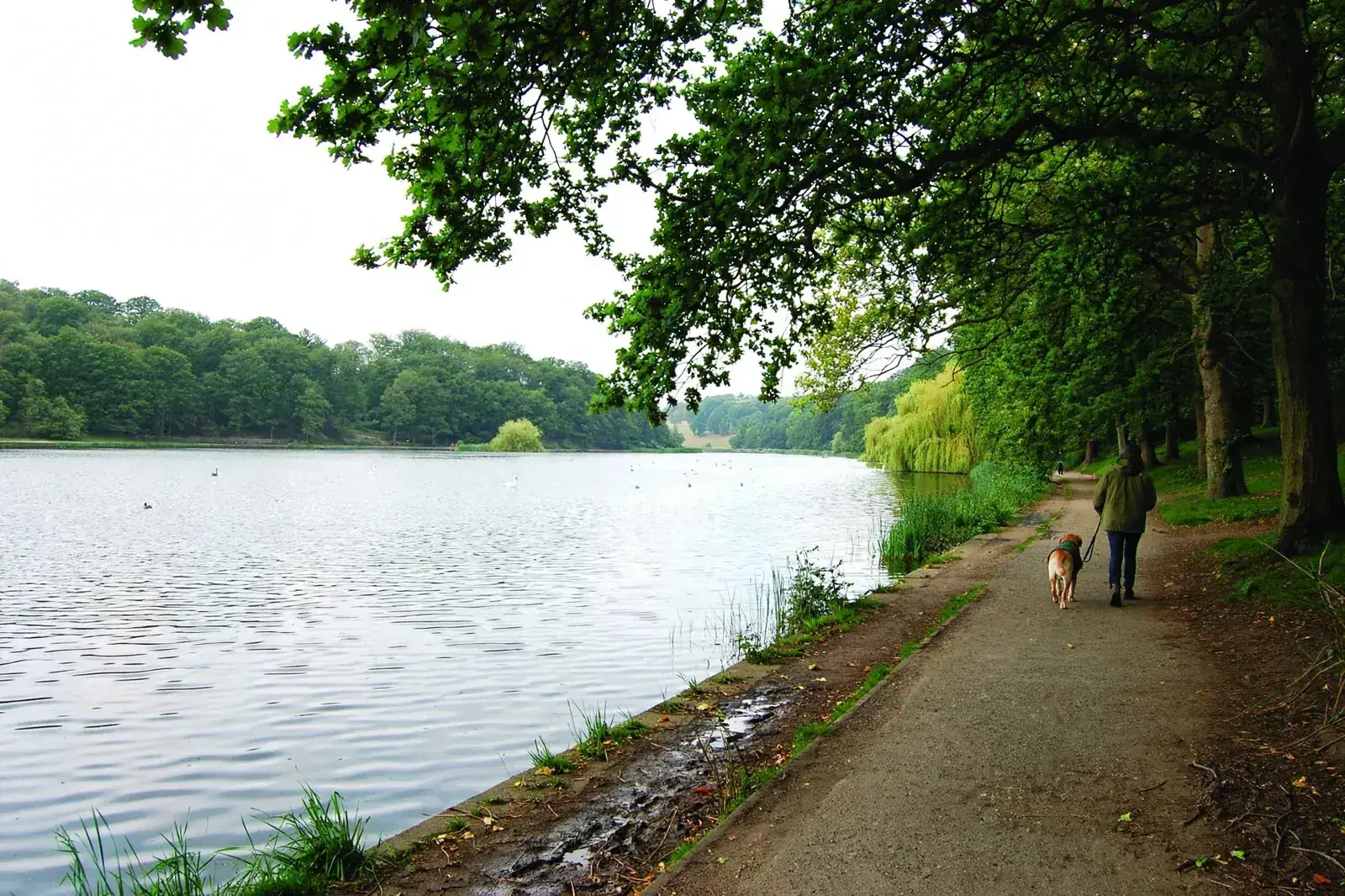
Lakeside is the natural starting point for any dog trip to Doncaster. The lake sits to the south-east of the city centre, beside The Dome leisure centre and the Lakeside Village outlet centre, and the paths around it form a flat, surfaced loop that is easy in every season. It is the walk most local dog owners use most often, and it is the best place to begin your visit: it tells you what Doncaster walking is like — open sky, water, long sightlines, and plenty of room to let a dog sniff without a crowd pressing in.
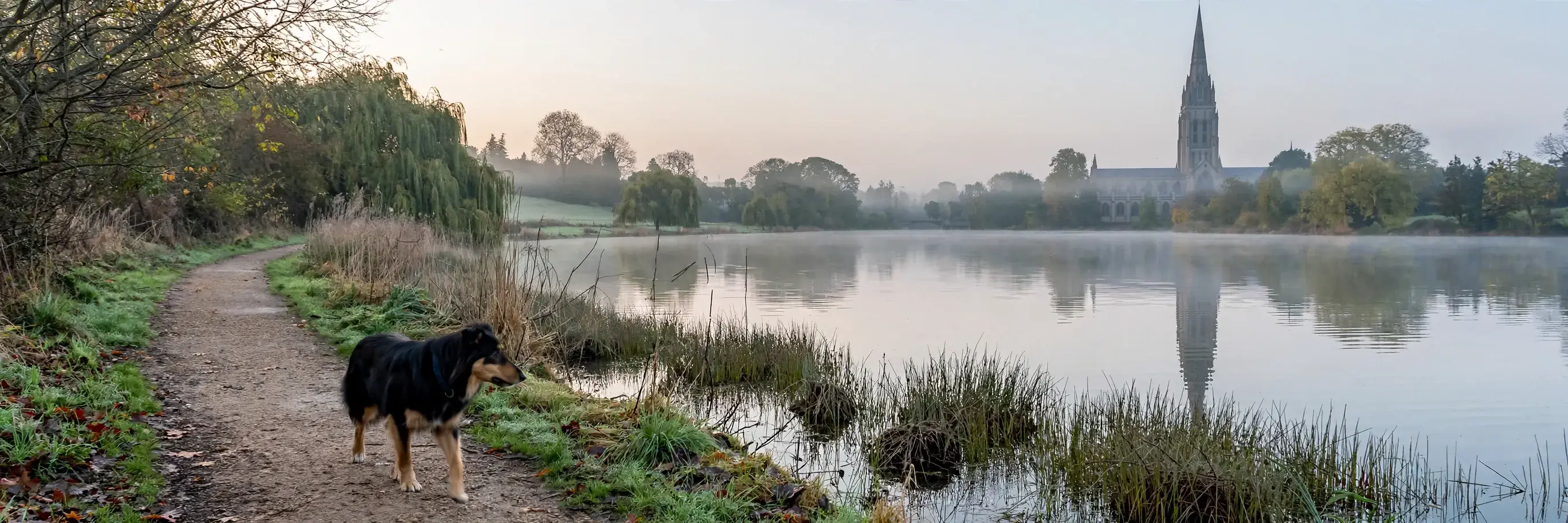
The loop itself is straightforward. Park near the lake, pick up the path, and follow the water. The surface is firm and mostly level, which suits older dogs, dogs recovering from injury and pushchairs, and the route is short enough to be a gentle twenty-minute stroll or long enough, with a detour along the connecting paths, to stretch into an hour. There are benches along the way, open grass where a dog can have a run on a long line, and views across the water that change with the light — early morning is the quietest and often the prettiest time, when the mist sits on the lake and the only other users are joggers and other dog walkers.
Keep your dog on a lead near the water. The lake is used by anglers, rowers and other visitors, and the banks are not fenced in every stretch, so a dog that loves water can be in it before you have finished saying its name. That is not a reason to avoid the lake — it is a reason to walk it with a lead in your hand and a towel in the car. Water-loving dogs will get wet here, and in cold weather a wet dog needs drying and warming up promptly. The same rule applies to the smaller ponds and drainage channels that thread through the area: treat every stretch of open water as a lead-on zone unless the signs say otherwise.
Lakeside is also practical in a way that matters on a dog trip. There is car parking close to the lake, the outlet centre and The Dome are nearby if you need supplies, and the area is well lit and well used, so an early-morning or evening walk feels comfortable. If you are staying in Doncaster for more than a day, use Lakeside as your default morning walk: the same route every morning gives the dog a familiar routine, and familiarity is what settles a dog in a new place faster than any amount of sightseeing.
One caution: Lakeside is popular. On a sunny weekend afternoon the paths fill with families, cyclists and other dogs, and a reactive dog will find it harder work than at 7am. If your dog struggles with other dogs, walk early, choose the quieter stretches away from the main path, and keep the walk short. The lake is at its best when it is quiet, and quiet is easy to find if you time it right.
Sandall Park and Cusworth Hall
If Lakeside is Doncaster's everyday walk, Sandall Park and Cusworth Hall are its green lungs — the two big parks where a dog can have a proper run and the humans can slow down. Both are worth a visit, and they suit different moods: Sandall Park is a busy, community park with a lake and open grass, while Cusworth Hall is a grander, more landscaped estate with a lake, woodland and views back across the city.
Sandall Park sits to the north-east of the centre and is one of the largest parks in Doncaster. It has a lake, wide open lawns, mature trees, a play area and a network of paths that link into the surrounding streets. For dogs, the open grass is the main attraction: there is room to play fetch, to practise recall on a long line, and to let a dog burn off energy before a calmer afternoon. The lake draws water birds, so keep dogs on a lead near the water, and be aware that the park is well used by families, runners and other dog walkers, especially at weekends. Early mornings and weekday afternoons are the calmest times, and the park rewards a slow lap rather than a quick circuit: take the paths, let the dog sniff the hedgerows, and use the benches as rest stops for older dogs.
Cusworth Hall is a different kind of day out. The hall itself is an 18th-century country house, now a museum, set in parkland with a lake, woodland walks and formal gardens. Dogs are welcome in the parkland on a lead, but not inside the museum itself, so this is another split-visit stop: one person can look around the house while the other walks the dog through the grounds. The lake at Cusworth is smaller and more sheltered than the one at Lakeside, and the woodland paths give shade in summer and shelter in wind — useful in a city where the open lakesides can be very exposed on a breezy day. The views from the higher ground back towards Doncaster are worth the gentle climb, and the climb itself is gentle: nothing here is steep, and the paths are mostly firm.
Between the two parks, you have a walk for every mood. Sandall Park for energy and open space, Cusworth Hall for shade, views and a slower pace. If you have a dog that needs a long, tiring walk, combine the two across two days rather than trying to do both in one morning. A dog that has had a proper morning walk will settle happily in a pub or a cafe in the afternoon; a dog that has been rushed from park to park will not.
Other green spaces are worth knowing about too. Potteric Carr Nature Reserve, run by the Yorkshire Wildlife Trust, lies close to Lakeside and offers a wilder, reed-bed landscape with hides and boardwalks. Dogs are allowed on a lead on some routes, but the reserve is primarily a wildlife site, so check the official guidance before you travel and keep to the paths where dogs are permitted. The Town Fields, south of the centre, give a shorter, flatter green walk close to the river, and the smaller neighbourhood parks dotted around the city are useful for a quick evening toilet walk if you are staying nearby.
The Minster, the markets and the town centre
The town centre is best taken in one short, well-planned burst. Start at Doncaster Minster, the great church of St George that dominates the skyline with its tall tower and spire. The Minster is a Grade I listed building designed by George Gilbert Scott and built in the 1850s after a fire destroyed the earlier church. It is one of the finest Victorian churches in the north of England, and it is worth looking at from the outside even if you never go in. Pet dogs are not normally admitted inside, while assistance dogs are welcome, so plan a split visit: one person goes in to look around while the other walks the dog around the Minster grounds and the streets nearby, then swap. Check the official guidance before you travel, as arrangements for services, concerts and events can change.
The Minster grounds themselves are a pleasant place to walk a dog on a lead. The churchyard is green and relatively quiet, the paths are paved, and the tower makes a useful landmark if you lose your bearings in the town centre. From there, walk the short distance to the market — the heart of Doncaster and the reason the town exists. Doncaster Markets are among the largest traditional markets in the country, and the market square, the Corn Exchange and the Wool Market together make one of the most characterful shopping areas in South Yorkshire.
The Corn Exchange is the building to look for: a Grade II listed market hall from 1849, with a grand facade and a busy interior of stalls. The outdoor market and the covered halls sell everything from fresh fish and meat to fruit, vegetables, flowers, clothes and household goods. Dogs are generally welcome around the outdoor market stalls on a lead, but the covered halls can be crowded, noisy and narrow, with food on low stalls at nose height. That is a lot of temptation and a lot of feet for a dog to navigate. If your dog is calm and comfortable in crowds, a short loop through the market is enjoyable. If your dog is nervous, reactive or very food-motivated, walk the dog around the edge of the market square instead, and let one person do the shopping while the other waits outside with the dog.
The town centre beyond the market is compact and walkable. The main shopping streets run from the market square towards the station, and the Frenchgate Centre covers much of the indoor shopping. Dogs are not generally admitted inside shopping centres except assistance dogs, so treat Frenchgate as a humans-only stop. The streets themselves are fine for a dog on a lead, and there are several dog-friendly cafes and pubs in and around the centre where you can sit down afterwards — see the section below. The riverside is a short walk from the centre, and the paths along the River Don give a quieter alternative to the shopping streets when the dog needs a break from the crowds.
Timing matters in the town centre. Market days are the busiest, and the centre is at its liveliest on Saturday mornings. That is also when it is at its best — the stalls are full, the atmosphere is buzzy, and there is plenty to look at — but it is also when a nervous dog will struggle most. If your dog is confident, go on a market morning and enjoy it. If your dog is not, go on a weekday afternoon, when the centre is calmer and the dog can walk the same streets without the press of people. Either way, keep the town-centre visit to an hour or so, and follow it with a proper walk: the dog will have earned it, and you will enjoy the rest of the day more.
Yorkshire Wildlife Park and split visits
Yorkshire Wildlife Park, at Branton on the eastern edge of Doncaster, is the city's biggest single attraction and the one most visitors ask about first. It is a large, modern wildlife park with polar bears, lions, giraffes, rhinos and many other animals in spacious, naturalistic enclosures, and it is a full-day visit for most families. It is also, for dog owners, the clearest example of why the split-visit system matters: pet dogs are not admitted to the park, although assistance dogs are accepted under the park's access arrangements, so a dog cannot come with you through the gates.
That does not mean you have to skip it. If you are travelling as a couple or a group, plan a proper split visit. One person — or one part of the group — goes into the park while the other takes the dog for a long walk on the paths and lanes around Branton, then you swap at lunchtime. The countryside around the park is flat and open, with quiet lanes and field paths, and a dog that has had a good morning walk will settle in the car or, better, in dog-friendly accommodation while the second half of the group visits the park. What you must not do is leave a dog in a car while you visit the park, even on a mild day: cars heat up quickly, and a dog left alone in a car park is at risk and will be distressed. Check the official guidance before you travel for the park's current dog policy and access arrangements.
If you are travelling alone with a dog, the honest answer is to leave Yorkshire Wildlife Park for a trip without the dog, or to build your Doncaster break around the lakes and parks instead. There is no shame in that: Doncaster has enough walking to fill two days without the wildlife park, and a day spent rushing between a car park and a wildlife park is a worse day for everyone than a day spent properly walking the lakes. If you do want to visit the park, consider a local dog-sitting or day-care service, or ask your accommodation whether they can recommend one — but book it well ahead, especially in school holidays, and check the official guidance before you travel.
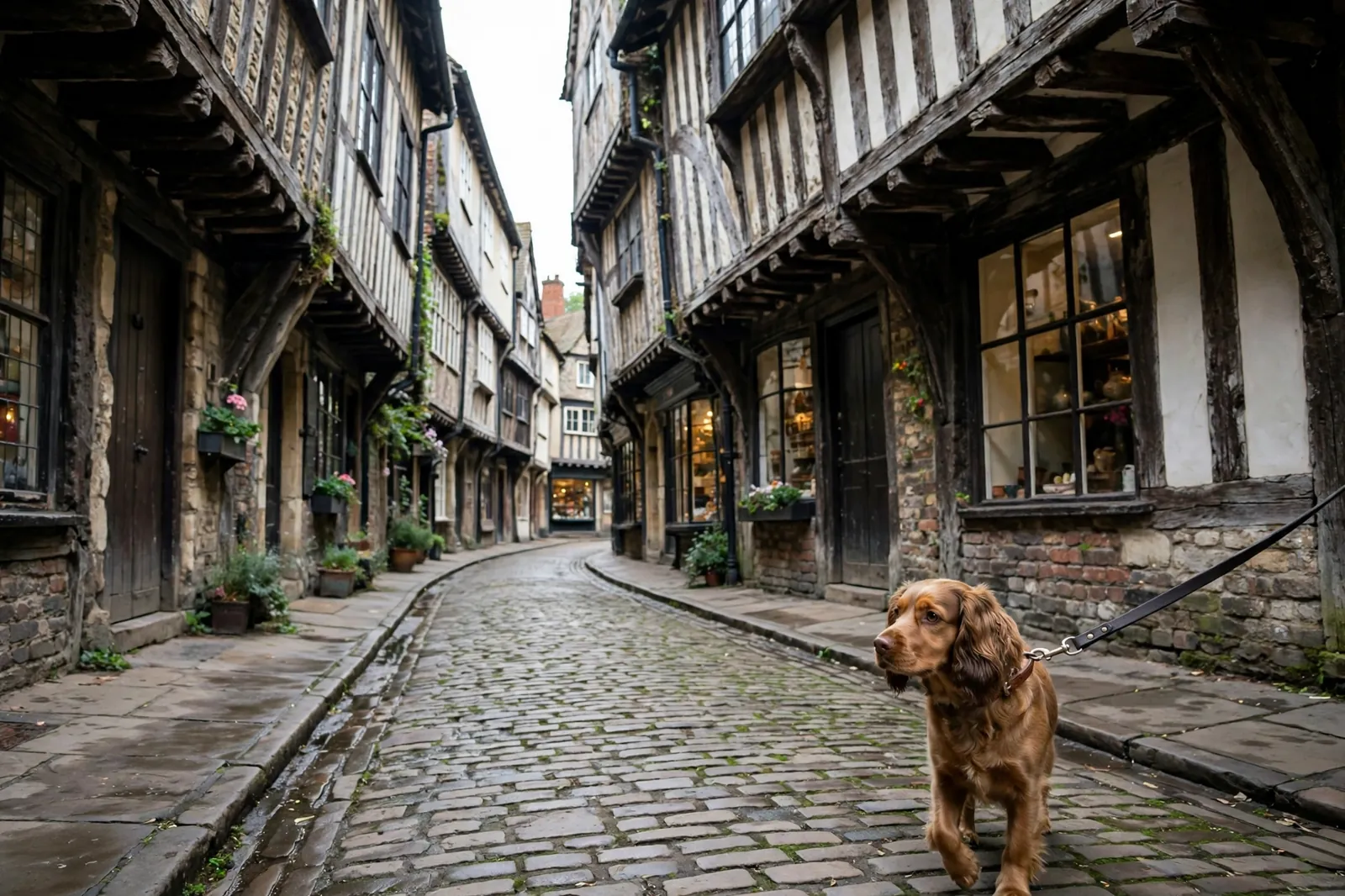
The same split-visit logic applies to the other indoor attractions in and around Doncaster. Doncaster Museum and Art Gallery, in the town centre, does not admit pet dogs. Brodsworth Hall and Gardens, a grand Victorian house a short drive north-west of the city, welcomes dogs on a lead in the gardens and grounds but not inside the house. Conisbrough Castle, the great Norman keep south-west of Doncaster, allows dogs on a lead in the grounds. In each case, the pattern is the same: the grounds are the dog's part of the visit, the interior is the humans' part, and the two can be shared by taking turns. For a broader sense of how other Yorkshire cities handle the same split-visit problem, our guide to York with a dog covers Minster split visits, city walls rules and riverside walks in a city where the same trade-offs apply.
One more practical point about the wildlife park: it is busiest in school holidays and on summer weekends, when tickets can sell out and the car parks fill early. If you are planning a split visit, go on a weekday if you can, arrive early, and agree in advance who goes in first and where you will meet. A split visit only works if everyone knows the plan before you arrive; deciding it in the car park, with a dog getting restless, is how good plans fall apart.
Hatfield Moors and the Trans Pennine Trail
For dogs that need a longer, wilder walk, the best option near Doncaster is Hatfield Moors, part of the Humberhead Peatlands National Nature Reserve to the east of the city. This is a lowland raised bog — a rare and fragile landscape of peat, heather, birch woodland and open water — and it feels a world away from the town centre. The paths are flat, the sky is enormous, and on a quiet weekday you can walk for an hour and meet almost nobody. It is the walk to choose when your dog needs space and you need quiet.
Because Hatfield Moors is a nature reserve, the rules are stricter than in a town park. Dogs must be kept on a lead, and you must stay on the marked paths: the bog surface is fragile, the drainage channels are deep and hidden, and ground-nesting birds use the open moor in spring and summer. That sounds restrictive, but in practice it suits most dogs well — a long lead gives a dog room to sniff and explore without leaving the path, and the flat, straight tracks are easy on older legs. Bring water, because there is little shade and no shop, and bring a map or a charged phone, because the moor is big and the paths can look alike. Check the official guidance before you travel for current access and any seasonal restrictions.
The Trans Pennine Trail is the other long-distance option. The trail runs coast to coast across the north of England, and the Doncaster section follows the River Don and the old railway lines through the city and out into the countryside. The surface is mostly firm and surfaced, the gradients are gentle, and the route is well signed. You do not need to walk the whole trail — nobody does in a day — but you can pick it up in the city centre, walk a few miles out along the river, and come back the same way. It is an ideal walk for a dog that likes a long, steady outing: flat, interesting, with water and wildlife to look at, and with plenty of places to turn back when the dog has had enough.
The River Don itself deserves a mention. The river runs through Doncaster from Sheffield towards the Humber, and the riverside paths give a quieter, greener alternative to the town-centre streets. The towpaths and riverside trails are good for a short evening walk, especially in summer when the water attracts herons, kingfishers and dragonflies. Keep dogs on a lead near the river, particularly where the banks are steep or the current is strong, and watch for anglers and cyclists sharing the path. After heavy rain the riverside paths can be muddy and, in places, flooded, so check conditions before you set out and choose the lake loop instead if the river is high.
For a longer day out, the countryside south and east of Doncaster opens up into the flat farmland of the Humberhead Levels, with quiet lanes, drainage channels and small villages. This is cycling and walking country rather than dramatic hill country, and it suits dogs that like steady, open walking. It is also worth knowing that the area around Doncaster is rich in nature reserves and country parks — Potteric Carr near Lakeside, the Dearne Valley to the west — so if you are staying for several days, you can walk somewhere different every morning without driving far. If you are combining Doncaster with another Yorkshire city, our guide to Leeds with a dog covers Roundhay Park and the Leeds-Liverpool Canal, a useful contrast to Doncaster's flat lakes and moors.
Where to stay with a dog
Doncaster has a good range of dog-friendly places to stay, from hotels near the station and the racecourse to self-catering cottages and lodges in the surrounding villages. The best choice depends on your dog, not on the star rating: a hotel room with a ground-floor entrance and a patch of grass outside the door is worth more than a grander room up two flights of stairs with nowhere to walk the dog at midnight.
When you book, ask the questions that actually matter. Is there a pet fee, and how much is it per night or per stay? How many dogs are allowed, and is there a size or breed condition? Is the room on the ground floor, and is there direct access to an outdoor area? Can the dog be left alone in the room, and if so, for how long and under what conditions? Is there a dog-washing or drying area, or at least an outdoor tap? And where is the nearest place for a late-night toilet walk? Get the answers in writing with your confirmation, and keep them with your booking. A hotel that answers these questions clearly has usually thought about dogs properly; one that gives vague reassurances has not.
Hotels in the town centre suit travellers arriving by train, because Doncaster station is on the East Coast Main Line with direct services to London, Leeds, Sheffield, York and Edinburgh. A town-centre hotel puts you within walking distance of the Minster, the market and the station, and the flat streets make evening walks easy. The trade-off is noise and limited outdoor space: a town-centre hotel room is rarely the place for a dog that barks at every footstep in the corridor. If your dog is noise-sensitive, look instead at the hotels and guesthouses on the edge of the city, near Lakeside or the racecourse, where the rooms are quieter and the walks start at the door.
Self-catering cottages and lodges in the villages around Doncaster often suit dogs better than hotels, especially for longer stays or multi-dog households. A cottage with an enclosed garden gives the dog a safe place to stretch its legs first thing in the morning, and a kitchen means you can feed the dog at its usual time without negotiating a hotel restaurant. Look for cottages that state their dog policy clearly — number of dogs, any pet fee, whether the garden is fully enclosed and how high the fence is — and be honest about your dog when you book. A cottage owner who knows your dog is a large, muddy spaniel will give you the right property; one who discovers it on arrival may not invite you back.
Booking ahead matters in Doncaster more than in some cities, because the dog-friendly rooms are fewer than the total rooms, and the best ones — ground floor, near a door, near grass — go first. That is especially true during the St Leger Festival at Doncaster Racecourse in September, when the city fills up and prices rise. The St Leger is one of the great events of the British racing calendar, and the racecourse is a short distance from the centre, but dogs are not generally admitted to the racecourse, so festival week is a poor time to bring a dog unless you are planning split visits or have booked dog care. Check the official guidance before you travel if you are visiting during race week.
Camping and caravanning are also options around Doncaster, with sites in the surrounding countryside that welcome dogs. The same questions apply: how enclosed is the pitch, where is the dog exercise area, and what are the rules about leaving dogs in caravans? A touring pitch near a lake or a trail can be a lovely base, but check the site's dog policy in advance, because some sites restrict the number of dogs per pitch or require dogs to be on a lead at all times.
Dog-friendly pubs and cafes
Doncaster's pubs are one of the best parts of a dog trip here. South Yorkshire has a strong pub tradition, and many of the city's pubs welcome dogs, particularly in the bar area and on the terrace. The pattern is familiar across Britain: dogs are usually welcome in the bar and the beer garden, less often in the restaurant area, and almost never in the kitchen. The best approach is to ask before you sit down, and to bring a blanket for the dog to lie on — a dog that settles on its own blanket under the table is welcome almost everywhere, while a dog wandering between tables is not.
In the town centre, look for the traditional pubs around the market square and the Minster, where the atmosphere is relaxed and the staff are used to dogs. The pubs in the villages around Doncaster — at Cusworth, at Branton, at Conisbrough — often have beer gardens and a more rural feel, and they make a good end to a walk. If you are walking the Trans Pennine Trail or the lanes around Hatfield Moors, a village pub lunch is the natural reward, and many of them keep water bowls by the door and dog treats behind the bar. Check the official guidance before you travel, because dog policies can change, and a pub that welcomed dogs last year may have changed its rules.
Cafes are more variable. The cafes around Lakeside and in the parks are generally dog-friendly, at least on the terrace, and the cafes in the market area often welcome dogs too. The rule of thumb is that a cafe with outdoor seating is usually a safe bet, while a small indoor cafe with food on display may not be. If you are unsure, ask — most cafe owners would rather you asked than brought a dog in and caused a problem. And if you are turned away, take it gracefully: the dog does not know it has been refused, and there will be another cafe a few minutes' walk away.
A few practical points make pub and cafe visits smoother. Feed the dog before you go, so it is not hungry and restless at the table. Bring a chew or a stuffed Kong to keep the dog occupied while you eat. Choose a table in a corner or by the door, where the dog is out of the main flow of people. And keep the visit short the first time: a successful twenty-minute pub visit is worth more than a failed hour, and a dog that learns pubs are calm, boring places will settle happily in them for years. If your dog barks, paces or begs, take it outside for a short walk and try again, or cut the visit short — pushing through rarely helps.
Getting there, parking and getting around
Doncaster is easy to reach, and the journey is part of why it works as a dog break. The station is on the East Coast Main Line, with direct trains to London King's Cross in around an hour and forty minutes, and to Leeds, Sheffield, York and Edinburgh. Dogs travel free on most trains in the UK when they are on a lead or in a carrier, and Doncaster station is step-free and straightforward to navigate with a dog. If you are travelling by train, book a seat in advance where possible, bring a blanket for the dog to lie on, and avoid the busiest peak services if your dog is nervous in crowds. The walk from the station to the town centre is short and flat, and the market and the Minster are a few minutes away on foot.
By car, Doncaster is served by the A1(M) and the M18, and the drive from Leeds, Sheffield or Lincoln is under an hour in normal traffic. That makes it an easy day trip as well as a weekend break, and it means you can bring everything the dog needs without worrying about luggage limits. Parking in the town centre is in the usual mix of council car parks and the Frenchgate Centre car park, and there is parking near Lakeside and at the parks. Charges and opening hours change, so check the official guidance before you travel, and use a car park close to your first walk rather than the cheapest one on the edge of town — a short walk from the car to the lake is worth more than saving a pound.
Getting around Doncaster with a dog is mostly a matter of walking. The centre is compact, the ground is flat, and the main walks — Lakeside, the parks, the riverside — are all within a short drive or a longer walk of each other. Local buses accept dogs at the driver's discretion, which usually means a well-behaved dog on a lead is fine, but a large or excitable dog may be refused, especially at busy times. Taxis are a useful fallback: many local firms accept dogs if you mention the dog when you book, and it is worth asking your accommodation which firms they recommend. If you are planning to use buses or taxis, ask in advance rather than assuming, and have a backup plan — a walk back to the hotel is always an option in a city this flat.
One thing to know about Doncaster's roads: the city is built around a ring road, and the main roads can be busy. Keep dogs on a lead near all roads, use the pedestrian crossings, and avoid the ring road on foot where there is a quieter alternative. The flatness that makes Doncaster easy to walk also makes it easy to cycle, and the cycle paths around Lakeside and along the Trans Pennine Trail are shared with walkers, so keep an eye out for bikes and keep the dog on a short lead on shared paths.
Practical kit, vets and weather
Packing for Doncaster is packing for flat, exposed, changeable weather. The lakes and the moors are open to the wind, and the rain in South Yorkshire can arrive quickly and stay all afternoon. Pack a waterproof coat for yourself and, if your dog feels the cold or hates being wet, one for the dog too. A long lead is the most useful single item: it gives a dog room to explore on the moor and in the parks while keeping it under control near water, roads and livestock. Bring a spare lead, plenty of poo bags, water and a portable bowl, a drying towel or a drying coat, and a blanket for the dog to lie on in pubs and cafes. A torch is useful for early-morning and evening walks on unlit paths, and a basic first-aid kit — tweezers for thorns, antiseptic wipes, a bandage — is worth the small space it takes up.
Know where the nearest vet is before you need one. Doncaster has several veterinary practices in and around the city, and there are out-of-hours emergency services, but the nearest practice to your accommodation may not be the one closest to your walk, so save the number and the address in your phone when you arrive. If your dog takes regular medication, bring more than you need for the trip, and carry the prescription details with you. If your dog has a health condition — epilepsy, diabetes, a heart condition — tell your accommodation and keep the vet's number on the fridge or by the door. It is a small step that matters a lot in the unlikely event that something goes wrong.
Weather in Doncaster is typical of lowland South Yorkshire: mild, changeable, and windier than it looks on a map. Summer can be warm, and the open lakesides offer little shade, so bring water, walk early in the day, and watch for signs of heat stress — heavy panting, drooling, reluctance to walk. Winter is cold and damp rather than snowy, and the flat paths can be icy in a cold snap, so a dog that is unsteady on its feet may need a shorter walk and a warmer coat. Spring and autumn are often the best seasons for a dog trip to Doncaster: the parks are at their greenest, the crowds are thinner, and the temperatures suit a dog that likes to walk. Whatever the season, check the forecast before you set out, and have a wet-weather fallback — a short lake loop, a dog-friendly pub, a drive to a covered market — so that rain does not end the day.
A final practical point: livestock. The countryside around Doncaster is farming country, and the fields around Hatfield Moors, the Trans Pennine Trail and the village walks often hold sheep and cattle. Keep your dog on a lead near livestock, and never let a dog chase or worry farm animals — it is distressing for the animals, dangerous for the dog, and against the law. The same applies to ground-nesting birds on the moors in spring and summer: keep to the paths, keep the dog on a lead, and give wildlife the space it needs.
Two easy day plans
If you have one day in Doncaster with a dog, make it a lakes and market day. Start early at Lakeside, when the lake is quiet and the light is soft, and walk the loop at the dog's pace — forty minutes to an hour, with time to sniff and paddle. Drive or walk into the town centre for a late morning visit to the Minster grounds and the market, keeping the visit to about an hour and using the split-visit system if anyone wants to go inside the Minster. Have lunch in a dog-friendly pub near the market square, then spend the afternoon at Sandall Park, where the dog can have a proper run on the open grass. Finish with an early evening stroll along the riverside before dinner. It is a full day, but it is not a rushed one, and every part of it gives the dog something to enjoy.
If you have two days, add a wilder second day. Start the second morning at Cusworth Hall, walking the parkland and the lake before the museum opens, then drive out to Hatfield Moors for a long, flat walk on the reserve paths — an hour or two, with water and a packed snack, and the dog on a long lead. Stop at a village pub for lunch on the way back, and spend the afternoon at Potteric Carr or on the Trans Pennine Trail along the river. If you are travelling with a group and want to visit Yorkshire Wildlife Park, make the second day the split-visit day: one half of the group visits the park in the morning while the other walks the dog, then swap after lunch. The dog gets two good walks, the humans get the wildlife park, and nobody spends the day in a car park.
Both plans share the same principles: walk first, town centre second, and a proper rest in the afternoon. A dog that has walked in the morning will settle in a pub, a cafe or a hotel room in the afternoon; a dog that has been dragged around all day without a proper walk will not. Build the day around the dog's needs — a morning walk, a midday rest, an afternoon walk, an evening toilet walk — and the sightseeing will fit around it. Doncaster rewards that approach more than most cities, because the walking here is the point, not the filler between attractions.
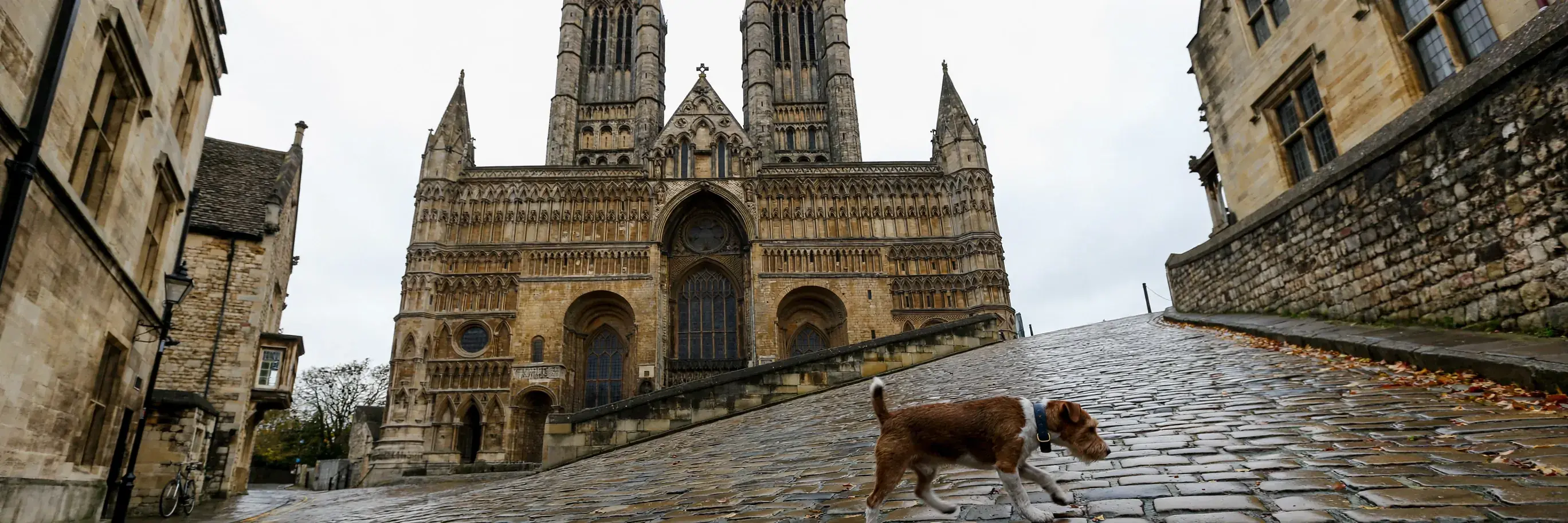
For ideas on extending the trip, our guide to Lincoln with a dog covers a cathedral city with a very different feel — a steep hill, a castle and a waterfront — and it makes a natural next stop if you are heading south from Doncaster. The contrast is the point: Lincoln's climb and Doncaster's flat lakes suit different dogs on different days, and knowing which your dog prefers is the kind of detail that makes the next trip better than the last.
Practical questions
Before you go
Can my dog go into Doncaster Minster?
Pet dogs are not normally admitted inside the Minster, while assistance dogs are welcome. Plan a split visit: one person looks around inside while the other walks the dog around the Minster grounds and the nearby market streets, then swap. Check the official guidance before you travel, as arrangements for services and events can change.
Where is the best lakeside walk with a dog in Doncaster?
The lake at Lakeside is the easiest starting point: a flat, surfaced loop with plenty of open grass, water views and benches, close to car parking. Sandall Park and the lake at Cusworth Hall are good alternatives when you want a quieter, greener walk. Keep dogs on a lead near the water and around other lake users, and check the official guidance before you travel.
Are dogs allowed at Yorkshire Wildlife Park?
Pet dogs are not admitted to Yorkshire Wildlife Park, although assistance dogs are accepted under the park's access arrangements. If you are travelling as a group, plan a split visit so the dog is never left in a car, or leave the park for another day and spend the time on one of Doncaster's lakeside walks instead. Check the official guidance before you travel.
Is Doncaster a good city break with a dog?
Yes, if you plan it as a relaxed two-day break rather than a packed sightseeing trip. Doncaster is compact and flat, the station is on the East Coast Main Line, and the best dog time is outdoors: lakeside paths, parkland, the Trans Pennine Trail and Hatfield Moors. The town centre works best in short bursts with a dog, using the markets and Minster grounds as the anchor.
Can dogs go off lead anywhere in Doncaster?
Some open parkland and designated areas allow off-lead exercise where your dog has reliable recall, but many of Doncaster's busiest spaces require a lead: lakesides, the town centre, nature reserves and anywhere near roads, livestock or water. Always read the signs at the entrance, keep a lead in your hand, and check the official guidance before you travel.
What should I pack for a dog trip to Doncaster?
Pack for flat, exposed walking: a long lead, a spare lead, poo bags, water and a bowl, a drying towel or coat, and a blanket for cafe floors. The lakes and moors are open to wind and rain, so a waterproof coat for the dog helps in wet weather, and a torch is useful for early-morning or evening walks on unlit paths.