This guide is independent and contains no paid placement. If affiliate links are added later, they will be clearly marked and will not change our editorial checks.
Dornoch is one of the quietest rewards on the north-east Highland coast: a huge sandy beach, dune paths, a compact walkable town and the Dornoch Firth on the doorstep. Dogs are welcome on the beach for most of the year, the town is easy to explore on foot, and the surrounding coast offers days of walking — but check the signs and the official guidance before you travel, because beach rules, car park charges and opening hours change.
Why Dornoch suits dogs
Dornoch sits on the northern shore of the Dornoch Firth in Sutherland, in the far north-east of the Scottish Highlands. It is a small town by any measure — a cathedral, a castle, a square, a handful of streets — and that smallness is exactly what makes it work for a dog trip. Everything worth reaching is within a short walk, traffic is light compared with Inverness or Aviemore, and the beach is so large that even on a busy summer day a dog can find space to run without bothering anyone.
The town has two faces that complement each other. One is the old royal burgh: Dornoch Cathedral, parts of which date to the thirteenth century, the former Bishop's Palace that is now Dornoch Castle Hotel, and the neat Georgian and Victorian streets around the square. The other is the sporting coast: Royal Dornoch Golf Club, founded in 1877, whose championship links run along the shore, and a beach that stretches for miles towards Embo and the mouth of the firth. Dogs fit naturally into the second face and politely into the first.
Dornoch also sits on the North Coast 500, the circular touring route that has brought a steady stream of visitors to the far north since it was launched. That brings advantages and one clear disadvantage for dog owners. The advantage is infrastructure: places to stay, places to eat, signposted walks and a town that is used to visitors with dogs. The disadvantage is summer pressure. In July and August the beach car park fills, the town's pavements get busier, and a nervous dog will notice the difference. Visit in May, June, September or October and you get the same beach with far fewer people, which is the single best piece of advice in this guide.
Distance is the other thing to plan honestly. Dornoch is roughly an hour's drive north of Inverness on the A9, and the nearest railway stations are at Tain and Golspie, each a short drive away. That is not far by Highland standards, but it is far enough that you should arrive with a plan: know where you are parking, know where the nearest vet is, and know what you will do if the weather turns. The rest of this guide covers all three.
Finally, Dornoch rewards a slower pace. This is not a town of checklist attractions. Its pleasures are a long beach walk at low tide, an hour in the dunes with a dog that can finally run, a pub lunch with a tired dog asleep under the table, and an evening stroll around the square as the light fades over the firth. If that sounds like your kind of break, the town will suit you. If you want constant entertainment, you will be happier basing yourself in Inverness and visiting Dornoch for a day.
Dornoch Beach and the dunes
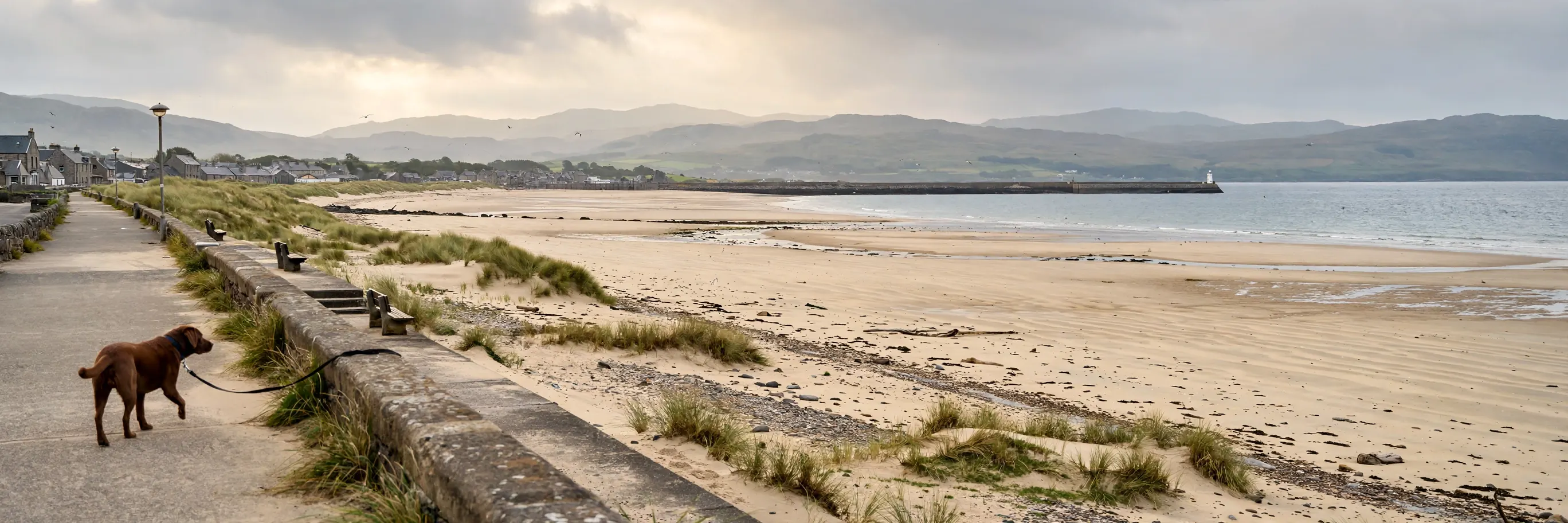
Dornoch Beach is the reason most dog owners come, and it is worth understanding before you arrive. It is a very wide, flat expanse of pale sand that runs from the edge of the golf course south towards Embo, backed by a belt of grassy dunes. At low tide the sand stretches a long way out into the firth, leaving firm, damp flats that are ideal for ball games and for dogs that like to run in straight lines. At high tide the water comes up to the dunes, and the beach narrows to a much thinner strip, so check tide times before you plan a long walk.
Dog rules on the beach are generally permissive, and dogs are walked here throughout the year. That said, restrictions and local notices can change, and the beach is shared with golfers, families, horse riders and wildlife, so check the signs at the beach car park and check the official guidance before you travel. The sensible routine is to keep your dog on a lead from the car park until you are well onto the open sand, give other beach users a wide berth, and put the lead back on well before you reach the car park again.
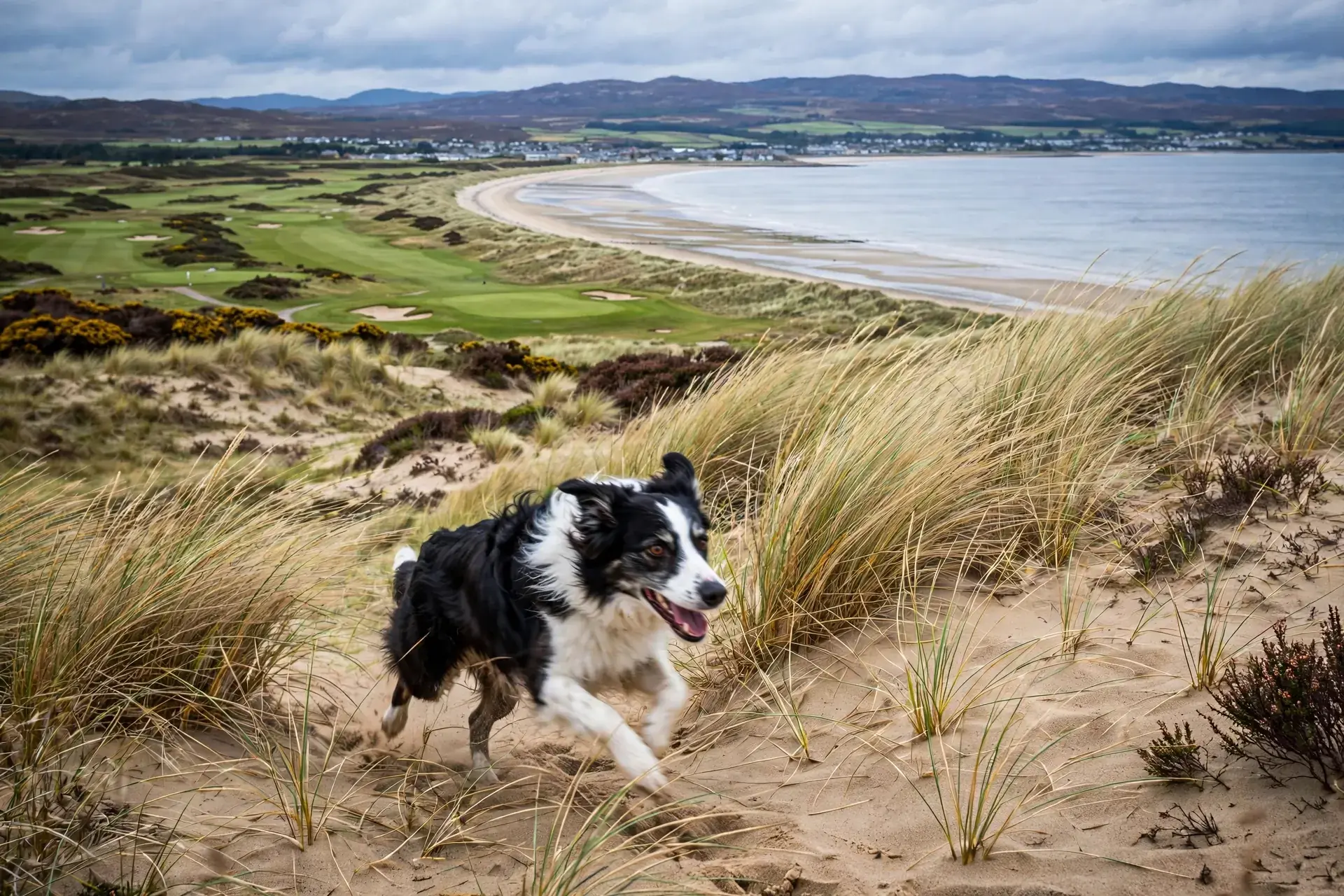
The dunes deserve respect as well as enjoyment. They are a fragile habitat, and the paths through them are there for a reason: stick to them where you can, and keep dogs from digging into the dune faces. In summer, adders are present in dune grassland across Scotland, so keep dogs on paths in long grass during warm weather and know the signs of an adder bite — sudden pain, swelling and distress — and where the nearest vet is. Ticks are also a year-round consideration in dune grass and bracken; check your dog after every walk and remove any ticks promptly with a tick hook.
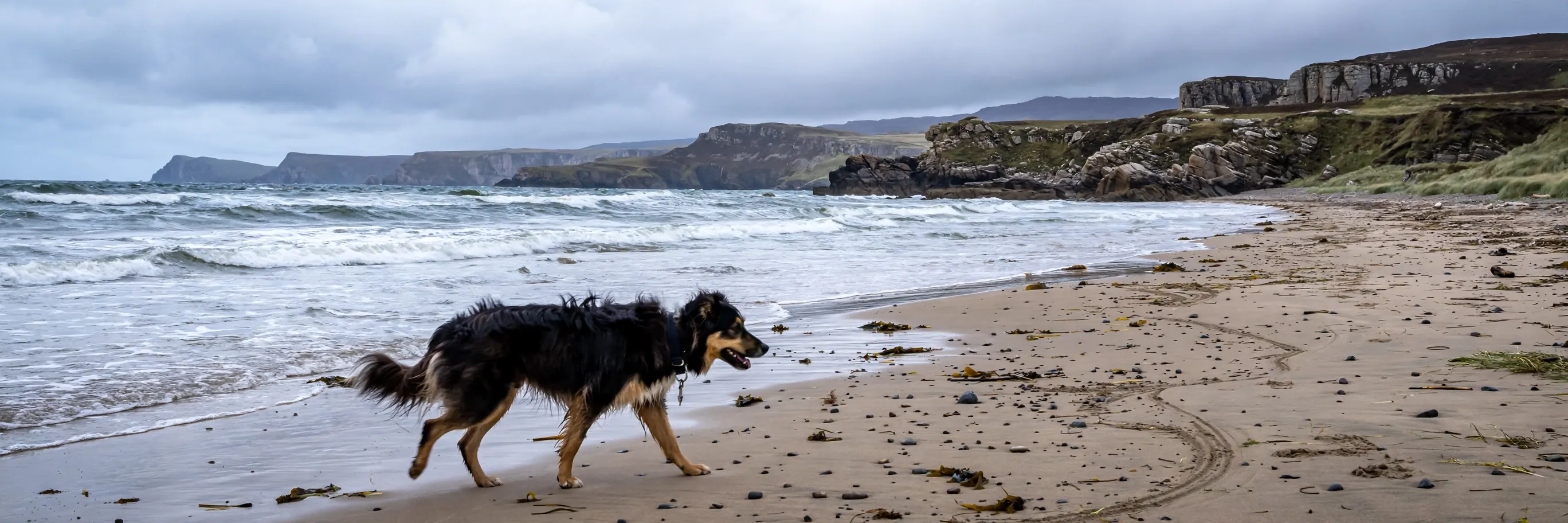
Water safety matters here too. The Dornoch Firth looks calm, but it is tidal, and the currents at the mouth of the firth can be strong. Dogs that love to swim should be watched closely, and you should never let a dog swim at the firth mouth or in fast-moving channels. Bring fresh water and a bowl: salt water upsets a dog's stomach, and there is no reliable drinking water on the beach itself. In hot weather, remember that pale sand reflects the sun and can get surprisingly warm underfoot; if it is uncomfortable for your bare feet, it is uncomfortable for paws.
For a classic Dornoch beach day, park at the beach car park, walk out through the dunes to the sand, and head south towards Embo for the longest, quietest stretch. The walk to Embo and back is a comfortable couple of hours with a dog, depending on how much running and sniffing you allow. If your dog is older or less fit, simply walk out to the sand, let them potter along the shoreline for twenty minutes, and come back the same way — the beach is generous enough that even a short visit feels like a proper outing.
Walks from the town
One of Dornoch's strengths is that the walking starts at the town, not at a distant trailhead. The most useful route is the simplest: from the square, walk down to the beach and along the shore. It is flat, it is obvious, and it works in almost any weather. From there you can build longer days, and the routes below are the ones dog owners come back to.
The Dornoch to Embo coastal walk is the town's signature outing. Follow the beach south from the car park, past the dunes, towards the small village of Embo. The sand is firm at low tide, the views open up across the firth towards the hills of Ross-shire, and the further you go, the fewer people you meet. Embo itself has its own sandy beach and a quiet, village feel. Check the official guidance before you travel for the current state of the paths and any local notices, and allow time to come back before the tide turns if you are walking on the lower shore.
The John o' Groats Trail, the long-distance walking route from Inverness to John o' Groats, passes through this stretch of coast, and the Dornoch section is one of its more forgiving parts. You do not need to walk the whole trail to enjoy it: pick up the signed route at the town and follow it for an hour or two along the shore. Waymarking and ground conditions vary by season, so check the official guidance before you travel, carry water, and keep your dog on a lead wherever the path crosses farmland or runs beside the golf course.
For a shorter, gentler loop, walk the streets of the town itself and the paths around the cathedral and castle. This is a good option for older dogs, for puppies that should not be doing long distances, or for an evening leg-stretch after a day on the beach. The pavements are generally wide enough for a lead, and the square gives a dog plenty of smells without much traffic. Combine it with a stop at a dog-friendly cafe and it becomes a proper outing rather than a chore.
The golf course is the one feature that needs a clear rule. Royal Dornoch's links run alongside the beach, and dogs must be kept off the playing surfaces and on a lead near the course. Golfers pay a great deal to play here, and a dog running across a fairway is a fast way to ruin someone's round and your own welcome. The boundary between beach and course is usually obvious; respect it, keep your dog close while you cross it, and never let a dog chase a ball — theirs or yours — onto the greens.
Whatever route you choose, the practical rules are the same: carry poo bags and use them, keep your dog under control around livestock and ground-nesting birds, and remember that Highland weather changes quickly. A route that is a gentle stroll in sunshine can be a wet, windy trudge an hour later, so pack a waterproof layer for yourself and a drying coat for the dog, and always have a way back that does not depend on a long exposed stretch.
Loch Fleet and wildlife
A few miles south of Dornoch, Loch Fleet is the area's great wildlife set piece, and it is worth a half-day of any dog trip. Loch Fleet is a tidal estuary and a national nature reserve, protected for its seals, wading birds, terns and, in the right season, ospreys. The reserve is managed for wildlife first, which means dogs are welcome on the paths and viewing areas but must be kept on a lead and under close control at all times. Check the official guidance before you travel for the current access arrangements, seasonal restrictions and the best viewing points.
The seal colony is the headline. Common seals haul out on the sandbanks at low tide, and on a calm day you can watch dozens of them from the shore. The rule is simple and non-negotiable: keep your distance, keep your dog on a lead, and never let a dog approach or chase seals. A frightened seal can be injured, a dog that gets too close can be bitten, and the disturbance alone is enough to ruin a haul-out for hours. Bring binoculars if you have them; they turn a distant grey blob into a proper wildlife sighting without anyone having to get closer.
Birdlife is the other draw. The estuary attracts waders and wildfowl in large numbers, especially in autumn and winter, and the tern colonies in summer are noisy, busy and fascinating. Ground-nesting birds are vulnerable to dogs running free, so the lead rule is not a formality: it is the condition on which dogs are allowed in the reserve at all. Keep your dog on the paths, do not let them enter the reedbeds or the saltmarsh, and be ready to move on quietly if birds are showing signs of alarm.
The practicalities of a Loch Fleet visit are straightforward. Park at one of the reserve's car parks, walk the signed paths to the viewing areas, and allow an hour or two including time to stand and watch. There are no facilities on the reserve itself, so bring water for the dog, a lead you trust, and a bag for waste. The best visits are at low tide, when the sandbanks are exposed and the birds are feeding on the mud, and on a still morning, when the light on the water is at its best.
Wildlife etiquette applies across the whole Dornoch area, not just at Loch Fleet. The dunes, the firth shore and the fields around the town all hold nesting birds in spring and summer, deer in the woods, and sheep on the surrounding farms. A dog that is reliable off the lead on a beach may still need a lead in a nature reserve or near livestock, and the Scottish Outdoor Access Code is the document that sets out the balance: you have a right of responsible access, and your dog's behaviour is part of that responsibility. Check the official guidance before you travel if you are unsure about access rules for a particular route.
The town itself
Dornoch is small enough to explore properly on foot in an hour, and it repays the effort. Start at the square, where the cathedral and the castle face each other across a green that has been the centre of town life for centuries. Dornoch Cathedral, with its thirteenth-century origins, is the town's most important building, and its grounds are a pleasant place to walk a dog on a lead. Whether dogs are allowed inside depends on services, events and the day, so check the official guidance before you travel, and plan on one person staying outside with the dog if you want to look around inside.
Dornoch Castle, the former Bishop's Palace, now operates as a hotel, and its bar and public areas are worth asking about if you are staying or eating there. The building sits right on the square, so it is easy to combine with a walk around the town. The streets around the square hold the town's shops: a butcher, a baker, small food shops, a post office and a handful of gift and craft outlets. These are the practical backbone of a self-catering stay, and they are worth supporting, because a town this size keeps its shops only if visitors use them.
Historylinks Museum, the town's small local museum, tells the story of Dornoch and the surrounding parish, from its medieval past to the golfing boom. Museum policies on dogs vary, and small museums often cannot admit dogs inside, so check the official guidance before you travel rather than assuming. Even if the dog has to wait outside with one of your party, the museum is a useful wet-weather stop for the humans, and the building itself is part of the town's story.
For dog owners, the town's real value is as a base rather than a destination in itself. You can buy food, pick up supplies, find a cafe, walk the dog around the square and be on the beach within minutes. That compactness is what makes Dornoch work for a multi-day stay: you are never far from the car, the accommodation or the sand, and an older or anxious dog can settle into a short, predictable routine — square in the morning, beach in the afternoon, quiet street in the evening — without ever being asked to cope with a new place every day.
One practical note: mobile signal and data coverage in the far north can be patchy, even in a town. Download offline maps before you arrive, save the addresses and phone numbers you need, and do not rely on being able to look something up at the beach car park. The same goes for cash: most places take cards, but a small amount of cash is useful for honesty boxes, small car parks and village shops.
Eating and drinking with a dog
Dornoch's pubs and cafes are generally welcoming to dogs, but the honest position is that policies vary by venue, by season and sometimes by time of day. The town's pubs around the square and the hotel bars are the most reliable bets: many Scottish Highland pubs welcome well-behaved dogs in the bar area, and some provide water bowls and dog treats. Cafes are more variable, with some welcoming dogs throughout and others limiting them to outdoor seating, so check the official guidance before you travel and phone ahead if your dog is large, reactive or needs space from other dogs.
A few habits make eating out with a dog in Dornoch much easier. First, bring a settle mat or blanket so your dog has a defined place to lie down; it signals to staff and other diners that you have thought about this. Second, arrive a little earlier or later than the lunch rush, when the room is quieter and a dog can settle without a constant stream of people passing the table. Third, order at the bar or counter where possible rather than asking a dog to wait through a long table service while food arrives in stages.
Outdoor seating is the town's great advantage in summer. Pavement tables and beer gardens give a dog space, air and something to watch, and many venues that are cautious about dogs indoors are happy to have them outside. That said, Highland weather is not to be trusted: a sunny lunch can turn into a sideways shower in minutes, so carry a waterproof layer and be ready to move inside or cut the meal short. A drying coat for the dog is worth its weight on a damp day, and a towel in the car is never wasted.
For self-caterers, the town's food shops cover the essentials, and the wider area has farm shops and delis within a short drive. If you are staying in a cottage or a caravan, plan a proper shop on arrival day rather than assuming you can pick things up as you go: opening hours in the far north are shorter than in a city, Sunday trading is limited, and a dog that needs feeding at six in the evening does not care that the shop shut at five. Buy dog food in Inverness or Tain on the way up if your dog eats a specialist diet, because the local shops may not stock it.
Finally, think about the dog's dinner as well as your own. A tired dog that has had a long beach walk needs food, water and rest more than it needs a pub, and the best evenings in Dornoch are often the quiet ones: cook in the cottage, let the dog sleep by the fire, and save the pub for a lunchtime when the dog is fresh. If you do take the dog out in the evening, keep it short, keep the dog fed first, and be ready to leave early if the dog starts to fret.
Where to stay with a dog
Dornoch offers the usual Highland mix of hotels, guesthouses, bed and breakfasts, self-catering cottages and caravan and camping sites, and most of them accept dogs in at least some of their rooms or units. The key word is "some": a property that is dog-friendly overall may still restrict dogs to particular rooms, floors or cottages, and those are often the ones that book first. Ask specifically which unit you are booking, whether it has an enclosed garden or direct outdoor access, and what the pet fee covers.
Pet fees in the Highlands typically run from around ten pounds per night to a flat charge of twenty to fifty pounds per stay, though the range is wide and some places charge per dog. Always get the all-in figure in writing before you pay, including any deep-clean charge or refundable deposit, and check whether the fee is per dog or per booking if you are travelling with two. Assistance dogs are a separate category and should not attract a pet fee or count against pet limits.
Self-catering cottages are often the best fit for dog owners in Dornoch, because they give you a kitchen, a door you can open straight onto a garden, and no shared corridors to negotiate with a lead. Look for an enclosed garden with a fence you can trust — ask for the height and check for gaps — and for hard floors downstairs, which are far easier to clean after a sandy beach walk than carpet. A cottage near the beach is convenient, but a cottage near the square is more practical for shops and cafes; decide which matters more to your dog.
Hotels and guesthouses work well for shorter stays, especially if you want breakfast provided and someone else to worry about the cleaning. The questions to ask are the same: which rooms take dogs, is there somewhere to dry a wet dog, can the dog be left alone in the room, and are dogs welcome in the bar or dining room? Many hotels allow dogs in the bar but not the restaurant, which is a workable compromise if you are happy to eat in the bar, but a problem if you assumed the dog could join you for dinner.
Caravan and camping sites around Dornoch and Embo suit owners who like to bring their own setup. The practical checks are the size and surfacing of the pitch, the distance to the dog-walking area, and whether there is an outdoor tap for washing sandy paws. Sites in this part of Scotland can be exposed to wind off the firth, so bring extra guy ropes and a windbreak, and think about how a nervous dog will cope with flapping canvas on a wild night. If your dog has never camped before, a single night close to home is a better test than a week in Sutherland.
Whatever you book, confirm the dog arrangements in writing and bring the confirmation with you. Dornoch is a small town, and a misunderstanding about a pet fee or a room allocation is harder to fix at nine in the evening than it is by email a week before. Also check the cancellation terms: Highland weather and dog illness are the two most common reasons a trip changes, and a booking that can be moved is worth more than one that can only be cancelled at a loss.
Getting there and parking
Most visitors reach Dornoch by car on the A9, the main road north from Inverness. The drive takes roughly an hour from Inverness in good conditions, and it is a beautiful one: the road crosses the Cromarty Firth and the Dornoch Firth on causeways and bridges, with wide views across the water. Allow extra time in summer, when caravans and campervans slow the single-carriageway stretches, and in winter, when ice and short daylight hours make the same drive slower and more tiring.
Plan the journey with the dog in mind. Stop at least once on the way up — there are lay-bys and services along the A9 — and give the dog water and a short walk before the final stretch. A dog that arrives stressed and bursting is a dog that will not settle in new accommodation, and the first hour in Dornoch sets the tone for the whole stay. Keep the car cool and ventilated, never leave a dog in a parked car in warm weather, and remember that a car in Highland sunshine can heat up fast even on a day that feels mild outside.
Public transport is possible but needs planning. The nearest railway stations are at Tain, about eight miles south, and Golspie, about ten miles north, both on the Far North Line from Inverness to Wick and Thurso. Dogs are generally allowed on trains, with small dogs in carriers and larger dogs on a lead, but check the official guidance before you travel for the current rules and any restrictions. Buses connect Dornoch with Tain, Golspie and Inverness, but services are infrequent, especially on Sundays, so check the timetable in advance and allow plenty of time. Without a car, Dornoch itself is walkable, but day trips become much harder, so most dog owners will want to drive.
Parking in Dornoch is straightforward. The beach car park, at the end of the road from the town to the shore, is the most useful base for dog walks: it puts you straight onto the dunes and the sand, and it is where most dog owners start their day. There is also parking around the town square and on streets near the cathedral. Charges, time limits and seasonal arrangements can change, so check the official guidance before you travel, and always check the signs on arrival. Do not leave a dog in a parked car while you walk the beach, and do not leave valuables visible in the car at the beach car park.
If you are arriving in an electric vehicle, plan charging before you set out. Charging points exist in the wider area, but they are fewer and further apart than in the central belt, and a single occupied or out-of-service charger can cost you an hour. Charge in Inverness or Tain on the way up, and check the official guidance before you travel for the current state of the chargers you plan to use.
Seasons and weather
Dornoch changes more with the seasons than most Highland towns, and choosing the right month is the single biggest decision you will make. The beach, the dunes and the town are the same in every season, but the light, the crowds, the midges and the weather are not, and each season asks something different of a dog.
Spring, from March to May, is arguably the best time for a dog trip. The days lengthen, the beaches empty out, the golf season is getting going and the worst of the winter weather is usually over. Ground-nesting birds are at their most vulnerable in spring, so keep dogs on leads in the dunes and on the reserve, and be ready for a cold snap: a sunny April morning can still turn into a hail shower by lunch. Pack layers, and do not be fooled by a warm sun into leaving the dog's coat at home.
Summer, from June to August, brings the longest days and the warmest weather, but it also brings the North Coast 500 traffic, the busiest beaches and the midges. Midges are a genuine consideration in the Highlands from roughly June to August, especially on still, damp evenings near water and woodland. Dogs are less bothered by midges than humans, but they still suffer, so avoid still evenings in sheltered spots, keep walks to breezy open ground when the midges are out, and carry repellent for yourself. Summer is also the season for the most careful beach etiquette: more people means more children, more picnics and more dogs, and the dog that is a delight on an empty beach in October can be a nuisance on a crowded one in August.
Autumn, from September to November, is the connoisseur's season. The crowds thin, the light turns golden, the beaches empty, and the birdlife at Loch Fleet builds towards its winter peak. September and early October are often the driest and calmest weeks of the year, and a dog that has spent the summer in the city will love the space. Later in autumn the storms arrive, and the firth can be wild: check the forecast, respect the sea, and do not walk the exposed shore in a gale.
Winter in Dornoch is quiet, dark and beautiful. Daylight is short — around six hours at the solstice — and the town is at its most peaceful. Winter is a good time for a dog that dislikes crowds and heat, but a hard time for a dog that dislikes cold and wet: bring a drying coat, a warm bed and a plan for indoor time. Snow is possible but not guaranteed, and ice on pavements and paths is a real hazard for older dogs. Check the forecast, drive carefully, and remember that the sun sets early, so plan walks for the middle of the day and carry a torch for the last outing.
Day trips from Dornoch
Dornoch makes a good base for exploring the north-east Highlands, and the day trips below all work with a dog, provided you check access and opening arrangements in advance. The pattern is the same for each: drive out, walk, eat somewhere dog-friendly, and be back in Dornoch for the evening.
South along the coast, Tain is the nearest town, about fifteen minutes away, with its own beach, a historic centre and the Glenmorangie distillery on its outskirts. Distillery tours are generally not suitable for dogs, but the town's streets, beach and pubs are, and Tain is also where you will find the nearest railway station and the nearest large supermarket. Check the official guidance before you travel for the current state of the beach and any local restrictions.
North along the coast, Golspie and Dunrobin Castle make a rewarding half-day. Golspie has a sandy beach and a quiet, village feel, and Dunrobin Castle's gardens are a famous Highland sight. Dogs are generally welcome in the castle gardens on a lead, but not inside the castle itself, so check the official guidance before you travel, and plan on one person staying outside with the dog if you want to tour the house. The drive from Dornoch to Golspie is short and scenic, following the coast past Loch Fleet.
Further north, the Caithness coast opens up, and the towns of Thurso and Wick make a longer but very rewarding day out. Our guide to Thurso with a dog covers beaches, clifftop walks and the Orkney ferry, while Wick with a dog covers harbour walks, cliff trails and the far north-east coast. Both are around an hour and a half's drive from Dornoch, so set off early, and remember that the far north is even more exposed to weather than Dornoch, so check the forecast before you commit to the drive.
South-east, the Moray coast offers a different flavour of Highland seaside. Our guide to Nairn with a dog covers beaches, Moray Firth views and easy day trips from a town that pairs naturally with Dornoch on a longer tour. Nairn is roughly an hour's drive from Dornoch, and the route along the coast is one of the prettiest in the north. Combine the two towns over a few days and you get a proper sense of the Moray Firth coast, from the dunes of Dornoch to the promenade at Nairn.
Inland, the road west from Dornoch climbs towards Lairg and the interior of Sutherland, a landscape of moor, loch and empty road that feels a world away from the coast. This is big-sky walking country, and it suits confident dogs and owners who are comfortable navigating without phone signal. Keep dogs on a lead around sheep, carry water, and check the official guidance before you travel for the current access and stalking season arrangements, because estate access can be restricted during the deer stalking season in autumn.
Practical dog care
A Dornoch trip is easy to plan well and easy to get wrong in small ways. The checklist below covers the points that dog owners most often overlook in the far north, and it is worth reading through it before you pack.
First, the vet. Dornoch itself has limited veterinary cover, so find the nearest practice in Tain or Golspie before you travel, save its number and its out-of-hours emergency number in your phone, and check the official guidance before you travel for current opening hours. If your dog is on regular medication, bring more than you need, and carry the prescription details with you. If your dog has a known condition — epilepsy, heart disease, diabetes — tell your accommodation host on arrival, so they know what to do if something happens while you are out.
Second, the beach kit. A Dornoch beach day needs fresh water and a bowl, poo bags, a long line for recall training on the open sand, a towel, and a drying coat for the drive home. Add a tick hook, a small first-aid kit with saline wound wash, and a spare lead. A dog that swims in the firth should be rinsed with fresh water afterwards if you can manage it, because salt and sand irritate skin and paws, and a dog that has swallowed sea water should be watched for vomiting or diarrhoea.
Third, identification and control. Make sure your dog's microchip details are up to date and that the dog is wearing a collar with your phone number on it — a dog that gets lost in the dunes or on a remote coastal path is much harder to find than one lost in a city park. Recall matters more here than almost anywhere: the beaches are wide, the dunes have hiding places, and the wildlife is tempting. If your dog's recall is not reliable, use a long line rather than letting them off and hoping. A whistle and a high-value treat are worth carrying on every walk.
Fourth, the Scottish Outdoor Access Code. In Scotland you have a right of responsible access to most land, but that right comes with responsibilities: keep your dog under control, keep dogs on a lead around livestock and during the bird breeding season, and clean up after your dog everywhere, including on the beach and in the dunes. Farmers and landowners in Sutherland are generally welcoming to responsible dog owners, and the fastest way to lose that welcome is to let a dog worry sheep or disturb nesting birds. Check the official guidance before you travel if you are unsure about access rules for a particular route.
Finally, pack for the weather you might get, not the weather you hope for. Highland weather changes fast, and a Dornoch trip that starts in sunshine can end in rain, wind or both. Bring waterproofs for yourself, a drying coat and a towel for the dog, and a warm layer for the evenings. A dog that is cold and wet after a beach walk will not enjoy the pub, the drive or the night, and a little preparation is the difference between a trip you remember fondly and one you spend drying out.
Practical questions
Before you go
Can dogs go on Dornoch Beach all year?
Dornoch Beach is generally welcoming to dogs, and many visitors walk their dogs there throughout the year. Seasonal restrictions and local notices can change, so check the signs at the beach car park and check the official guidance before you travel, and keep your dog on a lead near the car park, the golf course and other beach users.
Is Dornoch on the North Coast 500?
Yes. Dornoch sits on the North Coast 500 touring route, on the A9 between Tain and the far north. That makes it a natural overnight stop for drivers doing the loop, but it also means summer traffic and car parks can be busy. Arrive early or visit in the shoulder months if your dog dislikes crowds.
Where can I park with a dog in Dornoch?
The beach car park at the end of the road from the town is the most useful base for dog walks, with direct access to the sand and dunes. There is also parking around the town square and on streets near the cathedral. Check the official guidance before you travel for current charges, time limits and any seasonal changes.
Are dogs allowed inside Dornoch Cathedral?
Dogs are welcome in the cathedral grounds and around the square, but access inside the building is not guaranteed and can depend on services, events and the day. Check the official guidance before you travel, and plan on one person staying outside with the dog if you want to look around inside.
What is the nearest vet to Dornoch?
Dornoch itself has limited veterinary cover, so the nearest practices are usually in the surrounding towns such as Tain or Golspie. Save the number of the nearest open practice and an out-of-hours emergency vet before you arrive, and check the official guidance before you travel, because opening hours and emergency arrangements change.