This guide is independent and contains no paid placement. If affiliate links are added later, they will be clearly marked and will not change our editorial checks.
Dunbar is a compact harbour town where a dog can walk the harbour, the clifftop trail and Belhaven Bay in a single day. Keep your dog on a lead at the harbour and on the cliffs, check tide times before the beach, and check the official guidance before you travel for current access rules, seasonal restrictions and dog-friendly venues.
Why Dunbar works for dogs
Dunbar sits on the East Lothian coast in south-east Scotland, about thirty miles east of Edinburgh, where the land meets the North Sea in red sandstone cliffs and a sheltered working harbour. It is a small town, and that is exactly why it works so well with a dog. The harbour, the High Street, the clifftop path and Belhaven Bay are all within easy walking distance of each other, so you can build a full day without loading the dog in and out of the car between every stop. There is no need to drive from car park to car park, and no need to choose between a town day and a beach day: in Dunbar they are the same day.
The town is also a good first taste of the Scottish east coast for dogs that have only walked English beaches or city parks. The light is different, the wind is often stronger, and the smells are richer — salt, seaweed, fish boxes on the quay, gorse on the cliff tops. For a scent-driven dog, a slow harbour walk can be as tiring as a long run, which is useful to remember when you are planning distances. A dog that has sniffed its way around the harbour, climbed the short slope to the cliff path and then run on the sand at Belhaven Bay has had a genuinely full day, even if the mileage on your watch looks modest.
Dunbar suits most kinds of dog, with a few honest exceptions. Confident, lead-trained dogs that are comfortable with wind, waves and other dogs will love it. Nervous dogs can still enjoy the quieter stretches — the beach at low tide, the wooded paths of John Muir Country Park, the early-morning harbour before the boats and visitors arrive — but they will need more management around the harbour, where vehicles, ropes, gulls and sudden noises are part of daily life. Older dogs and dogs with stiff joints can enjoy the flat harbour and beach, but should skip the steeper cliff sections and the longer John Muir Way stretches. Puppies need the usual care: short walks, plenty of rest, and no long cliff-top marches while their joints are still developing.
What Dunbar does not offer is a fenced dog park or a purpose-built dog beach with facilities at every turn. It offers something better for most visitors: real coastal walking, real working-harbour atmosphere, and a beach wide enough that a well-controlled dog can run without crowding anyone. The trade-off is that you, the owner, have to do the planning — tides, wind, leads, water, shade and a place to eat — rather than relying on signs and facilities to do it for you. This guide is built to do that planning with you, step by step, so that the day feels easy even though the coast itself is wild.
One more thing worth saying at the start: Dunbar is the birthplace of John Muir, the naturalist whose writing helped shape the idea of national parks. That heritage is not a museum curiosity here; it is woven into the town, the country park and the long-distance trail that carries his name. Walking here with a dog, slowly, noticing birds, rock pools and weather, is very much in the spirit of the place. You do not need to know Muir's biography to enjoy Dunbar, but knowing a little of it makes the town feel less like a backdrop and more like a place with a story — and that story is part of what makes a day here memorable.
The working harbour
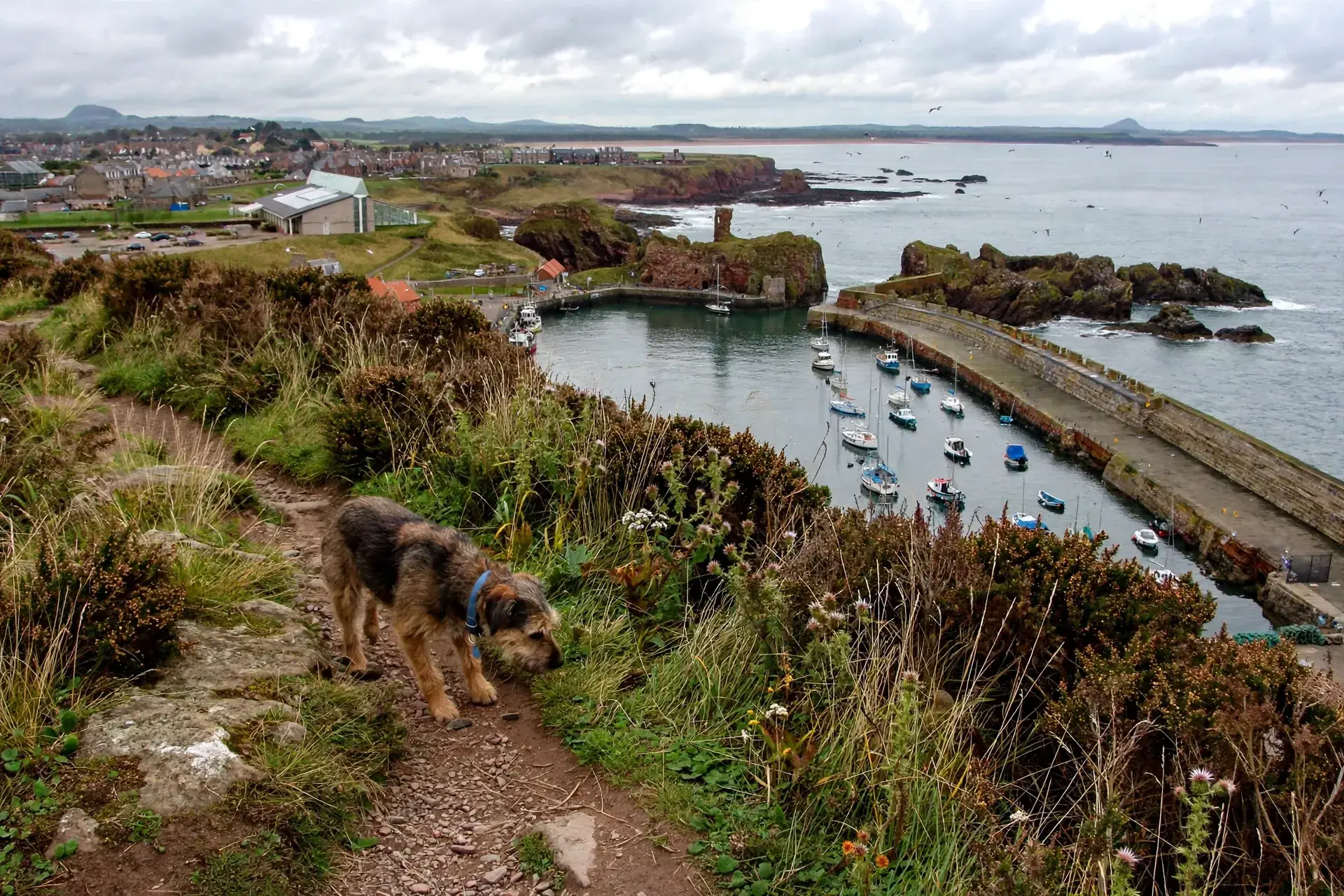
Dunbar harbour is the heart of the town, and the best place to start any visit. It is not a marina dressed up for visitors; it is a working harbour, with fishing boats, creels, ropes, fish boxes and vehicles moving around the quays. That is what makes it interesting, and it is also what makes the lead rule non-negotiable. Keep your dog on a lead around the harbour at all times, keep the lead short near edges and vehicles, and keep your dog away from open water, harbour steps and the gaps between boats and the quay. A dog that slips on a wet harbour wall or chases a gull across a working quay can be in trouble very quickly, and the harbour is not a place to test recall.
Start at the harbour's edge and walk slowly. The old harbour, with its stone walls and narrow entrance, is the picturesque part most visitors photograph, while the newer harbour handles more of the working boats. Both are worth a look, and both reward a slow pace: watch the boats, let your dog sniff the ropes and seaweed at a safe distance, and look out to sea for gulls, cormorants and, on a calm day, seals. Early morning is the quietest and often the most atmospheric time, when the boats are going out and the gulls are loud; late afternoon, when the light turns the red sandstone gold, is the prettiest. Midday in summer is the busiest, with visitors, ice-cream queues and dogs on every corner, so if your dog is reactive or nervous, choose the early or late slot.
Harbour surfaces deserve respect. Stone quays are uneven, wet in places even on a dry day, and slippery with seaweed near the waterline. Keep your dog on the dry, flat parts of the quay, away from the edge, and watch for fishing hooks, broken glass, discarded line and fish remains, all of which are common around a working harbour and all of which a scavenging dog will find before you do. A "leave it" that works at home is worth its weight in gold here. If your dog is a determined scavenger, a basket muzzle for the harbour walk is a sensible, unembarrassing precaution, not a failure — many experienced owners use one in exactly these places.
Do not let your dog swim in the harbour. The water is deep beside the walls, the sides are steep and slippery, ladders and steps are not designed for dogs, and boats move without much warning. If your dog loves water, save the swimming for Belhaven Bay at low tide, where the sand shelves gently and you can see what is underfoot. At the harbour, water is for looking at, not jumping into. The same applies to harbour steps and slipways: they look inviting to a dog on a hot day, but they are a trap if the tide is rising or a boat is manoeuvring.
Children, cyclists and other dogs all share the narrow harbour paths, so keep your lead short and your dog close when the quays are busy. A long line has no place here: it tangles around bollards, trips other walkers and lets a dog reach the edge before you can stop it. Use a standard lead of about one to two metres, keep your dog on the landward side of the path where possible, and step aside to let vehicles and working harbour users pass. The harbour belongs to the fishermen first; visitors, dogs included, are guests, and behaving like a considerate guest is what keeps the harbour welcoming to dogs in the long run.
Clifftop paths and cliff safety
East of the harbour, the coast rises into red sandstone cliffs, and the clifftop trail that follows them is one of the best short walks in East Lothian. The path runs along the cliff tops with wide views over the North Sea, the harbour behind you and, on a clear day, the Bass Rock and the Fife coast across the water. It is a walk that feels wild without being remote: you are never far from the town, but the wind, the height and the sound of the sea below make it feel like a proper coastal adventure. For a dog, it is a feast of smells — sea pinks, gorse, salt spray and the nests of the seabirds that use these cliffs in spring and summer.
Cliff safety comes first, every time, and it is not negotiable. Keep your dog on a lead on the clifftop path, and keep the lead short. The path is close to unfenced drops in places, the cliff edge can be undercut and crumbly, and grass at the edge can hide how close the drop really is. Do not let your dog run ahead, chase birds along the edge, or pull towards the cliff. If your dog is a strong puller, use a well-fitted harness and a short lead, and consider whether the clifftop section is right for that dog on that day: a windy day, a wet path or a dog that is already overexcited are all good reasons to choose the flatter beach walk instead.
Stay on the marked path. Shortcuts across the grass towards the edge, or scrambles down towards the shore, are where accidents happen — for people as well as dogs. The marked trail exists because the ground beside it has been checked and maintained; the ground beyond it has not. If you want to look over the edge, stop on the path, hold the lead firmly, and look from a safe distance. Do not sit your dog on the edge for a photograph, however tempting the view. A dog that shifts its weight, is startled by a gull or simply leans the wrong way can be over the edge before you can react, and there is no safe way down to retrieve it.
Wind is the factor most visitors underestimate. On the cliff tops, the wind can be much stronger than it feels in the sheltered harbour or on the High Street, and gusts can unbalance a small dog or push a larger one sideways. Check the forecast before you set out, and if the wind is gusting hard, keep the cliff walk short or skip it. Rain makes the path slippery, especially on the grassy and rocky sections, and fog can hide the edge entirely — if visibility is poor, do not walk the cliffs at all. The cliffs will still be there on a better day, and a dog that has a frightening experience on a cliff path may be nervous on every coastal walk afterwards.
Choose the right length for your dog. A short out-and-back from the harbour to the first viewpoint gives you the drama of the cliffs without the commitment of a long exposed walk, and it is the right choice for older dogs, small dogs, puppies and anyone short on time. Fitter dogs can continue further along the coast, but remember that the return journey is just as long, and the wind that was behind you on the way out will be in your face on the way back. Carry water for your dog — there is no fresh water on the cliff tops — and check paws afterwards for cuts from sharp rock or thorns. If your dog shows any sign of distress, heat, limping or fear, turn back at once; there is no prize for finishing a cliff walk, only a dog that trusts you to keep it safe.
John Muir and the town's heritage
John Muir was born in Dunbar in 1838, in a house on the High Street that still stands today, and he spent his childhood exploring the town, the harbour and the surrounding countryside before his family emigrated to America when he was eleven. In America he became one of the most influential naturalists of his time, a writer and campaigner whose work helped lead to the creation of national parks, including Yosemite. Dunbar is proud of that connection, and the town marks it in several places: the house where he was born, the country park that carries his name, and the long-distance John Muir Way, which runs across Scotland and passes through the town.
For a visitor with a dog, the Muir heritage is best enjoyed as a walking story rather than a museum visit. The birthplace house is in the town centre, and while the house itself is a museum with its own rules about dogs inside — check the official guidance before you travel — the streets around it, the harbour Muir knew as a boy, and the countryside he explored are all open to dogs on a lead. Walking the same shoreline a curious child once walked, with a curious dog beside you, is a more fitting tribute than any indoor display. Look for the small details: the narrow wynds off the High Street, the old stone of the harbour, the view from the cliff tops that Muir would have known by heart.
The John Muir Country Park, just west of the town towards Belhaven Bay, is the green heart of the Muir story. It is a stretch of coast, dunes, grassland and woodland managed for wildlife and for quiet recreation, and it is one of the best places near Dunbar to give a dog a long, varied walk without leaving the coast. Paths run through the park to the beach, and the mix of habitats — dunes, scrub, woodland and shore — means a dog gets a far richer walk than a single beach or a single cliff path can offer. Keep your dog under close control here, and on a lead where signs ask for it, because the park is also a home for ground-nesting birds and other wildlife that are easily disturbed by a free-running dog.
Dunbar Castle, or rather its ruins, is another piece of the town's long history. The castle stands on the rocky shore by the harbour, and its broken walls have watched over the town for centuries, through sieges and storms. The ruins themselves are not a place to climb with a dog — the stone is unstable, the drops are sheer and access is restricted — so admire them from the harbour and the cliff path, and do not try to scramble up to them. The castle is a reminder that Dunbar is an old town with a long memory, not a purpose-built resort, and that much of its charm comes from the way the old and the everyday sit side by side: fishing boats beside castle ruins, a modern cafe beside a seventeenth-century house.
Take the heritage gently. You do not need to visit every Muir site to enjoy Dunbar, and a dog does not care about dates and plaques. What matters is the habit Muir himself practised as a boy and as a man: walking slowly, looking closely, and paying attention to the natural world. Let your dog set the pace on part of the walk, stop to watch the birds, notice the rock pools at low tide, and give yourself time to stand on the cliff and look out to sea. That unhurried attention is the most Muir-like thing you can do in Dunbar, and it is also the thing that makes a dog walk genuinely restful rather than just exercise.
Belhaven Bay beach
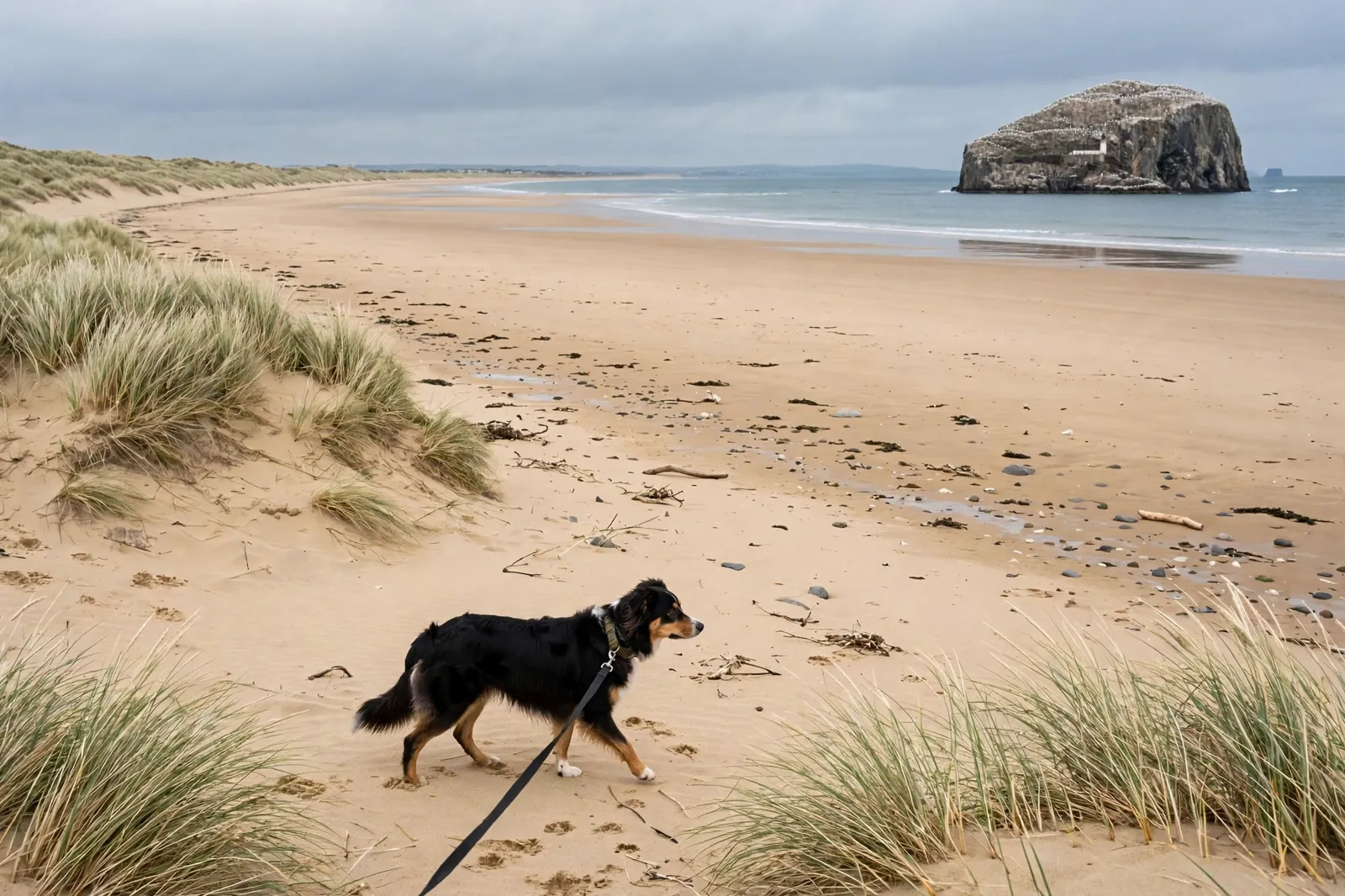
Belhaven Bay, just west of Dunbar town centre, is the beach most visitors with dogs come for. It is a wide, sandy bay at the edge of John Muir Country Park, with dunes behind it, the sea in front, and the Bridge to Nowhere — a footbridge across a tidal inlet that is only crossable at low tide — as its most photographed feature. At low tide the sand stretches a long way out, leaving rock pools, wet sand for running and plenty of space for a dog to play without crowding other beach users. At high tide the bay shrinks to a narrower strip, and the bridge is cut off, so tide times shape the whole visit.
Check tide times before you go, and plan around them. The safest and most enjoyable time is on a falling tide, a couple of hours before low water, when the sand is firm, the pools are exposed and the sea is retreating. Avoid starting a long beach walk as the tide is coming in, and never let your dog chase the tide out across wet sand you do not know — channels and soft sand can catch out even experienced walkers. The Bridge to Nowhere is a good test: if the bridge is surrounded by water, or the water is already rising around its base, do not cross it, and do not let your dog swim the channel. The bridge, and the beach beyond it, will be there at the next low tide.
Belhaven Bay is generally a good year-round beach for dogs, but that does not mean there are no rules. Seasonal restrictions can apply in parts of the country park and on parts of the beach, especially where birds are nesting or feeding, and local rules can change from year to year, so check the official guidance before you travel. Keep your dog under close control, and on a lead if signs or rangers ask for it, when birds are present. The bay is an important place for wading birds and wildfowl, and a dog chasing a flock across the mud can undo hours of feeding in a few seconds. The same respect applies to seals, which sometimes haul out on the shore: give them a wide berth, keep your dog on a lead and move away quietly.
For practical beach days, bring fresh water for your dog, a bowl, a towel and a long line if your dog's recall is not reliable in open space. A long line gives a dog freedom to run and sniff while keeping you in control near birds, other dogs and the water's edge, and it is a better choice than an extendable lead on a windy beach. Watch for the usual beach hazards: broken shells, fishing line, jellyfish washed ashore, and the salt water itself — most dogs that drink too much sea water will be sick, so offer fresh water often and discourage drinking from the sea. After the beach, rinse your dog's paws and coat if you can, and check between the toes for sand and small cuts.
If you are looking for more beaches nearby, our guide to East Lothian dog beaches covers Gullane, Yellowcraig and North Berwick, so you can plan a second beach day without repeating the same walk. Within Dunbar itself, Belhaven Bay is the main event, and it rewards repeat visits: the same beach at low tide in the morning, at sunset, in wind and in calm, is a different beach every time. Give your dog the time to explore it properly — sniffing the strandline, paddling in the pools, running on the firm sand — rather than marching from one end to the other, and you will both get more from the visit.
A walk around the town
Dunbar town centre is compact, mostly flat and easy to walk with a dog, which makes it a good place for a slow wander between the harbour and the beach. The High Street runs through the centre, with shops, cafes and the John Muir birthplace house, and the narrow wynds and lanes that lead off it are worth exploring on foot. Keep your dog on a short lead on the High Street, especially at busy times, and be ready for the usual town hazards: traffic at crossings, other dogs outside shops, food dropped on the pavement, and cyclists. A town walk is a training walk as much as a sightseeing walk, so keep it short, keep it calm, and reward your dog for settling beside you rather than pulling towards every smell.
The walk from the town centre to the harbour is short and downhill, and the walk back is the same slope in reverse — worth remembering for older dogs and for hot days. If your dog is tired after the beach, drive or take the gentler route rather than adding a steep climb at the end of the day. There are benches and open spaces where you can sit and rest, and a dog that has had a long beach run will often be happy to settle beside you for ten minutes while you watch the town go by. Bring a mat for your dog to lie on if you plan to sit outside a cafe, so the dog has a defined place to settle rather than the cold pavement.
Dunbar Castle ruins, on the rocks beside the harbour, are best viewed from the harbour wall and the cliff path. Do not try to climb the ruins with a dog, and do not let your dog scramble on the rocks below them: the stone is unstable, the rocks are slippery with seaweed, and the tide can cut off the shore quickly. The castle is a place to look at, photograph and wonder about, not a place to explore on foot with a dog. The same caution applies to the rocky shore generally — rock pools are wonderful at low tide, but the rocks are sharp, the seaweed is slippery, and a dog that slips can cut a paw or be trapped by a rising tide. Explore rock pools on the sand at Belhaven Bay, where the ground is flat and the escape route is obvious, rather than on the rocky shore by the castle.
For a quieter town walk, head for the wooded and grassy paths of John Muir Country Park, where the pace slows and the town noise fades. The park's paths are gentler than the cliff tops and more sheltered than the beach, which makes them a good choice for a second walk in the afternoon, for a nervous dog, or for a wet day when the cliffs are too exposed. Keep your dog under control and watch for other walkers, cyclists and horses where paths are shared. Pick up after your dog everywhere in the town and the park, and carry spare bags — there are bins in the town and the park, but they are not always where you expect them, and carrying a used bag for a few hundred metres is part of responsible dog ownership.
Evening in Dunbar is quiet, and that is part of its charm. The harbour at dusk, the High Street with its lights on, and the sound of the sea from the cliff path make a gentle end to the day. If you are staying overnight, take a short last walk before bed — the flat route around the harbour or the edge of the country park — and give your dog water and a chance to toilet before settling in. A dog that has had a calm last walk sleeps better, and a good night's sleep makes the next day's walk better too.
Longer walks: the John Muir Way
The John Muir Way is a long-distance walking route that runs across Scotland from Helensburgh in the west to Dunbar in the east, finishing — fittingly — in Muir's birthplace town. Most visitors will not walk the whole route, but the sections around Dunbar are excellent day walks for fit dogs, and they give you a taste of the trail without the commitment of a multi-day hike. The route east and west of Dunbar follows the coast for much of its length, with cliff tops, beaches, farmland and quiet lanes, and it is waymarked, so you can follow it without a map in most places — although carrying a map and a charged phone is still sensible, especially in poor weather.
West from Dunbar, the John Muir Way runs towards Belhaven Bay, John Muir Country Park and then on towards North Berwick, passing through coastal villages and open farmland. This is the gentler direction for most dogs: the ground is flatter, the path is well used, and there are beaches and parkland to break up the walk. A sensible day walk is Dunbar to Belhaven Bay and back through the country park, which gives you harbour, park and beach in a single loop. Fitter dogs and walkers can continue further west, but remember that the return journey doubles the distance, and the coast path can be exposed in wind and rain. Plan a turning point before you set out, and stick to it.
East from Dunbar, the route heads towards the Berwickshire coast and eventually Berwick-upon-Tweed, a longer and more exposed stretch with high cliffs, fewer facilities and fewer easy exit points. This direction suits experienced walkers with fit, confident dogs, and it should not be attempted as a casual out-and-back without planning. Check the official guidance before you travel for the current state of the path, carry water and food for both you and your dog, and have a plan for getting back — whether that is retracing your steps, a bus, or a pre-arranged lift. Do not rely on mobile signal on the more remote stretches, and do not start a long exposed section late in the day.
Whichever direction you choose, the John Muir Way rules are the same as for any long coastal walk: keep your dog on a lead near cliffs, livestock and roads, and under close control everywhere else. The route passes through farmland where sheep and cattle graze, and a dog that chases livestock can cause serious harm and put itself in danger. In Scotland, the access rights that allow you to walk the route come with responsibilities: keep your dog under control, keep it on a lead or close at heel near livestock, and do not let it disturb wildlife or farm animals. During lambing season, which is generally in spring, extra care is essential, and local signs may ask for dogs to be on a lead on particular stretches — follow them.
For a longer day that still feels manageable, combine the John Muir Way with the train. Dunbar station has trains towards Edinburgh and towards Berwick-upon-Tweed, which means you can walk one way along the coast and take the train back, or take the train out and walk back to Dunbar. Check the official guidance before you travel for train times, dog rules and the walking distance from the station to the coast path, and do not assume a late train will be running. A linear walk with a train at one end is a satisfying way to see more coast without retracing your steps, but it only works if the timetable works too — and on a Sunday or a public holiday, services can be much less frequent.
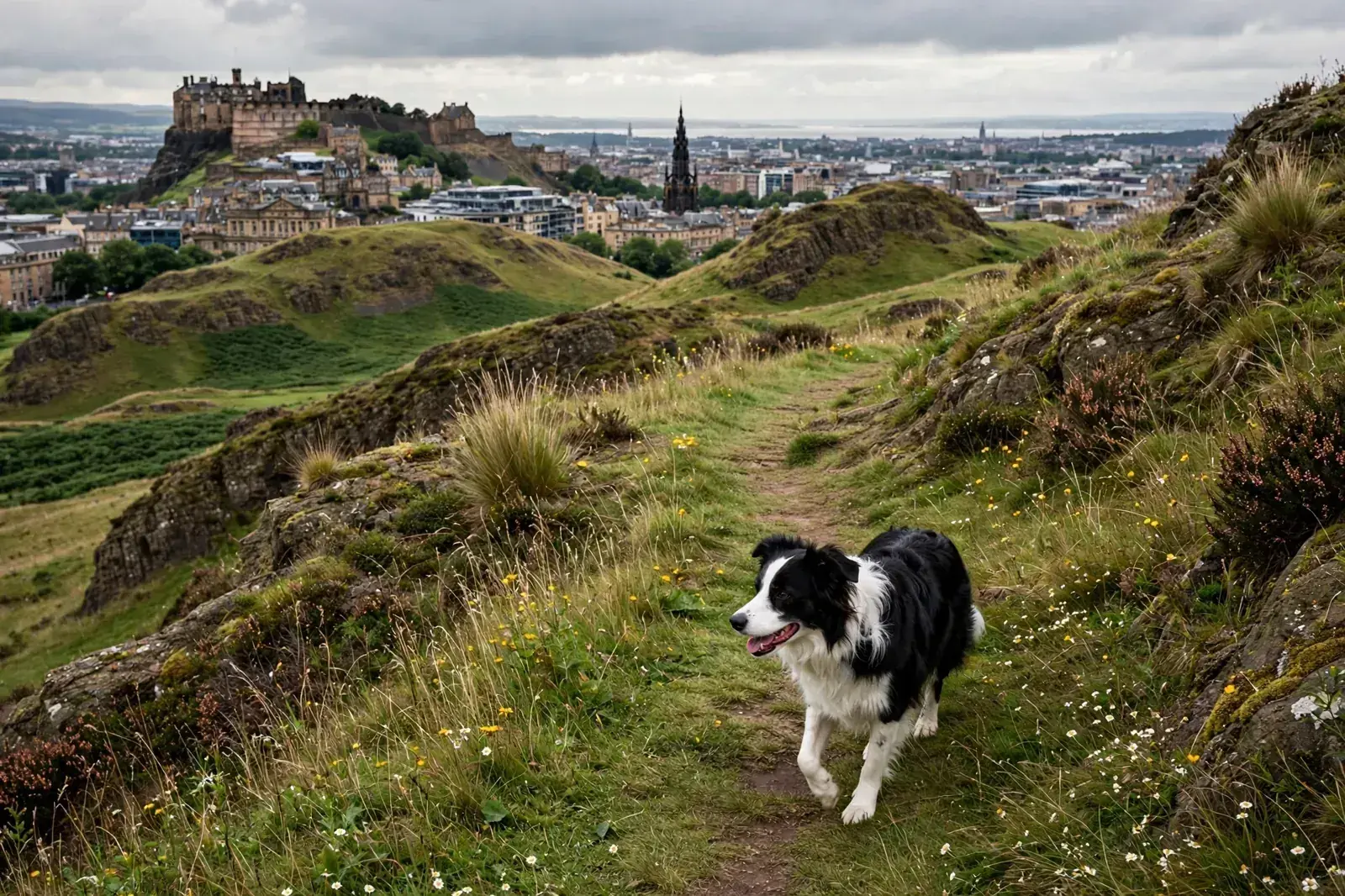
If you are planning to stay in Edinburgh before or after Dunbar, our guide to Edinburgh with a dog covers Arthur's Seat, the Water of Leith and a workable city plan, so you can pair a city day with a Dunbar coast day. The two places complement each other well: Edinburgh for hills and history, Dunbar for harbour, cliffs and open sand, with a short train ride between them.
Seabirds, seals and wildlife rules
Dunbar's coast is alive with wildlife, and much of what makes it special is also what needs the most care from dog owners. In spring and summer, the cliffs and offshore rocks are busy with seabirds — kittiwakes, fulmars, guillemots, razorbills and gulls — nesting on narrow ledges and feeding out at sea. The Bass Rock, visible offshore on a clear day, is one of the world's largest northern gannet colonies, and the sight of thousands of gannets wheeling over the sea is unforgettable. On the beach and in the country park, wading birds, wildfowl and ground-nesting birds use the dunes, grassland and shore, often in places where a dog would love to run.
The rule for birds is simple: give them space, keep your dog under control, and keep it on a lead when birds are nesting, feeding or resting on the ground. A dog that chases a flock of wading birds off the mud at Belhaven Bay may look like it is only playing, but for the birds it is a serious disturbance — they lose feeding time, burn energy they cannot spare, and may abandon a nest. The same applies to ground-nesting birds in the dunes and grassland: a dog running through the dunes in spring can destroy a nest without its owner ever noticing. If you see birds acting agitated, calling loudly or circling above you, you are too close — put your dog on a lead and move away calmly.
Seals are a regular sight around Dunbar, both in the water and hauled out on the shore, and they are a magnet for dogs. A seal on the beach looks slow and approachable, but it is a wild animal that can bite, and a dog that rushes a seal can be seriously injured. Keep your dog on a lead whenever seals are present, give hauled-out seals a wide berth — at least a hundred metres if you can — and move away quietly without making eye contact or noise. Do not let your dog enter the water near seals, and do not try to photograph a seal at close range with a dog beside you. If a seal looks injured, entangled or in distress, keep your distance and report it to the relevant local wildlife or rescue organisation rather than approaching it yourself.
Other wildlife needs the same respect. Rabbits and hares in the dunes, deer in the woodland edges of the country park, and livestock in the fields beside the John Muir Way are all animals a dog may want to chase, and all can be harmed — or can harm a dog — if a chase goes wrong. A strong recall is a wonderful thing, but it is not a guarantee, and the responsible choice on a wildlife-rich coast is to keep a dog on a lead or a long line in the places where wildlife is most likely to be. That is not a restriction on your dog's freedom; it is the condition that allows the wildlife to remain there for everyone to enjoy.
Finally, remember that the coast is a protected place in many areas, and local rules about dogs, access and wildlife can change with the season. Signs at car parks, beach entrances and country park gates are there for a reason — read them, follow them, and check the official guidance before you travel if you are unsure. Rangers and local wardens are a good source of up-to-date advice, and asking them where dogs are welcome and where birds are nesting is a quick way to plan a walk that is good for your dog and good for the wildlife too.
Tides, weather and what to pack
Tides and weather are the two things that shape a Dunbar day more than any other, and both need checking before you travel. Tide times for Dunbar and Belhaven Bay are published online and in local tide tables, and they change every day, so a time that was safe yesterday may not be safe today. As a rule, plan beach walks on a falling tide, give yourself a generous margin before the tide turns, and never rely on being able to outrun a rising tide across soft sand. If you are unsure, ask locally or check the official guidance before you travel — and if in doubt, stay on the dry sand and the cliff path.
Weather on the East Lothian coast can change quickly. A calm morning in the town can become a windy afternoon on the cliffs, and sea fog can roll in without warning, hiding the cliff edge and the way back. Check the forecast the night before and again in the morning, and pack for the worst it promises rather than the best. Wind is the biggest factor: it makes cliff walks harder, beach walks colder, and small dogs more vulnerable to being buffeted and chilled. Rain makes paths slippery and dogs cold, especially short-coated breeds, and strong sun — which does happen in East Lothian — can burn a dog's nose and ears and overheat a thick-coated dog on a cliff walk with no shade.
Pack for the dog as carefully as you pack for yourself. Fresh water and a bowl are essential — there is no reliable fresh water on the beach or the cliff tops, and sea water is not a substitute. A towel, a drying coat for wet or cold days, spare leads, poo bags, a first-aid kit with paw balm and tweezers for ticks, and a long line for the beach are the basics. In summer, add sun protection for pale-nosed dogs and a plan for shade; in winter, add a warm coat for short-coated, older or small dogs and a check on paws for salt and grit. A dog that is warm, hydrated and comfortable will enjoy the walk far more than a dog that is cold, thirsty and tired.
Foot care deserves a paragraph of its own. Sand, salt water, sharp shells, rocky shores and long walks on hard surfaces can all sore a dog's paws, and a dog that is limping at the end of the day will not thank you for an extra mile. Check paws before you set out, during a long walk and again afterwards, and rinse them with fresh water after the beach. If your dog's paws are cracked or sore, keep walks short and on soft ground, and consider dog boots for longer walks on rough ground — but introduce boots at home first, not on a cliff path. Ticks are present in grassland and woodland around Dunbar, especially in spring and summer, so check your dog after walks in the country park and remove any ticks promptly.
Finally, have a wet-weather fallback. Dunbar is best enjoyed outdoors, but a day of driving rain and high wind is not a day for the cliffs, and a sensible fallback keeps the trip enjoyable rather than miserable. A short harbour walk in a break in the rain, a drive to a sheltered woodland walk, a dog-friendly cafe for an hour, or simply a rest day in your accommodation are all better than a forced march in a storm. The coast will be there tomorrow, and a dog that has had a rest day will be readier for a long walk than a dog that has been dragged through a gale.
Cafes, pubs and places to stay
Dunbar has cafes, pubs and places to stay that welcome dogs, but policies change, and the only safe rule is to check before you travel or ask at the door. Do not assume that a cafe that welcomed dogs last year still does, or that a pub that welcomes dogs in the bar also welcomes them in the restaurant. When you arrive, ask politely where dogs are welcome — often a specific area, a terrace or a corner table — and settle your dog there with a mat and a chew. A dog that settles quietly under a table is welcome back; a dog that barks, begs or wanders is not, and the difference is usually down to the owner's preparation rather than the dog's nature.
For cafes and pubs, bring your own dog kit: a mat or blanket for the dog to lie on, a water bowl or a collapsible bowl, a chew or a stuffed Kong to keep the dog occupied, and a short lead you can hold or hook safely. Order quickly, keep your dog close, and do not let it approach other tables, other dogs or food on the floor. If your dog is restless, take it outside for a short toilet break rather than letting it get louder indoors. Many dog-friendly places in Dunbar are small, and a calm dog in a corner is a pleasure for everyone; a noisy dog in the middle of the room is a reason for a venue to change its policy.
Takeaway and picnic options are a useful fallback, and Dunbar is well suited to them. Buy food from a cafe, bakery or shop, take it to a bench by the harbour or a sheltered spot in the country park, and eat with your dog beside you. A picnic also solves the problem of a dog that is too tired, too wet or too muddy to sit in a cafe after a beach walk — and a muddy dog is not a cafe dog, however friendly the venue. Carry a bag for your rubbish, pick up after your dog, and leave the spot as you found it. The harbour benches and the country park are shared spaces, and keeping them clean is what keeps them pleasant for the next visitor.
For overnight stays, the same check-ahead rule applies, and it applies even more strictly. Dog-friendly accommodation in and around Dunbar includes hotels, guest houses, cottages and holiday lets, but not every room or unit accepts dogs, and the dog-friendly ones may be limited in number, charged at a supplement, or subject to conditions such as a maximum number of dogs, a size limit, or a rule about leaving dogs unattended. Check the official guidance before you travel, confirm the dog policy in writing when you book, and ask the specific questions that matter for your dog: is there a secure garden, is there a nearby toilet walk, are dogs allowed in the breakfast room or only in the bedroom, and what happens if your dog barks. A place that answers those questions clearly is a place that has thought about dogs properly.
Arriving at a place to stay with a dog deserves the same calm routine as arriving at a holiday park. Walk the dog first, let it toilet and sniff the new surroundings, then bring it inside, show it its bed and water, and let it settle before you unpack. Keep the first evening quiet, feed at the usual time, and do not leave the dog alone in an unfamiliar room until it has settled — and even then, only if the accommodation explicitly allows it. A dog that has had a long beach day will often sleep soundly, and a good night's sleep is the best preparation for another coastal walk the next day.
Getting there: parking and trains
By car, Dunbar is reached from the A1, the main road that runs down the east coast from Edinburgh towards Berwick-upon-Tweed and England. The town is well signed from the A1, and the drive from Edinburgh takes under an hour in normal traffic, which makes Dunbar an easy day trip from the capital as well as a destination in its own right. Parking in Dunbar is available in car parks and on streets around the town centre, the harbour and Belhaven Bay, but spaces fill up on sunny weekends and summer days, so arrive early if you can. Check the official guidance before you travel for current parking locations, charges and time limits, and do not park where signs prohibit it — a parking ticket is a poor souvenir.
Park with your dog in mind. Choose a space in shade on a warm day, never leave a dog in a parked car on a warm day even for a few minutes, and plan your first walk from the car park so the dog can toilet and stretch its legs before you set off. The car park at Belhaven Bay is the most convenient for a beach day, while parking near the town centre or the harbour is better for a harbour and cliff walk. If you park at Belhaven Bay, remember that the beach and the country park are a short walk from the car, and that the tide will shape your walk — check tide times before you leave the car, not after you are already on the sand.
By train, Dunbar station is on the East Coast Main Line, with services towards Edinburgh and towards Berwick-upon-Tweed and beyond. Dogs are generally welcome on trains, usually free of charge, but rules vary by train operator, so check the official guidance before you travel. Keep your dog on a lead, keep it off seats, and travel outside peak hours where possible so you have space and your dog is not stressed by crowds. The station is a walk from the harbour and the town centre — roughly a mile, along roads that are not all pavement-friendly — so plan the onward route before you arrive, and allow extra time if your dog is older or less mobile. A taxi from the station is an option if the walk is too far, but check in advance whether local taxis accept dogs.
By bus, services connect Dunbar with Edinburgh, North Berwick and other East Lothian towns, and dogs are often carried at the driver's discretion, but this is not guaranteed — check the official guidance before you travel and have a fallback plan. Walking and cycling are also options for the final stretch: the John Muir Way and local cycle paths connect Dunbar with the surrounding countryside, and a dog that is used to walking beside a bike can enjoy the traffic-free paths. Whatever your mode of transport, the principle is the same: plan the last mile as carefully as the long journey, because the last mile is where a tired dog, a busy road or a missing pavement can turn a good day into a stressful one.
If you are driving from further afield, remember that Dunbar is a small town with narrow streets in places, and that the harbour area is not designed for large vehicles. Drive slowly, watch for pedestrians and dogs on the harbour quays, and do not try to park on the harbour itself unless signs explicitly allow it. A little patience at the start of the day — parking properly, walking the dog, checking the tide — pays off all day, because a calm arrival sets the tone for a calm dog and a calm walk.
A practical one-day plan
Here is a day plan that works for most dogs and most weather, using the harbour, the cliffs and Belhaven Bay in the order that suits the tide. It is a plan, not a timetable: adjust the times to the tide, the weather and your dog's energy, and do not be afraid to cut it short. A shorter day that ends with a happy dog is better than a longer day that ends with an exhausted one.
Start early at the harbour, before the crowds arrive. Park near the town centre or walk from your accommodation, and take a slow loop around the harbour on a short lead. Let your dog sniff, watch the boats and settle into the day. This is the time for photographs, for a quiet coffee if a cafe is open, and for a gentle warm-up walk rather than a long march. Allow about forty-five minutes, including time to sit on a bench and watch the harbour wake up. If your dog is nervous, this early, quiet harbour walk is the best time to visit; if your dog is confident, it is still the best time, because the light is beautiful and the gulls are at their loudest.
Next, walk the clifftop trail east from the harbour for as far as suits your dog — a short out-and-back to the first viewpoint for older or smaller dogs, a longer stretch for fitter dogs. Keep your dog on a lead, stay on the marked path, and turn back at your planned point rather than pushing on. Allow an hour to ninety minutes for this section, including stops to look at the view and to give your dog water. By late morning, you will be ready for a break, and your dog will be ready for a rest — find a bench, offer water, and let the dog lie down for ten minutes before the next stage.
After lunch, head west to Belhaven Bay for the beach. Time this for the falling tide if you can, so the sand is wide and firm and the rock pools are exposed. Let your dog run on a long line or off lead only if its recall is reliable and there are no birds or seals to disturb, and keep a close eye on the tide. Allow two hours for the beach, including time to paddle, sniff the strandline and explore the pools. This is the part of the day most dogs enjoy most, and it is worth giving it the time it deserves rather than rushing through it on the way to somewhere else.
Finish with a slow walk back through John Muir Country Park, a cafe stop if your dog is settled and dry, and a short last walk around the harbour before you leave. If you are staying overnight, the evening harbour walk is a gentle end to the day; if you are driving home, a short toilet walk and a drink of water before the journey will help your dog settle in the car. Check your dog's paws, coat and ears before you leave, offer water, and let the dog sleep on the way home. You have walked a harbour, a cliff top and a beach in a single day, in the birthplace of John Muir — and your dog has had a day that was, in every sense, a proper coastal walk.
If the weather turns, shorten the plan without guilt: harbour in the morning, a sheltered walk in the country park, and Belhaven Bay only if the tide and the wind allow. Dunbar does not need a perfect day to be enjoyable; it needs a plan that fits the day you actually have, a dog that is comfortable, and an owner who is willing to turn back when the cliffs are too windy or the tide is too high. That willingness — to adapt, to wait, to come back another day — is the most practical skill a dog owner can bring to the Scottish coast, and it is the skill that will keep you and your dog coming back to Dunbar.
Practical questions
Before you go
Is Dunbar harbour safe to walk around with a dog on a lead?
Yes, with care. Keep your dog on a lead around the harbour walls, quays, ropes, vehicles and open water, and keep well back from unguarded edges. Harbour surfaces can be wet and slippery, and working boats, fish boxes and machinery are part of a working harbour, so treat it as a place to walk through calmly rather than a place for off-lead play.
Can dogs go on Belhaven Bay beach all year?
Belhaven Bay is generally a good year-round dog beach, but rules can change and seasonal wildlife restrictions may apply in parts of John Muir Country Park. Check the official guidance before you travel, keep your dog under close control near birds and seals, and check tide times so you are not cut off by the incoming tide.
Is the Dunbar clifftop trail suitable for dogs?
The clifftop trail is a rewarding walk for fit, lead-trained dogs, but it is not a casual off-lead route. Keep your dog on a short lead near cliff edges, stay on the marked path, and turn back if the wind is strong, the ground is wet, or your dog is nervous near drops. Older dogs and dogs that pull should take the shorter, flatter sections instead.
Can I take my dog on the train to Dunbar?
Dogs are generally welcome on trains to Dunbar, usually free of charge, but rules vary by train operator and you should check the official guidance before you travel. Keep your dog on a lead, keep it off seats, and travel outside peak hours where possible so you have space. Dunbar station is a walk from the harbour, so plan the onward route before you arrive.
Are dogs welcome in cafes and pubs in Dunbar?
Some cafes and pubs in Dunbar welcome dogs, often in a specific area or on an outdoor terrace, while others do not. Policies change, so check the official guidance before you travel or ask at the door before you settle in. Bring a mat and a chew so your dog can settle quietly, and always have a takeaway or picnic fallback.
What should I do if my dog meets seals or nesting seabirds near Dunbar?
Put your dog on a lead immediately, move calmly away, and give seals and nesting birds a wide berth. Do not let your dog approach, chase or bark at wildlife, and keep it out of the water near hauled-out seals. If a seal looks injured or a bird is in distress, keep your distance and report it to the relevant local wildlife or rescue organisation rather than handling the animal yourself.