This guide is independent and contains no paid placement. If affiliate links are added later, they will be clearly marked and will not change our editorial checks.
East Lothian dog friendly beaches reward a simple method: pick the beach by tide and wind, not by habit. Gullane suits a classic sandy walk, Yellowcraig adds woodland and Fidra views, North Berwick mixes town facilities with two bays, Tyninghame is the quieter connoisseur choice, and Belhaven Bay is the big-space option beside Dunbar. Keep dogs under close control near birds and seals, check parking and tide times before leaving Edinburgh, and use North Berwick or Dunbar stations if you would rather arrive by train.
Five beaches compared: choose before you drive
Start with a comparison, because East Lothian's beaches look similar on a map and feel completely different on the ground. They string along roughly forty miles of Firth of Forth and North Sea coast east of Edinburgh, backed in places by golf links, in others by pinewoods, dunes and saltmarsh. A dog that needs a short, sheltered leg-stretch and a dog ready for a half-day expedition should not automatically be sent to the same car park. Nor should you: facilities, exposure and crowd levels vary enough to make or spoil a day, especially in winter wind or on the first warm weekend of spring.
| Beach | Best for | Character with a dog | Watch for |
|---|---|---|---|
| Gullane Bents | A first East Lothian beach day | Broad, gently curving sand backed by dunes, close to village cafés and facilities | Busy on fine weekends; golf links behind the beach; wind exposure |
| Yellowcraig | Beach plus woodland variety | Sand, dune paths and pinewood trails near Dirleton, with island views to Fidra | Popular family beach; keep dogs close near play and picnic areas |
| Belhaven Bay | Long walks and big skies | Huge expanse at low tide in John Muir Country Park, beside Dunbar | Tide cuts distance judgement; saltmarsh and bird areas need control |
| Tyninghame Links | Quiet, spacious walking | Woodland approach opening to a wide, often quieter shore and estuary edge | Limited facilities; nesting and feeding birds; plan water and timing |
| North Berwick | Beach plus town convenience | Two town bays, West Beach and Milsey Bay, with Bass Rock views and cafés nearby | Busiest and most built-up; harbour, boats and other dogs in close quarters |
Read the table with three filters. First, tide: at high water some sections narrow dramatically against rocks, seawalls or dune edges, while at low water Belhaven and Gullane in particular become expeditions in their own right. Second, wind: an easterly off the North Sea turns an otherwise gentle beach into a sand-blasted endurance test for short-coated dogs and their owners, and a west or south-westerly can make the same beach feel sheltered by its dunes. Third, wildlife: the quieter a beach feels to you, the more important it may be to birds and seals, which is why the quietest options carry the strongest duty to keep a dog close, calm and predictable.
None of these beaches should be treated as a fenced dog field. Golf is a constant neighbour along this coast, horses use some beaches and firm sand at quieter times, kite and water sports appear when wind and tide suit them, and other beach users have as much right to an undisturbed afternoon as a dog walker does. The reward for accepting those neighbours is considerable: in general this coast does not operate the seasonal dog bans familiar from many resorts further south, so a well-controlled dog can enjoy these shores across the calendar. Our national explainer on dog-friendly beaches in the UK and their rules sets out how bans, local orders and fines differ around Britain, and why the signs on the day always outrank any guide, including this one.
Gullane and Yellowcraig: bays, dunes and Fidra views
Gullane Bents is the beach many Edinburgh dog owners learn first, and it earns that status. A broad sweep of sand arcs below dune grass, the village sits a short walk behind with food, supplies and a proper warm-up after a cold walk, and the shore itself offers the simplest possible dog maths: walk out along the sand as far as fitness and tide allow, then turn and walk back with the view changed. At low tide the walking is generous and the dog can settle into a steady rhythm away from the dune edge, where ground-nesting birds and fragile marram need feet — human and canine — to keep to established paths. At high tide, plan shorter and expect company to compress onto less sand.
West and east from Gullane the coast repays exploring in short sections rather than heroic single marches. Gullane Point and the bays towards Aberlady bring rockier ground, seabird noise and, around Aberlady Bay Local Nature Reserve, a much more sensitive wildlife setting where dogs must be kept under strict control and local reserve rules followed exactly. This is not a place to treat as an extension of the main beach. Read every sign, keep leads short where asked, and be ready to turn back if wardens, nesting closures or your dog's excitement say the visit is not working. A good dog beach day includes the walks you wisely shorten.
Yellowcraig, near Dirleton, solves a different problem: the mixed-weather, mixed-party day. Behind its beach sits a network of pinewood and dune paths that gives shelter when the shore wind rises, variety for a dog that bores on an out-and-back, and natural short loops for puppies, senior dogs or a second walk after lunch. Out front, the sand looks across to Fidra, the island said to have inspired Stevenson's Treasure Island, with its lighthouse and seabird colonies. Keep dogs out of the busiest family and play areas except on a lead passing through, use the woodland for calm sniffing rather than high-speed chasing around blind bends, and expect the car park to fill early whenever sun and weekend coincide.
Between Gullane and Yellowcraig, the coastal path links a chain of smaller bays and headlands that suit confident walkers with a map, a tide table and a dog fit for uneven ground. Do not improvise cliff-edge or rock-scramble shortcuts with a dog on a flexi lead, and do not assume a bay that is reachable at low water stays reachable an hour later. The disciplined version — path, beach sections in sequence, inland return where the waymarked route offers one — is both safer and more satisfying than any improvised line along the water's edge.
North Berwick and Tyninghame: town sand and quiet links
North Berwick gives you the coast with a town attached, which is exactly right for some days and exactly wrong for others. Its two main bays sit either side of the harbour: West Beach running towards the golf links, and Milsey Bay, often called East Beach, looking towards the Bass Rock. Both offer firm sand at low tide, rock pools to supervise carefully, and the rare luxury of a beach walk that can end with fish and chips, coffee or a vet, shop and train station within a short stroll. For a first coastal trip with a young dog, that density of facilities is reassuring. For a nervous or reactive dog at peak hour on a sunny Saturday, it can be a great deal of stimulation in a small space.
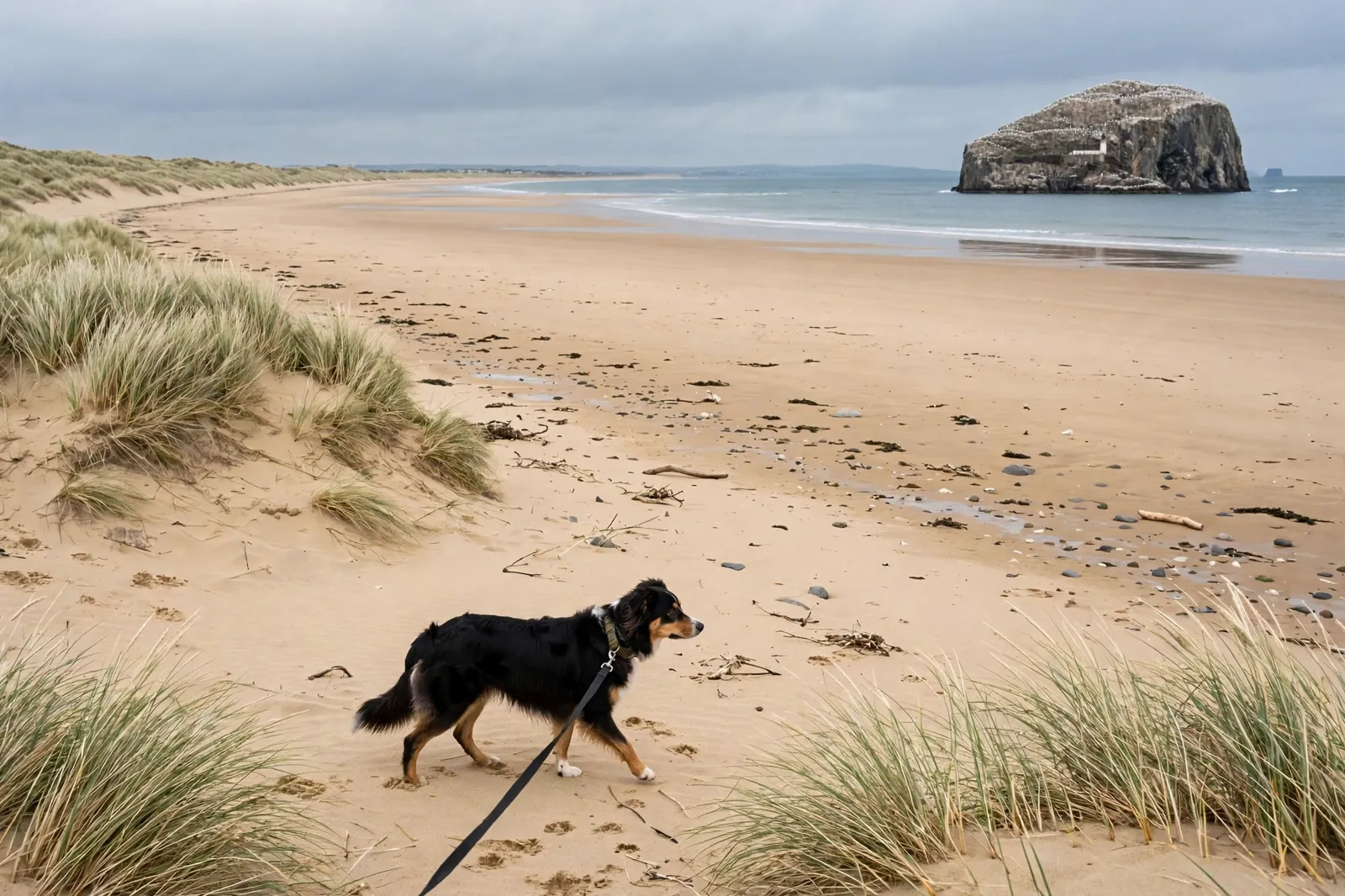
Manage North Berwick by timing. Early mornings and weekday walks transform both bays, and winter days, properly dressed for, can feel spacious even here. Keep leads short around the harbour, the lifeboat and boating activity, the Scottish Seabird Centre area and any crowds gathered for boat trips to the islands. Dogs are part of this town's everyday life, but gulls here are bold, practised food thieves: keep picnics guarded, do not let a dog chase or lunge at birds on the sand, and clear every scrap, because a beach where dogs learn to scavenge is a beach that becomes harder for the next dog owner. Bass Rock, white with gannets in season, is the view offshore; admire the colony from land and never let a dog disturb birds at roost or feeding sites along the rocky edges.
Tyninghame Links, reached through woodland south of Dunbar and north of the Tyne estuary, is North Berwick's opposite in almost every useful way. The approach through trees slows everyone down before the shore opens out: a wide beach, dune and saltmarsh edges, and the estuary's shifting channels and birdlife beyond. Facilities are minimal compared with the town beaches, so carry water for the dog, take waste away to a bin rather than expecting one on the shore, and agree your turning point before the estuary views persuade you onwards. Dogs that chase birds have no business off a lead here in any season; the Tyne estuary matters to feeding and roosting birds, and a single joyful charge across mud or marsh can scatter a flock that needed that hour to feed.
Paired in one stay, these two make an instructive East Lothian weekend: a town day at North Berwick with short beach sessions, cafés and the train home if legs tire, then a quiet day at Tyninghame walked slowly, at the dog's pace, with a picnic carried in and every trace carried out. The contrast teaches younger dogs two valuable lessons — settle amid bustle, and stay calm amid emptiness — that transfer to every coast they will ever visit.
Belhaven Bay: the big beach at Dunbar's door
Belhaven Bay is the East Lothian beach that recalibrates your sense of scale. At low tide the sand runs so wide between Dunbar and the Tyne estuary that the walk becomes a journey across a plain, with the Lammermuir Hills inland, Bass Rock appearing as you look back north, and the Biel Water crossing the beach near the famous bridge to nowhere — a footbridge that, at high tide, stands picturesquely surrounded by water. For a fit dog on a settled day, there are few better legal, open walks this close to a capital city. For any dog, the same scale is the hazard: distances deceive, weather arrives visibly but fast, and a return walk into a strengthening wind takes twice the effort of the stroll out.
The beach sits within John Muir Country Park, named for the Dunbar-born conservationist, and the park's mix of beach, dune, saltmarsh, grassland and woodland is managed for wildlife as much as for leisure. That shows in the walking. Use the established paths through the dunes, notably around the John Muir Stone and the cliff-top and woodland edges towards Dunbar, rather than trampling new lines through marram. Keep dogs out of saltmarsh creeks and away from roosting and feeding birds on the estuary side, and treat the Hedderwick and Linkfield areas as shared, working countryside with livestock possible in adjoining fields. John Muir's own lesson — that everything is connected — is practical here: a dog in the wrong creek affects birds, banks and other visitors all at once.
Dunbar completes the day usefully. John Muir's Birthplace museum anchors the town's claim on its famous son, the harbour and castle ruins give a short lead-walk extension after the beach, and the town offers food, supplies and a station for the return to Edinburgh. Dogs will not be welcome inside every attraction, so plan a two-adult handover or admire exteriors if you are solo. Watch harbour edges, fishing gear and boat activity with a short lead, and never let a dog drink harbour or estuary water: carry fresh water and offer it before the dog goes looking for its own.
Belhaven also teaches tide discipline better than any lecture. Check tide times from a reliable source before setting out, note the hour at which channels and the area around the bridge begin to fill, and build your walk backwards from that hour. Cut-off risk on this coast is less about dramatic cliffs than about quiet channels deepening behind you and soft ground slowing a tired dog. If the tide, wind or light is against the big version, take the dune and park paths instead and save the full low-tide expanse for the day it is genuinely on your side.
John Muir Way sections to stitch beaches together
The John Muir Way runs coast to coast across central Scotland between Helensburgh and Dunbar, and its eastern stages turn East Lothian's beaches from isolated car-park visits into a connected walking story. Walked in sections with a dog, it links North Berwick, dirleton-side paths, the Tyne estuary, Tyninghame, Belhaven and Dunbar in combinations that suit anything from a long weekend to a week of daily stages. You do not need to walk the whole route for it to be useful: its real gift to beach walkers is a waymarked inland-and-coast thread to follow when a beach section ends, a tide turns, or a return route is needed.
Choose sections honestly. The North Berwick to Dunbar stretch is a substantial day for a fit dog and a very long one for most, threading coast, farmland and estuary with limited bail-out points in its quieter middle; splitting it at Tyninghame or using Belhaven as a single-section target makes for happier dogs and better photographs. Shorter links — Dunbar into the country park, or a Yellowcraig and Dirleton loop using the way where it passes inland — suit older dogs and shorter winter days. Carry a map or downloaded route rather than relying on waymarks alone, because coastal diversions, farm operations and path works can reroute any long-distance trail, and phone signal should never be your only navigation plan.
Trail etiquette on the John Muir Way mirrors good beach etiquette, with cyclists added. The way is shared with bikes on many sections, so keep the dog on the verge side, shorten the lead when riders approach, and step aside together at gates and narrow bridges. Farmland sections bring livestock into the walk even on a beach day: leads on around cattle and sheep, gates closed, and no feeding of any animal, however friendly it appears over a fence. If cattle with calves occupy a field the route crosses, wait, reroute or retreat rather than walking a dog through them — the route will still be there tomorrow.
Logistics make or break a section walk with a dog. Two cars solve everything and are rarely available; more realistic is the train-and-walk pattern, using Dunbar or North Berwick as the far end and a bus or taxi booked ahead for the return where services are thin, with the dog's acceptance confirmed when booking. Carry more water than a beach-only walk suggests, because inland stages lack even the illusion of water — streams and troughs are not dog bowls — and pack a small towel and lead-cleaning plan for the muddy estuary edges that seem to find every white dog on this coast.
Birds, seals and seasons: when space matters most
East Lothian's coast is internationally important for birds, and a dog guide that ignored that would be sending you in unprepared. The Firth of Forth and its estuaries, mudflats and rocky shores support wintering waders and wildfowl in large numbers, breeding seabirds on the offshore islands including the Bass Rock gannet colony, and ground-nesting birds in dunes, saltmarsh and coastal grassland in spring and summer. The rule that covers almost everything is simple: a dog that stays close, does not chase, and is put on a lead whenever birds are feeding, roosting, nesting or simply present in numbers costs wildlife nothing. A dog allowed to range and flush birds repeatedly can cost a wintering wader the energy margin it needed, or a nesting bird its season.
Spring and early summer need the tightest control. Ringed plovers and other shorebirds nest in camouflaged scrapes on open shingle and sand, exactly where an off-lead dog loves to run, and their chicks feed away from the nest while still flightless. Roped areas, temporary signs and warden requests appear on this coast for good reason: obey them without negotiating the boundary, keep to the wet sand below dune and shingle nesting zones where asked, and choose a different beach entirely if your dog's recall around birds is not yet proof against temptation. Terns, eiders and gulls with chicks near harbours and rocks deserve the same respect at North Berwick and Dunbar.
Seals need a parallel discipline in every month, with a peak of vulnerability in autumn and early winter when grey seals pup on quieter shores and offshore haul-outs around the Forth. A pale pup resting alone on a beach is almost always waiting for its mother to return from feeding; it is not abandoned, and a curious dog approaching it can separate them permanently or provoke a dangerous bite from an adult. Keep a very wide distance — if a seal raises its head to watch you, you are already too close — put the lead on early, and leave the section of beach to them. Report a genuinely injured or entangled seal to the relevant rescue authorities rather than approaching it with a dog in tow.
Autumn and winter swap nesting worries for feeding ones, and add darkness and storms to the plan. Short days mean a beach walk that starts at eleven can still end in gloom if you misjudge distance at Belhaven or Tyninghame, so carry a torch, reflective gear for dog and human, and a hard finish time. Storm-tossed beaches deposit hazards — fish hooks, sharp debris, dead seabirds that dogs should not scavenge, and occasionally pollution — so keep scavengers on a lead for the first walk after heavy weather and check paws afterwards. The season's compensation is real: emptier car parks, dramatic light, and winter bird spectacles watched, undisturbed, from a respectful distance with a settled dog beside you.
From Edinburgh for the day: trains, buses and parking
East Lothian is Edinburgh's coast in practice, and the easiest dog beach day from the city often starts at Waverley rather than on the A1. North Berwick's station sits a short walk from both town bays, Dunbar's station serves Belhaven and the country park with a slightly longer approach, and Drem and Longniddry stations open quieter inland-to-coast walks for people who enjoy the approach as part of the day. Starting by train removes parking pressure entirely, lets a tired dog sleep on the way home, and turns a section of the John Muir Way into a simple station-to-station walk rather than a car shuffle.
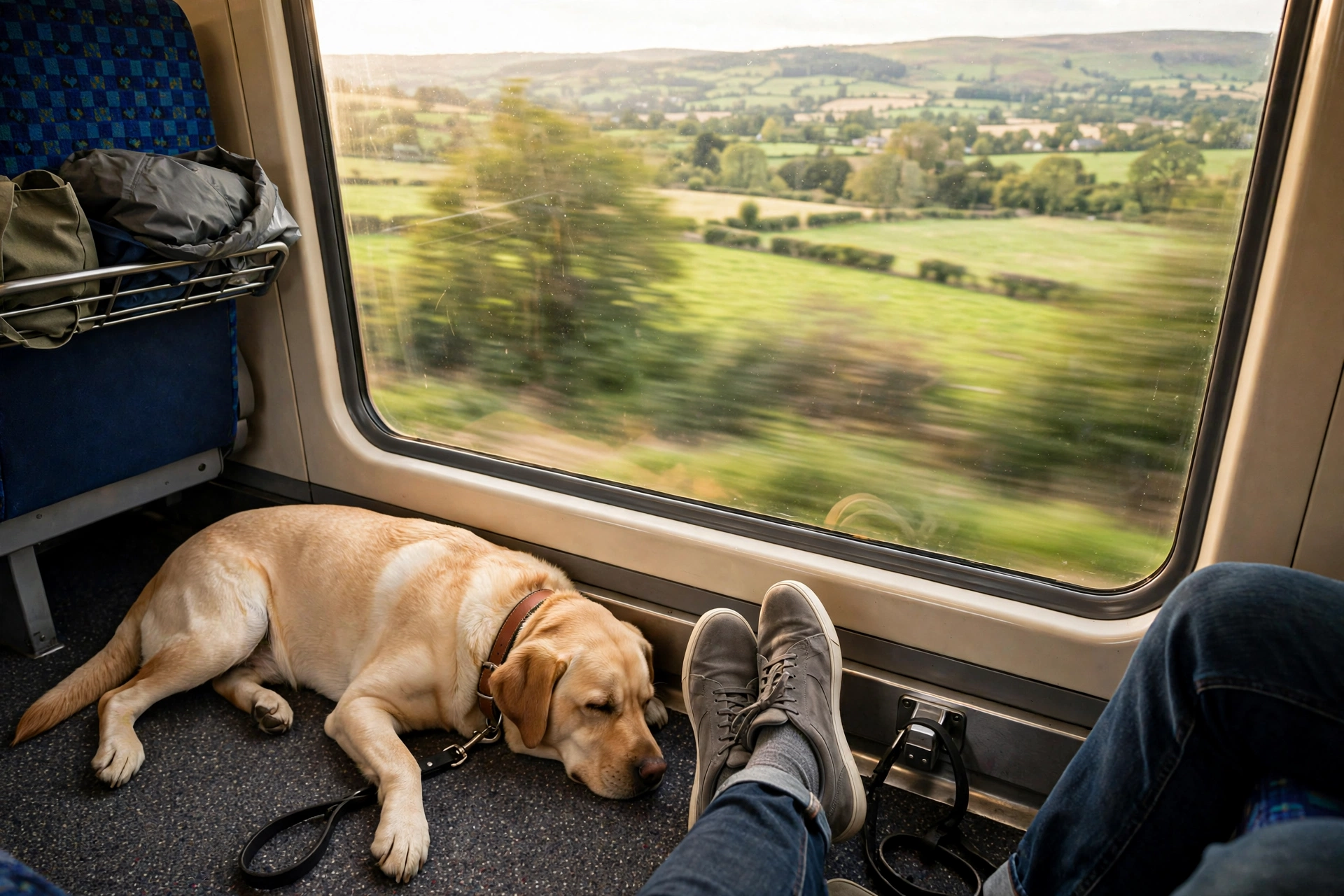
Dogs travel on ScotRail services subject to National Rail conditions — usually free, typically up to two dogs per passenger, kept on a lead or in a carrier, off seats and out of the way of other passengers — but conditions and any temporary restrictions can change, so check the latest official guidance before you travel rather than relying on any summary. Our broader guide to taking a dog on UK trains walks through the national rules, operator differences and the small courtesies that make rail travel with a dog unremarkable: travel off-peak where you can, settle the dog under or beside your seat with a familiar mat, offer water at stations rather than in a moving aisle, and plan a toilet stop before boarding, because neither of you wants a long, urgent hour to North Berwick. Muddy paws after Belhaven are the strongest argument in Britain for carrying a travel towel.
Driving remains the flexible option for Gullane, Yellowcraig and Tyninghame, and it comes with a parking discipline this coast now enforces. Coastal car parks operate paid parking at popular sites and in the main season, with charges, charging hours, height barriers and payment methods varying by location and changing over time. Check the latest East Lothian Council coastal parking information before you travel, assume the well-known car parks fill by mid-morning on fine weekends, and have a second-choice beach from the comparison table ready rather than joining verge-parking that blocks farm gates, bus turning and emergency access. A ticket bought for the shorter stay you hope for, followed by a rushed walk watching the clock, is worse value than an honest full-day choice at a quieter beach.
Buses fill gaps between stations, towns and some beach approaches, but dog acceptance, space and frequency vary, and a large or wet dog on a busy summer bus needs the driver's goodwill as well as a valid ticket. Confirm current operator policy before building a one-way walk around a bus return, and always hold a taxi fallback number for the nearest town, with the dog declared when you call. However you arrive, build the day backwards from the last comfortable return, not forwards from enthusiasm: East Lothian will offer you one more bay, one more viewpoint and one more mile in almost any direction, and a good day-trip plan is the one that says no to the last of them.
Tides, wind and clean paws: the practical finish
Finish with the unglamorous checks that decide whether a good East Lothian walk stays good. Tides first: consult a tide table for the specific day and place, remember that times shift along the coast and that wind can push water in earlier and higher than predicted, and tell someone your beach and expected finish on longer walks at Tyninghame and Belhaven. Channels, estuary edges and rock sections that were ankle-deep entertainment on the way out can be thigh-deep problems for a small dog on the way back. If in doubt, walk the upper shore and the waymarked paths and let the low-tide expanses wait for a day when the numbers are plainly in your favour.
Water and swimming deserve a clear-eyed word. Many dogs will swim in the North Sea here on calm days, and many owners will sensibly decide theirs will not: currents around headlands, river mouths and the Tyne estuary, cold water in every month, jellyfish in warmer spells, and hidden rock and debris below a pleasant surface all argue for caution. Never throw balls or sticks into surf or current for a dog to chase, keep dogs out of harbours, marinas and estuary channels altogether, and rinse salt water from coats and paws afterwards, offering fresh drinking water so the dog does not tank up on seawater, which reliably ends beach days early and messily. A dog that paddles at the edge under control has had a beach day; depth is not the measure.
Kit for this coast is short and specific. A standard lead plus a long line for controlled freedom where it is appropriate and permitted, a harness for dune-path scrambling if your dog pulls on a collar, poo bags in numbers that assume no bins for hours — because at Tyninghame and on John Muir Way sections there may be none — water and a bowl, a towel, a basic first-aid kit including tweezers for ticks from dune grass and woodland edges, and in summer a plan for shade and heat, because dune bowls become ovens on still days and pale, short-coated dogs can burn. In winter, swap the shade plan for a dog coat, paw checks for grit and ice balls, and the reflective gear already mentioned.
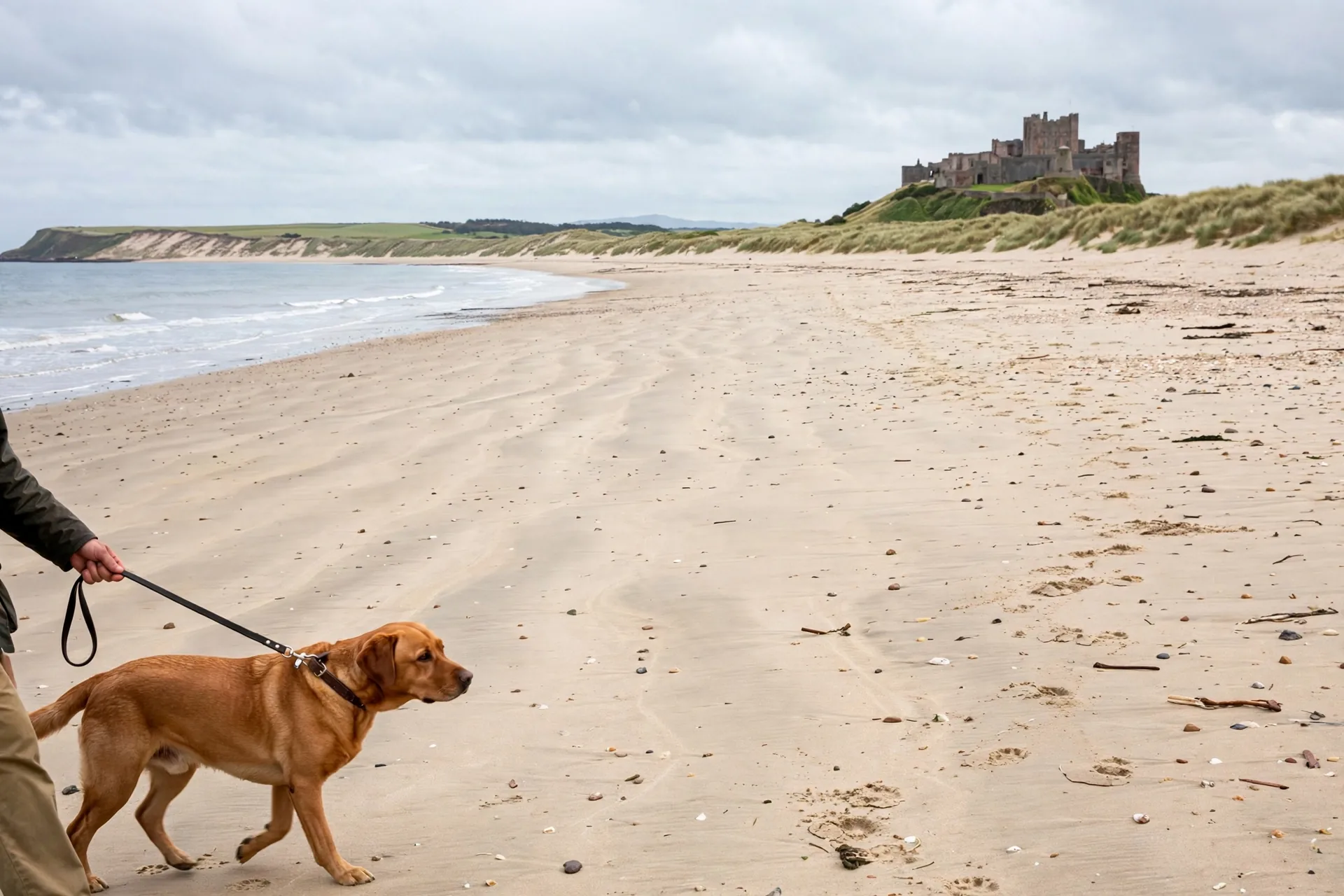
Leave each beach measurably no worse for your visit: waste bagged and carried out, picnic scraps secured from the famously capable gulls, gates and dune fences as you found them, and wildlife exactly as undisturbed as if a well-trained dog had never passed — because one has. East Lothian keeps its beaches open to dogs all year on a simple understanding that dog owners will behave like the coast matters to them. Walk Gullane at dawn, Yellowcraig in a woodland-sheltering blow, North Berwick on a town-and-sand morning, Tyninghame in estuary quiet and Belhaven under the biggest sky in the Lothians, and you will understand why Edinburgh keeps this coastline so close to its heart. For another Scottish shore with a very different character, our Northumberland with a dog guide continues the story south across the border, castles and all.
The East Lothian towns behind the beaches
The beaches are only half the story; the towns behind them decide where you park, eat and sleep. Our town guides cover North Berwick with a Dog, Dunbar with a Dog and Haddington with a Dog, each with its own beach rules, cliff and harbour walks, and dog-friendly cafes, so you can pair a beach morning with a town afternoon.
Practical questions
Before you go
Are dogs allowed on East Lothian beaches all year?
In general, East Lothian beaches do not operate the seasonal dog bans common in many English resorts, and dogs are welcome through the year on most of the coast covered in this guide. Local signs, wildlife closures and temporary restrictions still apply, especially around nesting birds and seal haul-outs. Always check signs on arrival and the latest council and nature reserve guidance before you travel, and follow any lead request on the day.
Which East Lothian beach is best for a long walk with a dog?
Belhaven Bay and the John Muir Way towards Tyninghame give the longest continuous walking, with big skies, dunes and links onward in both directions. Gullane to Yellowcraig is the best varied alternative, combining bays, woodland edge and views to Fidra. Choose by tide, wind and your dog's fitness rather than distance alone, and plan an out-and-back total you can finish in daylight.
Can I take my dog to East Lothian beaches by train from Edinburgh?
Yes. North Berwick and Dunbar are the most useful stations for beaches, with Drem and Longniddry opening up quieter sections for walkers who do not mind a longer approach. Dogs travel on ScotRail services subject to National Rail conditions, usually free for up to two dogs on a lead, but rules can change. Check the latest ScotRail and National Rail guidance before you travel and keep your dog off seats and out of aisles.
When should dogs stay away from seals and nesting birds in East Lothian?
Give seals space in every month, and extra space in autumn and early winter when grey seal pups may rest on quieter beaches. A pup alone is usually waiting for its mother, not abandoned. In spring and early summer, keep dogs on a lead or at heel near dune, saltmarsh and roped nesting areas for ground-nesting birds, and never let a dog chase birds on the mudflats or shoreline.
How much does parking cost at East Lothian beach car parks?
Coastal car parks in East Lothian operate paid parking in the main season and at popular sites, with charges, hours and payment methods varying by car park and changing over time. Gullane, Yellowcraig, Belhaven and Tyninghame are all popular enough to fill early on fine weekends. Check the latest East Lothian Council coastal parking information before you travel, arrive early, and never park on verges or block farm and emergency access.