This guide is independent and contains no paid placement. If affiliate links are added later, they will be clearly marked and will not change our editorial checks.
Start at Dunfermline Abbey and Palace, walk straight into the 76-acre Pittencrieff Park, then choose a longer loop at Townhill, Devilla Forest or Lochore Meadows. Keep your dog on a lead around the Abbey, the peacocks and livestock, and check the official guidance before you travel for opening times and any conservation closures.
Why Dunfermline suits a dog day out
Dunfermline is one of those places that rewards a slower pace, and that is exactly what makes it work with a dog. It was once the ancient capital of Scotland, the home of kings and queens, the burial place of Robert the Bruce and the birthplace of Andrew Carnegie, and it became a city in 2022. Yet the historic core is small. The Abbey, the Palace ruins, the Carnegie Birthplace Museum, the library and galleries, and the entrance to Pittencrieff Park all sit within a few minutes' walk of each other, so a dog is never asked to march for miles between sights, and nobody in the group has to choose between history and a proper walk.
The shape of the day is the real attraction. Most historic towns ask a dog to wait outside while the humans go indoors, and then offer a thin strip of pavement as compensation. Dunfermline does it the other way round. The two headline sights, the Abbey and the Palace, are largely outdoor experiences: stonework, lawns, graveyards and views over a wooded glen. The park beside them is 76 acres of woodland paths, formal gardens, lawns and water, gifted to the town by Carnegie, and it is where local dog walkers go every day. A visit can therefore be built around the dog's needs first — a good walk, somewhere to sniff, water, shade and a rest — with the history layered on top, rather than squeezed in around it.
It also works as a base, not just a stop. Dunfermline sits in west Fife, across the Forth from Edinburgh, with a direct train taking about half an hour from Edinburgh Waverley. From here, the Fife coast, the Lomond Hills and the towns of the East Neuk are all within an easy drive, and the city itself is compact enough to explore on foot. That matters for dog owners because it keeps the day simple: one train or one car park, one town centre, and a choice of walks that range from a gentle twenty-minute loop to a full afternoon in the forest. If the weather turns, the plan can shrink to the Abbey lawns and the sheltered paths of the Glen; if the sun comes out, it can stretch to a lochside loop or a coastal village without any replanning.
There are limits to be honest about. Dunfermline is not a beach town, and dogs are not welcome inside every historic building, so anyone arriving with a list of interiors to tick off will need a split-visit plan, with one person staying outside with the dog while the other goes in. Some paths in the Glen are steep, stepped or muddy after rain, and the town centre has the usual traffic, bins and dropped food that demand a short lead. None of that is a reason to stay away. It is a reason to plan the day in the order this guide suggests: history first while everyone is fresh, the park as the main walk, and the longer countryside loops only once you know how your dog has settled.
The first hour: Abbey, Palace and the Glen
The best first hour in Dunfermline follows the ground, not a checklist. Arrive at the Abbey, let the dog settle on the lawns, look at the Palace ruins and the tower that spells out the name of Robert the Bruce, then drop down into Pittencrieff Park and let the walk do the work. This order matters because it gives a new dog time to take in a new town — new smells, new sounds, other dogs on leads — before asking it to cope with woodland steps, peacocks and play areas. A dog that has had ten unhurried minutes on the grass will walk the Glen far better than one dragged straight from a car or a train platform into the busiest part of the park.
Start by finding water and a toilet spot before you do anything else. The Abbey grounds have open grass where a dog can relieve itself away from the main paths, and the park has bins and water points, but neither is a substitute for carrying your own water and bags. Give the dog a drink, offer a short toilet walk on a lead, and then stand still for a minute. Dogs read a new place through their noses, and a pause at the start is worth more than a brisk march that leaves them overstimulated by the first corner. If you have travelled by train, this pause is doubly important: a dog that has been still in a carriage for half an hour needs to stretch, sniff and reset before it is asked to walk politely past strangers.
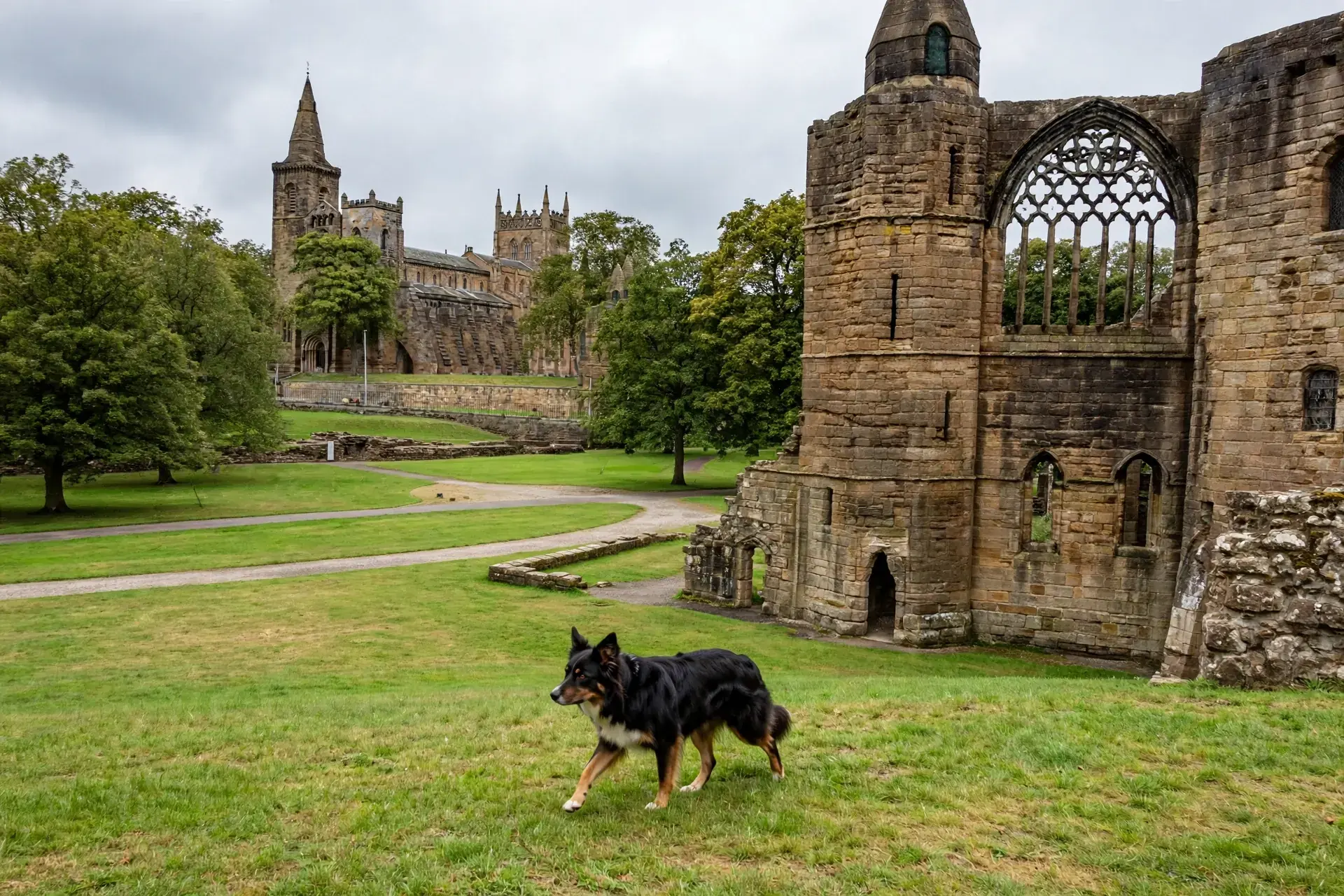
Then walk the Abbey exterior slowly. The church is two buildings in one: the medieval abbey nave and the newer parish church, with the famous tower carrying the words KING ROBERT THE BRUCE in large stone letters. The Palace ruins stand beside it, overlooking the steep wooded glen that drops away to the west. From the lawns you can take in the scale of the place without going inside anything, which is the point for a dog visit. Keep the lead short here, because the grounds are also a working churchyard and a place where other visitors stop to read stones and take photographs. A dog that is allowed to wander across graves or to pull towards other visitors will spoil the visit for everyone, including its owner.
From the back of the Abbey, steps lead down towards St Catherine's Wynd and the entrance to Pittencrieff Park. This is the natural hinge of the day. If your dog is older, stiff or nervous on steps, take the gentler road route into the park instead of the steepest set of steps, and do not rush the descent. Once inside the gates, the ground opens out, the noise of the town falls away, and the walk can begin properly. That change in atmosphere — from stone and traffic to trees and birdsong in under a minute — is the moment Dunfermline wins most dog owners over.
Dunfermline Abbey and Palace with a dog
Dunfermline Abbey was founded in 1072 by King Malcolm III and his queen, Margaret, who was later canonised as Saint Margaret of Scotland. Their youngest son, David I, raised the church to a full abbey, and for centuries Dunfermline was the preferred burial place of Scotland's kings and queens. At least six kings are buried here, along with queens, princes and nobles, and the most famous of them is Robert the Bruce, who died in 1329 and was buried before the high altar. His heart was removed and carried away separately, and was eventually buried at Melrose Abbey, while his body remained at Dunfermline. When builders uncovered a tomb during work on a new parish church in 1818, the skeleton inside, with its breastbone cut open, was identified as Bruce, and he was reburied under the floor of the new church.
That history is visible from outside, which is why the Abbey works so well as a dog visit. The Romanesque nave, with its massive pillars and round arches, survives from the twelfth century, and the later church carries the Bruce tower above it. The Palace ruins beside the Abbey grew from the abbey's guest house into a royal residence, and they are best known as the birthplace of Charles I, born here on 19 November 1600, the last monarch to be born in Scotland. The Palace was rebuilt for James VI's queen, Anne of Denmark, and after the court moved south it fell into ruin. Today the roofless walls, the great hall and the views over the glen give a clear sense of a royal house without needing to go indoors at all.
The dog rules for the Abbey are straightforward, and they are worth following exactly. Dogs are welcome in the grounds on a lead, must be kept on a lead at all times, must not be left unattended, and are not permitted in roofed areas. Owners must pick up after their dogs. In practice that means the Abbey is an outdoor visit for a dog owner: walk the grounds, look at the exterior, read the stones, and take photographs from the lawns, but do not expect to take the dog inside the church or into any covered part of the Palace. If someone in your group wants to see the interior, plan a split visit, with one person staying outside with the dog. Do not tie a dog to a gate or a railing and go inside alone, even for a few minutes, because an unattended dog in a busy historic site is a welfare problem and a theft risk.
Check the official guidance before you travel, because the Abbey and Palace are in the care of Historic Environment Scotland and opening arrangements can change. Conservation work has closed parts of the Palace at times, and winter opening hours for the Abbey have been shorter than summer hours, with the site sometimes open only from Tuesday to Saturday. Entry to the Abbey church has often been free, but that is a detail to confirm on the day rather than assume, and any charges, closures or guided tours should be checked before you set off. The same caution applies to the churchyard. It is a historic burial ground with uneven stones, low walls and, in wet weather, slippery grass. Keep a dog on a short lead, keep it off the memorial stones, and remember that this is a place where people come to remember family as well as to look at history.
A few practical points make the Abbey visit easier. Mornings tend to be quieter than afternoons, especially outside school holidays, and a quiet morning gives a nervous dog a much better first impression of the town. The lawns offer little shade at midday in summer, so bring water and do not linger on hot stone in the middle of the day. In winter, the stone and the grass can be icy, and the steps down to the park deserve care. And if your dog is reactive to other dogs, keep to the edges of the lawns rather than the main path through the middle, where every other visitor with a dog will pass. The Abbey grounds reward a slow circuit, not a dash to the best photograph, and the dog will enjoy the slow version far more.
Pittencrieff Park: the Glen, peacocks and paths
Pittencrieff Park, known to everyone in Dunfermline simply as the Glen, is the heart of a dog day out here, and it is worth understanding why it exists before you walk it. The 76-acre park was bought by Andrew Carnegie in the early 1900s and gifted to the people of Dunfermline. The story told locally is that Carnegie had been barred from the estate as a child, and that giving it to the town was his answer. Whether or not the detail is exact, the gift is real, and it is the reason a city centre has a wooded glen, formal gardens, glasshouses, lawns and a burn running through it, all free to enter and open all year round. For a dog, it is the difference between a town with a park and a town built around one.
The park is not one walk but a network, and the best way to enjoy it is to choose a loop that fits your dog rather than trying to see everything. A short, popular circuit of about a mile and a half links the Abbey and the park, taking in the upper lawns, the Carnegie statue, the gardens and the woodland paths before returning to the Pittencrieff Street car park. Longer wanders follow the burn down through the glen, cross the little bridges, climb the far side and come back along the top paths. The ground varies a lot: tarmac paths near the entrances, gravel and earth in the woods, steps in several places, and grass that can be soft and muddy after rain. Dogs that are fit and sure-footed will enjoy the climbs and the scents of the woodland; older dogs, puppies and dogs with joint problems will be happier on the flatter upper paths and the lawns, with the steep glen sections left out.
Wildlife is the part of the Glen that needs the most care. The park is famous for its resident peacocks, kept in an aviary and sometimes seen roaming, and for the squirrels, birds and other wildlife that live in the woodland. Park guidance asks owners to keep dogs on leads because of the wildlife, especially near the peacock area, and that rule should be taken seriously. A dog that chases a peacock is not being naughty in its own mind, but it can injure a bird, frighten other visitors and earn its owner a justified telling-off. Keep the lead short around the aviary, the glasshouses and the play areas, and do not let a dog push through planting or dig in the formal gardens. The themed gardens — the rock garden, the Japanese garden, the kitchen garden and the Laird's garden — are for looking, not for running through.
Facilities in the park are practical rather than luxurious, and they shape the visit. There is a cafe serving food and drinks, public toilets, a large greenhouse, three play areas, and plenty of benches. The cafe is a useful stop for humans, but its dog policy can change, so ask before assuming a dog can sit inside or at a particular table, and be ready to use outdoor seating instead. The play areas are busy at weekends and in school holidays, with children, balls and dropped food, so keep a dog on a short lead and give the playgrounds a wide berth unless your dog is genuinely calm around children. Picnics are welcome, which suits a dog day out well: a rug on the lawn, food from the town centre, and a dog that can settle beside you is often a better lunch than a crowded cafe.
The Glen is also a place to read the seasons. In spring, the woodland paths are at their best, with new growth and birdsong, but the ground can still be wet and the burn can run high after rain. In summer, the trees give good shade, which makes the park a cooler choice than the open Abbey lawns, but midges can be a nuisance in still, damp weather, and the park is at its busiest. In autumn, the trees turn, the paths fill with leaves, and the light in the glen is at its most attractive, though wet leaves on steps and slopes need care. In winter, the park is quieter, the views open up as the leaves fall, and the low sun through the bare trees is striking, but daylight is short and the paths can be icy. Whatever the season, the same rule holds: stay on the paths where they exist, keep the dog under control, and carry bags, because bins are not always where you need them.
The Carnegie trail through the town centre
Andrew Carnegie is the second great story of Dunfermline, after the kings, and his trail runs straight through the town centre, within easy walking distance of the Abbey and the park. He was born on 25 November 1835 in a small weaver's cottage in Moodie Street, the son of a handloom weaver, and the family emigrated to the United States in 1848, when he was twelve. From that unpromising start he became one of the richest men in the world, and then gave most of his fortune away, funding libraries, education and public parks, including the gift of Pittencrieff Park to his home town. The cottage where he was born is now the Andrew Carnegie Birthplace Museum, and the story it tells — from a weaver's cottage to a steel fortune and then to philanthropy — is one of the most complete rags-to-riches stories in Scotland.
For a dog owner, the Carnegie trail is an outdoor trail. The Birthplace Museum itself is a small indoor museum, and dogs are not generally expected inside, so treat it as a split visit if someone wants to go in, or admire the cottage exterior and the street from outside and move on. The same applies to the Dunfermline Carnegie Library and Galleries, across from the Abbey on St Margaret's Street. It is the city's main museum and gallery, covering local history, art, industry and Carnegie himself, in an award-winning modern building joined to the original Carnegie library. It is a strong introduction to the city for humans, but it is not a dog visit, and the honest plan is to let the dog wait outside with a companion, or to leave the museum for a return trip without the dog. Do not try to smuggle a dog into a museum or leave it tied outside a busy public building.
The street-level Carnegie trail, though, is very dog-friendly. Moodie Street, St Margaret's Street and the High Street are short, walkable streets with independent shops, cafes and bakeries, and the walk between them is flat and easy. Abbot House, the oldest house in the town, stands near the Abbey with its garden and changing displays, and its exterior and garden are worth a look from the street even if the interior is not a dog visit. St Margaret's Cave, the small chapel where Queen Margaret is said to have prayed, sits under the town centre and is another human-only stop to note rather than to attempt with a dog. The point of the trail is not to get inside every building. It is to walk the streets where Carnegie grew up, to see the cottage, the library and the park he gave away, and to understand how a small Fife town produced a man who changed libraries across the English-speaking world.
Walking the town centre with a dog needs the usual city manners. Keep the lead short on pavements, especially on the High Street, where shoppers, prams and other dogs pass close together. Watch for dropped food outside bakeries and cafes, and for bins and delivery vehicles in the narrower lanes. The town centre has car parks, including the Pittencrieff Street car park near the Abbey and the park, and the bus station and the train station are both a short walk from the historic core, so a dog never has to walk far on busy roads. If you are combining the Carnegie trail with the Abbey and the Glen, the natural order is Abbey first, then the park, then the town centre on the way back, when the dog is tired and happy to walk quietly beside you rather than pulling towards every new smell.
Longer walks: Townhill, Devilla and Lochore
Once the Abbey and the Glen have been enjoyed, Dunfermline offers three longer walks within a short drive, and they suit three different dogs. Townhill Country Park is the closest, a 180-acre park of woodland and a loch at Townhill, just north of the city. Its paths run through the woods and around the water, and there is a cafe at the watersports centre. Dogs are welcome under proper control or on a short lead, following Fife Council's park rules, and the loch is the feature that needs care: waterfowl, swimmers and watersports users all share the space, so keep a dog under control near the water and do not let it chase birds or plunge into the loch beside other people. Townhill suits a dog that likes woodland and water but does not need a long, hard run, and its paths are a good step up from the Glen without becoming a hill walk.
Devilla Forest, between Dunfermline and Kincardine, is the wilder choice. Managed by Forestry and Land Scotland, it is pine woodland with four lochs, waymarked trails and a reputation for red squirrels, though a sighting is never guaranteed and the walk should be enjoyed for itself. The best-known route is the Red Squirrel Trail, a waymarked walk of about a mile and a half around Bordie Loch and past the Standard Stone, graded moderate and taking about an hour. Forestry and Land Scotland welcomes dogs and asks owners to keep them controlled or on a lead, particularly around wildlife and livestock, and that advice matters here: ground-nesting birds use the forest floor from April to July, and deer and squirrels will tempt a chasing dog. Bins are scarce in the forest, so carry all waste out with you, and bring water, because there are no shops in the trees. Devilla suits a fit dog that enjoys woodland scent and uneven ground, and an owner who is happy to navigate by waymarks rather than by pavements.
Lochore Meadows Country Park, near Lochgelly, is the open, easy option, and it is the best choice for a dog that needs space to run without steep climbs. The park covers about 1,200 acres around Loch Ore, with free entry and several large free car parks, including the main car park near the visitor centre. The classic walk is the loop around the loch, about 3.4 miles on a mostly flat, surfaced path, taking about an hour, with shorter loops of one to two miles near the visitor centre for dogs that need less. Dogs are welcome in most areas of the park, with extensive areas for off-lead exercise in the woodlands and parkland, but they should be kept under control, especially near the loch with its waterfowl, near the play areas and the cafe, and when cyclists and other park users are present. The loch is used for sailing, rowing and swimming, so a dog should not be allowed to swim beside boats or training sessions, and the water should be treated with the same caution as any open water: check for algae, keep a dog out if the water looks discoloured or stagnant, and dry it off afterwards.
Choosing between the three is a matter of matching the walk to the dog in front of you. Townhill is the best all-rounder: close, wooded, with a loch and a cafe, and easy to shorten if the dog tires. Devilla is the best for a dog that needs woodland and quiet, and for an owner who wants a forest walk rather than a park walk, but it asks more of the dog's fitness and of the owner's navigation. Lochore is the best for a dog that needs a long, flat loop and open space, for multi-dog households, and for a wet day, because the surfaced lochside path holds up better than forest earth after rain. All three are within a short drive of Dunfermline, and all three can be combined with the Abbey and the Glen across a weekend, with one longer walk on the second day rather than trying to fit everything into a single afternoon.
A word on access law, because it governs all three walks. Scotland's outdoor access rights, under the Scottish Outdoor Access Code, give responsible access to most land and inland water, but they come with responsibilities: keep dogs under proper control, keep them on a lead or under close control near livestock and ground-nesting birds, pick up waste, and follow local signs. That means a dog can be off lead in the right place at Lochore, but should be on a lead in the Glen near the peacocks, in Devilla during nesting season, and anywhere livestock are present. The code is not a licence to let a dog run free everywhere; it is a framework for sharing the countryside, and dog owners who follow it keep access open for everyone.
A coastal half-day: Culross and the Fife coast
Dunfermline is inland, but the Fife coast is close enough for a half-day, and the village of Culross is the natural choice. A short bus or car ride west takes you to a remarkably complete seventeenth-century village of cobbled streets, pantiled roofs and whitewashed houses, with Culross Palace at its heart. The village was a centre of coal mining and salt panning, and its palace, built by a wealthy merchant, is one of the best-preserved town houses of its period in Scotland. For a dog, Culross is a street walk rather than a building visit: the lanes, the market cross, the town house and the views over the Forth are all outdoors, while the Palace interior and gardens have their own rules, so check the official guidance before you travel rather than assuming a dog can go in.
The Fife coast beyond Culross offers a longer option. The Fife Coastal Path runs for about 117 miles from Kincardine to Newburgh, passing harbours, beaches, cliffs and fishing villages, and the stages near Dunfermline are the quiet western end of the route, very different from the busy East Neuk. A dog owner who wants a coastal walk without driving to St Andrews can pick a short, flat section, walk out along the shore and return the same way, rather than committing to a full stage. Our guide to the Fife Coastal Path with a dog covers stage distances, beach rules, cliff and livestock safety, tides and train returns in detail, and it is worth reading before choosing a section, because tides, mud and cliff edges all matter more on the coast than they do in a town park.
Coastal walking with a dog needs a different checklist from a park walk. Check the tide times before you set off, and do not let a dog walk on a beach that will be cut off by a rising tide. Keep a dog on a lead near cliffs, harbour walls and fishing gear, and watch for fishing line, hooks and bait on the shore. Beaches in Fife have their own seasonal rules, and some restrict dogs in summer, so check the signs at the beach entrance rather than relying on a guide written months earlier. After a coastal walk, rinse a dog that has been in salt water, check its paws for cuts from shells and sharp stones, and dry it before the car journey home. The coast is a wonderful addition to a Dunfermline trip, but it is an addition, not a replacement for the town walk: the Abbey and the Glen come first, and the coast is the reward for a second day or a longer stay.
If the coast is too far for the day, the Forth itself is still part of the Dunfermline story. The city looks south towards the river, and the road and rail bridges at Queensferry are a short drive away. The bridges are a sight to see from a viewpoint rather than a dog walk in themselves, and the villages on the Fife side of the Forth offer short shore walks of their own. For a longer coastal trip, St Andrews with a dog covers the West and East Sands, the cathedral grounds and the links between the town and the Fife Coastal Path, and it pairs well with a Dunfermline base for a two-centre Fife break. The point is that Dunfermline does not have to do everything in one day: it is a base with a great town walk, and the coast is there when you want it.
Getting there and getting around
Getting to Dunfermline with a dog is straightforward, and the train is the easiest option for anyone coming from Edinburgh. Direct ScotRail trains run from Edinburgh Waverley to Dunfermline City, taking about 30 to 33 minutes, with services running frequently through the day. The station was known as Dunfermline Town before it was renamed, and the Abbey is roughly a ten-minute walk from it, about half a mile, so a dog can walk from the platform to the historic core without a taxi or a bus. A second station, Dunfermline Queen Margaret, serves the eastern side of the city and the hospital, and is a longer walk from the Abbey. Check the official guidance before you travel for the current timetable and for ScotRail's rules on dogs, which generally allow dogs on trains but ask owners to keep them on a lead and under control, and to use a carrier for small dogs where appropriate.
By car, Dunfermline is reached from Edinburgh over the Queensferry Crossing and from Glasgow and Stirling by motorway and main roads, with the city centre well signed. The most useful car park for a dog visit is the Pittencrieff Street car park, just off the A907, beside the park and a short walk from the Abbey. It puts the dog within minutes of grass, water and the park gates, which matters after a car journey. Other town-centre car parks are available, but they add a longer walk on pavements before the dog reaches open ground, so they are a poorer choice for a first visit. As with any town, check parking charges and time limits on the day, because they change, and do not leave a dog in a car in warm weather, even for a few minutes, and never in direct sun.
By bus, Dunfermline bus station is a five-minute walk from the Abbey, and local buses connect the city with Culross, the coast and the surrounding villages. Buses are a useful option for a dog owner who wants to visit Culross without driving, but dog policies on buses vary by operator, so check before you travel rather than assuming a dog can board. Walking is the best way to get around the historic core itself: the Abbey, the park, the Carnegie sites and the High Street are all within a compact area, and the distances are short enough for most dogs, including older ones, provided the route is planned to avoid the steepest steps in the Glen.
For a longer stay, Dunfermline also works as a base for Edinburgh with a dog, in the other direction: a day in the capital, with its hills, parks and the Water of Leith, followed by a quieter day in Dunfermline, is a good balance for a dog that finds a full city day tiring. The train makes the two cities easy to combine, and the contrast is the point: Edinburgh is grand, busy and hilly, while Dunfermline is compact, green and calm. A dog that has coped with Edinburgh's crowds will find Dunfermline a rest, and a dog that has never been to a city at all will find Dunfermline a gentler introduction than the capital.
Eating out and staying overnight with a dog
Eating out with a dog in Dunfermline is a matter of choosing the right kind of place and asking the right question. The town centre has cafes, bakeries and restaurants, and Pittencrieff Park has a cafe of its own, but dog policies vary from venue to venue and can change with the season, the weather and the management. The reliable approach is to look for outdoor seating first, to ask staff before sitting down whether dogs are welcome inside or only outside, and to have a backup plan for rain. A cafe with a covered terrace or a sheltered courtyard is worth more than a fashionable interior that does not allow dogs, and a takeaway eaten on a bench in the park is often the most relaxed lunch of all.
A few habits make cafe visits work. Bring a mat or a blanket for the dog to lie on, so it has a defined place and is not sprawled across a walkway. Bring water and a bowl, because not every cafe provides one, and bring a chew or a stuffed toy to keep a young dog settled while food is ordered. Keep the lead short and under a chair leg or a table leg, not stretched across a path where a waiter or another customer can trip. Order simply and eat at the dog's pace: a dog that has walked the Glen will settle for twenty minutes, but a dog that is still full of energy will not, so time the cafe stop after the main walk, not before it. And if a venue says no to dogs, accept it gracefully and move on; arguing with staff helps nobody, and there will be another cafe a few minutes away.
Staying overnight with a dog in Dunfermline needs the same careful questions as anywhere else, and the answers matter more than the listing. Ask whether dogs are allowed in the specific room or unit you are booking, not just in the property in general, because many places designate only selected rooms as dog-friendly. Ask about the pet fee, and get the total in writing, including any cleaning charge or refundable deposit. Ask whether a dog can be left alone in the room, and for how long, because many places prohibit unattended dogs outright. Ask where the nearest toilet walk is after dark, and whether the room has direct access to outside or requires a lift and a corridor. A ground-floor room near an exit is worth asking for, especially for an older dog or a puppy that needs frequent outings.
When you arrive at a place to stay, walk the room before unpacking, as you would at a holiday park. Check for gaps under doors, low windows, cleaning products left in a bathroom, and food left by a previous guest. Put the dog's bed in a quiet corner, offer water, and take a short toilet walk around the block so the dog knows where to go. Keep the first evening close to the home routine: same feeding time, same bed, same last outing. A dog that settles on the first night will enjoy the second day far more, and a dog that is left alone in a strange room while its owners go out to dinner is unlikely to settle at all. Plan as if the dog is coming to dinner with you, and choose a place to eat that welcomes dogs, or order a takeaway and eat in.
Packing for an overnight stay is the same as packing for a day out, with a few additions: the dog's own bed or blanket, its usual food measured out, any medication, a spare lead, a torch, and a drying coat or towels for wet walks. Dunfermline's weather can change quickly, and a wet dog in a small room is a miserable experience without a way to dry it. A portable water bowl, a few poo bags in every coat pocket, and a familiar toy all help a dog feel at home. And before you book anywhere, check the official guidance before you travel for the current dog policy of the specific place, because a policy that was true last year may not be true this year.
Seasons, weather and ground conditions
Dunfermline is a year-round destination, but the dog experience changes with the seasons, and the best plan changes with it. Spring is one of the best times to visit: the Glen is fresh and green, the birds are loud, the days are lengthening, and the town is quieter than in summer. The ground can still be wet, though, and the burn in the Glen can run high after rain, so waterproof footwear and a drying coat for the dog are worth packing. Spring is also nesting season, from April to July, when ground-nesting birds are at their most vulnerable, so keep a dog on a lead or under close control in woodland and on open ground, and follow the Scottish Outdoor Access Code.
Summer brings the longest days and the busiest park, and it asks the most of a dog owner. The Abbey lawns offer little shade at midday, and stone yards and pavements can become hot underfoot, so plan the main walk for the morning or the late afternoon, and use the shaded paths of the Glen at midday. Carry extra water, offer it often, and watch for signs of overheating, especially in flat-faced breeds, older dogs and dogs with thick coats. Midges can be a nuisance in still, damp weather in the woodland, particularly in the evening, so a walk in the open parkland may be more comfortable than a walk in the deep glen. Summer is also the season when the park's play areas and the town centre are at their busiest, so a reactive dog will do better on the quieter upper paths and at quieter times of day.
Autumn is, for many dog owners, the best season in Dunfermline. The trees in the Glen turn, the light is low and golden, the crowds thin out, and the air is cool enough for a long walk without overheating. Wet leaves on steps and slopes are the main hazard, and the paths can be slippery after rain, so take the steps slowly and keep a dog on a lead where the ground is steep. Autumn storms can bring down branches in the woodland, so check for fallen trees and closed paths after high winds, and do not walk under damaged trees. The shorter days mean planning the walk to finish in daylight, especially if you are driving to Townhill or Devilla, where the car parks have no lighting.
Winter in Dunfermline is quiet and atmospheric, with the bare trees opening up views across the Glen that are hidden in summer, and the Abbey stonework standing out against a grey sky. Daylight is short, so a winter visit needs a tighter plan: arrive in the morning, walk the Abbey and the Glen in the middle of the day, and be back at the car or the station before dark. Ice is the main hazard, on the steps down to the park, on the woodland paths and on the pavements, and a dog can slip as easily as a human, so take care and consider a coat for a short-coated or older dog. After a winter walk, dry the dog thoroughly, check its paws for grit and salt from treated pavements, and warm it up before the journey home. Winter opening hours for the Abbey and for some museums are shorter, so check the official guidance before you travel rather than assuming summer hours apply.
Practical kit, safety and dog etiquette
A Dunfermline day out does not need specialist kit, but it does need the right basics, and the list is short enough to fit in a small bag. Bring a lead and a long line, so the dog can have more freedom in the right place and be kept close in the wrong one. Bring water and a collapsible bowl, because the park has water points but they are not always where the dog needs them, and a thirsty dog should not have to wait. Bring more poo bags than you think you will need, and a small bag to carry used ones until you find a bin, because bins in the Glen and in the forest are not always nearby. Bring a towel or a drying coat, especially after rain, and a mat for cafes and for the car. Add a torch in winter, a coat for a cold-sensitive dog, and treats for recall and for settling in busy places.
Safety in Dunfermline is mostly about the ordinary hazards of a historic town and a woodland park. Traffic is the first: the town centre has busy roads, and the car parks have moving vehicles, so keep a dog on a short lead until you are inside the park gates. Steps are the second: the Glen has steep sections and several sets of steps, and a dog that rushes down them can slip or pull its owner over, so take them slowly and keep the lead short. Water is the third: the burn in the Glen, the loch at Townhill and the loch at Lochore are all attractive to dogs, but fast water after rain, steep banks and blue-green algae in still water in warm weather are all real risks. Do not let a dog drink from stagnant water, and keep it out of the water if the surface looks discoloured or scummy. If a dog does swim, dry it off and watch it afterwards, and check the official guidance before you travel for any local algae warnings.
Livestock and wildlife deserve a separate mention, because they are the most common cause of trouble on walks around Dunfermline. Sheep and cattle graze on farmland around the town, and the Fife countryside is working land, not a dog park. Keep a dog on a lead near livestock, and under close control at all times where livestock may be present, even if you cannot see them. Ground-nesting birds, deer and squirrels are present in the woods, and a dog that chases them can cause real harm and can itself be injured. The peacocks in Pittencrieff Park are the most visible example, but they are not the only one: the squirrels, the waterfowl at Townhill and Lochore, and the birds in the Glen all deserve the same respect. A dog that is under control is a dog that can be welcomed back.
Etiquette in a historic town is simple, but it matters. Pick up after your dog everywhere, including on grass and in the woods, and carry the bag until you find a bin. Keep a dog off memorial stones, flower beds and formal gardens, and do not let it dig in the park. Keep it on a lead in the Abbey grounds, near the play areas and near the cafe, and ask before letting it approach another dog, a child or a stranger. Not every dog wants to say hello, and not every person wants a dog to jump up at them, however friendly the dog is. A well-behaved dog in Dunfermline will be welcomed; a dog that is allowed to run loose through a churchyard or a formal garden will not, and its owner will be remembered for the wrong reasons.
Finally, know where to go if something goes wrong. Before you set off, note the location of the nearest vet in Dunfermline and save the number in your phone, because a rural or out-of-hours vet can be a drive away and the time to look it up is not when a dog is injured. Carry a basic first-aid kit for the dog: a bandage, saline for cleaning a wound, tweezers for ticks, and the vet's number. Check a dog's paws after a walk on rough ground, look for ticks after woodland walks, and watch for limping after steps and steep descents. Most Dunfermline dog days pass without any of this being needed, but the owners who enjoy them most are the ones who planned for the small things before they left home.
For a wider Fife break, our guide to Perth with a dog covers a river city that works well as a Highlands base, with Tay-side walks and day trips north from a single base. Dunfermline, Perth and St Andrews together make a practical triangle for a longer stay: a royal city, a river city and a coastal town, each with its own walks, and each within an easy drive of the next. Start with Dunfermline, though, because it is the one where the history and the dog walk are in the same place, on the same lawns, and a single morning can hold both.
Practical questions
Before you go
Are dogs allowed at Dunfermline Abbey?
Dogs are welcome in the Abbey grounds on a lead, but they are not permitted in roofed areas. Keep your dog on a lead at all times, do not leave it unattended, and pick up after it. Check the official guidance before you travel, because opening arrangements and conservation work can change access.
Is Pittencrieff Park good for dogs?
Yes, it is one of the best town-centre dog walks in Fife. The 76-acre park, known locally as the Glen, has woodland paths, lawns, gardens and a cafe, and dogs are welcome on a lead. Keep dogs on a lead near the peacocks and other wildlife, and follow the park signs.
Can I visit Dunfermline by train with a dog?
Yes. Direct trains run from Edinburgh Waverley to Dunfermline City in about 30 to 33 minutes, and the Abbey is roughly a ten-minute walk from the station. Dogs travel on ScotRail trains, so check the official guidance before you travel for the current rules on leads, carriers and busy services.
Where is the best longer dog walk near Dunfermline?
For a short drive, Townhill Country Park offers woodland and a loch, Devilla Forest has waymarked trails including the Red Squirrel Trail, and Lochore Meadows has a flattish loop of about 3.4 miles around Loch Ore. Choose by your dog's fitness and the weather, and keep dogs under control near water, livestock and ground-nesting birds.
Are there dog-friendly cafes in Dunfermline?
There are cafes with outdoor seating in the town centre and in Pittencrieff Park, but dog policies vary by venue and can change. Ask before you sit down, check whether dogs are welcome inside or only outside, and have a backup plan for wet weather. Check the official guidance before you travel.
What should I pack for a dog day out in Dunfermline?
Bring a lead and a long line, water and a bowl, poo bags, a towel or drying coat, treats, and a mat for cafes. Add a coat for a short-coated or older dog in cold wind, and a torch for dark winter afternoons. In summer, carry extra water and plan shade and rest stops, because stone yards and lawns offer little cover at midday.