This guide is independent and contains no paid placement. If affiliate links are added later, they will be clearly marked and will not change our editorial checks.
Dunwich rewards a slow, lead-aware day: heath and cliff-top views first, the shingle beach only when the tide and the wind allow, the friary ruins as a quiet stop, and the forest when the dog needs shade and shelter from the coastal wind.
Cliff-top heath above a drowned town
Dunwich is best understood before the first walk begins, because the ground itself tells the story. This was once a substantial medieval town, with streets, churches and a harbour, and centuries of storms and coastal erosion have taken most of it into the sea. What remains on land is a small village, a fringe of heath and cliff, and fragments of stone that hint at a much larger place. Walking here with a dog is therefore different from walking a pretty coastal path: every open stretch of heather and gorse sits beside a cliff that is still moving, and every dip in the ground can be read as part of a town that no longer exists. Keep that scale in mind and the walk becomes a piece of history as well as exercise.
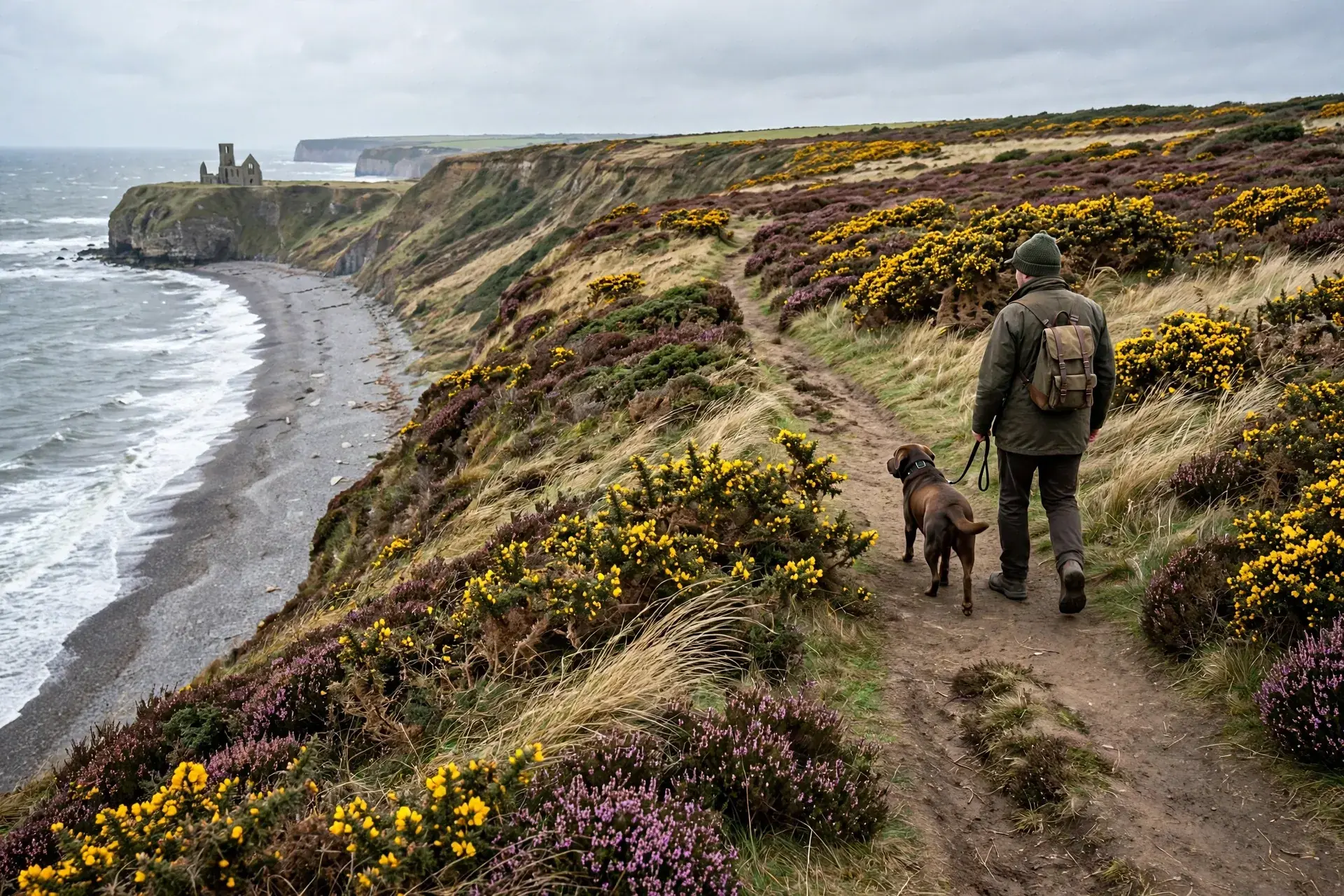
The cliff-top heath is the natural first route. Heather and gorse grow low and wind-shaped across open ground, with patches of coarse grass and sandy soil underfoot. The surface is generally firm enough for a steady walk, but it is uneven, with rabbit holes, exposed roots and sudden dips that can catch a running dog. A long line gives a keen dog room to sniff while keeping control near the edge, whereas a short lead is safer on narrow stretches and on windy days when a gust can startle even a calm dog. In late summer the heather colours the heath purple, and the scent of gorse fills the air, which makes this a rich sniffing walk; in winter the same ground is bleak, beautiful and very exposed, so a dog that chills quickly will need a coat and a shorter loop.
Plan the heath walk as a loop that stays inland from the edge rather than hugging it. Walk out with the sea on one side but with a clear margin of grass between the path and the drop, and turn inland at the first point where the path narrows, the turf looks cracked, or a fence or warning sign marks unstable ground. Dogs that chase birds need particular care here, because skylarks and other heathland birds nest and feed on open ground, and a dog sprinting after a bird can cross a surprising distance before recall catches up. Bring water even on a cool day, because there is no shelter or tap on the open heath, and watch for ticks in the longer vegetation during the warmer months. If the wind is strong enough to make walking uncomfortable, cut the heath section short and move to the forest instead, where the trees break the gusts.
The beach below the cliffs
Below the cliff, Dunwich beach is a wide sweep of shingle with sand exposed at lower tides, and it feels like a different world from the heath above. The sound changes, the wind changes, and the dog's whole body language changes as paws meet loose stones and the smell of seaweed and salt takes over. This is the place for a dog that loves the shore, but it is also the place where the cliff itself is closest, so the beach walk needs more thought than simply letting the dog run. Fresh falls of earth and stone are a normal part of an eroding cliff, and the safest line is well away from the cliff base, out towards the water where the ground is open and any fall would be visible from a distance.
The slope down to the shore is the first practical test. It is steeper and looser than a village pavement, and the return climb is harder than the descent, especially for older dogs, short-legged dogs and dogs carrying extra weight. Let the dog set the pace on the way down, keep the lead short enough to stop a tumble, and plan the beach time so the climb back does not become a struggle at the end of a long walk. On the shingle itself, paws can get sore on sharp stones, so watch for a dog that starts lifting a foot or shortening its stride. A paddle at the water's edge suits many dogs, but the North Sea here is cold, the undertow and currents deserve respect, and a dog that swims should be kept where you can reach it quickly. Check the official guidance before you travel for any current beach restriction or access change.
Tides shape the whole beach visit. At high tide the usable shore narrows, and a walk that felt spacious at mid-tide can become a thin strip squeezed against the cliff, which is exactly where you do not want to be. Check tide times before leaving the village, aim for a falling or low tide, and set a turn-back time rather than drifting further along the shore and discovering the return route has narrowed. The beach is also a place to keep an eye on what the dog picks up: fishing debris, sharp shells and dead sea creatures are all part of a working shingle shore. Carry bags, carry water for drinking, and rinse sandy paws before the car journey home, because shingle grit between toes causes more trouble on the drive than it does on the walk.
Greyfriars and the ruined friary ground
Greyfriars is the most striking surviving fragment of medieval Dunwich, and it anchors the whole visit. The ruined walls of the Franciscan friary stand in open ground near the village, and their scale makes the lost town suddenly imaginable: this was not a hamlet with a church, but a town with religious houses, streets and trade. For a dog walk, the ruins work best as a slow, thoughtful stop between the heath and the village, not as a destination to rush through. The ground is grassy and uneven, with low stonework, dips and patches of rough turf, so a dog on a lead can sniff around the perimeter while you take in the size of the surviving masonry and the openness of the site.
Keep the dog off the stonework itself and away from any fenced or roped section, and treat the ruins as a place for calm behaviour rather than play. A dog that jumps up at walls can damage fragile stone and can also hurt itself on rough edges, while a dog that barks at other visitors breaks the quiet that makes the site special. This is a good moment to practise a settle: a mat or a familiar blanket on the grass, a drink of water, and a few minutes of watching the world go by. Children, other dogs and walkers all pass through this open ground, so recall and lead manners matter more here than on the empty heath. If the dog is overexcited after the beach or the cliff walk, walk a loop of the surrounding grass first and let the energy settle before approaching the walls.
The ruins also help explain why Dunwich feels so different from its neighbours. The village today is small and quiet, and the contrast between the modest present and the substantial medieval past is the point of the place. Standing among the friary walls with a dog at your side, you can picture a town that once looked out over a harbour, and then look towards the sea and understand what erosion has taken. Check the official guidance before you travel for current access, opening arrangements and dog rules at the ruins, since historic sites can change their conditions. Take photographs from the grass rather than climbing for a viewpoint, and leave the site as you found it, with nothing taken and nothing left behind.
Dunwich Forest tracks
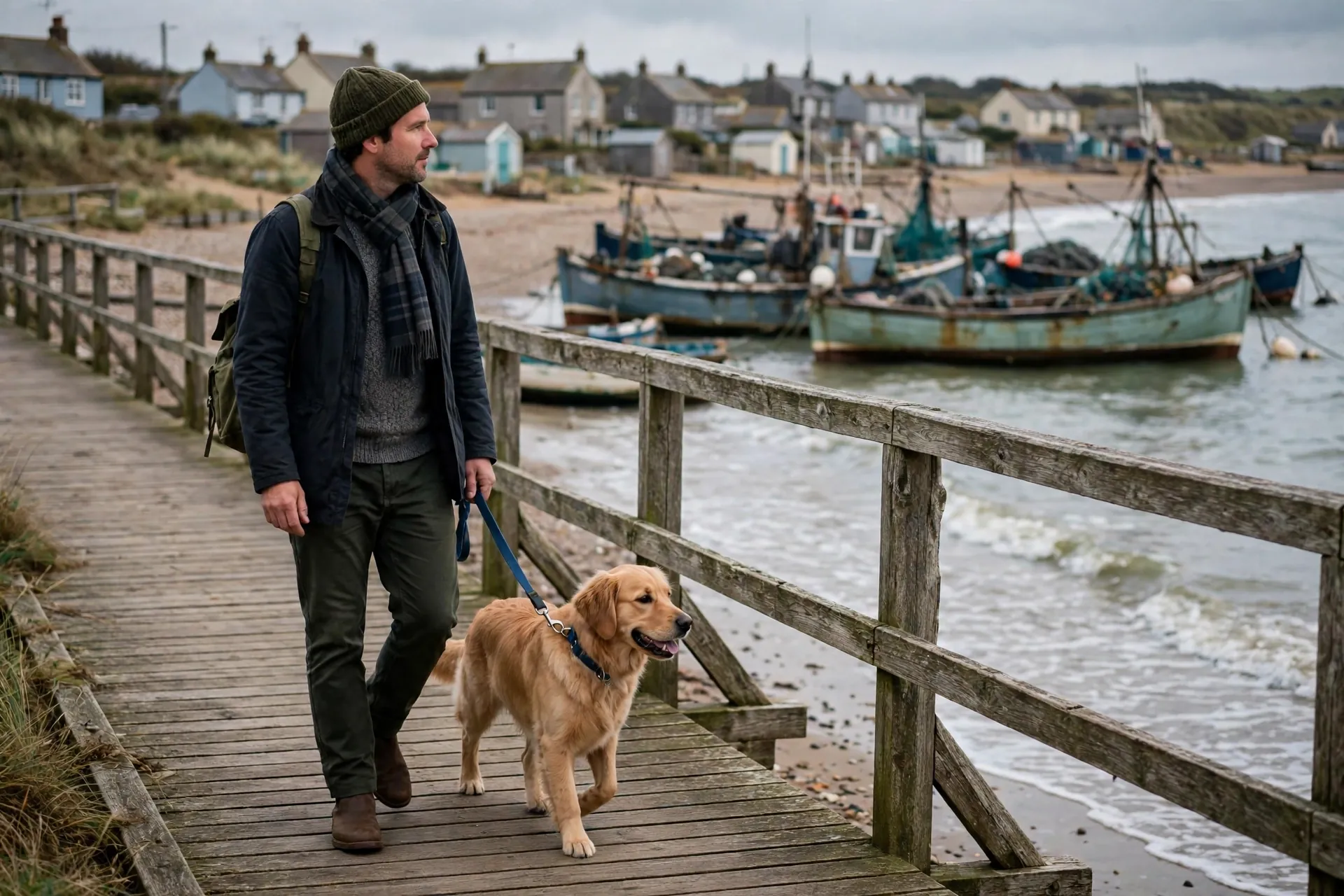
Dunwich Forest, inland from the village, offers the opposite of the cliff-top heath: shelter, shade and a softer, quieter atmosphere under trees. The tracks are generally wide and easy to follow, with a surface of earth, pine needles and, in places, sand, which is kinder on paws than shingle and easier on older joints than a steep cliff slope. This is the walk to choose when the coastal wind is strong, when the sun is hot, when the dog needs a calmer environment, or when you want a longer walk without the exposure of the open heath. The forest also gives a dog that is overwhelmed by open space a more enclosed world to explore, with scents layered under trees rather than blown away by the sea wind.
Choose a loop that matches the dog in front of you rather than the longest route on the map. A short circuit through the trees, with a turn-back point you have already agreed, beats a long trek that leaves a tired dog miles from the car. Forestry land is a working landscape, so watch for vehicles on the tracks, cyclists coming quietly from behind, and sections closed for work. Keep the dog on a lead where other users are likely, and be ready to step aside on narrow stretches. After rain, forest tracks can hold puddles and muddy patches, which most dogs love and most car boots do not, so pack a towel and a drying coat. In warmer months, check for ticks after a forest walk, especially around ears, armpits and groin, and brush out pine needles and burrs before the dog settles in the car.
The forest walk also works as a second walk later in the day, after the cliff and beach. By then the dog has had the excitement of the shore, and a shaded forest loop becomes a winding-down walk rather than a second burst of high energy. Walk slowly, let the dog sniff, and use the sheltered tracks to practise loose-lead walking without the distractions of the open coast. If you are combining the forest with the heath in a single day, do the exposed walk first while the dog is fresh and the light is good, and keep the forest as the sheltered return. Check the official guidance before you travel for any temporary forestry closure or diversion, and do not enter a closed section to complete a loop.
Museum and the surviving church remains
The village itself holds the next layer of the Dunwich story, in the museum and in the remains of the churches that once served the town. Dunwich Museum, in the village, tells the story of the lost city with models, maps and objects recovered from the sea and the shore, and it gives context that transforms the cliff walk from scenery into history. Dog policies for small museums vary, and a small village museum may not be able to admit dogs inside, so check the official guidance before you travel and plan for one person to wait outside with the dog if necessary. Even if the dog cannot go in, the museum stop is worth it: the story it tells makes the heath, the ruins and the beach read completely differently afterwards.
The church remains in and around the village are quieter and more scattered. All Saints, the last surviving medieval church of Dunwich, was itself largely lost to the cliff, and its remaining fragments, together with the churchyard and the ground around it, repay a slow walk rather than a quick photograph. Keep the dog on a lead in churchyard ground out of respect for graves and other visitors, and keep the dog from digging or scrambling on old stonework. The churchyard is often sheltered from the coastal wind, which makes it a useful pause on a blustery day, and the grass is a good place for a drink and a rest before the next stretch. If a church building is open, check the dog policy at the door rather than assuming, since policies differ between parishes and can change with events.
Walking the village streets between these stops is part of the experience. Dunwich is small, and its lanes, cottages and village green feel a long way from a busy seaside resort, which is precisely why many dogs settle well here. Traffic is light but not absent, so keep the dog on a lead on lanes where cars, tractors and delivery vehicles may appear without warning. The village green and the verges give good sniffing opportunities, and the slower pace suits older dogs that found the cliff slope hard. Finish the village loop at a bench or a patch of grass, give the dog water, and let the history settle before deciding whether to add the forest, the reserve edge or a neighbouring town.
Towards Minsmere: the reserve edge
North of Dunwich lies the Minsmere area, one of the most important wildlife sites on the Suffolk coast, and the temptation to extend the Dunwich walk in that direction is strong. The landscape changes as you head that way: heath gives way to marsh, reedbed and open water, and the birdlife becomes richer and more sensitive. This section therefore needs a different approach from the Dunwich heath walk, because a nature reserve is managed first for wildlife, and dogs are welcome only within the rules that protect it. Do not assume that a route that is open for walkers is open for dogs in the same way, and do not assume that a dog that was fine on Dunwich beach will be fine on a reserve path.
On the reserve edge, the general picture is that dogs are restricted to certain routes and must be kept on a lead, with some sensitive areas closed to dogs altogether, but the exact routes, lead rules and seasonal closures change, so check the official guidance before you travel and follow the signs on the day rather than relying on this guide for the current position. If you do walk a permitted edge route, keep the dog on a short lead, stay on the marked path, and keep well away from reedbed edges, nesting areas and grazing animals. A dog that barks at birds or lunges at other wildlife is not a good fit for a reserve-edge walk, and a quieter dog on a lead is the only kind of dog that belongs near breeding and feeding birds. Bring water, because the open marsh paths offer little shade, and watch for livestock and for ground-nesting birds in the breeding season.
If the reserve rules do not suit your dog on the day, that is not a failed walk: Dunwich itself already offers heath, beach, ruins and forest, and the reserve is an optional extra rather than a necessity. A good compromise is to walk the Dunwich heath and forest in the morning, and to visit the reserve area on foot without the dog only if that fits your plans, or to enjoy the reserve edge from a distance on a permitted path. Never let a dog into a reedbed, a scrape or a fenced nesting area, and never allow a dog to chase birds, even if the birds seem unbothered. The wildlife that makes Minsmere special is the reason the rules exist, and a dog walk that respects them is a better walk for everyone, including the dog.
Village facilities and places to eat
Dunwich village facilities are small-scale, and planning around that scale is part of a smooth dog day. There is a village shop and places to eat in and around the village, but opening hours, dog policies and menus change with the season, so check the official guidance before you travel and do not rely on a single venue being open. Pack the dog's essentials regardless of what the village offers: water and a bowl, food if you will be out past a mealtime, bags, a towel, and a familiar mat for settling under a table. A dog that has its own mat and a chew or a quiet activity settles far better in a cafe or pub garden than a dog left to improvise on a hard floor.
When choosing somewhere to eat, look for the practical details rather than the prettiest terrace. A shaded garden or a quiet corner suits a dog better than a busy entrance, and a place where staff bring water without being asked is a good sign. Ask at the door whether dogs are welcome inside or only outside, and respect the answer: a venue that welcomes dogs in the garden but not in the dining room is still a dog-friendly venue, and pushing the boundary helps nobody. If you eat outside, choose a table away from the path where other dogs pass, tether the lead safely so the dog cannot reach the next table, and keep the dog's food and water out of the walkway. On a windy day, the village lanes are more sheltered than the cliff top, so a village lunch can double as a wind break.
For a longer day, think about food as part of the walking plan rather than an afterthought. A village lunch between the cliff walk and the forest walk gives the dog a rest and a chance to digest, while a takeaway eaten on a bench gives flexibility if the dog is restless indoors. If you are staying nearby, self-catering or a dog-friendly stay with a kitchen can be easier than relying on village venues for every meal, especially with a dog that needs a strict feeding routine. Whatever you choose, carry a spare bag for rubbish, clean up after the dog in the village as carefully as on the beach, and leave tables and gardens ready for the next dog-owning visitor.
Parking and getting there
Dunwich is reached by narrow Suffolk lanes, and the arrival needs a little patience. The roads into the village are single-carriageway country lanes with passing places, hedges close to the carriageway, and occasional tractors, cyclists and walkers, so drive slowly and be ready to pull in. A dog that travels anxiously will benefit from a calm arrival: park, let the dog out for a toilet break on grass away from the road, offer water, and give the dog a few minutes to sniff the village air before starting the cliff walk. Rushing straight from the car to the cliff edge is the most common cause of a fraught first half hour.
Parking in Dunwich is centred on the village car park, and on fine weekends and in school holidays it fills early, because the village is small and the coast attracts walkers from across Suffolk. Arrive early if you can, and have a fallback plan: a later arrival, a shorter walk, or a neighbouring village as a starting point, rather than circling narrow lanes looking for a space. Check the official guidance before you travel for current parking charges, opening times and any change to the layout, since village parking arrangements can change. Do not park on verges, in passing places or across field entrances, and never leave a dog in a parked car on a warm day, even with a window open. If you arrive by public transport, check the official guidance before you travel for current bus routes and times, because rural services are infrequent and may not run on Sundays.
From the car park, the village, the heath, the beach slope and the forest are all reachable on foot, which is one of Dunwich's strengths: you can build a day without moving the car again. Start with a toilet walk on village grass, then choose the cliff heath or the beach depending on tide and wind, and keep the forest as a sheltered alternative. If you are staying in the area, consider walking into Dunwich from a nearby village on a longer route, but only if the dog is fit for the distance and the lanes are safe for walking. For most visitors, the village car park as a base, with a calm start and a clear turn-back time, produces a better day than a complicated multi-stop plan.
Cliff, tide and wind safety checklist
Safety at Dunwich is not about a single rule, but about a short checklist applied every time, because the cliff, the tide and the wind interact. The cliff is eroding, which means the edge you walked last year may not be the edge this year, and a path that looks solid can hide a crack a few steps inland. The tide controls how much beach you have and how safely you can return, and the wind controls how comfortable and how safe the cliff-top heath feels. Check all three before you leave the village, and re-check them at each stage of the walk: a calm morning can become a gusty afternoon, and a falling tide can turn while you are still on the shore.
- Cliff edge: keep the dog on a lead near the edge, stay well back from cracks, overhangs and fresh falls, and never let a dog approach the edge to look over. If the path narrows or the turf feels soft, turn inland immediately.
- Cliff base: on the beach, walk away from the cliff base and out towards the water, and do not sit, picnic or let the dog dig directly below an eroding face.
- Tides: check tide times before the beach walk, aim for low or falling tide, and set a turn-back time so the return route is not squeezed against the cliff.
- Wind: on strong-wind days, shorten the lead, keep the dog on the inland side of the path, and switch to the forest if gusts make the heath uncomfortable or unsafe.
- Ground underfoot: watch for rabbit holes on the heath, loose stones on the beach slope, and muddy or root-covered tracks in the forest, and slow down on each change of surface.
- Heat and cold: carry water on every walk, offer it often on the exposed heath and shingle, and use a coat for a dog that chills on a windy cliff top in winter.
- Wildlife and livestock: keep the dog on a lead near nesting birds, grazing animals and reserve boundaries, and check for ticks after heath and forest walks.
Finally, carry the small kit that makes a coastal walk forgiving: a lead and a spare, a harness that fits well, water and a bowl, bags, a towel, a drying coat, and a phone with charge for tide times and maps. Tell someone your planned route and return time if you are walking alone, especially on the longer heath and forest loops. If anything feels wrong — a path that has changed, a cliff fall blocking a route, a dog that is limping or overheating — turn back without embarrassment. Dunwich will still be there tomorrow, and a walk cut short is always better than a walk pushed too far on an eroding coast.
Joining Walberswick and Southwold
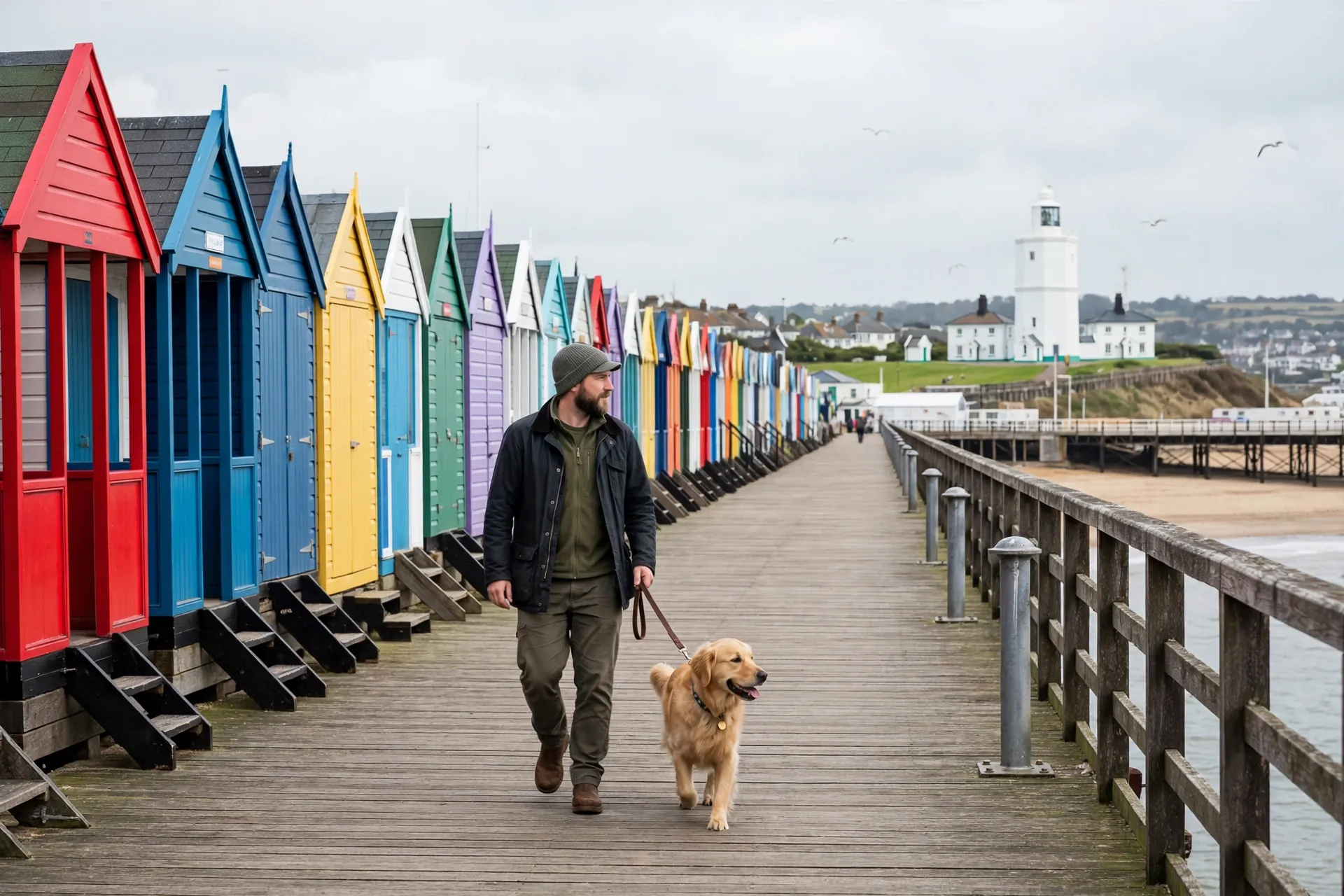
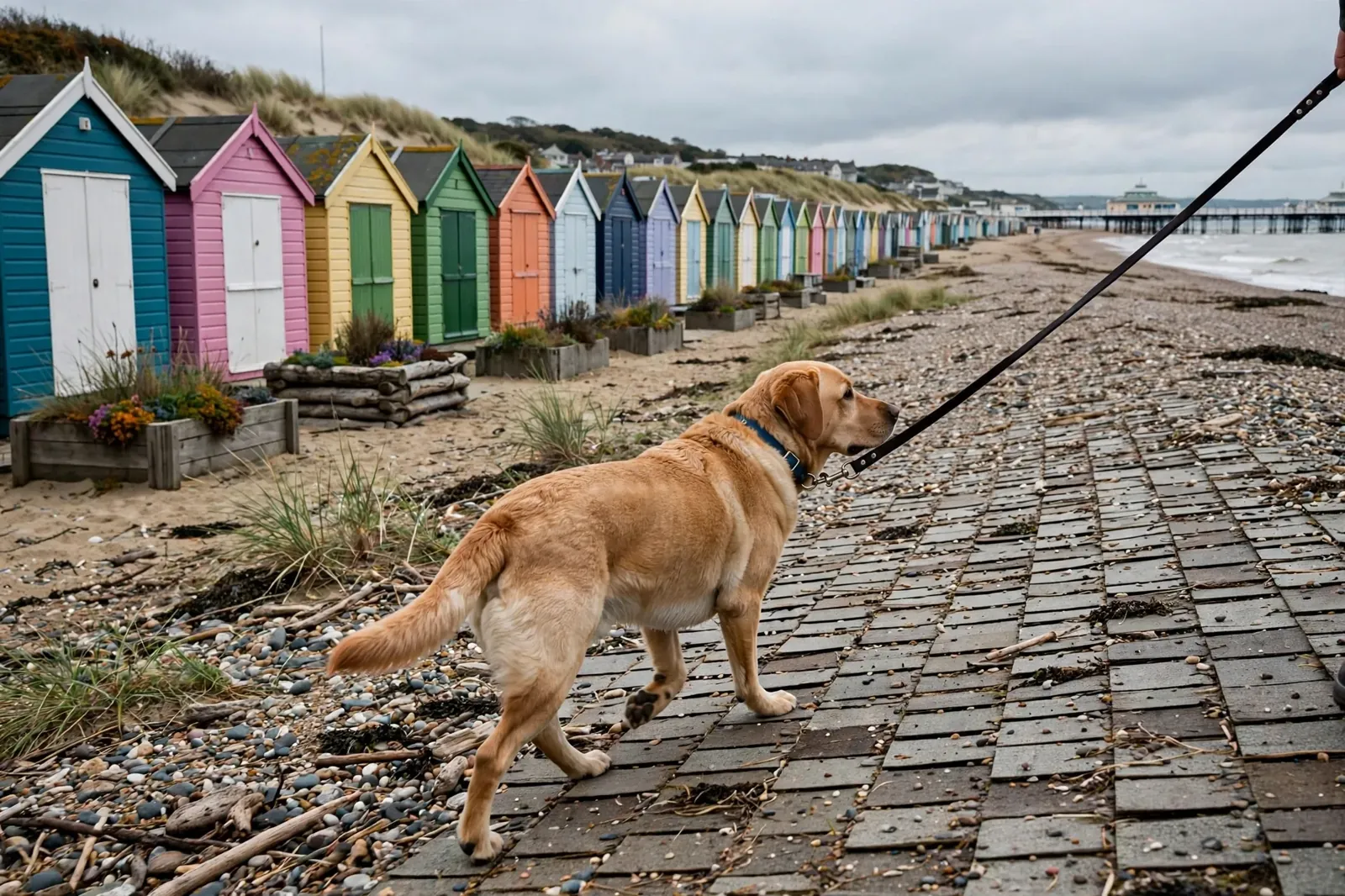
Dunwich pairs naturally with Walberswick and Southwold to the north, and the three together make a classic Suffolk coast day or a relaxed two-day break. Walberswick is a quiet village across the Blyth estuary from Southwold, with a village green, a beach and a slower pace that suits dogs that found Dunwich's cliffs exciting but tiring. Southwold is livelier, with a pier, a lighthouse, beach huts and a promenade, and it offers more places to eat and more facilities for a longer stay. The contrast is the point: Dunwich for history and open heath, Walberswick for quiet village calm, and Southwold for a traditional seaside town with a dog beside you.
Do not try to walk all three in a single linear slog with a dog that is already tired from Dunwich's cliffs and beach. A better plan is to drive between them, or to walk one leg and drive the next, so each place gets a proper visit rather than a hurried pass-through. For example, spend the morning on Dunwich heath and beach, drive to Walberswick for a village-green pause and a beach walk, and finish in Southwold for a pier and promenade stroll and an evening meal. Our Southwold with a dog guide covers pier walks, lighthouse trails and beach-by-beach rules in detail, while our Aldeburgh with a dog guide is the natural next step south if you are building a longer Suffolk coast trip. For the wider picture, the Suffolk coast dog guide sets Dunwich alongside the other year-round beaches and seasonal rules.
When joining the towns, keep the dog's energy and the tide in mind. Southwold's beach rules change with the season, so check the official guidance before you travel for the current zones and restrictions, just as you would for Dunwich. Walberswick's estuary and marsh edges need the same lead awareness as the Minsmere edge, especially where birds feed on the mud. If you are staying overnight, choose a base that lets you return to Dunwich early the next morning, when the car park is quiet and the heath is at its best, rather than trying to fit everything into one crowded afternoon. Done slowly, the Dunwich to Southwold stretch is one of the finest dog days on the Suffolk coast, and it is the history at Dunwich that makes the rest of the coast feel richer afterwards.
Practical questions
Before you go
Is it safe to walk my dog near the cliff edge at Dunwich?
The cliff edge at Dunwich is an eroding edge, not a fenced viewpoint, so a lead is the sensible default and the dog should stay well back from any crack, overhang or fresh fall of earth. Keep the walk on the inland side of the path, shorten the lead when the wind picks up, and turn back if the ground feels soft or the path narrows toward the drop. If your dog lunges at birds, other dogs or passing walkers, use a short lead and a harness you can hold firmly rather than relying on recall near a sheer drop.
How do we get down to Dunwich beach with a dog?
The beach sits below the cliffs, so the route down involves a slope and then shingle, which suits most dogs but can tire older dogs and small dogs on the way back up. Take water for the dog, because there is no shade on the open shingle, and check the tide before you set off so the walk back is not squeezed against the cliff base. Check the official guidance before you travel for any current access change, seasonal restriction or closure after a cliff fall.
Can dogs walk around the Greyfriars ruins at Dunwich?
The Greyfriars ruins are an open-air fragment of Dunwich's lost medieval town, and the ground around them is uneven grass with low stonework, so a lead keeps a curious dog from scrambling onto masonry or disturbing other visitors. Treat the site as a slow sniffing stop rather than a play area: walk the perimeter, look at the scale of the surviving walls, and keep the dog off any roped or fenced section. Check the official guidance before you travel for the current access and dog rules, since arrangements for historic ruins can change.
Which Dunwich Forest route suits a dog that needs shade and quiet?
Dunwich Forest offers sheltered tracks under trees where the wind drops and the ground is softer than the cliff-top heath, which suits dogs that overheat or get unsettled by open, gusty ground. Choose a shorter loop rather than pushing deep into the forest on a first visit, carry water even in the shade, and keep the dog on a lead where forestry work, cyclists or other walkers are likely. Check the official guidance before you travel for any temporary forestry closure, and turn back early if the dog is panting hard or lagging.
Where should we park for a dog walk at Dunwich?
Park in the village car park area and start the walk on foot, rather than trying to drop the dog beside a cliff path or a narrow lane where there is no safe place to stop. Arrive early on fine weekends, because Dunwich is small and the car park fills, and leave time for a calm toilet walk before the cliff or forest route. Check the official guidance before you travel for current charges, opening times and any change to the parking layout.