This guide is independent and contains no paid placement. If affiliate links are added later, they will be clearly marked and will not change our editorial checks.
Use the early May bank holiday as a careful reopening, not a summer rehearsal at full speed. Dogs must be on a short lead on open access land from 1 March to 31 July, lambing is still under way, and ground-nesting birds are at their most vulnerable. Choose path-based spring walks, give village events a wide perimeter, pack for cold evenings as well as bright mornings, and run the first-trip checks — fitness, car routine, identification and tick kit — before you leave.
Treat it as a season reset, not a repeat of last summer
Most dogs arriving at the early May weekend are not the dogs who finished last September. Fitness has slipped over winter, car journeys may have shrunk to short local trips, and routines that once felt automatic — settling in a new room, waiting outside a café, ignoring a pub garden full of strangers — can be rusty. Owners are rusty too. The lead that frayed in October is still in the drawer, the boot liner still carries last year's mud, and nobody has checked whether the dog still fits the harness bought two growth spurts or one winter coat ago.
That is why this weekend deserves a different mindset from every bank holiday that follows it. The late spring and August weekends can build on habits already restored. Early May has to restore them. Plan a first day that tests the basics at low stakes: a familiar style of walk rather than a new mountain, a short drive with a proper break rather than three hours straight, and an evening that ends at a normal time. If something is going to go wrong — a travel-sick puppy who is no longer a puppy, an older dog who now struggles with a step she once cleared — you want to discover it twenty minutes from your base, not halfway along a ridge.
Write the reset down as a short list and work through it in the week before, not on the morning of departure. Harness fit, collar tightness, lead clips, car restraint, bed, food measured into daily portions, medication counted, and the number of a vet near your destination saved offline. None of it is exciting, and that is precisely the point. The dogs who enjoy this weekend most are usually the ones whose owners removed the small, preventable frictions before the car door closed.
What early May really gives you — and what it does not
The early May bank holiday falls on the first Monday in May in England, Wales and Northern Ireland, with Scotland marking the same early May date in many calendars though local traditions vary. Check the exact date for your year and nation before booking, because accommodation, events and attraction opening times are set around it and a mistaken assumption costs real money. Daylight is the great gift of the weekend: evenings are long enough for a unhurried second walk, yet it is still light early enough that a dawn start does not feel punishing.
What the weekend does not yet give you is summer. Grass is growing fast and paths that were firm in March can be soft after April rain. Rivers run higher and colder. The sea around much of Britain remains genuinely cold, however bright the beach looks at noon, and a dog who swims enthusiastically for ten minutes can come out shivering. Coastal dog restrictions also begin on many managed beaches around the start of May, though dates and sections differ by council, so a beach that was fully open at Easter may already be lead-only or closed to dogs on its central stretch. Read our guide to dog-friendly beaches and the rules, bans and fines that apply for the specific beach you intend to use, and always read the sign at the access point on the day.
Prices and crowds sit in an in-between place too. This is the first weekend when many seasonal cafés, car parks, boat trips and attractions fully reopen, which brings energy and choice — and queues that have not yet settled into a summer routine. Book accommodation and any dog places on tours or terraces early, but keep the itinerary itself loose. A reopening weekend rewards people who have one firm plan per day and a flexible alternative, rather than a timetable borrowed from August.
The 1 March to 31 July lead rule: the centre of this weekend
If you remember only one fact from this guide, make it this one. On open access land in England and Wales — the mapped access land that includes much moor, heath, down and registered common — dogs must be kept on a short lead between 1 March and 31 July each year, and at all times in the vicinity of livestock. The early May weekend falls in the middle of that window, not at its edge. Our detailed explainer on where leads are legally required in the UK sets out how access-land rules interact with local orders, farmland and roads, and it is worth reading before any countryside trip in spring.
Short means short. A fixed lead of around two metres or less gives you control without wrapping around legs, gates or other walkers; a long extending lead locked at full length does the opposite of what the rule intends, letting a dog range into grass, flush birds and approach livestock while technically remaining attached. Many owners find a standard lead plus a separate long line for permitted, open, livestock-free ground — a recreation field where long lines are allowed, for example — is the honest way to give freedom without pretending a moorland in May is that place.
Local rules can be stricter than the national baseline. Nature reserves, estates and councils may require leads all year, exclude dogs from sensitive areas entirely during breeding season, or close paths temporarily. Signs are not decoration and “other dogs were off lead” is not a defence. In Scotland, access rights work differently and the Scottish Outdoor Access Code asks for close control, with particular care during lambing and bird breeding — the practical outcome for a visitor in May should look very similar: lead on, path followed, livestock avoided. Wherever you are unsure, the lead stays on and you check the managing body's latest guidance before you travel.
Lambing fields: read the field before you open the gate
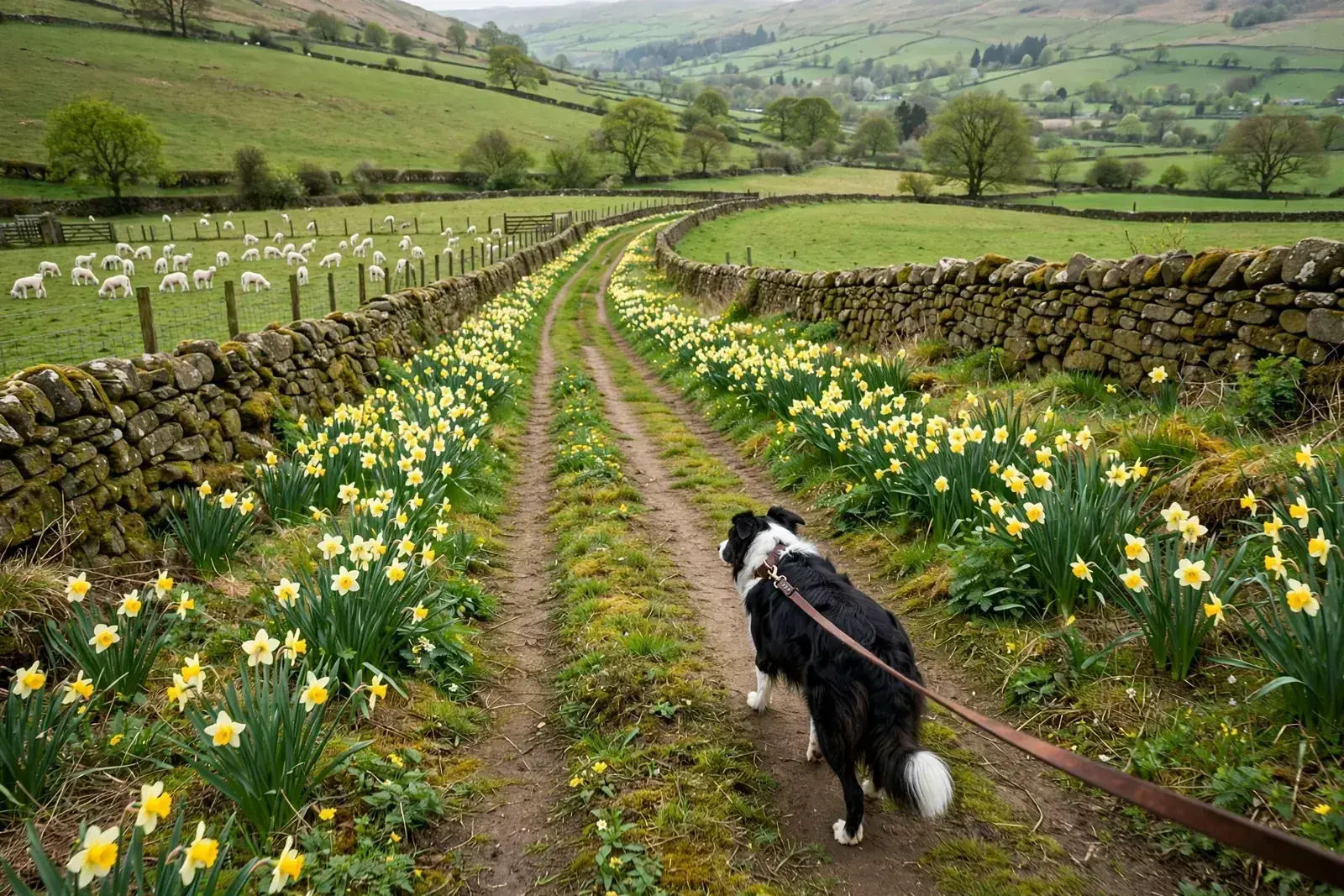
Lambing does not end neatly on a calendar date. Lowland flocks may be largely finished by early May while hill farms are still in the thick of it, and a single walk can cross one field of sturdy month-old lambs and the next of newborns still finding their legs. Ewes with young lambs are protective, easily stressed and quick to move — and a ewe separated from her lamb by a curious dog, even a friendly one on the far side of a fence, may not reunite with it cleanly. The risk is not only a chase. Presence, barking and pressure are enough.
Read each field from the gate before you commit to crossing it. Where are the sheep, where is the path, and can you keep a wide buffer without leaving the route and trampling grass that may be a hay crop? If sheep are clustered on the path itself, waiting quietly at a distance or turning back is often better than weaving through them. Keep the dog on a short lead at your side, not straining ahead, and keep moving at a steady, unhurried pace without stopping for photographs among livestock. Never let a dog approach a lamb that appears alone; its mother is almost certainly nearby, and your intervention makes reunion harder.
Know the emergency rule too. If cattle — which are a separate and serious risk in spring when cows have calves at foot — move towards you, let go of the lead so the dog can escape and you can reach a gate without being pulled between animals, then call the dog once you are safe. With sheep, the equivalent discipline is prevention: distance, lead and an exit you have already spotted. If a farmer is working in the field, follow any direction they give immediately and without argument. It is their workplace and their animals' most vulnerable week, not a debating point on a right of way.
Ground-nesting birds: the nests you will never see
Skylarks sing above meadows where their nests sit hidden in the grass below. Curlew and lapwing nest on damp pasture and moor, meadow pipits in rough grass, and ringed plovers on shingle where an egg looks exactly like a pebble. This invisibility is the whole problem of May. A walker can do real damage without ever seeing a nest, an egg or a chick: a dog quartering widely through grass flushes a sitting bird, eggs chill or are taken by predators while the parent is away, and repeated disturbance can cause a pair to abandon a site altogether.
The practical response is unglamorous and effective. Stay on the path where there is one, keep dogs on a short lead or at close heel where the rules require it, and resist the inviting shortcut across open grass, heath or shingle. On moorland, follow any breeding-season signs, flagged diversions or warden advice — some areas operate voluntary restraints, dog-free zones or temporary closures that exist because a rare species has chosen that exact slope this year. Give any agitated adult bird — calling repeatedly, circling you, feigning injury — a wide berth and leave the area by the way you came; that behaviour means you are close to something it is trying to protect.
Children need the same briefing, in simple terms: in spring, grass is somebody's nursery. Balls, picnics and games belong on the recreation ground, the beach section where dogs and families are directed, or the short amenity grass of a park — not in a wildflower meadow, however empty it looks. Building this into the family's habits in May pays off all summer, because the same awareness protects fledglings, leverets and ground flora long after the bank holiday ends.
Spring walks that suit cooler days and softer ground
The best early May walks share a quality that summer classics often lack: a firm surface underfoot. Forestry tracks, well-made riverside paths set back from flood-prone banks, canal towpaths, disused railway trails and surfaced estate routes stay walkable after rain and let an unfit dog build distance gradually. Towpaths need lead discipline around anglers, cyclists and nesting waterbirds, and canal water is not a swimming invitation — steep sides make exits hard — but as a level, navigable, pub-at-the-end option they are hard to beat for a first long walk of the year.
Match distance to the dog in front of you, not the dog of last September. A sensible pattern is to make Saturday's main walk about two-thirds of what you think your dog can do, watch how they move that evening and the next morning, and only then decide Sunday's length. Stiffness that appears twelve hours later is the honest fitness report. Puppies, adolescents still building joints, seniors and dogs returning from injury or illness need veterinary-led limits, not bank-holiday enthusiasm, and any lameness, lagging or reluctance to bear weight ends the walking programme until it is checked.
Build in sniffing time as a deliberate part of the walk rather than treating it as delay. Twenty unhurried minutes exploring a hedgerow, a woodland edge or a quiet churchyard path can tire a dog more kindly than an extra mile of marching, and it lowers arousal before cafés and events. For a broader framework for stitching walks, travel and rest into a short break, see our bank holiday weekend breaks guide, which covers booking and traffic timing that this seasonal guide deliberately leaves to one side.
May Day, maypoles and Morris dancing: enjoying events at dog height
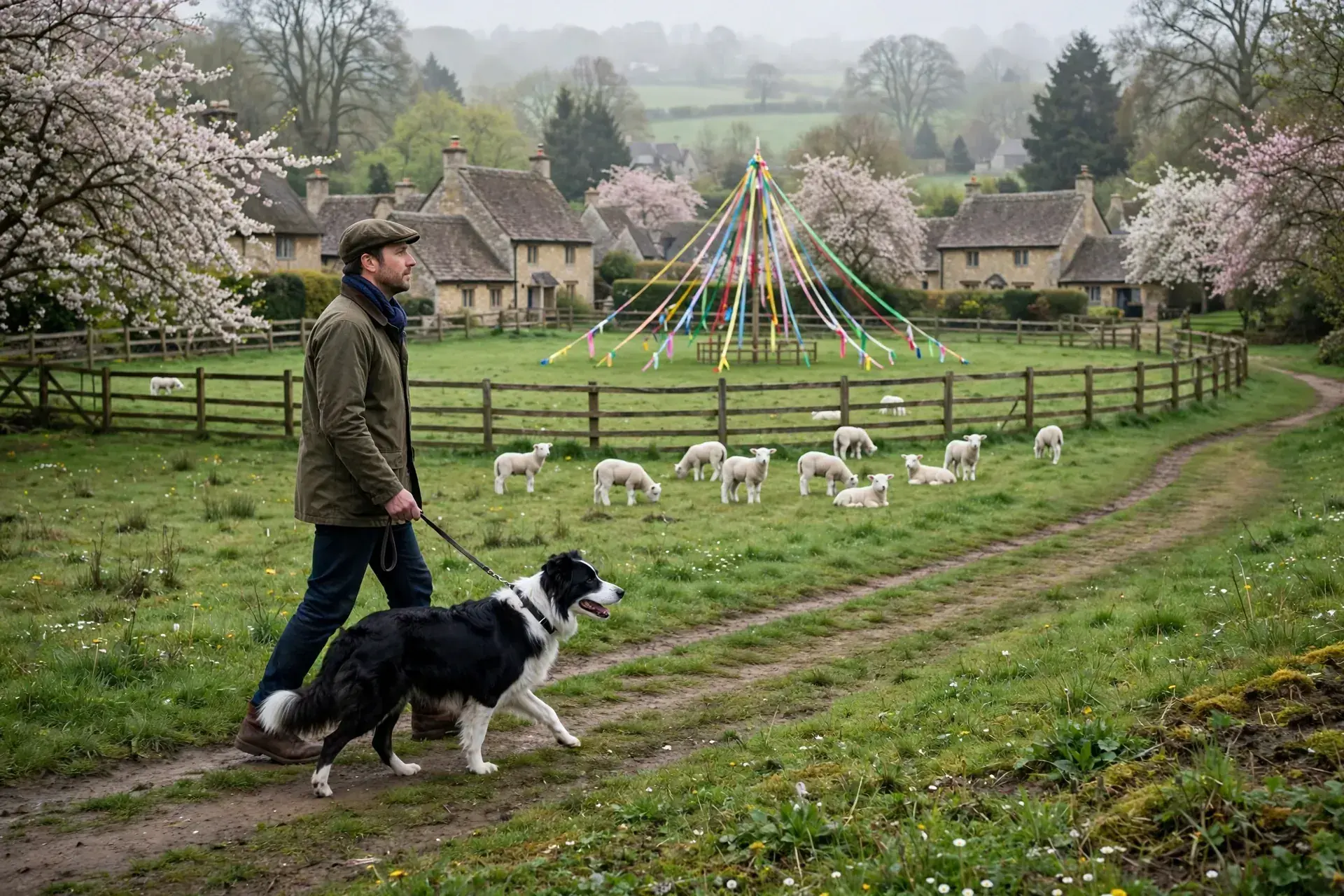
Early May brings a distinctive calendar that no other bank holiday copies: maypole dancing on village greens, Morris sides dancing at pubs and market squares at dawn or through the day, spring fetes, plant sales, duck races and the first outdoor markets of the year. Experienced from the edge, with a settled dog lying on a mat and room to step away, these are some of the most pleasant hours of the British spring. Experienced from the middle of a dense crowd, with bells, sticks, drums, accordions, livestock displays and a dozen other dogs within lead length, they are an entirely different proposition.
Scout before you settle. Arrive early enough to choose a perimeter spot with shade, an exit route and grass rather than tarmac, and watch one dance or performance from there before deciding to stay for more. Bells and handkerchiefs delight people and startle some dogs; a dog who flinches, pants, pulls to leave or barks continuously is giving you an answer, and the kind response is a quiet walk away from the green, not firmer holding of the lead. Keep leads short in any crowd, keep dogs out of food queues and cake stalls, and never tie a dog to a maypole, a marquee rope or a chair and walk away.
Check the listing before you set out. Some events welcome dogs on leads explicitly, some allow them only outside marquees and animal enclosures, and some — particularly those on private gardens, school grounds or sites with poultry and show animals — exclude them. Official event pages and parish notices are the source of truth, and rules can change year to year, so confirm before travelling rather than relying on a previous visit. Carry water for waits in the sun between showers, and plan the dog's toilet break away from the green itself; a village that welcomes dogs this year does so partly because last year's visitors cleared up scrupulously.
First-trip-of-the-year checks: car, body and paperwork
Start with the car, because May is when winter habits break down. Refit the restraint, crate or guard you removed for Christmas loads and tip runs, and confirm clips still work — our planning for any longer journey should assume the dog is secured on every mile, not just the motorway. Do a short practice drive in the preceding week if your dog has barely travelled since autumn: ten relaxed minutes ending somewhere pleasant rebuilds the association far better than discovering nausea or panic at the start of a two-hour trip. Never leave a dog in a parked car in spring sun; temperatures inside a vehicle rise quickly even in May, and “only five minutes” at a reopening attraction is exactly how it happens.
Then the dog. Check microchip details are current by contacting the database, confirm the phone number on the ID tag is the mobile you actually carry, and photograph both the tag and any vaccination or insurance documents so they are on your phone if the originals stay at home. Count medication for the trip plus a spare day, note your home vet's number and save an emergency provider near your destination, and check flea and tick prevention is in date — tick activity rises through spring, especially in woodland, bracken and deer country. Carry a tick remover and know how to use it, check the dog after every countryside walk, and speak to a vet promptly about any tick-borne illness concerns or a tick you cannot remove cleanly.
Finally, feet and coat. Paws softened by a winter of pavements meet gritty tracks and stony paths in May; check pads for cracks before you go and again each evening. Trim or arrange grooming so a long coat is not dragging through mud and burrs, but avoid a drastic clip just before the trip — a dog suddenly shorn feels cold evenings more, and sunburn becomes possible on thin or pale skin. Small checks, done at home with good light, prevent the small miseries that otherwise consume a holiday morning.
Packing for cool, changeable weather — for both ends of the lead
Early May packing fails in one direction more than any other: people pack for the photograph, not the forecast. A bright Saturday morning persuades them that the drying coat, the warm layer and the waterproof can stay behind, and by six o'clock they are drying a shivering dog with a tea towel. Pack in layers and systems instead. For the dog: normal food measured out, treats for settling, water and a bowl that lives in the car, a drying coat or large microfibre towel, a warm fleece or coat for thin-coated, young, old or wet dogs in the evening, spare lead and collar, poo bags in every pocket and bag rather than one central supply, and bedding protected by a waterproof liner or bag for transport.
For yourself, the item that saves the most walks is a genuinely waterproof jacket and footwear that handles wet grass without complaint. Owners cut walks short, rush dogs past the sniffing that settles them, and skip the second outing altogether when they themselves are cold — and then wonder why the dog is restless in the accommodation all evening. Gloves still earn their place on a May morning at altitude or on an exposed coast. A head torch, unfashionable as it sounds, makes the late toilet walk safer on unlit lanes and lets you check paws, ticks and anything the dog has just attempted to eat.
Add a small repair and contingency kit and keep it together all season once you have assembled it: spare clip lead, towel in the car even on day trips, plastic bags for soaked gear, a familiar chew or lick mat for the first evening, cleaning supplies for muddy accidents in accommodation, and a printed note of where you are staying in case phone signal fails. If your break follows directly from an Easter trip with your dog, compare the two packing lists rather than copying blindly — Easter and early May look similar on a calendar and feel different on a hill, with stronger sun, more insects and busier paths by May, but colder sea and higher rivers than many expect.
A three-day shape with margin built in
Saturday is for arrival and calibration. Travel with a proper break at least every couple of hours, arrive in daylight where you can, walk the immediate surroundings on a lead before unpacking, and do one moderate local walk rather than the headline route. Eat simply, keep the evening routine close to home — same feeding order, same bed, same last-outing pattern — and note honestly how the dog travelled, ate and settled. That note decides the rest of the weekend, and writing it into the plan in advance makes it easier to act on.
Sunday carries the main event, chosen to suit what Saturday taught you. A fit, settled dog earns the longer forestry or towpath walk and an hour at the edge of a village fete. A stiff, overwhelmed or travel-tired dog gets a shorter morning walk, a long sniffing session somewhere quiet, and an afternoon of rest while the humans take turns at the event or attraction. Splitting up briefly so the dog can rest is not a failed holiday; it is usually the decision that makes Monday pleasant instead of frazzled. Whatever you choose, keep one part of the day unplanned — reopening-weekend queues, weather turns and roadworks will fill any gap you leave, and a margin absorbs them without spoiling anything.
Monday is a closing day, not a bonus day. Walk early, pack the car so the dog's space is restored before the final items go in, check the accommodation for leads, tags, medication and the toy that will certainly be under the bed, and leave in good time rather than squeezing in one more attraction. Recheck the dog for ticks before the drive, offer water, and plan the homecoming too: a calm evening, normal food and no immediate visitors gives a tired dog the recovery that a good first trip deserves. Then, while it is fresh, note what worked — distance, surface, event distance, what you packed and never used — because that single page turns the next bank holiday from another experiment into a plan.
Practical questions
Before you go
Do dogs have to be on a lead on open access land in May?
Yes. On open access land in England and Wales dogs must be on a short lead between 1 March and 31 July, and at any time near livestock. That period covers ground-nesting birds and lambing, so the early May weekend sits squarely inside it. Keep to a short, fixed lead rather than a long extending lead, follow local signs that may be stricter, and check the latest official guidance before you travel.
Can I walk my dog through a field with lambs in spring?
Only with great caution and only if the public route actually crosses that field. Keep your dog on a short lead, give ewes and lambs as much space as the path allows, never let the dog approach, chase or bark at them, and leave by the nearest gate if sheep move towards you. If an alternative route avoids the field entirely, take it. A farmer may ask you to turn back during lambing, and following that request promptly is both safer and expected.
Why do ground-nesting birds matter for dog walks in May?
Species such as skylark, curlew, lapwing and meadow pipit nest on or close to the ground in grassland, moorland, heath and some coastal areas, often with no visible nest to warn you. A dog ranging widely off the path can flush a sitting bird and expose eggs or chicks even without making contact. Staying on paths and keeping dogs on a short lead or close at heel where required protects nests that you will usually never see.
What should I pack for a dog on an early May trip?
Pack for cool and changeable weather rather than summer: a drying coat or towel, a warm layer for an older or thin-coated dog in the evening, waterproof cover for bedding, spare lead and collar, tick remover, familiar food, water and a collapsible bowl, poo bags, and any medication. Add a light layer for yourself so you are not tempted to cut a walk short. Check photo identification, microchip details and vet contact details before the first trip of the year.
Are dogs welcome at May Day events in the UK?
It depends on the event and the venue. Village fetes on open greens often welcome dogs on leads around the edges, while crowded maypole dancing, Morris performances, funfairs, food halls and enclosed gardens may restrict dogs or be stressful even where they are allowed. Check the event listing in advance, arrive early or stay at the perimeter, give performers and other visitors space, and leave if your dog is unsettled by music, bells, crowds or other dogs.