This guide is independent and contains no paid placement. If affiliate links are added later, they will be clearly marked and will not change our editorial checks.
Exmouth works best for dogs outside the summer beach restrictions, at low tide, and on the estuary side when the cliffs are too hot or too steep. Check the seasonal beach rules and the tide times before you travel, keep your dog off the estuary mudflats and away from roosting birds, and use the Orcombe Point end of the beach when the town end is busy.
Why Exmouth suits dogs (and when it does not)
Exmouth sits where the River Exe meets the sea, on the eastern side of the estuary mouth in East Devon. It is the largest town in East Devon, and it is also the western gateway to the Jurassic Coast, the 95-mile stretch of coastline that runs east from here to Studland Bay in Dorset. For a dog owner, that geography is the whole appeal: a single base gives you a long sandy beach, a sheltered estuary, cliff-top walking and easy day trips along the coast, without the steep lanes and cramped parking that make some Devon villages hard work with a dog in the car.
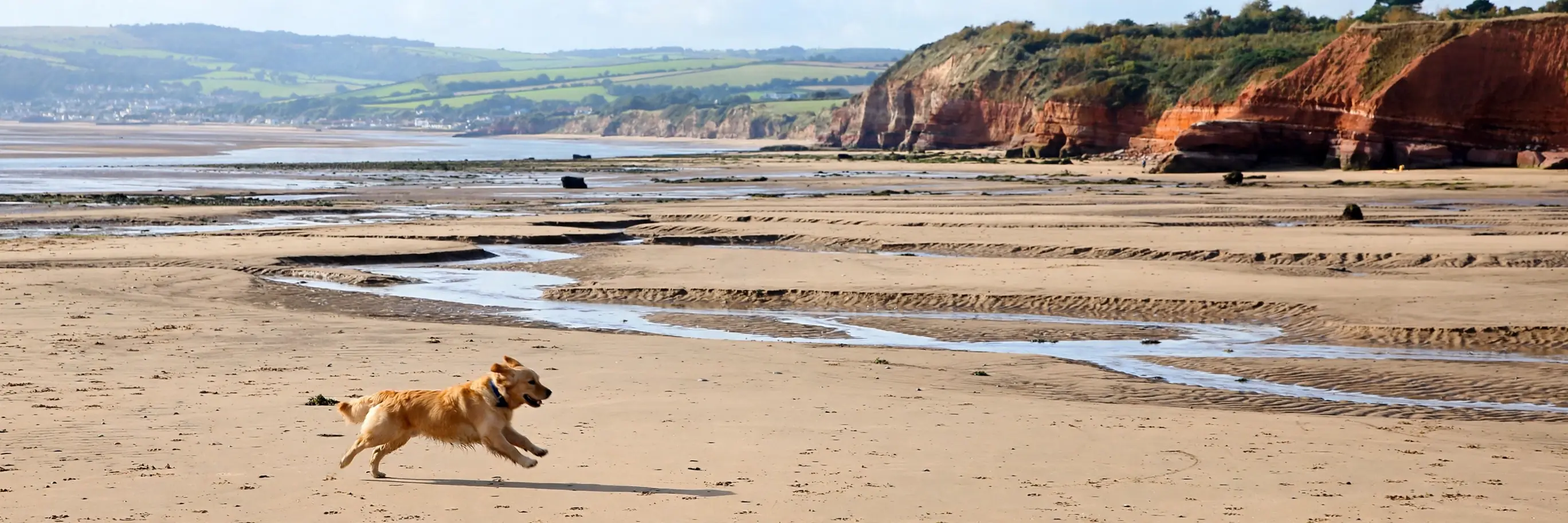
The beach is the headline. Exmouth beach runs for roughly two miles from the marina and the town end in the west to Orcombe Point in the east, and at low tide it becomes an enormous flat expanse of firm sand. Few beaches in Devon offer this much open running space, and the difference matters for dogs that need a proper gallop rather than a short paddle at the waterline. The sand is clean, gently shelving and free of the rock pools and pebble banks that slow smaller dogs down, which makes it a good first beach for puppies building confidence and for older dogs that want a level surface under their paws.
The estuary is the second reason to come, and the one that changes how you plan each day. The Exe Estuary is one of the most important wildlife sites on the south coast, a sheltered stretch of mudflats, saltmarsh and shallow water that supports large numbers of wintering waders and wildfowl, including avocets, brent geese, oystercatchers, curlews and dunlin. That makes the estuary side of Exmouth a rewarding place to walk with a dog, but it also means the usual beach rules do not cover everything: dogs that chase birds, wander onto mudflats or disturb roosting flocks can do real harm, and the estuary is protected accordingly. The best Exmouth trips treat the beach and the estuary as two different places with two different sets of manners.
There are days when Exmouth is not the right choice, and it is worth naming them before you book. On a hot August weekend the town end of the beach is crowded, seasonal dog restrictions apply, the cliff paths offer almost no shade, and the car parks fill early. A reactive dog that struggles with crowds, children and other off-lead dogs will find the main beach hard work in high summer, and the same dog will have a far better time here in October, when the restrictions lift, the light is softer and the beach empties out. Winter has its own trade-offs: the beach is gloriously empty, but the wind off the estuary is cold and the cliff paths can be muddy and slippery after rain. Spring and autumn are the sweet spot for most dogs, with long low tides, mild weather and room to move.
Exmouth is also a practical base rather than a picture-postcard village. It has a mainline railway station with trains to Exeter, a regular bus service along the coast, supermarkets, veterinary practices, pet shops and a wide choice of places to stay. That matters when a trip goes wrong: a dog that eats something it should not on the beach, a cut paw from a shell, or a sudden change in the weather is much easier to deal with in a town that has everything within a short drive than in a remote cove. If you are travelling with an older dog, a nervous dog or a dog with medical needs, the fact that Exmouth is a working town with proper facilities is a genuine advantage, not a compromise.
Exmouth Beach: the two-mile rulebook
Exmouth beach is long enough that it behaves like several beaches joined together, and the dog rules change along its length. The town end, around the Esplanade, the lifeboat station and the marina, is the busiest stretch, with cafes, amusements, the RNLI station and the main access points from the town centre. The middle of the beach, along Queen’s Drive and the Maer, is quieter and more open, backed by the flat green of the Maer recreation ground. The eastern end, towards Orcombe Point, is the quietest of all, where the sand meets the low red cliffs that mark the start of the Jurassic Coast. Learning which end suits your dog, and at what time of day, is the single most useful thing you can do before your first walk.
Seasonal dog restrictions apply on the main beach during the summer months. The restricted area and the exact dates are set by East Devon District Council under a Public Spaces Protection Order, and they can change from year to year, so check the official guidance before you travel rather than relying on what a previous visitor told you. As a general pattern, dogs are restricted from the main beach during the summer season, roughly from the start of May to the end of September, while other stretches remain open to dogs all year. Signs at each beach access point show the current boundary, and the boundary matters: a dog that is perfectly legal on one stretch of sand can be in breach a few hundred metres further along. Our guide to dog-friendly beaches in the UK explains how these seasonal bans and fines work in general, and it is worth reading before you arrive so the signs make sense on the day.
Outside the restricted season, the beach is one of the most dog-friendly stretches of sand in the south-west. From October through April, dogs can run the full length of the beach, and the winter light and empty sand make it feel like a different place entirely. Even in summer, the restrictions do not close the whole beach to dogs, and the areas that stay open are usually much quieter than the town end. If you are visiting in summer, plan your beach time for early morning or late evening, when the sand is cooler underfoot, the crowds have thinned and your dog can enjoy the open stretches without weaving between sunbathers and windbreaks.
Wherever you walk, the lead rules deserve a careful read. Dogs must be kept on a lead in some areas and at some times of year, and even where off-lead walking is allowed, your dog must be under effective control. That phrase is the one that catches people out: a dog that runs up to other dogs, chases children or ignores a recall is not under control, however friendly it is. Exmouth beach attracts kite surfers, windsurfers, paddleboarders and families with small children, and a dog that charges at a kite on the sand or a board at the waterline can cause a serious accident. Keep a long line in your pocket for the first walk until you know how your dog reacts to the particular mix of people, dogs and water sports on the day.
There are also a few beach-specific hazards worth knowing. The sand at Exmouth is firm and flat, which is easy on paws, but broken shells can cut pads after storms, and the town end has groynes and slipways that become slippery with weed at low tide. Dogs should not drink seawater, and the Exe is a working estuary, so the water near the marina and the docks can carry fuel and debris that the open beach does not. Bring fresh water and a bowl on every beach walk, rinse sandy paws before the drive home, and check between the toes for grit and shell fragments after a long run. If your dog eats sand while playing, watch for signs of gut discomfort afterwards and call a vet if it persists, because sand impaction is a real risk for enthusiastic diggers.
Finally, remember that the beach is a shared space with its own etiquette. Pick up after your dog every time, including on the open sand where it is tempting to think the tide will deal with it. Bag it, bin it in the bins provided along the Esplanade and Queen’s Drive, and never leave a bag on the sea wall or tucked behind a groyne. Dog waste bins are provided at the main access points, but they fill fast on busy days, so carry a spare bag and be prepared to carry waste to the next bin rather than leaving it. The beach is cleaned and loved by local volunteers and council teams, and the dogs that are welcomed back year after year are the ones whose owners leave nothing behind.
Tides, mudflats and the Exe Estuary
The tide shapes everything about an Exmouth dog walk, and it shapes it twice a day. The beach at low tide is a vast open plain; at high tide the same beach narrows to a strip of sand against the sea wall, and the estuary mudflats disappear altogether under the incoming water. Checking the tide times before you set out is not a nice extra here, it is the difference between a two-hour run and a twenty-minute walk along a crowded wall. Tide tables for Exmouth are published by the usual sources and posted locally, and it is worth checking them the night before as well as on the morning, because the times shift by roughly an hour each day.
Low tide is the best time for dogs, for three reasons. First, the exposed sand is at its widest and firmest, giving dogs room to run without crowding other beach users. Second, the shallow pools left behind by the retreating tide are good for paddling dogs that like water but are not strong swimmers. Third, the walk out to the waterline and back is itself a decent workout, which means a dog can be happily tired without a long cliff climb. Walk out with the falling tide rather than arriving at the lowest point and trying to beat the water back: the incoming tide at Exmouth comes in fast across flat sand, and a dog that is focused on a ball may not notice the water cutting behind it. Keep an eye on the sea, agree a turn-back point before you set off, and head for the shore while the water is still well out.
The estuary side of the town is a different world from the beach, and it needs different care. The Exe Estuary is a Site of Special Scientific Interest and a Special Protection Area, and its mudflats and saltmarsh support internationally important numbers of birds. The mud itself is the first danger: estuary mud is deep, soft and sticky, and a dog that runs out onto it can become stuck, panic and exhaust itself trying to get back. People have been caught out the same way, so never follow a dog onto the mud, and never let a dog off the lead near it. If your dog does get stuck, call for help rather than wading in after it, and keep the dog calm by talking to it from firm ground while help arrives.
The birds are the second reason to keep a dog close on the estuary side. In winter, the estuary holds thousands of waders and wildfowl that have flown in from the Arctic and northern Europe to feed and rest. A single dog running through a roosting flock can flush hundreds of birds at once, and each flush costs them energy they cannot easily replace in cold weather. Avocets, which feed in the shallow water at the edge of the estuary, are particularly sensitive, and brent geese grazing on the saltmarsh will leave an area altogether if they are disturbed repeatedly. The practical rule is simple: keep your dog on a lead on the estuary paths, give roosting flocks a wide berth, and move away calmly if birds take flight. The best birdwatching with a dog is done from the paths and viewing points, with the dog settled at your feet, not from the middle of the flock.
There are good places to enjoy the estuary without causing problems. The Exe Estuary Trail runs along the western side of the estuary and is popular with walkers and cyclists, and the Exmouth side has paths and viewpoints where you can watch the birds at a distance. The area around the marina and the docks offers views across the water to Dawlish Warren on the far side, and on a clear day you can watch the tide empty the estuary and expose the channels and sandbanks where waders feed. Bring binoculars if you have them, and a mat for your dog to lie on while you watch: a dog that has a job, even the job of lying still on a mat, is far less likely to lunge at a passing curlew than a dog that is standing at the end of a tight lead with nothing to do.
One more estuary fact is worth knowing before you plan a walk: the Exe is a working river, and the water quality and currents change with the rain and the tide. After heavy rain, the river carries more sediment and debris, and the water near the town can be murkier than the open beach. Dogs that swim in the estuary should be rinsed afterwards, and dogs that drink from the estuary should be discouraged, as they should be from drinking seawater anywhere. If your dog swims in the estuary regularly during a stay, watch for stomach upsets and skin irritation, and ask a local vet if you are unsure whether the water is safe on a given day.
Walking the Jurassic Coast from Orcombe Point
Orcombe Point, at the eastern end of Exmouth beach, is where the Jurassic Coast begins. A marker known as the Geoneedle stands on the cliff top here, and the South West Coast Path climbs away from the beach and heads east towards Budleigh Salterton, Ladram Bay and eventually Sidmouth. For a dog owner, this is one of the most rewarding stretches of the whole path: red cliffs, open sea views, and a proper sense of setting off along a coastline that changes colour and character with every headland. It is also a cliff walk, and cliff walks demand more from a dog and its owner than a beach walk does.
The first section, from Orcombe Point to Budleigh Salterton, is roughly three miles of undulating cliff-top path. It climbs steadily out of Exmouth, drops into small combes, and rises again to open grassland with wide views back across the bay. The path is well waymarked and generally well surfaced, but it runs close to unfenced cliff edges in places, and the drops are sheer. Keep your dog on a lead for the exposed sections, especially in wind, and do not let a dog run ahead around blind corners where the path narrows. Dogs that are used to moorland and hill walking will take it in their stride; dogs that have only ever walked on pavements and beaches may find the ascents tiring, so build up to the full distance rather than attempting it on your first morning.
Water and shade are the practical limits on this walk. There is no fresh water on the cliffs between Exmouth and Budleigh Salterton, and almost no shade on a sunny day, so carry more water than you think you need, for the dog as well as for yourself, and walk early or late in hot weather. A collapsible bowl, a litre of water per dog for a three-mile walk in warm conditions, and a plan to refill at Budleigh Salterton or back in Exmouth will cover most situations. In winter the problem reverses: the path can be muddy and slippery after rain, and the wind on the exposed headlands is much stronger than it feels in the shelter of the town, so bring a drying coat for the dog and a windproof layer for yourself.
Budleigh Salterton makes a natural turning point. It is a quiet pebble beach town with a long shingle shore, a brook that runs down to the sea, and a handful of cafes where dogs are welcome outside. The beach at Budleigh is pebbles rather than sand, which some dogs dislike underfoot, but the town itself is a pleasant place to stop for water and a rest before the walk back. The return along the same path is just as scenic in reverse, and many dog owners prefer to walk out to Budleigh and catch the bus back to Exmouth, which saves tired legs and paws. Check the bus times before you set off, and confirm that dogs are carried, because services and rules change with the season.
The longer option, from Budleigh Salterton on to Sidmouth, is a full day rather than a morning stroll. The path continues past Ladram Bay, with its sea stacks and holiday park, and climbs over the headlands to Sidmouth, a walk of around seven miles from Exmouth in total, with significant ascents and descents. Only attempt it with a fit dog, good weather and an early start, and plan your transport home in advance, because the walk back doubles the distance. Our guide to Sidmouth with a dog covers the red cliffs, the Esplanade and the Salcombe Regis walk at the far end, and it is worth reading if you are thinking of making Sidmouth your destination rather than your turning point.
One more point about the cliff path deserves emphasis: the Jurassic Coast is an eroding coastline, and the path is moved inland from time to time when a section of cliff falls away. Follow the waymarks and any diversion signs rather than the line on an old map or a downloaded route, and keep dogs well back from the cliff edge after heavy rain, when the ground can be undercut. If a section is closed, it is closed for a reason, and the diversion is usually short. The coast path is at its best when it is treated with respect, and a dog that stays on the path and on a lead near the edge is a dog that gets to come back and walk it again.
Quieter walks: the estuary side and the commons
Not every good Exmouth dog walk involves cliffs or crowds. The estuary side of the town offers flat, sheltered walking that suits older dogs, puppies, and any dog that finds the beach overwhelming. The Exe Estuary Trail runs from Exmouth towards Lympstone and on to Topsham and Exeter, and the first few miles out of Exmouth are level, well surfaced and easy to follow. This is the walk to choose on a hot day, when the cliff path is exposed and the beach is busy, or on a wet day, when the flat trail drains better than the muddy cliff-top grass.
The walk to Lympstone is about three miles each way along the estuary, and it passes through a landscape of saltmarsh, reedbeds and tidal creeks that feels a world away from the seafront. Lympstone itself is a small village with a harbour, a church on the hill and a couple of pubs, and it makes a good destination for a longer walk with a dog that needs a rest and a drink at the halfway point. Keep your dog on a lead on this trail: the path runs beside the railway line in places, crosses the estuary road, and passes close to grazing marshes and bird roosts where a loose dog can cause problems. Cyclists use the trail too, so keep to one side and keep the lead short when a bike approaches.
Further afield, the commons and heathland north of Exmouth offer a completely different kind of walk. Woodbury Common, a few miles inland, is a large area of lowland heath with open tracks, gorse, heather and wide views, and it is popular with local dog walkers for exactly that reason. The ground is sandy and free-draining, which makes it usable in winter when other paths are waterlogged, but there are adders on the heath in warm weather, and grazing animals in some areas, so keep dogs on a lead or under close control and stick to the marked tracks. Aylesbeare Common, managed as a nature reserve, is quieter still, with boardwalks and heathland trails, and it is worth checking the current access rules before you travel, because parts of the reserve have seasonal restrictions to protect ground-nesting birds.
Closer to town, the Maer and the Imperial Recreation Ground provide the everyday walks that matter on a longer stay. The Maer is a large flat green behind the beach, with paths, open grass and views across the bay, and it is where local dog owners go for a quick morning or evening walk without the sand and the tide to think about. The recreation ground and the green spaces around the town are good for training and for settling a dog that is new to the area, and they are also the place to go when the weather turns and a cliff walk or a beach run is not sensible. Every good dog holiday needs a boring local loop as well as the headline walks, and Exmouth has plenty of them.
For dogs that need enclosed space, it is worth asking locally about secure fields and dog exercise areas near Exmouth, because provision changes and new fields open regularly. A secure field is the right answer for a dog with unreliable recall, a rescue that is still learning to trust, or a dog that needs to run hard without the distractions of the beach. Book ahead in high season, check the fencing height and the gate arrangements before you let a dog off, and bring your own water and a long line for the walk from the car park to the field. The best fields are the ones with a double-gated entrance and a clear view of the whole enclosure from the gate.
The seafront, marina and town centre with a dog
Exmouth seafront is built for strolling, and it is at its best with a dog at either end of the day. The Esplanade runs along the town end of the beach, with the lifeboat station, cafes and amusement arcades on one side and the sand on the other, and a wide pavement that is easy to walk with a dog on a lead. In the morning, before the crowds arrive, it is a calm and pleasant walk, with the fishing boats and the estuary on one side and the beach opening out on the other. In the evening, as the day visitors leave, it takes on a quieter, local feel, and it is a good place for a last walk before bed.
Queen’s Drive, which runs along the middle of the beach, is the quieter sibling of the Esplanade. It is backed by the Maer on one side and the open beach on the other, with car parks, beach huts and access points spaced along its length. The pavement here is wide and the traffic is slower, which makes it a better choice for nervous dogs and for dogs that pull on the lead. The beach huts along Queen’s Drive are privately owned and not generally available to visitors, but the open green of the Maer behind them is a useful place to stop, water a dog and let it sniff before continuing along the front.
Exmouth Marina, at the western end of the seafront, is worth a visit in its own right. The marina and the docks area have been redeveloped in recent years, with new apartments, restaurants and walkways around the water, and the pontoons and moored boats make it an interesting place for a dog that likes to watch the world go by. Keep dogs on a lead around the marina, because the water is deep, the edges are hard, and a dog that slips in will struggle to climb out without help. The walkways are also popular with cyclists and families, so keep to the side and keep the lead short. The marina is a good place to stop for a coffee and a sit-down, and several of the venues around it welcome dogs outside.
The town centre, up the hill from the seafront around the Strand and the High Street, is a practical place rather than a scenic one, but it has what a dog owner needs: supermarkets, pet shops, cafes and the railway station. The Strand is pedestrianised in part and has outdoor seating where dogs are often welcome, and the side streets have a handful of independent shops that are worth a browse. Dogs are not generally allowed inside food shops, so plan your shopping around one person staying outside with the dog, and use the pet shops and outdoor markets for the browsing that a dog can join in with.
Getting around Exmouth with a dog is straightforward. The town is flat around the seafront and the town centre, which suits older dogs and dogs with mobility problems, and the railway station has step-free access to the platforms. Buses run along the coast to Budleigh Salterton and Sidmouth and inland to Exeter, and dogs are generally carried on local buses, though it is worth confirming with the operator before you travel. If you are driving, the one-way system around the town centre can be confusing on a first visit, so allow extra time and follow the signs to the seafront car parks rather than trying to cut through the town.
Pubs, cafes and fish and chips with a dog
Exmouth has a good spread of dog-welcoming places to eat and drink, and the pattern is familiar to anyone who has travelled with a dog in Devon: terraces and bar areas are usually fine, restaurants are more variable, and the best approach is to ask at the door and to have a backup in mind. The marina and the Esplanade have several venues with outdoor seating where dogs are welcome, and on a warm day a table outside with a view of the estuary is one of the pleasures of an Exmouth stay. Bring a mat for your dog to lie on, a chew to keep it occupied, and a water bowl if the venue does not provide one, because a dog that has somewhere comfortable to settle is a dog that will be welcome back.
Fish and chips is the classic Exmouth meal, and it is also one of the easiest to enjoy with a dog, because it is traditionally eaten outside. Buy from a takeaway on the Esplanade or in the town centre, find a bench on the seafront or a spot on the Maer, and eat with the dog at your feet. Keep the dog well away from the food: chips are too salty for dogs, battered fish is too fatty, and the tartar sauce and mushy peas are not suitable either. A few plain chips as a treat is one thing; a dog that has eaten a whole portion of fish and chips is a dog that may be unwell overnight. Bring the dog’s own food or a chew so it has something to do while you eat, and clear up every scrap before you leave.
Cafes in Exmouth vary in their dog policies, and the ones that welcome dogs tend to be proud of it, with water bowls by the door and dog treats on the counter. The town centre cafes around the Strand and the seafront cafes along the Esplanade are the best places to start, and the cafes at the marina are a good option for a longer sit-down. If you are planning a full meal, call ahead or check the venue’s own information before you travel, because policies change with the season and with staffing, and a venue that welcomed dogs in winter may restrict them to the terrace in summer when the dining room is full.
Pubs in Exmouth range from traditional town pubs to modern marina bars, and many of them welcome dogs in the bar area. The pubs in the town centre and around the harbour are generally the most dog-friendly, and a dog that can settle quietly under a table will usually be made welcome. The rules that matter are the ones you can control: keep the dog on a lead indoors, keep it out of the way of staff carrying food and drink, and take it outside for a toilet break before you settle in. A dog that barks at other dogs in a crowded bar will not be welcome for long, so choose a quiet corner, keep visits short at first, and build up to longer stays as the dog learns the routine.
One practical tip covers all of these: eat early. Exmouth’s dog-welcoming terraces fill up on summer evenings, and a dog that arrives at seven o’clock to a full terrace and a long wait for a table is a dog that is already tired and unsettled before the food arrives. An early lunch or an early dinner, with a walk before and after, is a much better shape for a day with a dog, and it leaves the evening free for a quiet walk on the beach as the light fades.
Where to stay with a dog in Exmouth
Exmouth has a wide range of dog-friendly places to stay, from large holiday parks on the edge of town to self-catering cottages, guest houses and a handful of hotels. The right choice depends on your dog as much as on your budget: a dog that needs enclosed outdoor space will be happier in a cottage with a garden than in a flat above a shop, and a dog that barks at passers-by will be happier in a quiet residential street than on the Esplanade. Book early for school holidays and summer weekends, and confirm the dog policy in writing before you pay, including the number of dogs allowed, any pet charge, and whether the dog can be left alone in the accommodation.
Holiday parks are the most common choice for families with dogs, and the large parks around Exmouth and at nearby Sandy Bay accept dogs in selected caravans and lodges. The advantage is space: a caravan or lodge with a deck or a patch of grass outside the door gives a dog somewhere to toilet last thing at night without a walk through a busy site. The disadvantages are the ones that apply to any holiday park: the dog-friendly units may be in the busiest part of the site, the pet charge can add up over a week, and the rules about leaving a dog alone in the unit are usually strict. Ask for the exact location of the unit, the size of the outdoor space, and the written rules about unattended dogs before you book, and read the cancellation terms carefully, because peak-season deposits are substantial.
Self-catering cottages and apartments in Exmouth town and in the surrounding villages are a good option for couples and smaller families. Look for a property with a secure garden or a courtyard, a hard floor in the living area that is easy to clean after a sandy beach walk, and a practical place to dry a wet dog. Ask whether the garden is genuinely enclosed, because a low wall or a hedge with a gap is not a fence, and ask where the nearest green space is for the first and last walks of the day. Properties that welcome dogs usually say so clearly in the listing, and the ones that do not mention dogs at all are best avoided rather than asked about as an afterthought.
Guest houses and small hotels in Exmouth vary widely in their dog policies. Some welcome dogs in selected rooms, sometimes with a charge per night, and some welcome dogs only in the bar or garden rather than in the bedrooms. If you are booking a hotel, ask which rooms accept dogs, whether there is a charge, whether the dog can be left in the room, and where the nearest toilet area is at night. A hotel on a busy road with no garden may look convenient on a map and be miserable in practice at eleven o’clock at night, so check the surroundings as well as the room.
Whatever you book, pack for the accommodation as well as for the walks. Bring the dog’s own bed and blanket, so the dog has a familiar smell in a strange place, and a non-slip mat for hard floors. Bring towels for sandy paws and a drying coat for wet days, and a stair gate or a travel crate if your dog needs a defined space to settle. Photograph any existing damage when you arrive, and keep food, medication and cleaning products out of reach. A dog that settles quickly on the first night is a dog that will enjoy the rest of the stay, and the first night is won or lost in the first hour after arrival.
Practical planning: parking, vets and beach safety
Parking in Exmouth is straightforward outside peak summer weekends, and the car parks along Queen’s Drive and the Esplanade put you within a short walk of the beach. The larger car parks near the Maer and the marina are the best bet for a longer stay, because they are close to the beach access points and to the toilets and cafes. Arrive early on summer weekends and bank holidays, because the seafront car parks fill by late morning and the overflow is a walk away. Check the charges and the maximum stay before you leave the car, and never leave a dog in a parked car in warm weather, even with the windows open: a car in the sun heats up far faster than most people expect, and the seafront car parks have almost no shade.
Veterinary cover in Exmouth is good for a town of its size, with practices in the town and in the surrounding area, and the larger veterinary hospitals in Exeter are a short drive away. Save the number of the nearest practice and the nearest out-of-hours emergency vet before you need either, and keep your dog’s vaccination record and any medication in the car or in your accommodation. If your dog is injured on the beach, a cut paw from a shell or a swallowed fish hook is the most common problem, and the right response is to keep the dog calm, apply pressure to any bleeding, and call the vet for advice rather than trying to treat a deep cut yourself. Bring a basic first-aid kit: saline wash, bandages, tweezers for thorns and ticks, and the vet’s number written down rather than only saved in a phone that may run out of battery.
Beach safety for dogs deserves a paragraph of its own. The sea at Exmouth is generally gentle, with a shelving beach and small waves, but the estuary mouth has strong currents, and the water near the marina and the docks is not a safe swimming area for dogs. Keep dogs out of the water near groynes and slipways, where currents run along the structures, and be careful after storms, when the sea can carry debris and the beach can hide sharp objects under the sand. Dogs that are not strong swimmers should wear a buoyancy aid if they are going to swim, and no dog should be allowed to swim alone or to chase a ball into deep water. If your dog gets into difficulty in the water, do not go in after it unless you are a strong swimmer and the conditions are safe: call the coastguard or the RNLI and keep the dog in sight while help arrives.
Heat is the other seasonal risk. Exmouth beach has almost no natural shade, and the sand can become hot enough to burn paws on a sunny day. Walk early or late in hot weather, test the sand with the back of your hand before letting a dog walk on it, and carry water and a shade option, such as a beach tent or a windbreak, if you plan to stay for a few hours. Signs of overheating in dogs include heavy panting, drooling, lethargy and vomiting, and the response is to move the dog to shade, offer small amounts of cool water, wet the paws and belly, and call a vet if the dog does not improve quickly. Brachycephalic breeds and older dogs are at higher risk, and they should not be exercised at midday in summer at all.
Finally, a word about the practicalities that make a trip run smoothly. Bring more poo bags than you think you need, a towel for the car seat, and a spare lead. Keep the dog’s identification tag on at all times, with a mobile number that works while you are away, and make sure the microchip details are up to date before you travel. If your dog is on medication, bring more than you need for the trip, and keep a note of the dose and the vet’s number with the medication. Exmouth is an easy town to enjoy with a dog, and the trips that go well are usually the ones where the boring preparation was done before the car was packed.
Day trips from Exmouth
Exmouth is a good base for day trips along the East Devon coast, and the obvious first choice is Sidmouth, about eight miles to the east. Sidmouth has red cliffs, a wide pebble-and-sand beach, a pleasant Esplanade and the cliff walk to Salcombe Regis, and it makes a rewarding day out for a dog that has already enjoyed Exmouth and is ready for a change of scene. Our guide to Sidmouth with a dog covers the beach rules, the cliff walk and the practical details, and it is worth reading before you set off, because Sidmouth’s beach and parking work differently from Exmouth’s.
Budleigh Salterton, halfway between Exmouth and Sidmouth, is a quieter option for a shorter day. It has a pebble beach, a brook that runs through the town to the sea, and a relaxed feel that suits dogs that find Sidmouth and Exmouth too busy. The walk from Exmouth to Budleigh along the coast path is itself a good day out, and the bus back makes it a practical one-way walk. Topsham, on the other side of the estuary, is a different kind of day trip altogether: a small estuary town with pubs, antique shops and views across the water to the birds, reached by the Exe Estuary Trail or by train from Exmouth via Exeter. Topsham is best enjoyed on foot, with a dog on a lead, and it is a good wet-weather alternative to the coast path.
Further afield, the wider Jurassic Coast offers a lifetime of day trips, from the fossil beaches around Lyme Regis to the shingle banks of Chesil Beach, but these are full days rather than casual outings, and they need their own planning. Closer to home, the market town of Honiton, inland from the coast, has a High Street of antique shops and a market, and the Otter Valley around it has gentle riverside walks. Dawlish Warren, across the estuary mouth from Exmouth, is a long sandy spit with a nature reserve, and it is reachable by the ferry from Exmouth in summer or by train. Check the ferry times and the dog rules before you travel, because both change with the season, and remember that Dawlish Warren’s nature reserve has its own restrictions to protect the birds and the dunes.
The best approach to day trips from Exmouth is to pick one destination per day and to give the dog a quieter day in between. A dog that walks the coast path to Sidmouth on Monday, the estuary trail to Lympstone on Tuesday and the beach at Exmouth on Wednesday will enjoy the holiday far more than a dog that is marched along a different cliff path every day. Build in rest, build in a lie-in, and let the dog set the pace on at least one day of the trip. The coast will still be there tomorrow, and a rested dog is a happy travelling companion.
Practical questions
Before you go
Can dogs go on Exmouth beach all year round?
Not on every part of it. Exmouth beach has seasonal dog restrictions during the summer months, and the restricted area and dates are set by East Devon District Council under a Public Spaces Protection Order. Outside the restricted season dogs can use the beach more freely, and some stretches are open to dogs all year. Check the official guidance before you travel, because the exact boundary and dates can change.
Where is the best place to walk a dog at low tide in Exmouth?
The wide sandy beach at low tide is the obvious choice, because the falling tide exposes a huge flat expanse of firm sand between the Esplanade and the water. Walk out with the tide rather than against it, keep an eye on the incoming tide, and stay off the soft mud of the estuary side, which can trap paws and is dangerous. The Orcombe Point end of the beach is usually quieter than the town end.
Is the South West Coast Path from Exmouth suitable for dogs?
Yes, with the usual cliff-path care. The path east from Orcombe Point towards Budleigh Salterton is a proper cliff walk with steep drops in places, so keep your dog on a lead near the edge and carry water, because there is little shade and no fresh water on the cliffs. The estuary-side path towards Lympstone is flatter and easier, and suits older dogs and hot days better.
Are dogs allowed in Exmouth pubs and cafes?
Many are, especially on terraces and in bar areas, and the marina and Esplanade have several dog-welcoming spots. Policies differ from venue to venue and can change with the season, so check before you travel and ask at the door rather than assuming. Bring a mat and a chew so your dog can settle while you eat.
What should I do if my dog disturbs birds on the Exe Estuary?
Put your dog on a lead straight away and move calmly away from the birds. The Exe Estuary is a protected site for wintering waders and wildfowl, and birds that are repeatedly flushed burn energy they need to survive the winter. Keep dogs out of the mudflats and saltmarsh, stick to marked paths, and give roosting flocks a wide berth at high tide.