This guide is independent and contains no paid placement. If affiliate links are added later, they will be clearly marked and will not change our editorial checks.
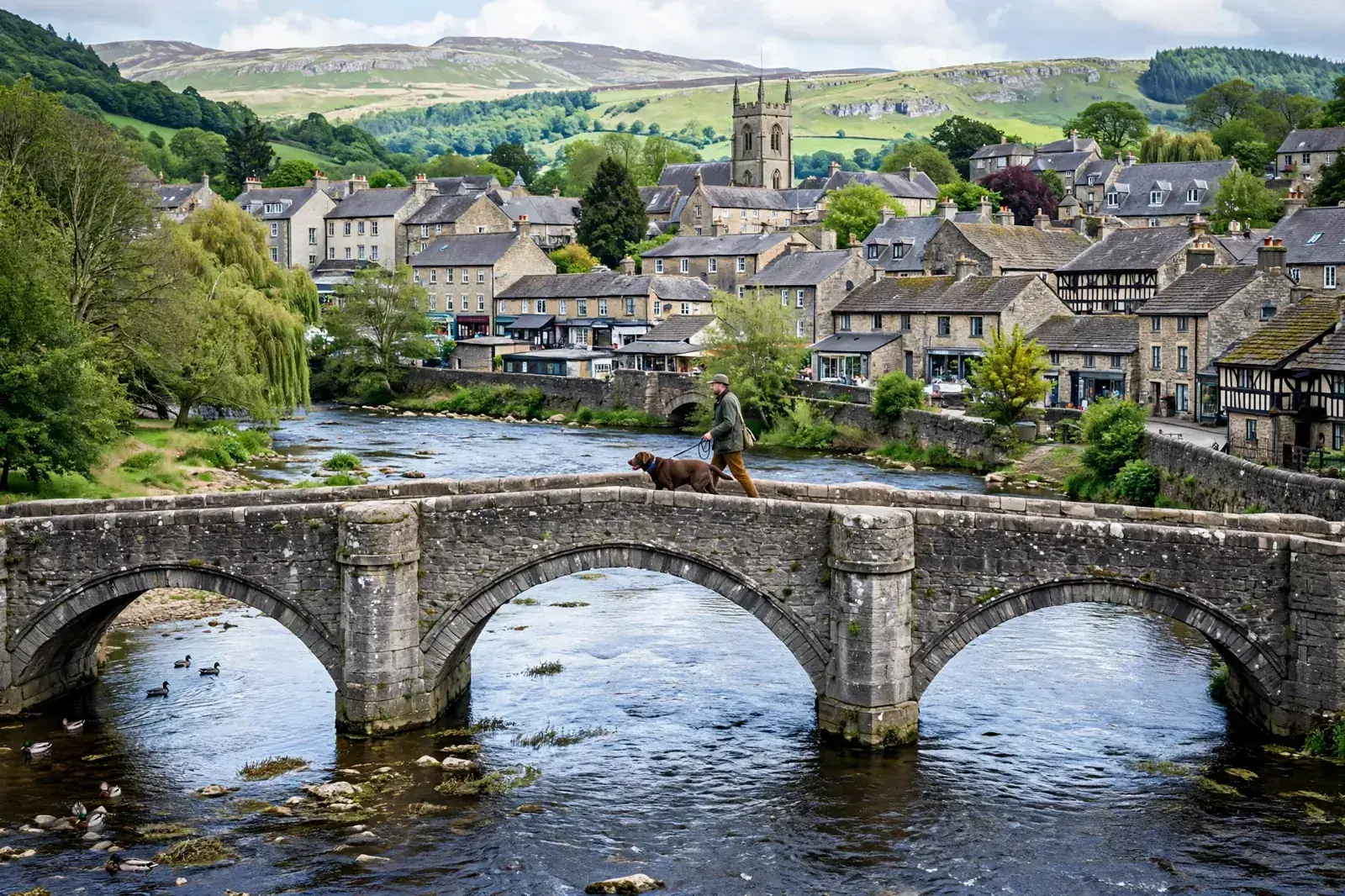
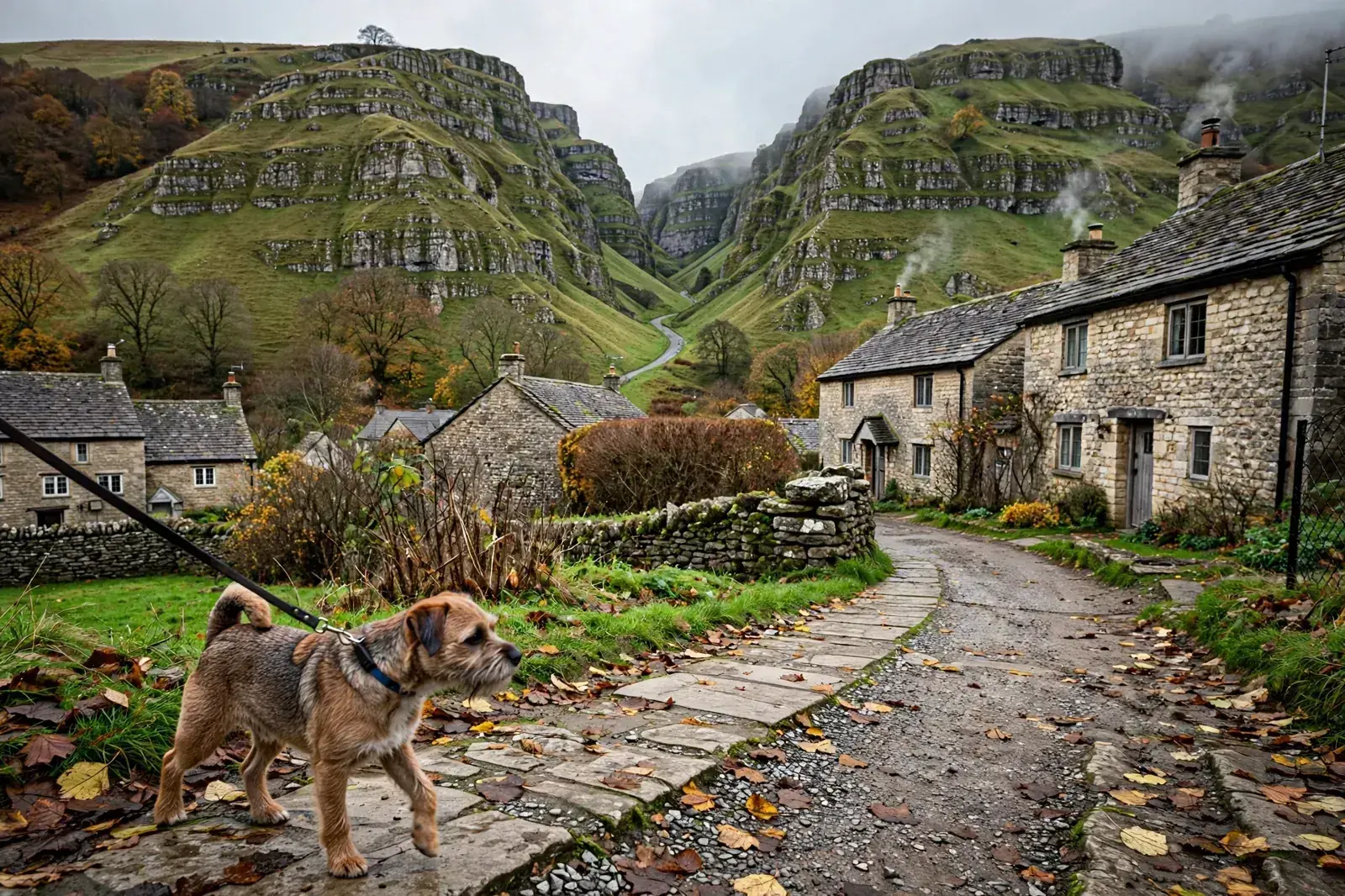
Eyam rewards a slow, quiet, on-lead visit: learn the plague story at the museum and on the village trail, give your dog a sniff-heavy stroll around the lanes, then stretch legs on Eyam Moor with livestock and weather in mind. Keep dogs close and calm around the churchyard, memorials and residents, and check the official guidance before you travel for current access and dog rules.
The plague story in brief, and why it still shapes the village
In September 1665, plague arrived in Eyam, a small gritstone village in the Derbyshire Peak District. The commonly told account is that it came in a parcel of cloth sent from London to the village tailor, and that the first victims were members of the tailor household. Within weeks, the disease was spreading from house to house in a community that was then largely cut off from the wider world by poor roads and distance. What happened next is why Eyam is still known, more than three centuries later, as the plague village.
Under the leadership of the rector, William Mompesson, and his predecessor Thomas Stanley, the villagers agreed to a remarkable and terrible decision: they would quarantine themselves. Nobody would leave Eyam, so that the plague would not be carried to neighbouring villages. Food and supplies were left at a boundary stone on the edge of the village, and payment was left in a hollow in the stone filled with vinegar, which people then believed would disinfect the coins. Families who could afford to do so left food and help for those who could not, and the churchyard, the fields and the Riley graves on the hillside above the village became burial places when the churchyard could no longer cope. By the time the outbreak ended in the autumn of 1666, a large proportion of the village population had died, and many households had lost several members.
That history is not a backdrop in Eyam; it is the reason the village looks and feels the way it does. Plaques on cottages record the names of people who died there, and the church of St Lawrence holds memorials and a register that still lists the plague dead. The village green, the stocks and the well are part of everyday village life, and at the same time they sit within a landscape of remembrance. Visitors are welcome, and the village depends on that welcome, but Eyam is a living community first and a historic site second. Residents live in the cottages whose plaques visitors stop to read, children walk to school through the village, and funerals and services still take place in the church. A dog visit that works well here is therefore a quiet one: dogs on leads, voices kept down near memorials, no blocking of doorways or lanes for photographs, and no treating the village as an open-air attraction to be ticked off at speed.
The story also explains why the most rewarding way to visit Eyam with a dog is slow. The village is compact, and its interest lies in small details rather than grand sights: a name on a cottage wall, the slope of a lane, the view from the churchyard, the way the moor rises directly behind the houses. Dogs are well suited to this kind of visit. A dog forces a slower pace, encourages pauses, and notices the smells and sounds of a place that a hurried walker misses. The key is to match the dog pace to the village mood. Keep the dog close on a short lead through the centre, allow longer sniffing stops on quieter lanes and on the moor, and plan the day so that the dog is never bored, overexcited or left waiting for long periods while the humans go inside somewhere the dog cannot follow.
It is worth reading a short account of the plague story before you arrive, rather than trying to absorb it all from plaques on the day. The museum gives the fullest version, and the trail plaques add names and places, but a little background reading helps you explain the story to children in an age-appropriate way and helps you decide which sites matter most to you. Some families prefer to focus on the courage of the quarantine decision and the help given by neighbouring villages; others want to visit the Riley graves and the boundary stone and to understand the cost of that decision in full. There is no single correct route, but there is a correct manner: respectful, unhurried and aware that the names on the walls belonged to real people whose descendants still live in the area. If your dog is excitable, noisy or uncomfortable in busy places, visit early or late in the day, keep the village section short, and spend the energetic part of the walk on the moor instead.
Eyam Museum with a dog: what to expect and plan around
Eyam Museum is a small, village-run museum that tells the plague story through displays, models, documents and personal stories. It is the best starting point for a first visit, because it turns the names on the cottage plaques into people with ages, occupations and family relationships, and it explains the quarantine decision, the boundary stone arrangements and the role of Mompesson and Stanley in a way that scattered plaques cannot. The museum is compact rather than large, and a visit usually takes well under an hour, which makes it easy to fit around a dog walk without leaving a dog waiting for too long.
Dog access inside the museum is the first thing to check, because small museums change their rules and seasonal arrangements. Check the official guidance before you travel for the current dog policy, opening days and hours, and admission charges. Plan on the basis that the dog may not be able to go inside, and arrange the visit so that one member of your group stays outside with the dog while the others go in, swapping over if you want everyone to see the displays. This is a common and perfectly workable pattern in small villages, and it is far better than leaving a dog in a car or tied up alone outside an unfamiliar building. If you are travelling alone with a dog and the museum does not admit dogs, you can still have a full visit by following the outdoor trail, which covers many of the same places, and by reading up on the story before or after the trip.
If you do split the group, make the waiting time pleasant for the dog rather than a chore to be endured. Find a shaded spot out of the main footpath, offer water, and let the dog settle on a mat or blanket if it is used to one. Keep the wait short: agree in advance how long the museum visit will take, and do not let it drift into a long browsing session while the dog waits in a strange place. A good pattern is to walk the dog first, so that it has already had exercise and a toilet break, then visit the museum, then walk again. A tired, toileted dog waits far more calmly than a fresh dog that has been driven straight to the village and asked to sit still.
Inside, the displays reward close reading rather than rushing. Look for the household stories, the way the quarantine was organised, and the records of who survived and who did not. The museum also gives context that changes how the rest of the village looks: once you know which cottages lost whole families, the plaques read differently, and once you understand the boundary stone system, the walk to the edge of the village feels more meaningful. For children, the museum offers a way into a difficult subject through individual stories rather than statistics alone, and it is worth talking beforehand about what plague meant in the seventeenth century, when there were no antibiotics and no clear understanding of how disease spread.
Practical points matter as much as history here. Eyam Museum is in the village centre, close to parking and to the church, so it fits naturally at the start or the middle of the trail. Check the official guidance before you travel for seasonal opening, because small museums often have shorter winter hours or close on particular weekdays. Do not assume that a cafe or shop will be open at the same times as the museum, and carry water and a portable bowl for the dog regardless of the season. If the museum is busy, a dog waiting outside may find the comings and goings overstimulating, so choose a quieter waiting spot a little away from the door and keep the dog on a short lead with its back to the flow of people where possible.
The village history trail on foot with a dog
The village history trail is the heart of an Eyam visit with a dog, because it is almost entirely outdoors and can be walked at whatever pace suits the dog. The route links the church, the village green, the stocks, the well and the cottages with plague plaques, and it can be followed with a trail leaflet or simply by walking the lanes and reading the plaques as you come to them. The village is small enough that you do not need to worry about getting lost, and the trail can be shortened at any point by cutting back through a side lane to the centre. Allow one to two hours for a leisurely circuit with stops, or split it into two shorter walks with a cafe break in between.
Start at the church of St Lawrence, which stands at the centre of the village story. The churchyard contains plague graves and memorials, and the church itself holds records and memorials connected with the outbreak. Keep dogs on a short lead in the churchyard, keep them off graves and memorial stones, and do not let them foul there. Even dogs that are normally reliable off lead should stay on lead here: a churchyard is a place of remembrance and a working burial ground, and a dog running across graves or barking during a service would be a serious discourtesy. If a service or funeral is taking place, give the church a wide berth and keep the dog quiet and close.
From the church, the lanes lead past cottages whose plaques record plague deaths house by house. Read them slowly, and notice how many names repeat within a single household. The plaques are on private homes, so stand on the public lane or pavement to read them, do not step into gardens or peer through windows, and do not block a doorway while you read. Dogs should stay on the pavement side, away from garden walls and gates, and should not be allowed to mark against cottage walls or gates. This is simple good manners, but it matters more in Eyam than in a busier tourist village, because the plaques are not decorations: they mark houses where people died.
The trail also takes in the village green, the stocks and the well, which are good places for a short rest and a drink of water. These are shared village spaces, so keep the dog under control around children and other dogs, and be ready to move aside if a local resident needs to pass with a car or on foot. Eyam lanes are narrow, and cars, tractors and delivery vehicles use them, so keep dogs on the inside of the pavement where there is one, and on a short lead on lanes without pavements. A long line or extending lead is a poor choice in the village centre: it lets a dog wander into gardens, trip up pedestrians and step into the road.
Beyond the centre, the trail reaches the boundary stone, sometimes called Mompesson Well, where food was left for the quarantined village and payment was left in vinegar-filled hollows. The walk to the boundary stone is a pleasant extension for a dog that still has energy, and it helps to make the quarantine story concrete: stand there and imagine a village that could not go beyond that point for more than a year. The Riley graves, on the hillside above the village, are a further and more sombre extension. The graves are said to mark the burial place of a family who isolated themselves in a hut on the hillside after the plague reached their home. The path to the Riley graves is steeper and rougher than the village lanes, so judge it against your dog fitness and the weather, and keep dogs on lead around the graves themselves.
Throughout the trail, the best approach is to let the dog set the sniffing pace on quiet stretches and to tighten up the lead and the focus through the busier and more sensitive spots. Carry poo bags and use them, carry water, and watch for signs that the dog is tiring, overheating or becoming stressed by crowds. On busy days, the village centre can feel crowded for a nervous dog, and the kindest option is to walk the quieter lanes and the boundary stone route, and to save the churchyard and the green for a quieter moment. The trail is not a race, and there is no prize for covering every plaque in one go.
Eyam Moor: open walking, livestock and weather
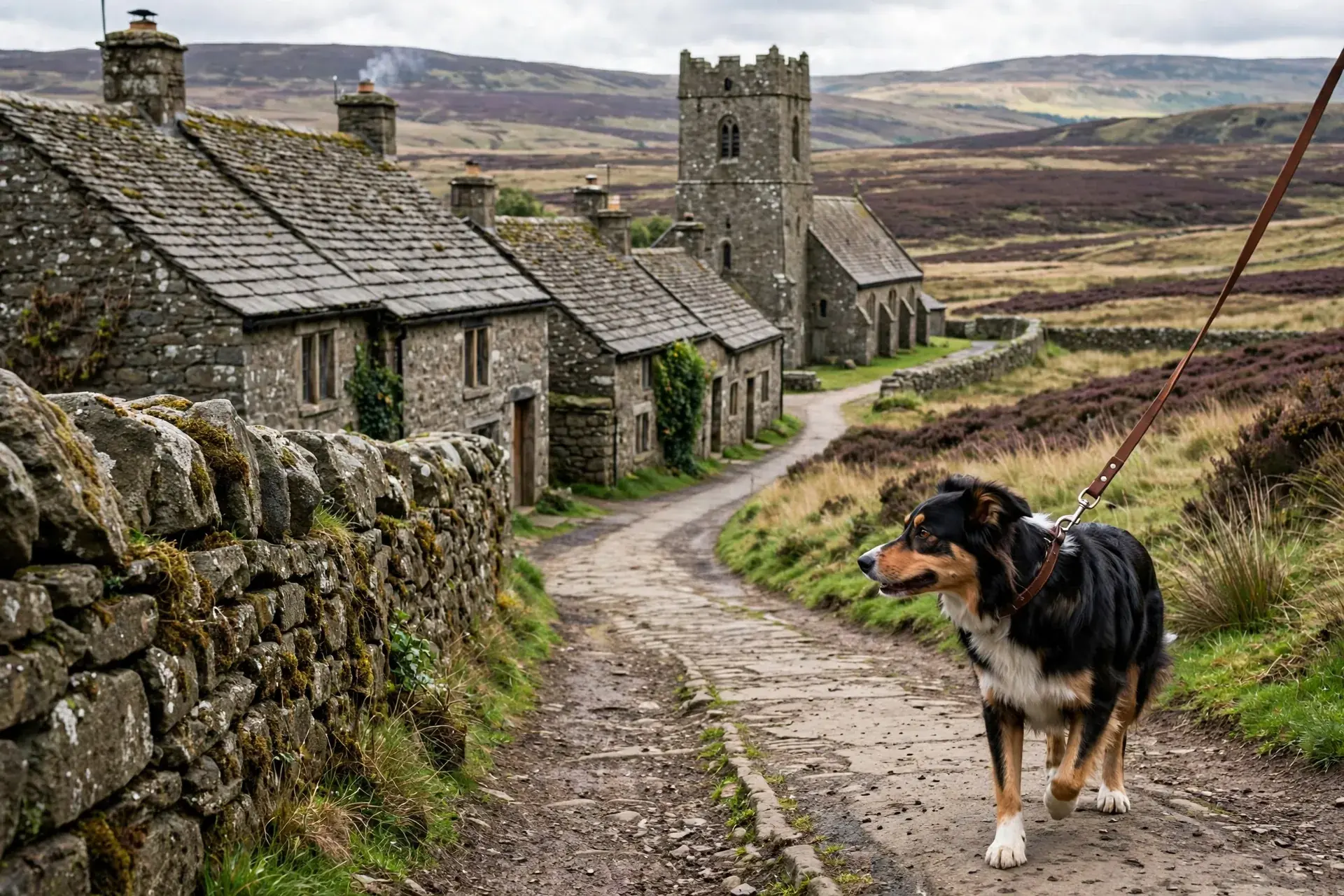
Eyam Moor rises directly behind and above the village, and it is where a dog visit to Eyam turns from a history walk into a proper Peak District outing. The moor is open access land, with wide grassy and heathery ground, gritstone edges, and long views across the Derbyshire hills. For a dog that has behaved well on a short lead through the village, the moor offers space to move, sniff and explore, and for the humans it offers the contrast that makes Eyam memorable: a small, enclosed, grief-marked village below, and a big, open, windswept landscape above it. The two belong together, and a visit that only does the village misses half the story of how isolated Eyam once was.
Livestock is the first practical consideration on the moor. Sheep and sometimes cattle graze the open ground, and ground-nesting birds use the heather and grass in spring and early summer. Keep your dog on a lead around livestock at all times, without exception, and keep to paths and open ground where birds are nesting. A dog that chases sheep can cause serious harm and distress, and farmers are entitled to act to protect their animals. Even a dog that has never shown interest in sheep can behave differently on open moorland, where the animals are spread out, the wind carries scent, and there is no fence to interrupt a chase. A lead is not a punishment here; it is the tool that lets a dog enjoy the moor safely. If your dog has a reliable recall and the ground is clear of livestock, a short period off lead on open ground may be appropriate, but return to the lead at once if animals, other walkers or other dogs appear.
Weather is the second consideration, and it changes faster on the moor than in the village. Eyam Moor is exposed, with little shelter from wind, rain or sun. A calm morning in the village can become a wet, windy walk on the tops within an hour, and summer sun on open moorland can overheat a dog that has no shade or water. Check the forecast before you set out, carry water and a portable bowl even on short walks, and take a waterproof layer for yourself and a drying coat or towel for the dog. In fog or low cloud, navigation becomes harder, so keep to clear paths, carry a charged phone, and do not let a dog range far out of sight. In icy or very wet conditions, gritstone and muddy paths become slippery, so shorten the route and choose the surest footing.
Route choice on the moor should follow the dog in front of you. A fit, energetic dog can enjoy a longer circuit that takes in the edges and the higher ground, while an older or smaller dog will be happier with a short out-and-back walk from the village edge, with plenty of sniffing stops and a gentle gradient. There is no single marked Eyam Moor circuit that suits every dog, so plan by time rather than distance: decide how long the dog can comfortably walk, allow for stops, and turn back at half that time. Watch the ground underfoot as well as the distance. Heather, tussocky grass and rocky sections are tiring for short legs and for dogs with joint problems, and boggy patches after rain can be deep and unpleasant for small dogs. If the dog starts to lag, pant heavily, limp or seek shade, the walk is over, whatever the plan said.
Other moor users deserve the same consideration as livestock. Walkers, runners, cyclists and horse riders all use the moor, and a dog that rushes up to strangers, jumps up or barks at horses is a problem for everyone. Keep the dog close when other users approach, step off the path where it is safe to do so, and put the dog on a lead well before a horse passes. Pick up after your dog even on open moorland, and take the bag with you: leaving bags by the path or hanging them from fences is littering, and it is a particular eyesore in a landscape that visitors come to see unspoiled. Finally, remember that the moor is also a place of history: old lead mining remains, field boundaries and burial mounds are part of the landscape, so keep dogs from digging at earthworks and do not let them disturb stone structures.
Quiet-dog etiquette in a memorial village
Eyam is not a theme park, and the etiquette that makes a visit work here is mostly a matter of remembering that distinction. The village is a place where people live, work, worship and remember their dead, and where the central historic event was a mass bereavement. A dog visit that respects that fact will be welcomed; a visit that treats the village as a backdrop for loud play, photo shoots and off-lead running will not be, however well intentioned. The rules below are not official regulations for the most part, but they are the habits that keep Eyam pleasant for residents and visitors alike.
First, keep the dog on a lead through the village at all times, on a short lead near the church, the green and the memorial sites. This is partly about safety on narrow lanes with traffic, and partly about tone. A dog on a short lead looks and feels calm; a dog on a long line or off lead in the centre looks uncontrolled, even if it is friendly. Second, keep barking to a minimum. If your dog barks at other dogs, strangers or church bells, move away promptly, create distance, and do not linger while the dog rehearses the behaviour. Third, never let a dog foul in the churchyard, on a memorial, on a cottage garden or on the village green without cleaning it up immediately. Carry more bags than you think you need, and bag and bin waste even when nobody appears to be watching.
Fourth, respect private space. Do not let a dog enter a garden, jump up at a gate, drink from a garden water feature or mark against a cottage wall. Stand on the public highway to read plaques, and keep the dog beside you rather than letting it wander up to doorways. Fifth, respect services and ceremonies. If the church is in use, keep the dog quiet and at a distance, and do not peer through windows or doors during a service. If you encounter a funeral or a memorial gathering, give it a wide berth and keep the dog close and silent. Sixth, respect other visitors, including those who may be visiting because a family member died in Eyam or because they have a personal connection to the plague story. Not everyone in the churchyard is a tourist, and a loud, playful dog can intrude on a private moment of grief.
Photography deserves a word of its own. It is natural to want photographs of a beautiful Peak District village, and dogs photograph well against gritstone cottages and moorland. But do not block lanes, doorways or pavements for a photograph, do not pose a dog on a grave or memorial stone, and do not use flash or loud encouragement inside or near the church. If a resident asks you to move on or to keep the dog away from a particular spot, do so graciously and at once. A short, polite exchange with a local resident can also be one of the pleasures of Eyam: residents often know the stories behind the plaques and are happy to chat when visitors are courteous and their dogs are under control.
Finally, think about the dog's own experience of a memorial village. Dogs do not understand history, but they do understand atmosphere: quiet voices, slow movement, close leads and frequent pauses. A dog that is used to busy parks and off-lead play may find Eyam restrained and a little dull, which is why the moor walk matters so much as a balance. Give the dog the village in small, calm doses, and give it the moor for energy and freedom within safe limits. If the dog becomes restless, whiny or overexcited in the village, that is a signal to move on to open ground, not to push through another hour of plaques. A respectful visit and a happy dog are the same thing here: both depend on pace, control and attention to the place you are in.
Cafes, pubs and resting spots
Eyam has a small number of cafes, tea rooms and pubs, and their dog policies can change with the season, the management and the layout of the room. Check the official guidance before you travel for current dog rules, and do not assume that a place that welcomed dogs last year still does so in the same way. As a general pattern in Peak District villages, dogs are more commonly welcome in pub bars, gardens and cafe terraces than in formal dining rooms, and a well-behaved dog on a lead under the table is far more likely to be welcomed than a dog that barks, begs or wanders between tables. If you are unsure, ask before you sit down, and be ready to use a garden or terrace instead of the main room.
Plan food and rest stops around the dog rather than treating the dog as an afterthought. A good Eyam day has at least one proper rest: water, a chance to lie down, shade or shelter, and a toilet break, ideally before the humans sit down for a long meal. Dogs that have already walked and toileted settle much better under a cafe table, and a mat or blanket from home gives the dog a defined place to lie. Bring a portable bowl and offer water on arrival, and keep treats low key and quiet: a long-lasting chew can help a dog settle, but a squeaky toy or a noisy game will disturb other customers and is best saved for the moor.
The village green and the quieter lanes also work as resting spots on fine days, provided the dog is on a lead and under control and you do not block paths or access. A short sit on a bench with the dog at your feet, watching the village go by, is often more restful for a dog than another hour of walking, and it gives older dogs a chance to recover between sections of the trail. On wet or cold days, look for a covered terrace or a dog-welcoming indoor space, and shorten the outdoor sections accordingly. Do not leave a dog tied up alone outside a cafe or pub while you eat inside: it is stressful for the dog, it can be a nuisance for passers-by, and in a small village it will be noticed.
Packing for cafe stops is simple but worth doing properly. Carry a collapsible bowl, water, poo bags, a lead that can be secured to a table leg or held comfortably, a mat if your dog uses one, and a towel for muddy paws after the moor. If your dog is a beggar, feed it before you sit down and keep human food out of reach. If your dog is nervous around strangers, choose a corner table away from the door and the main flow of people, and keep visits short. And if a cafe or pub is busy, consider a takeaway drink and a bench outside instead: the dog will often prefer the fresh air and the space, and you will still get the rest and the refreshment you need.
Combining Eyam with nearby Peak District villages
Eyam sits in a cluster of Peak District villages that combine naturally into a day or a weekend, and pairing it with one other village usually works better than trying to cover several in a single day. The village is close to the wider Peak District network of lanes, trails and market towns, and a second stop gives the dog a different kind of walk and the humans a different kind of history, without turning the day into a driving tour. The key is to choose a combination that suits the dog energy left after Eyam, and to leave enough time to enjoy each place rather than rushing between them.
Bakewell with a dog is a natural partner for Eyam, offering a larger market town with River Wye walks, a famous pudding tradition and a livelier centre after the quiet of Eyam. The contrast works well: Eyam in the morning, when the village is quietest and the light is gentle, followed by Bakewell for lunch and a riverside stroll, gives the dog two different walks and the humans two very different Peak District experiences. Bakewell is busier, so keep the dog on a short lead through the centre and use the riverside paths for the more relaxed part of the walk. Check the Bakewell guide for lead rules, market day patterns and pudding shop etiquette before you go.
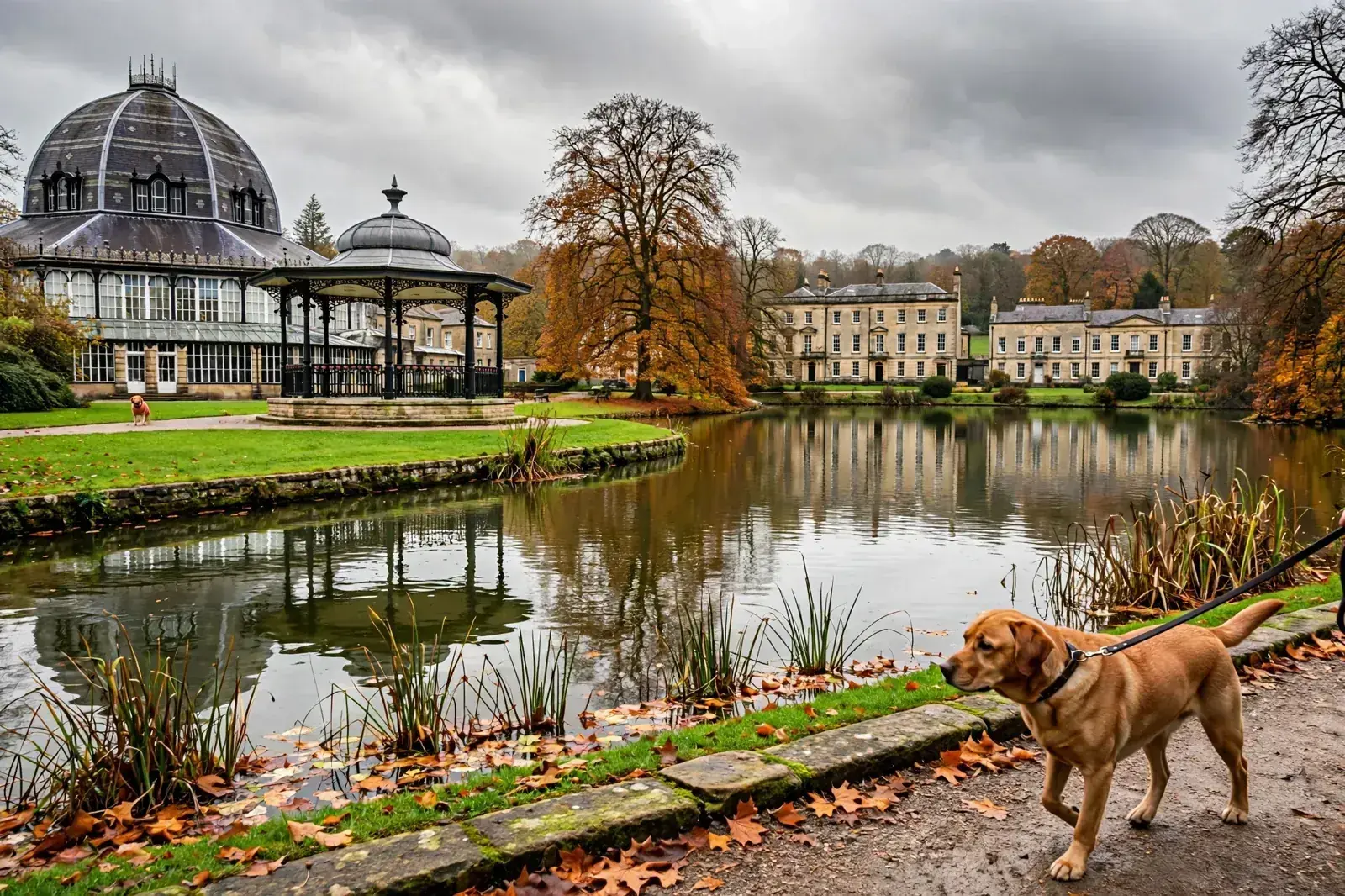
Buxton with a dog offers a different contrast again: a spa town with Pavilion Gardens, grand architecture and formal parkland, rather than a small memorial village. Buxton suits a day when the dog still has energy for a town walk and the humans want gardens, architecture and a wider choice of cafes. The gardens give a dog a structured, on-lead walk with plenty of smells and sights, while the town centre gives the humans a sense of the Peak District as a place of leisure as well as industry and agriculture. As with Bakewell, check the Buxton guide for garden rules, cavern access and parking before you travel.
Castleton, to the north-west of Eyam, is another strong option for walkers, with Cave Dale, Winnats Pass and Mam Tor nearby, though its caverns and steeper paths need separate planning for dogs. Check the official guidance before you travel for cavern dog policies, because underground attractions commonly restrict dogs, and plan Castleton as a walking and village stop rather than assuming the dog can go everywhere. For a quieter combination, consider a smaller neighbouring village or a stretch of the Monsal Trail or a nearby dale, where the dog can walk on a lead along a former railway line or a riverside path with fewer crowds. Whatever you choose, build in a rest between villages: a tired dog that is driven straight to a second busy centre will be less settled and less enjoyable to walk than a dog that has had water, shade and a short rest in between.
Overnight stays follow the same logic. Eyam itself has limited accommodation, and many visitors base themselves in Bakewell, Buxton, Castleton or a nearby market town and visit Eyam as a half-day trip. That pattern suits dogs well, because it gives the dog a settled base, a familiar sleeping place and a routine, rather than a new room every night. If you stay locally, confirm the dog policy of the specific accommodation in writing, including any charges, limits and rules about leaving a dog alone, and ask about the nearest evening toilet walk. A base with a garden or a nearby green is worth more to a dog owner than a prettier room further from open space.
Access, parking and shorter routes for less mobile dogs
Access in Eyam is village-scale rather than visitor-centre scale, which has advantages and limits for less mobile dogs. The village centre is compact, the distances are short, and a meaningful visit can be had without a long walk at all. At the same time, lanes are narrow, pavements are not continuous everywhere, and some surfaces are uneven gritstone, cobbles or grass. Dogs with arthritis, recovering injuries, very short legs or heart conditions need a plan that treats the village as a series of short outings rather than one long circuit, and that treats the moor as optional rather than essential.
Parking is usually in or near the village centre, but the exact arrangements, charges and capacity can change, so check the official guidance before you travel for current parking information. Arrive early on busy days, weekends and school holidays, when the village fills quickly and the walk from a more distant parking spot becomes part of the outing whether you planned it or not. When you park, think about the dog first: shade in summer, shelter from wind and rain, a flat and safe exit from the car, and a short, level route to the first toilet opportunity. Do not leave a dog in a parked car while you explore, even for a short time, and never in warm weather. If one member of the group needs to go inside somewhere the dog cannot follow, the other member should stay with the dog outside, as described for the museum.
For a less mobile dog, the best Eyam route is the village core: church, green, stocks, well and the nearest plaques, walked slowly with frequent rests on benches and low walls. This can be done in twenty to thirty minutes of gentle walking, broken by sits and sniffs, and it still gives the full sense of the village. Add the boundary stone only if the dog is coping well and the ground is dry and even, and skip the Riley graves and the moor if the gradient, the rough ground or the distance would be too much. A dog that enjoys the village core and a cafe terrace has had a successful Eyam visit, even without the moor, and there is no need to push further to prove a point.
Practical aids help a great deal. A harness with a handle can support an older dog on steps and uneven ground, a portable ramp helps with car access, and a dog pushchair or buggy can extend a visit for a dog that tires quickly but still enjoys being out, provided the lanes and surfaces suit wheels. Check the surfaces on your planned route before committing a buggy to it, because narrow, uneven lanes can be harder with wheels than on foot. Non-slip boots can help dogs that struggle on smooth stone, though many dogs dislike them and they should be tried at home first. Carry water, a bowl and a towel, and watch for signs of fatigue: lagging, heavy panting, lying down, limping or reluctance to continue are all signals to stop, rest or return to the car.
For humans with limited mobility, the same logic applies: choose the village core, use benches and cafe stops, and treat the moor as a separate decision on the day. Check the official guidance before you travel for step-free access, accessible toilets and the location of the nearest accessible parking, because small villages vary a great deal in what they can offer. If you use a wheelchair or a mobility aid, contact the museum and any cafe or pub in advance to confirm access, rather than assuming it. A short, well-planned Eyam visit with a comfortable dog and comfortable humans is far better than an ambitious route that leaves everyone exhausted.
Seasons and what changes
Eyam is worth visiting in every season, but the character of the visit, the dog rules that matter most, and the practical risks all change through the year. Spring brings lambing on the surrounding farmland and ground-nesting birds on the moor, so leads become even more important and some paths may have temporary local guidance. Spring also brings mud: lanes and moor paths can be wet and slippery after winter rain, so pack a towel and a drying coat, and expect the dog to need a wash after the moor. Early spring mornings in the village are often quiet, which suits nervous dogs, while Easter and spring bank holidays bring crowds that suit confident dogs better.
Summer is the busiest season, and the one that needs the most planning for dogs. The village centre fills with visitors, coaches and school groups, parking becomes harder, and cafes and pubs fill up. Dogs overheat more easily in summer, especially on open moorland with no shade, so walk early or late in the day, carry extra water, and never leave a dog in a car. Watch for hot pavements and gritstone surfaces on sunny days, and give the dog shaded rests. Summer also brings more livestock encounters on the moor and more dogs on the paths, so keep the lead handy and be ready to create distance from other dogs. On the plus side, summer evenings in Eyam are long and gentle, and a late village stroll with a dog, after the day visitors have left, can be the quietest and most atmospheric time to see the place.
Autumn is often the best season for a dog visit to Eyam. The crowds thin, the light softens, the moor turns to heather colours, and the air cools enough for comfortable walking. Autumn rain returns, so paths become muddy again, and early darkness shortens the walking day, but a dog that copes with wet ground will find autumn ideal. Fireworks season in late autumn can unsettle noise-sensitive dogs, especially in the evenings, so check whether local events are planned and keep evening walks short and close to home if your dog is affected. Autumn is also a good season for combining Eyam with Bakewell or Buxton, when the larger towns are calmer and parking is easier.
Winter brings the quietest Eyam of all, and the most need for preparation. Short days, cold wind on the moor, icy lanes and early darkness mean that the village core, rather than the moor, becomes the main walk for many dogs. Some attractions, cafes and museums reduce their hours or close on certain days in winter, so check the official guidance before you travel and do not assume summer opening times. Dress the dog for the weather if it needs a coat, dry it thoroughly after wet walks, and watch for grit or salt on lanes, which can irritate paws. Winter also brings a particular atmosphere to a memorial village: bare trees, low light and empty lanes make the plague story feel closer, and a quiet winter visit, with a warm cafe stop afterwards, can be more moving than a crowded summer one.
Planning checklist
A short checklist turns the advice in this guide into a plan you can use on the day. Work through it the evening before you travel, and again before you leave the car in Eyam, so that nothing important is left behind or assumed.
- Check before you travel: museum dog policy and opening hours, cafe and pub dog rules, parking arrangements, and any temporary moor or path guidance. Check the official guidance before you travel for each of these, because small village arrangements change.
- Lead and control: a short, non-extending lead for the village, a longer lead for the moor if you use one, a harness that fits well, and a plan for livestock, other dogs and horses.
- Water and food: water, a portable bowl, the dog's usual food if you will be out over a mealtime, and quiet treats for settling under a table.
- Weather kit: a waterproof layer for you, a drying coat or towel for the dog, a dog coat if your dog needs one, and sun protection and extra water in summer.
- Waste kit: more poo bags than you expect to need, a bag holder, and a plan to carry bags to a bin rather than leaving them on the moor or in the village.
- Comfort kit: a mat or blanket for cafe waits and museum waits, a towel for muddy paws, and any medication, ramp or buggy a less mobile dog needs.
- Route plan: a village core route for the first outing, an optional boundary stone extension, and a moor walk sized to the dog energy and the weather, with a turn-back time agreed in advance.
- Etiquette plan: short lead and quiet voices near the churchyard and memorials, dogs off graves and memorial stones, no blocking of lanes or doorways, and a wide berth for services and ceremonies.
- Safety plan: a charged phone, the location of the nearest vet, a first-aid basics kit for paws and minor cuts, and a decision rule for cutting the walk short if the dog tires or the weather turns.
- Combination plan: if you are adding Bakewell, Buxton or Castleton, a rest between villages, a second walk sized to the energy left, and accommodation dog rules confirmed in writing if you are staying overnight.
With that checklist covered, Eyam becomes a straightforward and rewarding day out: a village that asks for quiet and attention, a moor that offers space and air, and a dog that gets both a calm walk and a proper run of open ground. Go slowly, keep the dog close where the village asks for it, and let the story of 1665 and 1666 settle at its own pace. Eyam has waited more than three centuries for its visitors to listen; a dog walk that gives it an unhurried morning or afternoon is a fitting way to do so.
Practical questions
Before you go
Can dogs go inside Eyam Museum?
Check the official guidance before you travel, as indoor dog policies can change. Plan on the basis that a dog may need to wait outside with one member of your group, and build the village trail and Eyam Moor into the visit so the dog still has a full day out.
Is Eyam a good walk for a dog that needs to stay on a lead?
Yes, Eyam suits an on-lead dog well. The village trail is a short, pavement and lane based walk, and Eyam Moor is open access land where livestock, ground-nesting birds and other walkers make a lead the sensible default for most dogs.
How long does the Eyam village history trail take with a dog?
Allow one to two hours at a gentle pace with stops to read the plaques and let your dog sniff and rest. The village itself is compact, so the trail is easily shortened, and you can split it into two shorter outings with a cafe stop in between.
Are dogs allowed on Eyam Moor?
Eyam Moor is open access land and dogs are commonly walked there, but keep your dog on a lead around livestock at all times and during bird nesting season, follow any local signs, and check the official guidance before you travel for any temporary restrictions.
What should dogs not do in the churchyard and around memorials?
Keep dogs on a short lead, keep them off graves and memorial stones, do not let them foul in the churchyard, and keep voices and play low key. Treat the churchyard and memorial sites as places of remembrance first and a dog walk second.
Is Eyam suitable for older or less mobile dogs?
Yes, if you choose the village trail rather than the moor. The village route is short and can be broken into small sections with rests, while Eyam Moor is rougher, steeper in places and exposed to weather, so it suits fitter dogs and should be shortened or skipped for dogs with mobility problems.