This guide is independent and contains no paid placement. If affiliate links are added later, they will be clearly marked and will not change our editorial checks.
Start in Castle Park, loop past the church square and Town Hall, then choose a short countryside lane circuit that suits your dog's energy. Eye works best as a half-day town walk or as a calm base for the Mid Suffolk countryside, not as a race between attractions.
Small is the point in Eye
Eye is one of those Suffolk towns that is easy to underestimate on a map and easy to enjoy on foot. It is a small market town in Mid Suffolk, compact enough that the main sights sit within a short stroll of each other, and quiet enough that a dog walk rarely feels like an expedition through crowds. That scale is the attraction itself. There is no long queue to join, no sprawling attraction to navigate with a lead in one hand and a map in the other, and no sense that you have missed the point if you spend an hour watching your dog sniff a hedgerow. Eye invites a slower rhythm, and dogs tend to settle into it quickly.
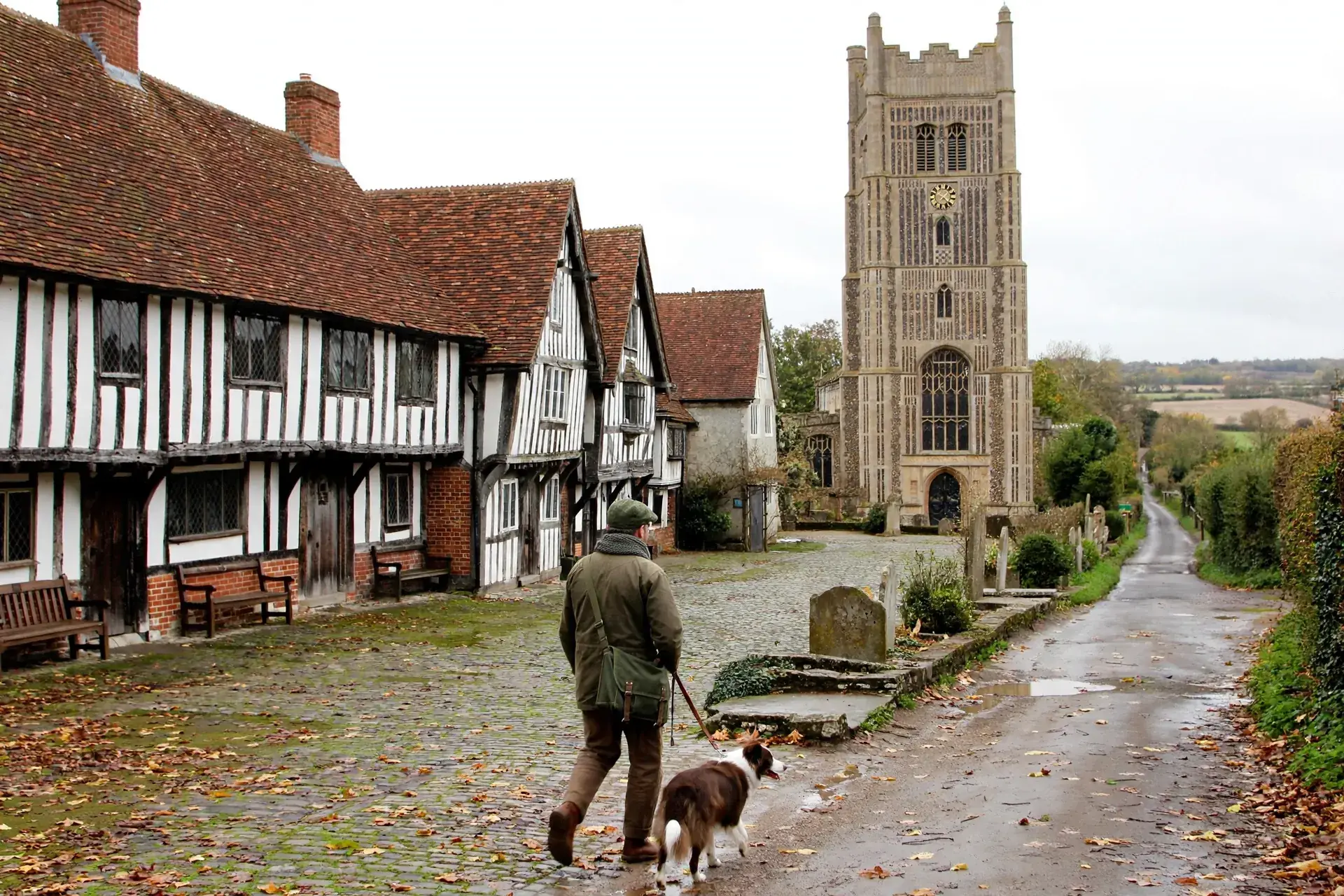
The town's shape helps. Castle Park sits close to the centre, the Church of St Peter and St Paul dominates its square with a tall tower that is visible from several approaches, and Church Street and the Town Hall area give the walk a clear spine. From there, the town thins out into residential streets and then into open countryside with surprising speed. A visitor can move from a churchyard wall to a field-edge lane in a matter of minutes, which matters for dog owners: the transition from town manners to countryside sniffing does not require a drive, a car park change, or a complicated route-finding exercise. It simply happens as the pavements give way to verges and the traffic thins.
That compactness also changes how to plan the day. In a larger town, dog owners often build an itinerary around separate destinations, each needing its own parking and timing. In Eye, the sensible plan is a single, flexible loop with options to extend or shorten it. Walk the park first, when your dog has the most energy and the most curiosity. Drift through the church square and Church Street when you want shade, shelter, or a pause. Add a lane loop only if your dog still wants more, and cut it short without guilt if the weather turns or the dog's pace slows. Nothing in Eye demands a full day, which is precisely why it suits dogs of different ages: a puppy can have a short, successful outing, an older dog can manage the town circuit without a punishing distance, and an energetic dog can stack the town walk and a lane loop into a satisfying morning.
Season and time of day shape the experience more than any single attraction does. Early mornings in Eye are notably peaceful, with birdsong carrying across the park and few other walkers about, which suits nervous or reactive dogs that prefer space. Midday brings more life to the centre, including shoppers, delivery vehicles, and other dogs, so a lead and a calm route through the square are wise. Evenings soften the town again, and a short dusk loop around the park can be a pleasant way to finish a day in the area. Summer brings longer light and fuller hedgerows, autumn brings leaf litter and muddy verges, winter brings short, crisp walks and early darkness, and spring brings lambs, nesting birds, and fields that demand extra care around livestock. None of these seasons rules Eye out; each simply asks for a slightly different kit list and a slightly different distance.
First-time visitors should resist the urge to treat Eye as a checklist. The town does not reward rushing, and dogs certainly do not. Instead, think of the visit as three layers: the park, the town, and the lanes. The park gives the dog open grass and a landmark to circle. The town gives structure, shelter, and places to pause. The lanes give distance, smells, and the open Suffolk sky. You can enjoy one layer, two, or all three, and the day still counts as a proper visit. The sections below follow that order, starting with the park, because that is where most dogs will want to begin.
It is also worth setting expectations honestly. Eye is not a beach town, a mountain town, or a resort with dedicated dog facilities on every corner. There is no single dog attraction to buy a ticket for, and that is part of its charm. What Eye offers is a well-proportioned small town in a farming landscape, with a castle mound to climb in spirit if not in stone, a church square to admire, and lanes that reward unhurried walking. Visitors who arrive expecting spectacle may be puzzled; visitors who arrive expecting a good dog walk in a handsome small town will find exactly that, and will probably leave planning to return when the seasons change.
Castle Park and the motte
Castle Park is the natural starting point for a dog day in Eye, and the reason is visible before you even enter it. The park preserves the remains of Eye Castle, a motte-and-bailey castle whose great earth mound, or motte, still rises above the surrounding grass and trees. The stone castle itself is long gone, but the shape of the earthwork remains legible: a steep-sided mound where a timber tower once stood, and the flatter bailey area beside it where the castle's everyday buildings would have clustered. For a dog, that translates into open grass for a leg stretch, paths to follow, trees to investigate, and a mound that offers a short, satisfying climb and a view back over the town's rooftops.
Begin at the park edge and let your dog settle before you head for the mound. A few minutes of calm sniffing on the flat grass does more for a successful walk than marching straight up the steepest path. Dogs arriving by car are often buzzy from the journey, and the park's open space can tempt an owner to let them charge ahead. Resist that impulse until you have seen who else is in the park: other dogs, children, joggers, and people simply sitting on benches all change the calculation. Once you know the layout, a loop around the bailey area gives a good sense of scale, and the paths around the mound let you choose the gentlest ascent for your dog's legs and confidence.
The motte walk itself deserves a little thought. The mound is steep in places, and the path surface can be worn, muddy after rain, or slippery with fallen leaves in autumn. Small dogs, puppies, and older dogs with stiff joints may prefer to circle the base rather than climb to the top, and that is a perfectly good walk: the base circuit still gives views of the mound, the trees, and the town beyond, without the strain of the slope. Fitter dogs usually manage the climb happily, but keep them on a lead on the narrow upper paths, where a sudden lunge toward another dog or a squirrel could unbalance both of you. At the top, pause rather than pushing on immediately. The view rewards a slow look, and a pause lets your dog take in the scents carried on the wind from the surrounding fields.
History adds depth to the walk without needing a lecture. A motte-and-bailey castle was a Norman statement of control as much as a fortress: earth was piled high, a wooden tower was built on top, and a defended courtyard, the bailey, sat alongside it. Eye's castle fits that pattern, and standing on the mound helps a visitor understand why the site was chosen: height, visibility, and proximity to the town that grew up around it. For children, the mound is an easy story to tell, a hill that was once a castle. For adults, it is a reminder that Eye was once a place of real strategic importance, not merely a quiet backwater. Dogs, of course, are gloriously indifferent to all of this, and will be far more interested in the rabbit scents at the mound's base, which is as it should be.
Practical park manners matter here because the space is shared and compact. Keep your dog under close control, especially near the mound paths where space narrows and sightlines shorten. Pick up after your dog every time, including on the grass away from the main paths, because the park is used by families and by people who sit on the grass in fine weather. Carry water in warm weather, since the climb and the open grass can tire a dog faster than a shaded woodland walk, and offer a drink before the dog starts panting heavily. In summer, check the grass for heat and for any litter or picnic debris before letting a dog off the lead, if off-lead walking is permitted and appropriate. If you are unsure about current lead rules, check the official guidance before you travel, since local rules can change with events or maintenance work.
Castle Park also works as a barometer for the rest of the day. If your dog is still pulling toward every smell after a full park loop, a longer lane walk is probably a good idea. If the dog is already slowing, sniffing less, and seeking shade, then the town trail and a cafe stop will be a better finish than another few miles. Older dogs in particular benefit from this honest check: the park loop is long enough to reveal tiredness but short enough that you are never far from the car or a bench. Use the park twice if it helps, once at the start for energy and once at the end for a final toilet stop before the drive home. A familiar second visit often settles a dog that was over-excited on the first.
Finally, treat the park as a place to return to across the seasons. In spring, the trees come into leaf and the grass grows fast, giving the mound a softer outline. In summer, shade under the trees is precious and early or late visits beat the midday sun. In autumn, the leaf fall changes the paths and the smells, and the mound can be muddy after rain. In winter, the bare trees open up views that summer foliage hides, and frost can make the paths crisp underfoot but slippery on the slope. Each visit gives the dog a slightly different park, which is one reason Eye repays repeat visits rather than demanding a single grand tour.
The church square and town trail
From Castle Park, the walk naturally drifts toward the Church of St Peter and St Paul, whose tall tower is Eye's most recognisable landmark. The church is a fine Suffolk parish church, large for the size of the town, and its tower gives the square a sense of occasion that smaller chapels cannot match. For dog walkers, the square is less about going inside and more about the pause it creates: a place to stand, look up, let the dog drink, and get bearings before continuing along Church Street and the Town Hall area. The tower rewards a slow look from the pavement, where its height, stonework, and proportions can be appreciated without craning in a crowd.
A simple town trail can be built around this square without any special map. Start from the park, walk toward the church, circle the square at a dog's pace, then follow Church Street past the Town Hall and the town's older buildings. Look for the details that make Eye distinctive: timber-framed houses, brick facades, shopfronts that have served the town for generations, and the quiet side streets that branch off the main route. Dogs will notice different details, mainly other dogs, food smells from cafes, and the interesting corners where pavements meet walls, and a good town walk allows time for those investigations rather than hurrying past them. A town trail with a dog is a sniffing trail first and a sightseeing trail second, and Eye's short distances make that easy to accept.
The Town Hall area anchors the civic side of the walk. It sits in the heart of the town and helps visitors understand Eye's history as a market town: a place where people gathered, traded, and governed local affairs. Today the area is quieter than a busy market day, but it still gives the walk a centre of gravity. Pause here, check your route, and decide whether to extend into the lanes or head back toward the park. If your dog is flagging, this is a natural turning point. If the dog is still keen, the Town Hall area is also a good place to ask a local for directions, since residents generally know the lane routes and can warn you about a muddy stretch or a field with livestock.
Church access for dogs deserves a direct note. Many English parish churches welcome well-behaved dogs, but policies vary by service, event, season, and the wishes of those responsible for the building, so entry should never be assumed. The churchyard and the square outside still give a rewarding stop, and the tower is best appreciated from the street in any case. If going inside is important to your visit, check the official guidance before you travel, and be ready with a plan B: one person can wait outside with the dog while the other looks inside, or the visit can be kept to the exterior and the square. Either way, keep dogs on a lead in the churchyard, respect graves and memorials, and do not allow digging or scent-marking on stonework or planted areas.
Town manners are straightforward but worth stating plainly. Keep dogs on a lead along pavements and near roads, even if your dog is normally reliable off the lead, because town traffic is unpredictable and includes delivery vans reversing into narrow entrances. Give way on narrow pavements, especially where a pavement narrows beside a wall or a shop display. Avoid blocking shop doorways while your dog sniffs, and step aside if a wheelchair, pushchair, or another dog needs to pass. These small courtesies make Eye more welcoming for the next dog owner, and they keep a short town walk from becoming a series of awkward encounters.
Refreshment stops fit naturally into the town trail. Eye has pubs and cafes in and around the centre, and many Suffolk establishments welcome dogs in at least part of their premises, often the bar area or a garden. Policies change, however, and a pub that welcomed dogs last year may have changed its rules, layout, or ownership, so always check before you settle in, and do not be surprised if dogs are welcome in one room but not another. Bring a portable water bowl, a mat or blanket for your dog to lie on, and a chew or quiet toy for longer stops. A dog that has a defined place to settle is far easier in a pub than a dog expected to lie on a cold, busy floor with nothing to do. If your dog barks at strangers or other dogs, choose a quiet corner, keep the visit short, and leave while the experience is still positive.
The town trail also offers a useful lesson in pacing. A complete circuit of the park, square, Church Street, and Town Hall area can be done in well under an hour at a leisurely dog pace, yet it feels like a full outing because each part is different. That is the right scale for puppies, older dogs, and dogs new to town walking. For fitter dogs, the town trail is a warm-up rather than the main event, and it pairs well with a lane loop afterwards. Either way, finish the town section with a water break and a toilet opportunity before the lanes, since field paths offer fewer convenient stopping points and fewer bins. A dog that has already had a town toilet stop is more relaxed on a lane walk, and the owner spends less time scanning hedgerows for a suitable spot.
Countryside lane loops for dogs
Beyond the town centre, Eye opens into the Mid Suffolk countryside that gives the area its character: arable fields, hedgerows, small woods, scattered farmhouses, and lanes that link one quiet parish to the next. These lanes are the best longer walks from Eye, provided they are treated with respect. They are working farm roads, not purpose-built trails, and they reward walkers who plan a loop, carry water, and keep dogs under control around livestock, farm machinery, and other road users. Done well, a lane loop is the most Suffolk part of the whole visit: big skies, long views across fields, and the particular quiet that comes from being a short distance from any main road.
The simplest approach is a short out-and-back lane walk rather than an ambitious circular route on a first visit. Choose a lane leaving the town edge, walk for fifteen or twenty minutes, then turn back the way you came. This has several advantages for dogs: the route is known on the return leg, the distance is easy to judge, and you are never far from the town if the weather changes or the dog tires. Out-and-back walks also suit reactive dogs, because you can see approaching walkers, cyclists, or vehicles from a distance and move to a verge or gateway in good time. Once you know the lanes, longer loops become easier to plan, but there is no need to force a loop on day one.
For a proper loop, use the lane network rather than inventing shortcuts across fields. Public rights of way do exist in the area, including footpaths across fields and along field edges, but they are not always well waymarked, and a path that looks inviting on a map may cross a cropped field, a farmyard, or a field with livestock. Stick to lanes and clearly marked paths unless you have checked the route in advance, and check the official guidance before you travel for any temporary closures, diversions, or seasonal notices. A lane loop that follows quiet roads and returns by a different lane is usually more reliable than a cross-field shortcut, and it avoids the awkward moment of finding a locked gate or a bull in a field that was empty last month.
Distance and surface need honest planning. A two-mile lane loop sounds short on paper, but on a hot day, on a hard tarmac surface, or with a dog that stops to investigate every gateway, it can take well over an hour. Older dogs and brachycephalic breeds tire faster on hard surfaces and in heat, while young, fit dogs may barely notice the same distance. In wet weather, lane verges turn to mud, and the road surface itself can be slick with leaf litter or farm mud. In dry summer weather, the same lanes can be dusty, and dogs may seek out puddles or ditches for a drink, which is not always safe if the water is stagnant or near a sprayed field. Carry fresh water, offer it regularly, and do not rely on field ditches as a water source.
Livestock is the most important safety topic on these walks. Suffolk fields hold sheep, cattle, and horses, and even a well-behaved dog can unsettle them by running, barking, or simply approaching a fence line. Keep dogs on a lead near livestock, and keep them well away from fields with young lambs or calves, where mothers are protective and easily stressed. If a footpath genuinely crosses a field with livestock and there is no alternative, keep the dog on a short lead, walk calmly and steadily through, and do not stop to let the dog stare or play. If cattle show interest and approach, stay calm, keep the dog close, and leave the field by the nearest safe exit rather than running. Farmers work these fields every day, and a dog owner who respects their stock will find the countryside far more welcoming on a return visit.
Traffic on the lanes deserves the same respect as livestock. These roads are quiet, but quiet does not mean empty. Tractors with wide trailers, milk tankers, delivery vans, and local cars all use them, and high hedges on bends mean a driver may not see a walker until late. Walk facing oncoming traffic where it is safe to do so, keep dogs on the verge side or on a short lead, and wear something visible in low light or mist. At bends and junctions, pull the dog in close and wait rather than assuming a driver will slow down. Cyclists are another consideration: a fast, silent cyclist approaching from behind can startle a dog into the road, so a lead and a habit of checking behind you at intervals are essential. A lane walk is a shared road, not a private trail, and the best dog owners behave as guests on it.
What to pack for a lane loop is simple but specific. Water and a collapsible bowl are non-negotiable, even on a short walk, because there may be no safe water source along the way. Poo bags, a spare lead, and a basic first-aid item such as a paw wipe cover most eventualities. A towel in the car handles muddy paws afterwards, and a drying coat helps in rain. In summer, add sun awareness: dark-coated dogs overheat faster, and a lane with no shade for a mile is a different proposition from a shaded park walk. In winter, add visibility: a reflective lead or coat for the dog and a light for the owner make a dusk lane walk far safer. In all seasons, a charged phone with an offline map is wise, since rural signal can be patchy and lane junctions can look alike.
Finally, choose the loop that fits the dog you have today, not the dog you wish you had. A short, successful lane walk that ends with a happy, tired dog is better than a long walk that ends with a limping, stressed, or over-excited animal. Note which lanes worked, which were muddy, and which had livestock, and use that knowledge next time. Eye's lane network rewards familiarity: the second visit is usually better than the first, because you know where the shade is, where the verges are wide, and where to turn back if the weather turns. That slow accumulation of local knowledge is the real pleasure of a small-town dog base, and it is why Eye works better as a place to return to than as a place to tick off once.
Nearby days out
Eye makes a good base for a wider Suffolk day, because its central position in the county puts several very different landscapes within a comfortable drive. The key is to treat these as separate days or as a single, well-chosen extension, rather than trying to stack them all onto one visit. A dog that has already walked the park, the town, and a lane loop does not need a second major outing the same day. Save the longer trips for a second day, or choose one extension and keep the Eye walk short to compensate.
The closest distinctive outing is the Mid-Suffolk Light Railway heritage line at Brockford, a short drive from Eye. This small heritage railway preserves the character of a rural light railway, with vintage carriages, a modest station setting, and the unhurried atmosphere that small preserved lines do best. For visitors, it offers a change of pace from walking: a short train ride, a station to explore, and a glimpse of how rural Suffolk once travelled. For dogs, it is a question of policy and temperament. Some heritage railways welcome dogs, others restrict them on certain services or during special events, and a dog that is nervous around noise, crowds, or confined carriages may not enjoy the experience even when dogs are allowed. Check the official guidance before you travel for current dog rules, operating days, and timetable details, since heritage lines often run on limited days and special events can change the usual pattern.
Planning a railway visit with a dog needs the same care as planning a pub stop. Arrive in good time so the dog can have a toilet walk before boarding, rather than rushing from the car to the platform. Bring water, a mat for the carriage floor if permitted, and a plan for what happens if the dog becomes unsettled: a short ride is easier to manage than a long one, and leaving early is better than enduring a stressful journey for the sake of completeness. If the railway is not running on your visit day, the Brockford area still offers quiet lanes and countryside views, so the drive need not be wasted. Treat the railway as a bonus when it aligns with your dates, not as a guaranteed centrepiece.
Neighbouring towns offer contrasting dog days that complement Eye's small-town calm. Woodbridge, to the south-east, gives a river-town experience on the tidal River Deben, with a quay, a tide mill, and riverside paths that feel very different from Eye's inland lanes. Our guide to Woodbridge with a dog covers the quay walks, market-town streets, and mud safety that matter on a tidal river, and it pairs naturally with Eye for a two-town Suffolk break: Eye for the castle park and lanes, Woodbridge for the water. Allow a full half day for Woodbridge rather than squeezing it into the same morning as Eye, since the drive and the riverside walk each deserve unhurried time.
Aldeburgh, further east on the coast, offers a third contrast: shingle beach, promenade, fishing boats, and fish-and-chip stops, with seasonal beach rules that need checking before you go. Our guide to Aldeburgh with a dog explains the promenade walk, the beach restrictions that apply in summer, and the parking and tide considerations that shape a seaside dog day. Aldeburgh is a longer drive from Eye than Brockford, so it suits a dedicated coastal day rather than a quick add-on. The contrast is the point: Eye's inland quiet, Woodbridge's river, and Aldeburgh's sea give three Suffolk dog days without repeating the same walk three times.
Other Mid Suffolk villages and market towns around Eye are worth exploring on the same principle: choose one, walk it properly, and leave the rest for another visit. Diss, just across the Norfolk border, offers a mere and a market-town centre, while smaller villages between Eye and the coast offer church walks, village greens, and pub stops that suit a short detour. The danger with this part of Suffolk is not a lack of options but an excess of them, and a dog day that tries to visit four villages, a railway, and a beach will satisfy nobody. Pick the outing that fits the weather, the dog's energy, and the time available, and let the rest wait. Suffolk rewards return visits, and a list of places not yet visited is a reason to come back, not a failure.
For multi-day stays, Eye's position also helps with accommodation choices. Staying in or near Eye keeps the town walk on the doorstep, while day trips to the coast or the river can be planned around the dog's routine: a morning walk near the accommodation, a drive to the day destination, a walk and a pub stop there, and a return in time for an evening toilet walk. This rhythm suits most dogs better than a constantly moving base, because the dog learns where home is for the week and settles faster each evening. When choosing accommodation, confirm the dog rules in writing, including the number of dogs allowed, any charges, and whether dogs can be left briefly unattended, since these details vary widely and are rarely clear from a headline that simply says dog-friendly.
Practical planning
Parking in Eye is straightforward if you plan for a town rather than a resort. Use a recognised town car park rather than blocking a narrow residential street, and choose a spot that gives a short, easy walk to Castle Park or the church square so your dog can stretch its legs promptly after the drive. Check the signs on the day for time limits, charges, and any restrictions, since these can change, and do not rely on memory from a previous visit. In warm weather, choose shade where possible, leave windows slightly open only where it is safe to do so, and never leave a dog in a hot car, even for a short stop. A car that feels warm to you is already dangerously hot for a dog, and the risk rises fast in direct sun.
Arrival routine matters more than arrival speed. When you park, give your dog a few minutes to toilet, drink, and sniff before you start the main walk. This settles car-sick or travel-excited dogs and reduces the chance of accidents on the town pavements. Keep the lead on until you are in the park and have assessed the space, even if your dog is normally off the lead in open areas. A new park has unknown dogs, unknown exits, and unknown distractions, and a lead for the first ten minutes costs nothing while preventing most first-visit problems. The same routine works in reverse at the end of the day: a final park loop, a drink, and a calm return to the car make the drive home easier for everyone.
Pubs, cafes, and places to eat with a dog in Eye follow the usual Suffolk pattern: many welcome dogs in at least part of their premises, but the details vary. Always ask before settling in, and be ready to use a garden, bar area, or terrace rather than a main restaurant room. Bring a water bowl, a mat, and something quiet for the dog to do, and keep the visit to a length your dog can genuinely enjoy. A dog that is relaxed under a table for forty minutes is a success; a dog that is barking, pacing, or begging after fifteen minutes is telling you the visit has already lasted long enough. If your dog is not a pub dog, that is fine: a takeaway eaten on a bench in the park or square can be just as pleasant, and it avoids the stress of a confined space altogether.
Veterinary planning is a small task that pays off only when it is needed, which is exactly when you will be glad you did it. Before you travel, note the location and opening hours of the nearest veterinary practice to Eye, and save an emergency vet number for out-of-hours cover, since rural practices may close early or direct emergencies to a neighbouring town. Pack any regular medication, a copy of vaccination records if your accommodation or a railway asks for them, and a basic first-aid kit including paw wipes and a tick remover in summer. If your dog has a known condition, such as epilepsy, diabetes, or a heart problem, carry a brief written summary of the condition and the usual treatment, so that any vet you meet can act quickly without relying on your memory under stress. Check the official guidance before you travel for any local notices about diseases or hazards, and keep your dog's identification up to date: a collar tag with your mobile number and a microchip with current contact details are legal and practical essentials.
Wet weather in Eye is a planning topic, not a reason to cancel. The town trail and Castle Park remain usable in most rain, since the paths are surfaced or firm grass, while the lane loops become muddier and less pleasant after sustained downpours. A sensible wet-weather day shortens the lanes, favours the town circuit, and builds in a pub or cafe stop where dogs are welcome. Pack towels for the car, a drying coat for the dog, a spare lead in case one gets soaked and muddy, and a waterproof layer for yourself that leaves your hands free for the lead. After a wet walk, dry the dog's paws and belly before the car journey, check between the toes for grit or small stones, and give the dog a chance to shake off and settle before driving. A wet dog that is dried and comfortable travels far better than a wet dog left to shiver on a car seat.
Seasonal notes round out the planning. Spring brings nesting birds and young livestock, so extra lead control near hedgerows and fields is wise. Summer brings heat, and the park's open grass and the lane's lack of shade mean early or late walks are kinder than midday ones; carry extra water and watch for heavy panting, drooling, or reluctance to walk, which are signs to stop and cool the dog. Autumn brings mud, leaf litter, and darker evenings, so visibility gear and a shorter route help. Winter brings frost, ice on the motte paths, and short daylight, so a head torch, a reflective lead, and a realistic distance matter more than an ambitious plan. Fireworks around early November can unsettle noise-sensitive dogs, so check for local displays and keep anxious dogs indoors with a familiar routine on those evenings. None of these seasons makes Eye unsuitable; each simply asks for a slightly different version of the same sensible walk.
Finally, leave Eye as you found it. Pick up after your dog on every walk, including the lanes, where a forgotten bag is more visible and less excusable than in a busy city park. Take litter home if bins are full, close gates behind you, and thank pub or cafe staff who welcome dogs, since their goodwill keeps those doors open for the next visitor. Small towns remember dog owners, for better and for worse, and a single considerate visit does more for the reputation of dog walkers than any guide can. Eye is a town that rewards that attitude with quiet lanes, a handsome square, and a castle mound that will still be there on your next visit, ready for another slow, sniff-filled walk.
Practical questions
Before you go
Is Eye Castle Park a good first walk for a dog?
Yes, for most dogs it is an ideal first stop. Castle Park is compact, close to the town centre and easy to read at a glance, so you can judge space, other dogs and exit routes before committing to a longer walk. Keep dogs under close control around the motte paths and other park users, and check the official guidance before you travel for any current rules on leads.
Can dogs go into the Church of St Peter and St Paul?
Church access for dogs varies by service, event and season, so do not assume entry is guaranteed. The churchyard and the square outside give dogs a rewarding stop in their own right, and the tall tower is best appreciated from the street. Check the official guidance before you travel if going inside matters to your visit.
Are the countryside lanes around Eye safe for dog walking?
The lanes are generally quiet, but quiet does not mean traffic-free. Farm vehicles, tractors and occasional cars use them, and bends with high hedges limit visibility. Keep dogs on a lead where the road narrows, use verges and field-edge paths where available, and check the official guidance before you travel for any seasonal farming or shooting notices.
Can dogs ride the Mid-Suffolk Light Railway?
Heritage railway dog policies can change with the season and the event, so confirm before you set off. The railway at Brockford is a short drive from Eye and makes a good half-day outing when dogs are welcome, but timetables are limited and special events may have different rules. Check the official guidance before you travel.
Where should I park in Eye with a dog?
Use a recognised town car park rather than blocking a narrow residential street, and plan a short walk from the car to Castle Park or the church square so your dog can stretch its legs promptly. Check signs for time limits and charges on the day, keep the car cool and shaded in warm weather, and never leave a dog in a hot car.
What is the best wet-weather plan for Eye with a dog?
Shorten the lane walks, favour surfaced town paths and the park, and build in a dog-welcoming pub or cafe stop where dogs are allowed. Pack towels, a drying coat and a spare lead, and check the official guidance before you travel for any closures after heavy rain, since field paths can become deep mud.