This guide is independent and contains no paid placement. If affiliate links are added later, they will be clearly marked and will not change our editorial checks.
Faversham rewards a slow visit with a dog: walk the creek at low tide to see the barges on the mud, loop through the brewery streets and the Market Place, then head out along the Saxon Shore Way to Oare Marshes. Keep the dog on a lead by the water and on the reserve, and check the official guidance before you travel for market days, tour rules and reserve notices.
A creek town
Faversham is a market town in north Kent, about halfway between Canterbury and Sittingbourne, and its whole shape is set by Faversham Creek. The creek is a tidal arm of the Swale, the stretch of water that separates the Kent mainland from the Isle of Sheppey, and for centuries it was the reason the town existed at all. Wool, grain, timber and gunpowder moved through the wharves, Thames barges carried cargo out to the Thames estuary, and the streets that run down to the water still follow the old trading routes. That history is visible in a single walk: timber-framed houses on Abbey Street, the wide Market Place, the brewery buildings on Court Street, and the barges and boatyards along the creek itself.
The town is small enough to explore on foot with a dog, which is part of its appeal. From Faversham station it is a short, level walk into the town centre, and from the Market Place the creek is only a few minutes away down Court Street or Preston Street. The population is roughly 20,000, so the centre feels busy on market days and calm on a weekday morning, and most of the places a visitor wants are within a half-mile of each other. The A2 runs through the town and the M2 passes nearby, so drivers arrive quickly from London or Canterbury, but the train is often the easier choice: services run from London St Pancras and London Victoria, and Canterbury is about fifteen minutes away by rail. Check the official guidance before you travel for current train times and any engineering work.
Faversham's past is older than the creek trade. The town has Roman and Saxon roots, a medieval abbey founded in the twelfth century, and a market charter that goes back centuries. The church of St Mary of Charity, with its tall spire, stands at the top of the town and is one of the landmarks you will keep spotting from the creek paths. Faversham Abbey itself is largely gone, but its name survives in Abbey Street, Abbey Place and the fragments of stonework built into later walls. Gunpowder was made here for hundreds of years, and the old powder mills at Oare and along the creek have left their mark on the landscape and on local place names. Brewing, which still defines the town centre, grew up alongside the trade in barley and hops from the Kent countryside.
For a dog owner, the practical shape of the town matters more than the dates. There are no long hills between the station, the Market Place and the creek, the pavements are wide enough for a lead in most of the centre, and the best walks start from the town itself rather than needing a drive. The creek paths, the Saxon Shore Way and the lanes out towards Oare and the marshes all begin within walking distance of the centre. That means a day in Faversham can be built around the dog's energy: a long morning walk to the marshes, a quieter afternoon in the town, and a pub stop on the way back, without loading the dog into the car between stops. In wet weather, the town centre still works: the market is outdoors, but the streets are short, the pubs are close together, and the station is never far away.
Planning the day around the tide makes the creek walk far better. At high tide the creek is full of water, the barges float, and the reflections make the wharves look like a working harbour. At low tide the water drops away to reveal mud, mooring posts and the flat bottoms of the barges, and the whole character of the place changes. Both are worth seeing, but low tide is the more dramatic for a first visit, and it is also the time to be most careful with a dog: the mud looks firm and is not, and a dog that runs onto it can get stuck or cut its paws on debris. Tide times for the Swale are published online and in local tide tables, so check them before you set out and plan the creek walk for the hour that suits the water you want to see.
The creek walk
The creek walk is the heart of a dog visit to Faversham, and it is best done slowly. Start at Town Quay, near the end of Court Street, where the creek bends past the wharves and the first barges come into view. From here the path follows the water upstream and downstream, past moorings, boatyards and the back of the brewery, with the town on one side and open marsh on the other. The Faversham Creek Trust has worked to keep the creek navigable and the paths open, and its noticeboards and the old swing bridge are useful landmarks for finding your bearings. The swing bridge carries the road across the creek near the town centre, and watching it open for a boat is one of the small pleasures of the walk.
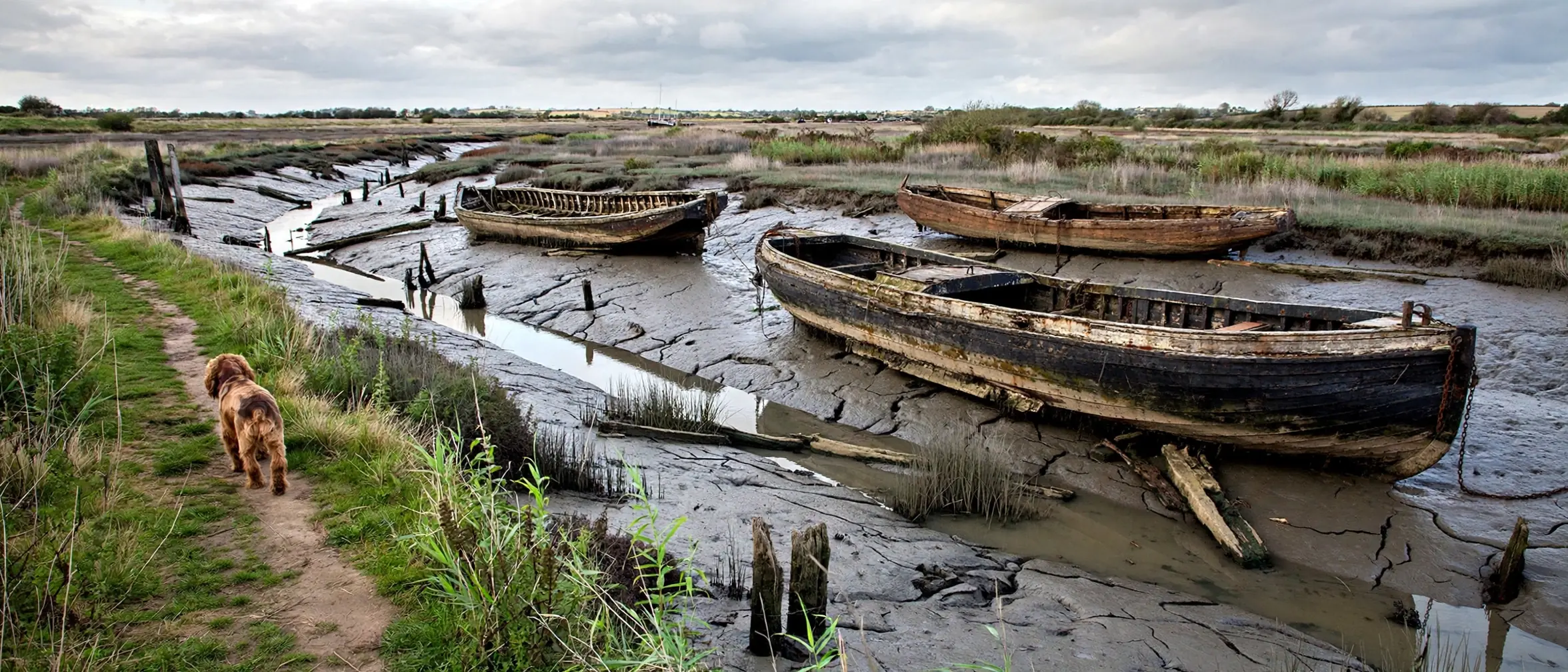
Walking downstream from Town Quay takes you towards Standard Quay and Iron Wharf, where Thames barges are moored and restored. The barges are the creek's most famous sight: broad, flat-bottomed sailing vessels with rust-red sails that once carried cargo all over the Thames estuary, and several of them now rest at Faversham as part of the town's maritime heritage. At low tide they sit on the mud at an angle, propped on their bottoms, and the sight of a barge high and dry beside the path is unmistakably Faversham. Keep your dog on a short lead here. The quay edges are unfenced in places, the ground drops to the water, and the mud beside the barges is deep enough to trap a dog that jumps down to investigate.
The Saxon Shore Way runs along the creek and out towards Oare, and it is the route to follow for a longer walk. The path is mostly flat and surfaced near the town, then becomes a grassy embankment and field path as it leaves the built-up area. From the creek it is roughly two to three miles to Oare village, depending on the exact route, and the walk can be extended into a circular route back through the lanes or shortened by turning back at any point. Cyclists use parts of the path, so keep the dog to one side and the lead short when a bike approaches. In winter the embankment can be muddy and exposed to wind from the Swale, so a drying coat and a towel in the car are worth packing, and in summer there is little shade on the open stretches, so carry water for the dog and walk in the cooler part of the day.
Upstream from the town centre, the creek narrows and the character changes again. The water becomes quieter, the banks are lined with reeds and willows, and the path passes the old gunpowder mill sites and the quieter back lanes of the town. This is the part of the walk where you are most likely to see herons, little egrets and wading birds picking through the mud at low tide, and where a calm dog on a lead can watch the birds without disturbing them. The creek here is also where the tide is most visible: the water rises and falls several metres, and a path that is dry at low tide can be close to the water at high tide. If you are walking with a dog that likes to swim, do not let it into the creek: the current is strong on a rising tide, the banks are steep and muddy, and the water quality is not suitable for dogs.
There are a few practical rules that make the creek walk easy. Start at the town end so the dog is tired by the time you reach the open marsh, and save the pub stop for the way back. Carry poo bags and use the bins in the town centre, because there are few bins on the marsh paths. Watch for livestock and horses in the fields beside the path, and keep the dog on a lead wherever animals are visible. If the dog does get muddy, the creekside taps and the town centre are not set up for washing dogs, so bring your own water and towels and plan to clean up at your accommodation. And check the official guidance before you travel for any path closures, because creekside paths can close after storms or during work on the flood gates and the swing bridge.
Shepherd Neame and the brewery
Shepherd Neame is the reason many visitors have heard of Faversham at all. Founded in 1698, it is Britain's oldest brewer, and its brewery on Court Street has been at the centre of the town for more than three centuries. The brewery buildings dominate the streets around the creek end of Court Street, with the brewhouse, the visitor centre and the brewery shop all within a few steps of each other. The names on the pumps are part of Kent's drinking landscape: Spitfire, Bishop's Finger, Whitstable Bay and the seasonal ales that appear through the year. The brewery uses water from its own artesian well and barley and hops from Kent farms, and the Faversham Hop Festival each September fills the town with music, stalls and visitors.
The brewery tour is the main attraction for visitors who want to see inside. Tours run from the visitor centre on Court Street and take you through the brewhouse, the fermentation rooms and the old cellars, with a tasting at the end. Dogs are not generally part of the tour, because it runs through working brewery buildings where food and drink are produced, and the tasting rooms are not set up for animals. Check the official guidance before you travel for the current tour policy, times and prices, because they change through the year. The practical answer for a dog owner is to split the visit: one person takes the tour while the other walks the dog along the creek or around the Market Place, then meet afterwards for a drink in one of the town's pubs.
Even without the tour, the brewery streets are worth a slow walk with a dog. Court Street runs from the Market Place down to the creek, passing the brewery buildings, the old offices and the pubs that have served brewery workers for generations. The street is narrow and the pavements are close to the road, so keep the lead short and the dog on the inside. Preston Street, which runs parallel to the creek, has more of the town's independent shops and cafes, and Abbey Street, a short walk away, is one of the finest streets in Kent, lined with timber-framed houses from the sixteenth and seventeenth centuries. The brewery shop on Court Street sells bottled beers, merchandise and gifts, and it is worth a look even if you are only passing: the shop staff can tell you which beers are current and which are seasonal.
The Hop Festival deserves a note, because it changes the town completely for a weekend each September. The festival celebrates the hop harvest with live music, street stalls, a procession and brewery tours, and the town centre fills with visitors from across Kent. It is a good event to enjoy with a calm, crowd-proof dog, and a poor one for a nervous dog that dislikes noise and crowds. If you are visiting during the festival, arrive early, keep the dog on a short lead, avoid the busiest streets around the Market Place in the middle of the day, and plan the creek walk for the morning before the crowds build. Outside the festival, the brewery streets are quiet enough for an easy stroll, and the smell of malt from the brewhouse is one of the town's most distinctive features.
Shepherd Neame's pubs stretch far beyond Faversham, but the ones in the town itself are the most convenient after a walk. The brewery's own pubs and the independent pubs around the Market Place and West Street are the natural end to a creek walk, and most of them welcome dogs in at least part of the building. The details change from pub to pub and from season to season, so ask at the door or check the pub's own page before you settle in. A useful habit is to ask for the dog-friendly area when you arrive: some pubs welcome dogs in the bar but not the restaurant, some have a garden or terrace where dogs are happier, and some keep water bowls and treats behind the bar. The brewery connection also means the beer list is usually long, so a designated driver or a train home is worth planning before the first pint.
The market and the Guildhall
Faversham's Market Place is the town's living room, and market day is when it works hardest. The charter market runs on Tuesdays, Fridays and Saturdays, with stalls selling fruit and vegetables, bread, cheese, meat, fish, flowers and household goods, and a monthly Best of Faversham market adds local producers, crafts and street food. The stalls fill the square from early morning, and by mid-morning the Market Place is busy with shoppers, dogs and children. The Guildhall stands at the centre of it all: a timber-framed building raised on pillars, with the market square open beneath it, and the town's coat of arms and history written into its structure. The Guildhall dates from the sixteenth century and has served as the town's civic heart ever since, and its open ground floor is a useful shelter on a wet market morning.
Visiting the market with a dog is a matter of timing. Early morning, just as the stalls are opening, is the calmest time: the square is open, the dogs are few, and the stallholders have time to chat. Mid-morning on a Saturday is the busiest, with narrow gaps between stalls, dropped food on the ground and children at dog height, so a nervous or food-driven dog is better walked elsewhere at that hour. Keep the lead short, keep the dog on your side away from the stalls, and watch for food on the ground, especially bones, cooked meat and anything with onions or chocolate in it. Stallholders are generally friendly to dogs, and many keep a water bowl out, but individual stalls set their own rules, so ask before letting the dog sniff the produce.
The streets around the Market Place are worth exploring once the market is done. West Street runs from the square towards the creek and has a mix of pubs, cafes and independent shops, while East Street runs in the opposite direction and leads towards the station. Preston Street, which runs south from the square, has more shops and the town's main supermarkets, and Court Street runs down to the creek and the brewery. The town's best architecture is on Abbey Street, where timber-framed houses lean over the pavement and the street feels almost unchanged from the seventeenth century. St Mary of Charity church stands at the top of the town, and its churchyard is a quiet place to pause, although dogs should stay on a lead and out of the planted areas.
Shopping with a dog in Faversham is mostly a matter of asking. The town centre has a good number of independent shops, from bookshops and delis to outdoor shops and antique dealers, and many of them welcome dogs inside, but the policy is set shop by shop and is not always signed. A short lead, a calm dog and a quick question at the door will get you further than assuming either way. The delis and food shops around the Market Place are useful for picking up picnic supplies: bread, cheese, fruit and Kentish produce for a walk out to Oare. The town also has a small museum, the Fleur de Lis Heritage Centre, which tells the story of the town's industries, and the Alexander Centre, a former school that now hosts events and exhibitions. Check the official guidance before you travel for opening times and dog policies at both.
The market is also the best place to get a sense of the town's food. Kent is known as the Garden of England, and Faversham's market reflects that: apples and cherries from the orchards around the town, vegetables from the farms of the Swale valley, and fish from the coast. The Brogdale Collections, just outside the town, hold the National Fruit Collection, with thousands of varieties of apples, pears, plums and cherries, and its fruit festivals through the year are a short drive or bus ride from the town centre. Dogs are not generally admitted to the orchards during festivals, so check the official guidance before you travel if you are planning to combine a market morning with a visit to Brogdale. For a simpler day, buy picnic supplies at the market, walk the creek to Oare, and eat on the marsh paths where the dog can rest beside you.
Oare Marshes and the nature reserve
Oare Marshes Nature Reserve is the wild end of a Faversham visit, and it is only a short walk from the town along the Saxon Shore Way. The reserve is managed by Kent Wildlife Trust and covers the grazing marsh, reedbeds and pools between Faversham Creek and the Swale estuary. It is one of the best places in Kent to see wading birds: avocets, redshanks, lapwings and black-tailed godwits feed on the mud and in the shallow pools, and in winter the marshes fill with brent geese, wigeon and teal from the north. Marsh harriers quarter the reedbeds through the year, and in spring the air is full of skylarks and the calls of breeding waders. The reserve has two main pools, the East Flood and the West Flood, with hides and viewing points that let you watch the birds without disturbing them.
Getting there with a dog is straightforward. From the town centre, follow the Saxon Shore Way along the creek to Oare village, then continue along the sea wall and the reserve paths. The walk is roughly three miles from the Market Place to the reserve, mostly flat, and it can be done as a there-and-back walk or as a circular route returning through the lanes past Oare village and the church of St Peter. Oare village itself is small and quiet, with a handful of houses, a church and the road to the Harty Ferry, the old crossing to the Isle of Sheppey. The village has no shops, so carry water and food for the dog, and plan the pub stop for the way back into Faversham rather than expecting anything at Oare.
Dogs are welcome at Oare Marshes, but the rules are strict and they matter. Dogs must stay on a lead and on the marked paths at all times, and they must not enter the pools, the reedbeds or the grazing marsh. The reasons are practical: ground-nesting birds abandon nests if a dog runs through them, grazing cattle and sheep are easily stressed, and the dykes and pools are deep enough to be dangerous for a dog that jumps in. The reserve is also a working landscape, with cattle grazing the marsh through the summer, so keep the dog well away from livestock and do not let it bark at or chase the animals. Check the official guidance before you travel for any seasonal restrictions, because parts of the reserve can close during the breeding season or during management work.
The best time to visit depends on what you want to see. Winter is the birdwatcher's season, with large flocks of geese and ducks on the floods and the marshes at their most dramatic under a grey sky. Spring brings breeding waders and the first marsh harriers, and the paths are drier and easier underfoot. Summer is quieter for birds but the marshes are green and full of dragonflies, and the long evenings make a late walk from Faversham a pleasure. Autumn brings the return of the wintering birds and the first Brent geese arriving from Siberia. Whatever the season, the wind off the Swale can be cold and the paths are exposed, so dress for the weather and bring a coat for the dog if it feels the cold. There is little shade and no shelter on the reserve itself, so a hot day needs water, sun protection and a shorter walk.
For a longer day, the Saxon Shore Way continues from Oare towards the Swale coast and the villages beyond, and the coast path links Faversham to the wider network of Kent's marshland walks. A fit dog and a fit walker can extend the Oare walk towards Conyer or along the coast, but the paths become rougher and the distances longer, and there are few places to stop for water or shelter. A better plan for most visitors is to keep the Oare walk to the reserve and back, then spend the rest of the day in the town. If you want a second marsh walk on another day, our guide to dog-friendly beaches and the rules that govern them explains the seasonal bans and the checks to make before you let a dog onto a beach, which is useful if you are combining Faversham with a trip to the Kent coast. And if the long-distance walking bug bites, our guide to the South Downs Way with a dog covers a very different kind of walking, along chalk ridges rather than tidal marsh.
Pubs and stays
Faversham's pubs are one of the town's best features for a dog owner, because they are numerous, close together and mostly welcoming to dogs. The Sun Inn on West Street is one of the oldest pubs in the town, with a timber-framed front and a traditional bar, and it is a natural stop after a market morning. The Phoenix Tavern on Abbey Street is another old favourite, tucked into one of the town's most attractive streets. The Railway Hotel, near the station, is convenient for a drink before the train home, and The Chimney Boy on Preston Street serves the streets around the market. The Three Tuns and the pubs around the Market Place and Court Street complete a circuit that can be walked in ten minutes. Policies change, so ask at the door and check the pub's own page before you settle in, and expect dogs to be welcome in the bar and garden but not always in the restaurant area.
A few habits make pub visits with a dog easy in Faversham. Arrive with the dog already walked, so it is ready to settle rather than restless. Ask for the dog-friendly area when you arrive, and choose a table out of the main walkway so the dog is not stepped on or tempted by passing plates. Bring a mat or blanket for the dog to lie on, because pub floors are often cold stone or wood, and bring a chew or a stuffed toy to keep a young dog occupied. Order water for the dog when you order your own drink, and keep the lead short and attached to you rather than to the table leg. If the pub is busy, the garden or terrace is often calmer than the bar, and in summer the pub gardens around West Street and Abbey Street are some of the pleasantest places in the town to sit with a dog.
Staying overnight in Faversham with a dog is straightforward, but the choice is smaller than in Canterbury, so book early on market weekends and during the Hop Festival. The town has a handful of bed and breakfasts, guest houses and self-catering cottages, and several of them welcome dogs, usually by prior arrangement and sometimes with a charge. The cottages around Abbey Street and the lanes near the creek are the most atmospheric, and a cottage with a small garden is worth seeking out for a dog that needs a late-night toilet break. Larger hotels on the edge of town and along the A2 also take dogs, and the Premier Inn and similar chains have their own dog policies that are worth checking directly. Whatever you book, confirm the dog policy in writing before you pay, including the number of dogs allowed, any charge, and whether the dog can be left alone in the room.
Self-catering is often the easiest option for a dog in Faversham. A cottage or apartment gives you a kitchen, a garden or yard, and no restaurant rules to navigate, and it lets you cook with market produce rather than eating out every night. Look for a property with a secure garden, a hard floor that is easy to clean after a muddy marsh walk, and a location within walking distance of the creek paths so the first and last walks of the day are short. The properties closest to the Market Place are convenient but can be noisy on market mornings, while the ones towards the creek and the station are quieter. Check the official guidance before you travel for the property's own rules, because some cottages welcome dogs only in certain rooms or charge for cleaning after a stay.
Faversham also works well as a base for a wider Kent trip with a dog. Canterbury is a short train ride away, and our guide to Canterbury with a dog covers the cathedral precinct rules, the Stour river walks and the city's dog-friendly pubs and stays. The Kent coast is within easy reach by car or train, and the North Downs offer a completely different kind of walking, with chalk hills and wooded valleys instead of tidal marsh. The town's position on the railway line means you can leave the car at your accommodation and travel by train for a day, which is often easier with a dog than driving and parking in a busy coastal town. For a first visit, though, there is no need to leave Faversham at all: the creek, the brewery, the market and the marshes fill two full days, and the town is at its best when you slow down and let the dog set the pace.
Practical questions
Before you go
Can my dog walk along Faversham Creek off the lead?
Keep your dog on a lead along the creek. The banks are unfenced in places, the mud at low tide is deep and sticky, and moored barges, boats, cyclists and other walkers share the same narrow paths. A short lead gives you control near the water and near the swing bridge and lock gates, and it keeps your dog out of the creek mud, which can trap paws and hide sharp debris.
Are dogs allowed on the Shepherd Neame brewery tour?
Dogs are not generally part of the brewery tour, which runs through working brewery buildings where food and drink are produced. Check the official guidance before you travel for the current policy, and plan for one person to take the tour while the other walks the dog along the creek or around the town centre. The brewery shop and the streets around Court Street are easier to combine with a dog.
When is Faversham market, and is it a good visit with a dog?
The charter market runs in the Market Place on Tuesdays, Fridays and Saturdays, with a monthly Best of Faversham market adding local producers. Mornings are the busiest time, so arrive early or late if your dog dislikes crowds, keep the lead short between stalls, and avoid the narrowest gaps around the Guildhall. Dogs are welcome in the open square but individual stalls and nearby shops set their own rules.
Can dogs go to Oare Marshes Nature Reserve?
Yes, dogs can walk the paths around Oare Marshes, but they must stay on a lead and on the marked routes. The reserve is a working wetland for breeding and wintering birds, and ground-nesting birds, grazing livestock and deep dykes make free running unsuitable. Keep to the Saxon Shore Way and the reserve paths, do not let your dog enter the pools, and check the official guidance before you travel for any seasonal restrictions.
Where can I park in Faversham with a dog?
The Central Car Park off Court Street and the car parks around the town centre put you within a short walk of the Market Place, the creek and the station. Check the current charges and time limits on arrival, because they change, and avoid leaving a dog in a car in warm weather. Arriving by train is often simpler: Faversham station is a short walk from the town centre and the creek.
Is Faversham a good base for a longer Kent trip with a dog?
Yes. Faversham sits between Canterbury and the Swale coast, with trains to London, Canterbury and the Medway towns, and the Saxon Shore Way linking the town to Oare and beyond. It works well as a quieter base than Canterbury, with its own creek walks, market and brewery, and day trips to the coast and the North Downs within easy reach.