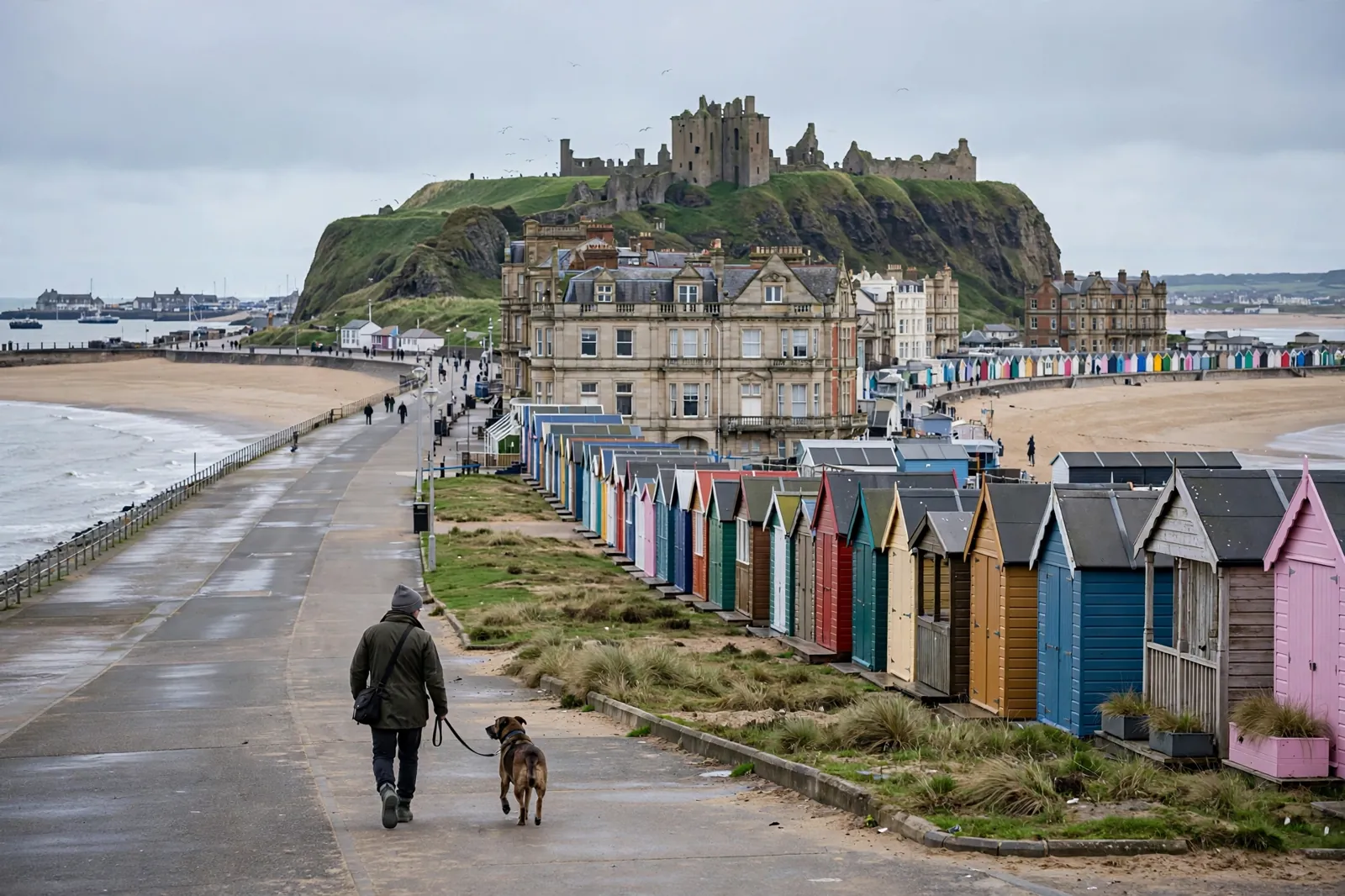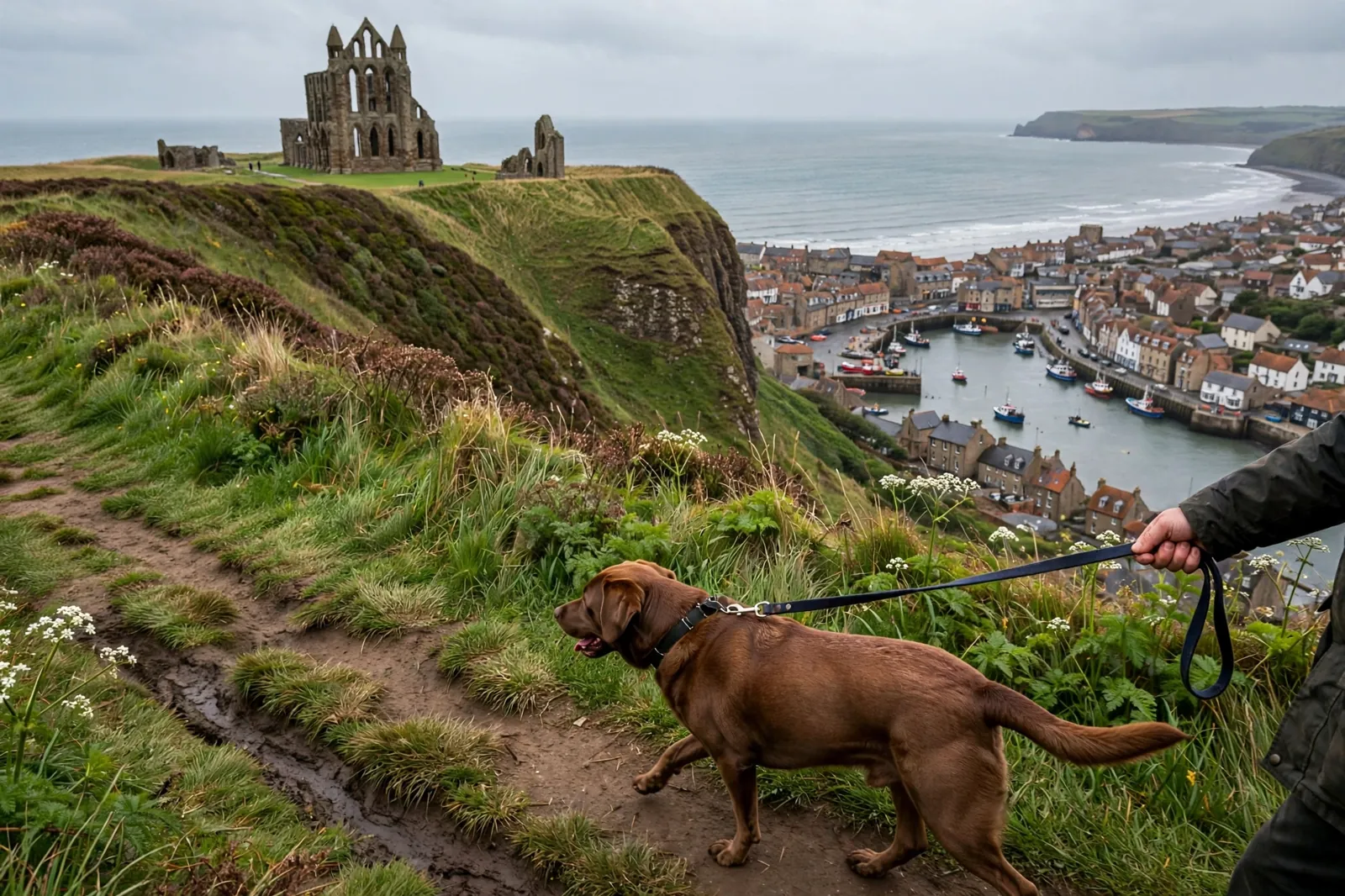
This guide is independent and contains no paid placement. Local rules on dogs, access and seasonal restrictions can change, so check the official guidance before you travel.
Check the tide before you promise a beach run. Filey is best as a low-tide beach walk plus a cliff-top return, with Filey Brigg saved for a calm, careful visit on a lead.
Let the tide choose the walk
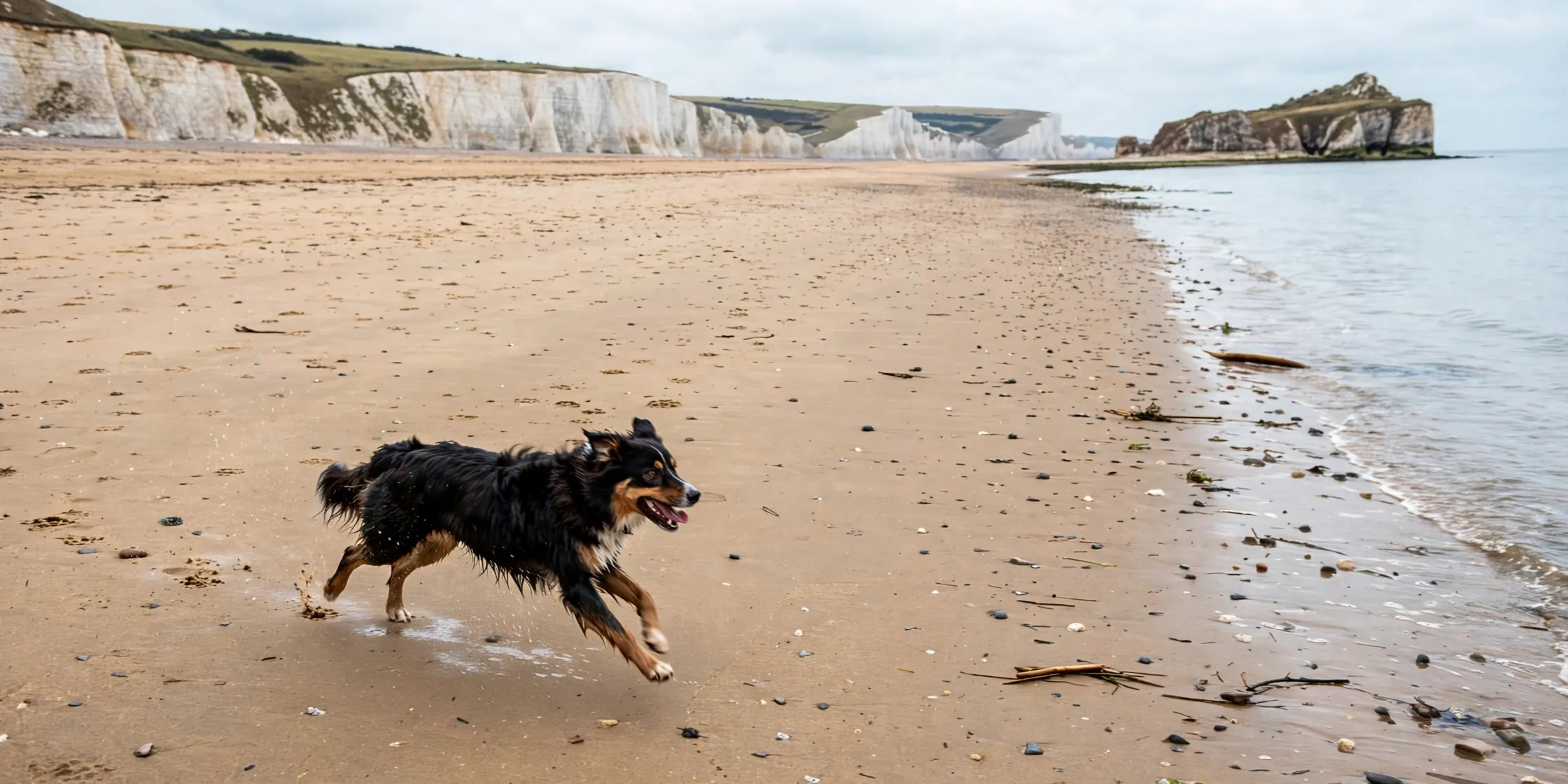
Filey Bay is a wide, gently curving sweep of sand, and its character changes completely with the tide. At low tide the beach is enormous: firm sand, shallow pools, and room for a dog to run without crowding other walkers. At high tide the same beach narrows to a strip, and the walk becomes a promenade stroll with a dog on a lead rather than a free run. The single most useful habit in Filey is checking tide times before you leave the car, not after you arrive. A dog that expected a run and gets a crowded strip will be frustrated, and a walk planned around low water will feel generous even on a short visit.
Seasonal zones are a second timing question, separate from the tide table. Parts of Yorkshire beaches carry different dog rules at different times of year, and those boundaries and dates do shift, so memory from a previous holiday is not a reliable guide. On arrival, look at the notice boards at whichever beach entrance you actually use; what is posted there governs that stretch that day. If the stretch you wanted is closed to dogs, move along without disputing it — wildlife, safety and other users are the usual reasons — because an open stretch is generally only a short walk away.
Plan the beach walk around the dog's fitness as well as the tide. Wet sand near the water's edge is firm and easy, while soft dry sand higher up the beach is hard work on legs and paws, especially for older dogs. A good pattern is to walk out on the firm sand, let the dog paddle in the shallows if conditions are safe, and return before the tide turns. Keep an eye on the time: a beach that was wide when you set out can narrow surprisingly fast, and the last thing you want is a tired dog having to climb a sea wall or scramble over rocks because the tide cut off the easy route back.
Beach zones, leads and other dogs
A big beach does not mean an unstructured one. Even where dogs are welcome, the sensible rules still apply: keep the dog under control, pick up immediately, and be honest about recall. Filey's open sand tempts owners to let dogs off lead at long range, but distance is where recall fails, especially when another dog appears over a dune or a child runs past with a ball. If your dog's recall is not reliable around other dogs, use a long line on the beach rather than a free run. A long line still gives the dog room to run and sniff, and it gives you a way back when excitement takes over.
Other dogs are the main variable on a busy beach day. Some dogs love a beach greeting; others find a charging stranger stressful, and a lead does not protect a dog from an off-lead dog that rushes in. Watch the beach ahead: if a group of dogs is playing loosely near the access point, walk past on a wide arc or wait until they move on. Step aside, shorten the lead, and keep moving rather than stopping for a nose-to-nose meeting in a bottleneck. A calm beach walk is mostly about space, and Filey at low tide has space to spare if you use it.
Wildlife deserves the same consideration. Shorebirds feed and rest on the bay, and a dog chasing birds across the sand is not harmless fun; it burns energy birds need for migration and can disturb nests in season. Keep the dog close where birds are gathered, and avoid the rocky areas where waders feed at low tide. The same applies to fishing: lines, hooks and bait on the sand are hazards for paws and mouths, so steer the dog away from anglers' gear. A beach walk that respects birds, anglers and other dogs is one that stays welcome for everyone, including the next dog owner.
Filey Brigg: rock, pools and a careful lead
Filey Brigg is the long, narrow finger of rock that juts into the sea at the northern end of the bay, and it is the most distinctive walk in town. The Brigg is not a beach walk: it is a rocky promontory with uneven surfaces, rock pools, slippery weed and exposure to waves on both sides. For a sure-footed dog on a lead, with an owner who watches the ground, it is a fascinating short expedition. For a dog that pulls, a puppy, or a dog with sore paws or poor balance, it is better admired from the beach or the cliff-top path above, and there is no need to force the issue.
Timing matters more on the Brigg than anywhere else in Filey. Go at low tide, in calm conditions, and with enough time to return before the tide turns. Waves can wash over the lower rocks, and wet rock is treacherously slippery for both dogs and people. Wear shoes with grip, keep the lead short, and do not let the dog jump between rocks or scramble down to the water's edge. Rock pools are tempting for dogs to drink from, but salt water and stagnant pools can upset a stomach, so carry fresh water and offer it often. If the sea is rough, the wind is strong or the light is fading, skip the Brigg entirely; the view from above is still excellent.
The Brigg is also a place to practise close control. Narrow rock, other walkers, photographers and anglers all share a small space, and a dog that lunges at a passing dog on a rocky path is a danger to both. Keep the dog on your inland side where possible, step into a wider spot to let others pass, and reward calm walking. If your dog is not comfortable with uneven ground, a short walk to the start of the Brigg and back is a perfectly good achievement. The geology will still be there on a future visit, and a dog that has had a positive short visit is more likely to enjoy a longer one later.
The cliff-top path and the wind
When the beach is out of reach at high water, or the sand is packed with walkers, the route above Filey Bay gives a steadier alternative. From up there the dog gets level ground, a clear line ahead and long views, instead of open sand to charge across. That steadiness helps a dog that does better with a defined path than with wide space. Keep the lead on and hold the dog well inland from the drop, because the edge is unfenced in stretches and a sudden gust can unbalance even a calm dog. A rabbit, a ball or a sudden scent near that edge is not a risk worth testing.
Wind is the cliff-top's defining condition, and it changes the walk more than rain does. A strong onshore wind can push a small dog sideways, carry away scent so the dog cannot settle, and make a walk that looks easy on the map feel exhausting. Check the forecast for the coast, not just inland, and be ready to shorten the walk or drop down to the sheltered promenade if the wind is too strong. A dog coat helps in cold wind, and a lead with a comfortable handle matters when you are holding against gusts. If the dog is leaning into the wind, squinting, or reluctant to go on, turn back; the cliff-top path is a walk to enjoy, not to endure.
The cliff-top also connects Filey to its neighbours, and that is where longer walks begin. Towards the south, the coast path runs in the direction of Bridlington, and to the north it heads towards Scarborough, with Scarborough offering a busier, two-bay contrast to Filey's quieter bay. Do not attempt a long coastal section without checking the route, the distance and the return transport first. Coastal paths can be muddy after rain, and a linear walk needs a plan for getting back. For most visitors, a there-and-back section from Filey, with a beach return at low tide if conditions allow, is the most satisfying version.
The town behind the beach
Behind the seafront, Filey narrows into a town that moves at a slower pace than Scarborough or Bridlington, and that slower pace is exactly what a post-beach dog needs. From Cobble Landing the streets climb gently away from the water, past small shops, gardens and benches where nobody is hurrying you on. A wander here changes everything the dog has just experienced: pavement underfoot instead of sand, hedges and gateways to sniff instead of open wind, and fewer dogs arriving from every direction. Let that wander be unhurried. A dog fresh off the beach is often still aroused, so a few minutes of ordinary pavement walking — lead short, pace easy, pauses allowed — does more to settle them than heading straight for a table. Step to one side when another dog passes, give the dog a drink, and only then look for somewhere to sit.
Gardens and green spaces in Filey are worth seeking out as a contrast to the beach. A grassy, enclosed-feeling space lets a dog toilet comfortably and sniff at leisure after the open exposure of the sand, and it is a useful stop for older dogs that need a break from soft sand. Check local signs for any lead or exclusion rules, because gardens and play areas often have different rules from the beach. If a space is busy with children, move on rather than adding a dog to a crowded play area; there will be a quieter patch nearby, and the dog will enjoy it more.
For food and drink, work backwards from the dog rather than from the menu. A sandy, thirsty dog will not settle at a table tucked into a busy walkway, however good the food, so first find shade, a bowl of water and a corner where the dog can lie without people stepping over them. Some Filey places will invite dogs in; many others are happier with dogs at an outside table, and a place that welcomed dogs last summer may have changed its mind, so confirm the current signs on the day before assuming. A takeaway carried to a promenade bench often beats a crowded room: the dog can watch the bay, you can eat without guarding a lead under a table, and a restless dog can be walked off without disturbing a whole room. If the dog is still buzzing after the beach, rinse paws, offer water, wait for the breathing to slow, and only then order — a settled dog makes the stop pleasant for everyone around you.
Seasons on the bay
Filey changes with the seasons in ways that matter for dogs. Summer brings the widest beach use, the most other dogs, and the warmest sand, but also the strictest zones and the busiest access points. Early morning and evening are the kindest times for a dog in summer: cooler sand, fewer people, and a lower sun that makes the bay look its best. Carry water even for a short beach walk in summer, because dogs overheat faster on sand than on grass, and dark-coated dogs absorb heat quickly. A shaded rest and a drink are not optional extras; they are part of the walk.
Winter transforms the bay into a quieter, wilder place, and many dog owners prefer it. The beach is emptier, the light is dramatic, and a dog that loves wind and space will be in its element. Winter also brings its own hazards: cold water, strong winds, shorter daylight and slippery promenades. Visibility matters on a grey winter beach, so a bright collar or a light on the dog's harness helps other walkers and cyclists see you. Keep walks shorter than in summer if the dog is older or thin-coated, and always have a warm, dry car waiting at the end.
Between the summer crowds and the winter storms sit the two seasons many regulars rate highest in Filey. In spring the cliff-top paths dry out and firm up, the bay empties of holiday crowds, and nesting birds return to the cliffs — a reason to hold the lead near the edge and respect any signed closures rather than letting a dog range freely up there. In autumn the light turns golden and the beach empties again, but storms can scatter fishing line, broken shell and other debris along the tide line, so a post-storm walk should end with a careful paw check. Neither season is a single experience: a mild October day can feel like summer, a sharp April wind can feel like winter. Read the sand, the sky and the signs in front of you on the day, and let those decide whether the beach, the promenade or the cliff-top is the right route.
Staying, parking and practical details
Parking in Filey is straightforward compared with larger resorts, but it still pays to plan. Choose a car park close to your chosen beach access point, and think about the end of the walk as well as the start: a tired, sandy dog is easier to load from a nearby car park than from a distant one. Keep a towel, a water bottle and a brush in the car, because sand gets everywhere, and a sandy dog in a car is a mess that lasts longer than the walk. If you are staying overnight, confirm the accommodation's dog policy for the specific room, including charges and where the dog can go in the evening.
For a longer coastal trip, Filey pairs naturally with its neighbours. Whitby to the north offers harbour life and abbey views, while Scarborough to the south offers two bays and a castle headland, and each town has a different beach character. Visiting two or three in one holiday lets you learn what your dog prefers: open sand, harbour bustle or cliff-top paths. Keep each day's walk moderate rather than stacking a long beach walk on top of a long drive, and give the dog a rest day or a short day between big coastal walks.
Health details for a beach dog are worth a paragraph of their own. Rinse sandy paws after the walk, check between the toes for grit and small cuts, and watch for limping after a run on soft sand, which can strain muscles in dogs that are not used to it. Salt water can upset stomachs, so discourage drinking from the sea and offer fresh water often. If the dog swims, even briefly, dry them afterwards and check ears, especially for floppy-eared breeds. A quick post-beach routine takes five minutes and prevents most beach-related vet visits.
A Filey day that works
A good Filey day starts with the tide table, not with breakfast. Pick the low-tide window, aim to arrive as the tide is still falling, and give the dog the beach while it is at its widest. Walk out on firm sand, let the dog run where it is safe and legal, and turn back with time to spare. By the time the tide turns, you should already be heading for the promenade, the town or the cliff-top path, with a sandy but satisfied dog and a plan for the rest of the day.
Give the middle of the day to recovery, not to a second adventure. After the morning beach, head for the town or back to where you are staying, find a shady spot, and let the dog drink, stretch out and sleep if they want to. A beach run takes more out of a dog than the distance suggests — soft sand, wind, swimming and excitement all add up — so a dozing afternoon is not wasted time, it is what makes an evening outing possible at all. If the light softens and the wind drops later on, a brief cliff-top loop works well as a second outing: the ground is firm, the views are long, and a dog that has slept will walk on a loose lead instead of pulling towards every scent.
For the evening, choose the shortest, flattest loop you already know, close to your car or your lodgings. The point is not scenery now but a last toilet stop, a sniff around familiar ground, and a calm end before dark. Walk it slowly, check paws for grit and small cuts, shake sand from the coat, and offer fresh water before you set off home. That rhythm — tide-timed beach in the morning, rest through the heat of the day, cliff-top or town in the late afternoon, and a quiet loop to finish — is what makes Filey repeatable. A dog that finishes the day relaxed, rather than exhausted, will be keen to come back to this bay.
A longer Filey: the bay in both directions
Once you know Filey's beach at low tide, the bay itself becomes a walk with two directions, and each direction has a different character. Walking north from the town towards the Brigg, the beach narrows as the rocks approach, the cliffs rise, and the walk feels wilder and more enclosed. Walking south, the bay opens out, the sand widens, and the walk feels spacious and relaxed. A dog that enjoys variety will benefit from trying both directions on different days, because the two walks exercise different things: the northern walk demands attention to rocks, tide and footing, while the southern walk offers open running and long, easy strides.
Distance on a beach is deceptive, and that matters for dogs. A mile on firm sand feels easy, a mile on soft sand feels long, and a mile into a headwind feels longer still. Build beach distance gradually across a holiday, and watch the dog rather than the distance marker. A dog that starts lagging, lying down or seeking shade is telling you the walk is long enough, even if the bay still stretches ahead. Turn back at that point, not at a planned landmark, and the dog will still be keen for the next beach day. A beach walk that ends with a dog that wants more is a success; a beach walk that ends with a dog that can barely walk back to the car is a warning.
Getting back is part of the plan on a beach walk, not an afterthought. The tide, the wind and the dog's energy all change during the walk, so the return route may not be the mirror of the outward route. If the tide is rising, return early along the firm sand near the water rather than waiting until the beach narrows. If the dog is tired, use the promenade for the return, where the surface is firm and the route is direct. Always know where the nearest beach access point is, and carry a phone, water and a lead even on a short beach walk. Filey Bay rewards this kind of planning: a bay walked in both directions, at the right tide, with a planned return, is a bay the dog will love for years.
Choosing your Filey beach access: steps, slopes and tide cut-offs
Filey looks like one beach from the promenade, but the way down to it changes the whole walk, and the right choice depends far more on the dog than on the view. A fit young dog will trot down any set of steps without a second thought and then sprint across the sand. An older dog with stiff hips, a dog that freezes on open stairways, a puppy still learning about heights, or a family pushing a pushchair will have a very different morning if they pick the wrong entrance. Decide before you leave the car, while the dog is still fresh and you can still drive to a better starting point, rather than discovering the problem at the top of a flight of steps with a reluctant dog behind you.
The gentlest way down is the slipway at Cobble Landing, at the northern end of the town beach, where boats come ashore and the slope runs down to the sand without a staircase. That slope is the natural first choice for older and arthritic dogs, for dogs that panic on steps, and for pushchairs, because there is no step edge to negotiate and no narrow flight to squeeze past other walkers. It is still a working landing, so keep the dog close, watch for vehicles and boat gear, and expect the surface to be damp and slippery in places. Walk down slowly, let the dog find its footing, and do not let it rush ahead onto wet concrete or across the path of anyone working there.
The stepped entrances along the promenade suit a different kind of dog. They drop straight from the level seafront walkway onto the sand, which is convenient when the tide is out and the dog is full of energy, and they spread walkers out along the bay instead of funnelling everyone through one point. The drawback is hidden in the sand itself: after the steps there is usually a stretch of soft, dry sand before you reach the firm, wet sand near the water, so a dog that struggles with steps then faces the hardest walking surface as well. For a pushchair, stepped entrances are simply the wrong tool, because wheels sink in soft sand and lifting a loaded pushchair down steps helps nobody. For a dog that dislikes steps, the same logic applies: do not coax, drag or carry a large dog down a flight it is afraid of when a sloping entrance exists a short drive away.
Whichever entrance you use, think about the return before you set off, because the tide rewrites the beach while you walk. The northern end, towards the Brigg, narrows first: as the water rises it presses the walkable sand against the rocks and the cliff base, and the easy route back can disappear while the middle of the bay still looks wide. The central beach in front of the promenade stays usable longer, and the southern bay stays open longest of all, but no part of Filey beach is immune once the tide is well on its way in. Set a turn-back time when you arrive, based on the tide table and on how slowly your dog walks when tired, and treat that time as fixed even if the dog still seems keen. A dog that is keen at the turning point is a dog that can still walk back comfortably; a dog that is already lagging has used up its margin.
If your planned entrance is cut off when you return, do not improvise a climb. Do not haul a dog up a sea wall, scramble it over rocks, or wade through rising water to reach a set of steps that is already awash. Instead, keep walking along the firm sand towards the next entrance while a strip of sand still exists, go up there, and walk back along the promenade to your car. That promenade return is flat, firm and direct, and it is far kinder to tired legs than any scramble. If the water has already reached the wall along your stretch, stay on the highest sand you can reach, keep the dog close, and wait for help or for the water to fall rather than attempting a dangerous crossing. The warning sign is not the water touching your feet; it is the sand strip narrowing, the waves reaching the wall, and the dog having nowhere dry to walk. Leave at the first of those signs, not the last.
A final practical point is worth making for dogs that truly hate steps. Fear of steps rarely improves by being forced through it on holiday, and a beach day is the wrong moment for training. Use the slipway, keep the first beach visits short, and let the dog learn that the beach itself is fun before you ask it to cope with a staircase as well. If you only have a small dog, carrying it down a short flight is a reasonable compromise, provided you can carry it safely back up again when it is sandy and tired. For a large dog, there is no safe compromise on a steep flight: choose the slope, accept the slightly longer walk to the firm sand, and save the steps for a dog and a day that can handle them.
Beyond the bay: Filey to Hunmanby Gap and the southward shore
South from Filey town, the bay opens out and the walk changes character completely. The promenade and the town fall behind, the cliffs soften, and the beach becomes a long, empty ribbon of sand running towards Hunmanby Gap, the break in the cliffs where a path climbs up to the headland above. On a falling tide this is one of the most rewarding dog walks on the Yorkshire coast: miles of firm sand, room to run without meeting another dog every few minutes, and a clear destination that gives the outing a shape. It is also a walk that punishes poor planning, because there is no promenade to bail out onto once you are well south of town, and the distance back is exactly as long as the distance out.
Be honest about the distance before you start. Filey to Hunmanby Gap is roughly three miles along the sand in one direction, which means roughly six miles there and back, and beach miles do not behave like pavement miles. Soft sand doubles the effort, a headwind on the return adds more, and a dog that runs in wide loops will cover far more ground than you do. Treat the outing as a half-day expedition, not as an extra loop after a morning beach walk, and do not attempt the full distance with a puppy, an elderly dog, or a dog that is already tired from the day before. A shorter version, walking south for half an hour on the falling tide and turning back while the dog is still fresh, gives you most of the pleasure with none of the risk.
The surface underfoot changes as you go south, and those changes matter for paws and legs. Near Filey the firm, wet sand near the water gives an easy, level path, and that is where a tired or older dog should stay. Further south the beach widens and the upper sand becomes softer and deeper, especially on a warm day, so a dog that stays high on the beach will tire much faster than one kept near the waterline. Small streams drain across the sand in places, leaving shallow channels that dogs love to splash through but that can hide soft, uneven ground. Near the Gap itself you may meet patches of shingle and pebble mixed with the sand, which are harder on pads than clean sand, so check paws at the turning point and again when you get back to Filey.
Tide discipline is the whole walk, and the rule is simpler than it sounds: start on a falling tide, turn back at or before low water, and be well on your way home before the tide turns in earnest. That gives you the widest beach for the outward leg and a firm, shrinking but still usable beach for the return. Do not let a beautiful empty beach tempt you into walking further south after low water, because the return journey will then be against a rising tide on a narrowing strip, with a dog that has already spent its energy. Watch for the early signs that it is time to go back: the water reaching the base of the cliffs, the strip of firm sand getting thinner, and the dog beginning to lag, seek shade or lie down. Any one of those is a turn-back signal, not a suggestion to push on to the Gap.
Getting a tired dog back is the question to settle before you leave Filey, because the options narrow once you are south of town. There is no promenade along this stretch, so the beach is the route home as well as the route out, and the cliff path above is not a shortcut for a tired dog: it is longer, uneven in places, and it does not run conveniently back to your starting point. If the dog tires badly, stop, offer water, let it rest on the firm sand, and then walk back slowly along the waterline, where the ground is easiest, rather than hurrying across soft sand. Small dogs can be carried for a stretch if you are able to do so safely; large dogs cannot, which is why the turn-back decision matters so much for them. At Hunmanby Gap itself, a path does climb to the road above, but only count on that as an exit if you have already arranged a lift or a car there; otherwise it is a steep climb to nowhere useful, and the beach back to Filey remains the sensible return.
Done properly, the southward shore is a walk to repeat. Go on a calm day with a falling tide, carry more water than you think you need, keep the dog near the firm sand, turn back while the dog still wants to go on, and you will arrive back in Filey with a sandy, satisfied dog and a whole afternoon still ahead. That is the measure of a good long beach walk: not the furthest point reached, but a dog that walks back into town willingly, drinks, sleeps, and is ready to do it again another day.
Practical questions
Before you go
When is the best time for a dog walk on Filey beach?
Aim for low tide, when the beach is widest and firm sand is available. Check tide times before you leave, and check the official guidance before you travel for current seasonal dog zones.
Can dogs go on Filey Brigg?
The Brigg is a rocky promontory best visited at low tide in calm conditions, with the dog on a lead and on firm footing. Skip it in rough seas, strong wind or fading light, and admire it from above instead.
Is the cliff-top path safe for dogs?
Yes, with a lead and distance from the edge. Cliff edges are not fenced everywhere, and wind can be strong, so keep the dog close, shorten the lead in gusts, and turn back if conditions worsen.
Are there seasonal dog restrictions on Filey beach?
Restrictions can apply to parts of Yorkshire beaches and may change, so read the signs at each access point on the day and check the official guidance before you travel.
What should I do after a beach walk in Filey?
Rinse sandy paws, check between the toes, offer fresh water, and dry the dog before the car. Watch for limping after running on soft sand, and discourage drinking sea water.
Can I walk from Filey to Scarborough with a dog?
The coast path connects Filey towards Scarborough, but it is a long section. Check the route, distance and return transport first, and for most visitors a there-and-back walk from Filey is more satisfying.