This guide is independent and contains no paid placement. If affiliate links are added later, they will be clearly marked and will not change our editorial checks.
Most first-trip mistakes share one cause: asking a dog to cope with too many new things at once. Keep the drive short, secure the dog properly, keep food and routines identical to home, find a vet before you need one, build in rest, and check every rule rather than assuming it. One calm fix at a time beats a frantic overhaul.
Mistake 1: the marathon first drive
The mistake: choosing a destination five or six hours away for a first trip, driving through the Friday evening rush, and arriving after dark with a tired, carsick or over-excited dog and no time to settle before bed. The cost: the first night is restless, the second day starts badly, and the whole holiday is spent recovering from the journey rather than enjoying the destination. Dogs pay for long journeys in stress hormones, dehydration, motion sickness and lost sleep, just as humans do, and a dog that arrives exhausted is more reactive, less responsive and more likely to have stomach problems the next day.
The fix is unglamorous and effective: keep the first drive under three hours, travel at a quiet time of day, and plan a proper stop every two hours at a place where the dog can walk, drink and toilet, not just a service-area car park. Feed a light meal three to four hours before departure, offer water at every stop, and keep the car cool and ventilated. If the dog is prone to sickness, keep journeys short and frequent before the holiday, ending each practice drive with something pleasant, and ask your vet for advice before departure if sickness has been a regular problem. Arrive in daylight, with time for a garden sniff and a short walk before dark, and treat arrival evening as a settling evening, not a sightseeing evening. A short drive is not a compromise: it is the decision that makes the rest of the holiday possible.
Also plan the return journey with the same care. A dog that travels home tired, after a full last day, in holiday traffic, is a dog that arrives home stressed and may associate car travel with misery. Keep the last day light, travel early if you can, and stop as often on the way home as on the way out. The journey is part of the holiday for a dog, not just the transport to it.
Mistake 2: the wrong car restraint, or none at all
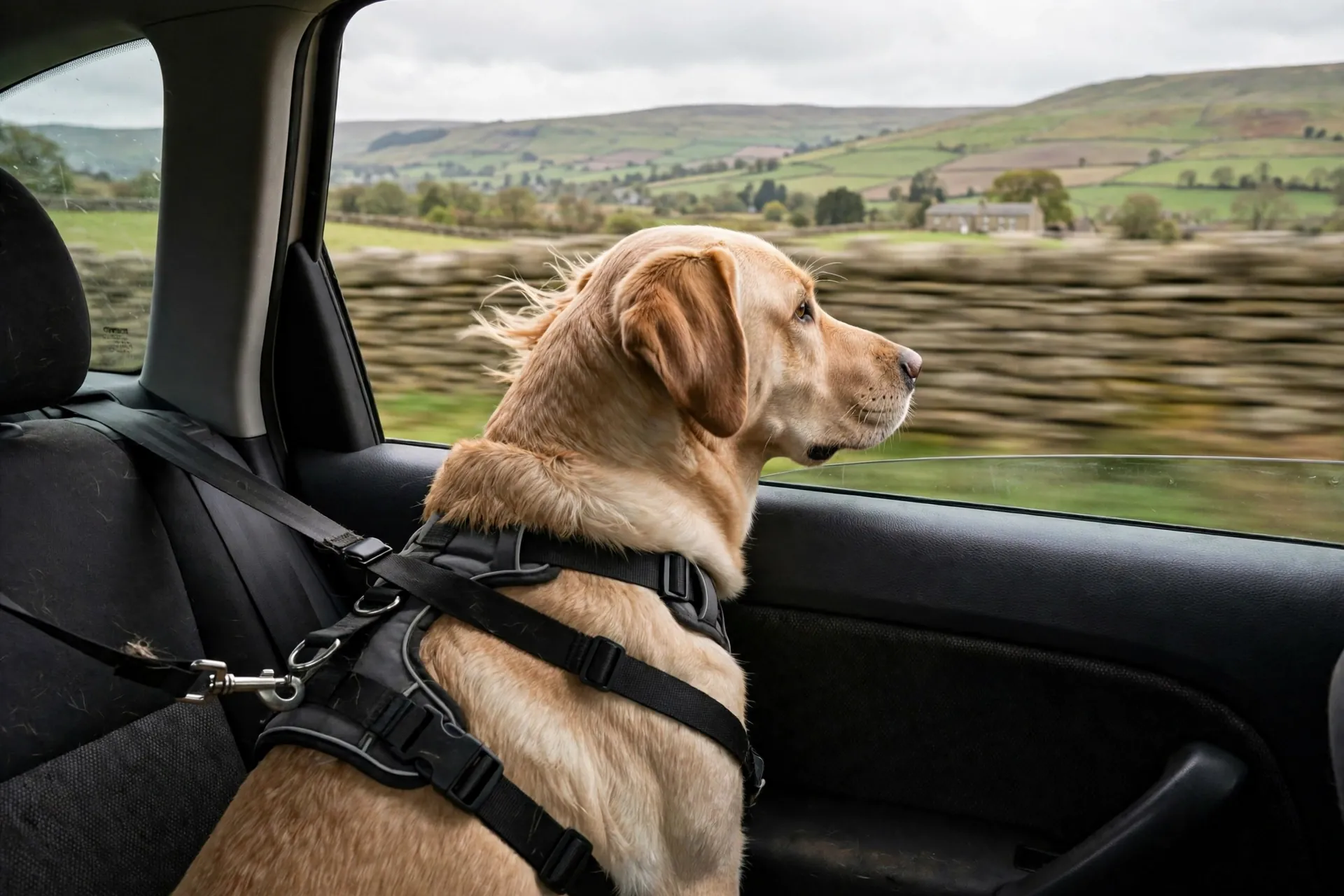
The mistake: letting a dog travel loose on the back seat, on a lap, or in an unsecured boot, or using a harness, crate or guard that does not fit the dog or the car. The cost is serious: an unrestrained dog can distract the driver, be thrown forward in a sudden stop, or escape through an opened door at a service area and run into traffic. In the UK, the Highway Code requires dogs to be suitably restrained so they cannot distract the driver or injure themselves or others if the vehicle stops quickly, and a driver who fails to do so can face penalties and insurance problems. This is not a matter of preference: it is a safety and legal requirement.
The fix: choose a restraint before departure day and test it. A crash-tested harness attached to a seatbelt, a secured crate sized for the dog to stand and turn, or a boot guard combined with a harness, are all legitimate options, but each must fit the specific dog and the specific car. A harness that is too loose lets the dog slip out; a crate that is too small causes distress; a boot guard without a harness does not prevent a dog being thrown within the boot. Practise short journeys with the restraint before the holiday, so the dog associates it with calm travel rather than a sudden, strange confinement on a long journey. Keep a spare lead accessible, not buried under luggage, for stops, and never leave a dog alone in a parked car in warm weather. Our guide to dog car safety covers restraint types, fitting and journey routines in detail, and it is worth reading before you buy anything.
Check the restraint again after the first stop, since harnesses loosen and dogs settle into different positions. A restraint that was correct at departure may need tightening after an hour, and a dog that has been sick or has drunk a lot of water may need a comfort break and a readjustment. Small checks at every stop prevent the slow slide into an unsafe journey.
Mistake 3: new food, rich treats and scavenged snacks
The mistake: changing the dog's food for the holiday, buying a new brand because it was on offer, feeding rich cafe treats, table scraps, ice cream or a whole chew the dog has never had, and letting the dog scavenge on beaches and in parks. The cost: vomiting, diarrhoea, stomach pain and a night spent cleaning a rented cottage, followed by a vet call and a miserable next day. Holiday stomach upsets are so common that many vets expect them in summer, and most are preventable by the simple rule of keeping the diet identical.
The fix: pack the dog's usual food for the whole trip plus two spare days, measured into daily portions if possible, and feed at the usual times in the usual bowl. Introduce no new food, no new treats and no rich human food during the holiday, however tempting the cafe menu looks. If you want to give the dog a treat, use its usual treats, in usual amounts. Carry fresh water and a bowl, since unfamiliar water can also upset some dogs, and do not let the dog drink from puddles, streams or the sea in large amounts. If the dog does develop loose stools, return to plain, familiar food, keep water available, and rest, but call a vet if vomiting persists, if there is blood, if the dog refuses water, or if the dog becomes lethargic. Puppies, older dogs and dogs with known sensitive stomachs deserve extra caution, and a small supply of the plain food your vet already recommends for upset stomachs is worth packing if it is part of your dog's existing routine.
Be especially careful on beaches and in parks, where dogs scavenge dead fish, seaweed, discarded food and animal droppings, all of which can cause illness. Keep a close eye on the dog in new environments, and train a reliable leave cue before the holiday if you have time. A dog that has learned to drop or leave an item at home will be far safer on a beach than a dog meeting scavenging opportunities for the first time.
Mistake 4: travelling without a vet, ID or safety plan
The mistake: arriving somewhere new with no idea where the nearest vet is, no out-of-hours number, no vaccination record, no medication list, and a microchip registered to an old phone number. The cost: a minor problem becomes a panic, because every minute spent searching for a vet is a minute not spent helping the dog, and an out-of-hours search in a rural area at night can take far longer than expected. A dog that slips a lead in an unfamiliar place without up-to-date identification is also far harder to reunite with its owners.
The fix takes twenty minutes before departure: find the nearest vet practice and the nearest out-of-hours service to your accommodation, save both numbers in every phone travelling, and print them as a backup. Check that your dog's microchip details are up to date, and that the dog wears an ID tag with your name and current mobile number while travelling. Pack the vaccination record, any medication with its instructions, and your pet insurance policy number and claims number if you have them. Tell your usual vet you are travelling, and ask what to do for minor issues while you are away, so you are not guessing in a crisis.
For a fuller plan, including what to ask an out-of-hours practice and what to carry in a holiday first-aid kit, see our guide to finding an emergency vet on holiday. Read it before departure, not during an emergency, because the value of a plan is that it is already in place when you need it. Also keep a recent photo of your dog on your phone, in case you ever need to describe it quickly to a warden, a vet or a stranger who has found it.
Mistake 5: a schedule with no slack, and no rest day
The mistake: planning something for every hour of every day, including a long drive, a famous walk, a town visit and a restaurant on day one, and treating a rest day as wasted time. The cost: an overtired dog that becomes reactive, barky, reluctant to walk, or unwell, and owners who spend the second half of the holiday managing tiredness instead of enjoying it. Mental stimulation tires dogs as surely as physical exercise, and a new place adds mental load to every walk, every meeting and every night's sleep.
The fix: build the schedule around rest, not around attractions. Plan one main outing per day at most, keep walks shorter than the dog's home maximum for the first two days, and build in a full rest day in the middle of the week, with short garden walks, enrichment and an early night. Leave at least one day unplanned, so bad weather, illness or a walk that takes longer than expected can be absorbed without cancelling something important. If the dog shows signs of over-tiredness, such as reluctance to start walks, increased reactivity, restless sleep or a normally sociable dog becoming snappy, shorten the next day rather than pushing through. Rest is not wasted holiday: it is the reason the active days work.
Owners also need rest, and a schedule with no slack leaves no time for the practical jobs, such as shopping, checking the next day's route, or simply sitting in the garden with the dog. A holiday that feels like a timetable is tiring for everyone, while a holiday with slack feels spacious even when the weather is poor. For a first trip, under-planning is a skill, not a failure.
Mistake 6: assuming off-lead freedom everywhere
The mistake: assuming that because a place looks open, dogs can run free there, and letting a dog off the lead on a beach, moor or park without checking the rules, the livestock, the wildlife or the dog's recall in that environment. The cost can be serious: a dog chasing sheep can cause livestock worrying, which is a criminal offence and can lead to a dog being shot by a farmer in extreme cases, while a dog chasing ground-nesting birds in spring can disturb protected wildlife and breach local rules. A dog with unreliable recall in a new place can also vanish, run onto a road, or approach an aggressive dog with no escape route.
The fix: check before you unclip. Look for signs, check the official guidance before you travel for local lead rules, seasonal restrictions and livestock, and keep the dog on a lead around livestock at all times, without exception. Use a long line in open areas where off-lead running is not safe or not allowed, so the dog still gets freedom to sniff and explore without the risk of a lost dog. Practise recall before the holiday in increasingly distracting environments, and be honest about whether it is reliable: a recall that works in the garden may fail completely on a beach full of other dogs. If in doubt, keep the lead on. A dog on a long line in a beautiful place is having a better holiday than a dog that has run off and frightened livestock or itself.
Also check the specific rules for beaches, nature reserves and national parks, since they change by place and season. A beach that allows dogs off the lead in winter may require leads in summer, and a moor that is open in autumn may have lead rules during nesting season. Signs on site override general assumptions, so read them even when they are inconvenient.
Mistake 7: leaving the dog alone in a new place too soon
The mistake: leaving a dog alone in a rented cottage on the first evening, for a long dinner or a day out, because the dog is fine alone at home. The cost: barking, howling, scratching at doors, chewing, toileting indoors, or a complaint from neighbours that can end a stay early. A dog that is settled alone at home is not automatically settled alone in a strange house, where every sound is unfamiliar and the owners' scent is the only familiar thing. First-trip alone time needs to be built gradually, not assumed.
The fix: check the property's alone-time rule before booking, since many cottages forbid leaving a dog unattended at all, and some allow only short periods if the dog is quiet. On the first days, keep alone time to zero or to a few minutes while you are in the garden, and build up only if the dog remains calm. Leave the dog with its bed, a familiar blanket, a stuffed food toy and a radio or television at low volume if that is part of the home routine, and keep departures and arrivals low-key, without long goodbyes or excited greetings. If you want to eat out, choose dog-friendly venues for the first few days, or take it in turns to stay with the dog, rather than leaving it to cope alone. For nervous dogs, our guide to calming anxious dog travel covers settling routines, safe spaces and the signs that a dog is not coping, which are worth recognising before they become a complaint.
If the dog does bark or become distressed when left, do not punish it on return, and do not repeat the same long absence the next day hoping it will get used to it. Shorten the absence, increase the settling routine, and consider whether the trip needs to be reorganised around the dog, for example by choosing dog-friendly dining for the rest of the week. A dog that learns that being left is brief and safe will cope better next time than a dog that learns that being left means hours of panic.
Mistake 8: ignoring heat, cold, wet and ground conditions
The mistake: walking a dog in midday heat, leaving it in a car, failing to dry it after a wet walk, or walking it on hot pavements, salted roads or muddy, rutted tracks without checking paws and coat. The cost ranges from discomfort to danger: heatstroke can develop quickly in warm weather, especially in brachycephalic breeds, older dogs and overweight dogs, while a wet, chilled dog in a draughty cottage can become ill, and salted or hot surfaces can injure paws. British weather changes fast, and a morning that starts cool can become hot by midday, or a dry walk can turn into a muddy slog by afternoon.
The fix: check the forecast every morning and plan walks for the coolest, driest part of the day in heat, and for sheltered, surfaced routes in wet or cold weather. Carry water and a bowl on every walk, offer water frequently, and watch for heavy panting, slowing down, drooling or seeking shade, which are signs to stop, cool the dog and head for shade or the car. Never leave a dog alone in a parked car in warm weather, even with windows open and even for a few minutes, since car temperatures rise dangerously fast. After wet walks, dry the dog thoroughly, check paws for mud balls, cuts and irritation, especially between the toes, and ventilate the accommodation after drying to prevent condensation. In cold weather, small, short-coated and older dogs may need a coat, and all dogs need a warm, draught-free sleeping spot. In summer, check for ticks after woodland and long-grass walks, and remove them promptly and cleanly.
Also check ground conditions, not just the sky. Coastal paths, forestry tracks and surfaced park trails stay usable after rain, while clay woodland paths, riverside meadows and farm tracks can become impassable or painful for paws. Ask locally which walks hold up best in wet weeks, since that advice is rarely written down but is given constantly by people who live there.
Mistake 9: trusting the dog-friendly label without checking the details
The mistake: booking a property because it says dog-friendly, without checking whether the specific unit accepts dogs, how many dogs are covered, what the pet fee totals, whether the garden is enclosed, what the alone-time rule is, and whether dogs are allowed in the cafe, terrace or other shared areas. The cost: arriving to find the dog is not allowed in the unit you booked, the garden is open to a road, the pet fee is double what you expected, or you cannot eat together anywhere on site. Dog-friendly is a spectrum, not a guarantee, and the details matter more than the label.
The fix: ask the awkward questions before paying a deposit, and get the answers in writing. Confirm the specific unit, the number and size of dogs covered, the all-in pet fee and any deposit, the garden enclosure including fence height and gate gaps, the alone-time rule, the check-in window, and the rules for shared areas. Read the cancellation terms, and check who holds your money if you book through a platform rather than direct. Compare two or three properties in the same area on the same details, rather than choosing the prettiest listing. Our first-time booking checklist lists those questions in the order worth asking them, and it is designed to catch exactly the surprises that spoil first trips.
Also check the location, not just the property. A cottage beside a busy road, a children's play area or a dog exercise field may be noisy or over-stimulating for a nervous dog, while a cottage at the edge of a site, away from foot traffic, may suit it far better. Ask for a map, look at roads, footpaths and service areas, and request a quieter location if your dog needs it. A booking that suits the dog is worth more than a booking that photographs well.
Mistake 10: trying to fix everything at once, instead of one thing at a time
The mistake: realising on day two that several things have gone wrong, and trying to fix them all at once, by changing the food, the walks, the sleeping arrangement and the whole itinerary in a single day. The cost: the dog faces another wave of change on top of the changes that already caused the problem, and owners cannot tell which fix helped, because everything changed together. Dogs cope with change best when it is gradual and predictable, and a frantic overhaul feels to a dog like another upheaval, not a rescue.
The fix: choose the single most important change, make it, and let the dog settle for a day before changing anything else. If the dog is overtired, the fix is a rest day, not a new food, a new bed and a new walk. If the dog has stomach problems, the fix is familiar food and rest, not a new treat and a longer walk to tire it out. If the dog is barking when left, the fix is shorter absences, not a new routine, a new room and a new toy all at once. Write down what you changed and what happened, so the next day's decision is based on evidence rather than anxiety.
Also accept that a first trip does not need to be perfect to be successful. A holiday with one bad day, handled calmly, teaches you more about your dog than a flawless holiday teaches you about anything, and it leaves a dog that has learned that problems are fixed gently, not dramatically. The goal is not a mistake-free holiday, which does not exist, but a holiday where mistakes are small, noticed early and fixed one at a time. That is a skill worth learning on the first trip, because it is the skill that makes every later trip easier.
Finally, debrief after the trip. Note the mistakes you made, the fixes that worked, and the things you would do differently, while the details are fresh. That note turns a first trip, with all its errors, into a reliable plan for the second trip, and it is the most honest souvenir a first dog holiday can produce.
Practical questions
Before you go
What is the biggest mistake first-time dog travellers make?
Trying to do too much too fast: a long drive, a big walk and a busy evening on day one, with no rest built in. Dogs need time to learn a new place, and a first trip that starts slowly almost always ends better than one that starts at full speed.
Can I let my dog travel loose in the car boot?
No. Dogs must be suitably restrained in a vehicle so they cannot distract the driver or be injured in a sudden stop. Use a crash-tested harness, a secured crate or a boot guard, and check that the restraint fits your dog and your car before departure day.
Should I change my dog's food for a holiday?
No. Keep the diet exactly the same, including the brand, the amount and the feeding times. New food, rich cafe treats and scavenged food are the most common causes of holiday stomach upsets, and a dog with diarrhoea in a rented cottage is miserable for everyone.
What if my dog is sick in the car?
Keep journeys short, keep the car cool and well ventilated, feed a light meal several hours before travel, and stop for fresh air if the dog drools, pants or looks unwell. Many puppies outgrow travel sickness, and your vet can advise on options if sickness is a regular problem.
Is it a mistake to plan something for every day?
Yes, for a first trip. A full schedule leaves no slack for bad weather, tired dogs, illness or a walk that takes longer than expected. Build in a rest day and leave at least one day unplanned, so the holiday can bend without breaking.
What should I do if I have already made one of these mistakes?
Fix the next decision, not the last one. Shorten the next walk, add a rest day, return to familiar food, secure the car properly or call a vet for advice. Dogs recover quickly from a single bad day when the routine stabilises, and one mistake does not ruin a holiday.