This guide is independent and contains no paid placement. If affiliate links are added later, they will be clearly marked and will not change our editorial checks.
Fishguard works best as a walking base, not a resort: arrive with a plan for the hill between its two halves, use the flat harbour and beach paths for easy days, keep dogs on a lead near cliffs and livestock, and check ferry pet rules and beach signs before you travel.
A town in two halves: read the hill before you plan the day
Fishguard is not one town at one level. It is two settlements stacked on top of each other, and understanding that split is the single most useful thing you can know before you bring a dog here. Upper Town sits on the hilltop, with the main road, the shops, the market square and most of the everyday services. Lower Town sits in a steep, sheltered valley at sea level, wrapped around the old harbour, with cottages, a quay and a slipway. A winding road drops sharply between them, and the walk that looks like a gentle ten minutes on a map is a serious climb on the way back up, particularly with a dog that is already tired, hot or carrying a few extra years.
That geography shapes everything about a dog-friendly visit. Dogs that love hills will be delighted; dogs with stiff joints, heart conditions or short legs will not. Plan the day around the hill rather than fighting it. Do the climb once, in the cool of the morning, and then let the rest of the day happen at sea level: the harbour, the beach at Goodwick and the flat stretches of the coast path. If your dog struggles with slopes, drive between the two halves without guilt. There is parking near the harbour in Lower Town and in Upper Town, and nobody awards points for making an arthritic spaniel climb a hill twice a day.
The two halves also feel different, which is part of the town's charm. Upper Town is practical and slightly plain: a working Welsh market town with a square, a handful of cafes, a supermarket and the kind of shops that sell what residents actually need. Lower Town is the postcard — narrow lanes, whitewashed and colourfully painted cottages, boats, gulls and the smell of the sea. Most visitors with dogs end up spending their mornings in one and their evenings in the other, and that rhythm works well. Shop and stock up in Upper Town, then walk down to the harbour for the slow part of the day.
Goodwick, the neighbouring settlement to the north-west, is effectively a third piece of the same place. That is where the ferry terminal sits, along with the railway station and the long sandy beach. Fishguard, Lower Town and Goodwick blend into one another along the coast, and a dog walker can move between all three on foot, although the roads between them carry traffic and need a lead. Think of the whole area as one walkable harbour town with three centres, and plan your routes accordingly.
One more piece of local context helps. Fishguard is famous as the site of the last invasion of Britain, when French forces landed nearby in 1797 and were turned back within days. You will see references to it around the town, and it is a useful story to know when you are walking the lanes with a dog and wondering why a small harbour town has such a strong sense of its own history. The town's identity is tied to the sea and to arrival by water, which is still true today: the ferry to Ireland is the reason many people pass through, and the harbour remains a working place rather than a museum piece.
The ferry port and your dog: what to expect at Fishguard Harbour
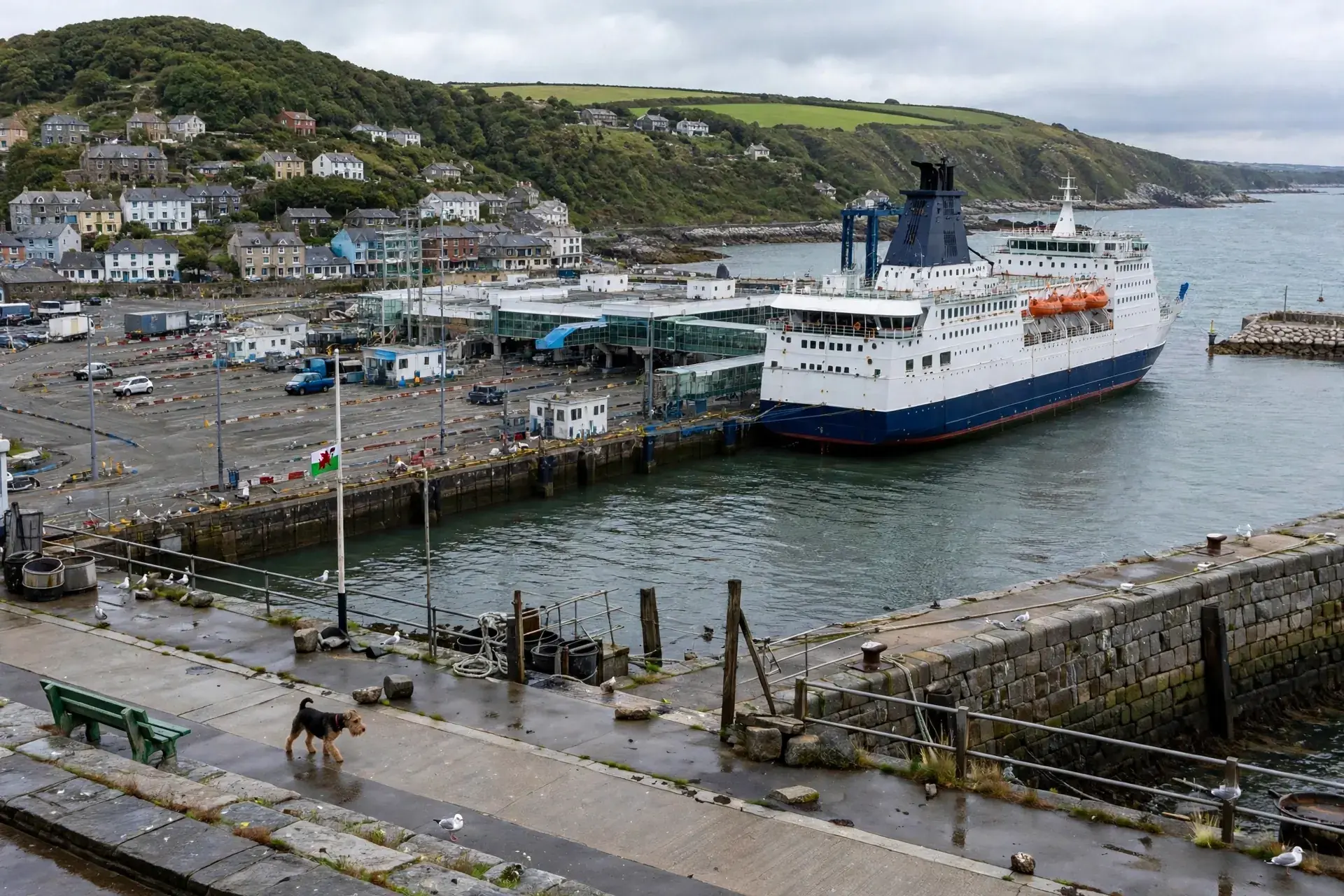
The ferry terminal at Goodwick is the busiest part of Fishguard, and it is also the part that needs the most advance planning if you are travelling with a dog. Ferries run from Fishguard to Rosslare in Ireland, and the terminal handles cars, lorries, foot passengers and the railway station alongside them. For a dog, that means noise, diesel, moving vehicles, unfamiliar people and a lot of standing around — manageable with preparation, miserable without it.
If you are taking the ferry with a dog, book the pet arrangements at the same time as your ticket rather than assuming you can sort it out at the port. The options generally depend on whether you are travelling with a car or on foot, and kennel spaces on board are limited. Dogs travelling in vehicles usually stay in the car for the crossing, which is why you should check the official guidance before you travel about ventilation, access during the sailing and the rules for checking on your dog. Foot passengers generally use on-board kennels or a designated pet area, and the details change between operators and seasons, so treat any advice from other travellers as a starting point and confirm the current rules with the operator directly.
Arrive early and plan the waiting time. The terminal area is not a pleasant place for a dog to hang around for an hour: hard surfaces, traffic and little shade. Give your dog a proper walk and a toilet break before you reach the port, and bring water and something familiar for them to lie on. If you have a nervous dog, a familiar blanket and a chew can make the difference between a tolerable wait and a miserable one. Keep the lead short around the terminal and the car park, because vehicles move in all directions and drivers are watching for signs, not for dogs.
If you are not catching a ferry at all, the port is still worth a visit on foot. The walk around the harbour at Goodwick gives you big-sky views across the bay, the ferry coming and going, and the coast path heading west towards Strumble Head. It is one of the best places in town to watch the weather roll in from the Irish Sea, and dogs tend to enjoy the open air and the smells after the enclosed lanes of Lower Town. Just keep them on a lead near the working quays and the car park, and well away from the vehicle lanes.
A practical point about the railway station: Fishguard Harbour station sits at the ferry terminal, and trains connect with sailings. If you are arriving by train with a dog, the walk from the platform to the town is straightforward but not short, and the route involves roads. A dog that travels well on trains will manage it, but build in time, water and a toilet stop before you set off. Check the official guidance before you travel for current timetables, because services on this line are less frequent than on main lines and a missed connection can mean a long wait.
Harbour and Lower Town walks: the easy, flat heart of the visit
The best dog walking in Fishguard starts at the harbour in Lower Town, and the reason is simple: it is flat, sheltered and full of smells. The quay, the slipway and the lanes around the harbour make a gentle loop that suits almost every dog, from puppies on their first holiday to old dogs that can only manage twenty minutes. Start at the harbour car park, walk the quay, follow the lane past the cottages, and come back along the water. It is short, but it is the kind of walk dogs actually enjoy — slow, sniffy, with boats to watch and other dogs to greet from a polite distance.
The harbour itself is still a working place, which is part of its appeal and part of what to watch for. Fishing boats come and go, nets and ropes appear on the quay, and gulls are everywhere. Keep dogs on a lead around the working areas, and do not let them drink from puddles near the boats or eat fish scraps off the ground. Hooks, line and bait are real hazards for a dog that hoovers everything, and a lead is the cheapest insurance. The same applies to the slipway, which can be slippery with weed and algae at low tide.
From the harbour, the lanes of Lower Town reward a slow wander. The cottages are close together, the lanes are narrow, and there is very little traffic, which makes it one of the few places in town where a dog can walk on a loose lead without constant cars. Look out for the small details: the old lime kilns, the chapel, the pub by the water. Dogs will be more interested in the smells than the history, and that is fine — the point of this walk is to let the dog set the pace.
For a slightly longer flat walk, follow the coast from Lower Town towards Goodwick. The route runs along the shore of Fishguard Bay, with the water on one side and the town on the other, and it is mostly level. It is a good first walk of the day because it lets you judge how your dog is coping with the sea air, the wind and the new surroundings before you commit to a longer cliff walk. It is also a good last walk of the day: an easy, predictable loop when everyone is tired and the light is going.
Two practical warnings belong here. First, the harbour walls have no railings in places, and the drop to the water at high tide is not trivial. A dog on a long line can reach the edge faster than you expect, so use a short lead near the quay. Second, the lanes flood in heavy rain. Lower Town sits at the bottom of a valley, and after a downpour the road can carry a surprising amount of water. It drains quickly, but if you arrive after a storm, check the road before you drive down, and keep dogs out of fast-moving runoff.
The Pembrokeshire Coast Path in both directions
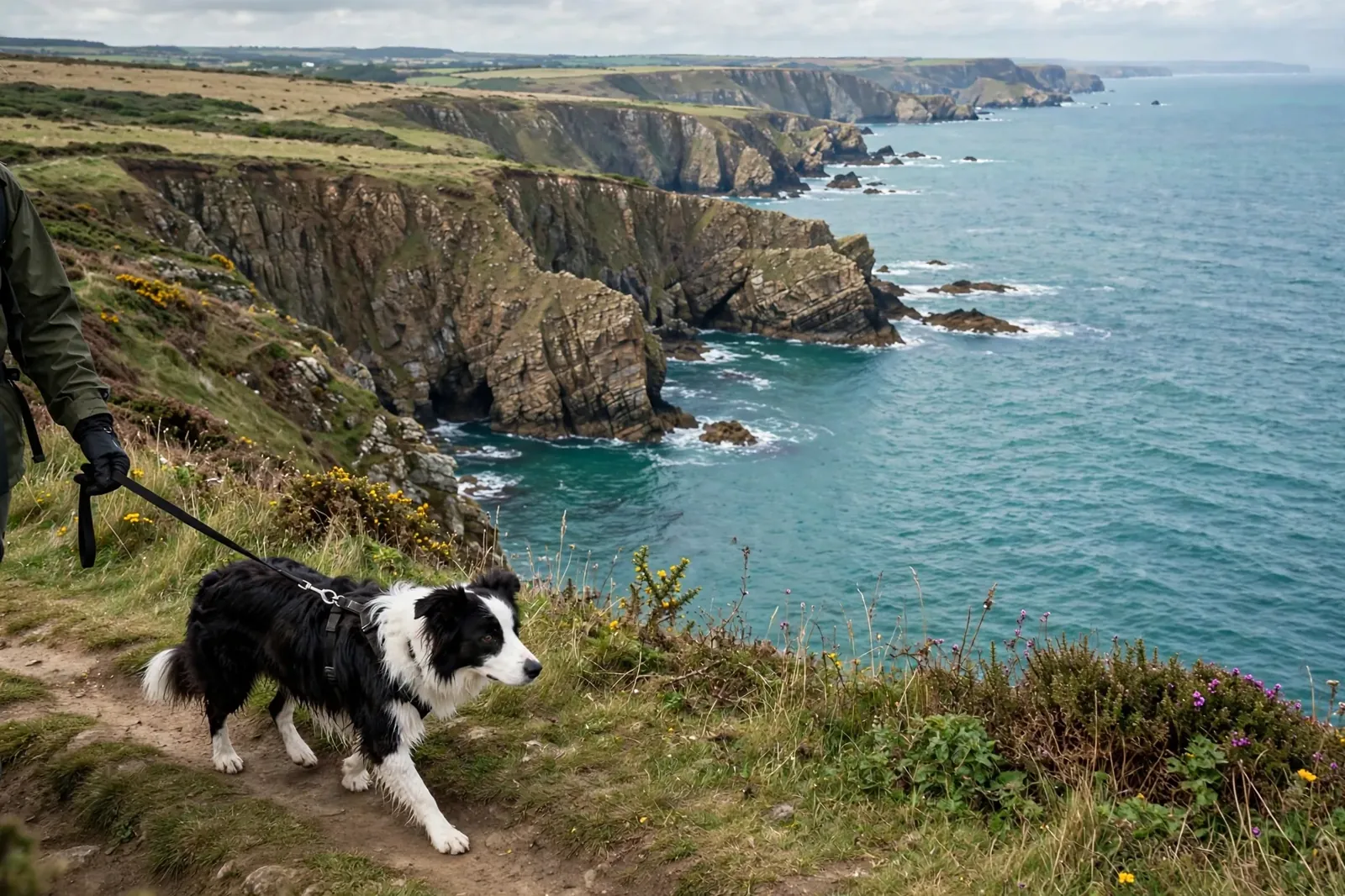
Fishguard sits directly on the Pembrokeshire Coast Path, which means you can join one of Britain's great long-distance trails from the town centre without a car. That is a genuine advantage, and it is also the reason to take the path seriously: this is a proper cliff path, not a promenade. The sections around Fishguard are beautiful and exposed, with steep drops, uneven ground, livestock and long stretches without water or shelter. A fit, well-behaved dog will love it; a dog that pulls, chases or panics near edges needs a short lead and a shorter route.
Heading west from Goodwick, the path climbs towards Strumble Head, with its lighthouse standing on a rocky island reached by a bridge. This is one of the most dramatic stretches of the whole coast path: open sea, seabirds, seals in the water below and views back across the bay to Fishguard. It is also exposed to wind, and the path is narrow in places. Allow more time than the distance suggests, carry water for the dog, and keep dogs on a lead near the cliff edge and around sheep. Our full guide to the Pembrokeshire Coast Path with a dog covers section-by-section planning, water gaps, livestock and multi-day logistics in detail, and it is worth reading before you commit to a long day.
Heading east from Fishguard, the path runs towards Dinas Head and on to Newport, a smaller harbour village with its own beach and a more sheltered feel. This direction is gentler at first and suits a half-day walk, especially if you arrange a lift back or walk out and back along the same stretch. Dinas Head is a rounded headland with big views and a good chance of seeing seals and porpoises offshore. The path here crosses farmland, so dogs must be on a lead around livestock, and you should expect gates and stiles that need a hand — and a plan for getting a larger dog over them.
Whatever direction you choose, a few rules make the difference between a good day and a bad one. Check the weather forecast and the wind, not just the rain: a strong onshore wind on a cliff path is harder for a dog than a shower. Tell someone your route if you are walking alone. Carry more water than you think you need, plus a collapsible bowl, because there are long stretches with no taps and no shops. Pack a lead you can shorten quickly, poo bags, and a basic first-aid kit. And agree a turnaround point before you set off. The coast path rewards the walker who turns back with energy to spare far more than the one who pushes on to the next headland and limps home.
For dogs that cannot manage cliff walking, the coast path still has something to offer. The flat sections around the harbour and the beach at Goodwick give a taste of the same coastline without the drops, and the views from the lower paths are often just as good as the views from the top. There is no rule that says a dog holiday has to include a cliff. A tired, happy dog on a flat harbour walk has had a better day than a stressed dog dragged along a cliff edge.
Beaches around Fishguard: sand, tides and the rules that change
Goodwick beach is the town's main sandy beach, a long sweep of sand at the ferry-port end of the bay, and it is the easiest beach day you will have in Fishguard. It is flat, open and close to parking, which makes it a good choice for a first beach visit, for puppies and for older dogs. At low tide the sand stretches a long way, giving dogs room to run without crowding other beach users, and the water is shallow near the shore. Check the tide times before you go, because the beach changes character completely between high and low water, and a dog that runs out at low tide has a long way back if the tide turns.
Beach rules in Pembrokeshire are set by the local council and enforced through public spaces protection orders, which means they can differ from beach to beach and from season to season. Some beaches restrict dogs during the summer months, others do not, and the signs at the entrance are the final word on the day. Read them every time, even on a beach you visited last year, and check the official guidance before you travel if you are planning a summer visit. Our guide to dog-friendly beaches in the UK explains how seasonal bans work, how fines are applied and how to check a beach before you go, which is worth a read before any beach-heavy trip.
Smaller coves and rocky shores around Fishguard suit dogs that prefer exploring to running. The rocky shoreline near the harbour and the coves along the coast path are good for sniffing and scrambling, but they need care: sharp rock, slippery weed, deep pools and the occasional fishing line. Keep dogs on a lead until you can see the ground clearly, and check paws afterwards for cuts. The tide also matters more on rocky shores than on sand, because a cove that is easy to enter at low tide can be cut off at high tide. Never let a dog swim in a cove you have not checked for currents and exit points.
Swimming is a judgement call, not a given. The water off Fishguard is cold even in summer, and the currents around headlands and harbour mouths are stronger than they look. Dogs that swim confidently in lakes and rivers can still struggle in the sea, and the cold can tire them quickly. Let a dog paddle and wade first, watch how they cope with the waves, and keep them close to shore. If your dog does swim, rinse them with fresh water afterwards and dry their ears, because salt water and sand can irritate skin and ears. Bring a towel and a drying coat even on a warm day, because a wet dog in a sea breeze gets cold fast.
One last beach habit is worth building in Fishguard: check the sand for hazards before you let the dog off the lead. Fishing hooks, broken glass, sharp shells and discarded food are all possible on a working harbour beach, and a five-minute scan of the area where your dog will run is time well spent. It also helps to walk the beach once on a lead first, so the dog learns the boundaries and you learn where the other dogs, the picnics and the kite flyers are.
Eating and drinking with a dog in Fishguard
Fishguard is a small town, so the eating-out scene is modest, friendly and very much on dog-walking terms. You will not find a long list of restaurants, but you will find cafes, pubs and takeaways where a well-behaved dog is a normal sight rather than a special event. The key is to ask ahead and to read the room when you arrive. A dog that settles under a table is welcome almost anywhere with outdoor seating; a dog that barks at every passing spaniel is not, and no amount of asking will change that on the day.
Cafes in Upper Town are the easiest option for a mid-walk stop. Many have pavement seating or a small terrace where dogs are welcome, and the town square is a natural place to pause with a coffee while the dog watches the world go by. Takeaway food is a good fallback in Fishguard: buy sandwiches or fish and chips, walk down to the harbour, and eat on a bench with the dog beside you. It is often a better experience than a restaurant with a dog, and it costs less too.
Pubs are the other half of the Fishguard eating-out picture. The pub by the harbour in Lower Town is the classic dog-walker's pub: low ceilings, a fire in winter, and dogs asleep on the floor. Pubs in this part of Wales are generally more relaxed about dogs than restaurants, especially in the bar area and outside, but policies vary between landlords and can change with the season. Ask at the door, keep the dog on a lead inside, and bring a mat or blanket for them to lie on. A dog that has its own place to settle is far more likely to be welcome back.
A few practical habits make eating out with a dog easier here. Feed the dog before you go, so they are not begging for your lunch. Bring water and a small bowl, because not every cafe has one. Keep the lead short and the dog out of the walkway, and take them out for a toilet break before you sit down. If the dog cannot settle, finish quickly and leave gracefully rather than letting them rehearse barking. And remember that many places welcome dogs outside but not inside, which is fine in summer and a reason to choose takeaway in a January gale.
If you are self-catering, the supermarket in Upper Town covers the basics, and the town has a butcher and other small shops for supplies. Stock up on dog food, treats and poo bags when you arrive, because the smaller shops around the harbour do not always carry pet supplies. It is also worth buying a local map or checking a walking app before you set off, since mobile signal can be patchy on the coast path and you do not want to be relying on a single bar of signal to find your way back.
Where to stay with a dog in Fishguard
Accommodation in Fishguard is small-scale: cottages, bed and breakfasts, a hotel or two and a handful of self-catering lets, plus campsites and caravan parks a short drive away. There is no big resort and no long strip of dog-friendly hotels, which is both the charm and the challenge. Book early, especially for school holidays and summer weekends, because the number of genuinely dog-friendly places is small and they fill up fast.
Self-catering cottages are usually the best fit for a dog holiday here. A cottage in Lower Town puts you steps from the harbour walk, while a cottage in Upper Town puts you close to the shops and the square. Either way, check the details that matter for your dog: is the garden enclosed, and how high is the fence? Is there a ground-floor bedroom if your dog cannot manage stairs? Where is the nearest toilet area after dark? How many dogs are allowed, and what is the pet fee? Get the answers in writing before you pay, because "dog-friendly" can mean anything from a fully fenced garden and a dog bed to a grudging tolerance of one small dog.
Bed and breakfasts and small hotels can work well for a shorter stay, but they need a direct conversation before booking. Ask whether the dog can stay in the room, whether dogs are allowed in the breakfast room or only in the garden, and what happens if you want to eat out in the evening. Some places welcome dogs warmly and will even offer treats; others accept them only in certain rooms. The honest answer from the owner is worth more than a "pets allowed" tick box on a booking site, so phone or email rather than relying on a filter.
Campsites and caravan parks around Fishguard suit dogs that are happy outdoors and owners who like a base with space. The ground can be wet after rain, so bring a drying coat and a towel, and check whether the site has a dog-walking field or direct access to a footpath. If you are staying further out of town, in the villages towards St Davids or Newport, check the driving time to Fishguard itself: a twenty-minute drive each way is fine for a day trip, but it changes the rhythm of a holiday built around harbour walks.
Whatever you book, do the arrival routine properly. Walk the boundary of the garden before you let the dog off the lead, check gates and gaps, move cleaning products and food out of reach, and set up the dog's bed in the same place you use at home. Photograph any existing damage and tell the owner about it. A calm first hour sets the tone for the whole stay, and a dog that knows where its bed is and where the door is will settle far faster than one left to work it out alone.
Getting there and getting around with a dog
Most visitors arrive in Fishguard by car, and that is the easiest option with a dog. The town sits on the A487, the main road along the west Wales coast, and the drive in from the east is straightforward, if slow in places. The last stretch of road is winding, so dogs that suffer from travel sickness may struggle — stop for a break, keep the car cool and ventilated, and do not feed a big meal just before the winding section. Once you arrive, the car is useful for reaching the coast path car parks, the beaches and the day-trip destinations, but it is not essential for the town itself.
Parking in Fishguard needs a little planning in summer. The harbour car park in Lower Town is small and fills quickly, and the streets around it are narrow. The car parks in Upper Town and around Goodwick are larger and easier, and the walk between them is part of the visit rather than a chore. Avoid parking where you block a slipway, a farm gate or a resident's access, and never leave a dog in a parked car on a warm day — even with the windows open, a car heats up fast, and a dog can overheat in minutes.
Arriving by train is possible but slow. Fishguard Harbour station is at the ferry terminal, and Fishguard and Goodwick station serves the town itself. Services are infrequent, so check the official guidance before you travel and plan your connection carefully. Dogs travel on trains in the UK without a ticket, but they must be kept on a lead and under control, and a nervous dog may find a busy carriage stressful. Bring a mat for them to lie on, and choose a quieter service if you can.
Once you are in Fishguard, the best way to get around with a dog is on foot. The town is compact, the harbour walks are flat, and the coast path starts at the edge of town. Buses run along the coast to St Davids, Newport and Cardigan, and dogs are generally allowed on local buses, but check the operator's rules before you travel and keep the dog on a lead and out of the aisle. A car gives you more freedom for day trips to the Preseli Hills, the castles and the beaches further afield, and if you are planning a longer stay it is worth having one.
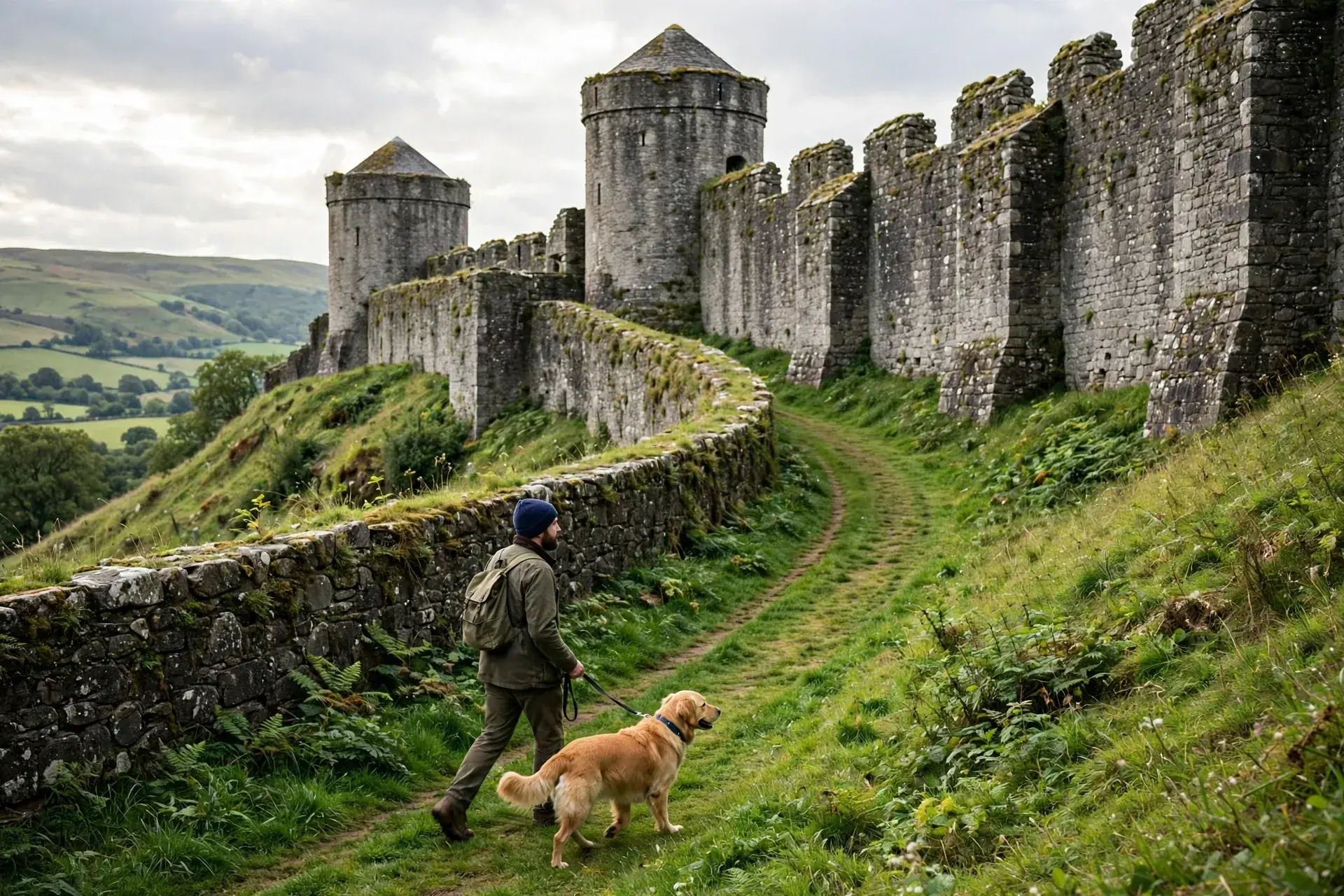
Day trips from Fishguard are one of its strengths as a base. St Davids, Britain's smallest city, is a short drive to the south-west, with its cathedral, coastal walks and cafes. Newport, to the east, has a sheltered beach and a quieter harbour. The Preseli Hills inland offer open moorland walking and long views, and the castles of Pembrokeshire and Carmarthenshire make good half-day outings — our guide to dog-friendly castles in Wales covers which sites welcome dogs and how the different zones work. Plan one day trip at a time rather than stacking three into a single day, because a dog that has already walked five miles on a cliff path does not need a castle on top of it.
Wet weather and quiet days: Fishguard in the rain
Fishguard is on the west coast of Wales, which means rain is not a possibility but a certainty. The town gets its fair share of Atlantic weather, and a dog holiday here needs a wet-weather plan rather than a hope that it stays dry. The good news is that Fishguard handles rain better than many coastal towns: the harbour walks are short, the lanes are sheltered, and a wet dog can be dried off in a cottage far more easily than on a campsite.
On a wet day, keep the walks short and frequent rather than long and heroic. A twenty-minute harbour loop, a sniff around the lanes, and a quick beach visit at low tide will tire most dogs out without soaking them through. Bring a drying coat and two towels, and dry the dog properly after every walk — wet fur, cold wind and a car ride is a miserable combination. Check paws for salt and grit after beach walks, and dry between the toes, where irritation starts.
Wet weather also changes the ground. The coast path becomes slippery, especially on grass and clay, and the cliff sections are no place for a dog in heavy rain and wind. Save the long cliff walks for dry days and use the flat harbour paths and the beach when it rains. The lanes of Lower Town can flood after a downpour, so check before you drive down, and keep dogs out of fast-moving water in the road.
A quiet day in Fishguard is not a wasted day. Use it to rest the dog, plan the next walk, stock up on supplies and let the dog sleep. Dogs on holiday need rest as much as they need exercise, and a day of short walks and long naps often produces a happier dog than a day of forced marching in the rain. If you do want to get out, the drive to a sheltered woodland walk or a village cafe with a dog-friendly interior can break up the day without asking much of the dog.
Finally, pack for the weather you will actually get. A waterproof coat for you, a drying coat for the dog, a spare lead, poo bags, a towel in the car and a towel in the cottage. That is the whole kit, and it is worth more than any amount of hoping. Fishguard rewards the walker who is prepared for rain and pleasantly surprised by sun, not the other way round.
Practical questions
Before you go
Can dogs travel on the Fishguard to Rosslare ferry?
Yes, dogs can travel on the Fishguard to Rosslare ferry, but the arrangements depend on the operator and the sailing. Dogs may travel in a vehicle, in a kennel on board, or in a designated pet area, and the rules differ between foot passengers and drivers. Book the pet option at the same time as your ticket, because kennel spaces are limited, and check the official guidance before you travel for the current pet policy, fees and check-in times.
Is Goodwick beach dog-friendly all year?
Goodwick beach is generally one of the more relaxed beaches in the area, but seasonal dog restrictions can apply on Pembrokeshire beaches and the rules are set by the local council, not by the town. Read the signs at the beach entrance on the day, and check the official guidance before you travel if you are visiting in the summer months, when restrictions are most likely.
How steep is the walk between Lower Town and Upper Town with a dog?
It is steep. Lower Town sits in a sheltered valley at sea level and Upper Town sits on the hill above it, joined by a winding road that climbs sharply. Fit dogs manage it easily on a lead, but older dogs, very small dogs and dogs with joint problems will find it hard work, especially in warm weather. If your dog struggles with hills, drive between the two halves of town and save their legs for the flat harbour paths and the beach.
Can dogs walk the Pembrokeshire Coast Path from Fishguard?
Yes. The Pembrokeshire Coast Path runs straight through Fishguard, so you can join it in either direction without a car. West takes you towards Strumble Head, east towards Dinas Head and Newport. Keep dogs on a lead near cliff edges and livestock, carry water because there are long stretches with no shops, and check the official guidance before you travel for any temporary path closures.
Where can I park in Fishguard with a dog?
There is parking in Upper Town, near the harbour in Lower Town and around Goodwick by the ferry port, but the harbourside spaces are small and fill quickly in summer. Arrive early on busy days, avoid blocking slipways and access lanes, and never leave a dog in a parked car on a warm day. If the harbour car park is full, use the larger spaces in Upper Town or Goodwick and walk down.
Is Fishguard a good base for a dog-friendly holiday in Pembrokeshire?
Yes, it is a practical base rather than a resort. You get a working harbour, a sandy beach, coast path access in both directions, and day trips to St Davids, Newport and the Preseli Hills, all within a short drive. It suits travellers who want walks and quiet evenings more than nightlife, and it works best if you book dog-friendly accommodation early, because the town is small and the best options fill up in school holidays.