This guide is independent and contains no paid placement. If affiliate links are added later, they will be clearly marked and will not change our editorial checks.
Start at the Harbour Arm for a short, lead-only stroll and a drink outside, then cross to the Lower Leas Coastal Park for the main walk, and climb the Zig Zag Path to The Leas for the view. In summer, keep off Sunny Sands and Mermaid Beach from 1 May to 30 September, and save off-lead time for the Warren. Check the official guidance before you travel, because beach and park rules are set by Folkestone & Hythe District Council and can change.
The Harbour Arm first
Stand at the far end of the Harbour Arm and look back, and the whole of Folkestone makes sense at once. Behind you is the open Channel, with ferries and shipping moving across the water and the white cliffs rising towards Dover on a clear day. In front of you is the town in layers: the sandy curve of Sunny Sands, the green strip of the Lower Leas Coastal Park, the pale cliff-top line of The Leas, and, tucked behind the harbour, the steep streets of the Old Town. It is the best possible orientation point for a dog trip, because it shows you, in a single view, how the new and old parts of the town fit together — and how small the distances between them really are.
The Harbour Arm itself is a former ferry pier that has been turned into a promenade of food stalls, bars and seating, and it works well as the first stop of the day precisely because it is short, flat and contained. Dogs are welcome on the open sections of the pier, on a lead, and the usual pattern is a slow walk out, a pause at the end to look back at the coast, and a slow walk back. That is enough. The pier is not a long-distance walk, and it was never meant to be one: its value is the view, the sea air and the chance to settle the dog in a new place before the longer walk begins. On a first visit, treat it as a warm-up rather than the main event.
Timing matters more here than at most seaside stops. Mid-morning on a weekday is calm, with room to move and space to sit. A sunny Saturday afternoon, a bank holiday or an event day is a different place: queues at the stalls, children running between tables, dogs threading past pushchairs and cyclists, and music or a big screen drawing a crowd. None of that makes the Harbour Arm unusable with a dog, but it changes the job. A short lead, a dog that can settle under a table, and a willingness to keep moving rather than queue for twenty minutes with a restless dog make the difference between a pleasant stop and a stressful one. If your dog is nervous in crowds, come early, keep the visit short, and save your sit-down drink for a quieter spot in the Old Town or the park.
Eating and drinking with a dog on the pier follows the same logic as anywhere busy: choose the outside tables, keep the dog on the far side from the walkway, and bring water and a small mat or blanket so the dog has a defined place to lie down. Many of the food traders put out water bowls, but do not rely on it — bring your own bottle and bowl, especially on a warm day, because the pier is exposed and there is little shade. Ask at each stall or bar rather than assuming a whole venue is dog-friendly inside; the open-air areas are the reliable option, and indoor rules can differ from one trader to the next. If a place is full or the dog cannot settle, move on without a fuss: the park is a five-minute walk away and has far more room.
Safety on the pier is mostly about edges, drops and other dogs. The Harbour Arm is a working harbour structure with water on both sides, so keep the dog on a lead at all times, keep the lead short near the edge, and do not let the dog jump up onto walls or lean over railings. The surface is hard and can be hot in strong sun, so check it with your hand on a warm day and carry a small dog if the ground is too hot for paws. In wind, the end of the pier is fully exposed; a light dog can be buffeted, and a long lead can tangle around legs and railings in a gust. A short lead, a harness rather than a collar for a puller, and a quick retreat to the sheltered harbour side are the practical answers.
One more thing to check before you count on the pier as your lunch stop: opening hours and trader days change with the season, and some stalls close on quiet weekdays in winter. The structure itself is a public walk, but the food and drink offer is not guaranteed every day of the year. Check the official guidance before you travel if a particular trader or a full lunch is the point of the visit, and have a back-up in mind — the Old Town, a few minutes inland, has cafes and pubs that stay open through the year.
The Lower Leas Coastal Park
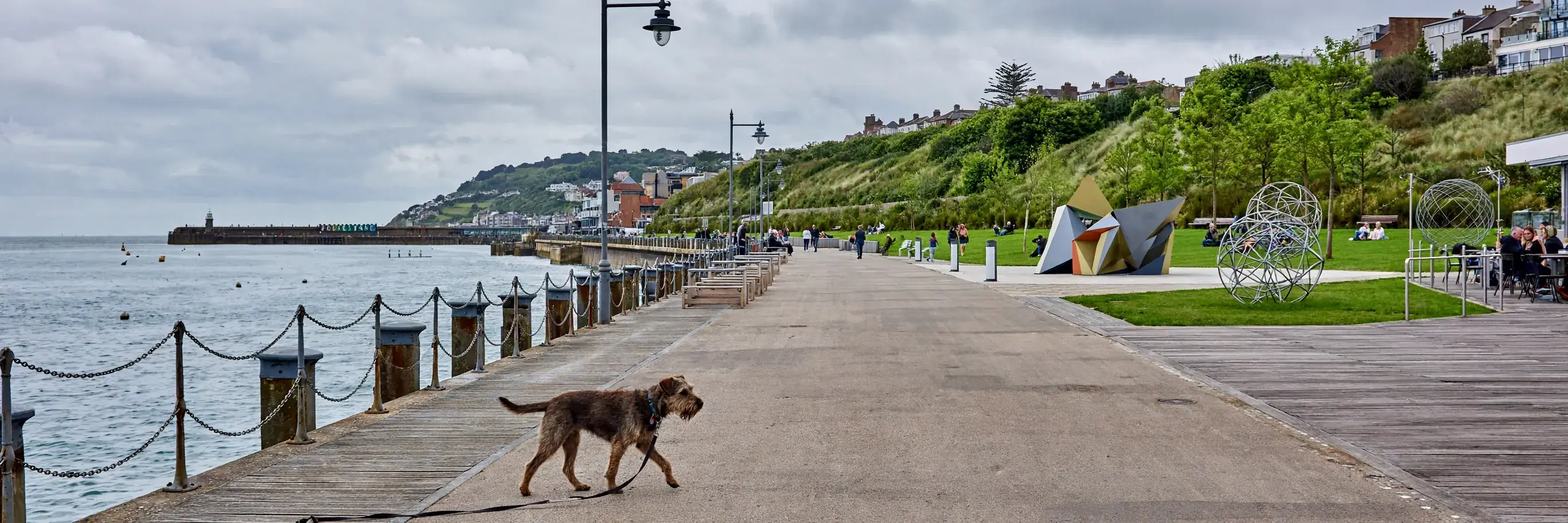
From the harbour, the Lower Leas Coastal Park is the obvious next step, and it is where most of the day's walking happens. The park runs in a long strip between Folkestone and Sandgate, along Lower Sandgate Road, and it was developed in phases from 2000 onwards on about 11 hectares of seafront land, with a second phase funded by the Heritage Lottery Fund and opened in 2006. It is divided into three broad zones — formal, fun and wild — and the change in character as you walk from one to the next is part of the pleasure: manicured gardens and flowerbeds give way to open play space, and then to quieter, wilder planting where the wildlife has more room.
The formal zone, near the harbour end, is the most garden-like part of the park. Paths are wide and surfaced, beds are planted for the maritime setting, and there are benches and viewpoints looking out to sea. This is the best stretch for an older dog, a puppy on its first seaside walk, or any dog that needs a gentle, level start. Keep the dog on a lead here, stay on the paths, and do not let the dog run through the planted areas: the council has extended the on-lead areas in the park precisely because dogs running through beds and near play areas caused complaints, and the signs in each section are the authority on the day.
The fun zone holds the large adventure play area, which is described as the largest free adventure playground in the South East, and it is the busiest part of the park on a family day out. For a dog owner, the practical point is simple: give the play area a wide berth. Children, dropped food, running games and excited shouting are a lot of stimulation for any dog, and a reactive dog will find this stretch hard work. Walk through on the seaward path if you need to pass, keep the lead short, and do not stop for a long sniff beside the fence. The park is long enough that you can usually find a quieter stretch a few minutes further on, and the dog will enjoy the walk far more if the busiest hundred metres are treated as a transit rather than a destination.
The wild zone, towards Sandgate, is the quieter end of the park and the best place for a slow, sniff-heavy walk. Planting is looser, the paths are less formal, and there is more to smell and watch. Even here, the lead rules apply in the designated areas, and the 2025 Dog Control Public Spaces Protection Order, which came into force on 1 August 2025, extended the areas where dogs must be on a lead. There is still an off-lead area below Leas Cliff Hall and around the amphitheatre, but do not assume that the whole wild zone is off-lead, and do not take another dog owner's word for it. Read the signs at the entrance to each section, keep the lead in your hand even where the dog is off it, and recall the dog before you reach a junction, a play area or a group of picnickers.
Practical facilities in the park are straightforward and worth knowing in advance. There are toilet blocks at intervals along the park, a cafe in the park, and Mermaid's Cafe nearby, and you can park at either end of the park, at the harbour end or towards Sandgate. The Lower Leas Coastal Park car park is closed between 8pm and 7am daily, so do not plan a late-evening walk that depends on it. Barbecues are no longer permitted in the park, and the pods that once stood there have been removed, so do not plan a barbecue stop here. Bring your own water, because a long, sunny walk along an exposed coast with no shade will leave most dogs thirsty, and there is no guarantee of a dog bowl at every cafe.
The park's other great strength is that it is mostly flat, with ramps and bridges in places, which makes it accessible for pushchairs, wheelchairs and older dogs that cannot manage steps. That flatness is exactly why it pairs so well with the Harbour Arm and the Zig Zag Path: you can do the hard climb once, at the point you choose, and keep the rest of the day level. If your dog is recovering from an injury, is very young, or is simply not a climber, you can spend the whole day in the park and along the seafront without ever touching a steep path, and still have a proper seaside walk.
The Zig Zag Path and The Leas
The Zig Zag Path is the link between the two Folkestones, and it is worth understanding before you set foot on it. It was built in 1921, after the First World War, as a public works scheme that gave work to unemployed local men, and it was rebuilt by James Pulham and his company after the first attempt failed. The cliffs, grottoes, arches and planting pockets that look like natural rock are entirely artificial: they were formed from waste material and rubble, then coated in a special cement called Pulhamite, named after its creator. The path is now a Grade II listed structure, and it is one of the most distinctive short walks on the Kent coast.
Walking it with a dog is a short, steep, stop-and-start climb rather than a long hike. The route winds from the bandstand on The Leas down through the artificial rockwork to the amphitheatre and the Coastal Park below, and the turns are tight enough that a long lead is a liability. Use a short lead, keep the dog close on the inside of the path, and pause at the wider turns to let the dog look around and let other walkers pass. The surface can be slippery when wet, and the steps are uneven in places, so go slowly in rain and do not hurry a dog that is hesitating. If the dog stops and will not go on, do not pull: turn back, take the gentler route, and try again another day.
For many dogs, the Zig Zag Path is a once-a-day feature rather than a route to repeat. Fit, sure-footed dogs enjoy it, and the views back over the beach and the Channel from the turns are genuinely good. Older dogs, very small dogs, dogs with sore joints and dogs that are nervous on steps may find it hard, and there is no shame in skipping it. The alternative is the Leas Lift, the Victorian water-powered lift that opened in 1885 to improve access between the seafront and the Upper Leas. It was closed for modernisation and refurbishment in 1980 and reopened in 1981, and it has been restored since. Dogs travel on it, and it is the sensible choice for a dog that cannot manage the climb. Check whether the lift is running on the day you visit — check the official guidance before you travel — because it does not run in all weathers or at all hours, and you do not want to discover that at the bottom of the cliff with a tired dog.
At the top, The Leas is a mile-long cliff-top promenade of lawns, flowerbeds and footways, with the bandstand, Leas Cliff Hall and the Channel Suite along its length. It is a different kind of walk from the park below: open, breezy and exposed, with long views along the coast towards Dover in one direction and Hythe and Dungeness in the other. Dogs must be kept on a lead on The Leas under the district rules, and that is sensible here: the cliff edge, the road, cyclists and other walkers all share a narrow strip, and a dog on a long line can quickly become a hazard. Keep the lead short, stay on the footways, and keep the dog well back from the cliff edge and any unfenced drops.
The Leas is also where the town's Victorian history is most visible. Folkestone grew as a fashionable seaside resort in the nineteenth century, and The Leas was laid out as its elegant promenade, with grand houses and hotels facing the sea. The Leas Cliff Hall, designed in 1913 and opened in 1927, still anchors the cliff top, and the bandstand is a reminder of the days when visitors came to listen to music and take the air. Walking here with a dog, you are walking through a piece of seaside history that has barely changed in outline, even as the town below it has changed completely. Take your time at the top, let the dog sniff the sea air, and then choose your way down: the Zig Zag Path if the dog is up for it, the lift if it is running, or the road route back to the harbour if you want the gentlest descent.
The Old Town and Creative Quarter
Back down at harbour level, the Old Town and the Creative Quarter are the other half of Folkestone, and they are the part most visitors miss if they only walk the seafront. The Old Town is the steep, narrow streets behind the harbour, and the Creative Quarter is the cluster of artists' studios, independent shops, cafes and galleries that has grown up there, centred on the Old High Street. It is a working, lived-in quarter rather than a polished tourist street, and that is its charm: the shops are small, the cafes are independent, and the art is part of the street, not just in a gallery.
For a dog owner, the Creative Quarter is one of the most dog-friendly parts of town, in the practical sense that many of the cafes and shops welcome dogs, often with a water bowl by the door. That does not mean every door is open: always ask, look for the sign, and respect a shop that says no. The streets are steep and cobbled in places, so a small dog may need carrying on the worst stretches, and a dog with sore paws will feel the cobbles after a while. Keep the lead short — the pavements are narrow, and a dog on a long lead will block the street — and keep the dog close when you stop to look in a window, because the street is shared with delivery vans and other walkers.
The Folkestone Triennial is the other reason to walk the Old Town with a dog. It is Britain's largest free outdoor art exhibition, held every few years, and it leaves permanent installations scattered across the town. More than twenty of those works are now part of the streetscape, and walking the art trail with a dog is a good way to spend an afternoon: the works are outdoors, free to look at, and spread out enough that the walk has a natural rhythm. You do not need to know anything about contemporary art to enjoy it — the point is the walk, the looking, and the way the installations make you notice corners of the town you would otherwise pass. Pick up a trail map if one is available, or simply follow the town and see what you find.
Food and drink in the Old Town are best approached the same way as on the Harbour Arm: choose outside seating where you can, ask about the indoor rule, and bring the dog's mat so it has a place to settle. The difference is that the Old Town is quieter and more sheltered than the pier, so a nervous dog will often settle better here, and a long lunch is more realistic. If you are staying overnight, this is also the area to explore in the evening, when the seafront is quiet and the Old Town's lights come on. Keep the dog on a lead, carry a torch in winter when the streets are dark early, and remember that the walk back to the seafront is downhill — which is easy on the way down and a climb on the way back.
Beaches, seasons and tides
Folkestone's beaches are the part of the trip where the rules matter most, because they change with the season and with the exact stretch of sand you are standing on. The district council's seasonal restrictions apply from 1 May to 30 September each year, and the beaches where dogs are banned in that period include Sunny Sands and Mermaid Beach. From 1 October to 30 April, dogs are allowed on those beaches. The fines for breaking the rules are real: the council can issue a £100 fixed penalty, rising to up to £1,000 if the matter goes to court. That is reason enough to read the signs at every beach entrance, every time, rather than relying on memory or on what another dog owner tells you.
Sunny Sands is the town's main sandy beach, tucked beside the harbour, and it is the beach most visitors picture when they think of Folkestone. In winter, when dogs are allowed, it is a good, straightforward beach walk: sand underfoot, a ramp down from the promenade, and room to run when the tide is out. In summer, when dogs are banned, do not try to argue the boundary or slip in at the edge — the ban covers the beach, and the promenade above it has its own on-lead rule in the summer months. If you arrive in summer and the dog is desperate for sand, the answer is not Sunny Sands but the Warren, a short walk east along the coast, where dogs are allowed all year round.
Mermaid Beach, opposite the Lower Leas Coastal Park, is a pebble beach rather than a sandy one, and it follows the same seasonal pattern: no dogs from 1 May to 30 September, dogs allowed from 1 October to 30 April, and dogs on a lead on the promenade in summer. The pebbles are hard on paws and on bare feet, so bring footwear for yourself and watch for a dog that is limping or picking its way carefully. The beach is a good place for a swim for a confident dog in calm conditions, but the Channel is cold, the currents are strong, and the shore shelves steeply in places, so do not let a dog swim far out, and never let a dog swim after a storm or in rough water.
Tides are the other half of beach safety, and they deserve a paragraph of their own. The Folkestone coast has a large tidal range, and a beach that is wide and inviting at low tide can disappear completely at high tide, leaving no dry sand and no easy way back along the shore. Before you set out for a beach walk, check the tide times for the day, plan to walk on a falling tide, and know where the nearest steps or ramp back to the promenade are. Do not walk under cliffs at high tide, do not let the dog run ahead around a headland where the beach may be cut off, and carry a phone with charge. If you are unsure about the tide, ask at the harbour or check the official guidance before you travel — a missed tide is the most common way a pleasant beach walk turns into a rescue.
For the full picture of how these rules fit into the national pattern, our guide to dog-friendly beaches in the UK explains when seasonal restrictions apply, how public spaces protection orders and fines work, and how to check a beach before you go. Folkestone is a good example of why that guide matters: within a single town, one beach is banned in summer, another is open all year, and the promenade above them has a third set of rules. The only safe approach is to treat each beach separately, read the sign at the entrance, and keep the lead ready even where the dog is allowed off it.
One last beach habit is worth building into every visit: pick up after the dog, every time, and take the bag with you. Dog waste on a beach is not just unpleasant — the council's own guidance notes that it can affect bathing water quality and harm marine life, and it is one of the reasons the seasonal bans exist. Carry more bags than you think you need, use the bins provided, and if a bin is full, take the bag home rather than leaving it beside the bin. It is a small habit, but it is the one that keeps beaches open to dogs in the long term.
The Warren and longer walks
If the Harbour Arm and the Coastal Park are the town walk, the Warren is the wild walk, and it is the one to choose when the dog needs a proper run. The Warren is a Site of Special Scientific Interest between Folkestone and Dover, a tumbled landscape of chalk cliffs, scrub woodland and beach boulders created by landslips, and it is reached by the Zig Zag path and then the coast path eastwards, or from Wear Bay Road. Dogs are allowed here all year round, and the remoteness means it never gets as crowded as the town beaches, even in summer.
The walk itself is uneven and adventurous, which is both its appeal and its warning. The ground is a mix of grass, chalk, scrub and boulders, the paths are informal in places, and the cliffs above are unstable — do not walk close under them, do not let the dog scramble up loose slopes, and keep the dog on a lead near the cliff edge. The beach at the Warren is rocky rather than sandy, so check paws afterwards for cuts, and carry water, because there are no facilities once you leave the town. Allow plenty of time: the Warren is not a place to rush, and the return walk is uphill.
Longer still, the coast path continues towards Dover, with views of the white cliffs that are among the best on the south coast, and the North Downs Way runs inland from Folkestone through the downs towards Canterbury. Both are serious walks rather than town strolls, and they need proper planning: a map, water, a charged phone, and a realistic turn-back time. Do not attempt a long cliff walk in high wind, in fog, or after heavy rain, when the chalk paths are slippery and the cliff edge is hard to judge. For a shorter extension, walk from the Coastal Park westwards to Sandgate and back along the seafront: it is flat, it is on the level, and it gives the dog a longer walk without any climbing at all.
Whatever longer walk you choose, build in a margin. A dog that is tired on the way out will be exhausted on the way back, and a walk that looks short on a map can take twice as long when the dog stops to sniff every interesting patch of ground. Take a rest at the halfway point, offer water, and check the dog's paws and energy before you press on. The best longer walks in Folkestone are the ones that end with the dog tired and happy, not the ones that cover the most miles.
Getting there and parking
Folkestone is on the Kent coast, south-east of London, and it is easy to reach by train and by car. Folkestone Central is the main station for the town, with trains from London and from Ashford and Dover, and Folkestone West serves the western side of town. From Folkestone Central, the walk to The Leas and the Zig Zag Path is along Castle Hill Avenue and then along the cliff top, and the walk down to the harbour is a further few minutes. If you are travelling by train with a dog, check the train company's rules before you travel — dogs usually travel free on a lead, but they must not occupy a seat, and a nervous dog will do better in a quiet carriage at a quiet time of day.
By car, Folkestone is reached from the M20, and the town centre and seafront are well signed. The most practical parking for a dog trip is the Lower Leas Coastal Park car park, which puts you at one end of the park with a level walk to the beach and the harbour, and there is also parking at the harbour end. The park car park is closed between 8pm and 7am daily, so check the signs for the current charges and time limits, and do not plan to leave the car there overnight. On sunny weekends and bank holidays, arrive early: the seafront car parks fill quickly, and a late arrival can mean a long walk from a car park further inland, which is not the start you want with a dog that has been in the car.
Never leave a dog in a parked car in warm weather, even for a few minutes and even with a window open. A car heats up far faster than most people expect, and a dog can overheat in the time it takes to queue for a coffee. If you need to stop on the way, take the dog with you or wait until you are parked in shade with the dog out of the car. In winter, the opposite problem applies: a wet dog in a cold car will chill quickly, so bring a drying coat and a towel, and warm the car up before you set off home.
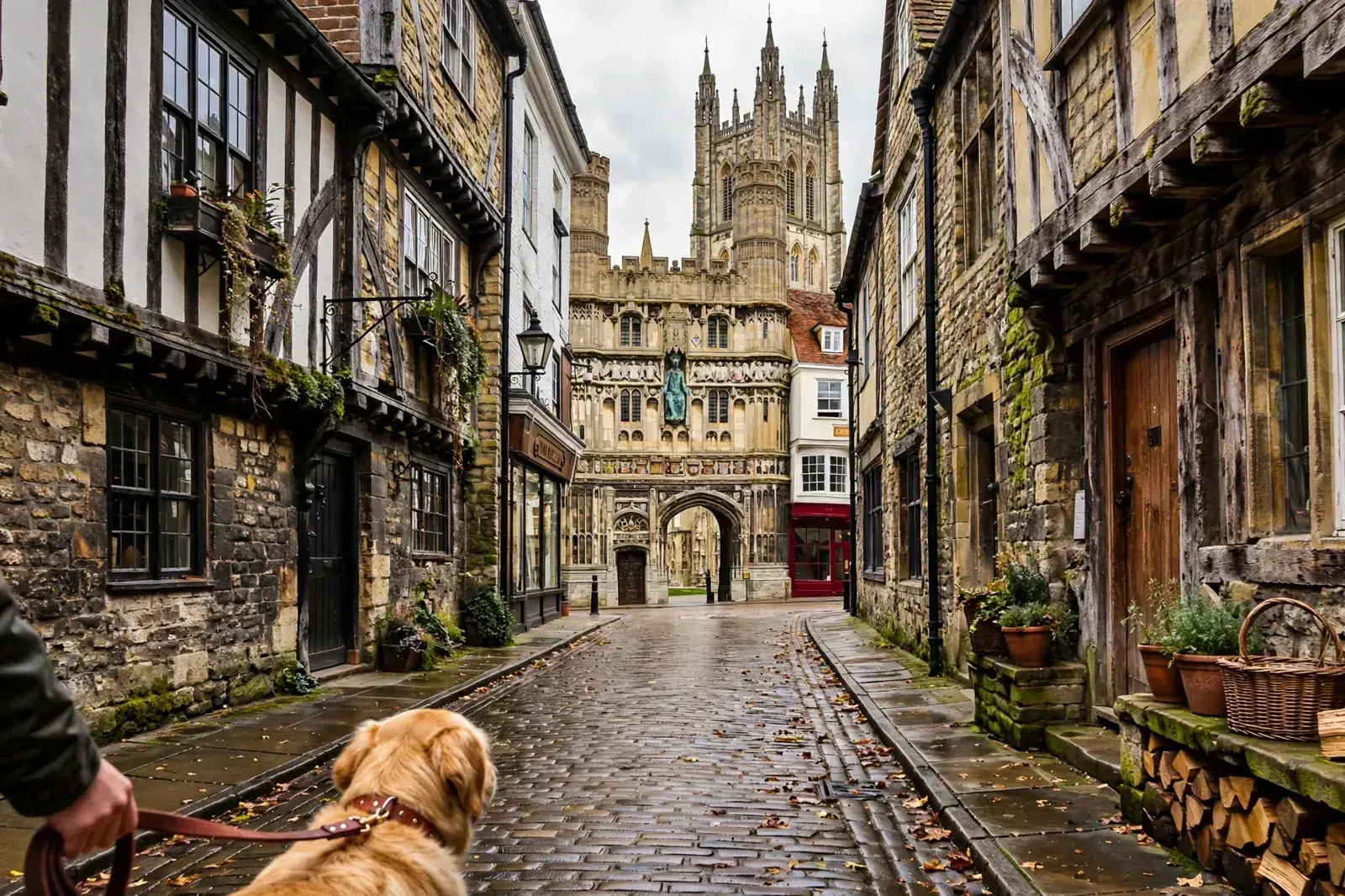
Once you are in Folkestone, the town is compact enough to walk everywhere with a dog, and that is the best way to see it. The distances between the Harbour Arm, the Coastal Park, the Old Town and The Leas are all short, and the only real climb is the one between the seafront and the cliff top. If you are staying for more than a day, Folkestone also makes a good base for the wider area: Dover and its castle are a short drive east, Hythe and Dymchurch are a short drive west along the coast, and Canterbury with a dog is an easy day trip inland, with its cathedral precinct rules, medieval lanes and river walks. Plan one base and one day trip, rather than trying to move every night, and the dog will settle far better.
Where to stay with a dog
Folkestone has a good range of dog-friendly places to stay, from hotels and guesthouses in the town to self-catering cottages and flats near the seafront, and the right choice depends on the dog more than on the view. A dog that settles quickly and sleeps through the night will be happy almost anywhere; a dog that barks at every footstep in the corridor, that cannot manage stairs, or that needs a garden at midnight needs a more careful choice. Before you book, ask the specific questions that matter for your dog, and get the answers in writing.
The questions to ask are the same ones that matter anywhere: does this specific room or unit accept dogs, or only selected ones? Is there a pet charge, and is it per night, per stay or per dog? How many dogs are allowed, and is there a size or breed condition? Is there a garden, a yard or a nearby toilet area that is usable after dark without a long walk or a road crossing? Are dogs allowed in the bar, the restaurant or the breakfast room, or only in the bedroom? And what happens if the dog barks — is there a warning first, or will you be asked to leave? A place that answers those questions clearly is a place that has thought about dogs; a place that answers with a vague "we love dogs" has not.
Location matters as much as the room. A stay near the harbour or the Coastal Park means the first and last walks of the day are short and level, which is a real benefit for an older dog or a puppy. A stay up on The Leas means a view and a quieter night, but it also means a climb down to the beach every morning and a climb back up every evening. A stay in the Old Town means character and cafes on the doorstep, but also steep streets and more noise. There is no single best answer — there is only the best answer for the dog you have, on this trip, in this season.
When you arrive, make the first hour boring, in the same way you would at a holiday park. Walk the dog first, let it sniff the room, put its bed in the place it will sleep, and give it water and a familiar chew. Check the room for hazards before you unpack: cleaning products under the sink, chocolate or biscuits left as a welcome gift, trailing cables, and any gap under a door or window that a small dog could slip through. Photograph any existing damage, and keep the dog's lead, bags and towel by the door so the midnight walk is easy. A calm first evening is the best predictor of a calm stay.
If you are staying for a weekend rather than a single night, plan the weekend as a whole rather than as two separate days. One long walk and one short walk each day is usually better than two long walks, and a rest in the middle of the day — a proper nap, not just a sit-down — will keep the dog's energy steady. Our guide to weekend breaks with dogs in the UK covers the 48-hour pattern in detail: a realistic travel radius, a calm Friday arrival, one anchor walk a day, and a weather back-up. Folkestone fits that pattern well, because the town walk, the park walk and the Warren walk are three different days in one place.
Rain, wind and the seasons
Folkestone is a Channel coast town, which means the weather can change quickly, and the wind is a bigger factor than the rain. A calm morning can turn into a blustery afternoon, and the exposed end of the Harbour Arm and the open stretch of The Leas are the first places to feel it. Check the forecast before you set out, and check it again at lunchtime if you are planning a long cliff walk. If the forecast is for strong winds, skip the Warren and the cliff edge, stay in the sheltered park and the Old Town, and keep the dog on a short lead everywhere.
Spring is one of the best seasons for a dog trip to Folkestone. The Coastal Park is in flower, the beaches are open to dogs until the end of April, and the town is busy enough to be lively without being crowded. The one caution is the changeover at the start of May: the seasonal beach bans come into force on 1 May, so a trip that straddles the end of April and the start of May needs two different beach plans. Check the dates for the year you are travelling, and check the official guidance before you travel if you are anywhere near the boundary.
Summer is the busiest season, and it needs the most planning. The beaches that ban dogs are out of bounds, the Harbour Arm and the park are at their fullest, and the sun on the pier and the pebbles is strong. Walk early in the morning and again in the evening, rest in the shade in the middle of the day, and carry water for the dog at all times. Watch for hot pavements and hot sand, and do not let the dog swim in the sea when it is rough or when there are warning signs. The Warren is the summer answer for a beach walk, but even there, go early, because the car parks and the paths fill up on a hot weekend.
Autumn is often the best season of all. The beach bans lift on 1 October, the town quietens, the light on the Channel is at its best, and the Coastal Park's autumn colour is worth the trip on its own. A dog that has spent the summer on a lead on the promenade can run on Sunny Sands again, and the longer walks to Sandgate and the Warren are at their most comfortable. The one thing to watch is the weather: autumn storms can arrive quickly on the Channel coast, and a wet, windy day on an exposed cliff is no place for a small or nervous dog.
Winter is quiet, bracing and honest. The town is at its emptiest, the beaches are open to dogs, and the Harbour Arm and the Old Town have a different, more local feel. The trade-offs are short days, cold wind off the sea, and the fact that some stalls and cafes reduce their hours or close on quiet weekdays. Dress for the wind, bring a drying coat for the dog, and plan a warm stop in the middle of the day — a cafe in the Old Town, or a pub with a fire — rather than trying to stay outside for six hours. A winter walk in Folkestone, done well, is one of the best dog walks in Kent.
Rain deserves a note of its own, because it is the most common reason a Folkestone trip goes wrong, and it is also the easiest to plan for. The Coastal Park paths are surfaced and stay usable in wet weather, the Old Town cafes and shops give you somewhere to dry off, and the Leas Lift, when it is running, keeps the cliff-top walk accessible without a slippery climb. What does not work in rain is the Zig Zag Path taken at speed, a cliff walk in a downpour, or a long beach walk with no shelter. Pack a dog drying coat, two towels, a waterproof mat for the car, and a change of clothes for yourself. If the rain is heavy and persistent, shorten the walk, dry the dog properly, and save the long walk for the next dry spell — the town will still be there.
A one-day route that works
Here is a route that puts the pieces of this guide together into a single day, in an order that respects the dog's energy and the town's geography. It is a plan, not a timetable: adjust it to the weather, the season and the dog in front of you, and do not be afraid to cut it short. A shorter day that ends well is better than a longer day that ends with a tired, overstimulated dog.
Start at the Harbour Arm, mid-morning, when the pier is calm and the light is good. Walk out to the end, look back at the coastline, and walk back slowly. Give the dog time to sniff the harbour smells and watch the boats, and stop for a drink outside if the dog can settle. Keep this stop to half an hour at most: it is the orientation and the warm-up, not the main walk.
From the harbour, cross to the Lower Leas Coastal Park and walk west through the formal zone towards the fun zone, then on into the wild zone. This is the main walk of the day: level, varied, and long enough to tire most dogs without exhausting them. Keep the dog on a lead in the designated areas, give the play area a wide berth, and take a rest on a bench halfway through. If the dog is still full of energy, continue towards Sandgate and back; if the dog is tiring, turn back at the amphitheatre and save the rest for another day.
After the park, choose your climb. If the dog is fit and the path is dry, take the Zig Zag Path up to The Leas, slowly, with pauses at the turns. If the dog is tired, small or unsteady, take the Leas Lift if it is running, or the road route up. At the top, walk a short stretch of The Leas, look along the coast in both directions, and then come back down by the gentlest route. Do not climb twice in one day unless the dog is clearly asking for it.
Finish the day in the Old Town and the Creative Quarter. Wander the Old High Street, look at the art trail installations, and find a cafe or pub where the dog can settle outside or in a dog-friendly corner. This is the slow, sociable end of the day, and it is where the "new and old" story of Folkestone comes together: the harbour below, the cliff top above, and the steep streets between them that have connected the two for centuries. If you are staying overnight, walk the dog once more before bed, on a short, familiar loop near your stay, and keep the evening quiet.
That is the whole of Folkestone in a day, and it is a day that works for most dogs, in most seasons, with only the beach choice changing. In winter, add Sunny Sands to the morning. In summer, swap it for the Warren. In rain, shorten the cliff walk and lengthen the Old Town stop. The town does not need a complicated plan — it needs a short lead, a read of the signs, and a willingness to let the dog set the pace.
Practical questions
Before you go
Can dogs go on Folkestone Harbour Arm?
Yes, dogs are welcome on the open sections of the Harbour Arm, on a lead. It is a busy food and drink destination, so keep the lead short near stalls and seating, carry water, and check the current signs and any event notices before you go, because rules can change for busy days.
Are dogs allowed on Sunny Sands beach in summer?
No. Sunny Sands and Mermaid Beach are dog-free from 1 May to 30 September each year under the district rules. Dogs are allowed on those beaches from 1 October to 30 April. In summer, use the year-round beaches instead, such as the Warren, and keep dogs on a lead on the promenade where signs require it.
Where can dogs run off the lead near Folkestone?
The Warren beach, reached by the Zig Zag path and the coast path towards Dover, allows dogs all year round and is the usual choice for a longer off-lead walk. Parts of the Lower Leas Coastal Park have an off-lead area below Leas Cliff Hall and around the amphitheatre, but most of the park now requires a lead, so read the signs in each section.
Do dogs have to stay on a lead in the Lower Leas Coastal Park?
In most of the park, yes. The council states that owners must keep dogs on leads in the designated areas, and the 2025 Dog Control Public Spaces Protection Order extended the on-lead areas. There is still an off-lead section below Leas Cliff Hall and around the amphitheatre, but do not assume a whole stretch is off-lead: check the signs at each entrance and keep the lead ready.
Is the Zig Zag Path suitable for dogs?
It is suitable for fit, sure-footed dogs on a lead, but it is steep, with steps, narrow turns and artificial rockwork. Older dogs, very small dogs and dogs that struggle with steps may find it hard, especially in wet weather. A gentler alternative is the Leas Lift or the road route down to the seafront, where the lift is running; check the official guidance before you travel.
Where should I park in Folkestone with a dog?
The Lower Leas Coastal Park car park is the most practical choice for a park and beach walk, and there is parking at the harbour end too. The park car park is closed between 8pm and 7am daily. Arrive early on sunny weekends, check the signs for charges and time limits, and never leave a dog in a parked car in warm weather.