This guide is independent and contains no paid placement. If affiliate links are added later, they will be clearly marked and will not change our editorial checks.
Fraserburgh works best as a relaxed, outdoors-first dog trip: a long sandy beach for a proper run, a lighthouse headland for views, and a working harbour for a short on-lead stroll. Book a dog-friendly stay early, check beach and attraction rules before you travel, and plan around wind, tides and the working port.
Fraserburgh at a glance
Fraserburgh sits on the north-east coast of Aberdeenshire, where the land turns a corner into the North Sea. It is one of Scotland's most important fishing ports, and that working character shapes the whole visit: boats, nets, gulls, the smell of the sea and a harbour that is busy long before most visitors are awake. For a dog owner, that means a town that is best enjoyed outdoors, on foot, with the dog on a lead in the busiest spots and free to stretch out on the open sand.
The town is compact enough to explore without a car once you arrive. The beach lies to the east of the town centre, the harbour and Kinnaird Head lighthouse sit at the northern edge, and the main shopping streets run between them. A fit dog can comfortably cover the highlights in a single day, while a slower or older dog will be happier with the beach and one short harbour loop, split across two easy outings with a rest in between.
Fraserburgh is not a resort town in the usual sense. There are no arcades, no long promenade of amusements and no crowds of holidaymakers for most of the year. What it offers instead is space: a beach that runs for miles, big skies, a lighthouse with a genuine claim to history, and a coastline that feels properly wild when the wind picks up. Dogs that love open ground, sand and sea air will be in their element here, and owners who like their walks unhurried will find the pace suits them too.
Getting here takes a little planning. Fraserburgh is about 40 miles north of Aberdeen, and the drive follows the A90 and then the A952 through farmland and small villages. There is no railway station in the town, so most visitors arrive by car or by bus from Aberdeen. That relative remoteness is part of the appeal, but it also means you should sort out accommodation, parking and a vet contact before you set off, rather than assuming everything will be easy to find on arrival.
Before the detail, it is worth setting expectations honestly. Fraserburgh is a working port, not a manicured tourist destination, so some streets are plain, some buildings are weathered, and the harbour is a place of work first and a viewpoint second. The reward for accepting that is a dog trip that feels real rather than packaged: gulls overhead, boats coming and going, sand underfoot and a lighthouse that has guided ships since the eighteenth century. If that sounds like your kind of break, the sections below cover the beach, the lighthouse, the harbour, the walks, the food and the practical details in turn.
Fraserburgh Beach with a dog
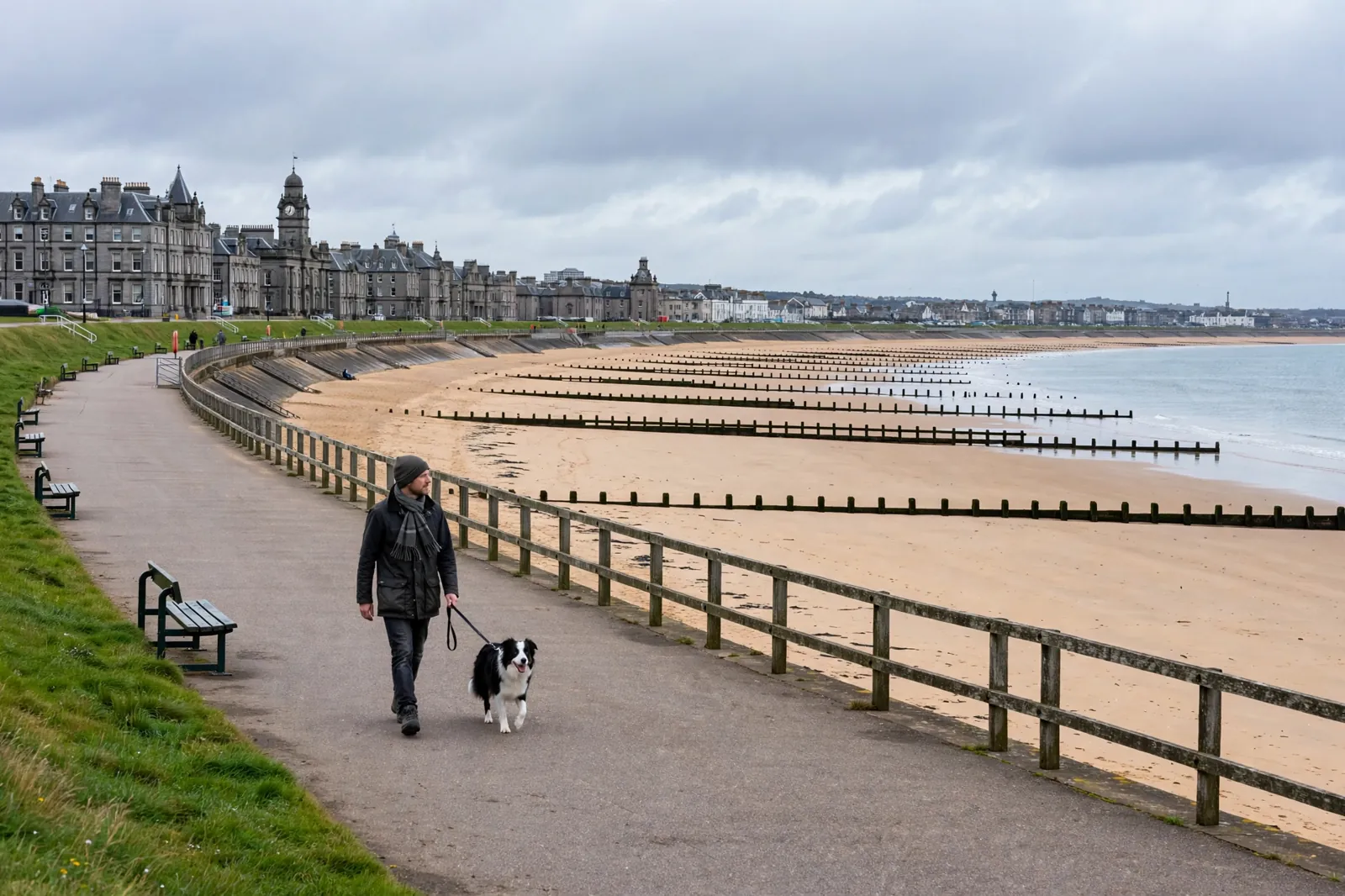
Fraserburgh Beach is the main reason most dog owners come to the town, and it does not disappoint. It is a long, wide stretch of pale sand running east from the town, backed by dunes and grassland, with the North Sea on one side and open sky on the other. At low tide the sand firms up into a huge, flat expanse that suits ball games, long recalls and the kind of run that tires a busy dog properly. At high tide the beach narrows, so check the tide times before you plan a long walk and give yourself time to get back.
Access is straightforward. There are paths from the town and from parking areas near the beach, and the sand is generally easy underfoot for dogs of all sizes. The dunes behind the beach are worth exploring too, but keep your dog under control there: dunes are fragile habitats, ground-nesting birds use them in the breeding season, and the grass can hide rabbit holes and sharp debris. Stick to the paths where they exist, and keep a lead handy for the moments when other walkers, horses or wildlife appear.
Rules are the one thing to check rather than assume. Fraserburgh Beach is commonly walked with dogs, but seasonal or signed local rules can apply, so check the official guidance before you travel and read the notices at the access points you use. Scottish beach rules are set locally, and what applies on one stretch of coast may not apply on the next. If a sign asks for dogs on leads in a particular area, follow it: the restriction is usually there to protect wildlife, livestock or other beach users, and it is generally short and clearly marked.
Safety on a beach this exposed deserves a proper thought. The North Sea is cold all year, and the water off Fraserburgh can have strong currents, so never encourage a dog to swim far out, and do not let a dog chase waves into deep water. Watch for fishing debris, broken shell and the occasional jellyfish washed up on the sand. In summer, check the sand temperature with your own hand before a long walk, and carry water for the dog rather than relying on the sea: salt water upsets a dog's stomach, and a thirsty dog that drinks from the sea will only feel worse.
After the walk, plan the clean-up. Sand gets everywhere: between toes, in ears, in the car and in the bed of any accommodation that does not expect it. A quick rinse with fresh water, a towel dry and a check between the toes will prevent most of the irritation that follows a beach day. If your dog has rolled in something unpleasant, a dog-friendly shampoo and a proper wash at your stay will be needed, so check whether your accommodation has an outdoor tap or a wash area before you book. Bring more poo bags than you think you need, because the nearest bin may be a long way back along the sand.
For many dogs, the beach is the best part of the day, and the best way to use it is simply: go early, when the light is good and the beach is quiet; let the dog run where it is allowed; and save the harbour and town for later, when the dog is calmer and happier on a lead. A tired, sandy, happy dog is the usual result, and that is the whole point of coming here.
Kinnaird Head and the lighthouse
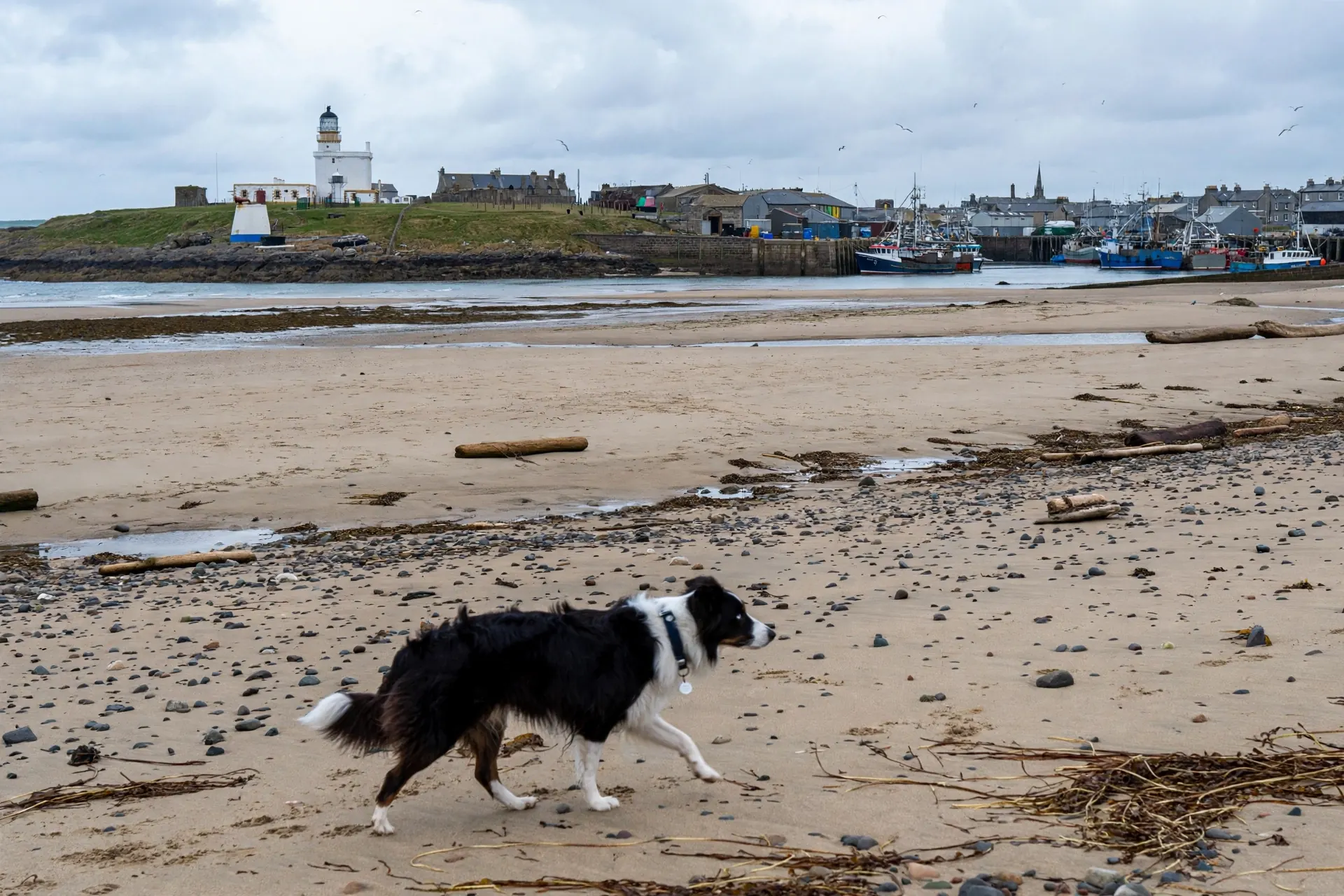
Kinnaird Head is the rocky headland at the northern edge of Fraserburgh, and it holds the town's most famous landmark: the lighthouse that stands in the former Kinnaird Head Castle. The lighthouse was first lit in 1787, making it the first lighthouse built by the Northern Lighthouse Board in Scotland, and the castle tower it sits in dates back further still. Today the site is home to the Museum of Scottish Lighthouses, which tells the story of Scotland's lights, their keepers and the engineering behind them.
For a dog owner, the headland is best treated as an outdoor visit. The museum itself is an indoor attraction, so dogs are not generally expected inside the galleries, and assistance dogs should be welcome as usual. Check the official guidance before you travel, because access policies can change, and if you are travelling as a pair, one person can visit the museum while the other walks the dog around the headland. The grounds, the views and the walk to the point are all enjoyable with a dog on a lead, and the lighthouse itself photographs well from the rocks and the paths around it.
The walk to Kinnaird Head from the town centre is short and easy, and it gives a good sense of the town's geography: the harbour on one side, the beach curving away on the other, and the open sea ahead. The ground around the headland is rocky in places, so keep your dog on a lead near the cliff edges and the harbour walls, and watch for slippery stone after rain. The wind here is often stronger than in the town, so hold on to hats, leads and anything loose, and be ready to cut the visit short if a nervous dog finds the gusts unsettling.
There is more to see around the headland than the lighthouse alone. The Wine Tower, a small sixteenth-century structure near the harbour, is one of the oldest buildings in the area and a reminder that Fraserburgh has been a port for centuries. The harbour lighthouse on Balaclava Pier, at the end of the pier, is a smaller and more modern light, but it makes a good destination for a short walk and a photograph. Neither building is a dog attraction in itself, but both give a walk a sense of purpose, which matters when you are trying to keep a dog interested on a lead.
If the museum is on your list, check its opening times before you go, because seasonal hours apply and the site can be closed on some days. The same applies to any guided tour or tower climb: these are popular, they are ticketed, and they are not suitable for dogs. Plan the museum as a human activity with the dog's walk fitted around it, rather than the other way round, and nobody will be disappointed.
The harbour and a town walk
Fraserburgh Harbour is one of the largest fishing harbours in Scotland, and it is a working place first and foremost. Boats come and go, lorries move fish, forklifts cross the quays, and nets and crates are part of the scenery. That activity is exactly what makes a harbour walk interesting, but it also means the dog stays on a lead, close to you, for the whole visit. Never let a dog run loose around a working harbour, and never let a dog swim in harbour water, where boats, ropes and pollution make it genuinely dangerous.
A sensible harbour loop starts near the town centre, follows the quays out towards the piers, and returns along the same route or by a parallel street. Along the way you will see trawlers and smaller boats, the fish market buildings, the lifeboat station and the harbour lighthouse at the end of Balaclava Pier. The walk is flat, which suits older dogs, and it is short enough to fit between beach outings. Early morning is the busiest time for harbour work, so if your dog is nervous around vehicles and noise, choose a quieter time of day and keep the loop short.
From the harbour, the town centre is a short walk away. Fraserburgh's main streets hold the practical things a dog trip needs: supermarkets, a pharmacy, cafes, pubs and places to buy forgotten supplies. The town centre is not large, and a slow wander through it with the dog is a pleasant way to fill an hour. Keep the dog on a short lead on the pavements, watch for dropped food near takeaways, and be ready to cross the road if another dog appears and yours would rather not meet it.
One thing worth noting is the smell. A working fishing harbour smells of fish, diesel and salt, and most dogs find that fascinating. It also means there may be fish waste, bait and discarded food on the ground, so keep a close eye on what your dog is sniffing and be ready to move them on. A "leave it" command earns its keep in a harbour town, and a dog that is prone to scavenging should stay on a lead and be watched closely throughout the town walk.
For a longer town loop, combine the harbour with the beachfront path and the streets around Kinnaird Head. The route is easy to improvise, and the town is small enough that you are never far from your starting point. A map on your phone helps, but the landmarks are obvious: follow the sea, follow the lighthouse, and you will find your way back. Finish the walk at a dog-friendly cafe if you can, and give the dog a rest and some water before the next outing.
Longer walks from the town
Fraserburgh is a good base for longer coastal walks, and the coastline in both directions rewards the effort. To the east, the beach and dunes continue for miles towards the sands at Philorth and beyond, and a fit dog can enjoy a long out-and-back along the shore. To the west, the coast runs towards Rosehearty, a small fishing village with its own harbour and beach, and the clifftop paths in between offer a different kind of walk: shorter grass, sea views and the sound of the waves below.
The Rosehearty direction deserves a mention because it is the most popular longer walk from the town. The village is a few miles west, and the route follows the coast with views back towards Fraserburgh and Kinnaird Head. The walking is generally straightforward, but the ground is uneven in places and the cliffs demand respect, so keep your dog on a lead near the edges and check the route before you set out. If you drive to Rosehearty instead, the village beach and harbour make a quieter alternative to Fraserburgh Beach, and the walk back towards town can be done in either direction.
Inland, the walking is gentler. The countryside around Fraserburgh is farmland, and there are quiet lanes and tracks that suit a calm, on-lead walk, but remember that this is working agricultural land: keep dogs on a lead around livestock, close gates behind you, and follow the Scottish Outdoor Access Code. That code gives the public a right of responsible access to most land in Scotland, but it also places a duty on dog owners to keep dogs under control, especially around farm animals, and to pick up after them. Lambing season, roughly spring, is the time to be most careful of all.
Whatever route you choose, plan for the coast's changeable weather. A walk that starts in sunshine can end in rain and wind, and there is little shelter on the open beach or the clifftops. Carry a waterproof for yourself, a towel for the dog, water, and a phone with charge. Tell someone your route if you are walking alone in a remote stretch, and be honest about your dog's fitness: a long beach walk in soft sand is hard work, and a dog that is tired halfway back still has to walk the whole way home.
Finally, think about the dog's paws and coat on longer walks. Sand, salt and rough ground can irritate paws, and a long walk in the rain will soak most dogs through. A paw check at the end of the walk, a rinse if needed, and a dry bed will keep a multi-day trip comfortable. If your dog is not used to long coastal walks, build the distance up over the first two days rather than doing the longest walk on the first morning.
Eating out with your dog
Fraserburgh's cafes and pubs are mostly small, local places, and that is part of their charm. Some welcome dogs, often in outdoor seating areas or in a specific indoor space, and some do not, so the golden rule is to check before you sit down. Policies can change, and a place that welcomed dogs last year may have changed its rules, so check the official guidance before you travel or simply phone ahead on the day. A quick call saves an awkward moment at the door with a tired dog and a hungry owner.
When you do find a dog-friendly spot, make it easy for everyone. Bring a mat or blanket for your dog to lie on, a water bowl, and a chew or a stuffed toy to keep them settled while you eat. Choose a table at the edge of the room or outside, away from the main walkway, and keep the lead short and under your chair. Order promptly, keep the visit reasonably short, and be ready to leave if your dog becomes restless: a calm dog that is welcome back is worth more than one long lunch.
Outdoor seating is the most reliable option in a harbour town, and Fraserburgh has places where you can sit outside with a view of the street, the harbour or the sea. In summer that is a pleasure; in winter it can be cold and windy, so bring an extra layer for yourself and a coat for a short-coated dog. If the weather turns, a takeaway eaten on a bench or back at your accommodation is often the better choice, and nobody will think less of you for it.
Fish and chips are the obvious local food, and Fraserburgh has chippies and cafes that do them well. Remember that fried food, bones and hot fat are all bad for dogs, so keep your meal out of reach and do not be tempted to share. The same goes for ice cream, cakes and anything with chocolate or xylitol. A few treats from your own pocket will keep your dog happy without risking an upset stomach or a vet visit.
If you are self-catering, the town's supermarkets cover the basics, and a dog that eats its usual food on holiday is a dog with a settled stomach. Stick to the dog's normal diet, bring enough of their usual food for the whole trip plus a day spare, and avoid sudden changes. A holiday is not the time to experiment with new treats or new brands.
Where to stay with a dog
Dog-friendly accommodation in Fraserburgh is available, but the choice is smaller than in a big resort town, so book early, especially for summer weekends and school holidays. The options are a mix of hotels, guest houses, bed and breakfasts, self-catering cottages and caravan sites in the surrounding area. Each suits a different kind of dog: a hotel room suits a calm dog that settles quickly, while a self-catering cottage with a garden suits a dog that needs outdoor space and a routine close to home.
When you book, ask the specific questions that matter for your dog rather than relying on a "dog-friendly" label. Is there a charge per dog, and how much? How many dogs are allowed? Is there a garden, and is it enclosed? Are dogs allowed in all rooms or only in selected ones? Is there somewhere to wash a sandy dog, and is there a charge for extra cleaning? Get the answers in writing with your confirmation, because a friendly phone call is no substitute for a written record if there is a dispute on arrival.
Self-catering is often the easiest option for a dog trip to Fraserburgh. A cottage or flat gives you a kitchen, a door you can open for a late-night toilet trip, and a space where the dog can follow its normal routine. Look for ground-floor access, a garden or yard, hard floors that are easy to clean, and a location near the beach or a quiet street rather than a busy road. If the listing mentions a garden, check whether it is genuinely enclosed: a low wall or an open gate is not the same as a secure fence, and a dog that escapes in an unfamiliar town is a serious worry.
Hotels and guest houses can work well too, but check the details. Some welcome dogs only in certain rooms, some charge a per-night fee, and some ask that dogs are not left alone in the room. If you plan to eat in the hotel restaurant, ask whether the dog can join you on a terrace or in a bar area, or whether you will need to take turns staying with the dog. A hotel near the harbour or beach will save you a drive at the start and end of each day, which matters more than it sounds when you are walking a dog twice a day in all weathers.
Caravan and campsite options in the wider area suit owners who like to bring their own space, but check the site rules on dogs, leads, awnings and exercise areas before you book. Some sites have a dedicated dog walk, some require dogs to be on a lead at all times, and some restrict the number of dogs per pitch. Arrive in daylight if you can, walk the pitch boundary before letting the dog off the lead, and keep the first evening quiet so the dog settles.
Whatever you choose, pack for the accommodation as well as the dog. Bring the dog's bed, bowls, usual food, a towel, a lead and a spare, poo bags, and a familiar toy or blanket. Photograph any existing damage when you arrive, keep the dog off beds and sofas unless the host has said it is allowed, and leave the place as you found it. A good guest is a welcome guest, and hosts remember the dog owners who leave a clean room.
Parking, vets and practical details
Parking in Fraserburgh is generally straightforward, and there is parking near the beach, the harbour and the town centre, with on-street parking also available in parts of the town. Choose a spot close to your planned walk so your dog does not have to cross busy roads, and check the signs for time limits and charges, because rules vary from one car park to another. In summer, the beach car parks fill up on fine days, so arrive early or be ready to walk a little further.
Never leave a dog in a car on a warm day, even with the windows open a little: cars heat up fast, and a dog can overheat in minutes. In winter the risk is different, but the rule is the same on a sunny day: if in doubt, take the dog with you. Plan your stops so the dog is never left waiting in the car while you visit a shop or an attraction that does not allow dogs.
Before you travel, save the details of a local vet. Fraserburgh has veterinary practices in the town, and there are others in the surrounding area, but opening hours vary and emergency cover may be provided by a practice some distance away. Save the number in your phone, note the address, and check the opening hours for the days you will be there. If your dog takes regular medication, bring more than you need, keep it in its original packaging, and carry the prescription details with you.
A few other practical points are worth covering. Bring a first-aid kit for the dog: saline for rinsing eyes, a tick remover, bandages, and any medication your vet has advised. Ticks are present in grassland and dunes in Scotland, so check your dog after walks in long grass and remove any ticks promptly. If your dog is not used to the sea, watch for the signs of salt-water sickness after swimming, and contact a vet if the dog is vomiting, lethargic or unsteady.
Phone signal and data are generally fine in the town, but can be patchy on the more remote stretches of coast, so download your maps and tide times before you set out. A charged phone, a spare lead, water and a towel in the car will cover most eventualities. Finally, remember the Scottish Outdoor Access Code: pick up after your dog everywhere, keep dogs under control around livestock and wildlife, and leave gates as you find them. The coast is shared with farmers, fishermen and other walkers, and good manners keep it open for everyone.
Seasons and coastal weather
Fraserburgh's weather is the weather of the north-east Scottish coast: changeable, windy and often brighter than the forecast suggests. The town faces the North Sea, and the wind is a constant companion, even on a sunny day. That wind keeps the air fresh and the skies dramatic, but it also means you should dress for the conditions you will actually meet on the beach, not the conditions you can see from the car window.
Late spring and summer, from May to September, are the most popular months for a dog trip. Daylight is long, the beach is at its most inviting, and the town's cafes and attractions are open for the longest hours. This is also the busiest time, so book accommodation early and expect more people and dogs on the beach. Even in summer, bring a windproof layer and a waterproof: a sea breeze can turn a warm afternoon cold in minutes, and a shower can arrive with little warning.
Autumn, from September to November, is often the best-kept secret. The crowds thin out, the light turns golden, and the beach belongs to dog walkers again. The sea is at its warmest in early autumn, although it is never truly warm, and the walking is comfortable for dogs that overheat in summer. Storms become more frequent as the season goes on, so check the forecast and the tide times, and be ready to swap a beach walk for a shorter harbour loop on a rough day.
Winter brings short days, strong winds and the possibility of frost, snow and sea haar, the coastal fog that can roll in quickly and cut visibility. Winter visits can be rewarding: the beach is empty, the light is extraordinary, and the town feels properly local. But the cold is real, and a short-coated or older dog will need a coat, shorter outings and a warm place to dry off afterwards. Check that your accommodation has heating that works well, and plan your walks for the middle of the day when the light and the temperature are at their best.
Whatever the season, the practical advice is the same: check the forecast the night before and again in the morning, check the tide times for any beach walk, and carry a waterproof and a towel. A dog that is warm, dry and tired at the end of the day is a happy dog, and the North Sea coast rewards the walkers who come prepared.
Day trips from Fraserburgh
Fraserburgh makes a good base for exploring the north-east, and a day trip with the dog can add variety to a longer stay. The most obvious is Aberdeen, about 40 miles to the south, where a long sandy beach, parks, the old town and the River Dee give a city day a dog-friendly shape. Our guide to Aberdeen with a dog covers the beach and boulevard rules, Duthie and Hazlehead parks, dolphin watching at Torry Battery and the walks into Royal Deeside, and it is worth reading before you drive south.
To the west, Moray offers a different landscape: sandy beaches, a cathedral town and quieter roads. Elgin is about an hour's drive, and its cathedral ruins, riverside paths and compact town centre make a relaxed day out. Our guide to Elgin with a dog covers the cathedral walks, the riverside paths, the dog-friendly cafes and the practical details of visiting Moray's main town, and it pairs well with a stop at one of the Moray coast beaches on the way.
Inland, Royal Deeside is the classic Aberdeenshire day trip, and Ballater is one of its most dog-friendly villages. The River Dee, the woodland trails, the village cafes and the walk towards Balmoral give a day out a very different feel from the coast, and the drive itself is part of the pleasure. Our guide to Ballater with a dog covers the riverside walks, the village, the parking and the seasonal tips, and it is a good read if you fancy a change of scenery after two days of sand and sea.
Closer to home, the villages along the Aberdeenshire coast are worth a slow drive. Peterhead, the other great fishing port of the north-east, is about half an hour south, and its harbour and maritime museum give a different view of the fishing life. Smaller places such as Rosehearty, Banff and Macduff each have their own harbour, beach and character, and a dog that travels well in the car will enjoy the variety. Keep the day trips short and the dog's routine steady, and the base at Fraserburgh will still feel like home at the end of the day.
One final piece of advice for day trips: plan the dog's day first, and fit the sightseeing around it. A morning walk near your accommodation, a drive with a stop halfway, a walk at the destination, and an early return will suit most dogs far better than a long day with no proper exercise. The north-east is a big area, and the best trips are the ones that leave the dog tired and content rather than restless and overstimulated.
Practical questions
Before you go
Can dogs go on Fraserburgh Beach all year?
Fraserburgh Beach is a long, open sandy beach and dogs are commonly walked there, but seasonal or signed local rules can apply, so check the official guidance before you travel and read the signs at the access points. Keep your dog under control around other beach users, pick up after them, and be ready to use a lead near car parks, roads and other dogs.
Is the Museum of Scottish Lighthouses dog-friendly?
The museum at Kinnaird Head is an indoor attraction, so dogs are not generally expected inside the galleries. Assistance dogs should be welcome, and the outdoor grounds and lighthouse views can still be enjoyed with a dog on a lead. Check the official guidance before you travel, because access policies can change.
Where can I walk my dog near Fraserburgh Harbour?
The harbour area suits a short, on-lead walk along the quays and piers, with views of fishing boats and the lighthouse. Keep your dog on a lead at all times around the working harbour, stay clear of moving vehicles, cranes and mooring lines, and never let a dog swim in the harbour.
Are there dog-friendly cafes in Fraserburgh?
Fraserburgh has cafes and pubs in the town centre and near the harbour, and some welcome dogs, often in outdoor seating areas or specific indoor spaces. Policies vary from place to place and can change, so check the official guidance before you travel, phone ahead, and bring a mat and water bowl for your dog.
Where should I park with a dog in Fraserburgh?
There is parking near the beach, the harbour and the town centre, with on-street parking also available in parts of the town. Choose a spot close to your planned walk so your dog does not have to cross busy roads, check the signs for time limits and charges, and never leave a dog in a car on a warm day.
What is the best time of year to visit Fraserburgh with a dog?
Late spring, summer and early autumn usually give the best walking weather, with long daylight hours and the widest choice of open attractions. Winter visits can be rewarding too, with quieter beaches and dramatic North Sea light, but expect strong winds, rain and shorter days, and dress for the exposed coast.