This guide is independent and contains no paid placement. If affiliate links are added later, they will be clearly marked and will not change our editorial checks.
Climb Catherine Hill first, while the dog is fresh, then browse the independent shops and the market streets at a slow pace, and finish with a flat riverside walk to cool down. Most shops and cafes welcome dogs, the town is compact and walkable, and the Somerset lanes start at the edge of town — check the official guidance before you travel for current rules.
Climb Catherine Hill first
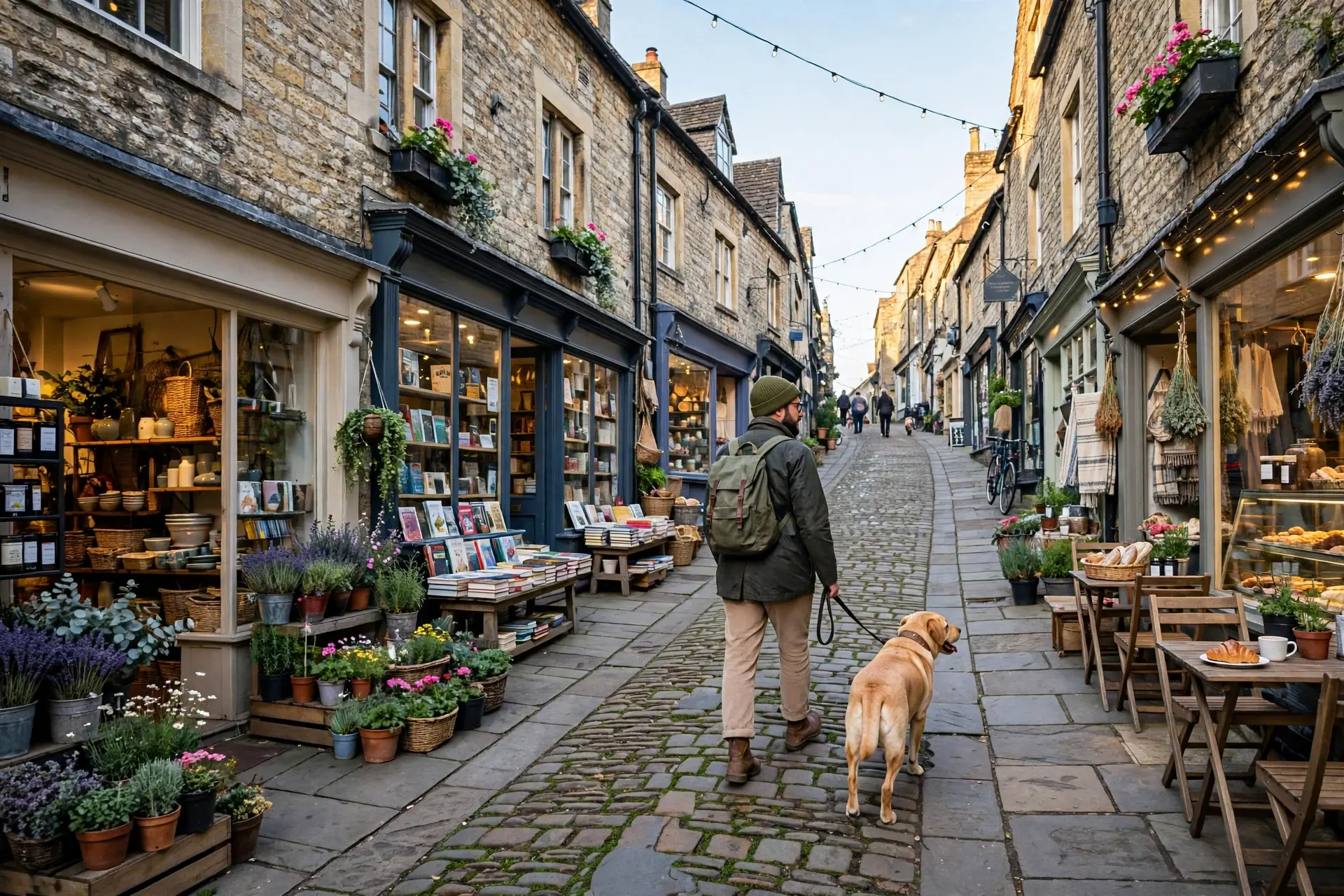
Catherine Hill is the street that defines Frome: a steep, cobbled lane of stone cottages and small independent shops that climbs from the town centre to the top of the hill, and it is the first thing to do with a dog in Frome. The climb takes only a few minutes, but the cobbles are uneven and the hill is steep enough to make your calves work, and the street is narrow, with shoppers, dogs and delivery vans sharing the same space. Dogs on leads are welcome on the hill, and the climb is the best way to get a feel for the town — the shopfronts, the stone walls, the views back down the street and the sense that this is a town built for walking rather than driving.
Take the climb slowly, and watch the dog's paws on the cobbles, particularly in hot weather, when the stone can be warm, and in wet weather, when the cobbles are slippery. A harness gives you better control than a collar on a steep, narrow street, and a short lead keeps the dog out of the way of other shoppers. The shops on Catherine Hill are small and individual — a bakery, a bookshop, a gallery, a cafe — and several of them welcome dogs inside, so the climb doubles as a shopping trip. Stop halfway for a look back down the hill, because the view of the rooftops and the church tower is one of the best in the town, and the dog will appreciate the pause.
At the top of the hill, the town opens out into the quieter streets around the church and the old town, and the walking gets easier. The hill is at its best in the morning, when the shops are opening and the light catches the stone, and again in the late afternoon, when the day visitors have gone and the street is quiet. If your dog is older, very small or struggles with steps, the hill is still worth a look from the bottom, and the flat streets and the riverside paths give the same town a gentler shape. Whatever your dog's fitness, do the hill first, while the dog is fresh and the street is quiet, and save the flat walking for later in the day.
The lanes and the old town
Beyond Catherine Hill, Frome is a town of lanes: narrow, stone-walled passages that wind between the houses, climb the hillsides and connect the different quarters of the town. The lanes are the pleasure of walking in Frome, and they are the reason the town rewards a slow, aimless wander rather than a fixed route. Dogs on leads are welcome in the lanes, and the walking is easy once you are off the main hill, with the lanes giving you shade in summer and shelter from the wind in winter. The old town around the church and the Market Place is the historic heart of the town, with medieval street patterns, old coaching inns and a parish church that dominates the skyline.
Start at the Market Place and work your way through the lanes towards the church, stopping at the shops and the cafes that catch your eye. The town has a long history as a centre for the wool trade, and the buildings tell that story: the old mills by the river, the merchants' houses on the hillsides, and the weavers' cottages in the lanes. The lanes are residential as well as commercial, so keep the dog close, keep the noise down, and do not block the doorways. The best time to enjoy the lanes is early morning, before the shops open, or late afternoon, when the town is quiet and the light is low. If you are here in summer, the lanes are cool and shaded, which makes them a good refuge from the heat of the open streets.
The lanes also connect the town centre to the riverside and the open ground on the edge of town, so a wander through the lanes naturally leads into a longer walk. Look out for the small details: the stone doorways, the old signs, the gardens behind the walls and the views across the rooftops to the hills beyond. Frome is a town that rewards looking up as well as looking ahead, and a dog on a lead is the perfect companion for that kind of slow, curious walking. Keep to the pavements where there are any, because the lanes carry traffic, and the pavements are narrow in places.
Independent shops, with a dog
Frome is famous for its independent shops, and the town has one of the highest proportions of independent traders of any town in England. The High Street, Catherine Hill and the side streets are full of small, individual businesses — bookshops, delicatessens, bakeries, galleries, craft shops, vintage stores and cafes — and the town's reputation for independence is a point of local pride. Dogs are welcome in many of the shops, and the traders are generally relaxed about dogs, because the people who live in Frome own dogs and bring them shopping. Ask at the door if you are unsure, and keep the dog close in the smaller shops, where the aisles are narrow and the stock is delicate.
Shop the way the town wants to be shopped: slowly, and with the dog's comfort in mind. Catherine Hill's shops are small, with narrow aisles and delicate stock at nose height, so keep the lead short and the dog close, and ask at the door if you are unsure — most traders will wave you in, because they keep dogs themselves. A mat from home gives the dog a place to lie in the cafes while you look at the books and the pottery, and the delicatessens and bakeries are the practical stop, selling picnic supplies for the riverside. If the dog is nervous in crowds, use the side streets and visit on a weekday, when the same shops are open and the browsing is calm.
The shops are at their liveliest on market days, when the town fills with visitors and the streets are busy, but the same shops are open on quieter weekdays, when the browsing is calmer and the dog can settle. If your dog is nervous in crowds, visit on a weekday instead of a market day, and use the side streets to avoid the busiest stretches. The shopkeepers are a good source of local information: ask about the best riverside walk, the dog-friendly pubs, and the quiet lanes, and you will get advice that no guidebook can match. Frome is a town that rewards a slow, curious shopper, and a dog on a lead is the perfect companion for that kind of day.
Market days and the Frome Independent
Frome's markets are the town's great social occasion, and the best known is the Frome Independent, a monthly market held on the first Sunday of the month, when the town centre fills with stalls selling local food, crafts, vintage goods and street food, with live music and a festive atmosphere. The Independent is one of the biggest monthly markets in the South West, and it draws visitors from across Somerset and beyond. Dogs on leads are welcome at the market, and the town is used to dogs, but the streets are crowded on market days, so the visit needs more planning than a quiet weekday. If your dog is confident in crowds, market day is a delight; if your dog is nervous, visit on a quieter day instead.
The regular markets run through the week as well, with a farmers' market and a general market on different days, and the stalls sell local produce, cheese, bread, flowers and crafts. The Market Place is the centre of the market activity, and the streets around it fill with stalls and shoppers on market days. The market is a good place to pick up picnic supplies for a riverside walk, and the street food stalls are a good source of lunch. Keep the dog on a short lead in the market, because the stalls are close together and the crowds are dense, and watch out for dropped food, which a greedy dog will find before you do.
Practical points for market days: arrive early, before the crowds build, and park in one of the larger car parks on the edge of town; bring water and a bowl for the dog, because the market streets offer little shade; and have a quiet backup plan — the riverside paths or the lanes — if the dog gets overwhelmed. The market is also a good place to meet local people and to learn about the town, so talk to the stallholders and ask about the dog-friendly pubs and the best walks. Check the town's events calendar before you travel, because the market dates can change, and a local fair or a festival can make a visit more interesting or more crowded.
The riverside walk: the town's green lung
Follow the River Frome downstream from the town centre and the town falls away fast. The path leaves the last houses behind, crosses Rodden Meadow — flat, open grassland where the river spreads out and the kingfishers work the banks — and settles into the easy, level walking that makes this the dog's favourite part of Frome. The ground is soft, the trees close overhead in summer, and there are shallow spots where a dog can paddle without a scramble down a bank. It is the counterweight to Catherine Hill: where the hill is steep, narrow and busy, the riverside is flat, wide and quiet, and after an hour on the cobbles the dog will choose the meadow every time.
Look for the signs of the river's working past as you walk. Old mill buildings stand along the banks, the weir still runs below the town, and the path passes the sort of brick and stonework that tells you this river once powered the town's cloth trade. Dippers bob on the stones in the faster stretches, herons stand motionless in the shallows, and in spring the banks are loud with birdsong. Keep the dog on a lead through the meadow edges where the ground-nesting birds are, and do not let it chase the ducks up from the water. The path can be muddy after rain, and after heavy rain the river rises quickly and the lower sections flood, so boots and a towel in the car are worth having from October to March.
Time the riverside for the edges of the day. Early morning, before the shops open, the meadow belongs to the local dog walkers and the mist sits on the water; late afternoon, when the day visitors have left, the light comes low through the trees and the path empties. Both are better than midday, when the sun hits the open meadow and there is little shade. The walk links easily to the lanes out of town, so a short riverside loop can stretch into a half-day if the dog is fresh — out along the river, back through the fields above the town — and there are benches where the path meets the meadow for a sit-down and a sandwich. Before you set off after heavy rain, look at the local river levels: a flooded path is no fun for anyone, and the town centre gives you a dry alternative.
Out into the Somerset lanes and villages
Frome sits at the edge of the Somerset countryside, and the lanes and footpaths that lead out of town are the town's great walking asset. The countryside around Frome is a patchwork of fields, woods, streams and small villages, with the Mendip Hills to the west and the Wiltshire downs to the east, and the walking is gentle, varied and rewarding. The most popular routes start from the edge of town and follow the lanes and the footpaths out into the open country, and a two-hour loop is easy to put together without ever crossing a busy road. The ground underfoot is mostly grass and earth, which stays firm in dry weather, and the walking is easy once you are out of town.
The villages around Frome — Nunney, with its castle and its brook, Beckington, with its village green, and the smaller hamlets in the lanes — make good destinations for a walk, with a pub at the far end and a quiet return along the lanes. Nunney Castle is a romantic ruined castle in a village setting, and the castle grounds are a pleasant place to walk a dog on a lead, though the interior is not open to dogs — check the official guidance before you travel for the latest access rules. The walk to Nunney takes about an hour each way, and the village has a pub and a cafe for a rest. The lanes around Frome are also good for cycling, and the quiet roads are popular with local cyclists, so watch out for bikes on the narrow lanes.
- Rodden Meadow circuit: roughly an hour, flat, good for pups and older dogs, with the river beside you throughout.
- Out to Nunney: an hour each way, through fields and lanes, with a castle and a pub at the far end.
- Lanes above the town: ninety minutes there and back, a gentle climb and open views across the rooftops.
- Up to the Mendips: half a day for fit dogs; dry weather, water and a packed lunch in the bag.
The lanes have no water points and no shade, so the bottle and the bowl go in the bag before you leave the house, and the forecast gets checked before you set off — the lanes are exposed, and a bright morning can turn wet by the afternoon. Carry a map or offline maps, because the footpaths are waymarked but the countryside is a working landscape, and the fields are full of livestock: keep to the marked paths, shut the gates behind you, and keep the dog on a lead or a long line unless you have checked the field is empty of stock. Pick up after your dog, and the lanes will stay open to walkers.
Eating and drinking with a dog in Frome
Catherine Hill sets the tone for eating in Frome: small, independent and relaxed about dogs. The cafes climbing the hill serve breakfast and brunch with local eggs, Somerset cheese and bread from the town's bakeries, and most of them have a water bowl by the door before you even ask — this is a town where the traders own dogs themselves. The pubs down in the Market Place and along the river serve the heartier end of things, with pies, ploughman's lunches and Sunday roasts, and the beer gardens are the place to be when the sun comes out. Between the two, the delicatessens and bakeries on the High Street sell the makings of a picnic, which matters in a town where the best lunch spot is a bench on Rodden Meadow rather than a table indoors.
Market days change the food completely, and they are worth planning around. On the first Sunday of the month the Frome Independent fills the town centre with street-food stalls — noodles, flatbreads, cakes, coffee — and the smell of it drifts up Catherine Hill before you can see the stalls. It is also the busiest day of the month, so a nervous dog will do better on the edge of the market, with a table at a cafe on a side street, while a confident dog can work the stalls with you. If you are staying in a cottage, the farm shops in the villages around Frome — Rode, Beckington, Nunney — sell local meat, vegetables and cider, and the larger supermarkets on the edge of town cover everything else. For an evening meal on a market weekend, ring ahead: the best tables go early, and telling the pub about the dog when you book is what gets you the corner table rather than the draughty one by the door.
The practical side is simple, and it comes down to timing and water. Feed the dog after the main walk, not before it, so it arrives at the pub tired and ready to sleep; a dog that has just climbed Catherine Hill will settle under a cafe table for an hour without a sound. Carry a bottle and a bowl, because the hill has no water points and the cobbles throw back the heat on a summer afternoon — check the stones with your hand before you let the dog stand on them at midday. A reactive dog is happier at a table on the edge of a garden, facing out, with the lead short and a mat from home underneath it. Get those small things right and Frome is one of the easiest towns in Somerset to eat in with a dog at your feet.
Where to stay in and around Frome
Staying in Frome itself puts Catherine Hill, the shops and the riverside within a few minutes of your front door, and the town's bed and breakfasts and small hotels are used to dogs — many of the owners keep one. The things to settle before you book are the same ones that matter everywhere, but they matter more in a town of steep streets and small houses: is there a ground-floor room, or will the dog be climbing stairs all weekend; is there a yard or a garden for the last walk of the night; and can the dog come to breakfast, or will you be eating alone while it waits upstairs. The hosts who answer those questions straight away are the ones to book with, and they will usually tell you about the quiet lane behind the house that makes the morning walk easy.
Cottages in the villages around Frome suit a longer stay, or two dogs, better than a town room. Nunney has cottages with gardens backing onto the brook, Beckington has stone houses on the village green, and Rode and Mells sit in the lanes to the west and north with fields straight from the garden gate. Expect a small charge per dog and a limit of one or two, and ask the questions that save an awkward arrival: how high is the fence and are there gaps a terrier could find, where is the nearest field for the morning walk, and what are the rules about leaving the dog alone in the cottage while you eat out. Campsites and touring parks on the edge of town offer the same freedom with more space, and they suit families who want the dog to have room to run without worrying about the neighbours.
Frome's streets are steep and its houses are small, so the questions to ask a host are different from anywhere else: is there a ground-floor room, or will the dog be climbing stairs all weekend; is there a yard for the last walk of the night; and can the dog come to breakfast. Say in the first message what dog you are bringing — breed, size, number, whether it is used to stairs — and a good host will answer all of it straight away, and tell you about the quiet lane behind the house that makes the morning walk easy. Pack the dog's bed and its usual food, plus a blanket from home, and keep the first evening quiet so the new place stops being strange. Frome works well as a base for the whole of east Somerset: Bath is a short drive one way, Wells and the Mendips the other, and the lanes between them are full of villages worth a stop. Our guides to Bath and Bristol cover the bigger cities to the north in the same practical detail.
Parking and getting there
Frome is reached by the A362 from Bath or Warminster, and the drive in follows the river valley into town, which is the prettiest approach in Somerset on a clear morning. The Cattle Market car park, on the edge of the town centre, is the one to aim for: it is large, a short flat walk from the shops and the riverside, and it fills more slowly than the smaller car parks tucked into the centre. The station car park is the other useful option, a longer walk but quieter on a market day. Charges apply in most of the town car parks, so check the board at the entrance and note the time limit — the first Sunday of the month, when the Frome Independent fills the town, is the one day when arriving after ten means circling for a space.
The train is a genuine alternative here, which is not true of every Somerset town. Frome station sits on the edge of town with services from Bristol, Bath and Westbury, and the walk from the platform into the centre takes about ten minutes downhill — dogs travel free on the trains, though they need to stay off the seats. Buses run from Bath, Wells and Trowbridge, and they take dogs at the driver's discretion, so it is worth a quick check with the operator before you rely on one. Once you are in town you will not need the car: Catherine Hill, the shops and the riverside are all walkable, and the lanes out to Nunney and Beckington start at the edge of town. The streets in the centre are narrow and one-way in places, so drive slowly and watch for walkers, cyclists and dogs on the corners.
Do not leave the dog in a parked car while you climb Catherine Hill or browse the shops — the town car parks have little shade, and a car heats up fast even on a mild day. If the dog cannot come with you, leave it with a companion on the riverside paths, where there is water and shade, and plan the day so the dog is never waiting alone. Electric charging is available in a few of the town car parks, but it is limited, so charge before you arrive if you drive an electric car. And if the Cattle Market car park is full on a market Sunday, the honest backup is the station car park and the ten-minute walk in — it is downhill, and it starts the day better than circling the centre.
Seasons, weather and what changes
The months to aim for in Frome are May and September, when the lanes are full of blossom and the town is busy without being packed. May brings wildflowers to the banks above the river and the gardens along the lanes, and the first Independent market of the summer feels like the town waking up; September brings warm days, quieter streets and the same market with thinner crowds, and October turns the trees along the river a deep gold. These are the months when a dog gets the best of the town — the hill climb in the cool of the morning, the riverside in the afternoon, and a pub garden in the evening — without the crush of a market Sunday at the height of summer.
Summer is the hardest season to get right, because the town's charms are also its problems. Catherine Hill's cobbles throw back the heat by midday, the Market Place fills with visitors on the first Sunday of the month, and the car parks are full before ten. The answer is to start early: climb the hill while the stones are still cool, do the shops before the crowds arrive, and save the riverside for the afternoon, when the trees shade the path and the dog can paddle. Test the cobbles with the back of your hand before a midday walk, carry water for the dog, and watch for the signs of overheating — heavy panting, drooling, a reluctance to keep going — which mean shade and water now, not in ten minutes.
Winter in Frome is quiet, atmospheric and not without its traps. The town looks its best in low winter light, the pubs are warm, and the riverside is empty, but the cobbles on Catherine Hill get slippery when they are wet or icy, and the river can flood the lower paths after heavy rain. Short days mean the hill climb and the riverside walk have to be fitted around the available light, and a torch is worth carrying for the walk back to the car. Look at the forecast the evening before you set off, and check it again over breakfast — the weather in east Somerset can turn in an hour, so pack a waterproof for yourself and a drying coat for the dog, especially for the lanes, where the wind comes straight across the fields.
A one-day plan that works with a dog
A good Frome day starts early. Arrive by nine, park near the river, and climb Catherine Hill first while the dog is fresh and the street is quiet. The climb takes only a few minutes, but it sets the tone for the day, and the views from the top are the reward. Then wander the lanes and the old town at a slow pace, browsing the shops and the cafes, and stop for a coffee when the dog needs a rest. By late morning the town is waking up, and the Market Place is the natural next stop for a look at the stalls and the street life. This order matters: the steep climb comes first, the gentle browsing second, and the food and rest last.
Lunch is best taken slowly, and the afternoon belongs to the river. Follow the Frome downstream to Rodden Meadow, where the dog can paddle and sniff along the banks while you sit on a bench with a sandwich, and let the afternoon stretch — the riverside is the calmest part of town and the right place for a tired dog. If the dog still has energy, the walk to Nunney and its ruined castle makes a good late-afternoon outing, with the village pub as the reward at the far end. Be back in town by early evening for dinner in a dog-friendly pub, and book the table in advance if it is a market day or a weekend, because the town's best rooms fill fast.
- 09:00 Park by the river and climb Catherine Hill while the street is quiet.
- 10:00 Wander the lanes and the old town, browsing the independent shops.
- 11:30 Coffee and a rest in a cafe on the hill or the Market Place.
- 13:00 Riverside walk to Rodden Meadow, with paddling stops for the dog.
- 15:30 Market streets and shops, or the walk out to Nunney if the dog is fresh.
- 18:00 Dinner in a dog-friendly pub, table booked in advance.
Bath on the second day, with its Georgian streets and skyline walks, and Wells and the Mendips on the third, where the cathedral city and the hills fill a whole day, turn the same shape of day into a longer break in east Somerset. Keep the shape the same — the climb first, the gentle walking second, food and rest in between, and no long waits in cars or queues — and Frome will reward it. The dog will tell you it worked by falling asleep at your feet in the pub as the evening wears on. For a longer stay, our guides to Salisbury and Bath cover the neighbouring cathedral cities, with split visits, parking and places to stay covered just as carefully.
Practical questions
Before you go
Can dogs walk up Catherine Hill in Frome?
Yes, dogs on leads are welcome on Catherine Hill, the steep cobbled street at the heart of Frome. The cobbles are uneven and the hill is steep, so it suits fit dogs and takes only a few minutes to climb. Watch the dog's paws on the cobbles in hot weather, and keep the lead short, because the street is narrow and busy with shoppers.
Is Frome a dog-friendly town for shopping?
Frome is one of the most dog-friendly shopping towns in Somerset. Many of the independent shops welcome dogs inside, and the cafes and pubs are relaxed about dogs. The town is known for its independent traders, so ask at the door if you are unsure, and keep the dog close in the smaller shops.
Where can my dog walk off the lead near Frome?
The open ground above the town and the quieter lanes give dogs room to run, but check the field first: sheep and cattle graze much of the land around Frome, so keep the dog on a long line unless you have checked the field is empty of stock. The riverside paths and the town centre streets are lead-only, and Rodden Meadow is best walked on a lead because of the ground-nesting birds. Ask a local dog walker about the current dog fields if you want a proper enclosed run.
Is there a riverside walk in Frome for dogs?
Yes — follow the River Frome downstream from the town centre to Rodden Meadow, where the path is flat, tree-lined and quiet, with shallow spots for dogs to paddle. The meadow loop takes about an hour and links to the lanes out of town, so it can stretch into a half-day. After heavy rain the lower path floods, so look at the local river levels before you set off.
Where do I park in Frome with a dog?
The Cattle Market car park is the one to aim for: large, flat, and a short walk from the shops and the riverside. The station car park is the quieter second choice on market days. The first Sunday of the month, when the Frome Independent is on, fills both — get in before ten, or come by train. Never leave the dog waiting in the car; the town car parks have almost no shade.
What is the best day to visit Frome with a dog?
The first Sunday of the month, when the Frome Independent market fills the town centre with stalls, food and music, is the liveliest day — and also the busiest, so it suits a confident dog better than a nervous one. If your dog dislikes crowds, pick a weekday instead: the same independent shops are open, the streets are calm, and the riverside is quiet.