This guide is independent and contains no paid placement. If affiliate links are added later, they will be clearly marked and will not change our editorial checks.
Galashiels is best used as a base, not just a stop. Stay in the town, arrive by train from Edinburgh, and walk out along the river in one direction and into the woods in the other. The riverside loop suits most dogs, Gala Hill adds height and views, and the Borders Abbeys Way leg towards Abbotsford and Tweedbank is the day to save for a fit dog in settled weather.
Why Galashiels works as a walking base
Galashiels sits where two waters meet. The Gala Water runs through the town and joins the River Tweed just downstream, and the Borders Abbeys Way, a 109 km (68-mile) circular long-distance trail, passes close by on its way between Selkirk, Abbotsford, Tweedbank and Melrose. That geography gives a dog owner something unusual for a town of this size: a choice of walks that start on foot from the station, the high street or a place to stay, without a car journey first. A short riverside stroll, a woodland climb and a full long-distance leg can all begin within a few minutes of each other.
The town is also the practical hub of the central Borders. It has a railway station on the Borders Railway from Edinburgh Waverley, a transport interchange for buses across the region, supermarkets and outdoor shops for forgotten kit, cafes and pubs for a post-walk stop, and a range of places to stay that accept dogs. That matters on a walking trip, because the logistics are as important as the scenery. A base with a train, a shop and a dry place to eat makes it easy to shorten a walk when the weather turns, to swap a riverside day for a woodland day, or to catch a train one stop and walk back.
Galashiels has a working-town character rather than a postcard-village feel. It grew around textiles, especially wool, and the Gala Water powered mills along its course. The mills have largely gone, but the town keeps a compact centre, a market square, the Old Gala House, and a strong sense of its own calendar, including the Braw Lads Gathering in the summer. For a dog owner, the practical point is that the town is lived in all year, not only in the tourist season. Cafes, vets, pet shops and transport keep running in winter, and a wet Tuesday in February still has somewhere warm to sit with a dog.
Think of the guide that follows as three routes radiating from one hub. Route one follows the water at a gentle pace. Route two climbs into trees and open hill for views and a harder workout. Route three borrows a section of a long-distance trail and uses the railway to make it a one-way walk. Around those routes sit the town itself, the confluence where the two rivers meet, the Abbotsford and Tweedbank options a short distance downstream, and the seasonal rules that decide which route is sensible on a given day. Choose the route to match the dog, the weather and the river, not the other way round.
If you are comparing Borders bases, the difference is one of emphasis. Peebles leans towards the upper Tweed, Glentress Forest and a classic market-town centre, while Melrose leans towards the abbey, the Eildon Hills and a smaller, prettier town. Galashiels leans towards transport and variety: the train, the interchange, the two rivers, the hill above the town and the long-distance trail all within reach. For a multi-day trip without a car, that variety is the strongest argument for staying here.
Before any walk, match the plan to the dog in front of you. A young, fit collie may finish a 14 km leg and still want to play; an older terrier, a brachycephalic breed, a puppy or a dog recovering from injury needs a shorter, flatter loop with plenty of sniffing stops and a clear way back. Check paws after riverside and woodland walks, carry water even on cool days, and keep a lead, poo bags and a towel in the day pack as a matter of routine. The routes below give distances and surfaces so you can judge the effort honestly before you set out.
Arriving by train with a dog
The Borders Railway runs from Edinburgh Waverley south through Midlothian to Galashiels and on to Tweedbank, the terminus. The journey from Edinburgh to Galashiels takes about 55 minutes, and trains run regularly through the day, although the timetable changes by season and by day of the week, so check the official guidance before you travel. Galashiels station is close to the town centre, which means a dog can step off the train and be on a pavement, then a riverside path, within minutes. Tweedbank, one stop further on, is the station to use for the Abbotsford and Melrose end of the trail.
Dogs travel well on this line if you plan the small details. Under the National Rail Conditions of Travel, you may take up to two dogs free of charge per passenger, and dogs must be kept on a lead throughout the journey, including on station property, unless they are in a suitable enclosed carrier. Dogs are not allowed on seats in any circumstances, and animals other than assistance dogs are not allowed in buffet or restaurant cars. If a dog causes a nuisance or inconvenience to other passengers, staff may ask you to remove it from the train or the station. Check the official guidance before you travel, as individual operators may publish their own conditions.
Choose your seat with the dog in mind. A table seat with floor space, a seat near the doors on a quiet service, or a window seat with the dog settled at your feet all work better than a crowded aisle seat at peak time. Avoid the busiest Edinburgh commuter trains if your dog is nervous, reactive or large, and travel earlier or later in the day when the carriage is quieter. Bring a mat or blanket so the dog has a defined place to lie down, a chew or a lick mat for the journey, and water for the dog after arrival rather than on a moving train. Keep the lead short on the platform, especially at Waverley, where crowds, luggage and other dogs can appear suddenly.
At Galashiels, the station exit leads towards the town centre and the Gala Water. Give the dog a short toilet walk before you do anything else, and let the dog sniff and settle after the train rather than marching straight onto a long route. If you are staying in the town, walk to the accommodation first, drop bags, and then start the walk properly. If you are arriving for a day trip, use the station as the start of the riverside loop and save the hill climb for after the dog has warmed up.
One-way walks are the great advantage of the railway. Walk from Galashiels to Tweedbank and catch the train back, walk from Tweedbank to Galashiels and finish in the town, or ride one stop to Melrose and walk back along the trail. This avoids retracing the same path and lets a tired dog finish at a station rather than facing a long return. Check return train times before you leave, note the last train, and carry a phone with charge. If the dog is tired, sore or unwilling, cut the walk short and use the train or a bus rather than pushing on.
Buses are the other half of the transport picture. Borders Buses and other local operators link Galashiels with Melrose, Selkirk, Peebles, Hawick, Kelso and Jedburgh, and dogs are generally carried at the driver's discretion, usually on a lead and on the floor, not on a seat. Policies and space vary by service, and a busy school bus is not the place for a nervous dog, so check the official guidance before you travel and ask the driver if you are unsure. Taxis are also available in the town, but confirm in advance that the driver will take a dog, and bring a blanket to protect the seat.
Route 1: the riverside loop
The riverside loop is the walk to choose first. It is gentle, mostly level, and close to the town, so it works as an arrival walk, a morning stretch, an evening wind-down, or a wet-weather fallback when the hill is too exposed. The core idea is simple: follow the Gala Water downstream through the town, reach the point where it meets the River Tweed, and return along the Tweed or through the town streets. The exact loop you take will depend on path conditions, river levels and how far the dog wants to go, but a town-centre circuit of 3 to 5 km (about 2 to 3 miles) is a realistic first outing, taking 45 minutes to an hour and a half at a dog's pace.
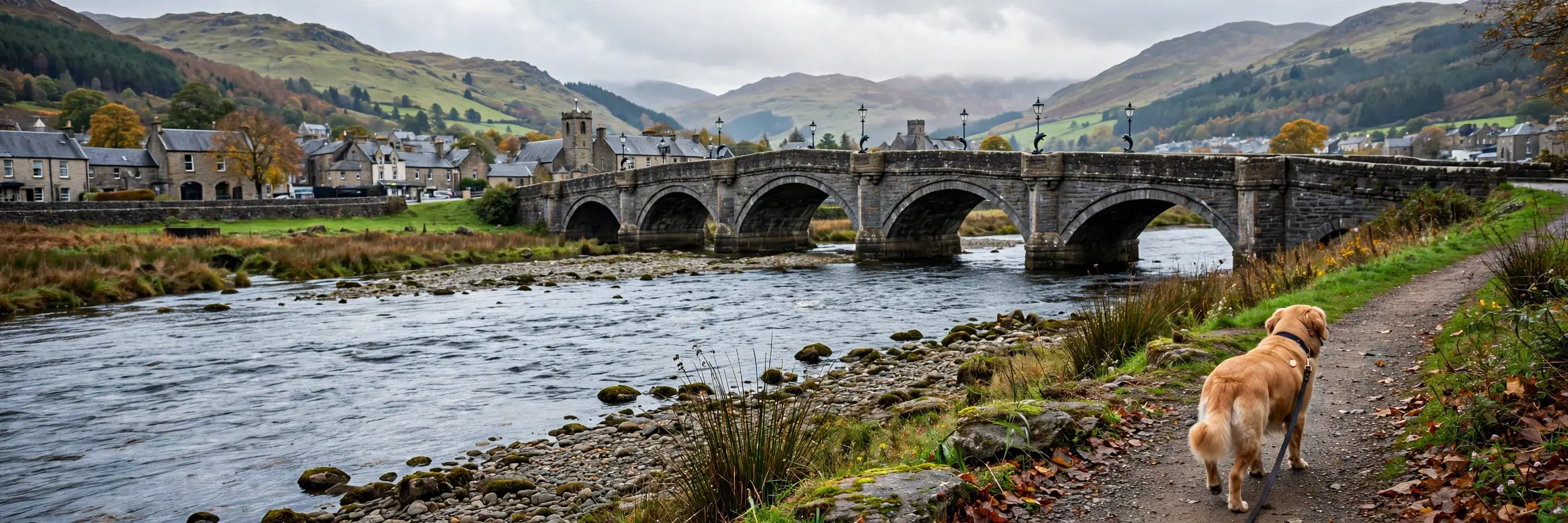
Start in the town centre and head for the Gala Water. The river runs through Galashiels in a partly channelled course, with bridges, riverside paths and green spaces along the way. The surface varies: pavements and surfaced paths in the centre give way to grass and earth paths further out, which can be muddy after rain. Keep the dog on a lead through the town, near roads and bridges, and where other walkers, cyclists and children are close by. The water itself is fast in places and the banks can be steep, so do not let a dog scramble down to the Gala Water unsupervised, especially after rain.
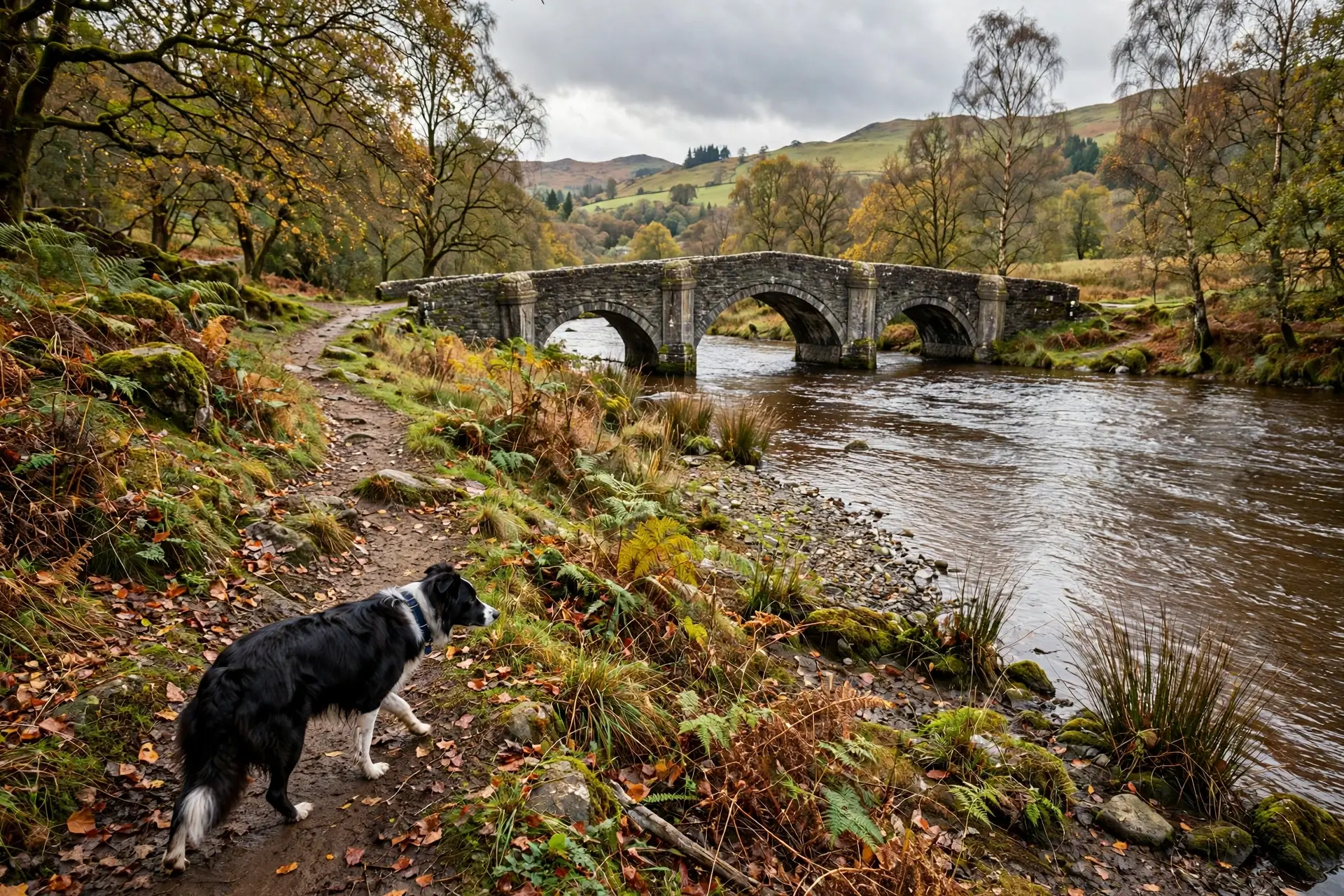
As the Gala Water leaves the town it opens out, and the walking becomes easier and quieter. Look for kingfishers, grey herons, dippers and wagtails along the water, and for the trees and scrub that line the banks. This is a good stretch for a dog that likes to sniff: the river brings a constant stream of scents, and the path is wide enough in places for a long line. Keep the dog out of the water if the current is strong or the bank is slippery, and watch for fishing lines, hooks and discarded tackle near popular fishing spots. Pick up after the dog even on a riverside path, and carry the bag to a bin rather than leaving it by the trail.
The Tweed itself is a different scale of river. It is wide, powerful and, in places, deceptively fast. The riverside path along the Tweed gives long, open views across the water to fields and woodland, and the walking is generally flat. This is the stretch where a fit dog can stretch its legs, but it is also the stretch where control matters most. Keep the dog on a lead near the bank if the dog is a keen swimmer, a chaser, or unreliable on recall. Anglers use the Tweed through the fishing season, and a dog crashing through a fishing beat will not be welcome. Give anglers a wide berth, keep the dog close, and pass quietly.
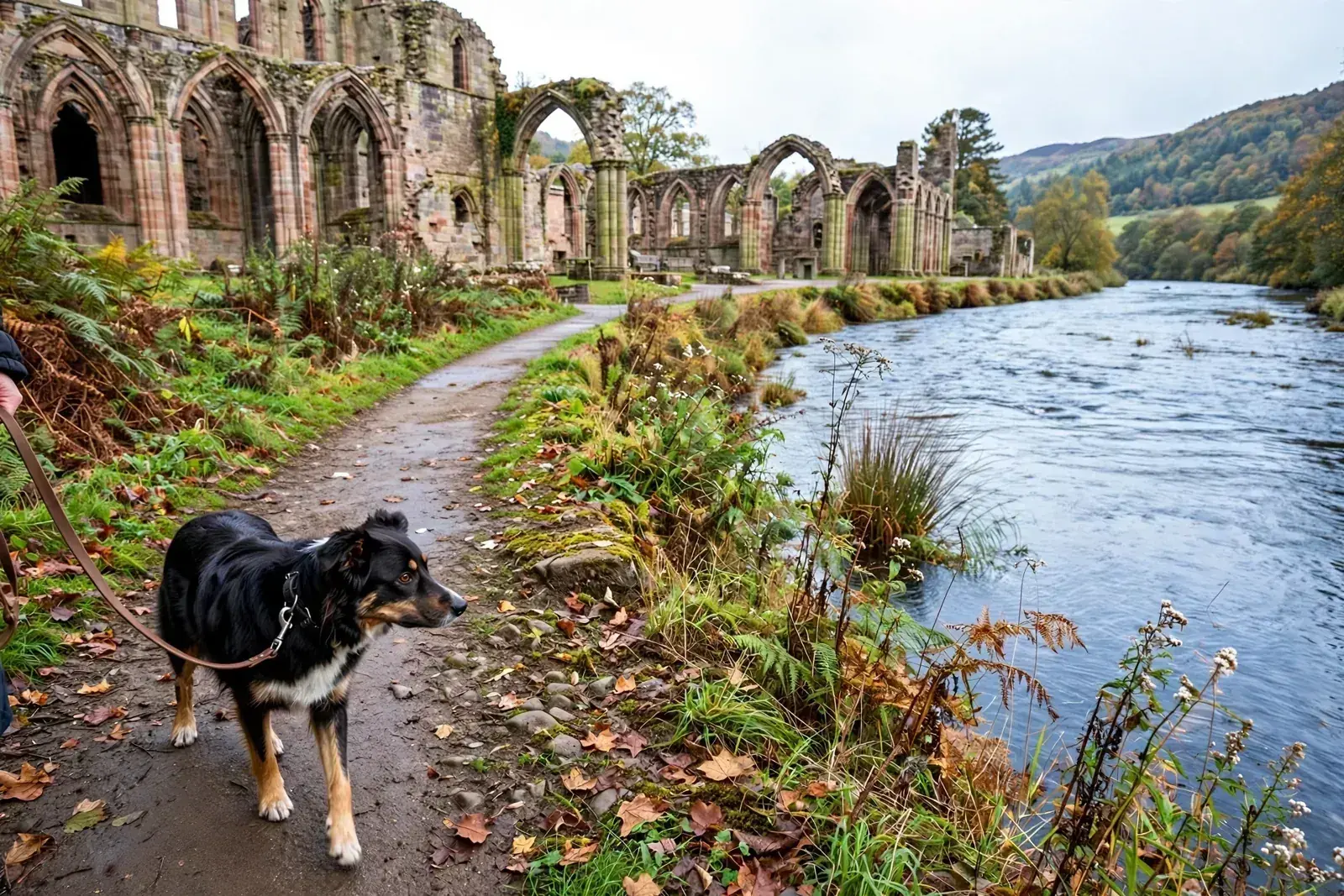
For a longer riverside day, extend the loop downstream towards Tweedbank. The Borders Abbeys Way follows the Tweed in this direction, and the path is generally clear and well used. A Galashiels to Tweedbank riverside walk is roughly 4 to 5 km (about 2.5 to 3 miles) one way, depending on the exact path, and can be combined with a train back from Tweedbank to Galashiels. Allow two to three hours for the one-way walk with stops, water breaks and sniffing time. The return by train is short, which makes this a good first one-way walk for a dog that has not done a linear route before.
Turn the walk into a loop if you prefer to finish where you started. From the Tweed, return through quieter streets or along the Gala Water in the opposite direction, and finish with a cafe stop in the town centre. The loop works well in either direction, but walking downstream first and returning through the town gives the dog the most interesting smells early and a calmer, more familiar finish. In summer, walk early or late to avoid the heat of the day, and carry water for the dog, because there is no guarantee of a safe, accessible drinking spot on every stretch.
After the walk, check the dog for ticks, especially in long grass and riverside scrub, and check paws for cuts from stones, glass or fishing tackle. Dry the dog if the dog has been in the water, and wash off river water if the dog has been swimming in a stretch that looks polluted or smells unusual. A riverside walk should leave the dog tired and content, not cold, wet and shivering, so build in a warm, dry finish and a rest after the walk.
Route 2: Gala Hill and the woodland
Gala Hill rises above the town to the north-east, and the Gala Policies Community Woodland and the paths around it give Galashiels its woodland walk. This is the route to choose when the river is high, when the dog needs a harder workout, or when you want views across the town and the Tweed valley. A loop that takes in Gala Hill and the woodland is roughly 7 to 8 km (about 4.5 to 5 miles) if you link the hill with the Abbotsford direction, and shorter loops of 3 to 5 km are possible by staying closer to the town. Allow two to three hours for a full loop, and more if the dog stops often.
The climb is steady rather than steep, but it is a climb. Paths include surfaced tracks, woodland earth paths, grass and, in places, steps and uneven ground. The surface can be muddy and slippery after rain, especially on shaded woodland slopes and on clay soil. Wear boots with grip, keep the dog on a lead on the steepest sections, and take care on descents, where a pulling dog can unbalance a walker. Older dogs, puppies and dogs with joint problems may find the full hill loop too much; for them, a shorter woodland circuit on the lower slopes is a better choice.
The woodland itself is the reward. Mixed trees, undergrowth and open clearings give shade in summer and shelter in wind, and the paths are quieter than the riverside. This is a good place for a dog that likes to explore with its nose, but it is also a place to keep control: squirrels, deer, rabbits and birds are all present, and a dog that chases can disappear quickly in trees. Use a long line in open woodland if recall is not reliable, and keep the dog on a lead near roads, car parks and the edge of the wood.
From the higher ground, the views open out across Galashiels, the Gala Water valley and the Tweed. On a clear day you can pick out the Eildon Hills to the east, the hills around Selkirk to the south, and the line of the railway. Stop at a viewpoint, give the dog water, and let the dog rest. Dogs that are not used to hill walking will tire faster than the distance suggests, because the climb, the uneven ground and the constant sniffing all add effort. Watch for slowing down, lagging behind, panting that does not ease with a rest, or a reluctance to continue, and shorten the walk if any of those appear.
Link the hill with the riverside for a varied half-day. Climb Gala Hill first, when the dog is fresh, then descend to the river for a flatter, cooler finish. Or walk the river first and climb the hill only if the dog still has energy. Either order works, but climbing first is usually kinder on the dog's legs and gives the best views in morning light. Carry more water than you think you need on the hill, because there is no reliable drinking water on the higher paths, and a dog that has been working uphill will drink more than a dog on a flat walk.
In autumn, the woodland is at its most colourful, but fallen leaves can hide mud, holes, sticks and broken branches. In winter, the hill can be icy on shaded paths and exposed to wind on the open top, so check the forecast and dress for the wind chill. In spring, keep the dog on a lead near nesting birds and young livestock in the fields around the wood, and in summer, check for ticks after every woodland walk and watch for heat on the climb. The hill is a year-round walk, but the right version of it changes with the season.
Route 3: a Borders Abbeys Way leg
The Borders Abbeys Way is a 109 km (68-mile) circular trail linking the ruined abbeys of Melrose, Dryburgh, Kelso and Jedburgh, and passing through Hawick and Selkirk and close to Abbotsford House. It is normally walked over five or six days, with daily stages of roughly 16 to 28 km, but few dog owners need to walk the whole circuit to enjoy it. From Galashiels, the useful approach is to walk one leg at a time, using the railway to start and finish, and to treat the trail as a menu of day walks rather than a single expedition.
The most accessible leg from Galashiels is the Selkirk to Tweedbank section, walked in the direction that suits you. The published Selkirk to Tweedbank stage is about 14.4 km (8.9 miles), and the Selkirk to Melrose section is about 16.5 km (10.2 miles). From Galashiels, a shorter version is to join the trail near Abbotsford and walk to Tweedbank, or to walk from Tweedbank towards Melrose and return by train. The trail in this area follows the River Tweed, passes Abbotsford House, skirts Cauldshiels Loch, and uses a mix of riverside paths, farm tracks, woodland and quiet roads. Check the official guidance before you travel for the current route, diversions and closures.
Plan a long-distance leg like a small expedition, even if it is only a day walk. Check the weather and river levels the night before and again in the morning. Pack water for the dog and for yourself, food, a lead and a spare lead, poo bags, a first-aid kit, a towel, and a phone with charge and offline maps if you use them. Tell someone your route and expected return time. Wear broken-in boots, and consider a harness for the dog rather than a collar alone, because a harness gives better control on a long day and spreads the load if the dog pulls.
On the trail, the rules that matter are the Scottish Outdoor Access Code and common sense. Keep dogs under close control at all times, on a lead near livestock, and do not let dogs worry sheep, cattle or lambs. Lambing season, roughly spring, is the most sensitive time, and fields with young lambs or calves should be passed on a lead and without delay. Close gates behind you, keep to the marked path through fields and farmyards, and do not let the dog enter crops or gardens. If cattle are in a field, keep the dog on a short lead, walk steadily around the edge, and be ready to release the dog only if you are threatened and the dog is safer off the lead; check the official guidance before you travel for the current advice on livestock.
Stiles, gates, bridges and road crossings are part of the trail. Some stiles are dog-friendly, with a gap or a lift-over point, but others are awkward for a large or older dog. Be ready to lift a small dog over a stile, to help a larger dog through a gate, and to wait for a gap in traffic at road crossings. The trail is well waymarked in most places, but waymarks can be missing, overgrown or confusing at field corners, so carry a map or a downloaded route and check your position at each junction rather than assuming the path continues straight on.
A fit, experienced dog can manage a 14 km leg in four to five hours of walking time, plus stops. A less experienced dog, a dog that has not walked that far before, or a dog carrying extra weight should start with a shorter leg of 6 to 8 km and build up. Watch the dog's pace: a dog that starts fast and then slows, that lies down, that limps, or that stops drinking is telling you to stop. Do not push a dog to finish a leg because the train timetable says so; cut the walk short, find a road or a station, and finish early. The trail will still be there next time.
If you enjoy the leg, the trail offers a natural next step. Melrose is the abbey town at the heart of the Borders Abbeys Way, with the Eildon Hills above it and the Tweed below, and it makes a good second base or a day trip by train. The full circuit, walked over several days with overnight stops, is a bigger undertaking that needs dog-friendly accommodation booked in advance, luggage transfers or a car, and a plan for each day's distance. Start with one leg from Galashiels, learn how the dog copes, and then decide whether a longer trail holiday is the right next trip.
The Gala Water and Tweed confluence
The meeting of the Gala Water and the River Tweed is the geographical heart of this guide, and it is worth understanding before you walk it. The Gala Water is a tributary that rises in the Moorfoot Hills and runs south through Galashiels. The Tweed is the great river of the Borders, rising in the Lowther Hills and flowing east through Peebles, Galashiels, Melrose and Kelso to the sea at Berwick-upon-Tweed. Where the two meet, just downstream of Galashiels, the smaller river loses its name and its water joins the larger flow. The confluence is not a formal viewpoint with a car park and a sign, but a place on the riverside path where the water changes character and the valley opens out.
For a dog, the confluence is a place of scents and sounds. The two waters bring different smells, the banks hold different plants and animals, and the open ground near the meeting point is a natural pause. Walk to the confluence slowly, let the dog sniff, and use the stop as a water and rest break. The ground can be soft and muddy near the water, and the bank can be undercut, so keep the dog back from the edge and do not let the dog jump in where the two currents meet. The water at a confluence can be faster and deeper than it looks, and a dog that swims confidently in a still pool may struggle in moving water.
The history of the confluence is also the history of Galashiels. The Gala Water powered the textile mills that made the town, and the Tweed carried wool, cloth and people through the Borders. In the nineteenth century, the riverside near the confluence was a busy industrial landscape, with mills, dye works and workers' housing. Today the mills have gone and the riverside is quieter, but the paths still follow the old mill lades and trackways in places, and the names of streets and buildings recall the wool trade. Walking the confluence with a dog is a reminder that the Borders landscape is not only natural, but worked and lived in.
Wildlife at the confluence rewards a patient walker. Grey herons stand motionless in the shallows, goosanders and mallards use the slower water, dippers work the faster stretches of the Gala Water, and kingfishers flash along the bank. Otters use the Tweed, although they are shy and most active at dawn and dusk. Keep the dog on a lead and quiet near wildlife, and do not let the dog chase birds on the water or disturb an otter's holt. If you see an otter, give it space, keep the dog close, and enjoy the sighting without approaching.
The confluence is also a practical decision point. From here you can continue downstream along the Tweed towards Tweedbank and Abbotsford, return upstream along the Gala Water to the town, or cross to the other bank and make a loop. Check the path ahead before you commit: after heavy rain, the riverside path near the confluence can flood, and the low ground can be waterlogged even when the town centre is dry. If the path is flooded, turn back and use the higher route through the town or the hill, and do not wade through floodwater with a dog.
Town-centre practicalities
Galashiels town centre is compact and walkable, which makes it easy to combine a walk with errands. The high street and the streets around it have supermarkets, a range of independent shops, cafes, bakeries, takeaways and pubs, and a market square that hosts events through the year. Dogs on a lead are welcome on pavements and in the open spaces of the town, and many businesses welcome dogs inside or on a terrace, but policies vary and can change, so check the official guidance before you travel or ask at the door. Do not assume that a dog-friendly cafe in summer will have the same policy in winter, and do not leave a dog tied up outside a shop for more than a few minutes.
For a cafe or pub stop, look for the signs that a place genuinely welcomes dogs: a water bowl by the door, a dog treat on the counter, a mention on the menu or the website, and staff who greet the dog. Sit in the area the business designates for dogs, usually the bar or the terrace, keep the dog on a lead and settled on a mat, and order food that the dog will not be tempted to steal. If the dog is reactive, nervous or a barker, choose a quiet table at the edge, visit at a quiet time, or take food away and eat on a bench by the river instead. A short, calm cafe stop is better than a long, stressful one.
Supplies are easy to find in Galashiels. Supermarkets stock dog food, treats and poo bags, and pet shops and outdoor shops in the town can supply a forgotten lead, a towel, a drying coat or a pair of boots. If you are staying for several days, buy a spare lead and a bag of the dog's usual food at the start of the trip, so a lost lead or a change of food does not become a problem. A local vet is available in the town and in nearby Melrose and Selkirk; save the number and the opening hours in your phone before you need them, and note the nearest out-of-hours vet as well. Check the official guidance before you travel for current vet details.
Toileting in the town needs a plan. Use the riverside path or a green space for the first and last toilet walks of the day, and carry poo bags at all times. Pick up after the dog on pavements, in parks and on paths, and use the bins provided. Do not let the dog toilet on shop doorways, on children's play areas, or on private gardens. If the dog is a male that marks, keep the lead short in the town centre and steer the dog away from shop fronts and street furniture where marking causes a problem.
Galashiels is also a good town for a rest day. If the dog is tired after a long leg, spend a day in the town: a short riverside walk in the morning, a cafe stop, a browse around the shops, and a quiet afternoon. The Old Gala House and the town's textile heritage give a cultural stop, although dogs may not be allowed inside historic buildings, so check the official guidance before you travel. A rest day is not a wasted day; it lets muscles recover, paws heal, and the dog settle into the routine of the trip.
Noise and crowds vary through the year. The Braw Lads Gathering in the summer brings parades, horses and crowds to the town, which some dogs enjoy and others find overwhelming. If your dog is nervous around horses, crowds or loud noises, avoid the town centre on the main gathering days, or walk the riverside and the hill instead. Fireworks around early November, Christmas markets, and busy Saturday shopping can also unsettle a sensitive dog, so plan a quieter route on those days and keep the dog on a lead in crowds.
Abbotsford and Tweedbank as day options
Abbotsford House, the home of Sir Walter Scott, lies beside the River Tweed between Galashiels and Melrose, and it is one of the easiest day options from Galashiels. The house and gardens are a major visitor attraction, and the estate has a network of walking trails through woodland and along the river, including a riverside route of about 5 km (3 miles) and a Cauldshiels Loch route of about 6.5 km (4 miles). Dogs are generally welcome on the estate trails on a lead, but dogs may not be allowed inside the house, the visitor centre or the gardens in the same way, so check the official guidance before you travel for the current dog policy, opening times and admission.
Walk to Abbotsford from Galashiels along the Tweed, or take the train one stop to Tweedbank and walk from there. The riverside path from Tweedbank to Abbotsford is short and flat, and it links with the Borders Abbeys Way. Allow time to explore the estate trails, to sit by the river, and to enjoy the designed landscape that Scott created. Keep the dog on a lead on the estate, close to the house and gardens, near livestock, and where other visitors are close by. The estate is a working landscape with gardens, woodland and farmland, and a dog running free through a garden or a field is not acceptable.
Tweedbank itself is a small village built around the railway terminus, with a loch, a nature trail and a short riverside walk. The Tweedbank Nature Trail is about 1.5 km (1 mile) and is a good short walk for a puppy, an older dog, or a dog that needs a gentle outing. Gunknowe Loch, in the village, attracts ducks, swans and other water birds, and the paths around it are flat and surfaced. Keep the dog on a lead near the loch and do not let the dog chase the birds or enter the water where birds are nesting.
From Tweedbank, the options fan out. Walk to Melrose along the trail, a distance of about 4 to 5 km, and finish at the abbey town with its cafes and shops. Walk to Abbotsford and back. Or walk the longer loop that takes in Cauldshiels Loch, Rhymer's Glen and the woodland above the Tweed, a route of about 7 km (4.5 miles) that is moderate to challenging and best saved for a fit dog in dry weather. Each of these walks can be combined with a train back to Galashiels, which makes Tweedbank a useful hub for one-way walking.
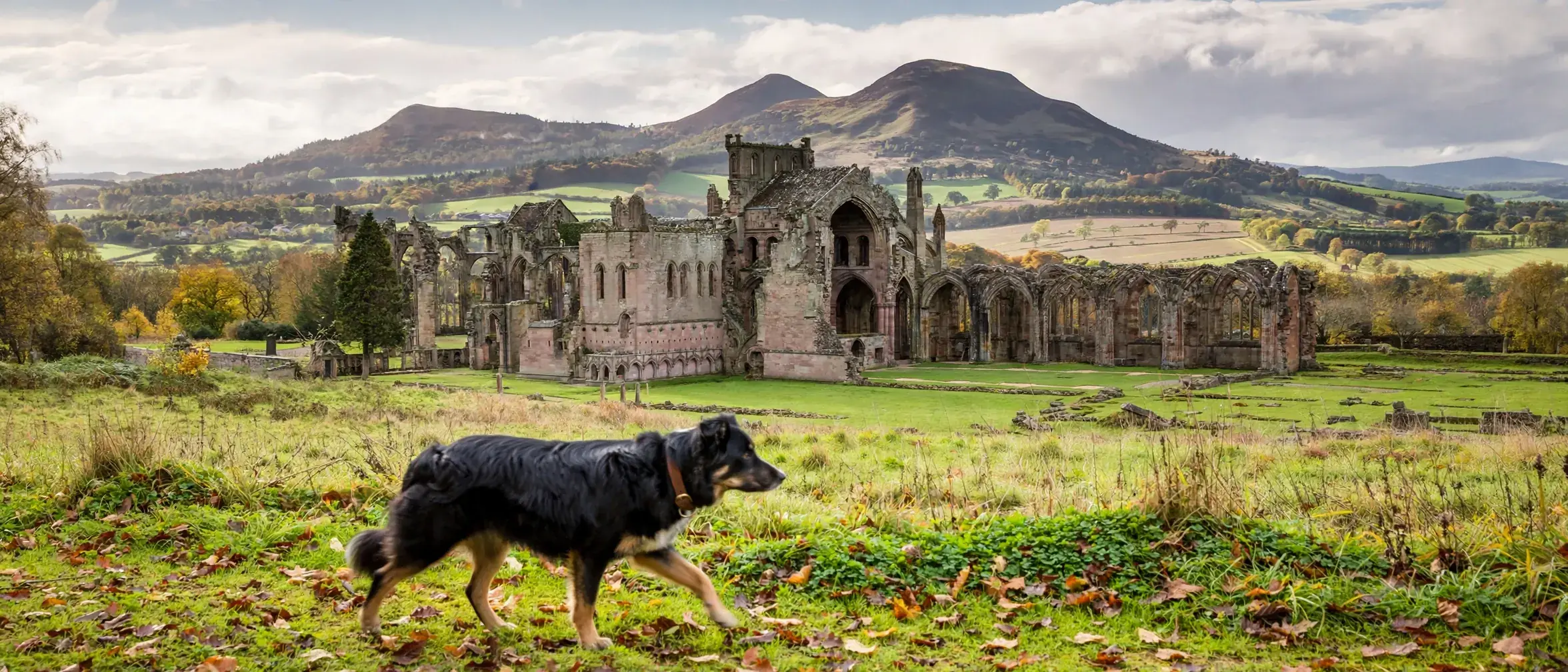
Melrose, a short train ride or a walk away, deserves a day of its own. The abbey ruins, the Eildon Hills, the river paths and the town centre make it one of the most rewarding dog walks in the Borders, and our guide to Melrose with a dog covers the abbey, the hills and the town in detail. If you have only one extra day, spend it in Melrose. If you have two, spend the second in Selkirk, the town to the south, with its own riverside, woodland and long-distance trail links.
Seasons and river levels
The Borders have four distinct walking seasons, and the right route in Galashiels changes with each one. Spring, from March to May, brings longer days, lambs in the fields, nesting birds and the first green on the trees. Keep dogs on a lead near livestock and nesting birds, watch for ticks as the weather warms, and expect muddy paths after winter rain. Spring is a good time for the riverside and the hill, but check the forecast for late frosts and cold winds on the higher ground.
Summer, from June to August, brings the longest days and the warmest weather, but also heat, midges and busy paths. Walk early in the morning or late in the evening, carry water for the dog, and watch for heatstroke, especially in brachycephalic breeds, older dogs and dogs with thick coats. Midges are worst at dawn and dusk near water and woodland, and they can make a riverside walk miserable for both dog and owner. A midge repellent for the owner, a shaded route, and a breeze on the hill can help. Summer is also the season for the Braw Lads Gathering and for busy weekends, so plan quiet routes on event days.
Autumn, from September to November, is often the best walking season in the Borders. The air is cool, the light is low, the woodland turns colour, and the paths are quieter after the school holidays. Autumn rain can make riverside paths muddy and raise river levels, so check the river before a Tweed walk and choose the hill if the river is high. Fireworks around early November can unsettle dogs, so keep a nervous dog indoors or on a quiet walk on firework nights, and ask local businesses whether displays are planned.
Winter, from December to February, brings short days, cold winds, frost and, in some years, snow. The riverside paths can be icy, the hill can be exposed, and the river can be high after winter storms. Walk in daylight, wear boots with grip, and keep the dog warm and dry after the walk. A drying coat, a towel and a warm place to rest are essential in winter. On the other hand, a crisp, clear winter day on Gala Hill, with frost on the trees and views across the valley, is one of the best walks of the year.
River levels deserve a section of their own, because the Tweed and the Gala Water can change quickly. After heavy rain in the hills, the Tweed can rise by a metre or more in a few hours, and a path that was dry in the morning can be flooded by the afternoon. Never cross a flooded path, a ford or a footbridge with water over it, and never let a dog swim in a river that is high, fast or coloured brown with silt. Check the official guidance before you travel for river levels, flood warnings and path closures, and ask locally if you are unsure. If in doubt, choose a higher route and save the riverside for a drier day.
Blue-green algae is a seasonal hazard on slow-moving water in warm weather. It can appear as a green scum or paint-like film on the surface of lochs and slow rivers, and it can be toxic to dogs. Do not let a dog drink from or swim in water that looks green, scummy or unusual, and seek veterinary advice immediately if a dog has drunk or swum in suspect water. Check the official guidance before you travel for current algae warnings, especially in summer.
Parking, buses and getting around
If you arrive by car, Galashiels has a range of car parks in and around the town centre, including car parks near the station, the transport interchange and the high street. Parking charges, time limits and payment methods vary by car park and can change, so check the official guidance before you travel and read the signs on arrival. Do not leave a dog in a car, even for a short time, in warm weather, and do not leave a dog in a car in cold weather without adequate ventilation and insulation. A car is a poor place for a dog to wait while you shop or eat.
For walkers, the best parking is the car park closest to the start of your chosen route. For the riverside loop, park near the town centre and walk to the river. For Gala Hill, park near the lower slopes and walk up. For the Abbotsford and Tweedbank walks, park at Tweedbank station car park, which gives access to the riverside, the nature trail and the trail to Melrose. Arrive early on busy weekends, because the most convenient car parks fill up, and have a second car park in mind if the first is full.
Buses from Galashiels link the town with the rest of the Borders. Services run to Melrose, Selkirk, Peebles, Hawick, Kelso, Jedburgh and Edinburgh, although frequencies vary by route and by day, and Sunday services can be sparse. Dogs are generally carried at the driver's discretion, on a lead and on the floor, and a well-behaved dog on a quiet bus is usually welcome. Check the timetable and the dog policy before you travel, and allow extra time for a bus journey, because a missed bus in a rural area can mean a long wait or a long walk back.
For a car-free trip, the combination of train and bus is enough to cover the central Borders. Use the train for Edinburgh, Galashiels, Tweedbank and Melrose, and the bus for Selkirk, Peebles and Hawick. Walk between the stations and the trails, and use a taxi for the occasional journey that public transport does not cover. Confirm that a taxi will take a dog before you book, and bring a blanket for the seat. A car-free trip needs more planning than a car trip, but it also gives a slower, more rewarding way to see the Borders, and it suits the long-distance trail particularly well.
Finally, plan for the unexpected. Save the numbers for a local vet, a taxi firm, the railway station and your accommodation in your phone. Carry a charged phone, a power bank, water, food and a first-aid kit. If a walk goes wrong, if the dog is injured, or if the weather turns, stop, find shelter, and ask for help. The Borders are a friendly place, and walkers, farmers and local businesses will usually help a dog owner in difficulty. A well-planned trip is not one where nothing goes wrong, but one where you have a plan for when it does.
Galashiels rewards the walker who treats it as a base and the dog as the priority. Start with the river, climb the hill when the dog is ready, borrow a leg of the long-distance trail when the weather and the river allow, and return to the town for food, rest and a dry bed. The Borders Abbeys Way will still be there for the next leg, and the Tweed will still be flowing past the town. Walk it one route at a time, and let the dog set the pace.
Practical questions
Before you go
Can dogs travel free on the train to Galashiels?
Yes, under the National Rail Conditions of Travel you may take up to two dogs free of charge per passenger, kept on a lead throughout the journey and off seats. Dogs must not cause a nuisance to other passengers, and staff may ask you to move or leave if they do. Check the official guidance before you travel, as individual operators may publish their own conditions.
Is the Borders Abbeys Way suitable for dogs?
For fit, lead-trained dogs, yes, in sections. The full circuit is 109 km (68 miles) and is normally walked over five or six days, so most visitors walk one leg at a time from a rail stop. Expect farm tracks, riverside paths, quiet roads, livestock, stiles and gates. Keep dogs on a lead near livestock and roads, carry water, and check the official guidance before you travel for diversions and closures.
Can dogs swim in the River Tweed at Galashiels?
Some dogs paddle at shallow, slow-moving edges in settled weather, but the Tweed is a large, powerful river and levels can rise quickly after rain. Never let a dog swim near weirs, fast water, undercut banks or fishing beats, and keep dogs out of the water altogether when the river is high, coloured or fast. Check the official guidance before you travel and watch the dog at all times.
Are dogs allowed off lead on the riverside paths around Galashiels?
There is no single rule for every path. Many riverside and woodland stretches are used off lead by dogs with reliable recall, but dogs must be under close control, on a lead near roads, livestock, other walkers, cyclists and anglers, and wherever signs require it. If your dog chases wildlife or livestock, or cannot recall past a distraction, keep the lead on and use a long line in open ground.
Where can dogs go in Galashiels town centre?
Dogs on a lead are welcome on pavements, in the town centre and on riverside paths, and many cafes and pubs welcome dogs in at least part of the premises, often on the terrace or in a bar area. Policies change by business and by season, so check the official guidance before you travel or ask at the door. Do not assume a dog can go into a food shop, and never leave a dog tied up outside for long.
What should I do if the River Tweed is high after rain?
Choose a higher, surfaced route instead, such as Gala Hill or a town-centre loop, and keep the dog on a lead and well back from the bank. Do not cross flooded paths, fords or footbridges with water over them, and do not let the dog enter the river. If in doubt, shorten the walk, turn back at the first flooded section, and check the official guidance before you travel for river levels and path closures.