This guide is independent and contains no paid placement. If affiliate links are added later, they will be clearly marked and will not change our editorial checks.
Melrose packs three big draws into one small, walkable town: the ruined abbey in the centre, the triple-peaked Eildon Hills rising behind it, and the rugby ground where sevens was invented in 1883. Dogs on leads are welcome in the abbey grounds and on the hill and riverside paths, and the town centre is full of dog-friendly cafes and pubs — but the abbey building itself, the steep hill ground and the livestock on the lower slopes all need planning.
The abbey and the hills in one frame
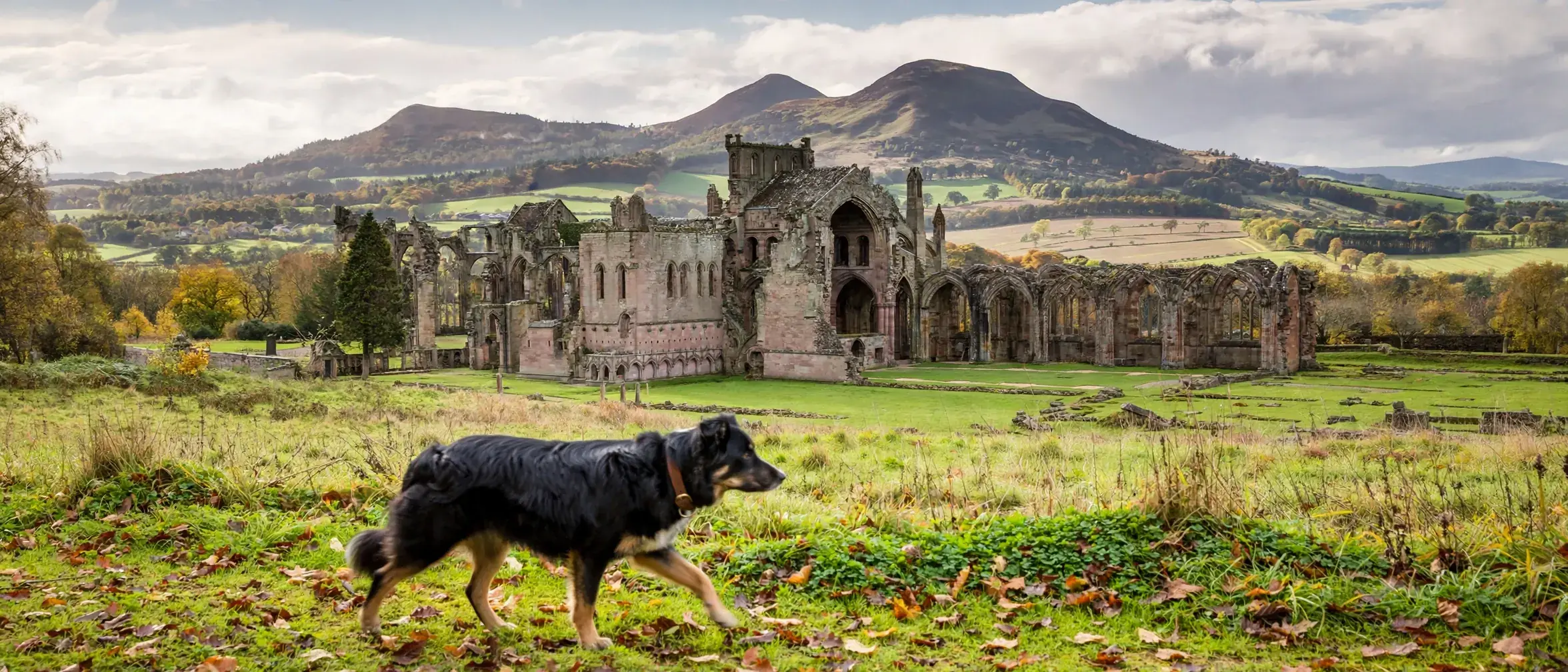
Stand on the grass in front of Melrose Abbey on a clear morning and the whole town makes sense at once. In front of you is the ruined Cistercian abbey, its pinkish stonework rising in broken arches and tall window tracery against the sky. Behind it, filling the horizon, are the Eildon Hills — three smooth, separate peaks that look less like ordinary hills and more like a skyline someone drew on purpose. A dog on a lead, sniffing the grass at your feet, is the only thing in the picture that seems entirely unconcerned by eight hundred years of history, and that is exactly why Melrose works so well as a dog trip: the town's two great sights are outdoors, they are free to look at from the paths, and they are best enjoyed slowly, on foot, with a dog setting the pace.
That single view is also the best orientation tool in the town. The abbey sits in the middle of Melrose, a short walk from the market square, the high street and the car parks. The Eildons rise immediately to the south, close enough that you can walk from a cafe table to the start of the hill path in about fifteen minutes. The River Tweed runs along the northern edge of town, and the rugby ground at the Greenyards sits on the eastern side, near the road towards Kelso. Nothing in Melrose is far from anything else, which matters when you are planning around a dog: toilet stops, water, shade and a place to sit down are never more than a few streets away.
The hills are the first thing to understand, because they explain the town's shape and its stories. The three Eildons — Eildon Hill North at 422 metres, Eildon Mid Hill at 422 metres and Eildon Hill South, the lowest of the three — are the remains of an ancient volcano, worn down over hundreds of millions of years into their distinctive rounded forms. Local legend says the hills were split into three by a wizard, and the story has stuck because the shape is so unusual: from the abbey grounds you can count all three peaks at a glance, which is rare for any British town. The Romans noticed the same thing. They built a signal station on Eildon Hill North and, at the foot of the hills near Newstead, the fort of Trimontium — "the place of the three hills" — one of the largest Roman sites in Scotland. Walkers still find the Roman road and the fort's outline on the lower ground today.
Melrose itself is a small town of around 2,500 people in the Scottish Borders, roughly 35 miles south-east of Edinburgh and close to Galashiels, the largest town in the Borders. It sits on the A6091 and the A68, the main road south from Edinburgh to Jedburgh and the English border, and it is one of the most visited towns in the region — not because of its size, but because the abbey and the hills give it a concentration of history that larger towns struggle to match. The town's name is said to come from the old British words for a bare moor, and the original monastery at Old Melrose, a couple of miles downstream, was founded in the seventh century. The abbey you see today is the second foundation: a Cistercian abbey established in 1136 by King David I, rebuilt and damaged repeatedly across the Border wars, and now cared for as one of Scotland's most important historic sites.
For a dog owner, the practical consequence of all that history is simple and good. Melrose is a town where the main attractions are outside, where the best walks start from the town centre, and where the local economy is used to visitors with dogs. Cafes put out water bowls, pubs welcome dogs by the fire, and the paths — hill, riverside and town — are well used by local dog walkers, which means they are generally well maintained and easy to follow. The complications are the ones this guide works through in order: the abbey building has different rules from the abbey grounds, the hills are steep and exposed, the lower slopes and riverside fields hold livestock at certain times of year, and the town's popularity means weekends and school holidays can be busy. None of these is a reason not to come. Each is a reason to plan the day in the right order, which is what the rest of this guide does.
One more thing the view from the abbey grounds tells you: Melrose rewards looking up. The abbey's carved stonework — including the famous pig playing the bagpipes, one of the building's best-known details — rewards a slow circuit, and the hills change colour through the day, from grey-green in the morning to a deep purple-brown at dusk. Dogs do not care about carved pigs, but they do care about the long grass, the open ground and the smell of the river on the wind. Plan the day so that both of you get what you came for: the history and the views for you, the sniffing and the space for the dog.
Visiting Melrose Abbey with a dog
Melrose Abbey is the reason most visitors come to the town, and it is the first stop to get right with a dog. The abbey was founded in 1136 by Cistercian monks from Rievaulx in Yorkshire, at the invitation of King David I of Scotland, and it became one of the richest and most powerful monasteries in the country. Its most famous association is with Robert the Bruce: after his death in 1329, his heart was buried at Melrose Abbey, while the rest of his body was taken to Dunfermline. A small lead casket found during excavations in the twentieth century is believed to have contained the heart, and it was reburied in the abbey with a memorial stone marking the spot. That single fact explains why the abbey still draws visitors from around the world, and why the grounds are treated with the care they are.
The abbey suffered badly during the wars between Scotland and England. English armies damaged it repeatedly, most famously in 1322 and again in 1385, and the building was rebuilt in stages over the following centuries — which is why the stonework shows a mix of styles, from the early Gothic of the original church to the later, more elaborate carving of the fifteenth century. The roof is long gone and the building stands open to the sky, which is part of its atmosphere: light falls through the great east window onto the grass where the monks once sang, and the walls frame the Eildon Hills like a picture. The abbey passed into state care in the twentieth century and is now managed by Historic Environment Scotland.
For dog owners, the important distinction is between the abbey grounds and the abbey building. Dogs on leads are generally welcome in the grounds, where the open grass, the paths around the ruins and the views of the hills are the main attraction anyway. Dogs are not usually allowed inside the abbey building itself or inside the visitor centre and exhibition, and that is worth knowing before you arrive so you can plan accordingly. If you are travelling as a pair, one person can look around the interior while the other stays with the dog in the grounds — the circuit of the exterior, with its carved buttresses, the chapter house foundations and the famous bagpipe-playing pig, takes a good half hour on its own and is arguably the better part of the visit for a dog owner. Check the official guidance before you travel, because access rules, opening times and ticket arrangements can change with events, conservation work and the season.
Arrive early if you can. The abbey grounds are at their best in the first hour after opening, when the light is low on the stone and the coach groups have not yet arrived. Early also suits dogs: the grass is cool, the paths are quiet, and you can take the circuit at a sniffing pace without feeling in anyone's way. Allow forty-five minutes to an hour for the grounds and the exterior, longer if you want to read the interpretation boards or sit on one of the benches with the hills in front of you. Bring water for the dog — there is no guarantee of a dog bowl on site — and a lead short enough to keep the dog close to the walls, since the grounds are a historic site and not a dog exercise field.
The visitor centre and museum are worth a look for the human half of the party. The displays cover the abbey's history, the Bruce connection and the finds from the site, and the small exhibition gives context that makes the ruins themselves easier to read. If you are visiting with a dog and travelling solo, this is the one part of the abbey visit that needs a plan: either visit the centre before you collect the dog from the car, or accept that you will skip it this time and enjoy the grounds instead. The grounds are the part of Melrose Abbey that stays with most people anyway, and they are the part your dog can share.
Just outside the abbey, the town offers two smaller historic gardens that suit a dog walk well. Priorwood Garden, cared for by the National Trust for Scotland, is a small walled garden near the abbey with an orchard of old apple varieties and a dried-flower garden, and Harmony Garden, across the road, is a walled garden with lawns, flower beds and a view back towards the abbey and the hills. Both are compact — twenty minutes each is plenty — and both are the kind of quiet, enclosed green space that suits an older dog or a dog that needs a calm walk after the excitement of the abbey. Check the official guidance before you travel, since opening days and dog rules for gardens can vary by season, and gardens with planted beds generally need dogs on a short lead throughout.
Two further facts help you read the town once you leave the abbey. The first is that the abbey's stone was quarried locally, and the same warm pink-red sandstone shows up in the town's houses, the market cross and the church — Melrose has a visual consistency that makes it feel like one place rather than a collection of streets. The second is that the abbey is not the only religious history in the town: the original monastery at Old Melrose, two miles east along the Tweed, was where St Cuthbert began his monastic life in the seventh century, and the long-distance St Cuthbert's Way passes through Melrose on its way from Melrose Abbey to Lindisfarne. Dog walkers following the Way often use Melrose as a start or finish point, and the first miles of the route, towards the Eildons, double as one of the town's best dog walks.
Walking the Eildon Hills with a dog
The Eildon Hills are the walk that defines a dog trip to Melrose, and they are also the walk that most needs honest preparation. The full loop over all three summits from the town centre is roughly 7 to 8 miles with around 600 metres of ascent, and it takes most walkers four to five hours including stops. A shorter out-and-back to Eildon Mid Hill, the middle and most-visited summit, is about 3.5 miles and takes around two hours. Both routes are on good, well-used paths for most of their length, but the upper ground is steep, rough underfoot and fully exposed to wind and weather, and there is no shelter, water or facilities anywhere on the hills. That is the deal: the best views in the Borders in exchange for carrying everything you need.
The usual start is from the southern edge of Melrose, following the path from the town towards the hills through the fields below Eildon Hill North. The path climbs steadily through bracken and grass, with the abbey and the town dropping away behind you and the views widening with every step. On a clear day the view from the top of Eildon Mid Hill takes in the whole of the central Borders: the Tweed valley below, the Cheviots to the south-east, the Lammermuirs to the north-east, and on the clearest days the hills beyond Edinburgh. The three summits are close enough together that the loop between them feels like one long ridge walk rather than three separate climbs, and the descent back towards Melrose, with the abbey coming back into view, is one of the most satisfying finishes in Scottish hillwalking at this scale.
For dogs, the Eildons are a serious but rewarding walk. The ground suits fit, confident dogs: the paths are mostly grass and gravel, with rocky sections near the summits and some steep, eroded stretches on the descent. Dogs that are used to hill walking will love it; dogs that are not used to sustained climbing, or that have joint problems, will find the descent hard on their legs, and the full loop is too much for puppies, very small dogs and older dogs with mobility issues. A shorter option — walking up to the first viewpoint on the lower slopes and back — still gives a dog a proper hill outing and gives you the abbey-and-hills view from above, without the exposure of the summits. Judge the walk by the dog in front of you, not by the walk you had planned.
Livestock is the main rule to plan around. The lower slopes and the fields around the hills are grazed, and sheep are common, particularly in spring when lambs are present. The Scottish Outdoor Access Code, which governs access to most open land in Scotland, asks dog owners to keep dogs on a lead or under close control around livestock, and to keep dogs on a lead during the lambing season. The practical approach is simple: keep the dog on a lead from the town until you are well clear of the fields and onto the open hill, keep the lead on whenever you can see sheep, and put the lead back on well before you descend into the fields again. A long line is a good compromise on the open hill, giving the dog room to move while keeping you in control. If your dog has a strong chase instinct around sheep, the Eildons are a lead-on walk for the whole route, and that is the right call — a single incident with livestock can end a trip and, far worse, can end a sheep's life.
Weather on the Eildons changes fast. The hills are exposed, the wind is often strong on the ridge, and cloud can come down quickly even on a morning that started clear in the town. Check the forecast before you set out, and be ready to turn back: a shortened walk is a good walk, and the hills will still be there tomorrow. Carry water for the dog — there are no reliable streams on the upper hill in dry weather — and carry more than you think you need in summer. A collapsible bowl, a spare lead, a basic first-aid kit and a towel for the descent are worth their weight, and in winter or after rain the paths can be muddy and slippery enough that walking poles help the human half of the party as much as the dog. In warm weather, watch for heat: there is no shade on the ridge, and a dark-coated dog working hard uphill in sun needs rest stops and water, not encouragement to push on.
Two longer routes start from the same ground and are worth knowing about for a longer stay. The first is St Cuthbert's Way, the 62-mile long-distance route from Melrose to Lindisfarne, which begins at the abbey and climbs over the Eildons on its first day. The Melrose-to-Eildon stretch is the same path described above, and it makes a natural first taste of the Way. The second is the Borders Abbeys Way, a 68-mile circular route linking Melrose, Dryburgh, Kelso and Jedburgh, which passes through the town and along the Tweed. Both routes are waymarked and both are popular with dog walkers doing them in sections, and both are covered in more detail in our guide to Scottish Borders dog walks, which also covers lead rules, livestock seasons and where to stay across the region.
Finally, a note on the summit itself. Eildon Hill North carries the remains of a Roman signal station, and the hillfort ramparts on the summit are among the largest in Scotland — the hill was a defended settlement long before the Romans arrived. The summit is a good place to stop, give the dog water, and look at the view, but it is also an exposed, windy spot where a dog on a long line can quickly get tangled around rocks and other walkers' legs. Shorten the lead at the summit, keep the dog close while you take photographs, and save the off-lead running for the open grass on the way down, where you can see clearly in all directions.
The River Tweed and riverside paths
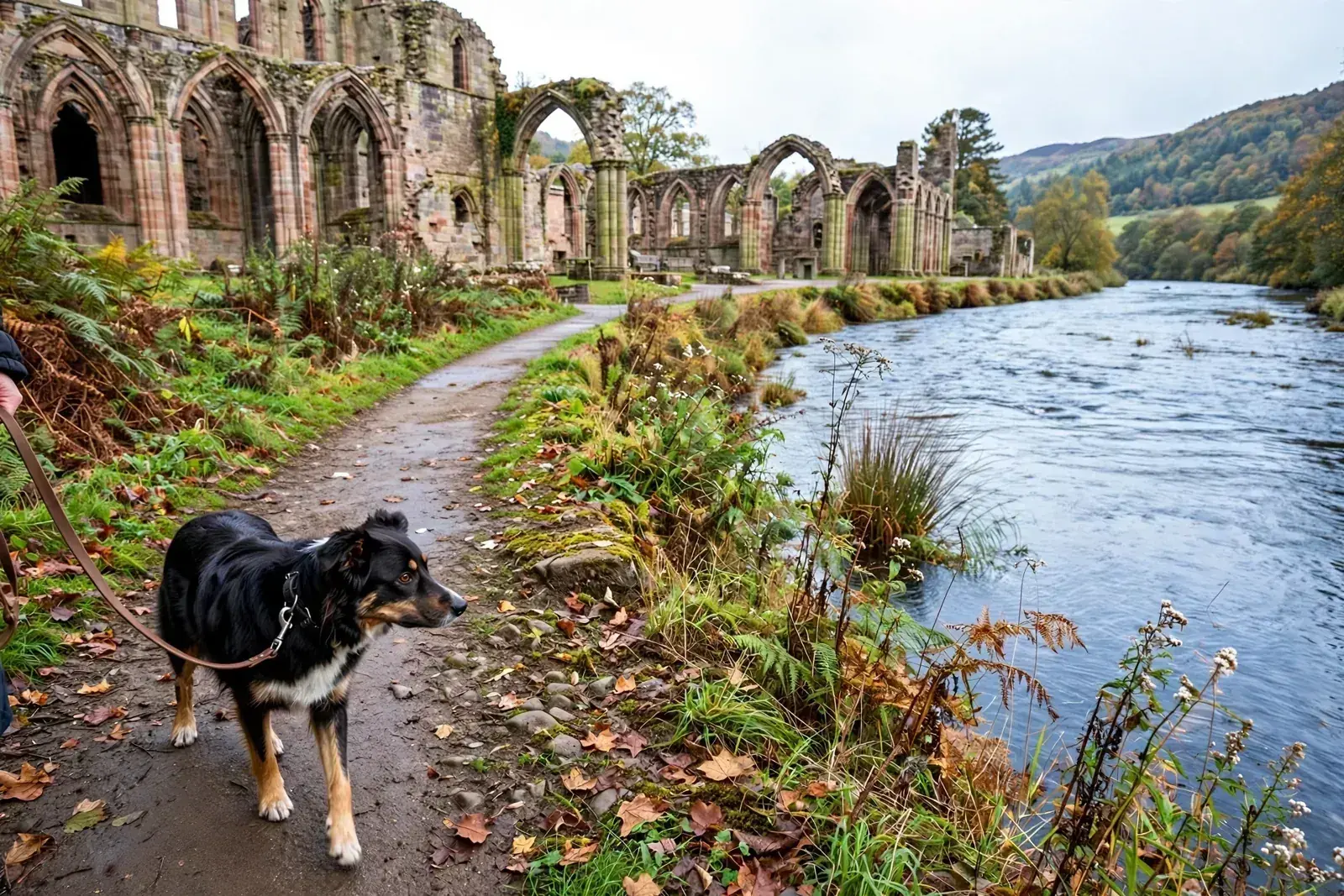
The River Tweed is the quiet third landscape of a Melrose dog trip, after the abbey and the hills, and it is the one that suits the most dogs. The Tweed runs along the northern edge of the town, cold, clear and fast, and the riverside paths near Melrose offer flat, easy walking with shade, water and the constant interest of the river. For older dogs, for dogs that have already done the hills, or for the second walk of the day, the Tweed paths are the right choice — and on a hot day they are the best choice for any dog, because the riverside is cooler and the water is never far away.
The most useful riverside walk starts from the town centre and follows the path downstream towards Newstead and the site of the Roman fort of Trimontium. The walk is flat, mostly on grass and riverside track, and it takes about an hour there and back at a dog's pace. The fort itself is marked by interpretation boards and the low outline of the site rather than by standing walls, but the walk is the point: the river on one side, the fields on the other, and the Eildons behind you for the first half of the outward leg. The path is part of the Borders Abbeys Way, so it is waymarked, and it connects with longer stretches of the route towards Dryburgh Abbey to the west and Kelso to the east for walkers who want a longer day.
Dogs and rivers need a few rules. The Tweed is a salmon river, and anglers fish its banks for much of the year, particularly in the autumn salmon season. Keep your dog on a lead when you pass anglers, and do not let the dog disturb the water near someone fishing — a dog splashing through a pool a fisherman has been working for an hour is the fastest way to sour a riverside walk. The river also runs fast and cold after rain, and the banks can be steep and slippery in places. Not every stretch is safe for a dog to swim in, and a dog that loves water should only be allowed in where the bank is shallow, the current is slow and you can see the entry and exit points clearly. Never let a dog swim near weirs, bridges with strong currents underneath, or in spate conditions after heavy rain. If in doubt, keep the dog on the bank and let it paddle at the edge instead.
The riverside fields hold livestock at times, and the same lead rules apply as on the hills: lead on near sheep and cattle, lead on during lambing season, and close control at all times. The path is also shared with cyclists and other walkers, so a short lead on the narrower stretches keeps everyone comfortable. In spring and summer, the riverside vegetation is thick and the path can be overgrown in places; long grass means ticks, so check your dog after a riverside walk, particularly around the ears, armpits and groin, and carry a tick remover in your kit.
One of the best times to walk the Tweed is early morning, when mist sits on the water and the town is still quiet. Another is late afternoon, when the light comes down the valley and the river turns silver. Both are good for dogs because the paths are quiet and the temperature is kind. Midday in summer is the time to avoid the open stretches, particularly for dark-coated dogs, and to choose the shaded woodland sections instead. The riverside is also the walk to choose on a wet day: the paths drain better than the hill paths, the tree cover gives some shelter, and a wet dog dries faster after a flat riverside walk than after a muddy hill descent.
Beyond the town, the Tweed valley opens up a whole set of dog walks that repay a longer stay. Dryburgh Abbey, a few miles west, is a quieter, more romantic ruin than Melrose, set in a bend of the river among trees, and the walk there along the river is one of the prettiest in the Borders. Kelso, to the east, has its own abbey and a riverside walk along the Tweed and the Teviot. Both are easy drives from Melrose, and both are covered in our regional guide to Scottish Borders dog walks, which also covers the Borders Abbeys Way in more detail. If you have three or four days in the area, using Melrose as a base and walking a different stretch of the Tweed each day is a better plan than repeating the same hill loop.
Rugby heritage: the town that invented sevens
Melrose's third claim to fame is the one most visitors discover last and remember longest: this small Borders town invented rugby sevens. In 1883, Ned Haig, a local butcher and a player for Melrose Rugby Football Club, devised a seven-a-side version of the game as a way to raise funds for the club. The idea was simple — fewer players, shorter matches, a whole tournament in a single afternoon — and it worked so well that the first Melrose Sevens tournament, held in 1883, became an annual event that has run ever since. The seven-a-side format went on to become one of the world's most popular forms of rugby, now played at the Olympics and in a global series, and it all started on a field in this town.
The Greenyards, Melrose's rugby ground, sits on the eastern edge of the town, a short walk from the centre, and it is the heart of the town's rugby life. The ground has been the club's home since the nineteenth century, and the annual Melrose Sevens, held in spring, is one of the great days in the Scottish rugby calendar, drawing crowds far larger than the town itself. The tournament is a festival as much as a sporting event: pipe bands, local food, and a crowd that treats the day as a celebration of the town as well as of the sport. For a dog owner, the Sevens is a day to plan carefully — the ground is busy, noisy and crowded, and a dog that is not comfortable in crowds will be much happier on a hill walk that day, with the rugby watched later on television. If you do bring a dog to the ground, check the official guidance before you travel, since access rules for dogs at sporting events can vary and the club's policy may change for tournament days.
Outside tournament days, the Greenyards is a calmer place, and the walk around the ground and the surrounding streets gives a sense of how deeply rugby runs in the town. Melrose RFC is one of the oldest rugby clubs in the world, founded in 1877, and the town's connection to the sport shows up everywhere: in the club shop, in the photographs in the pubs, in the names of streets and in the conversations you overhear in cafes. The Borders as a whole is rugby country — the towns of Galashiels, Hawick, Kelso and Jedburgh all have historic clubs and fierce local rivalries — and Melrose's claim to have invented the short form of the game gives it a special place in that landscape.
The rugby story also explains something about the town's character. The Borders towns were mill towns and market towns, built on wool, farming and trade, and rugby was the sport of those working communities. The game was played hard and watched passionately, and the clubs were — and still are — social institutions as much as sporting ones. Visiting Melrose with that in mind makes the town easier to read: the pubs with their rugby photographs, the clubhouse at the Greenyards, and the pride in a local invention that went global are all part of the same story. A dog walk past the ground on a quiet weekday, when the pitch is empty and the Eildons are behind the posts, is a small, satisfying way to take in a piece of sporting history without a ticket or a queue.
If you are in Melrose during the Sevens, or during a home match, a few practical points help. Book accommodation early, because the town fills up for the tournament and the nearest alternatives in Galashiels and Kelso fill up too. Plan your dog walks for early morning, before the crowds arrive, and expect the town centre to be busy and noisy through the afternoon. Keep your dog on a lead in the town on match days — the streets are crowded, the pubs spill out onto the pavements, and a dog in a crowd needs a short lead and a calm handler. And if your dog is noise-sensitive, treat a match day like a fireworks night: plan a long, quiet walk in the morning, give the dog a safe, comfortable place to rest in the afternoon, and do not expect them to enjoy the atmosphere.
Melrose town centre on four paws
Melrose town centre is small, compact and easy to walk with a dog, and that is one of its chief pleasures. The centre is built around the Market Square and the High Street, with the abbey at one end and the roads to Galashiels and Kelso running off in either direction. The streets are lined with sandstone buildings in the same warm pink-red stone as the abbey, and the overall effect is of a town that has kept its shape: a market town that grew up around the monastery and never outgrew it. Most visitors can walk the whole centre in twenty minutes, and a dog can cover it in half that time if you let it — which is why it is worth slowing down and treating the town itself as part of the trip rather than as a route between attractions.
The Market Square is the natural starting point. The square holds the town's market cross and a scattering of benches, and it is the place where the weekly market and the town's events gather. On market days the square is busy with stalls, which is good for atmosphere and bad for a nervous dog — if your dog is not comfortable in crowds, walk the square early in the morning before the stalls open, or skirt around it on the quieter side streets. The square is also the best place to get your bearings: the abbey is a short walk in one direction, the High Street runs off in another, and the road to the Eildons leaves from the southern edge of town.
The High Street and the streets around it hold the town's shops, including the small independent shops that make Melrose worth a browse: a bookshop, outdoor and gift shops, food shops and the kind of local businesses that have served the town for decades. Many of the shops are dog-friendly in practice, though it is always worth asking at the door — a quick "is it all right if my dog comes in?" is the normal courtesy, and most shopkeepers will say yes if the dog is on a lead and calm. Dogs that are not comfortable in small, busy shops are better left outside with one person while the other browses, and on warm days no dog should be left in a car while you shop, even for a few minutes.
Pavements in the town centre are generally wide enough for a dog on a lead, but the streets are narrow and the traffic, particularly on the A68 through the town, can be busy. Keep your dog on the inside of the pavement, away from the road, and be careful at the junctions where the main road meets the side streets — the traffic moves fast through the town and drivers do not always expect a dog to step off the kerb. The town is also used by coaches and tour groups, particularly in summer, and a dog that is startled by large vehicles is best walked on the quieter streets behind the High Street, where the traffic is lighter and the pavements are calmer.
Two town-centre details are worth looking for. The first is the town's connection to Sir Walter Scott, who lived nearby at Abbotsford House, a few miles west along the Tweed, and who wrote about Melrose Abbey in his poem "The Lay of the Last Minstrel" — the lines about visiting the abbey by moonlight are still quoted on the town's interpretation boards. Abbotsford itself is a popular day trip from Melrose, and its riverside grounds and gardens are worth a visit, though you should check the official guidance before you travel for the current dog rules in the house and gardens. The second is the town's war memorial and the small closes and wynds that run between the main streets, which are worth a slow wander with a dog in the early evening, when the light is warm on the stone and the day's visitors have gone.
For a longer stay, the town centre is also where you will sort out the practicalities: the small supermarket and food shops for supplies, the pharmacy, the cash machine and the post office. Stock up before a hill day, because there are no shops on the Eildons and no cafe on the summit. A dog owner who has done this once never forgets it twice.
Where to eat and drink with your dog
Melrose is a good town for eating and drinking with a dog, and the reason is simple: the town's cafes and pubs are used to walkers, and walkers in the Borders usually have a dog with them. The High Street and the Market Square hold a cluster of cafes, tearooms, pubs and a hotel bar, most of which welcome dogs in at least part of the premises. The pattern is the familiar one for a Scottish market town: dogs are usually welcome in the bar and on the terrace, sometimes in a designated part of the dining room, and rarely in the formal restaurant. Ask at the door, and be ready to sit in the part of the room where dogs are welcome rather than the part you would have chosen without a dog.
Cafes are the easiest option for a dog owner, and Melrose has several that are genuinely dog-friendly rather than merely dog-tolerant. The usual arrangement is a water bowl by the door, a dog biscuit with the coffee, and staff who are happy to see a wet spaniel settle under the table after a hill walk. The town's cafes are also the best place to warm up and dry off after a wet walk: a cafe with a fire or a warm corner, a towel for the dog and a pot of tea is worth more than any view. For more on what to look for in a dog-friendly cafe — and how to tell a genuinely welcoming one from a merely tolerant one — see our guide to dog friendly cafes in the UK, which covers indoor etiquette and how to check before you go.
Pubs are the other half of the Melrose eating scene, and the town has several that welcome dogs in the bar. A Borders pub with a dog asleep by the fire is one of the great pleasures of a walking trip, and the pubs in Melrose are built for exactly that: low ceilings, open fires, local ales and a clientele that expects dogs. The practical rules are the same as anywhere: keep the dog on a lead, keep it out of the way of staff carrying food, bring a blanket or a mat for the dog to lie on, and be ready to take the dog outside if it gets restless. A dog that barks at other dogs in a crowded bar will not enjoy the evening, and neither will anyone else — in that case, an early supper and a quiet evening at your accommodation is the better plan.
Lunch is the easiest meal to eat with a dog in Melrose, because cafes and pub bars are at their most relaxed in the middle of the day and the dog can settle under the table while you eat. Dinner is slightly more formal in some places, so check in advance if you have your heart set on a particular restaurant. Some of the town's restaurants welcome dogs on the terrace in summer but not indoors in the evening, and a few are no-dogs throughout. A quick phone call the day before saves a disappointed walk back to the car park. If you are self-catering, the town's food shops cover the basics, and a takeaway eaten in your accommodation with the dog beside you is a perfectly good end to a walking day.
Two courtesies make the difference between a dog that is welcome and a dog that is tolerated. The first is to bring the dog's own water bowl or mat, so the dog has its own place and is not drinking from a borrowed bowl on a polished floor. The second is to feed the dog before you sit down to eat, so the dog is settled and not begging while you eat. A tired dog that has walked the hills in the morning will sleep through lunch; a fresh dog that has been waiting in the car will not. Plan the meal for after the walk, not before it, and the whole experience improves.
Finally, remember that the town's eating places are small, and a large dog in a small cafe takes up real space. If you have a large breed, choose the larger pubs and the cafes with outdoor seating in summer, and avoid the smallest tearooms at their busiest. A little consideration — asking before you enter, keeping the dog close, and leaving if the dog is unhappy — is what keeps these places dog-friendly for the next visitor.
Staying overnight in Melrose with a dog
Melrose is small enough that most visitors stay one or two nights and use the town as a base for the abbey, the hills and the wider Borders, and the accommodation in the town reflects that: a handful of hotels and guesthouses, a few self-catering cottages, and bed and breakfasts in the town and the surrounding villages. Dogs are welcome in many of them, but the dog-friendly rooms are usually the minority, and they are the first to book out in summer and on rugby weekends. Book early, confirm the dog arrangements in writing, and ask the questions that matter before you pay — the details are covered in our guide to dog friendly hotels in the UK, which covers room types, pet fees and the booking questions that prevent disappointment later.
Hotels and guesthouses in Melrose generally accept dogs in selected rooms, often ground-floor rooms with direct access to outside, and usually charge a pet fee of around £10 to £25 per dog per night. The fee may be described as a cleaning charge, and it is worth asking whether it is per dog or per stay, and whether there is a limit on the number of dogs per room. The rules that matter most are the ones that shape the stay: can the dog be left alone in the room, is the dog allowed in the bar and dining room, and where is the nearest place for a late-night toilet walk? A hotel where the dog is welcome in the bar but not in the dining room is a different stay from a hotel where the dog is welcome everywhere, and a hotel where the dog cannot be left alone is a different stay again — plan your evenings around the answer.
Self-catering cottages are often the best option for dog owners in Melrose, particularly for a longer stay or for households with two dogs. A cottage gives the dog its own space, a kitchen for its food, and a door to a garden or a yard, and it removes the question of whether the dog can be left alone — the dog is in your own space, not a hotel room. The trade-off is that cottages often have a minimum stay, particularly in summer, and the best ones book up months ahead. When you book a cottage, ask about the garden: is it enclosed, how high is the fence, and is there a gate that a determined dog could open? A garden that looks enclosed in a photograph may have a low wall or a gap that a small dog treats as an invitation. Ask for the exact arrangement, and check it yourself on arrival before you let the dog off the lead.
Bed and breakfasts in and around Melrose can be excellent for dog owners, because the hosts are often dog owners themselves and the stays are personal. The same questions apply, plus one more: where does the dog sleep? Some B&Bs provide a dog bed or a crate; others expect you to bring your own. Bring the dog's own bed either way — a familiar bed is the fastest way to settle a dog in a new place, and it protects the host's furniture. Also ask about breakfast: if the dog is not allowed in the dining room, you may be eating breakfast in shifts, or taking it in your room. Knowing this in advance avoids an awkward first morning.
Wherever you stay, a few habits make the stay easier for everyone. Walk the dog before you check in, so the dog arrives tired and calm rather than excited and restless. Bring the dog's food, bowls, bed, a towel and a spare lead — the things that make a strange room feel familiar. Keep the dog on a lead in the corridors and communal areas of a hotel, and wipe muddy paws before you go inside. If your dog barks when left alone, do not leave it alone: take it with you, or stay in. A single complaint about barking can end a stay, and a hotel that has had a bad experience with one dog may stop welcoming dogs altogether — the consideration you show protects the next dog owner as well as your own stay.
If Melrose itself is full, the nearby towns are practical alternatives. Galashiels, about six miles north-west, is the largest town in the Borders and has more hotels and a railway station on the Borders Railway. Kelso, about twelve miles east, is a handsome market town with its own abbey and riverside walks. Both are easy drives from Melrose, and both make good bases in their own right — but neither has the abbey-and-hills view from the breakfast table, which is the reason to book Melrose first if you can.
Practical planning: parking, vets and seasons
Getting to Melrose is straightforward. By car, the town is on the A6091 and the A68, about an hour's drive south-east of Edinburgh, and the drive itself is part of the pleasure: the A68 runs through the Borders hills and the views open up as you come south. Parking in the town centre is limited, and the car parks near the abbey and the Market Square fill up on busy days, so arrive early in summer and on rugby weekends, and be ready to walk a few minutes from the car park to the abbey. Never leave a dog in a car on a warm day, even with the windows open — a car heats up far faster than most people expect, and a dog in a parked car on a sunny day is at real risk.
Without a car, the nearest railway station is Tweedbank, the terminus of the Borders Railway from Edinburgh, about three miles from Melrose. The railway, which reopened in 2015, runs from Edinburgh Waverley through the Borders to Tweedbank, and it is a scenic ride in its own right, following the old Waverley line through the hills. Buses connect Tweedbank and Galashiels with Melrose, and dogs are generally allowed on local buses at the driver's discretion — check the official guidance before you travel, since bus dog policies vary by operator and a large dog may be refused on a crowded bus. A taxi from Tweedbank to Melrose is a short ride and a useful option if you are travelling with luggage and a dog. Walking from Tweedbank to Melrose is possible along the road and the paths, but it is about an hour on foot with a dog and luggage, and the road is busy in places — the bus or a taxi is the better choice.
Seasons change the trip more than most visitors expect. Spring, from April to June, is the best all-round season: the hills are green, the lambs are in the fields, the days are long and the town is not yet at its busiest. Lambing season means dogs must be on leads around livestock, and the fields are at their most sensitive, so spring is a lead-on season for the lower slopes and the riverside. Summer, from July to September, brings the warmest weather, the longest days and the most visitors — the abbey is busy, the car parks fill up, and the hills are hot and exposed at midday. Walk early in summer, carry extra water, and plan the middle of the day for the riverside or a cafe rather than the summit ridge. Autumn, from October to November, is the quietest and in many ways the finest season: the hills turn russet and gold, the light is low and beautiful, the crowds have gone, and the walking is cool and comfortable. The Tweed is at its most dramatic in autumn, when the salmon are running and the anglers are out in force. Winter, from December to February, is cold, short-dayed and often wet, but it has its own rewards: the abbey in frost, the hills under snow, and a fire in a pub at the end of a short, crisp walk. Winter walks need to be shorter, the daylight hours are few, and the hill paths can be icy — check the forecast and be ready to swap the summit for the riverside.
Two practical details deserve attention whatever the season. The first is the nearest vet. Save the number of a local veterinary practice before you need it — Melrose has veterinary services in the town and in nearby Galashiels, and knowing the number and the opening hours in advance is worth more than any amount of searching in an emergency. The second is ticks and midges. Ticks are a risk on the riverside and in long grass from spring to autumn, and midges can be a nuisance on still, damp evenings in summer, particularly near the river. A tick remover, a check of the dog after every walk, and a midge repellent for the human half of the party cover most of it.
What to pack for a Melrose dog trip is simple but worth listing: a lead and a spare, a long line for the open hill, a collapsible water bowl and a water bottle, the dog's food and bowls, a bed or blanket, towels for muddy paws, a tick remover, poo bags, a basic first-aid kit, and a waterproof coat for the dog if it is the sort that gets cold when wet. For the human half, walking boots with a good grip matter more than anything else — the hill paths are steep and can be slippery, and trainers are a poor choice for the descent. A waterproof jacket, a hat and gloves for the ridge, and a map or a downloaded offline map of the Eildons complete the kit. Mobile signal on the hills is patchy, so do not rely on a phone for navigation.
Finally, a note on access and the law. Scotland has a right of responsible access to most open land under the Land Reform (Scotland) Act 2003 and the Scottish Outdoor Access Code, which is more generous than the position in England and Wales — but the right comes with responsibilities, and the responsibilities for dog owners are clear: keep dogs under close control, keep them on a lead around livestock, and pick up after them everywhere. The abbey, the gardens and the rugby ground are managed sites with their own rules, and those rules take precedence over the general right of access. Check the official guidance before you travel for the places you plan to visit, and if a sign says dogs on leads, it means dogs on leads.
A one-day Melrose plan that works for dogs
The best way to use this guide is to turn it into a day, and the day below is the one that works for most dogs. It is built around the order that matters: hills early, abbey and town in the middle of the day, river in the late afternoon, and a pub or a cafe to finish. It can be shortened by dropping the summit, lengthened by adding the riverside walk to Newstead, or split across two days by taking the abbey and the town on one day and the hills on the next.
Start early, before the town wakes up. Walk the dog around the town centre first — a short, easy loop from your accommodation to the Market Square and back — to give the dog a toilet stop and a stretch after the night. Then drive or walk to the start of the Eildon path and climb to Eildon Mid Hill, aiming to be on the summit by mid-morning, when the light is at its best and the paths are quiet. Carry water, take the descent slowly, and be back in the town by late morning with a tired, happy dog.
Late morning is for the abbey. Walk to the abbey grounds with the dog on a lead, take the circuit of the exterior, find the bagpipe-playing pig and the Bruce memorial, and sit on the grass with the hills behind you. The dog, tired from the hill, will settle. If you are travelling as a pair, take turns visiting the interior and the visitor centre while the other stays with the dog in the grounds.
Lunch is the reward. Choose a dog-friendly cafe or a pub bar, feed the dog first, then eat slowly. After lunch, the town centre is the afternoon's entertainment: the gardens at Priorwood and Harmony, the bookshop, the market square and the quiet streets behind the High Street. Keep the afternoon walk short and flat — the dog has already done the hill, and an old or tired dog will thank you for it.
Late afternoon is for the river. Walk the Tweed path towards Newstead and the Trimontium site, letting the dog paddle at the edge where it is safe, and watch the light come down the valley. The riverside is the calmest part of the day, and it is the walk that most dogs enjoy most — flat, cool, full of smells and with water at the end of it. Finish with a drink or an early supper at a dog-friendly pub, and let the dog sleep by the fire. That is a Melrose day: abbey, hills and river, with rugby in the background and a tired dog at your feet.
If you have a second day, use it for the wider Borders. Dryburgh Abbey, a few miles west along the Tweed, is the quietest of the four Borders abbeys and the most romantic, set in a bend of the river among trees. Abbotsford House, the home of Sir Walter Scott, is a short drive in the same direction. Kelso, to the east, has its own abbey and a riverside walk along the Tweed and the Teviot. Or take the Borders Railway from Tweedbank to Edinburgh for a day in the city — but leave the dog behind for that one, or plan it as a separate trip, because a city day is a different kind of day from a Melrose day. The Borders rewards a slow stay, and Melrose rewards it most of all.
Keep going along the Tweed from Melrose
From Melrose the river keeps offering new bases, and three of the closest now have their own guides: Galashiels with a Dog for the riverside loop and the Borders Abbeys Way leg, Selkirk with a Dog for hill walks above the Ettrick, and Innerleithen with a Dog for quieter Tweed-side trails. Read them together and the middle Tweed becomes a three- or four-day walking trip.
Practical questions
Before you go
Can dogs visit Melrose Abbey?
Dogs on leads are generally welcome in the abbey grounds, but they are not usually allowed inside the abbey building itself or the visitor centre. The grounds are the main draw for dog owners: open grass, views of the ruins and the Eildon Hills behind them. Check the official guidance before you travel, because access rules and opening times can change with events and conservation work.
How long is the Eildon Hills walk from Melrose?
The full loop over all three Eildon summits from Melrose is roughly 7 to 8 miles and takes most dogs and walkers around four to five hours. A shorter out-and-back to the top of Eildon Mid Hill is about 3.5 miles and takes around two hours. Both routes involve steep, rough ground, so fit dogs and proper footwear matter more than speed.
Can dogs walk on the River Tweed paths near Melrose?
Yes. Riverside paths along the Tweed near Melrose are popular dog walks, including stretches of the Borders Abbeys Way and the route towards Newstead and the Trimontium site. Keep dogs on a lead near livestock, anglers and the riverbank in spate, and be aware that the Tweed can run fast and cold after rain.
Is Melrose a good base for a dog-friendly break in the Scottish Borders?
Yes. Melrose is compact and walkable, with the abbey, the Eildon Hills, the River Tweed and a cluster of dog-friendly cafes and pubs all within a short stroll of each other. It also sits within easy driving distance of other Borders abbeys, Abbotsford House and the Borders Railway at Tweedbank, which makes it a practical base for a longer stay.
Where did rugby sevens start?
Rugby sevens was invented in Melrose in 1883, when local butcher and player Ned Haig devised the seven-a-side format to raise funds for the Melrose Rugby Football Club. The town still hosts the annual Melrose Sevens tournament at the Greenyards, and the sport's origins are marked around the town.
How do I get to Melrose with a dog without a car?
The nearest railway station is Tweedbank, the terminus of the Borders Railway from Edinburgh, about three miles from Melrose. Buses connect Tweedbank and Galashiels with Melrose, and dogs are generally allowed on local buses at the driver's discretion. Check the official guidance before you travel, as bus dog policies can vary by operator.