This guide is independent and contains no paid placement. If affiliate links are added later, they will be clearly marked and will not change our editorial checks.
Do the Tor first, while the dog is fresh and the hill is quiet, then the Abbey grounds and the High Street in the middle of the day. Dogs on leads are welcome at both landmarks, most shops and cafes are relaxed about dogs, and the flat Levels paths make the perfect easy afternoon walk — check the official guidance before you travel for current rules.
Start with the Tor: the climb that sets the day
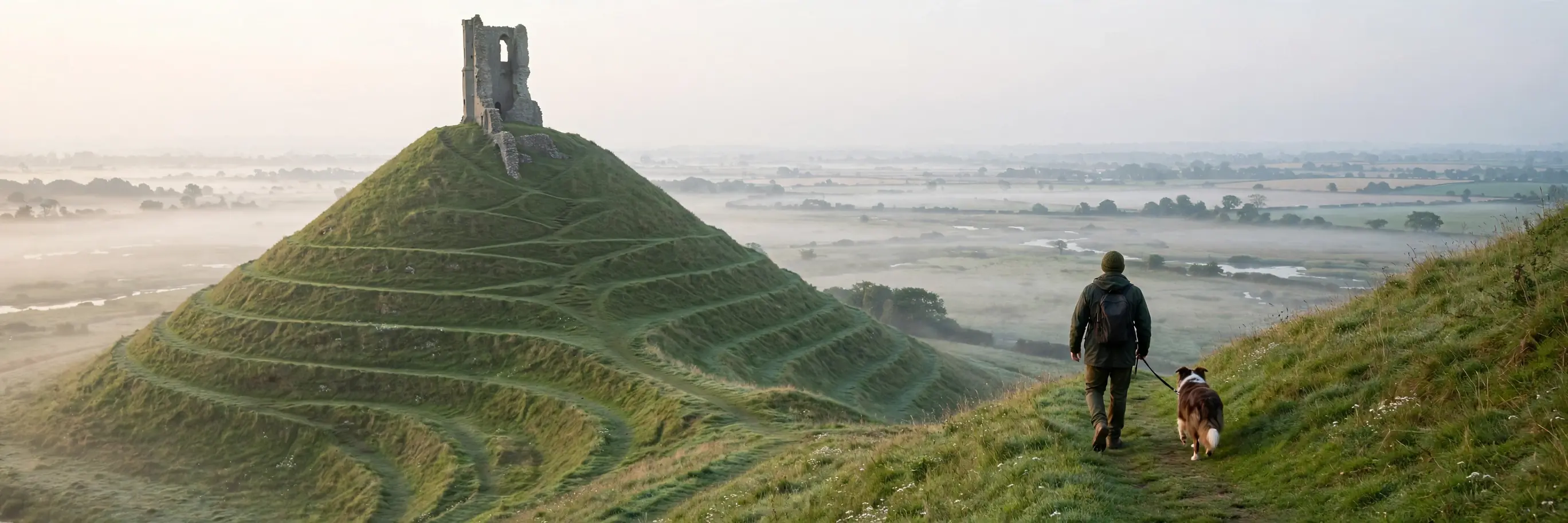
Glastonbury Tor is the landmark that defines the town: a steep, grassy hill topped by the roofless stone tower of St Michael's church, rising out of the flat Somerset Levels like an island. Dogs on leads are welcome on the Tor, and the climb is the single best thing to do with a dog in Glastonbury, but it deserves respect. The path from the town is steep in places, with stone steps near the top, and the whole hill is exposed to wind and sun, so the climb takes twenty to thirty minutes at a steady pace and feels longer on a hot day. There is no drinking water or shade on the hill, so carry water and a bowl for the dog, and do the climb in the morning before the heat builds.
At the top, the reward is a 360-degree view across the Levels, with the Mendip Hills to the north, the Quantocks to the west and the town spread out below. The tower itself is a good windbreak on a blustery day, but the summit is crowded at weekends and at sunset, so keep the lead short and the dog close to you while other visitors take photographs. The grass on the Tor is short and the ground is firm in dry weather, but the steps can be slippery after rain, and the hill is steep enough that a dog pulling on the lead can unbalance you — a harness with a handle, or a short lead held close, makes the climb safer for both of you. Older dogs and very small dogs may find the upper steps hard work, and there is no shame in stopping halfway: the views from the lower slopes are already excellent, and the dog will be just as happy with a shorter climb.
The Tor is managed by the National Trust, and the paths are well maintained, but the hill is also a place of pilgrimage and quiet reflection for many visitors, so keep barking to a minimum and give other people space at the summit. Dawn and dusk are the most atmospheric times to climb, and the early morning is also the quietest, which suits a dog that dislikes crowds. If you climb at sunrise, bring a torch for the walk back down, because the path is unlit and the steps are easy to miss in the half-light. In winter the Tor is often wrapped in mist, which is beautiful but disorienting, so stick to the marked path and keep the dog on a lead. Whatever the season, the Tor is the walk to do first, while the dog is fresh and the day is young.
The Abbey ruins: grass, stone and space to breathe
Glastonbury Abbey is one of the great ruined abbeys of England, a place of legend that claims connections to King Arthur and Joseph of Arimathea, and its grounds are a wonderful place to walk a dog. The ruins stand in large, well-kept grounds of lawns, trees and wildflower areas, with the broken walls of the abbey church rising out of the grass and the old fish ponds glinting at the edge of the site. Dogs on leads are welcome in the grounds, which is where you will spend most of your time, and the space is generous enough that a lead walk never feels cramped. The museum and the shop take assistance dogs only, so treat the visit as an outdoor one, and look at the Abbey's own page before you travel for the current rules.
The Abbey grounds are at their best in late spring and summer, when the trees are in leaf and the wildflower areas are in bloom, but they are pleasant in every season, and the winter light on the stone is particularly fine. Allow an hour to wander the grounds properly, reading the information boards and finding the quiet corners away from the main paths. There is a cafe on the site with tables outside for dogs, and the Abbey shop sells books and local crafts, though dogs wait outside the shop itself. The grounds are mostly flat, which makes them a good option for older dogs or dogs recovering from the Tor climb, and there are benches and shaded spots for a rest.
Walk the grounds slowly and the Abbey explains itself. The fish ponds at the edge of the site, the broken walls of the abbey church rising out of the grass, the information boards marking where the medieval buildings stood — it is a place to wander rather than to rush. The small exhibition about the archaeology of the Abbey is worth a look, though dogs wait outside it, and the Abbey shop sells books and local crafts. Children as well as dogs do well here, with open grass and no traffic, but keep the dog on the paths through the wildflower areas, pick up after it, and remember the ruins are fragile: no climbing on the stonework, no digging in the grass.
High Street and market: the most unusual shopping street in Somerset
Glastonbury High Street is unlike any other shopping street in England. Alongside the usual cafes, bakeries and charity shops are crystal shops, esoteric bookshops, candle makers, vegan cafes and stalls selling everything from incense to handmade jewellery, and the atmosphere is relaxed, colourful and unhurried. Dogs are welcome in many of the shops and cafes, and the town is used to dogs of every shape and size, so a well-behaved dog on a lead is a normal sight on the High Street. The pavements are wide enough for comfortable walking, and the side streets and the Market Cross area give you room to step aside if the main street gets busy.
On a market day the High Street shows its stranger side. Stalls sell local produce, crafts and street food, the town fills with visitors browsing and chatting to the traders, and the smell of incense and fresh bread drifts down the street together. A confident dog will enjoy the bustle; a nervous one will do better on a weekday, when the same shops are open and the pavements belong to the locals again. The Market Cross at the top of the High Street is the traditional meeting point, with benches and a good view down the street — look out for the George Hotel, one of the oldest purpose-built inns in the country, and the Tribunal, a medieval merchant's house that now holds a small museum, which dogs wait outside.
The High Street rewards a slow shopper and a calm dog. The crystal shops, the esoteric bookshops, the candle makers and the vegan cafes all have narrow aisles and delicate stock at nose height, so keep the lead short and ask at the door if you are unsure — most traders will wave you in. The bookshops, second-hand and new, are the particular pleasure, with everything from local history to alternative spirituality, and the cafes with outdoor tables are the natural rest stops. Sit, order, let the dog settle on its mat, and the street slows down with you. The dog policy can change between the front room and the back room of a cafe, so ask at the counter rather than assuming the whole building takes dogs.
Walking the Somerset Levels: flat, open and full of birds
Step off the edge of Glastonbury and the ground drops away into the Levels — a flat, low-lying patchwork of fields, rhynes, reedbeds and waterways that feels like a different country from the Tor. For a dog, the change of pace is the point: after the steep climb, here is level walking with long views, soft ground underfoot and water to sniff at every turn. The best routes leave the town along the droves, the old green lanes between the fields, and follow the rhynes out into the open country; a two-hour loop is easy to put together without ever crossing a busy road, and the flatness makes it ideal for older dogs, puppies and any dog that struggles with hills.
The birds are the reason to walk the Levels slowly. In winter the fields fill with starlings, ducks and wading birds, and at dusk the murmurations at Ham Wall and Shapwick Heath — thousands of starlings wheeling over the reedbeds — draw visitors from across the country. Spring brings cuckoos and lapwings, summer brings dragonflies and butterflies along the rhynes, and the hides on the reserves are the place to watch them, though dogs wait outside the hides and the visitor centres. The Levels are farmed, so livestock grazes many of the fields and the rhynes are deep drainage ditches a dog can fall into: keep the dog on a lead or a long line until you have checked the field is empty and the water is safe.
The Levels give you nothing for free, so come prepared. After rain the paths turn to mud, especially in winter, and a towel in the car earns its keep; the open droves have almost no shade, so water goes in the bag on a warm day; and the ground is so low that wet winters can flood it for weeks and shut the paths. Look at the local conditions before you set off, and have a backup in town if the Levels are under water. The flatness also means the wind cuts across the fields in winter, so bring a coat for yourself and a drying coat for the dog. For a longer day, the route to Meare and the lake at Meare Pool makes a good half-day outing, with a pub at the far end and a quiet return along the lanes.
Festival season, handled calmly
Glastonbury is famous for its festival, but the festival itself is held at Pilton, several miles from the town, and dogs are not allowed on the festival site. That distinction matters, because the town during festival week is a different place from the town in an ordinary week: it fills with visitors, the pubs and cafes are busy, and the atmosphere is lively and sometimes chaotic. If you love a crowd and a buzz, visit the town during festival week and enjoy the fringe events, the street performers and the general excitement. If your dog dislikes crowds, come the week before or the week after, when the town has the festival atmosphere without the festival crowds, and the Tor and the Levels are quiet again.
The festival also affects accommodation and parking for miles around, with prices rising and availability falling sharply during the festival weekend. If you are planning a trip that coincides with the festival, book months ahead and expect to pay more, or choose a different weekend entirely. The town's own events, including the Frost Fayre in winter and the various markets and fairs through the year, are smaller and more dog-friendly, and they give a better sense of the town's community than the festival week does. Check the town's events calendar before you travel, because a local fair or a market day can make a visit more interesting, while a very busy event can make it harder for a nervous dog.
One practical warning: the roads around Glastonbury and Pilton are heavily congested during the festival, and the traffic can add hours to a journey. If you must travel during festival week, allow extra time, use the signed routes, and do not rely on satnav to find a shortcut through the lanes. For most dog owners, the best festival-season plan is to visit Glastonbury in the shoulder weeks, enjoy the town and the Tor, and save the festival itself for a dog-free trip another year.
Eating and drinking with a dog in Glastonbury
Glastonbury eats differently from any other town in Somerset, and the High Street shows it: alongside the usual cafes and bakeries are vegan kitchens, vegetarian cafes, crystal shops with tea rooms, and pubs that have been serving travellers since the Middle Ages. Dogs are welcome in many of them as a matter of course — water bowls and treats behind the counter, a mat by the door — and the town is so used to dogs of every shape and size that a well-behaved dog on a lead is simply part of the street. The cafes serve breakfast, brunch and lunch with local produce and homemade cakes, and the pubs serve classic pub food alongside more unusual options; the beer gardens are good places to sit with a dog on a sunny afternoon, and the rule can change from room to room, so ask at the counter when you arrive.
The Abbey grounds are the picnic spot to aim for. Buy the supplies on a market morning — a loaf, some Cheddar, a pork pie, fruit — and carry them into the grounds, where the dog can lie in the grass while you eat, or down to the lower slopes of the Tor on a dry day. A picnic is also the answer when the dog is too tired or too muddy to sit in a cafe after the climb, and it keeps the day flexible if the weather turns. If you are staying in a cottage, the town's shops and the larger supermarkets in Street and Wells stock everything you need, and the farm shops in the villages around sell local produce. For an evening meal, ring ahead in summer and during festival season: the best tables go early, and telling the pub about the dog when you book is what gets you the corner table.
Let the Tor decide when you eat. A dog that has climbed the hill in the morning will sleep through lunch in a cafe, but the same dog will struggle if you make it cross the High Street at midday in full sun, because the Tor has no water and no shade and the town pavements throw the heat back. Ask for a bowl at the counter when you order — most places bring one without a fuss — and pick the table under the trees rather than the one in the middle of the garden. Dogs that bark at strangers do better at the edge, with a mat from home underneath them, and the meal itself should come after the walk, not before it. Get that order right and the cafe part of a Glastonbury day is the easy part.
Where to stay in and around Glastonbury
Two kinds of stay, and the choice is between the town and the Levels. In town, the small hotels and bed and breakfasts around the High Street and the Abbey put the Tor, the Abbey and the shops within a few minutes on foot — ask for a room on the ground floor if the dog is old or large, a garden for the last walk of the night, and whether the dog can join you at breakfast or has to wait in the room. The one week to avoid, or to book a year ahead for, is festival week at Pilton: the town fills completely, even though the festival itself is miles away, and the best rooms go months ahead.
Ask the cottage questions before you pay, not after you arrive. How many dogs does it take, and what is the charge for each? Is the garden genuinely enclosed, and how high is the fence? Where is the nearest field for the morning walk, and what are the rules about leaving the dog alone while you eat out? The cottages that answer all four straight away are the ones to book — most of them are in the villages out on the Levels: Street, a short drive south, with gardens and flat walks from the door; Meare, with its lake; West Pennard and Butleigh, quieter still, with lanes straight onto the rhynes and the droves. The campsites and caravan parks around the town suit families, with space, dog-walking areas and nobody minding a bark at breakfast time.
Introduce the dog in the first message, as if you were introducing it in person: breed, size, how many, whether it sleeps in a crate, whether it is used to stairs. A host who gets that message will put you in the right room and tell you about the quiet lane behind the house for the morning walk; a host who finds out at the door will put you in whatever is left. Pack its bed, its usual food and a blanket from home, and give it a quiet first evening so the new place stops feeling strange. From Glastonbury the whole of central Somerset opens up — Wells one way, the Mendips the other, the Levels in every direction — and our guides to Bath and Bristol cover the bigger cities to the north, with the same attention to split visits, parking and places to stay.
Parking and getting there
Glastonbury sits on the A39 between Wells and Street, an easy drive from the M5 and the A303, and the approach from Wells is the scenic one — across the Levels with the Tor ahead of you the whole way. For a first visit, aim for St John's car park off Northload Street: a short flat walk from the High Street and the Abbey, and large enough to have spaces on an ordinary weekday. The Abbey car park on Magdalene Street is the other option, closer to the Abbey itself and the start of the Tor path. Charges apply in most of the town car parks, so read the board at the entrance and note the time limit; market days, festival season and sunny weekends are the days they fill, and arriving before ten in the morning is the only reliable plan.
The bus stop on the High Street is the public-transport hub, with services from Wells, Street, Taunton and Bristol, and dogs are welcome at the driver's discretion — worth a quick check with the operator before you rely on one. There is no railway station in Glastonbury, so the bus is the only way in without a car, and it drops you a short walk from the Tor path and the Abbey. Staying in town, you will not need a car at all: the Tor, the Abbey and the High Street are all walkable, and the Levels paths start at the edge of town. Drivers should take the approach slowly, because the roads across the Levels are narrow in places and busy in summer, and the lanes around the town are full of walkers and cyclists.
If the dog cannot climb the Tor with you, one of you stays with it in the Abbey grounds, where there is grass and shade — the car is never the answer. The town car parks have almost no cover, and the inside of a car heats up far faster than people expect, even on a mild day. The same applies to the Abbey museum and the shops: if the dog cannot come in, leave it with a companion outside. Electric charging exists in a few of the town car parks but it is thin on the ground, so top up before you arrive. And if St John's is full on a market day, the fallback is the Abbey car park on Magdalene Street, or coming back early and walking in from the Levels side.
Seasons, weather and what changes
May and September are the months to aim for in Glastonbury. The Tor is green, the Abbey grounds are in bloom, the Levels are full of birds, and the town is lively without being crowded — May brings wildflowers to the Levels and the Tor, September brings warm days and quiet streets, and October brings autumn colour to the trees in the Abbey grounds. A dog gets the best of the town in those months: the climb in the cool of the morning, the flat Levels walks in the afternoon, and a pub garden in the evening, all without the festival crowds or the winter floods.
The festival at Pilton sets the pace of a Glastonbury summer, even though the site itself is miles away. The town fills, the car parks are full by mid-morning, and the Tor is at its most crowded — so the quiet version of the town only exists before ten. Climb the stone steps at dawn, while they are still cool underfoot, and leave the Levels for the evening, when the sun drops and the breeze picks up; the open droves have no cover at midday. Feel the stones with your palm before a midday walk, keep a bottle in the bag, and if the dog starts panting hard or lagging behind, stop in the shade and let it cool down before you go any further.
The starlings are the reason to come in winter. At dusk the murmurations at Ham Wall and Shapwick Heath — thousands of birds wheeling over the reedbeds — draw visitors from across the country, and the Tor in fog is one of the most evocative sights in England. The town's cafes are warm, the Levels fill with winter birds, and the crowds are gone. The price is the weather: the Levels can flood for weeks, the paths get muddy, and the Tor takes the wind and rain full in the face. Fit the Tor climb and the Levels walk around the short days, pack a torch for the walk back to the car, and look at the forecast the evening before, and again over breakfast — the Levels can change in an hour, so bring a waterproof for yourself and a drying coat for the dog.
A two-day plan that works with a dog
Glastonbury deserves two days if you can spare them, because the town, the Tor and the Levels each reward a slow look. Day one starts with the Tor: arrive early, climb the hill while the dog is fresh, and spend an hour at the top taking in the view. Come down for a late breakfast in a High Street cafe, then spend the middle of the day in the Abbey grounds, wandering the ruins and resting in the shade. The afternoon is for the High Street itself — the shops, the bookshops and the market stalls — and the evening is for a pub dinner, with the dog settled at your feet after a full day. This order matters: the hard climb comes first, the gentle walking second, and the food and rest last.
Day two is for the Levels. Start with a flat walk out from the town along the rhynes, following a loop that suits your dog's fitness, and aim to be back by lunchtime. The afternoon can be a drive to a nearby village — Meare, with its lake and its pub, or a longer trip to Wells or the Mendips — or a second, quieter visit to the Tor at sunset, when the light is at its best and the crowds have gone. If you are staying for a third day, the coast at Burnham-on-Sea and the Quantock Hills are both within an hour's drive, and the town makes a good base for exploring the whole of central Somerset.
- Day 1, morning: Arrive early, climb the Tor and take in the views from the summit.
- Day 1, midday: Abbey grounds, then lunch in a dog-friendly cafe on the High Street.
- Day 1, afternoon: Browse the shops and the market, then dinner in a pub.
- Day 2, morning: A flat Levels walk along the rhynes, with birds and open views.
- Day 2, afternoon: Meare village and the lake, or a sunset return to the Tor.
- Day 2, evening: A quiet dinner in town, or a drive to Wells for the cathedral.
Burnham-on-Sea is under an hour away, and the Quantocks not much further, so a third day at the coast or on the hills turns two days into a proper break. The pattern holds whatever you do: the big walk first, the gentle walk second, with food and rest fitted in between, and no long waits in cars or queues. You will know it worked when the dog drops off to sleep at your feet in the pub. For a longer stay, our guides to Salisbury and Bath cover the neighbouring cathedral cities, with the same attention to split visits, parking and places to stay.
Practical questions
Before you go
Can dogs climb Glastonbury Tor?
Yes, dogs on leads are welcome on the Tor. The climb is steep and exposed, with stone steps near the top, so it suits fit dogs and takes about twenty to thirty minutes from the town. Bring water, because there is no shade or drinking water on the hill, and keep your dog on a lead around the tower and the other visitors.
Can dogs go into Glastonbury Abbey?
Dogs on leads are welcome in the Abbey grounds, which are large grassy ruins with plenty of space for a walk. Only assistance dogs are allowed inside the Abbey museum and the shop. Check the official guidance before you travel, because event days and the Abbey's own rules can change what is open to dogs.
Is Glastonbury town centre dog-friendly?
Glastonbury is one of the most relaxed towns in Somerset for dogs. Many of the independent shops, cafes and pubs welcome dogs inside, and the High Street is easy to walk on a lead. The market days are busier, so if your dog dislikes crowds, visit on a quieter weekday and use the side streets.
Where can my dog walk off the lead near Glastonbury?
The flat, open paths of the Levels give dogs room to run, but check the field first: livestock grazes much of the Levels, and the rhynes are deep drainage ditches, so use a long line unless you are certain the field is stock-free and the water is safe. The Tor and the Abbey grounds are both lead-only. If you want a proper enclosed run, ask locally about the current dog fields, or head for the quieter Levels paths early in the morning.
Where do I park in Glastonbury with a dog?
Aim for St John's car park off Northload Street: a short flat walk from the High Street, the Abbey and the Tor path. The Abbey car park on Magdalene Street is the second choice, closer to the Abbey itself. Market days and festival season fill both, so get in before ten or come by bus — and never leave the dog waiting in the car, because the town car parks have almost no shade.
Is Glastonbury worth visiting with a dog during festival season?
The town is lively during festival season, but the festival itself is held at Pilton, several miles away, and dogs are not allowed on the festival site. Visit the town a week either side of the festival for the atmosphere without the crowds, or come in the quieter months when the Tor and the Levels are at their best.