This guide is independent and contains no paid placement. Opening times, ferry rules, parking charges and cafe policies change, so check the official guidance before you travel.
Greenock suits a dog day built around water and height: a flat, mile-long Esplanade walk along the Firth of Clyde, a steep 35 to 60 minute climb to Lyle Hill for the panorama, and the level Greenock Cut trail above the town. Keep dogs on lead on the promenade and the hill roads, carry water and a windproof layer, and check ferry and venue rules before you travel.
First, read the Clyde
Greenock sits on the south bank of the Firth of Clyde, in Inverclyde, between Port Glasgow to the east and Gourock to the west, about 24 miles west of Glasgow. The town grew up around shipbuilding, sugar refining and the sea trade, and the river is still the first thing you notice: a wide stretch of grey-green water, the Cowal hills rising on the far shore, and, on a clear day, the shape of Arran far to the south. For a dog walk, that geography is the whole plan. Everything worth doing with a dog here is either along the water, above it, or on the old aqueduct contour that follows the hillside behind the town.
The practical consequence is that Greenock works best as a walk-first destination. There is no single dog attraction to queue for, and that is the point. The Esplanade gives a flat leg-stretch with constant interest for a dog that likes to watch the world; Lyle Hill gives a proper climb and a view that makes the effort obvious; the Greenock Cut gives a long, quiet, mostly level walk for dogs that need distance rather than novelty. Between them they cover the three kinds of day most dogs actually want: a short sniff, a climb, and a long steady walk.
It helps to know the town's scale before you arrive. Greenock is a working town, not a resort, and the waterfront is shared with a cruise terminal, a college campus, a cinema, an arts centre and the comings and goings of a port. On a quiet weekday morning the Esplanade can feel almost empty; on a cruise-ship day, with thousands of passengers ashore, the same stretch is busy, noisy and full of new smells. Neither version is wrong, but they suit different dogs. A confident, social dog will enjoy the bustle; a nervous or reactive dog is better brought early, or on a day when no ship is berthed. The Ocean Terminal publishes cruise schedules, so check the official guidance before you travel if crowds matter to your dog.
Orientation is simple once you have the three anchors. The Ocean Terminal and the Custom House mark the eastern end of the waterfront walk. The Esplanade runs west from there, past the Beacon Arts Centre and the war memorial, towards Gourock. Lyle Hill rises directly behind the western half of the town, its memorial visible from the water on a clear day. The Greenock Cut runs along the hillside above and behind the whole town, reached by road from Cornalees Bridge or the Overton car park. Hold those three lines in mind — water, hill, aqueduct — and you will not get lost.
The Esplanade, end to end
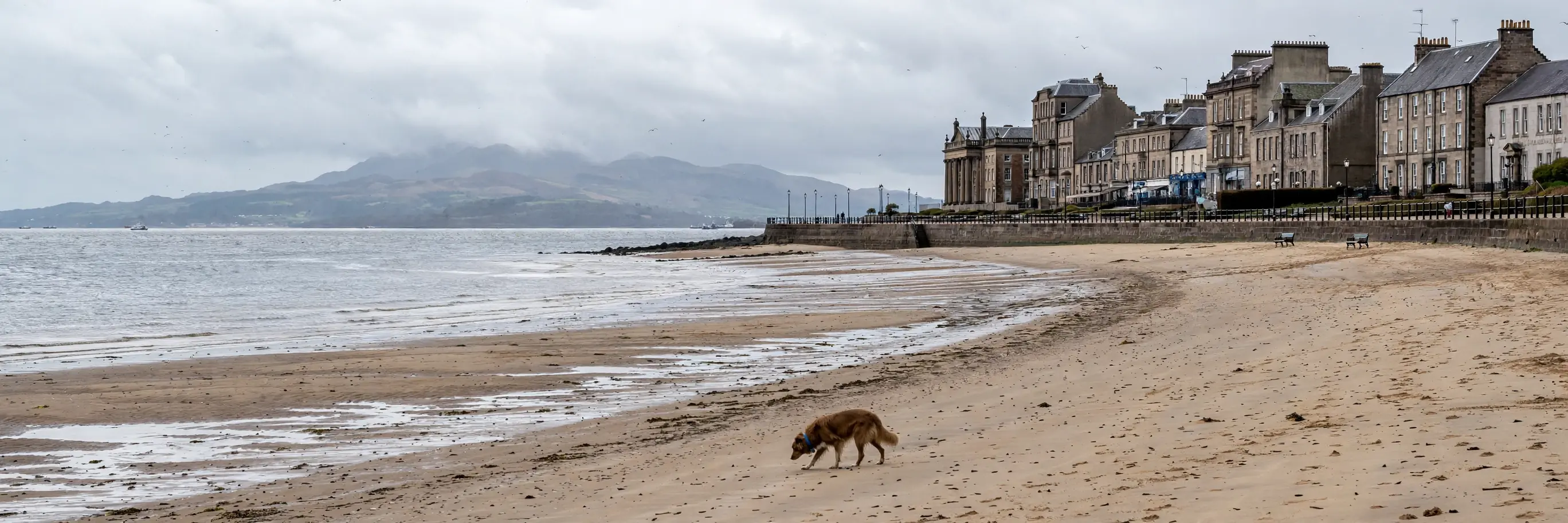
The Esplanade is Greenock's best dog walk, and it is also its simplest: a Victorian promenade, just over a mile (1.6 km) long, running west from Ocean Terminal along the shore to the Royal West of Scotland Amateur Boat Club, near the old Fort Matilda site. The surface is flat and paved, the views are open from the first step, and there is almost nothing to decide except how far to go and when to turn back. For an older dog, a puppy on a first proper outing, or a dog recovering from an injury, it is the rare Clyde walk that asks for nothing except a lead and a sensible pace.
Start at the eastern end, by Ocean Terminal, and walk west with the water on your right. The first stretch passes the terminal building and the Wyllieum gallery, then opens out along the sea wall. Across the firth the Cowal hills fill the horizon; to the north-west you can pick out Helensburgh and the mouth of the Gare Loch, and on the clearest days the hills of Argyll stack up behind them. Ships, ferries, fishing boats and the occasional cruise liner pass close enough to hold a dog's attention, and the working harbour at the eastern end adds cranes, tugs and the low thrum of a port that is still in use. Dogs that are sound-sensitive may find the eastern end, with its traffic and terminal activity, the busiest part; the walk calms noticeably as you move west.
About halfway along, the Beacon Arts Centre sits right on the water, a glass-fronted building that is hard to miss, and the war memorial stands close to the promenade. This middle stretch is where most local dog walkers are found, especially in the morning, and it is also where the pavement is widest and the benches most frequent. It is a good place to pause, let the dog watch the water, and decide whether to continue to the western end or turn back. Benches face the firth, and on a still day the pause is the point of the walk. On a windy day, the same benches are a reminder to keep moving: the wind off the firth finds every gap in a coat, and a short-coated dog will feel it sooner than you do.
Keep your dog on a lead for the whole Esplanade. It is a shared promenade used by cyclists, runners, families and other dog walkers, and it runs beside open water with a sea wall between pavement and shore. There is no fence between a loose dog and the drop in places, and a dog that bolts after a gull or another dog has nowhere safe to go. A short lead, rather than a long line, is the right tool here: it keeps the dog out of the cycle line and out of the path of oncoming walkers. Pick up after your dog — bins are provided along the route, and a promenade this well used only stays pleasant if everyone does.
The western end, around the boat club and Fort Matilda, is quieter and feels more like the edge of town. From here you can either retrace the Esplanade, which gives a round trip of just over two miles, or continue the short distance into Gourock, where the waterfront continues past the pier and the outdoor pool. The full walk from Ocean Terminal to Gourock takes about 30 minutes each way at a steady pace, and it is flat throughout, which makes it a realistic option even for dogs that cannot manage Lyle Hill. If your dog is tired, turn back at the boat club; the view is just as good in reverse, with the town and the hill behind you instead of the open firth ahead.
Lyle Hill and the Free French memorial
Lyle Hill is the climb that earns the view. The hill rises to about 130 metres (426 feet) above the town at its western end, and from the top the whole of the lower Clyde opens out: Greenock and Gourock below, the firth stretching east towards the Erskine Bridge, the Cowal hills and the lochs of Argyll to the north, and Arran, some 45 miles to the south, visible on a clear day. It is widely described as one of the best viewpoints on the Clyde, and for once the description is not an exaggeration. The panorama is the reason to come; the memorial at the top is the reason to stay a while.
The memorial is a Cross of Lorraine fused with an anchor, unveiled in 1946, remembering the Free French sailors based on the Clyde during the Second World War, including the crews of the corvettes Alysse and Mimosa and the submarine Surcouf. It is a quiet, significant place, and dogs should be kept on a lead and close by out of respect as much as safety. The hill is named after Abram Lyle, the sugar refiner who was Provost of Greenock in the 1880s and developed the viewpoint as a way of creating work for unemployed people in the town. The road up, Lyle Road, was built for the same purpose, and the hill has been a public leisure destination ever since.
The walking route from the Esplanade is well signposted and takes 35 to 60 minutes, depending on your pace and your dog. From the east end of the Esplanade, walk a short distance inland along Campbell Street to Brougham Street, turn right, and after about half a mile turn left into Madeira Street, following the signs for Lyle Hill. Continue past Glenpark Early Learning Centre, and at the top of Madeira Street turn right; the road continues up the hill to the memorial. The terrain is tarmac throughout, but the hill is steep, and the final stretch is the hardest. Fit dogs take it in their stride; older dogs, short-legged breeds and brachycephalic dogs will need pauses, water and shade on a warm day. Do not rush the climb, and do not let a dog pull you up it — a harness with a handle, or a short lead held close, gives you control on the steepest sections.
If the climb is too much, drive it instead. Lyle Road can be driven most of the way, and parking is available near the top, from where the memorial is a short walk. That is the right choice for an older dog that still deserves the view, for a dog recovering from surgery, or for a day when the weather turns and you want the panorama without the hour-long ascent. From the memorial, a short walk through the adjacent golf course, following the signpost to Craig's Top, extends the view east beyond Port Glasgow as far as the Erskine Bridge. Keep dogs on a lead on the golf course and stay on the marked path; golfers and dogs do not mix well, and a loose dog on a fairway is a fast way to end a good morning.
At the top, give the dog time. The wind is stronger up here than on the Esplanade, and a dog that has just climbed a steep hill in a cold wind will cool quickly, especially a small or short-coated one. A drying coat or a windproof layer in your bag is worth its weight on Lyle Hill, even on a day that feels mild at sea level. Water matters too: there is no reliable drinking water at the summit, so carry a bottle and a collapsible bowl. The descent deserves the same care as the climb — steep tarmac is hard on paws and joints, particularly for older dogs, so take it slowly and use the grass verge where it is safe to do so. From the summit you can either retrace your route to the Esplanade or continue over the hill and, after about a quarter of a mile, turn right downhill to Battery Park, then eastwards back to the Esplanade, which makes a satisfying loop.
The Greenock Cut above the town
Above Greenock, on the hillside behind the town, runs one of the best low-level walks near Glasgow. The Greenock Cut is an aqueduct built between 1825 and 1827 to carry water from Loch Thom to the town's mills and homes. It is now a scheduled monument, and the path that follows it is a mostly level contour walk with views over the whole firth — a completely different experience from the Esplanade below, and the right choice when your dog needs distance and quiet rather than promenade bustle.
The full circular trail is about 7 miles (12.5 km) and takes around 2.5 hours, according to the Clyde Muirshiel Regional Park trail leaflet. Most walkers start from the Greenock Cut Visitor Centre at Cornalees Bridge or from the Overton car park, and the path is mostly level, running along the hillside with the firth spread out below. The Cut is rated among the top 50 walks in Scotland in some listings, and whether or not you put stock in rankings, the combination of easy gradients, open moorland and constant views explains why it is so well regarded. Shorter options exist, including a nature trail through Shielhill Glen, so you do not have to commit to the full circuit to enjoy it.
For dogs, the Cut is a long-line walk rather than an off-lead one. The path crosses open moorland where livestock may graze, where ground-nesting birds are present in season, and where other walkers, runners and cyclists share a narrow trail. The Scottish Outdoor Access Code applies: dogs should be under close control, on a lead or at heel, around livestock and during the bird breeding season, and owners should pick up after their dogs throughout. A long line gives a dog room to sniff and explore without the risk of a chase across open ground, and it keeps you in control when the path narrows beside the aqueduct itself.
Plan the Cut as a half-day, not a quick add-on. There is no cafe on the trail, and the exposed hillside is colder and windier than the town below, so pack water for the dog, a snack for yourself, a windproof layer and a towel for the car. The ground can be boggy after rain, particularly on the moorland sections, and the path surface varies from firm gravel to wet grass. Dogs that hate wet feet will hate the Cut after a wet week; dogs that love a bog will think it is the best walk in Scotland. Check the official guidance before you travel for current path conditions, and tell someone your route if you are walking the full circuit alone. The visitor centre at Cornalees Bridge is a useful starting point for orientation, toilets and local advice, though its own opening hours vary by season, so check before you travel.
The Cut also works as a second-day walk if you are staying in the area. After the Esplanade and Lyle Hill, which are both essentially town walks, the Cut feels like the countryside proper: skylarks in summer, the smell of heather and wet grass, and a horizon that keeps widening as you climb. Dogs that were overstimulated by the promenade crowds usually settle into the steady rhythm of a contour walk, and the return to the car — tired, muddy and content — is the best possible end to a Greenock visit.
Battery Park and the town's green corners
Battery Park sits at the western end of Greenock, close to the Gourock boundary, and it is the town's most useful piece of open ground for a dog. It is a broad, open park with grass, paths and views back across the water, and it works as everything the Esplanade is not: a place where a dog can move more freely, where a ball can be thrown, and where a reactive dog can be given space from other walkers. It is also the natural end point of the Lyle Hill loop, the place where the descent meets the shore, and a practical parking base for the waterfront walk.
Use Battery Park as your off-lead option, but use it with judgement. It is a public park, not a secure dog field, and it is shared with families, sports users and other dogs. Only let a dog off lead here if recall is reliable, if the dog is comfortable around strangers and other dogs, and if no event or restriction is in force that day. Keep the dog away from the road edge and from the shore, and keep a lead in your hand, not in your pocket. For dogs that cannot safely go off lead, Battery Park is still valuable: the open grass and the perimeter paths give a good on-lead walk with far fewer pinch points than the Esplanade.
Elsewhere in town, Lyle Park is a smaller town park closer to the centre, useful for a short toilet break or a leg-stretch between errands rather than a destination walk. The streets around Cathcart Square, with the Municipal Buildings and the Victoria Tower, are worth a short stroll for the architecture, but they are town streets first and dog walks second: pavements, traffic and crowds, with little green space. Treat them as a ten-minute diversion, not a walk, and keep the dog close. The real green space in Greenock is at the edges — Battery Park to the west, the Cut above, and the shore all along the front — and that is where a dog's time is best spent.
The working waterfront and town centre
Greenock's waterfront is a working place, and the dog-friendly parts of it are the outdoor ones. The Custom House, a Greek Revival building designed by William Burn and built in 1818, stands at the water's edge and is worth looking at from the outside, where a dog can wait comfortably. The Municipal Buildings in Cathcart Square, topped by the Victoria Tower finished in 1886 and 245 feet (75 metres) tall, dominate the town centre and are visible from almost anywhere — a useful landmark when you are finding your way back to the car with a tired dog. The Watt Institution, which brings together the McLean Museum and Art Gallery, the Watt Library and the Inverclyde Archives in the west end of town, is Greenock's museum, and it sits near the birthplace of James Watt, the engineer born in the town. These are human-only interiors: plan them as split visits, with one person staying outside with the dog, or enjoy the buildings from the street.
Ocean Terminal is the modern face of the waterfront. Cruise ships berth alongside the terminal, with no tender boat needed, and the 2025 season was a record one, with 82 calls and more than 145,000 passengers. The terminal building houses the Wyllieum, a free gallery devoted to George Wyllie (1921 to 2012), the customs officer turned sculptor. Dogs are not part of a gallery visit, but the terminal area itself — the quayside, the views of berthed ships, the comings and goings — is an absorbing outdoor stop for a dog that likes to watch the world. On cruise days the area is busy and the atmosphere is festive; on non-cruise days it is quiet, and the scale of the empty berth gives a better sense of the ships that use it.
Central Greenock is changing. A £24 million transformation of the town centre is under way until 2027, intended to reconnect the centre with Ocean Terminal, so expect roadworks, hoardings and diversions in the town centre. For a dog walk this matters in two practical ways: pavements and crossings may be temporarily rerouted, and the noise and machinery of a building site can unsettle a nervous dog. Check the official guidance before you travel if you plan to walk through the centre, and consider sticking to the Esplanade and the hill, which are unaffected. The Beacon Arts Centre, the glass-fronted building on the waterfront, hosts theatre, music and community events; like the museums, it is a human-only interior, but its terrace and the pavement outside make a natural pause point on the Esplanade walk.
Shopping and errands with a dog in Greenock are best kept short and practical. The town centre has the usual high-street shops and supermarkets, and a dog will be welcome in some and not in others, with no single rule to rely on. Plan errands as a quick in-and-out, with the dog waiting outside only if the weather is mild and the wait is genuinely brief — never leave a dog in a car, and never leave a dog tied up outside a shop for longer than a few minutes. The waterfront walk, not the town centre, is the reason to bring a dog to Greenock, and the town centre is best treated as a place to pass through on the way to it.
On to Gourock, the ferry and Lunderston Bay
Greenock's best day trip is also its easiest: follow the water west into Gourock. The Esplanade walk continues from Greenock into Gourock in about 30 minutes, or you can take the train one stop from Greenock West. Gourock is a smaller, quieter town with its own pier, its own waterfront, and the ferry terminal for crossings to Dunoon on the Cowal peninsula. For a dog, the change of scene is the point: a new town, new smells, and the option of a boat.
Gourock Outdoor Pool, Scotland's oldest heated outdoor saltwater lido, has been open since 1909, and it sits on the waterfront with the Firth of Clyde as its backdrop. Dogs do not swim in the pool, but the walk past it, along the Gourock waterfront, is one of the prettiest short stretches on this coast. From Kempock Place in Gourock, the three-mile coastal walk west to Lunderston Bay shows the Clyde estuary at its best, passing the pool and the shore before reaching the bay. Lunderston Bay itself is a sandy bay popular with families and dog walkers, and it is the natural turning point for a longer coastal day. Check the tide times before you go: at high tide the beach narrows, and at low tide the bay opens out into a wide expanse of sand that dogs love.
The ferry is the bigger decision. Ferries run from Gourock to Dunoon, with both a passenger service and a vehicle service operated by different companies, and dogs do travel on Clyde ferry services — but the rules differ between services and operators. Some carry dogs on deck or in designated areas, while others ask that dogs stay in the car. Check the official guidance before you travel with the operator you plan to use, confirm whether dogs are allowed in passenger lounges, and arrive early so you are not rushing a nervous dog up a gangway. A dog that has never been on a boat will find the engine noise, the movement and the unfamiliar surfaces stressful, so a short crossing to Dunoon is a better first ferry than a long one, and a calm dog on a short lead, with a familiar blanket to lie on, will cope far better than a dog left to work it out alone.
Dunoon itself, on the Cowal peninsula, is a straightforward ferry-day destination: a small town with a waterfront, cafes and walks, and the gateway to the Cowal hills and the Argyll coast beyond. If you cross with a dog, plan the Dunoon side as carefully as the Greenock side — know where you are walking to, where the dog can rest, and when the return ferry leaves, because missing the last sailing with a tired dog is a poor end to a day. For many visitors, the better plan is simpler: walk to Gourock, enjoy the waterfront and Lunderston Bay, watch the ferries come and go, and save the crossing for a day when you have the time and the dog has the confidence for it. Our Ayr guide covers the other great Clyde-side town to the south, with its own beaches and seafront, if you want to compare the two coasts before choosing where to spend a longer break.
Where dogs can rest, eat and sleep
Greenock's dog-friendly eating is concentrated in a handful of cafes, and the best source for the current list is Discover Inverclyde, which has published a top-five list of dog-friendly cafes across Inverclyde. In Greenock itself the list names Cafe Monza and Cafe Mor; in Gourock it names Riviera Coffee, the 1830 Eatery and The Cove. Those names are a starting point, not a guarantee: cafe policies change, seating areas change, and a cafe that welcomes dogs on its terrace may not welcome them inside. Check the official guidance before you travel, and when you arrive, ask before you settle — a quick question at the door saves an awkward retreat with a dog in tow.
The practical rules for eating out with a dog in Greenock are the same as anywhere, but the waterfront setting makes them easier to follow. Choose outdoor seating where it is offered, keep the dog on a short lead under the table, bring a portable water bowl and a chew or a mat to settle on, and order with the dog's needs in mind: a quick coffee and a cake is a better plan than a long lunch if your dog is restless. The Beacon Arts Centre cafe, on the Esplanade, is a natural stop on the waterfront walk, and the cafes around Gourock pier serve the same purpose at the far end. If the weather turns, a takeaway coffee and a bench with a view is often the better option than a crowded indoor room.
For an overnight stay, the Holiday Inn Express Greenock is the town's most straightforward dog-friendly option, with dogs welcome according to the venue's Facebook page, as recorded by Wag Scotland in November 2026. That welcome comes with conditions that you must confirm when you book: which rooms take dogs, whether there is a charge, and how many dogs are allowed per room. Check the official guidance before you travel, get the dog policy in writing with your booking, and ask where the nearest practical toilet walk is from the hotel door — a late-night walk in an unfamiliar town is no time to discover that the nearest grass is across a busy road. Greenock also works well as a base for a longer stay elsewhere: Glasgow, about 30 to 40 minutes away by train, has a wider range of dog-friendly stays and cafes, and many visitors stay in Glasgow and visit Greenock as a day trip, or stay in Greenock for the quiet and the water and visit Glasgow for the city.
If you are staying over, ask about the small things that make a hotel stay work with a dog: a ground-floor room or a lift, a room away from the main corridor if your dog barks at footsteps, and somewhere to dry a wet dog after a Clyde walk. Pack the dog's own bed, a familiar blanket, and enough food for the stay plus a day, because the nearest pet shop may not be open when you need it. And keep the first evening quiet: the same feeding time, the same bed, the same last walk as at home. A dog that has climbed Lyle Hill and walked the Esplanade will sleep well; a dog that has been dragged through a long dinner and a noisy bar will not.
Getting there, parking and trains
Greenock is about 24 miles west of Glasgow, and the train is the easiest way to arrive with a dog. ScotRail services run from Glasgow Central to Greenock Central and Greenock West, and on to Gourock, with a journey time of 30 to 40 minutes. Dogs travel on ScotRail services, and the practical rules are straightforward: keep the dog on a lead, keep it off the seats, and keep it close in a crowded carriage. A dog that is nervous on trains will do better in a quieter carriage at an off-peak time, and a short settling walk before boarding makes the journey easier for everyone. Check the official guidance before you travel for the current rules on the number of dogs per passenger and any restrictions.
By car, the route from Glasgow follows the M8 west, then the A8 through Port Glasgow into Greenock. The drive takes around 40 minutes in normal traffic, and the A8 along the Clyde is a scenic approach in its own right, with the river appearing and disappearing beside the road. From the south, the A78 and the ferry from Hunter's Quay are the alternatives, and from the north the Erskine Bridge and the A82 connect Greenock to the Highlands route. Allow extra time on cruise-ship days, when traffic around Ocean Terminal is heavier, and during the central Greenock redevelopment works, when diversions are in force.
Parking is available along the Esplanade itself, at Battery Park at the western end, and around the Ocean Terminal area, which makes a waterfront walk easy to start without a long walk from the car. Bays along the Esplanade fill up on sunny days and when a cruise ship is in, so arrive early or use Battery Park and walk east instead. Charges and time limits change, so check the signs at the bay you use before you leave the car. For the Greenock Cut, use the Cornalees Bridge visitor centre car park or the Overton car park, both of which put you at the start of the trail; for Lyle Hill, parking near the top of Lyle Road saves the climb, while parking on the Esplanade and walking up is the better option if you want the exercise.
Greenock Central station is the most useful arrival point for the town centre and the eastern Esplanade, while Greenock West is closer to the western Esplanade, Lyle Hill and the walk to Gourock. If you are arriving by train with a dog, choose your station by your first walk: Central for the terminal and the Custom House, West for the hill and the long waterfront. Both stations are a short walk from the water, and neither requires a bus or a taxi to reach a good dog walk, which is one of the reasons Greenock works so well as a car-free day trip. If you do need a taxi, book one that accepts dogs in advance rather than hoping at the rank, and confirm the fare for the Lyle Hill climb if you are taking a taxi to the top — the short ride is inexpensive, but a driver who is not expecting a dog may decline.
Wind, tides and Clyde safety
The Clyde is the defining feature of a Greenock dog day, and it is also the feature that demands the most respect. The wind off the firth is the first thing to plan for: it is stronger on the Esplanade than in the town centre, stronger still on Lyle Hill, and it can turn a mild day into a cold one in minutes. Pack a windproof layer for yourself and a coat for a short-coated, small or older dog, even in summer. The wind also carries sound and scent, which is why dogs find the Esplanade so absorbing — and why a dog that is already overstimulated may find it too much. If your dog is struggling, move inland for a while: the streets behind the Esplanade are noticeably calmer, and a short break from the wind often resets a dog completely.
Rain is the second certainty. Greenock, like the rest of the west of Scotland, gets its share of rain, and the Esplanade in the rain is a different walk from the Esplanade in the sun: the pavement is slippery, the sea wall is wet, and the wind drives the rain horizontally. A waterproof coat, a towel in the car, and a drying coat for the dog turn a wet walk from a misery into a minor inconvenience. The Greenock Cut after rain is boggy, the Lyle Hill tarmac is slick, and the steps and slopes around the town centre need care. None of this is a reason to stay away — a wet Clyde walk, with the rain on the water and the hills disappearing into cloud, has its own beauty — but it is a reason to pack properly and to shorten the walk if the dog is cold or miserable.
Tides matter at Lunderston Bay and along the shore west of Gourock, where the beach narrows at high tide and opens out at low tide. They matter less on the Esplanade itself, which sits above the water, but they still shape the walk: at high tide the waves reach the sea wall and the spray can reach the pavement, while at low tide the shore is exposed and the smell of the estuary is stronger. Check the tide times before you travel if you plan to walk the beach at Lunderston Bay, and never let a dog swim in the Clyde without knowing the currents, the water quality and the exit points. The firth looks calm from the promenade, but it is a working estuary with strong currents, boat traffic and cold water, and a dog that jumps in after a ball may not be able to get out where it went in. Keep dogs out of the water unless you are certain of a safe entry and exit, and keep them on a lead near the sea wall at all times.
Other Clyde hazards are quieter but worth knowing. The shore can hold fishing line, hooks and broken glass, particularly near the harbour and the boat club, so check the ground before letting a dog sniff freely. Gulls and other seabirds nest and feed along the shore, and a dog that chases birds will quickly be in trouble with other walkers and with the birds themselves. In summer, the usual Scottish precautions apply: check for ticks after moorland walks on the Cut, carry water on every walk, and watch for signs of heat exhaustion on the climb up Lyle Hill, where there is little shade. In winter, the wind chill on the hill and the promenade is the main risk, and short walks with warm layers beat long walks with a cold dog. As always, check the official guidance before you travel for current safety advice, and if in doubt, shorten the walk.
A half-day plan that actually works
The best Greenock dog day is a simple one, built in order: water first, height second, food third. Arrive by train at Greenock West or park at Battery Park, and start with the Esplanade, walking east towards Ocean Terminal. The morning light is on the water, the promenade is at its quietest, and the dog gets a flat, sniff-rich walk to settle into the day. Allow 45 minutes to an hour for the round trip from Battery Park to the terminal and back, with pauses at the benches and the war memorial. If a cruise ship is in, reverse the direction and start at the terminal end, walking west away from the crowds.
From the Esplanade, climb Lyle Hill. Walk inland from the eastern end of the promenade along Campbell Street and Brougham Street, then up Madeira Street and Lyle Road to the memorial. Allow an hour for the climb and the time at the top, and carry water for the dog. At the summit, take the short walk to Craig's Top if the dog is still fresh, then descend by the Battery Park route for a loop that brings you back to the shore. By now the dog will have had a flat walk and a climb, and will be ready for a rest — which is the point. A tired dog is a happy dog, and a dog that has done both the water and the height has had the full Greenock experience.
Finish with food and a slow wind-down. Walk back along the Esplanade to a cafe — Cafe Monza or Cafe Mor in Greenock, or continue to Gourock for Riviera Coffee or the 1830 Eatery — and give the dog water, a chew and a mat to settle on while you eat. If you have a full day, add the Greenock Cut in the afternoon, or take the train to Gourock and walk to Lunderston Bay; if you have only a half day, the Esplanade and Lyle Hill are enough, and the Cut is the reason to come back. Either way, finish before the light goes: the Esplanade is pleasant at dusk, but the Lyle Hill descent and the Cut are not walks to do in the dark with a tired dog.
For a full day, the order can be reversed: the Cut in the morning, when the dog is freshest and the moorland is quietest, then the Esplanade in the afternoon, when the light is on the water and the cafes are open. For a weekend, add Gourock and the ferry as a second day, and consider Edinburgh or Glasgow as a contrasting city day if you are touring Scotland with a dog — the capital's hills and parks make a very different kind of walk from Greenock's waterfront, and the comparison is part of the pleasure of travelling with a dog in Scotland.
Practical questions
Before you go
Can my dog walk off lead on the Greenock Esplanade?
There is no single off-lead rule for the whole promenade, so keep your dog on a lead along the Esplanade itself. It is a shared, unfenced walkway beside open water, with cyclists, runners, children and other dogs passing close by, and the drop to the water at the sea wall is not a place for a loose dog. Save off-lead time for an enclosed space or a quieter stretch of open ground such as Battery Park, and only where your dog has reliable recall and no local restriction applies.
How long does the walk up Lyle Hill take with a dog?
Allow 35 to 60 minutes on foot from the Esplanade to the Free French memorial, depending on your route and your dog's pace. The climb is short but steep, on tarmac roads and pavements, so fit dogs manage it comfortably while older or short-legged dogs may need pauses. If walking up is too much, you can drive most of the way up Lyle Road and park near the top, then walk the last short stretch to the viewpoint.
Is the Greenock Cut suitable for dogs?
Yes, for dogs that are fit for a long, mostly level walk. The full circular trail is about 7 miles (12.5 km) and takes around 2.5 hours, following the historic aqueduct contour above the town with wide views over the firth. Shorter out-and-back sections from the Cornalees Bridge visitor centre or the Overton car park work better for older dogs or a half-day visit. Carry water, keep dogs under control near livestock and other walkers, and check the official guidance before you travel for current path conditions.
Can dogs go on the Gourock to Dunoon ferry?
Dogs do travel on the Clyde ferry services from Gourock, but the exact rules differ between the passenger ferry and the vehicle ferry, and between operators. Some services carry dogs on deck or in designated areas, while others ask that dogs stay in the car. Check the official guidance before you travel with the operator you plan to use, confirm whether dogs are allowed in passenger lounges, and arrive early so you are not rushing a nervous dog up a gangway.
Where can I park near the Esplanade with a dog?
Parking is available along the Esplanade itself, at Battery Park at the western end, and around the Ocean Terminal area, which makes a waterfront walk easy to start without a long walk from the car. Bays along the Esplanade fill up on sunny days and when a cruise ship is in, so arrive early or use Battery Park and walk east instead. Charges and time limits change, so check the signs at the bay you use before you leave the car.
Are dogs allowed inside the Watt Institution or the Beacon Arts Centre?
Do not plan on taking a dog inside either building. Museums, galleries and theatres in Greenock generally admit assistance dogs only, and pet dogs are not part of the visit. Treat the Watt Institution, the Wyllieum at Ocean Terminal and the Beacon Arts Centre as human-only stops, and plan them as a split visit, with one person staying outside with the dog, or enjoy them from the waterfront instead. Check the official guidance before you travel, as policies can change.