This guide is independent and contains no paid placement. If affiliate links are added later, they will be clearly marked and will not change our editorial checks.
Grinton is a small Swaledale village where the River Swale does most of the work: flat riverside paths, meadow picnics, a handsome church and a gentle two-mile walk to Reeth. Keep the dog on a lead near livestock and the river, arrive early for parking, and treat the Swale with respect after rain.
Start at the river, not the road
Most Dales villages are best approached from their main street. Grinton is the exception, because the village only makes sense once you have stood beside the River Swale and watched it slide past the meadows. The river is the reason the settlement is here, the reason the church is as grand as it is, and the reason the walking is so gentle: the valley floor is flat, the paths follow the water, and the hills rise on either side like the walls of a long green room. Arrive, find the river first, and the rest of the village falls into place.
That order matters for dogs too. A dog that has had twenty minutes beside the water — sniffing the bank, watching the current, settling into the sounds of a working valley — is a calmer companion for the churchyard, the lanes and the walk to Reeth than a dog unloaded straight into a car park and marched off. Let the river set the pace. The Swale at Grinton is wide and shallow in places, quick and deep in others, and its mood changes with the weather upstream, so the first job is simply to look at it: how fast it is running, how clear the water is, whether the banks are firm or soft after rain.
The village sits on the northern side of the valley, roughly two miles west of Reeth along the B6270, in the heart of the Yorkshire Dales National Park. It is small — a church, a scattering of stone houses, a bridge, and fields that run down to the water — and that smallness is the point. There is no high street to work through, no queue of attractions, and no need to rush. A visit to Grinton with a dog is a half-day of river, meadow and village lane, or a full day if you add the walk to Reeth and a long lunch. Dogs that dislike crowds, traffic and busy town centres tend to do very well here, because there is almost none of any of those things.
Before setting out, check the official guidance before you travel for the latest access information, path closures and river conditions. Swaledale is a working farming valley, and routes, stiles and field access can change with the seasons and with farm work. A quick check the evening before saves a wasted drive and, more importantly, keeps you from guessing about livestock, lambing or a path that has been temporarily diverted.
Grinton Bridge and the riverside meadows
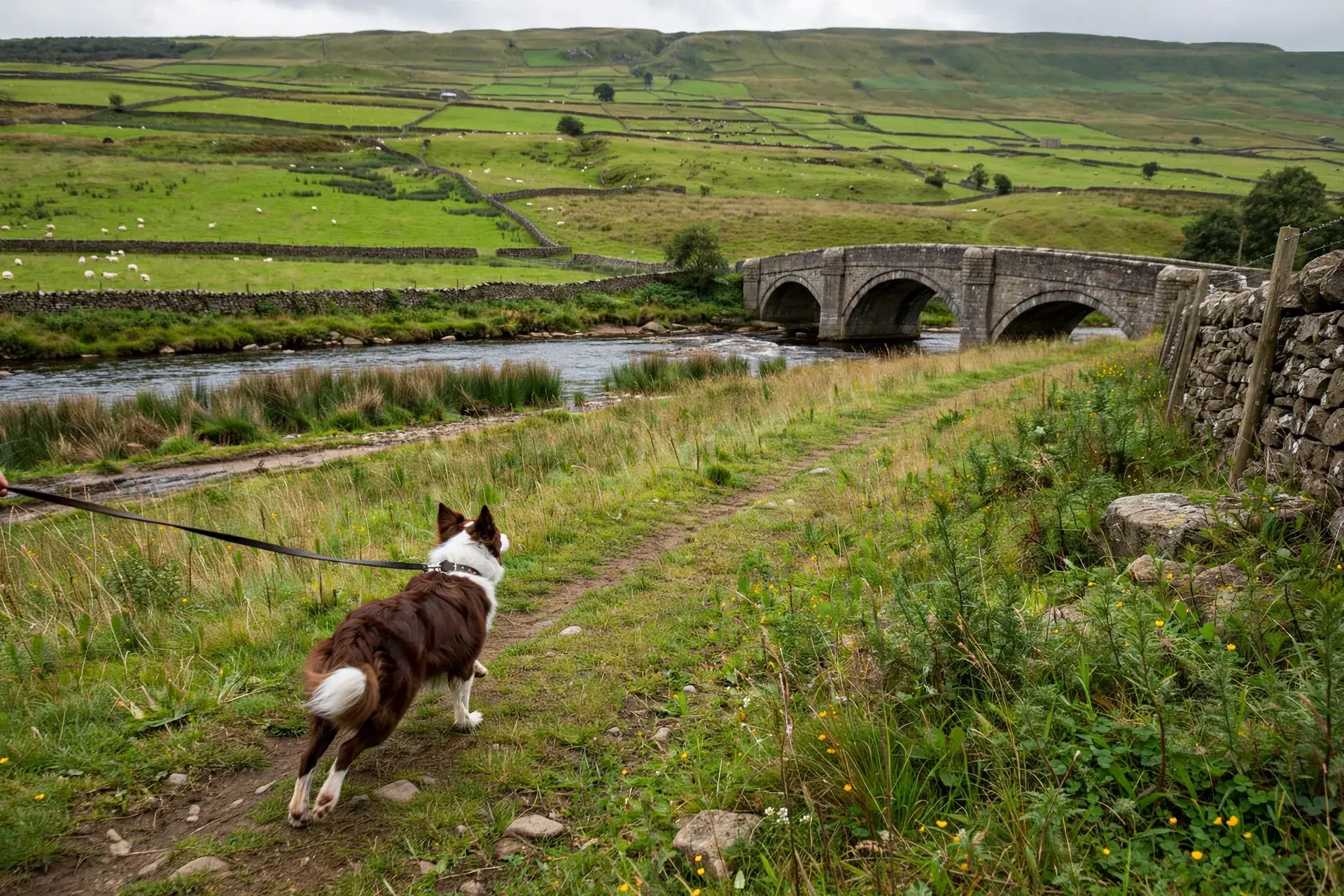
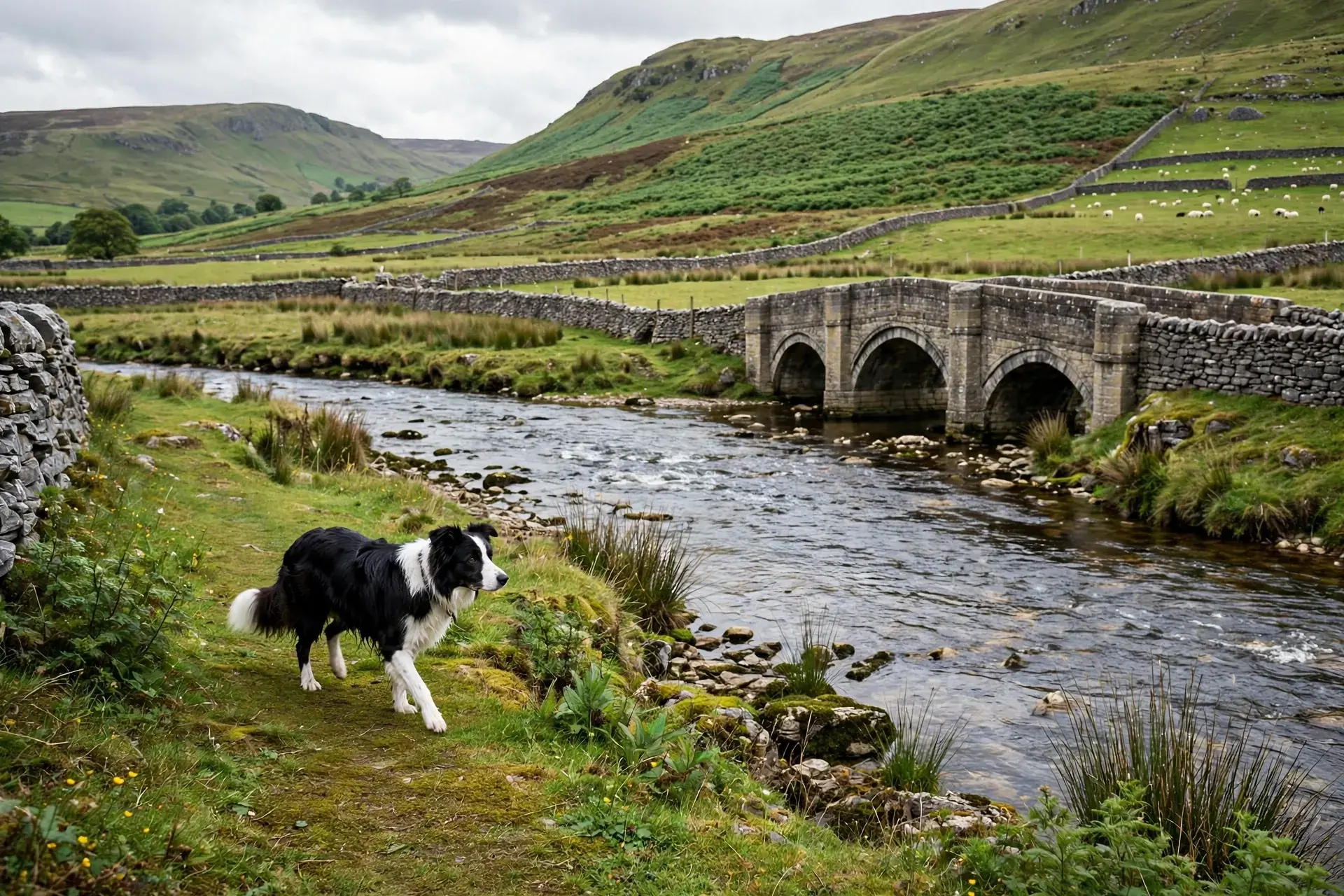
Grinton Bridge is the natural centre of a dog walk here. The stone bridge carries the road across the Swale at the eastern edge of the village, and the views up and down the river from its parapet explain why so many walkers stop, lean and stay a while. Upstream, the river bends between meadows and dry stone walls; downstream, it runs towards Reeth through the broad floor of the valley. The bridge is narrow, and traffic uses it carefully, so keep the dog close on a short lead while crossing and do not linger in the carriageway. The parapet is solid, but a small dog should never be lifted onto it for a photograph.
From the bridge, the best dog walking is along the riverside meadows rather than along the road. The valley floor here is mostly level pasture, crossed by public footpaths that link Grinton with Reeth and with the lanes climbing gently towards the surrounding hamlets. The going underfoot is grass and riverside track, which is kind to paws and easy for older dogs, although it can be soft and muddy after wet weather and slippery on the bank itself. A long line is useful in the meadows when there is no livestock nearby, giving a keen dog room to sniff without losing control near the water, but the lead goes back on the moment sheep or cattle appear.
Meadow walking in Swaledale has its own etiquette. Stay on the marked path, close every gate behind you, and keep the dog from worrying sheep even from a distance — a dog running at a flock through a fence is still a problem for the farmer. In spring, lambing season calls for extra care: ewes with lambs are easily stressed, and some fields may have temporary restrictions, so check the official guidance before you travel and follow any signs at the field entrance rather than relying on habit. If a field looks full of livestock and the path is unclear, choose another route; there are enough of them around Grinton that you never need to force one.
The meadows are also where the valley shows its history. Dry stone walls divide the fields into the long, narrow strips that are characteristic of Swaledale, and the old lead-mining landscape survives in the spoil heaps and ruined structures on the fellside above the village. The Coast to Coast long-distance path passes through Grinton, so you will often meet through-walkers with heavy packs and tired dogs of their own — a good reminder to keep your dog under close control on the shared paths and to give other walkers room at stiles and gates. A short riverside loop of forty minutes to an hour, out along the bank and back through the lanes, is enough for most dogs; fitter dogs can extend it towards Reeth, which is covered in its own section below.
St Andrew's Church and the churchyard
St Andrew's Church at Grinton is the village's landmark, and it is worth a slow look even on a trip that is mostly about the dog. Known locally as the Cathedral of the Dales, it is far larger than a village of Grinton's size would normally justify, a reminder that this valley was once busy and prosperous on the back of lead mining. The church stands above the river on the edge of the village, and its tower is visible across the meadows from a long way off, which makes it a useful landmark when you are out on the valley paths and working out where you are.
For a dog owner, the churchyard is the practical part of the visit. It is a quiet, enclosed-feeling space with old gravestones, mature trees and views across the valley, and it makes a calm pause between the riverside walk and the lanes. Keep the dog on a lead, keep it off the graves, and be ready to move on if a service, wedding or funeral is taking place — the church is a working parish church, not a museum, and the needs of a congregation come first. If you hope to go inside, check the official guidance before you travel or ask locally on the day, because opening arrangements and dog policies vary, and a sign on the door is worth more than a general rule found online.
The churchyard also teaches a useful lesson about visiting historic places with dogs: the best visits are short and low-key. Ten minutes admiring the stonework, the tower and the setting, a few photographs from the path, and then on to the meadow is a better plan than a long, restless wait while the dog gets bored and starts pulling at the lead. Dogs that are comfortable settling on a mat can rest at the edge of the churchyard while their owner looks around; dogs that cannot settle are better walked on to the next stretch of riverside path. There is no need to make the church the centre of the day — in Grinton, the river already holds that role.
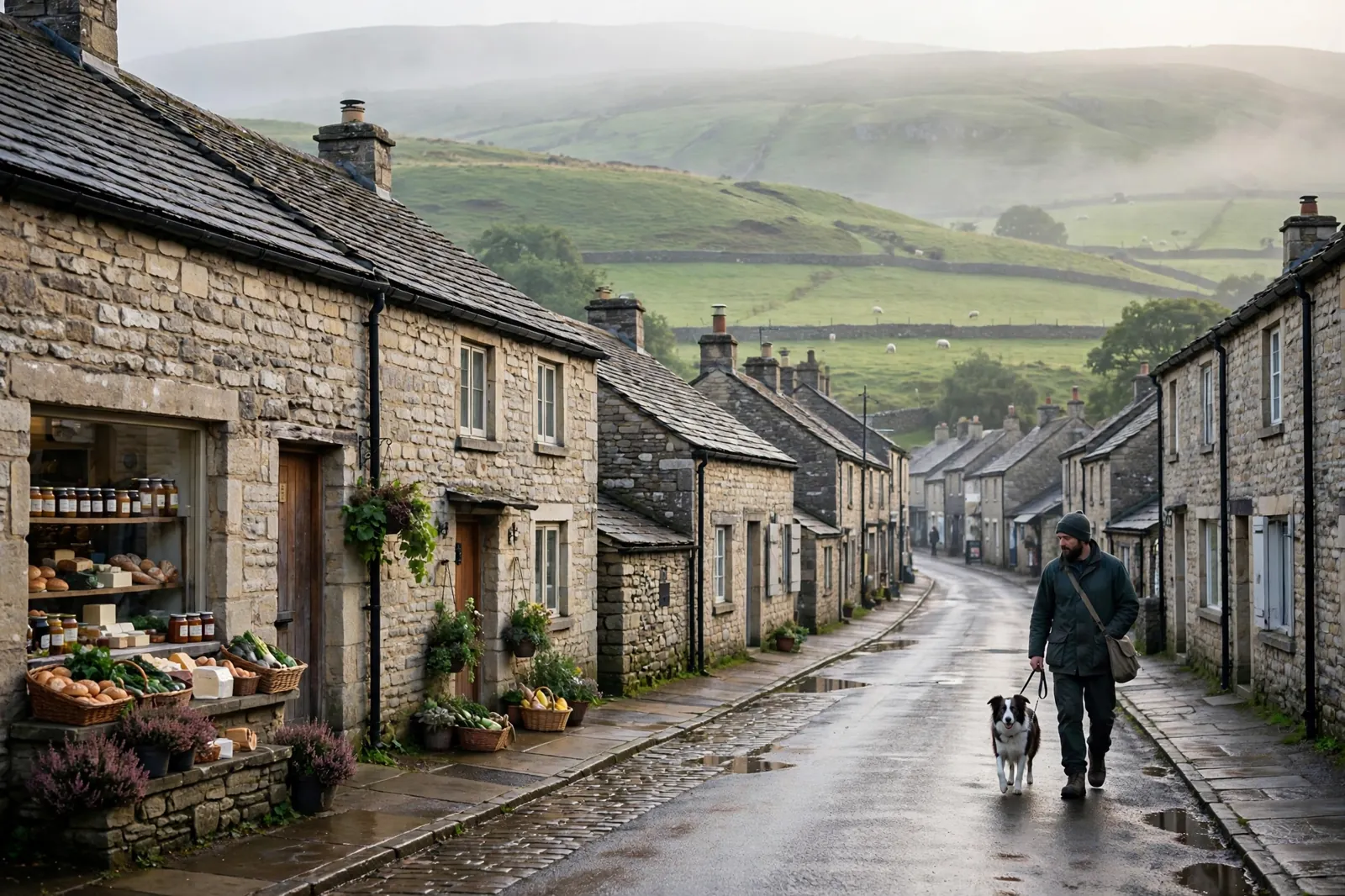
From the church, the lanes of the village wind between stone cottages and gardens, and a short stroll here is a pleasant way to finish a walk. The lanes are narrow, with little pavement, so walk facing oncoming traffic where there is no footway, keep the dog on the inside away from the road, and be ready to step into a gateway when a tractor or delivery van comes through. Farm traffic is part of daily life in Swaledale, and drivers are used to walkers, but a dog that darts into the road is a risk nobody wants. The village is small enough that a loop of the lanes takes only fifteen minutes, and it pairs naturally with the riverside path for a rounded hour of walking.
Meadow picnics and quiet corners
Grinton suits a picnic better than almost any village in Swaledale, because the ingredients are all here: flat grass, a river to look at, and very little passing traffic. The meadows beside the Swale are the obvious place to spread a blanket, provided you are on a public right of way or on land where access is clearly allowed, and provided you leave no trace at all. Choose a spot with a clear view of the river but a little way back from the bank, so the dog can settle beside you rather than fixating on the water, and so a sudden gust or a passing herd does not send sandwiches into the grass.
Pack the picnic with the dog in mind. Bring a collapsible water bowl and more water than you think you need, because river water is not a reliable drink for dogs, especially after rain when it carries silt and farm run-off. Bring a blanket or mat for the dog to lie on, since damp meadow grass chills a resting dog quickly, and a chew or a stuffed food toy to keep a busy dog occupied while people eat. Keep food in sealed containers rather than open bags, and keep the dog's lead clipped to you or to a secure point while you eat — a loose dog in a meadow with picnics, other walkers and livestock nearby is a recipe for a stolen sandwich and an awkward apology.
The quiet corners worth finding are the ones away from the bridge and the main path. A bend in the river with a flat bank, a field corner with a dry stone wall at your back, or a shaded spot under a riverside tree on a warm day all work well. Avoid picnicking in the middle of a working field where sheep are grazing, and avoid blocking a gate or a stile with your blanket and bags, since farmers and other walkers need those gaps clear. Take everything home with you, including food scraps and dog waste — a meadow is not a bin, and leftover food attracts rats and upsets grazing animals.
For dogs that struggle to settle, a picnic is good training in disguise. A short settle on the mat, rewarded calmly, then a short sniffing walk, then another settle, builds the habit of relaxing outdoors without demanding a full hour of stillness at once. If the dog simply cannot settle, do not force it: pack up, walk the riverside loop instead, and try the picnic again on a quieter day. Grinton rewards patience more than persistence, and a dog that has had a good walk first is a dog that can enjoy a picnic second.
The walk to Reeth and back
The walk from Grinton to Reeth is the single best reason to bring a dog to this part of Swaledale. It is roughly two miles each way, mostly level, and it follows the river and the meadows through some of the prettiest valley floor in the Yorkshire Dales. The route is a public footpath rather than a road walk, which means grass underfoot, dry stone walls on either side, and the Swale never far away. Most dogs cover it comfortably in under an hour each way, and there is no pressure to hurry: the pleasure is in the valley itself, not in reaching the other end.
Walk it as an out-and-back rather than a one-way trip unless you have arranged transport at the far end. The return leg looks different from the outward leg — the light changes, the river bends the other way, and the dog gets a second chance at all the smells it rushed past the first time — and it avoids the awkward question of how to get a tired dog back along the main road. There is no pavement for much of the B6270 between the villages, and the road carries more traffic than the footpath, so the riverside route is the safer and pleasanter choice in both directions. Our guide to Reeth with a dog covers the village green, the swing bridge and the pubs at the far end in detail, so read it before you go if you plan to spend time there.
At Reeth, the village green is the natural turning point. It is a broad, open space where dogs can have a sniff and a drink, and it is ringed by the shops, cafes and pubs that make Reeth the practical hub of upper Swaledale. Give the dog a proper rest here — water, a short settle, and a chance to cool down — before starting back, and check the dog's paws for grit or dampness picked up on the meadow paths. If the dog is tired, do not push on to another walk; the return to Grinton is a walk in itself, and a tired dog on a valley path is a dog that needs its owner to slow down and pay attention.
The route is also a good introduction to walking in a farmed valley. You will pass through gates, cross small bridges, and walk beside fields that may hold sheep, cattle or horses depending on the season. Keep the dog on a lead through every field with livestock, close gates, and be ready to wait while a farmer moves animals — it happens, it is normal, and it is not a delay worth resenting. In wet weather, the low-lying sections near the river can be boggy, so wear waterproof boots and be prepared to turn back if the path is under water. A flooded riverside path is not a challenge to wade through with a dog; it is a sign to take the higher lane route instead.
Longer valley loops for fit dogs
Grinton is also a starting point for longer walks, and fit, experienced dogs can use it as a base for a proper day in the fells. The Coast to Coast path runs through the village, heading west towards Keld and east towards Richmond, and the fellside tracks above Grinton climb towards the old lead-mining country and the moorland edge. These are serious walks — longer distances, steeper ground, exposed weather and far fewer places to stop — and they suit only dogs that are fit, well-trained and comfortable on rough ground. A dog that has only ever walked park paths should not be taken straight onto a ten-mile fell crossing.
One rewarding longer option is to extend the Reeth walk into a loop that returns by a higher lane, giving a full morning of walking without retracing every step. Another is to follow the valley west from Grinton towards the smaller hamlets upstream, where the river narrows, the meadows give way to wooded banks, and the walking feels wilder without becoming difficult. Whichever longer route you choose, plan it properly: a printed map or a downloaded offline map, enough water for the dog as well as for people, food, a first-aid kit, and a realistic turning-back time. Mobile signal in Swaledale is patchy, so do not rely on a phone for navigation or for calling help.
Longer walks also need a different approach to the dog's fitness. Build distance gradually over several weekends, watch for signs of tiredness such as lagging behind, lying down or a change in gait, and be willing to shorten the route even if the plan says otherwise. Carry a towel and a spare lead, and know where the nearest road access is at each stage of the route in case you need to cut short. In hot weather, start early, seek shade at midday, and never push a dog to keep walking when it is panting hard and seeking every patch of shade — that is the dog telling you the walk is over.
For walkers who want a change of valley after Grinton, the market town of Hawes in Wensleydale makes a good next stop, with its own riverside paths and waterfall walks, while Leyburn offers a market square and woodland falls a short drive to the south. Both are covered in their own guides, and both pair well with a Grinton base because the driving between the valleys is part of the pleasure — narrow Dales roads, dry stone walls, and a new valley opening out at every turn.
Arriving, parking and the first ten minutes
Grinton is reached by the B6270 from Reeth, and the approach itself is part of the visit: the road runs along the valley floor with the river on one side and the fell rising on the other. Driving in Swaledale needs care, especially with a dog in the car. The roads are narrow, with passing places rather than wide verges, and sheep, tractors and walkers all share the same tarmac. Drive slowly, use the passing places properly, and never park in one — they exist so that traffic can pass, not so that visitors can stop for a photograph.
Parking in Grinton is limited. The village has no large car park, and the available space is roadside parking that fills quickly on fine weekends and bank holidays. Arrive early, park considerately, and never block a farm gate, a field entrance, a passing place or the approach to the bridge. If the village looks full, it is better to drive on to Reeth, where there is more parking, and walk back to Grinton along the riverside path — that turns a parking problem into the best walk of the day. Check the official guidance before you travel for the latest parking arrangements, as spaces and rules can change, and be prepared for the possibility that the most convenient spot is not available on the day you visit.
The first ten minutes after parking set the tone for the whole visit. Give the dog water, let it stretch its legs on a short lead near the car, and check its paws and coat before setting off. If the dog has been in the car for a while, a short toilet walk on a quiet patch of grass is more useful than an immediate march to the river. Keep the first stretch of walking slow and sniff-heavy: the dog is gathering information about a new place, and a dog that has been allowed to sniff is a dog that will walk more calmly for the rest of the day. Resist the urge to head straight for the prettiest viewpoint; the meadows will still be there in twenty minutes.
Before you leave the car, run through a quick kit check: lead and spare lead, water and bowl, poo bags, a towel, and a coat for the dog if the weather is cold or wet. A whistle or a recall aid is worth carrying on the valley paths, and a small first-aid kit — tweezers for ticks, a bandage, and antiseptic wipes — is sensible in a valley where the nearest vet is a drive away. Save the number of a local vet before you set out, and note where the nearest road access is on your planned route, so that a tired or injured dog can be carried or collected without a long carry across fields.
Food, drink and a dry place to sit
Grinton itself has limited places to eat and drink, which is part of its charm and part of its planning. The village is small and residential, and visitors should not assume that a cafe or pub will be open on the day they arrive. Check opening times before you travel, and carry enough food and water for the dog and for yourselves in case nothing is open. A flask, sandwiches and a picnic in the meadow is a more reliable plan than hoping for a table, and it suits a dog far better than a crowded dining room.
Reeth, two miles away, is where the food and drink options concentrate. Its pubs, cafes and tea rooms are used to walkers and dogs, and several welcome dogs in at least part of the premises, often in a bar area or on a terrace. Even so, dog policies change, and a pub that welcomed dogs last summer may have changed its rules, so check the official guidance before you travel or telephone ahead rather than arriving with a wet dog and expecting a welcome. When a dog is welcome, the usual courtesies apply: keep it on a lead, settle it under the table or on its mat, bring its own water bowl, and do not let it beg from neighbouring tables or wander between legs.
A wet day changes the calculation. A dog that has been walking in Swaledale rain is a wet dog, and few indoor spaces welcome a dripping coat. Pack a drying coat and a towel for the dog, and be ready to sit outside under cover, or to eat in the car, or to cut the walk short and drive to a dog-friendly cafe in Reeth with a proper drying routine first. The practical test is simple: if you would not want the dog's wet coat against your own furniture, do not expect a pub's furniture to welcome it either. A quick towel-down at the car, a drying coat on for the walk to the door, and a settled dog on its mat make the difference between a welcome guest and an apology.
For supplies, Reeth has the shops for the basics — snacks, drinks, dog treats and the forgotten lead — while larger supermarkets are a drive away in Richmond or Leyburn. If you are staying for several days, stock up on the way in rather than assuming the village shop will have everything a dog needs. Dog food, medication and any special dietary items should travel with you from home, not be left to chance in a small Dales shop. And if you are self-catering near Grinton, remember that the nearest late-night shop is not close: plan the evening meal before the afternoon walk, not after it.
River safety and lead rules
The River Swale is the best thing about Grinton and the thing that demands the most respect. It is one of the fastest-rising rivers in England, because rain falling on the high fells upstream funnels quickly into the valley, and the river can rise sharply while the sky above Grinton is still blue. A calm, shallow-looking stretch in the morning can be a different river by the afternoon. Never assume that because the water looks safe now, it will still be safe in an hour, and never let a dog swim after heavy rain, when the water is brown, fast or full of debris.
The practical rules are straightforward. Keep the dog on a lead near the bank unless you are in a spot you know well and the river is low and slow. Never throw a ball or a stick into the river — a dog that chases a toy into fast water is a dog in danger, and a person who goes in after it is in danger too. Keep the dog out of the water entirely when the river is high, when the bank is steep or undercut, or when you cannot see the bottom. After any paddle, check the dog for cuts on the paws, dry its ears if it has been in the water, and watch for signs of stomach upset in the days after a swim, since river water can carry bacteria and parasites. Check the official guidance before you travel for current river conditions and any local safety notices.
Lead rules in Swaledale are mostly a matter of common sense and the Countryside Code, but they are worth stating plainly. Dogs should be on a lead near livestock, near the road, near the river bank, and whenever the path is shared with other walkers, cyclists or horse riders. Off-lead time is for open meadows with no livestock, good visibility and a dog with a reliable recall — and even then, the lead should be in your hand, not in your pocket at the bottom of your bag. A long line is a good compromise on the riverside paths: it gives the dog freedom to explore while keeping you in control near the water and the walls.
Two risks deserve special mention. The first is the dry stone walls themselves: they look solid, but they are loose stone, and a dog that scrambles over a wall can dislodge stones, injure itself, or end up in a field it should not be in. Keep the dog from climbing walls and use gates and stiles instead. The second is ticks, which are common in Dales grassland and riverside vegetation, especially from spring to autumn. Check the dog after every walk, paying attention to the ears, armpits and groin, remove any tick promptly with a tick remover, and speak to your vet about tick prevention before a trip to the Dales. Adders are present in parts of the Yorkshire Dales, though encounters are rare; keep the dog on the path in warm weather, do not let it nose into rocky crevices or dense bracken, and know the signs of a bite so you can act quickly if the worst happens.
Seasons, weather and midges
Grinton changes with the seasons more than many Dales villages, because the river is always there to reflect the change. In late spring, the meadows are at their best: fresh grass, lambs in the fields, firm paths and long, cool evenings. This is the easiest season for dogs, with moderate temperatures, good visibility and plenty of daylight for a late walk after the drive in. It is also lambing season, so lead rules matter more than ever, and some fields may be temporarily closed or diverted — follow the signs and check the official guidance before you travel.
Summer brings the lowest river levels and the best paddling, but also the greatest heat risk. The valley floor can be surprisingly warm on a still July day, and the meadows offer little shade, so start walks early, carry extra water, and watch for the signs of overheating: heavy panting, drooling, reluctance to walk and seeking shade. Midges and flies are a real nuisance on still summer evenings near the river, and some dogs are badly bitten around the ears and belly; a vet-approved repellent and a light coat can help, and an evening walk is often better taken on the higher, breezier lanes than down by the water. Summer weekends are also the busiest, so arrive early for parking and expect to share the paths with Coast to Coast walkers.
Autumn is many regulars' favourite season in Swaledale. The crowds thin, the light turns golden across the meadows, the river runs clear and cool, and the walking is at its most comfortable for dogs. The ground can be soft after rain, and the days shorten quickly, so carry a torch for a late return and allow extra time for the walk back from Reeth. Winter is quiet and starkly beautiful, with frost on the walls and the river running high and fast, but it is also the hardest season for dogs: cold water, muddy paths, short days and the risk of ice on the lanes. A winter visit is best kept short, with the dog in a coat, the walk on the level valley floor, and a warm car or cottage waiting at the end of it.
Whatever the season, Swaledale weather changes fast. A clear morning can turn to rain by lunchtime, and a shower on the fells can raise the river while the valley floor stays dry. Check the forecast before you set out, pack waterproofs for people and a coat for the dog, and be willing to change the plan: a short riverside loop in the rain is a better day than a long fell walk in a storm. The village will still be there on a better day, and so will the river.
Staying overnight near Grinton
Grinton makes a good base for a longer stay in Swaledale, but it is a quiet base, and that suits some travellers better than others. The village itself has limited accommodation, and the nearest concentration of dog-friendly places to stay is in Reeth, with cottages, bed and breakfasts and a youth hostel in the wider valley. Grinton Lodge, the former shooting lodge above the village, operates as a youth hostel and is a well-known landmark on the Coast to Coast path, though its booking arrangements, dog policy and opening dates should be checked directly before you plan around them — check the official guidance before you travel rather than assuming a hostel that welcomes walkers also welcomes dogs in every room.
When choosing somewhere to stay near Grinton, the questions are the same ones that matter anywhere in the Dales, but the answers matter more because the valley is rural. Ask whether the specific room or cottage accepts dogs, how many dogs are allowed, and what the pet charge is; ask whether the dog can be left alone in the room, and for how long; ask where the nearest toilet walk is after dark, and whether it is lit or fenced; and ask about drying space, because a wet dog in a small cottage with no drying area is a miserable evening for everyone. A place with a walled garden or a fenced yard is worth more in Grinton than a place with a view, because a secure garden gives the dog a safe toilet area at 11pm without a walk down a dark lane.
Self-catering cottages in and around Reeth are often the best fit for a Grinton-based stay, because they give the dog a familiar base, a kitchen for its food, and a door that opens straight onto a garden or a lane. Book early for school holidays and for the summer months, because dog-friendly cottages in Swaledale sell out well ahead, and confirm the dog arrangements in writing rather than relying on a website filter. If you are staying for a week, plan the days around the valley rather than around the car: a day in Grinton and Reeth, a day in the upper valley towards Keld, a day over the hill to Wensleydale, and a rest day where the dog does little more than a riverside loop and a long sleep. Dogs on holiday need rest days just as people do, and a week of long walks with no break is how sore paws and tired dogs happen.
Finally, remember that staying in the Dales means living with farm sounds and farm hours. Sheep, tractors and early-morning activity are part of the valley, and a dog that barks at every unfamiliar noise will have a busy night. Bring the dog's own bed, keep the evening routine close to home, and give the dog a good walk before bed so that it settles. A quiet, tired dog in a dark cottage is the best end to a day in Grinton, and the river will still be there in the morning, running past the meadows exactly as it has for centuries.
Practical questions
Before you go
Can my dog swim or paddle in the River Swale at Grinton?
Some dogs paddle happily in the shallows near Grinton Bridge on a calm summer day, but the Swale is a fast, spate river that can rise sharply after rain upstream, even when the sky above the village is clear. Never let a dog swim after heavy rain, keep a lead on near the bank, and check the official guidance before you travel for current river conditions and any local access notices.
Is Grinton an easy walk from Reeth with a dog?
Yes, the valley path between Grinton and Reeth is one of the easiest and prettiest short walks in Swaledale, roughly two miles each way along the river and through meadows. Keep the dog on a lead through fields with livestock, carry water in warm weather, and allow time to stop at the village green in Reeth before the return leg.
Where can I park in Grinton with a dog?
Grinton is a small village with limited roadside parking, so arrive early on fine weekends and park considerately without blocking farm gates, passing places or the narrow bridge approach. Leave space for farm vehicles at all times, and check the official guidance before you travel for the latest parking arrangements, as spaces and rules can change.
Are dogs allowed in St Andrew's Church at Grinton?
Churches in the Yorkshire Dales vary in their approach, and access can depend on the service, event or time of year. Many visitors admire the church from the churchyard with the dog on a lead, which is a pleasant stop in itself. If you hope to go inside, check the official guidance before you travel or ask locally on the day.
What is the best short walk from Grinton for an older dog?
The level riverside loop from the bridge towards the meadows is the kindest option: flat ground, soft grass, plenty of sniffing and a natural turning point whenever the dog tires. Avoid the steeper fellside tracks and the longer Coast to Coast stretches, and bring a towel and water for the return to the car.
When is the best time of year to visit Grinton with a dog?
Late spring and early autumn usually suit dogs best, with firm paths, cooler air and fewer crowds than high summer. Summer brings low river levels for paddling but also heat and midges, while winter can be beautiful and very quiet, though paths get muddy and the river runs high. Check the official guidance before you travel for seasonal access and weather.