This guide carries no paid placement. Details in a small Dales village shift with seasons and river conditions, and nothing here names a price, a timetable or a single business. The Swale and the green's event calendar both change, so ask locally on arrival rather than relying on last year's timetable.
Reeth suits dogs that like riverside meadows, a village green and longer valley walks. Keep dogs on lead on the green, on bridges and around livestock, treat the Swale with respect after rain, and use the village car park rather than blocking the green.
The green is the village living room
What turns a patch of grass into the centre of a whole valley? In Reeth, the answer sits under your boots the moment you step off the lane. The green opens wide between rows of stone cottages, with shops and pubs edging its sides and the fells rising beyond the rooftops, and it gathers everything the village does: neighbours pausing for news, walkers shaking mud from boots, children chasing a ball that never quite stays on the grass, dogs circling for the best sniff of the day. A dog arriving here reads the village in one sweep, space and voices and other dogs and the smell of the river below,
Where the grass runs out at a lane, the dog belongs at its owner's side, not ranging ahead, because traffic slips past the green without warning and a loose dog can cross from grass to road in a few strides. Away from those edges, the green is a sociable place, and dogs meet here the way people do, with a sniff, a pause and a decision about whether to move on. A dog that can pause, greet briefly and walk on again fits Reeth at once, while a dog that charges every greeting turns the village living room into a scramble. Owners who read those first greetings, shorten the encounter and move on keep the green pleasant for the next dog through.
Shops and small businesses ring the green rather than hiding down side streets, so a dog often waits on the grass while its owner dips inside, and that wait is part of the village rhythm. Some doors welcome dogs in, others draw the line at the threshold, and the difference changes with the room, the season and whether food is on sale, so each doorway gets its own question. A dog waiting on the green wants shade on a hot day, a drink and its owner in sight, not a long absence and a tether to a bench. On gathering days, when the green fills with stalls and voices, the same rule holds in a louder key: keep the dog close, keep the visit short and let the village happen around a settled dog.
Stand still for a minute. Let the dog watch the green work, and the village stops feeling like a stop and starts feeling like a place.
The swing bridge and the river
How much can a narrow bridge change a walk? The swing bridge at Reeth answers that question with a sway. Its deck hangs over the Swale on a slender span, moving faintly underfoot, with water sliding beneath and walkers coming the other way, and a dog that strides confidently along a meadow path can hesitate at the first step onto boards that give. Crossing works best with the dog tucked at its owner's side and moving steadily, no stopping mid-span for a photograph, A nervous dog gets the same courtesy in reverse: time to sniff the approach, time to watch others cross, and a turn back without fuss if the sway or the water below proves too much.
Below the bridge, the Swale sets the terms for everything else. In low summer water it runs clear over stones, shallow enough for a paddle at the edge and gentle enough to look harmless, and that harmless look is exactly what makes it deceptive. Rain falling miles upstream, on hills Reeth cannot see, can send the river up brown and fast while the village itself stays dry, turning a friendly riffle into a push of water that no dog should enter. Anyone weighing a paddle against a current should read the swimming safety for dogs guide first, and anyone finding the river high and hurrying should simply walk somewhere higher, along a lane or a moor-edge track, and leave the riverside for a calmer day.
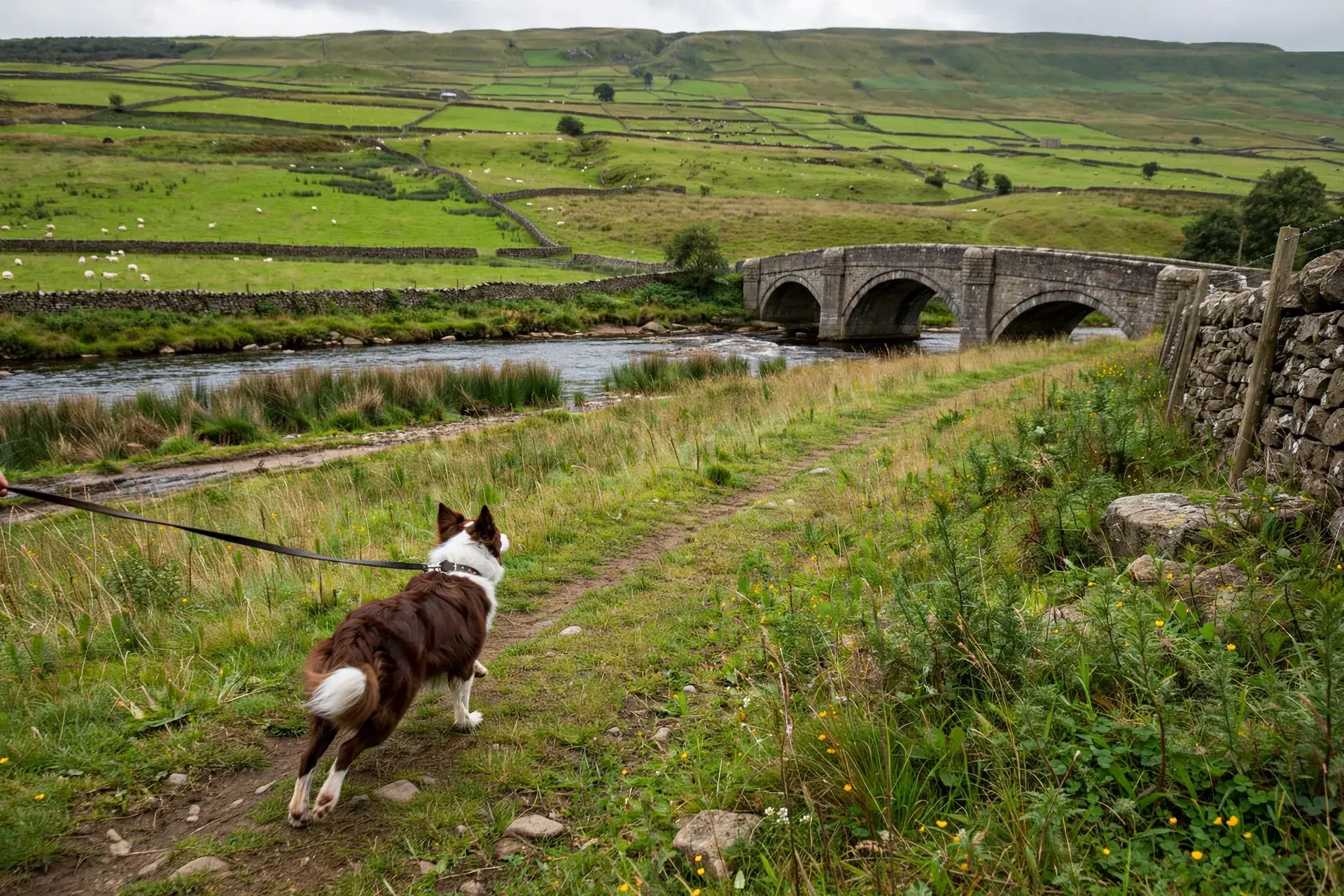
The meadows on either bank give Reeth its easiest walking, flat grass between dry stone walls, wide views up the valley and room for a dog to stretch after the confines of the bridge. In dry spells the river edge draws dogs like a magnet, and the shallow riffles below the bridge are where most Reeth dogs first learn what the Swale feels like, cold and quick even when it looks lazy. Stone walls and field gates break the meadows into separate pieces, and each gate marks a change of ground, from open grass to a lane, from a lane back to the river, so the walk never settles into one long stride. That broken rhythm suits dogs that like variety, a splash, a sniff, a wall to investigate, and then open grass again.
Cross, look back, and the village rearranges itself: green behind, valley ahead.
Grinton and Fremington: the easy extension
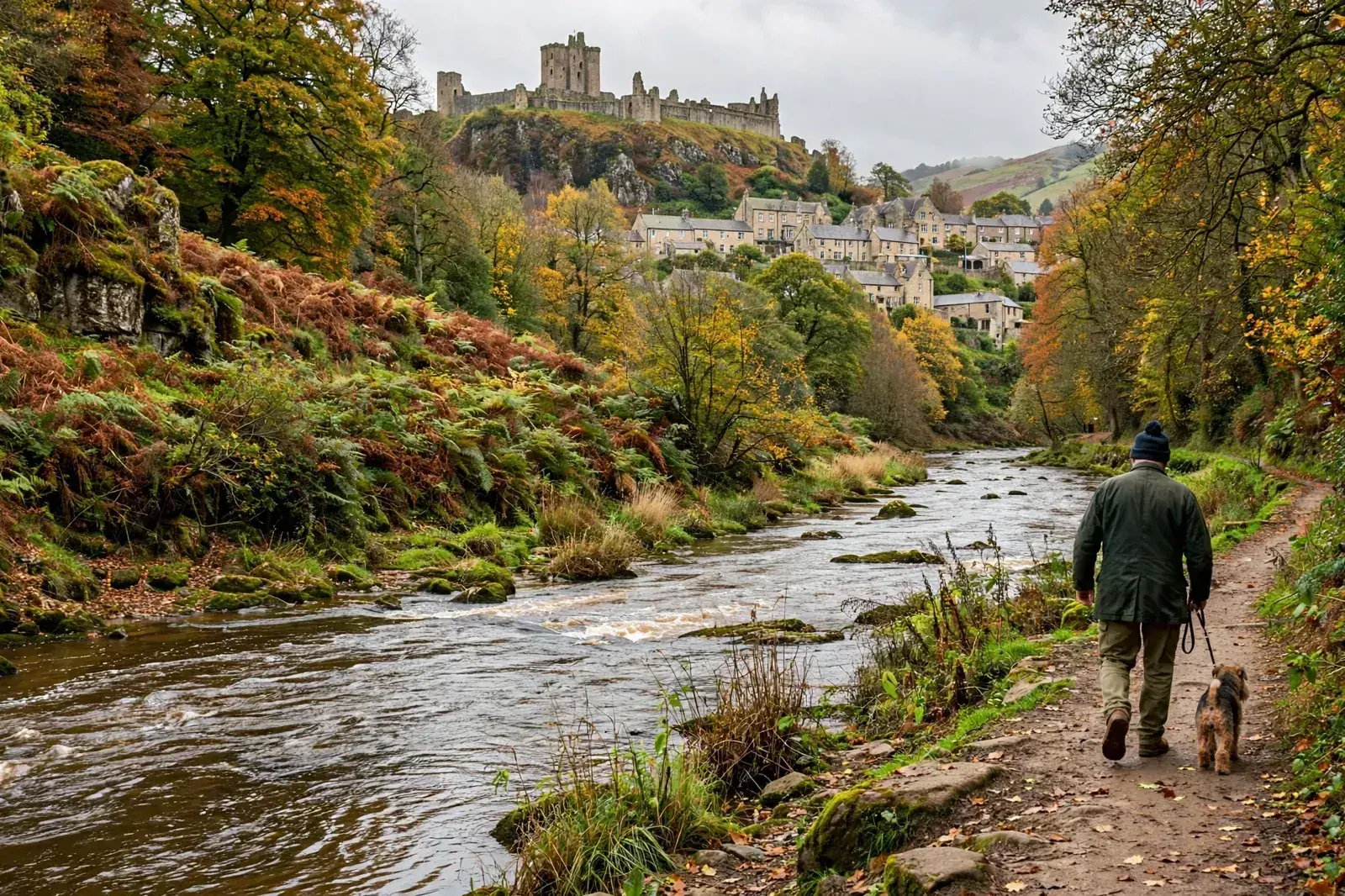
Where does Reeth end and the wider valley begin? Follow the valley floor in either direction and the answer stretches out in meadows. Eastward, the path runs toward Grinton, past stone bridges and field gates, with the river close by and the fells opening on both sides. Westward, the quieter lane toward Fremington offers the same valley in a softer voice, fewer walkers, smaller groups of houses, and views back toward the Reeth green that shrink with every field. Both arms belong to the same walk in spirit, a flat valley walk with the river for company, and either can be shortened at a bridge or a lane junction when the dog's pace says enough.
Sheep graze the riverside meadows between Reeth and Grinton at many times of year, so the open grass here is not one continuous playground but a sequence of fields, some empty and some stocked, and a dog runs free only on the stretches where no stock stands. Grinton itself rewards the longer walk, with its church standing above the valley and its stone bridge crossing the Swale, while Fremington rewards the shorter one, a hamlet-scale pause where the valley narrows and the road thins. Dogs that reach either village have earned their rest, and the rest matters as much as the distance, water in the shade, a pause on the grass verge, and a look back down the valley before the return leg.
Downstream, the valley widens toward a market town with a castle above the same river, and the Richmond in Yorkshire guide covers that very different end of Swaledale, steep gorge and market square against Reeth's open green. Pairing the two gives a Swaledale break its contrast without a long drive: Reeth for meadows and a village green, Richmond for town streets and gorge paths. The valley between them is the link, a river that starts as a Reeth riffle and grows into a town river, and a dog that has walked both ends of it has walked Swaledale properly.
Turn where the dog's pace tells you to turn. The valley will still be there tomorrow.
Lead mining heritage on foot
Why do the hills above Reeth look worked over rather than wild? The answer is lead, and the evidence covers the slopes in stone. Spoil heaps ridge the hillsides, ruined dressing floors and chimney stumps stand against the sky, and old trackways cut across the moor where miners once hauled ore down to the valley. Swaledale's lead industry shaped this landscape for centuries, and its remains are not fenced into a single site but scattered across the ground a dog walker crosses, a hush gully here, a level entrance there, a line of stones that once held a building now open to the wind. Walking here means walking through an industry that has gone quiet, not past a monument to it.
The ruins demand a different kind of attention from a riverside meadow. Shafts and broken walls sit close to some paths, stone is sharp underfoot, and a building that looks solid from a distance can be roofless and unstable at close quarters, so dogs stay on the marked line through the old workings and out of every ruin, adit and fenced enclosure. That discipline costs nothing in interest, because the story reads perfectly well from the path: the scale of a spoil heap, the cut of a hush down a hillside, the way a trackway contours toward the valley. Children and dogs alike do better with an adult watching the ground ahead, since a shaft or a drop can hide around a bend where a dog would otherwise run on.
Climb a little higher and the mining ground opens into moor, wind over heather, long views back down to the Reeth green as a small patch of bright grass in the valley floor. The contrast is the point of the walk, valley softness below and worked, exposed hillside above, and a dog that has trotted the flat riverside in the morning finds the climb and the wind a different kind of tiredness. Weather moves fast up here, cloud dropping over the tops and rain sweeping the slope, so the return route deserves a thought before the outward leg gets too ambitious, with the valley track always available as the shorter way home.
The past here is not in a museum. It is underfoot, in stone.
Arkengarthdale: a wilder valley day
What happens when the valley narrows and the crowds thin? Take the road north-west from Reeth and Arkengarthdale answers within a few miles. The valley tightens, the villages shrink to hamlets, the fells press closer, and the walking changes character from sociable riverside to something quieter and more exposed. Becks cut down from the moor, farm tracks replace surfaced paths, and the sky feels larger because there is less village in it. Dogs that have spent a day on the Reeth green, meeting every other dog in Swaledale, find Arkengarthdale a different pleasure, long stretches with no one to greet and nothing to do but walk.
Fewer people means fewer facilities, and that sparseness is part of the valley's honesty rather than a flaw in it. Shops and pubs thin out to almost nothing, mobile signal comes and goes with the hills, and the distances between useful stopping places stretch longer than they do around Reeth. A walker heading up the dale carries what the day needs and knows the route before setting off, because there is no convenient place to improvise halfway up. That self-reliance suits a settled dog and an owner who likes planning, and it makes the valley a second- or third-day choice rather than a first-morning experiment.
Water shapes Arkengarthdale the way the Swale shapes Reeth, only on a smaller and trickier scale. The becks that look like stepping-stone streams in dry weather rise quickly after a wet night, and a crossing that was easy outward can be a different proposition on the way back. A walker who finds a beck running high and brown does better to turn, take a higher track or cut the walk short than to coax a dog across fast water, and the valley offers plenty of higher ground for exactly that decision. Farm traffic on the narrow road needs the same respect, with walkers stepping aside and dogs held close as tractors and trailers pass.
Quiet is the point here. Arkengarthdale gives it generously.
Pubs, tea rooms and green manners
Where does a muddy dog eat in a village built around its green? In Reeth, the answer is usually a room just off the grass, a pub or a tea room whose door opens onto the same open space where the dog has already spent the morning. Many of those rooms welcome dogs, but the welcome changes with the room and the season, a bar in winter and a tea room at lunch behaving like different places, so the question gets asked at each doorway rather than assumed for the whole village. A dog that has already walked the riverside settles fastest, curling under a table while its owner eats, and a dog fresh from a long journey does better with a short turn around the green first, burning off the excitement before being asked to lie still.
Fine weather moves the meal outside, onto benches and the grass edge, and that is where Reeth eating feels most like itself, food in hand, dog at feet, village life passing a few yards away. The same manners apply outdoors, with the added temptation of other people's food drifting across the grass, and a dog that begs from neighbouring tables quickly becomes the table everyone remembers. A quieter bench, a shorter meal or a takeaway eaten on the grass edge all solve the problem more gracefully than a long struggle at a busy table. On busy nights, a dinner table is best reserved ahead, with the dog named in the reservation, so the room can seat dog and owner where both fit rather than squeezing a large dog into a corner built for two chairs.
A dog that has paddled below the swing bridge arrives at a pub door carrying the Swale with it, mud on paws and belly, and a towel outside the door does more for the dog's welcome than any apology inside. Most rooms in Reeth are generous about dogs precisely because owners keep floors reasonably clean, and a quick rub-down before entry, plus a drying coat on a cold day, keeps that generosity intact. A dog soaked through may suit a takeaway on a bench better than a carpeted bar, and nobody in the village will think less of an owner who chooses the bench.
A calm dog under a table gets remembered. A begging dog gets remembered differently.
Parking, arrival and buses
Where does the car go in a village whose centre is grass? In Reeth, the answer is the village car park, set apart from the green so that the grass stays a village space rather than a parking surface. Lanes around the green are narrow, cottages open straight onto them, and a car tucked into a lane blocks farm traffic, walkers and neighbours alike, so the car park earns its keep by keeping the village moving. Fine weekends fill it early, and reaching the green on foot from there becomes part of the day, a short stroll past stone walls and gardens before the grass itself opens out. Arriving early is less about convenience than about joining the village at its calmest, before the green fills.
Arrival works best as a slow unravelling rather than a sudden release. A short turn around the quieter edges of the green, a toilet stop on grass away from gardens, a moment for the dog to take in the scale of the place, and only then the main walk toward the bridge or the meadows, gives a dog a far easier start than a leap from the car straight into the middle of a busy green. Dogs that meet five other dogs in their first minute tend to pull and bark for the next hour, while dogs given ten quiet minutes tend to walk like they belong here. The green rewards patience at the start of a stay and repays it for days.
Buses reach Reeth from the Richmond direction and from the upper dale, but the service is thin, especially on Sundays and in winter, and a bus-based day needs its times checked before setting out rather than assumed at the roadside. Dogs travel on these buses at the driver's discretion, on the floor and close to their owner, and a quiet dog with muddy paws kept off the seats is rarely a problem. For most visitors, though, Reeth is a driving village, and the car park, the green and the riverside paths form a compact triangle that makes a car-free afternoon perfectly possible once the car is parked.
Reeth rewards arriving slowly. The village opens at walking pace.
Stays, seasons and river sense
What does sleeping in Reeth actually feel like for a dog? The village offers its accommodation in the same shapes as its streets: cottages tucked around the green and along the lanes, pub rooms above the rooms where dogs are already welcome at lunch, bed and breakfast houses in stone cottages, and campsites out in the valley beyond the village edge. A cottage near the green puts the morning walk at the door and the evening toilet walk on familiar grass, while a lane cottage trades that immediacy for quiet, and a pub room trades quiet for the hum of the bar below. The shape that fits the dog decides it, a sociable dog near the green, a nervous dog in a quiet lane, a dog that sleeps through noise above a pub.
Seasons change Reeth more than they change a town, because the village sits in the open valley and the weather reaches it unfiltered. Spring brings light back to the fells and the meadows green up fast, summer brings crowds onto the green and heat onto the stone, autumn colours the valley sides and thins the visitors, winter brings short days, cold wind down the dale and a Swale that runs higher and darker. Each season moves the best walking ground: summer belongs to the riverside meadows and the bridge, winter and wet spells belong to the green, the lanes and the moor-edge tracks above the flood line. A stay that follows that seasonal geography, rather than forcing the same riverside route every day, gives a dog a better week.
River sense runs through every season in Reeth, not just the wet ones, because the Swale's mood is set upstream and can change while the village sky stays blue. After heavy rain, the riverside paths are the first ground to surrender, and the village answers with its higher alternatives, the green itself, the lanes toward Fremington and Grinton, the mining tracks above the valley floor. A wet day in Reeth is not a lost day but a different-shaped one, a short green walk, a long lunch in a dog-welcome room, and a rest in the cottage while the river does what rivers do. A week with one deliberately easy day suits a dog far better than seven days of effort.
Stay near the green, and the valley starts at the door.
A Reeth day from green to river
How do you read Reeth as one walk rather than a list of stops? Read it as space, not as a timetable. The green is the centre, the bridge is the threshold, the meadows are the open ground beyond, and the valley arms toward Grinton, Fremington and Arkengarthdale are the routes that lead outward from that open ground. A dog that understands that geography understands Reeth: green for greetings and settling, bridge for the crossing that changes the walk, meadows for running and paddling, lanes for the return when the river is high or the legs are tired. The village never asks a dog to do more than move from one of those spaces to the next.
From the green, the natural line runs down to the swing bridge, across the Swale and out along the meadows, with stone walls and field gates marking each change of ground. From the meadows, the line branches, east toward Grinton and its church above the valley, west toward Fremington and its quieter lanes, north-west up Arkengarthdale when the day wants wildness, and up onto the mining tracks when the day wants height and history. Each branch returns to the same centre, the green, and that return is part of the pleasure, a familiar patch of grass after unfamiliar ground, water, a rest and the smell of home for the night.
For a longer stay, Reeth works as a hub with spokes, not as a single route to be repeated until it goes stale. One spoke follows the river east, one follows the lanes west, one climbs to the old lead workings above the valley, one runs up the narrow dale to the north-west, and one runs downstream toward Richmond and its castle above the same Swale. Between spokes, the green does the work of a rest day, a short walk, a long lunch, an evening on familiar grass, and a dog that has had that rhythm for a week leaves Reeth knowing the valley by its spaces, not by a schedule.
Green, river, valley. That is the whole route, in that order.
Practical questions
Before you go
Can dogs walk off lead in Reeth?
On open riverside meadows clear of stock, roads and the bridge, a reliable dog can run free in Reeth, but the village itself, the green where it meets the lanes, the swing bridge deck and any field holding sheep or cattle all call for the dog to be held close. The difference is ground, not a village-wide rule: open grass away from hazards allows freedom, and a dog that comes back promptly earns the meadows while a dog that cannot should stay on a long line there.
Is the swing bridge safe for nervous dogs?
The swing bridge suits confident dogs, but its narrow deck, faint sway and water sliding below can unsettle a nervous dog, and no crossing is worth forcing. Let the dog sniff the approach and watch other walkers cross, keep the dog tucked at its owner's side if you do start across, and turn back without fuss if the dog freezes or panics, because the Reeth bank alone, with its meadows and riverside grass, already makes a full and satisfying walk without the far side.
How fast can the River Swale rise after rain?
Rain falling upstream can lift the Swale surprisingly fast, even while Reeth itself stays dry, because the water gathering on the high fells reaches the village river before any local cloudburst. A clear morning after a wet night is no guarantee, and a river that looks friendly at breakfast can run brown, fast and high by the time a riverside walk begins. Avoid spate water entirely, and swap to a lane, a moor-edge track or the green itself whenever the river looks high, hurried or discoloured.
Where should I park in Reeth with a dog?
Use the village car park rather than the green or the narrow lanes, which need to stay clear for residents, farm traffic and walkers, and walk from the car park to the green as the start of the day. Fine weekends fill the car park early, so an early arrival saves a longer walk in, and a shaded space on a warm day suits a dog waiting briefly while its owner sorts the first walk. The green itself is for walking, meeting and resting, not for cars.
Are dogs welcome in Reeth pubs and tea rooms?
Dogs are welcome in many of Reeth's pubs and tea rooms, but the welcome varies by room and by season, so ask at each door rather than assuming one village rule. A dog that settles beneath the table with its own blanket and a bowl of water, stays off chairs unless invited and keeps clear of other diners' food fits almost any room in the village. Name the dog in any dinner reservation, so staff can seat dog and owner where both fit comfortably.
Is Reeth a good base for a Swaledale break with a dog?
Yes, for owners who like valley walking from the door rather than driving to every walk. Reeth gives a dog the green for settling, the swing bridge and riverside meadows for daily walks, Grinton and Fremington for easy extensions, lead mining tracks for height and history, and Arkengarthdale for a wilder day, with Richmond downstream for a market town contrast. Few Dales villages pack that much variety into such a compact centre.