This guide is independent and contains no paid placement. Venue dog rules change, so where this guide flags a check, please confirm the latest official information before you travel.
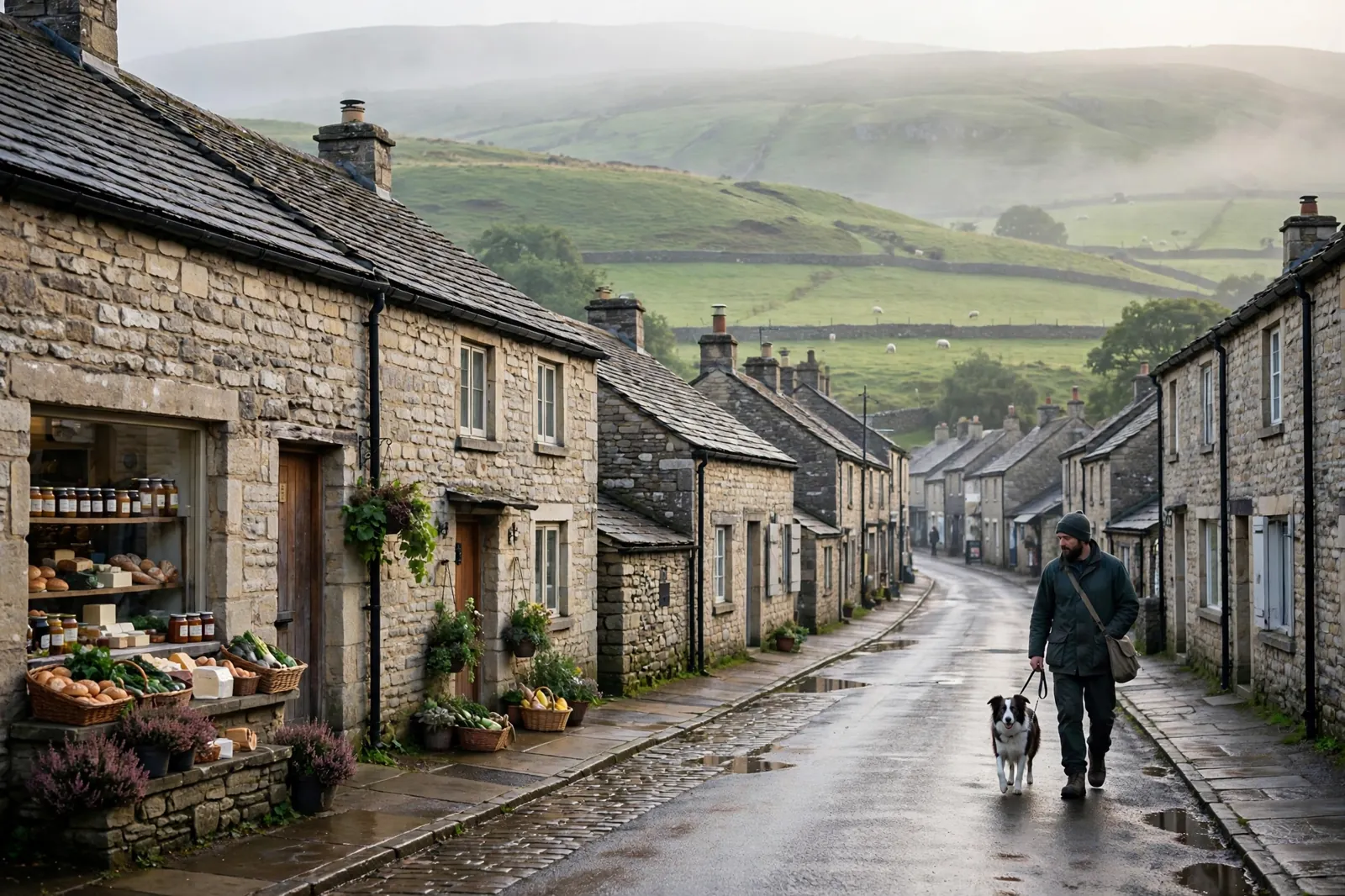
Hawes works well with a dog if you build the day around its rhythm: an early River Ure walk before the town fills, the Tuesday market early and on a short lead, and one waterfall at a time — Hardraw Force is a paid-entry visit on private land, Aysgarth Falls is a lead-on woodland walk, not a dog swimming trip. The Wensleydale Creamery is a shop-and-split-visit stop, not a full dog walk-through. Sheep are everywhere beyond the pavements, so leads are the default.
A market day in Hawes, hour by hour
06:30 — before the stalls. Hawes at first light is a different town from Hawes at noon. The main street is quiet, delivery vans are still doing the work that visitors never see, and the River Ure paths below the town are almost empty. This is the hour to give a dog a proper first walk: out of the accommodation, down towards the river, twenty or thirty unhurried minutes of grass, water sounds and sniffing, with no market crowds to negotiate and no sheep surprises if you stay on the town-side paths and keep a short lead near any grazing. A dog who has had this hour can handle what comes later. A dog taken straight from car to market place rarely can.
08:30 — the town sets up. On a Tuesday, stallholders are claiming their pitches, shop shutters are coming up and the first walkers are looking for coffee. This is the sensible window for a first pass through the market: busy enough to feel like a market, spacious enough for a dog to keep distance, cool enough that pavements are not yet warm. Do the browsing pass now, note which shops have dog-welcome signs and which do not, and buy anything heavy early so you are not carrying cheese, shopping and a pulling dog at peak time. On non-market days the same hour is ideal for a longer river walk while the town is still waking.
11:00 — peak and pivot. By late morning the centre compresses. Coaches, cars looking for parking, shoppers, other dogs and market trolleys all share a street that was not designed for any of them in modern numbers. This is not the hour to test a nervous dog in the market aisles. Pivot to water: the Ure paths, a drive of a few minutes to Hardraw, or, on a planned day, the longer run east to Aysgarth. Hawes rewards visitors who leave the centre at its busiest and return when it breathes again. Build lunch around that pivot — an early picnic by the river, a café garden where dogs have been confirmed welcome, or a pub stop outside the tightest part of town — rather than queuing in the middle of it with a hot, tired dog.
14:30 — the second wind. Early afternoon suits the Creamery, with an honest plan for the dog set out later in this guide, or a short town loop taking in Gayle Beck and the quieter lanes on the edge of Hawes. The light in Wensleydale changes quickly in the afternoon, especially outside summer, so any hill or moor-edge walk should already be underway by now, not just being considered. Check the time honestly: a route that looks like an hour on the map becomes ninety minutes with stiles, stock and photograph stops, and dusk in the dales arrives with very little negotiation.
17:30 onwards — the town gives itself back. Day visitors thin, market stalls pack away on a Tuesday, and Hawes becomes a small working town again: dog walkers on the river path, locals doing last shopping, pubs filling at a human pace. A final slow circuit at this hour is often the best walk of the day. That hour-by-hour shape — river first, market early, waterfall in the middle, town again at the end — is the whole method of this guide. The sections that follow fill in each part with the detail you need to do it safely and without unwelcome surprises.
Tuesday market with a dog: timing and lead length
Hawes has held a market since the fourteenth century in tradition, and Tuesday remains its market day, with stalls in the market place and along the main street selling food, clothing, household goods and local produce, alongside the town's permanent shops. There is also a long livestock tradition in upper Wensleydale, and on sale days the agricultural side of town is a working environment, not a visitor attraction: keep dogs well away from livestock handling areas, follow any signs and staff directions, and never take a dog among penned animals for a closer look.
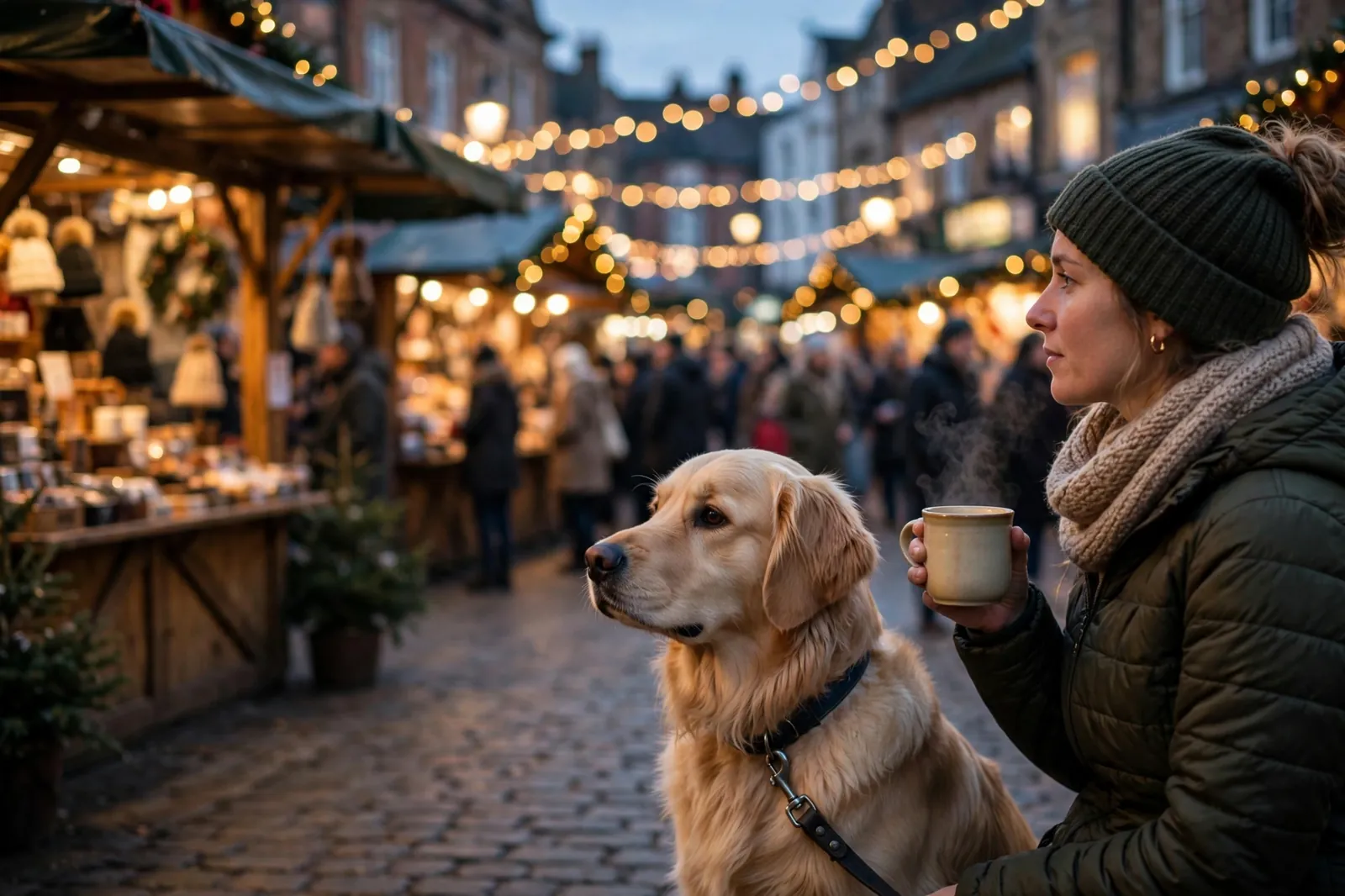
For a pet dog, the street market itself is manageable outdoors on a short lead, and many dogs enjoy the smells and sociability of an early pass. The problems are predictable and avoidable, and our wider guide to dog-friendly markets in the UK describes the same pattern across the country. Aisles narrow without warning where a stall, a parked car and a crowd meet. Dropped food collects near food stalls and bins. Extending leads become tripwires. Small children are at dog-face height, and dogs who are normally calm can become overwhelmed by the sheer density of legs, wheels and noise.
Work the market like a local rather than a browser. Keep the lead short enough that your dog walks at your side, not a metre ahead investigating other people's shopping. Position yourself between your dog and the busiest flow where you can. Step out regularly — down a side lane, to the edge of the market place, or best of all back towards the river for five minutes of grass — because decompression breaks are what turn a stressful endurance test into a series of manageable short exposures. Watch the ground ahead near food traders and use a practised leave-it command; cooked bones, skewers and discarded packaging around waste areas are genuine veterinary risks, not untidiness.
Shops are a separate question from stalls. Hawes has independent shops, cafés, a ropemaker visitor attraction in the wider town story and everyday services, each with its own dog policy that can change with ownership and season. Some welcome dogs inside, some allow them in part of the premises, and food shops in particular may not. Read door signage, ask cheerfully before entering, and accept a refusal without argument. If a shop is a no, the Hawes fallback is unusually good: one person shops while the other walks the river path, and nobody has lost anything except a few minutes. Never tie a dog up outside a shop on a busy market street and leave it unattended; theft, tangling, lunging at passing dogs and simple panic are all foreseeable, and market day multiplies every one of them.
River Ure walks from town: the everyday essential
The River Ure is Hawes's greatest daily asset for a dog owner, more important in practice than any single attraction. The Ure forms here in upper Wensleydale, gathers the becks coming off the surrounding fells and flows east through the dale past Aysgarth and beyond. Around Hawes itself, riverside and beckside paths and nearby field paths give you level, scenic walking that starts within minutes of the main street and can be cut to almost any length, from a ten-minute comfort loop before breakfast to a steady hour before lunch.
Build at least two Ure walks into every Hawes stay: a short, reliable morning loop on made or well-trodden paths close to town, and one longer exploration when weather and stock allow. Follow current maps and waymarking rather than memory, because riverside routes divert after flooding, bank work and seasonal closures, and a path that was straightforward on a previous visit may now route you through a different field with different stock in it. After heavy rain, treat the Ure with respect. This is a spate river that rises fast off the fells, colours up quickly and can make banks, stepping areas and low paths unsafe in a surprisingly short time. If the water is high, fast and carrying debris, stay well back from the edge, keep your dog on a lead and choose lanes and higher paths instead. Check the official latest guidance before you go if flood warnings or path closures are in place.
Swimming needs the same honesty as everywhere on the Ure. Calm-looking edges in summer can hide a strong current a few metres out, submerged rock and sudden depth changes, and the river around falls and gorges is never a dog swimming place. Angling is important throughout Wensleydale, with fishing rights, private banks and anglers whose lines, hooks and equipment deserve a wide berth. Keep dogs out of the water where signs ask you to, call your dog away from anyone fishing, and do not let a dog shake over tackle or picnics on the bank. Waterbirds and dippers work the edges, and in spring and summer nesting and feeding birds need dogs kept close and under control near banks even where other dogs appear to be loose.
The practicalities are simple and worth stating. Bins are concentrated in town, so carry bags on every walk and take waste back rather than leaving it at a path edge. In summer the town-side stretches busy up by mid-morning, so dogs who need space should walk early or head for quieter outer sections. In winter the issue reverses: the paths are quiet but can be icy, muddy and dark by mid-afternoon, so a headtorch, reflective gear for both of you and a towel back at base stop being optional extras. A drying coat and a spare lead in the car solve most Hawes weather problems before they become accommodation problems.
Hardraw Force: the honest version — paid, private and worth planning
Hardraw Force, a short distance north of Hawes at Hardraw village, is often described as England's highest single-drop waterfall above ground, where Hardraw Beck drops in one unbroken sheet behind the Green Dragon Inn into a natural amphitheatre of rock. It is a genuinely striking place, enclosed, green and loud after rain in a way photographs do not prepare you for. It is also the waterfall in this guide where honesty matters most, because visitors regularly arrive expecting a free, open-access beauty spot and find something different.
Access to Hardraw Force is across private land, and entry is paid. Historically access has been arranged through the Green Dragon Inn, with a charge per person and set opening arrangements, but prices, payment methods, opening times and exactly how entry is managed can and do change, including with changes at the inn itself. Do not rely on any price quoted in any guide, including the absence of a price in this one. Check the current official information for Hardraw Force and the inn before you set off, take a means of payment, and be prepared for the possibility that access is unavailable on a given day. That is not a flaw in the visit; it is the nature of a waterfall in private grounds, and the entry charge contributes to maintaining the paths and the site.
With a dog, the visit is a short, controlled woodland and gorge walk rather than a hike. Dogs on leads are generally welcome on the grounds, but the path to the fall involves damp stone, steps and sections that are slippery after rain, and the plunge area and beck demand close control. Keep your dog on a short lead throughout, well back from any unfenced edges, and out of deep or fast water below the fall. After prolonged heavy rain the beck can be powerful and paths may be restricted; after drought the fall can be a fraction of its famous image. Both versions are worth seeing, but set the expectation correctly for children and photographers in your party. Early in the day the grounds are quieter, which suits nervous dogs and anyone who wants to stand and look without a queue forming behind them.
Combine Hardraw sensibly. It pairs naturally with a Hawes morning — river walk, market pass, then Hardraw before lunch — rather than with Aysgarth on the same outing, because although the two falls are both in Wensleydale they pull you in different directions and each deserves unhurried time. Parking at Hardraw is limited village and inn-side parking, so arrive considerately, do not block lanes or gates, and never leave a dog in a car while you walk to the fall, on the familiar grounds that a short visit stops being short the moment a path, a view or a closure intervenes. If Hardraw is closed or unsuitable on your day, Hawes itself has not failed you: Gayle Beck, the Ure paths and the town will fill the slot without any sense of a wasted trip.
Aysgarth Falls as a day trip: three falls, one river, no swimming
Aysgarth Falls, several miles east of Hawes down Wensleydale near Aysgarth village, is not one waterfall but a celebrated series — Upper, Middle and Lower Falls — where the River Ure pours over broad limestone shelves through woodland. It is one of the classic sights of the Yorkshire Dales National Park, with a national park visitor centre and car park nearby, waymarked woodland paths and viewpoints, and a scale that rewards a half day rather than a quick stop. For dog owners it is an excellent day trip from Hawes, provided it is approached as a lead-on viewing walk and not as a water park.
The paths through the woods, including the Freeholders' Wood side of the river, are generally well made but include steps, roots, slopes and viewing areas that become slippery in wet weather. Keep your dog on a lead throughout the falls area. The limestone shelves look invitingly flat in low water, and people do venture onto them, but they are wet, algae-slick in places, undercut at the edges and directly above fast water. A dog allowed to scramble or paddle at the shelf edges can be in serious trouble in seconds, and a human going in after a dog compounds an emergency. Admire the falls from the paths and viewpoints, use the bridges to appreciate how the river changes character at each level, and give your dog its water break from your own bottle and bowl at a safe spot away from the edge.
Water level decides what kind of day Aysgarth gives you. After rain the three falls merge into a thundering, brown, spectacular whole and the woodland paths demand waterproofs, grip and a willingness to shorten the walk. In a dry summer the falls are gentler, the limestone architecture is clearer and the woods are at their most pleasant for an older dog who needs shade and steady going — but low water does not make the river safe to enter, because depth, current and slippery rock remain. In either case, check parking and visitor centre information before you travel, arrive early in peak season when the car park fills, and pay as signed on the day rather than trusting any figure in print. Check the official latest guidance before you go for any path closures after storms or flooding.
Plan the dog logistics of Aysgarth explicitly. There is no point in the falls visit where leaving a dog in the car becomes acceptable, so everyone in the party who comes to the car park should be part of the outdoor plan. If some of the group want indoor time at the visitor centre, split as you would in Hawes: check the centre's current dog policy at the door, assume the dog party stays on the woodland paths, and reunite for a picnic or café stop where dogs are confirmed welcome. On the drive back to Hawes, resist adding a second major stop with a tired dog. Aysgarth plus a gentle evening Ure loop is a complete Wensleydale day, and a dog who arrives back fed, dried and uninjured has had the best version of it.
Wensleydale Creamery: the cheese is famous, the dog access is limited
No Hawes guide can pretend the cheese is a side issue. Wensleydale cheese has been made in the dale for centuries in tradition, and the Wensleydale Creamery on the edge of Hawes is the modern home of that story, with a visitor experience, cheese shop, gift shop and café that draw visitors from well beyond Yorkshire. It is also the Hawes attraction most often misdescribed in dog-friendly round-ups, which tend to list the whole site as dog friendly because a dog was seen in a car park or an outdoor area. This guide will be more precise, because precision is what saves a wasted journey.
The honest position is this: do not plan on taking your dog through the full Creamery visitor experience. An attraction built around food production, viewing galleries, tasting and indoor displays is not a dog walk-through, and dog access to indoor and food areas is limited, regulated and subject to change. The shop, café arrangements and any outdoor or designated dog areas operate under their own current rules, which may differ from the main experience and from each other. Policies also change with refurbishment, season and food safety requirements. So check the Creamery's official dog information before you visit — check the official latest guidance before you go — and design the visit around what that information actually says on the week you travel, not around a blog post from a previous year.
In practice, most dog parties use one of two workable patterns. The split visit: one or more adults do the full experience while the dog party does a proper Ure or Gayle Beck walk — and Hawes makes this split unusually painless, because the walking from the Creamery side of town is good in its own right, not a car park exile — then everyone reunites for the shop, where you can confirm at the door what the dog can and cannot do, and for a café or outdoor stop if dogs are currently welcome in that part of the site. Or the shop-only stop: a shorter, deliberate visit for cheese to take home, with the dog kept to the areas clearly confirmed as dog accessible and the experience saved for a dog-free trip. Both patterns are respectable. The pattern that is not respectable is the one involving a dog in a car in the Creamery car park while the humans enjoy a leisurely tasting inside. That option does not exist, in any weather, for any length of time.
Two cheese-specific safety notes belong in every dog plan. First, keep all purchases sealed and out of reach in the car and accommodation: rich cheese in quantity will make many dogs ill, and the wax, string, packaging and accompanying chutneys and crackers in a gift bag add obstruction and toxicity risks that have nothing to do with the cheese itself. Raisin-containing accompaniments, in particular, are toxic to dogs. Second, tastings and café stops generate dropped food at dog height, so the market discipline from earlier in this guide applies here too: short lead, dog settled away from walkways, no feeding from the table, and a pavement scan before you let a scavenging dog hoover under a bench. Buy the cheese, enjoy the cheese, and let the dog enjoy being the reason you discovered the river walk you did while someone else was tasting it.
Walks beyond the centre: Gayle, the Pennine Way and dale edges
Once the market, river and headline falls are done, Hawes still has walking to offer, and for a stay of more than a day this quieter layer is what turns a visit into a base. Gayle, the small settlement just south of Hawes across Gayle Beck, gives a short, characterful extension to a town walk, with the beck, stone buildings and lanes that feel a world away from the market place while being only minutes from it. Beck water needs the usual care after rain, road sections need a short lead and verge awareness, and the whole loop works best as a gentle morning or evening circuit rather than a destination in itself.
Hawes also sits on the Pennine Way, the long-distance trail that passes through the town on its way across the dales and over Great Shunner Fell towards the next stages. Dog owners do not need to be walking the whole trail to use its presence well: short out-and-back sections from town, walked honestly for a set time and then retraced, give a taste of higher, wilder country without committing a dog to a full hill day. The fell sections climb quickly into exposed, stock-grazed, weather-exposed ground where navigation matters, wind chill is real even in summer and retreat options narrow. Take a map you can read offline, proper footwear, water for the dog and a turn-back time, and treat Great Shunner-scale ambition as a fair-weather, fit-dog plan, not a stroll that happens to start near a café.
Shorter field-path circuits around the town, linking lanes, beck bridges and the edges of Appersett and Burtersett directions on current rights of way, suit most visiting dogs better than fell tops. Whichever route you choose, read a current route description for stiles before committing: Wensleydale field paths use ladder stiles, stone stiles and gated gaps in variety, and at least one design on any longer circuit may defeat a large, elderly or anxious dog. A route you turn back from at a stile is a route that has taught you something useful for tomorrow. A route you attempt to force, lifting a heavy muddy dog over a wall beside a lane, is how holidays acquire a vet or a physiotherapist chapter.
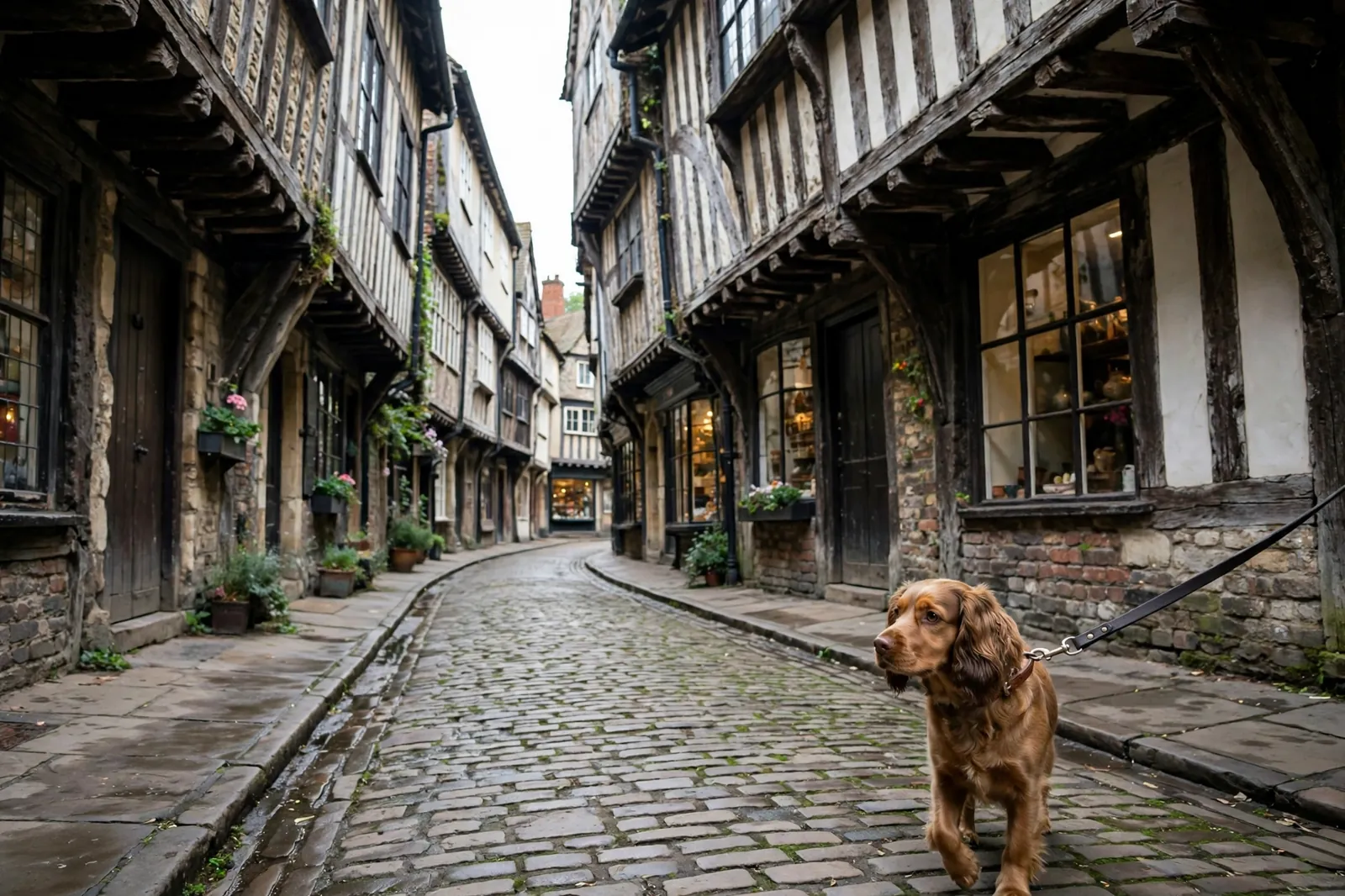
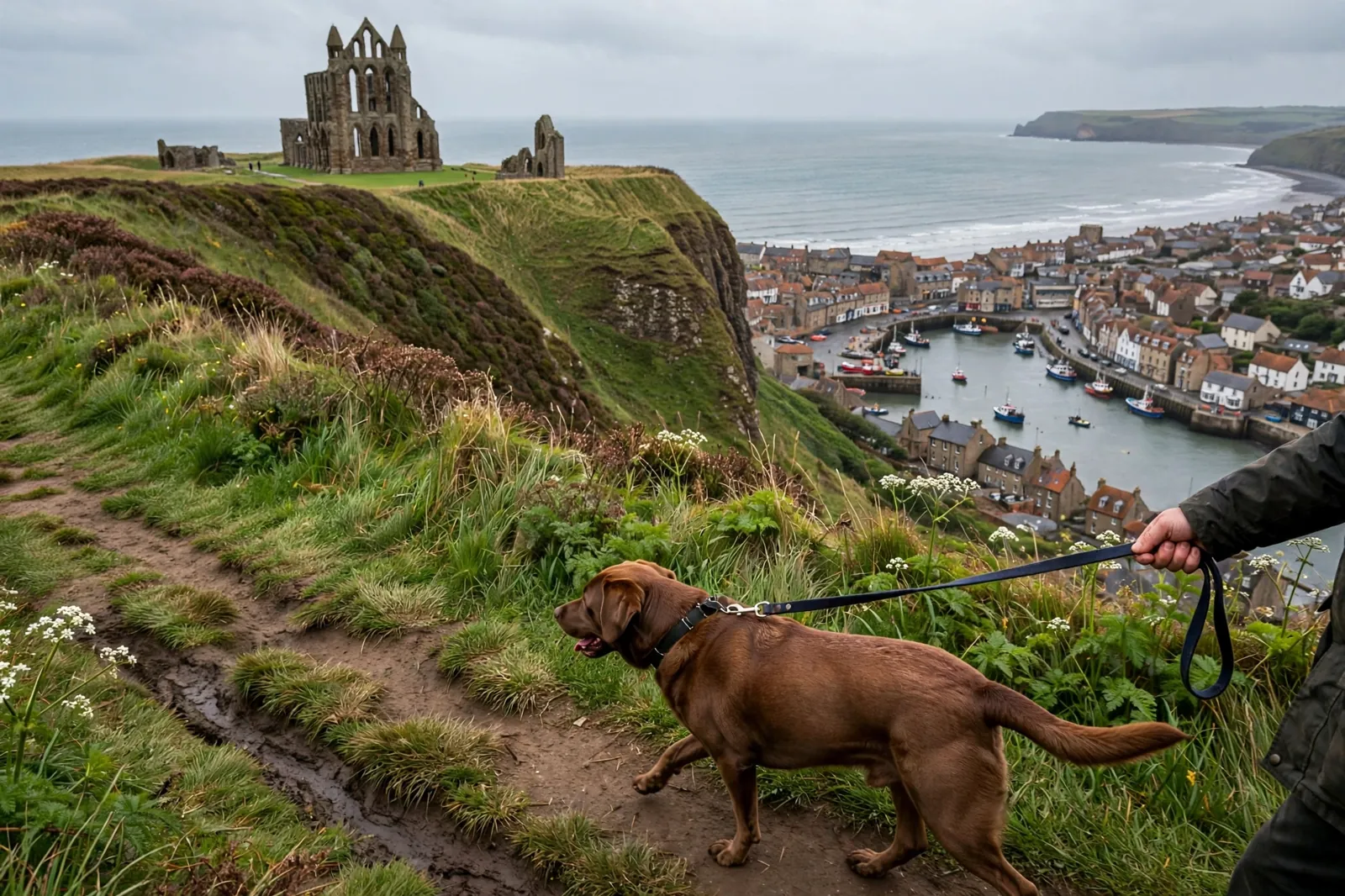
For a complete change of scene during a longer Wensleydale stay, compare the town-and-river pattern here with a city day in York with a dog, where early starts beat crowds in streets rather than on fells, or plan the coast as a separate base rather than a casual add-on to a dale day. Hawes sits deep in the dales, drives in every direction are scenic and slow, and a dog who has done a full Ure and falls day will vote, correctly, for an evening in Hawes over another hour in a car.
Sheep, moorland and lead discipline in upper Wensleydale
Every walk beyond Hawes's pavements runs on one condition, and it deserves its own section rather than a footnote. Upper Wensleydale is sheep country in the most literal sense: Swaledale sheep graze the valley fields, the intake land and the open fell, cattle graze in rotation, and the dry stone walls that make the landscape so photogenic are field boundaries in a working farming system. Dogs must be kept on a lead or under the closest possible control around livestock, as our guide to dogs on leads and the law in the UK sets out in full, and the only safe assumption anywhere outside the town centre is that there is stock in the next field even when the field you are in looks empty.
Moorland and fell-edge ground add seasonal duties. Between early spring and late summer, ground-nesting birds including curlew and lapwing nest on open ground across the dales, and on access land dogs are subject to specific seasonal lead requirements and local restrictions that are signed at access points. Follow those signs exactly, keep to paths where asked, keep the lead short in nesting areas and give alarm-calling birds a wide berth — check the official latest guidance before you go, because restriction dates and areas are set locally and can vary. Grouse moor management also shapes parts of the high ground around the dale; obey any temporary notices, keep dogs out of shooting activity entirely, and never let a dog range through heather where young birds may be present.
Cattle deserve a separate, calm paragraph, because Wensleydale field paths do cross cattle pasture and visitors underestimate the risk every year. Cows with calves can regard a dog — even a dog on a lead, even a quiet dog — as a threat, and incidents most often happen when a walker is caught between a herd and its calves with no exit. Walk calmly around herds rather than through them, give them the widest berth the field allows, keep your dog close and quiet, and if cattle approach in a way that feels threatening, let the dog go, move yourself to safety by the nearest gate or wall opening and call the dog once you are safe. That advice, to release the dog, surprises people, but it is the standard safety guidance for cattle encounters and it protects both of you, because cattle interest is usually in the dog, which can outrun them once free.
The small courtesies complete the picture. Close and fasten every gate as you found it. Keep dogs out of water troughs. Do not let a dog chase, worry or even play-bow at lambs for a photograph; worrying includes chasing, and the legal and financial consequences for the owner, and the outcome for the dog, can be severe. Take every poo bag back to a town bin, including from field paths, because livestock disease transmission through dog waste is a real farming concern and not a nicety. The dales welcome an extraordinary number of visiting dogs every year. The lead, the closed gate and the carried bag are how that welcome is earned, one walk at a time.
Stays, parking and practicalities: base yourself in Hawes
Hawes makes an unusually practical base for a Yorkshire Dales dog trip, because it combines real town services with immediate walking. Inns, bed and breakfasts, self-catering cottages and holiday accommodation in and around the town, plus campsites and caravan options in the wider upper dale, give most budgets a workable choice. As always, dogs welcome is a headline to interrogate rather than a promise to trust. Confirm how many dogs are accepted, whether there is a per-dog fee, whether a dog may be left alone in the property and on what terms — many hosts say no, and that answer shapes whether a Creamery experience or a meal inside a dog-free pub is possible at all — and what the dog's first and last walk of the day actually looks like from that front door.
Ask about the details that decide whether a Wensleydale stay is relaxing or damp. Is there a genuinely enclosed garden or yard, secure against a small dog at the gate gap and a large dog at the wall height, or is enclosed a hopeful description of a space opening onto a lane? Where can a wet dog be rinsed and dried before entering, and are old towels provided or should you bring your full kit? Stone floors, boot rooms and outside taps are worth real money in this valley in October. Bring your own bedding, throws, drying coat and food regardless, store cheese and market purchases in sealed containers out of reach, and keep evening routines lead-on: Hawes lanes are unlit in places, farm traffic moves early and late, and a black dog on a dark lane is invisible until it matters.
Parking and arrival need a plan on busy days. Hawes has pay-and-display car parks including the larger site by the Dales Countryside Museum side of town and other town parking, plus limited on-street spaces that fill quickly on Tuesdays, on sunny weekends and throughout school holidays. Arrive early, read the charges, time limits and payment methods exactly as signed when you arrive rather than relying on any guide's figures, and think about the dog before you think about proximity: a slightly longer walk from a car park with a grass verge beats a central space where your dog steps straight into market traffic. The Dales Countryside Museum itself, housed in the old station, is a useful wet-weather and orientation stop for humans; check its current dog policy before assuming any indoor access, and treat it, like the Creamery, as a potential split visit. And repeat the rule that outranks all parking convenience, for the last time in this guide: never leave a dog alone in a parked car in Hawes while you shop, eat or visit an attraction, whatever the dale weather appears to be doing when you lock the door.
For supplies and reassurance, Hawes is better equipped than its size suggests, with everyday shops, fuel and local services, but veterinary and out-of-hours cover for the upper dale should be looked up and saved in your phone before a fell or falls day, not searched for with wet hands beside a beck. Mobile signal is patchy away from town, so download maps, bus and parking information and attraction details for offline use, tell someone your route on longer walks, and carry the unglamorous kit that keeps small problems small: bags, water, a bowl, a spare lead, a towel and a charged phone. Do that, follow the hour-by-hour rhythm this guide opened with, and Hawes will do the rest: a proper town, a proper river and a proper dale, all of them better for being shared with a dog who was planned for rather than merely brought along.
Practical questions
Before you go
Is Hawes market dog friendly on Tuesdays?
The Tuesday market is outdoors on the main street and market place, so a dog on a short lead can walk through it with you. It is busiest in the middle of the day, with narrow gaps between stalls, trolleys and dropped food. Go early, keep the lead short, step out to the River Ure paths for a break, and check individual shop and stall rules before going indoors.
Can dogs visit Hardraw Force?
Dogs on leads are generally welcome on the Hardraw Force grounds, but access is through private land with a paid entry charge, historically via the Green Dragon Inn, and opening and payment arrangements can change. Check the current price, opening times and dog rules before you go, keep your dog on a lead near the water and gorge edge, and do not expect entry to be free.
Can dogs go into the Wensleydale Creamery?
Do not plan on taking your dog through the full Creamery visitor experience. The cheese experience, viewing areas and food production areas are not a dog walk-through, and dog access is limited and changes over time. The shop and outdoor or designated areas may differ from the main attraction. Check the Creamery official dog information before you visit, and plan a split visit or a shop-only stop with your dog rather than assuming full access.
Can dogs walk at Aysgarth Falls?
Yes, dogs can walk the woodland paths at Aysgarth Falls on a lead, but they should not be allowed to scramble on the wet limestone shelves or swim in the fast water below the falls. After heavy rain the River Ure runs high and powerful here, paths can be slippery and sections may be unsafe. Keep to the marked paths, keep your dog close at viewpoints, and check the official latest guidance before you go.
Where can I park in Hawes with a dog?
Hawes has pay-and-display parking near the Dales Countryside Museum and the main town car parks, plus limited on-street parking that fills quickly on Tuesday market days and in summer. Arrive early, read the current charges and time limits on the signs when you arrive, and never leave a dog alone in a parked car while you shop, eat or visit an attraction.