This guide is independent and contains no paid placement. Market stalls and castle opening times move around, so a quick check with the stallholder or castle office on the morning itself saves a wasted trip.
Leyburn gives dogs a market town morning and a woodland waterfall walk in one outing. Keep dogs on lead in the town, on the Shawl and through the falls woods, use the car parks on the town edge, and check the official guidance before you travel for current shop and attraction dog policies.
A market town that still works
Leyburn's broad market square gives the town its working rhythm, audible long before any shop door opens. Stall canvas snaps in the Wensleydale wind, crates thud onto stone, voices carry across an open space wide enough for a dog to read the whole scene without being pressed against strangers, and the smell of cheese, cured meat and baked bread drifts from one end of the square to the other. The scale matters for a dog: pavements are generous in places and pinched in others, corners funnel foot traffic into sudden meetings, and the square itself offers room to pause and let a busy moment pass.
The shopfronts around Leyburn's square reward a slow circuit rather than a dash from one doorway to the next. A dog meets a different threshold at every step, from a doorway with a water bowl outside to a narrower entrance where food, leather and flower smells collide, and the sensible pace is the pace of a dog working through those thresholds one at a time. The square's side streets give the dog somewhere to breathe between encounters, with quieter stone, fewer voices and a chance to shake off the stalls' stimulation before the next shopfront.
The market square on a stall day changes the whole texture of a Leyburn outing, and the change is worth planning around rather than simply enduring. Crowds thicken between the stalls, children dart at dog height, other dogs appear around every canvas corner, and the smells that were pleasant in an empty square become a dense, competing wall of scent that can lift even a calm dog onto its toes. Dogs stay beside their people through the stalls, never tethered to a railing while an owner browses, because a dog left alone in a crowd cannot step away from a hand, a child or another dog approaching too fast.
Leyburn Shawl: the view without the climb
The Shawl's limestone edge runs behind Leyburn like a long, grassy balcony above Wensleydale, and its appeal for a dog lies in the disproportion between effort and outlook. The climb from the town is modest beside a fell ascent, yet the grass opens suddenly onto a wide valley view, with Pen Hill across the dale, patchwork fields falling away below, skylarks and wind moving over the turf, and a horizon that gives a dog far more air and scent than a town street can offer. Dogs that tire on steep ground often find the Shawl's gentler gradient a fairer bargain, with views earned in short, level stretches rather than in one punishing pull.
The Shawl's viewpoints demand respect for the drop, because the escarpment edge is unfenced in places and the ground falls away sharply beyond the grass. A dog drawn by a rabbit, a ball or a sudden gust toward that edge is in genuine danger, so the town side of the path is the safe side at every viewpoint, and the walk works best when the dog is held close beside you where the grass thins toward the lip. The view loses nothing for being enjoyed slowly, and a dog that has sniffed the turf, watched the valley and rested on the grass has had the full Shawl experience without ever approaching the brink.
The Shawl's length also makes it forgiving, because the walk need not be taken end to end to count as a proper outing. A short out-and-back stretch from the town gives an older dog the wind, the grass and the valley view, followed by a rest in a quiet Leyburn street, while a fitter dog can extend the same line further along the edge and still return to town for water and shade. Turning back where a dog slows, seeks shade or lies down unprompted is not a failed walk on the Shawl; the edge, the view and the valley air remain exactly where they were, ready for another short stretch on another day.
The falls walk through the woods
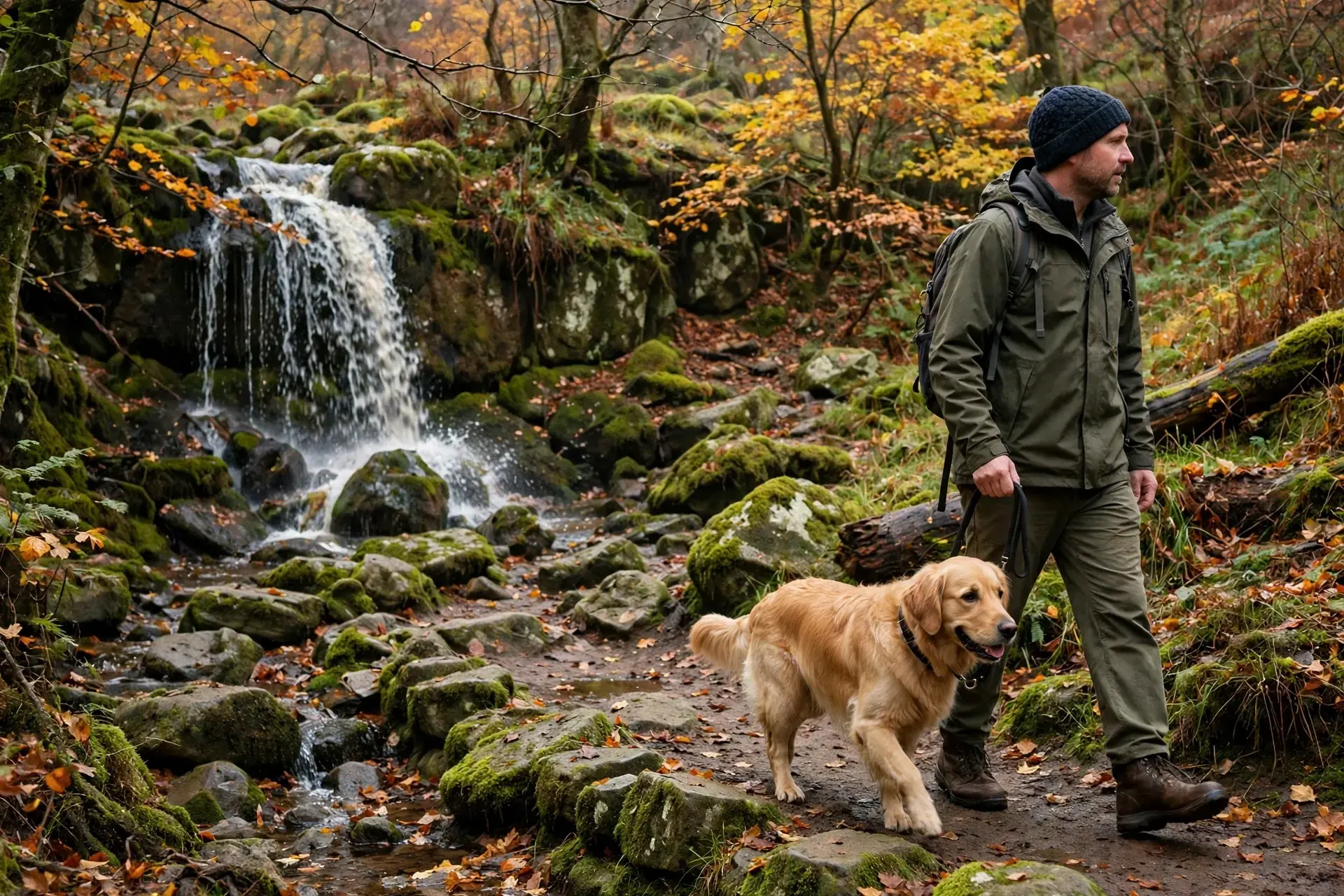
The woodland below Leyburn swallows town noise quickly, replacing the square's voices and stone with dripping leaves, mossy rock and the rising sound of falling water. The beck threads through the trees in a series of small drops and shaded pools, with ferns crowding the banks, roots crossing the path, and light breaking through the canopy in shifting patches that keep a dog's nose working hard from the first tree to the last. Dogs love the density of scent here, from damp earth and leaf mould to the clean, mineral smell of the water itself, and the woods reward a slow pace that lets that scent unfold rather than a hurried push toward the falls.
The falls themselves arrive as sound before sight, with water breaking over rock into a pool that fills the surrounding woodland with spray and echo. The main flow is not a paddling place, especially after rain, when the beck runs fast, cold and deceptively strong over smooth stone, and the safest water for a dog is a gentle, shallow side pool away from the main drop, entered only where the bank slopes gradually and the dog can climb out unaided. The woods are at their best when the falls are treated as something to watch, listen to and circle at a respectful distance, with any paddling kept brief, shallow and entirely at the dog's own choosing.
The climb back from the falls to Leyburn's streets catches many walkers by surprise, because the descent that felt effortless on fresh legs lengthens on the return, with roots, mud and a steady gradient conspiring against tired paws. A rest beside the beck before the ascent, with water and a pause in the shade, makes the climb a manageable second half rather than a slog, and a slower pace with frequent stops suits dogs with short legs, stiff joints or simply a long morning already behind them. Leyburn's woods will still be there tomorrow, with the same beck, the same moss and the same falling water.
Bolton Castle and the Wensley loop
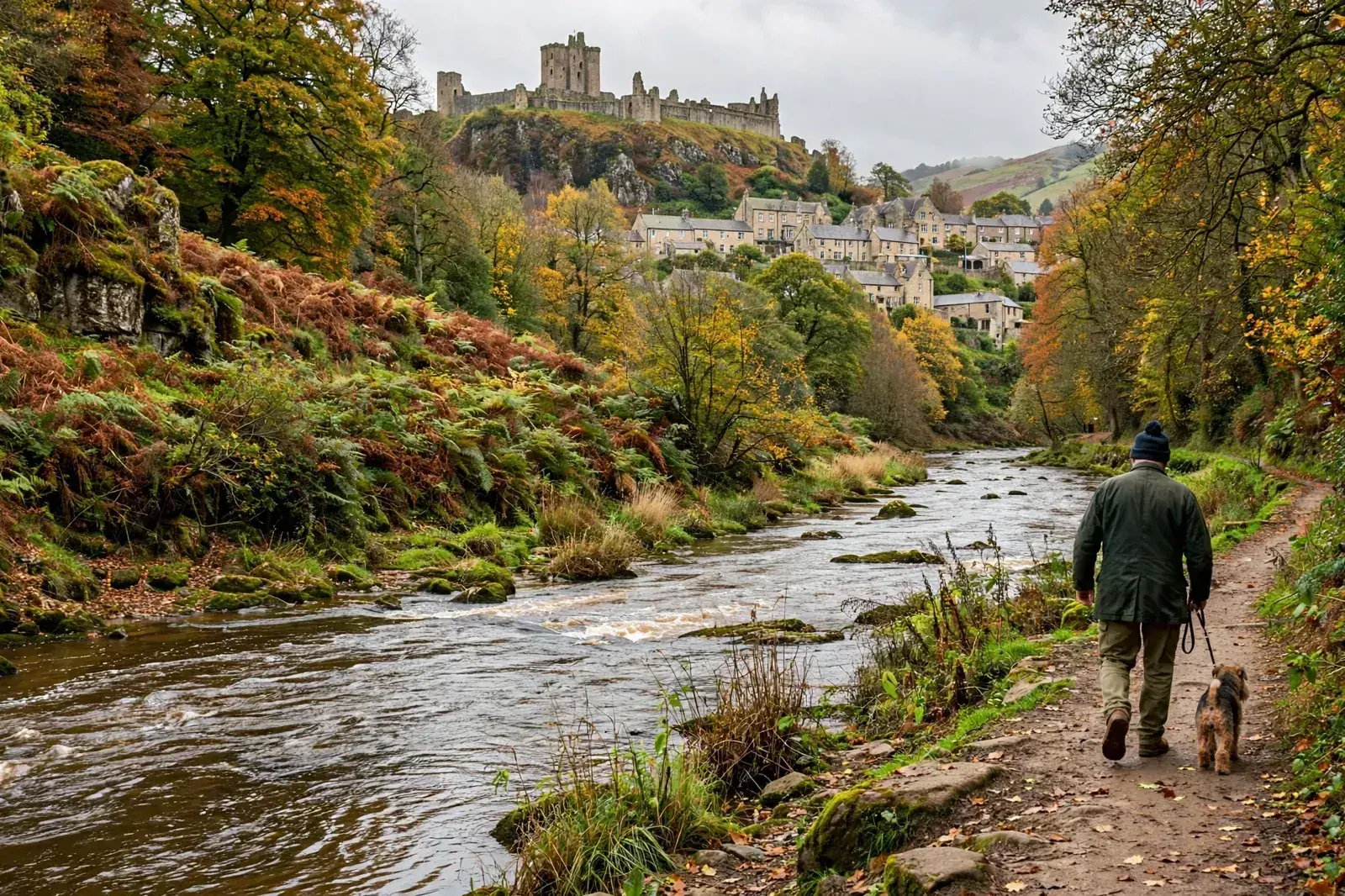
Bolton Castle's stone mass rises above the Wensleydale fields a short drive from Leyburn, and the contrast with the market town is immediate: where Leyburn bustles with stalls and shopfronts, the castle grounds offer open grass, high walls, long views and a quieter, more spacious kind of dog walk. Dogs in the grounds meet a different set of boundaries from those in the town, with furnished rooms and certain displays carrying restrictions that the open courtyards and grass do not, so the visit is best shaped around the grounds themselves, with the dog enjoying the walls, the lawns and the valley outlook while the historic interior is treated as a separate question settled at the gate. Water matters more here than in the falls woods, since the castle grass offers little shade on a bright day.
Wensley's village green and riverside lanes, a short distance from Leyburn, provide the castle day with its gentler second half. The village church, green and quiet lanes sit at a slower tempo than the market square, with stone walls, field gates and narrow carriageways replacing stalls and shopfronts, and the walk suits a dog that has already spent its liveliest energy at the castle or in the town. The village loop is short, calm and easy to abandon, which makes it a good late-day outing when a dog has energy left for scent and grass but not for another long climb or a crowded square.
The road between Leyburn, Wensley and Bolton Castle also opens the wider Wensleydale picture, where each neighbouring town has its own market character rather than repeating Leyburn's. The Hawes market town guide describes a higher, more exposed market town further up the dale, with its own square, cheese heritage and fell-edge walks, and the comparison helps an owner decide whether a day trip up the valley suits the dog in front of them or whether Leyburn's lower, wooded setting is the better base. A week built around Leyburn can therefore mix the town's own square, Shawl and falls with a castle morning, a Wensley lane stroll and a Hawes day out, each outing different in scale, scent and sound, without ever requiring the dog to repeat the same walk twice or to travel far from its sleeping place.
Pubs, cafes and market-day manners
Leyburn's pubs and cafes sit at the town's social centre, and their rooms carry the same working character as the square outside, with low ceilings in places, tables close enough for conversation to travel, kitchen smells drifting from the back, and dogs settling under tables while their people eat. A dog that has walked the Shawl or the falls woods usually drops straight onto a blanket and sleeps through lunch, lulled by the room's warmth and the steady murmur of other diners. The rooms that suit dogs best are the ones where the dog has a corner rather than a thoroughfare, away from the door where every arrival brings a new face, a new smell and a new reason to lift its head, and where water can sit undisturbed under the table.
The market-day dining room is a louder, busier place than the same room on a quiet weekday, and the difference changes which table and which hour suit a particular dog. Stall-day crowds spill from the square into doorways, children and other dogs pass at close quarters, and the clatter of plates competes with the square's voices outside, so a sociable dog that ignores passing dogs and children may enjoy the buzz while a nervous dog may prefer a weekday table, a quieter corner or an outside seat on a mild day where the air is thinner and escape routes are clearer.
Leyburn's evening rooms change again as the market stalls come down and the town's visitors thin out, with pubs filling for dinner and the day's walkers comparing routes over their meals. Some rooms welcome dogs through the evening, others keep dogs to bar areas once dinner service begins, and a popular dining room may draw its own line even when the bar beside it is dog-friendly, so the evening works best when the dog's place in the room is settled on arrival rather than discovered mid-meal. Dogs that have slept through the afternoon in their accommodation may arrive bright and restless for an evening outing, while dogs that have walked all day may prefer a short evening stroll through the quiet square and an early night, and both patterns are easily accommodated in a town where the square, the pubs and the sleeping places sit within a few minutes of one another.
Parking, buses and arrival
Leyburn's town-edge car parks shape the arrival experience, because the walk from a car park into the square is the dog's first proper introduction to the town. The route runs from open parking ground into narrower streets, with the square's sounds growing louder step by step, stall smells arriving on the wind, and pavements widening and narrowing as the town centre approaches, so a dog given a calm first circuit of a quiet street arrives in the square settled rather than bursting straight from a vehicle into the thickest crowd. The town's compact scale is an advantage here, since even a further car park leaves only a short, pleasant walk to the stalls, the shops and the start of the Shawl path.
Leyburn's bus connections link the town to surrounding dale settlements, and the bus stop in the town centre puts an arriving dog straight into the square's atmosphere rather than at a distant interchange. Services run thinner on Sundays and in winter, when the dale timetable contracts and the gaps between buses lengthen, so a bus arrival needs its return time settled before the walk begins, and the guide to travelling with dogs on buses and coaches explains how dogs are carried on these services in practical detail. The bus route into Leyburn also gives a dog a grandstand view of the dale, with fields, stone walls and the Shawl's edge sliding past the window on the approach.
The approach lanes into Leyburn deserve their own attention, because the dale roads narrow, twist and climb between stone walls before opening suddenly onto the town's broad square. Farm vehicles use these lanes daily, cyclists appear quietly around bends, and walkers with dogs share the same carriageway where no pavement exists, so the final approach to town is best taken slowly, with the dog close on the verge side and plenty of room given to oncoming traffic. Arriving unhurried, whether by car, by bus or on foot from a neighbouring village, sets the tone for the whole Leyburn day.
Stays, seasons and wet days
Leyburn's sleeping places cluster around the square and along the lanes that lead out toward Wensley and Bolton Castle, and their character follows the town's own scale rather than any resort pattern. Cottages near the square put a dog within earshot of market-morning sounds, with stone walls, small gardens and a short step to the stalls, while pubs with rooms above the town centre offer a dog a place above the evening murmur, and farm stays on the lanes beyond the town trade square noise for pasture quiet, field scent and a longer, darker night. The choice is less about luxury than about which Leyburn sounds a dog will hear through the night.
The seasons change what a Leyburn stay feels like, and the same cottage or pub room takes on a different character from one quarter to the next. Spring brings lambs to the surrounding fields and a fresher, greener scent through open windows, summer brings market crowds and long, light evenings on the square, autumn brings colour to the Shawl turf and the falls woods with shorter days and a need for a torch on late lane walks, and winter brings cold wind across the square, earlier darkness and a town that contracts to its warmest rooms. A dog that has a dry, warm sleeping place and a familiar bed copes with all of these seasons, since the town's walks and rooms remain close at hand whatever the sky does.
Leyburn's value as a sleeping base lies in the variety reachable without moving house, since the square, the Shawl, the falls woods, Wensley's lanes and Bolton Castle all sit within a short radius of the same bed. A week can therefore alternate a market-square morning with a Shawl afternoon, a falls-woods day with a castle and village day, and a busy stall day with a quiet lane day, each outing returning to the same familiar room, the same garden or the same pub corner. The town's compactness is the point: a dog need not endure long daily drives to reach good walking, because Leyburn's best outings begin at its own square, its own edge and its own woods.
Livestock, lanes and lead discipline
Wensleydale's pastures surround Leyburn on every side, and every walk from the town crosses working farmland where sheep and cattle graze behind dry-stone walls and field gates. Sheep scatter across the Shawl's lower slopes and the fields around Wensley, while cattle occupy the richer valley pastures, and both kinds of stock change fields with the seasons, so a path that was empty in one month may hold a herd in the next. The farmland character is not a backdrop to Leyburn walking but its substance, since the town's market tradition grew from these very pastures, and a dog walk here is a walk through someone's livelihood as much as through scenery.
The cattle encounter is the moment that tests a Leyburn walk, and the Wensleydale field is the place to meet it with a wide, calm arc rather than a straight push through the herd. Cattle gathered near a path, especially cows with calves, deserve a generous berth, with the dog held on a short lead at your side, the walk curving around the field's edge rather than cutting between animals, and no shouting, running or barking to stir the herd. The same calm arc works for sheep, though sheep more often move away on their own, and a dog that has learned to curve around stock in a Wensleydale field has learned the single most useful skill for dale walking.
Leyburn's lanes carry the livestock lesson onto the road, where farm vehicles, cyclists and walkers share narrow carriageways between stone walls. A wide tractor or trailer needs far more room than a car, and a dog on a lane must be tucked to the verge side with its person between it and the traffic, while cyclists approaching quietly around bends need a dog held close rather than ranging across the carriageway. Gates, lanes and pastures together form one discipline: close the gate, give stock room, give traffic room, and keep the dog where its person can reach it in a single step.
One full Leyburn day with a dog
Leyburn's square at first light belongs to delivery vans, early shopkeepers and the first dogs of the day, with shutters lifting, stall frames appearing on market mornings, and the stone still cool underfoot before the crowds arrive. A circuit of the square at this hour lets a dog read the town while it is still quiet, with shopfront smells fresh, pavements empty enough for easy passing, and the Shawl's edge visible above the rooftops as the day's first walking prospect. The early square is Leyburn at its most workaday, and a dog that has absorbed that rhythm is ready for the open air rather than overwhelmed by it.
The Shawl's grass and valley view make the middle of a Leyburn day, with the limestone edge offering wind, scent and a panorama that rewards a slow, level stroll rather than a forced march to the furthest point. The path's viewpoints give a dog places to pause, sniff the turf and watch the dale, while the town side of the edge keeps the walk safe and the return to Leyburn's streets short and easy when energy fades. Dogs that have had square, edge and woods in one day have had Leyburn's three distinct landscapes, each with its own sounds, smells and scale, without ever leaving the town's immediate surroundings.
Leyburn's evening square settles into a quieter register as stalls come down, shop doors close and pub rooms fill with the day's walkers, and the last outing of the day can be a short, unhurried circuit of the quiet streets rather than another expedition. A stroll past the square's stone, a pause where the day began, and a return to a familiar sleeping place gives a dog the same landmarks in reverse, reinforcing the town's geography in a way that a car journey cannot. The Leyburn day works because its parts are close together, its landscapes are distinct, and its pace can shrink to a single square circuit or expand to castle, village and woods without ever losing the town as its anchor.
Practical questions
Before you go
Can dogs walk off lead in Leyburn?
Leyburn's square, the Shawl's edge and the falls woods are places where dogs stay close beside their people, since crowds, drops and narrow woodland paths leave no safe margin for a ranging dog. Open pasture away from livestock, roads and the Shawl's lip may suit a dog with genuinely reliable recall, but the town, the edge and the woods themselves are not off-lead ground, and any freedom should end well before a gate, another walker or grazing stock comes into view.
Is the Leyburn Shawl walk suitable for older dogs?
The Shawl's gentle gradient and level grass make it kinder than a fell climb for many older dogs, with valley views available from a short out-and-back stretch rather than only from the full length of the edge. The walk suits an older dog best when taken slowly, with pauses on the turf, a turn at the first sign of tiredness, and a rest afterwards in a quiet Leyburn street, since the Shawl's appeal lies in air and outlook rather than distance covered.
Are dogs welcome at Bolton Castle?
Bolton Castle's grounds and its furnished rooms carry different dog rules, with open grass and courtyards generally more welcoming than furnished interiors and certain displays, and those rules shift with the seasons. The gate is the place to settle the question for the day, and a visit shaped around the castle grounds, the walls and the valley outlook gives a dog a full outing even when an interior room is closed to dogs.
Where should I park in Leyburn with a dog?
Leyburn's town-edge car parks are the natural starting point for a dog day, since they keep vehicles out of narrow residential streets and leave only a short, pleasant walk into the market square. Market days fill the most convenient ground early, so an earlier arrival earns a shorter walk and a calmer first circuit of the square, while a further car park still offers grass verges, stone walls to sniff and a gradual introduction to the town's sounds.
What should I do if my dog meets cattle on a Wensleydale walk?
A Wensleydale field holding cattle calls for a wide, calm arc around the herd's edge, with the dog held on a short lead at your side and the walk curving away from cows and calves rather than pushing between them. Shouting, running or barking only stirs the herd, and a field where cattle press close to the path or block the exit is a field to leave by another route, since turning back toward Leyburn or Wensley costs nothing and a confrontation costs far more.
Is Leyburn a good base for a Wensleydale break with a dog?
Leyburn works as a Wensleydale base because its square, Shawl and falls woods all begin at the town itself, while Wensley's lanes, Bolton Castle and day trips further up the dale sit within a short journey of the same sleeping place. A week here can alternate market mornings, valley views, woodland water and village lanes without moving house, and that variety, all anchored to one familiar town, is exactly what a dog break needs.