This guide is independent and contains no paid placement. If affiliate links are added later, they will be clearly marked and will not change our editorial checks.
Hadrian's Wall Path is 84 miles from Bowness-on-Solway to Wallsend. Most dog walkers take seven days, keep the dog on a lead through farmland, carry water on the exposed middle sections, and book dog-friendly stays and baggage transfer well ahead.
The route at a glance
Hadrian's Wall Path is one of England's great long-distance walks, and it is also one of the most dog-friendly of the big National Trails, provided you plan it properly. The route follows the line of the Roman frontier built in the second century AD, running 84 miles (135 kilometres) from Bowness-on-Solway on the Cumbrian coast to Wallsend on the River Tyne, just east of Newcastle. Most people walk it west to east, which puts the prevailing wind at your back and saves the finest scenery — the high crags of Northumberland — for the middle of the trip, when your legs and your dog have found their rhythm.
The table below is the fastest way to understand the walk. It breaks the route into the seven stages most walkers use, with the distance and character of each day. The first two days cross flat farmland and the marshes of the Solway, the middle three climb onto the crags where the Wall is at its most dramatic, and the final two days descend through the Tyne valley into the city. Distances are approximate: guidebooks differ by a mile or two depending on where exactly the overnight stop falls, so treat the figures as planning numbers rather than promises, and check the official guidance before you travel for any diversions.
| Day | From – to | Miles | Character |
|---|---|---|---|
| 1 | Bowness-on-Solway – Carlisle | 15 | Flat Solway marshes and farmland |
| 2 | Carlisle – Walton | 12 | Gentle farmland, Roman sites at Lanercost |
| 3 | Walton – Gilsland | 11 | First climbs, Birdoswald Roman Fort |
| 4 | Gilsland – Steel Rigg | 12 | The crags: steep, exposed, spectacular |
| 5 | Steel Rigg – Chollerford | 14 | More crags, then down to the Tyne |
| 6 | Chollerford – Heddon-on-the-Wall | 15 | Rolling farmland, villages and pubs |
| 7 | Heddon-on-the-Wall – Wallsend | 13 | Riverside paths into Newcastle |
That shape matters more than the total distance. A fit dog that already walks ten miles on a Saturday will cope with the daily distances, but the crags days ask for something different: short, sharp climbs and descents on rocky ground, often with the dog on a lead beside a wall and a drop. Older dogs, very small dogs and dogs that have never walked consecutive long days will find the middle of the route hard work, and the honest answer for them is to walk the flatter eastern and western ends as separate day walks instead of attempting the full trail. The Wall will still be there next year, and a dog that enjoys three good days remembers the trip fondly; a dog pushed through seven exhausted ones does not.
Section by section: what each day is really like
Day one starts at Bowness-on-Solway, a quiet village on the edge of the Solway Firth, and follows the coast and then the River Eden into Carlisle. It is flat, exposed to the wind, and crossed by long stretches of farmland where the dog stays on a lead. There is little shade and few places to buy anything until Carlisle, so this is a day for carrying water and for letting the dog settle into the routine of walking, stopping, drinking and walking again. Carlisle itself is a proper city with vets, pet shops and a railway station, which makes it a useful place to deal with any kit problem before the remoter days begin.
Days two and three are the gentle build-up. From Carlisle the path runs east through farmland and small villages towards Walton and Lanercost, where the priory and the Roman fort at Birdoswald give the first real taste of the frontier. The walking is mostly on field paths and quiet lanes, with stiles and gates that slow a dog down more than they slow you. Livestock is common here: cattle and sheep graze the fields the path crosses, and the lead rule is not a suggestion. A dog that chases, or even one that merely runs at sheep with enthusiasm, can cause real harm and real trouble, so keep the lead short and the dog close whenever animals are in sight.
Days four and five are the reason most people come. Between Gilsland and Chollerford the Wall rides a ridge of volcanic rock called the Whin Sill, and the path climbs and drops along the crags past Housesteads, Vindolanda and Steel Rigg. This is the most beautiful and the most demanding part of the walk. The ground is rocky underfoot, the climbs are short but steep, and there is almost no shade or shelter. Dogs need water carried for them here, because the becks are intermittent and the villages are off the ridge. It is also the busiest section, so expect other walkers, other dogs and narrow stretches where passing takes patience.
The final two days are a long, gentle descent into the Tyne valley. From Chollerford the path follows the river through Corbridge and Hexham country, then along riverside paths and old wagonways towards Newcastle. The walking is easier, the pubs and villages come thicker, and the dog can relax into longer off-lead stretches where the path allows it. The finish at Wallsend, at the Segedunum Roman Fort, is urban and anticlimactic in the best way: a cup of tea, a photo, and a short bus or Metro ride into Newcastle for the train home.
How many days with a dog
Seven days is the standard plan, and it is the right one for most dogs. Six days is possible for a fit, experienced walking dog, but it turns two of the days into 16- or 17-mile efforts, and the crags day does not forgive tired legs — human or canine. Eight days is a kinder pace that suits older dogs, first-time long-distance dogs and anyone who wants an afternoon at Vindolanda without rushing. The extra day costs one more night of accommodation, but it buys a rest day or a short day in the middle, which is often the difference between a dog that finishes bright-eyed and one that finishes limping.
Think in terms of walking time rather than miles. Twelve miles on flat farmland takes about four hours of steady walking; twelve miles over the crags, with stops for photos, water and a sit-down, takes six or more. Add an hour for lunch and the dog's rest stops, and a seven-day plan means leaving after breakfast and arriving mid-afternoon, which leaves time to settle the dog, wash paws and find dinner. A plan that arrives at dusk every day is a plan that will break down the first time the weather turns or the dog goes lame, so build slack into every day and keep one spare day in the diary if you can.
Training matters more than breed. A dog that walks five miles a day at home and then attempts 84 miles in a week will struggle, whatever its breed. Build up over at least six weeks before the trip: longer weekend walks, two long days back to back, and practice walking on a lead for hours at a time. Watch for the signs of a dog that is tiring — lagging behind, lying down at stops, a stiff gait in the morning — and be ready to shorten a day with a taxi or a bus. The route is well served by roads at most points, so bailing out of a single day is straightforward, and there is no shame in it at all.
The crags: the hardest miles for a dog
Between Birdoswald and Chollerford the trail stops being a riverside stroll and turns into a staircase cut across the Whin Sill, the dark volcanic ridge the Romans chose because it was already a wall of its own. No single climb is huge — most rises are only a few dozen metres — but they arrive one after another, up over a crag, down into a dip, up again, and the descents punish knees and paws as much as the climbs. The surface underfoot is broken rock and loose stone, and after rain the slabs shine and turn slick. This is the stretch to plan in short stages, with the dog's water and your own patience both topped up before you leave the last village.
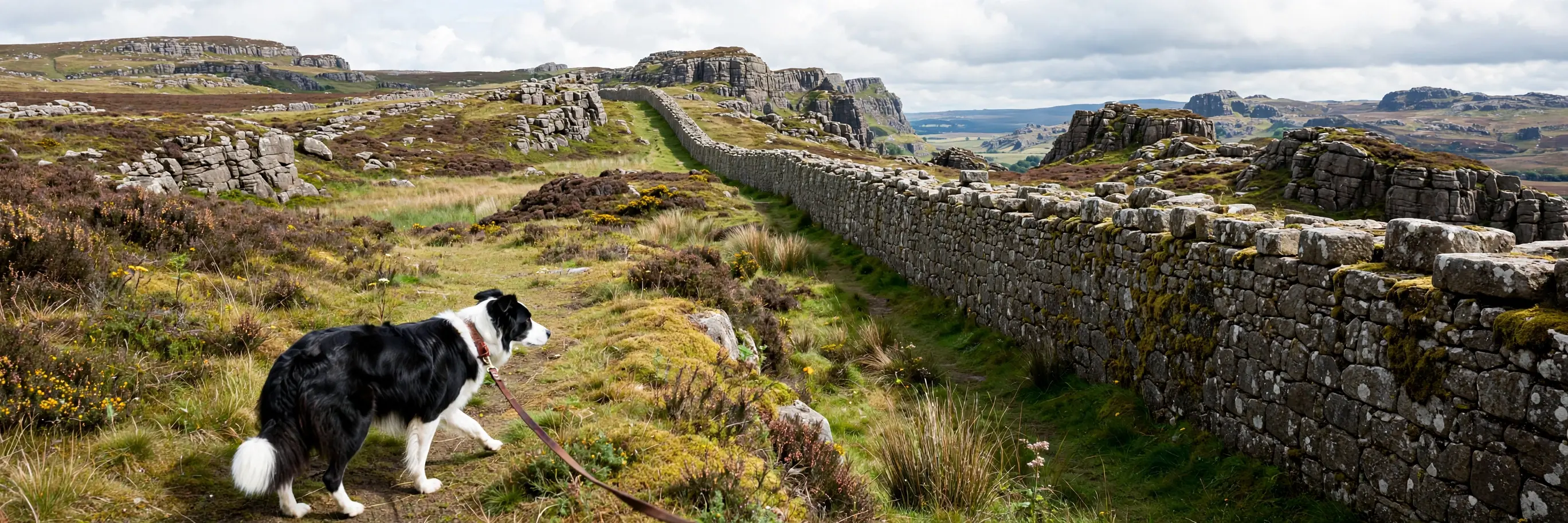
Keep the dog on a short lead here, even if it is normally reliable off lead. The path runs close to the Wall and to drops on the northern side, and a dog chasing a rabbit or a pheasant can be over an edge or through a gap before you can react. There are also sheep grazing the crags, and ground-nesting birds in spring and early summer, so the lead protects wildlife as well as the dog. Fit dogs enjoy the scrambling; small dogs may need a lift over the rockiest steps, and older dogs will be grateful for a slower pace and extra water stops.
Plan the crags days around water and shade, because there is very little of either on the ridge. Fill every bottle at the start of the day, carry a collapsible bowl, and offer the dog water at every stop, not just when it asks. On a hot day, walk the crags early and rest through the middle of the day in the shade of a wall or a stand of trees. If the forecast is for high temperatures, consider splitting the crags into shorter days or walking them in the cool of the morning and evening, and check the official guidance before you travel for any heat or access warnings.
Roman sites and dog rules
The forts are the reward for the walking, and they are also where a dog needs the most patience. At Housesteads, Chesters and Birdoswald, and at the Segedunum fort in Wallsend, dogs on leads are welcome to wander the open remains — the barrack blocks, the granaries, the stretches of Wall itself — but the indoor rooms are closed to them: no museums, no exhibitions, no shops, no cafes. Vindolanda runs under its own trust and works the same way, with the outdoor site open to leashed dogs and the museum kept dog-free. That split is easy to manage if you walk as a pair, taking turns to look inside while the other stays out with the dog among the ruins, which most dogs prefer to a display case in any case. Solo walkers should treat the open-air remains as the visit and save the museum for another trip. Assistance dogs are admitted indoors. Rules shift for excavations, school holidays and conservation work, so confirm the current position on each site's own pages before you set out rather than trusting this guide alone.
The practical answer for two walkers is to take turns: one visits the museum while the other waits outside with the dog, then swap. Solo walkers will need to choose between the museum and the dog, and the honest advice is to enjoy the outdoor remains — which are the spectacular part — and save the museum for a return visit without the dog. The outdoor sites are large, open and full of smells, and most dogs find them far more interesting than a display case anyway. Keep the dog on a lead throughout, because the sites are scheduled monuments and the grass is often grazed by sheep.
Do not let the dog climb on the Wall itself. The stonework is fragile, and climbing accelerates erosion; the sections that survive best are the ones walkers have respected. The same applies to the fort walls and the milecastles. A dog that scrambles over the masonry is not just damaging a monument, it is also at risk of a fall on the far side. Walk beside the Wall, photograph it, and let the dog sniff the turf at its foot, which is where the interesting smells are in any case.
Livestock, leads and ground-nesting birds
From the Solway marshes to the Tyne valley the path runs through farms that are still working, and sheep are rarely out of sight — on the open crags, in the riverside fields, even on the grass beside the Wall. Spring brings lambs, and a dog does not have to touch a lamb to harm it: chasing, or even running at a flock, can separate ewes from lambs and leave animals injured in the panic. Cattle fill the lower fields around the Eden and the Tyne, and a field of cows with calves deserves a wide loop rather than a straight line through the middle. English law gives a farmer whose animals are being worried by a dog the right to act, and the result for the dog can be fatal, so the lead stays on whenever stock is in the field, visible ahead, or likely to be waiting over the next rise. A dog on a lead is also the fastest way to show a farmer that the walkers passing through respect the land they are crossing.
From March into July the open ground adds a second reason for the lead. Curlew, lapwing and skylark all nest on the ground across the moors and the crags, and a dog ranging through rough grass can put a foot through a nest before its owner has noticed anything wrong. The loss is invisible from the path — a nest deserted after a dog passed too close looks no different from ground where no bird ever nested — so the rule is to stay on the marked line and keep the dog close through the breeding months. The drinking routine that carries a dog across the dry ridge days is set out in our guide to dog hydration on long walks, and the same steady lead work it describes is what keeps nests safe here.
The Wall path is crossed by more stiles and field gates than most walkers expect, and they are worth a thought before the first one appears. Many stiles have a small gate beside them, or a gap at the side that a dog can slip through; others are solid stone steps with nothing for a dog at all, and a big dog then needs a lift while a small one can be passed over in your arms. Rehearse the lift at home so it is routine rather than a struggle on a windy crag, and unclip the lead before the dog goes over — a lead snagged on a stile can injure a dog badly. Field gates are simpler: leave each one exactly as you found it, shut when it was shut, and look back after the dog has gone through, because a gate swinging open behind a walker is the kind of thing a farmer remembers for the rest of the season.
Water and food on the trail
On this route the water question changes with the miles. The western end around Bowness and Carlisle, and the eastern end around Corbridge and Newcastle, are generous: villages, pubs and overnight stops come often enough that a litre each is usually plenty. The middle is different. Between Gilsland and Chollerford the path rides the ridge, the villages drop away below, and a whole day can pass without a certain tap. Start those days with every bottle full, carry a litre for the dog on top of your own supply, and take more when the forecast is warm. Bring a bowl the dog will actually drink from — test it at home, because plenty of dogs refuse a strange bowl on a hot day — and offer water at every halt rather than waiting for the dog to ask. Becks such as the Irthing cross the path and look tempting, but after rain they run brown with soil and farm run-off, and in a dry spell the pools turn still and stale. A dog may lap from a clear, fast beck if it wants to; the plan itself should never depend on finding one.
Take water whenever it is offered. Breakfast at the overnight stop, a pub garden at lunch, a tap in a village green — each is a chance to fill everything you carry, and the extra weight is a small price against a thirsty dog five miles from the next roof. On warm days, wet the dog's belly and paws where a beck crosses the path; evaporation off the coat cools far better than a single long drink. Offer sips little and often instead of letting a hot, tired dog gulp a litre at once, which can bring the water straight back up. Learn the warning signs before you need them: gums gone dry and sticky, saliva thick, a dog that lags and then stops. Those signs mean the day is over — find shade, cool the dog down, and walk no further.
Feeding on the Wall is a matter of routine rather than invention. Keep the dog on its usual food, served morning and evening, and skip the big midday meal: a small handful of its ordinary kibble or a few treats during the walking hours is enough to keep energy up without a heavy stomach on the climbs. Changing food mid-week is the quickest route to an upset stomach, so buy what the dog eats at home before you leave Carlisle, and carry it in sealed portions marked by day. If you use a baggage service, the bulk of the food travels in the transferred bag while a single day's portion stays in your day pack, in case a bag goes missing. A walking dog burns far more than a dog at home, so the evening meal can be a little larger than usual, and there should always be fresh water beside the bowl at the overnight stop.
Where to stay with a dog
The beds along the Wall are the part to sort out first, because the dog-friendly ones are few and the walking season is busy from May into September. The pattern repeats along the route: a village pub with rooms above the bar, a small bed and breakfast, a farmhouse stay, a hostel bunk, a campsite pitch — and, at either end, the hotels and guesthouses of Carlisle and Hexham. Most pubs and bed and breakfasts take dogs, but often in only one or two rooms, and many add a small charge per dog per night. Get the dog details into the booking confirmation itself: which room, what the nightly charge is, whether the dog can stay in the room by itself while you eat downstairs, and where to put its bed at night. A cheerful welcome for dogs at a busy bar can turn out to mean something narrower when you arrive with a muddy spaniel at six in the evening.
For a dog that settles in a tent, camping is the easiest arrangement on this route. Pitches sit close to the path at Gilsland, at Steel Rigg and near Corbridge, and a tent gives the dog a familiar den of its own instead of a strange room with strange smells. The trade is weight and noise: the tent, the dog's bed and its food all travel with you unless a baggage service carries them, and a dog that barks at every footstep past the tent will keep a whole field awake. Hostels are less predictable — some offer private rooms where a dog is welcome, others take no dogs at all — so ask directly rather than assuming. Whichever you choose, keep the evening close to home: feed at the usual hour, lay out the same bed, take a last short walk before dark, and give the dog a quiet hour to settle.
Carlisle at the start and Newcastle at the finish look after themselves — both have a wide choice of hotels and guesthouses that take dogs. The nights that need booking first are the small ones in the middle: Walton, Gilsland, Once Brewed, Chollerford, Heddon-on-the-Wall. Those villages have a handful of beds between them, and when they fill, the nearest alternative may be a taxi ride away in Haltwhistle or Hexham. That is not a disaster if it is planned, but it is a miserable discovery at six in the evening, and rural taxis need booking ahead — especially on a Sunday, when some firms do not run at all. Book the middle nights first, then fill in the ends around them.
Baggage transfers and transport
Letting someone else carry the heavy bag is what turns this walk from a slog into a holiday with a dog. Local firms collect your main bag each morning from the overnight stop and leave it at the next one, so the only weight on your back is the day pack: water for both of you, the dog's bowl, waterproofs, a few treats, a small first-aid kit. Booking the whole route in one go is usually cheaper than arranging it day by day, and it saves a phone call every evening. For each stop, sort out the morning collection hour, the weight allowance and the precise drop-off address, and mark the bag clearly with your name and where you are sleeping that night. The dog's essentials never travel in the transferred bag: the day's food, any medicine, the poo bags, a spare lead and the towel all stay with you, in the day pack, where you can reach them.
The getting-there plan is half the trip on a linear trail. Carlisle station sits on the main line from London, Manchester and Scotland, and Bowness-on-Solway is a short bus or taxi ride from the city. At the far end, Wallsend has its own Metro station, and Newcastle Central is a few minutes away by Metro, with trains to everywhere in the country. Most train companies carry a dog without a ticket as long as it stays on a lead and off the seats, and the Metro takes leashed dogs too — but the rules belong to each operator, so look them up for the exact services you plan to catch before you travel. Drivers can choose to park in Carlisle and ride back by train at the end, or book one of the walker-transfer services that moves people as well as bags along the Wall.
The AD122 bus is the walker's friend on the central section. Named for the year the Wall was begun, it runs between Haltwhistle and Hexham through the middle of the route during the walking season, stopping near the main forts and villages. It is the simplest way to split a long crags day in two, to reach a fort without walking the whole distance, or to collect a tired dog and carry it to the overnight stop. The catch is the timetable: services are seasonal, they change from year to year, and on some days there are only a couple of runs. Look up the current times on the operator's pages before you rely on one, and never plan a day around a bus you have not confirmed that morning.
Paws, weather and fitness
On a week-long walk it is the dog's feet that usually give out first. The Whin Sill is broken rock, the farm tracks are flint and stone, and the lanes near the towns are hard tarmac — three different kinds of wear in a single day. Make the evening paw check part of the routine: look between the toes for grit and small cuts, feel for pads that are red, swollen or starting to split, and wash the mud off with clean water before drying the paws properly. A smear of paw balm helps pads that are drying and cracking, and a dog that begins to limp should be given a rest day in the village rather than pushed on. One day off costs little; three more days on a worsening limp can end the walk altogether.
The Wall sits open to weather from both seas, and it changes faster than the forecast suggests. Wind off the Solway can drive rain sideways across the crags with almost no warning, and a waterproof coat earns its place in the pack on any wet week — most of all for short-coated dogs, older dogs and small dogs that lose heat quickly. Summer flips the problem: the same bare ridge offers no shade at all, so the heat becomes the risk, and the answer is to walk early, rest through the middle of the day in whatever shade a wall or a stand of trees provides, and watch for heavy panting or a dog that will not move. A handle on the harness is genuinely useful on the rocky steps, for steadying a dog up and down, and our guide to choosing a dog hiking harness explains how to fit one so it never rubs over a week of climbing.
Do not let the first long day be the dog's first long day. Start five or six weeks before the trip and turn weekends into rehearsals: a long Saturday walk over mixed ground, then a second long walk on Sunday while the dog is still tired from the day before — that second day is the one that teaches you what the Wall will ask. Work in hills wherever you can find them, and rehearse the daily rhythm too: breakfast, a long walk with water stops, an evening meal, a quiet night in a strange bed. A dog with arthritis, a heart condition or an old injury needs a vet's opinion before any booking, and the vet's answer should be taken seriously. For an older dog, a shorter taste of the Wall — the central crags over a long weekend, for instance — is often the kinder trip, and it is still a magnificent walk.
What to pack for the dog
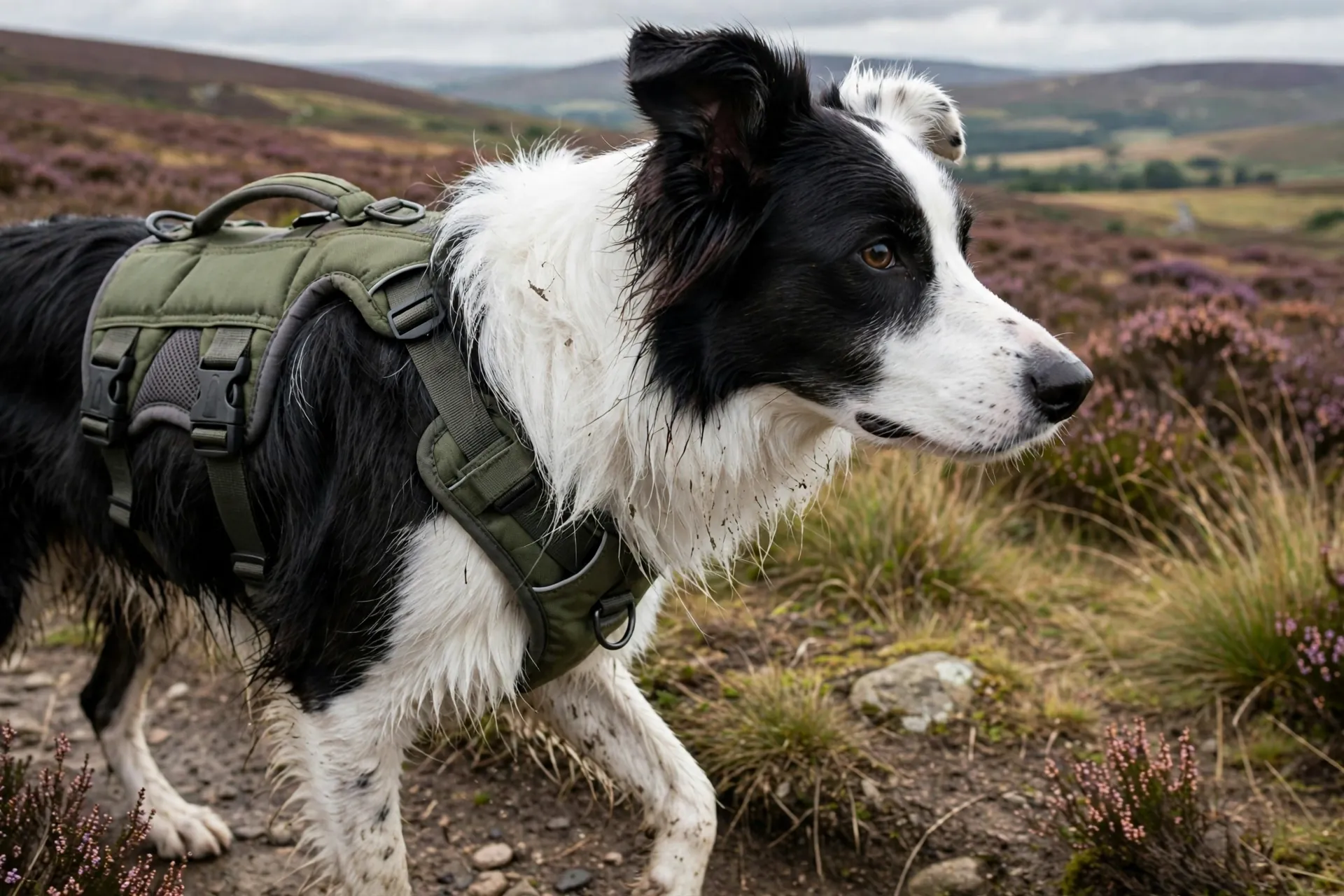
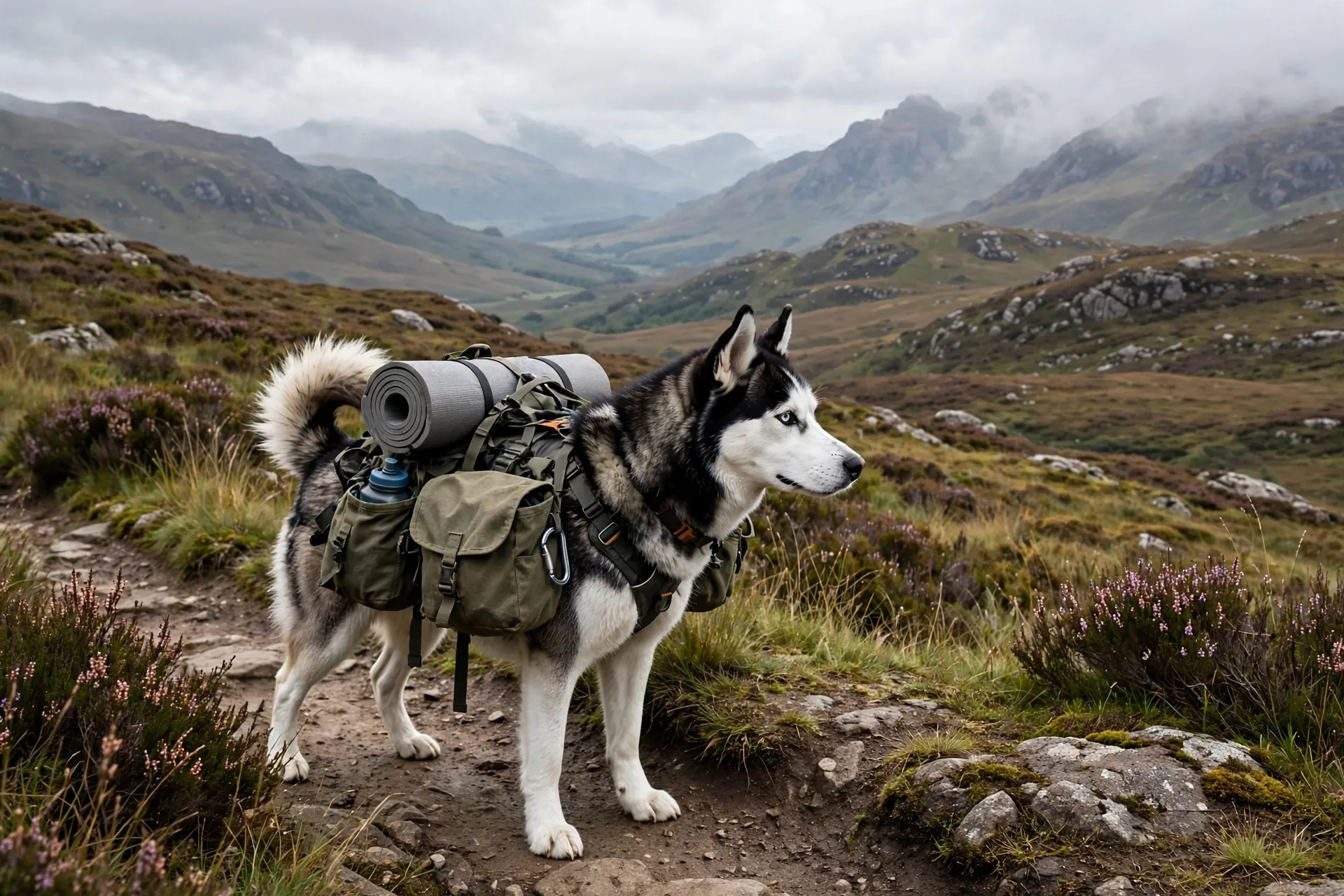
Think of the kit in three piles. On the dog: a harness that fits well and has a handle for the rocky steps, a collar with an ID tag, and a lead — plus a spare lead, because a broken clip miles from anywhere is a walk-ender. In the day pack: a collapsible bowl, water capacity of at least a litre for the dog, the day's food in a sealed bag, poo bags, a towel, a rain coat for wet or chilly days, paw balm, a compact first-aid kit with tick removers, and any medicine the dog takes daily. In the transferred bag: the rest of the food in portions marked by day, the dog's bed or blanket so every stop smells familiar, and a spare towel for the end of a wet day. Before you leave, save two numbers in your phone — a vet near the route, and your own vet at home — and take a copy of the vaccination record.
Portion the food before you leave home, one sealed bag per day with the date written on it, and the guessing stops for the whole week. The day's bag rides in the day pack; the rest travels in the transferred bag, so a lost bag costs you a day's food at most, not the week's. Take more poo bags than the arithmetic suggests — a week of walking uses more than a weekend ever does — and carry every used bag out with you. The Wall is a World Heritage Site as well as a working landscape, and a bagged parcel left beside the path is litter, however tidy it looks. A small dry bag inside the day pack keeps the dog's food and medicine dry when the rain comes in sideways, and it weighs almost nothing.
Allow for the sniffing. The dog will want to stop at every gatepost, every beck, every patch of grass that smells of sheep, and those pauses are the walk, not an interruption to it. Build them into the day, and seven days on the Wall feels spacious; fight them, and every mile feels twice as long. The frontier was made to be crossed slowly, and a dog is the best possible reason to do it that way.
Practical questions
Before you go
Can dogs walk the full Hadrian's Wall Path?
Yes — the full 84 miles from Bowness-on-Solway to Wallsend are open to dogs, but the lead is not optional through farmland, near livestock or around the Roman sites, and dogs stay out of the fort museums and visitor centres. Build the days around those lead stretches, and look up the latest access rules for each site before you set out.
How many days does Hadrian's Wall Path take with a dog?
Most walkers take six to seven days, walking about 12 to 15 miles a day. With a dog, seven days is the safer plan: it leaves time for rest stops, water breaks and the steep crags section in the middle, and it gives a tired dog a shorter day if the weather turns. Fit dogs that already walk long distances regularly can manage six days, but there is no prize for rushing.
Are dogs allowed at Housesteads, Vindolanda and Chesters?
Leashed dogs are welcome across the open remains at Housesteads, Chesters, Birdoswald and Segedunum, and at Vindolanda's outdoor site, but the museums, exhibitions, shops and cafes are dog-free, with assistance dogs the exception. Rules can shift for events or conservation work, so confirm them on the site's own pages, and if you walk as a pair, take turns inside while the other waits out with the dog.
Where does the dog drink on Hadrian's Wall Path?
Take water with you and top up at the overnight stop, in village pubs and at taps along the way. Becks cross the path, but they are not a safe plan after rain or near farmland. A folding bowl and a litre for the dog is a sensible minimum on the dry ridge stretches, and more again on hot days.
Is there a baggage transfer service for Hadrian's Wall Path?
Yes — local firms carry bags between the overnight stops for the whole route, usually charging per bag per day. Arrange it before you travel, agree the collection time and the drop-off address for each stop, and keep the dog's food, water, medicine and a lead in your day pack, not in the bag that travels separately.
When is the best time to walk Hadrian's Wall Path with a dog?
May, June and September usually suit dogs best: cooler air, long daylight and fewer midges than the height of summer. Winter brings short days and ice on the crags, while July and August mean heat, busy paths and livestock with young at foot. Pick the season that fits your dog, and check the current trail conditions before you set out.