This guide is independent and contains no paid placement. If affiliate links are added later, they will be clearly marked and will not change our editorial checks.
Haltwhistle is one of the most practical bases for the central section of Hadrian's Wall with a dog: a real town with a station, shops and places to stay, close to Walltown Crags, Greenhead and Birdoswald. Walk the National Trail in short sections, keep the dog on a lead through farmland and near livestock, and pair one longer crag day with a gentler South Tyne river day.
Why Haltwhistle works as a Wall base
Haltwhistle is a small market town in Northumberland, close to the border with Cumbria, and it sits just south of the central stretch of Hadrian's Wall. That position is the whole point of choosing it. Many Wall walks start from isolated car parks or single farmsteads, which is fine for one long day, but less forgiving when the weather turns, the dog is tired, or you need a vet, a shop or a warm room. Haltwhistle gives you those things without losing the feeling of being in Wall country. You can sleep in a town, walk to the station, buy food, dry a wet dog properly and still be on the crags within a short drive or a longer walk.
The town is often described as the centre of Britain, a claim that rests on its position roughly midway between the east and west coasts, and it is also a useful centre for this part of the Wall. To the east lie the high crags around Steel Rigg and Housesteads; to the west lie Birdoswald, Lanercost and Carlisle. Haltwhistle sits between them, so a stay of two or three nights lets you sample both directions without moving accommodation every day. For a dog, that stability matters. The same bed, the same morning routine and the same last walk each evening make a multi-day trip calmer than a tour that changes base every night.
Haltwhistle also suits dogs that are not ready for a full long-distance walk. The Hadrian's Wall National Trail runs for 84 miles from Wallsend in the east to Bowness-on-Solway in the west, and nobody needs to walk all of it to enjoy it. From Haltwhistle you can walk a short, satisfying section, turn back at a clear landmark, and still say you have walked the Wall. A two-hour out-and-back to a crag viewpoint is a real walk, not a compromise, and it leaves the dog with energy for the next day. Older dogs, puppies, reactive dogs and dogs that are still building fitness all benefit from that kind of honest, shorter day.
The town itself is compact and walkable, with a main street, a market place, churches, a railway station and the South Tyne running nearby. That mix gives you a useful rhythm: a big Wall morning, a quiet town afternoon, and a short river loop in the evening. If your dog is sociable, the town centre is a good place for gentle socialisation at a distance you control. If your dog is nervous around traffic, other dogs or crowds, the quieter lanes and river paths give you space to move away. Either way, you are not trapped on one exposed ridge with no alternative.
Before you book, think about what kind of trip this is. A fit, experienced walking dog and an owner who wants mileage will use Haltwhistle differently from a family with a young spaniel that needs sniffing time, toilet stops and frequent rests. Both trips work here, but they need different daily plans. Decide on the first evening whether the next day is a crag day, a river day or a rest day, and let the dog's recovery decide the day after that. The Wall has been there for nearly two thousand years; it will still be there tomorrow.
Hadrian's Wall National Trail: the basics
The Hadrian's Wall National Trail is a waymarked long-distance path that follows the line of the Roman frontier across northern England. It passes through fields, over crags, along country lanes and through small settlements, and it is maintained as a walking route rather than a single paved path. The surface changes constantly: grass, stone flags, gravel, mud, rocky steps and tarmac lanes all appear within a single day. For a dog, that variety is both the pleasure and the risk. Paws need checking after rocky sections, leads need shortening on narrow stretches, and water needs carrying on the exposed parts where there is no stream.
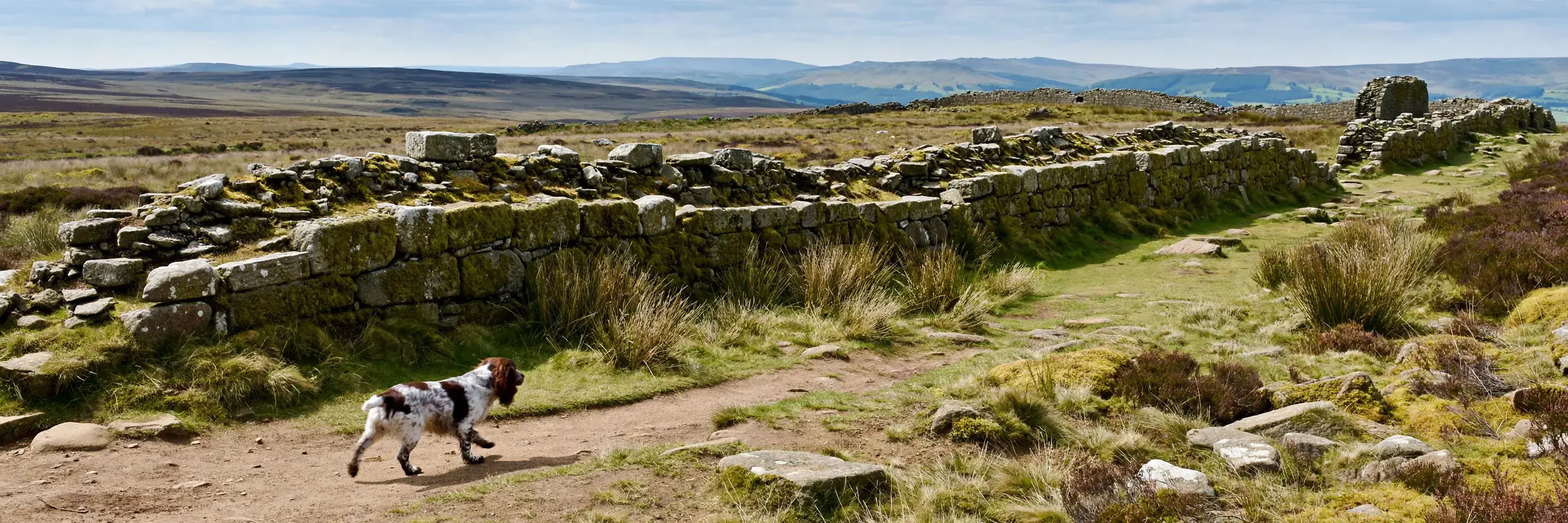
The central section around Haltwhistle is the most dramatic part of the Wall. Here the Roman builders used the natural line of the Whin Sill, a ridge of hard dolerite rock, so the Wall climbs and falls over a series of crags with wide views north into Northumberland and south across the Tyne valley. The walking is up and down rather than flat, with stone steps, stiles and gates. A dog that is comfortable on hills will love it. A dog with joint problems, a very small dog, or a dog that pulls hard on the lead will find the same ground tiring and, in wet weather, slippery. Plan the distance by time and effort, not by miles alone, and build in a turning point.
The trail is generally open all year, but conditions change with the seasons and with farming. Fields may hold sheep or cattle, paths may be closed or diverted for lambing or for conservation work, and some sections can be very muddy after rain. The official National Trail guidance, the Hadrian's Wall Path National Trail information and local signs on the ground are the sources to trust on the day. Check the official guidance before you travel, and check again at the car park or trailhead, because a sign at the start of a section is more current than any guide written weeks earlier.
Navigation is straightforward in good weather. The trail is waymarked with the familiar acorn symbol used on National Trails in England, and the Wall itself is often visible as a low stone line, a ditch, or a rebuilt stretch. In mist, rain or low cloud, however, the crags can feel confusing, especially where the path leaves the Wall line to follow a field edge. Carry a paper map or a downloaded offline map, keep the dog close, and do not rely on a phone signal that can disappear in dips and valleys. A simple rule helps: if you cannot see the next waymark, stop, look back, and retrace to the last one you passed.
Water, food and waste are your responsibility on the trail. There are no regular water points on the crags, and streams are not always safe or available, so carry water for the dog as well as for yourself, especially on warm or windy days when dogs lose moisture faster than their owners expect. Carry poo bags and take them with you; there are few bins on the open trail, so a small sealed bag holder and a spare bag are essential. Food for the dog should be portable and familiar: a small amount of the usual kibble or treats, offered at rest stops rather than in one large meal before a climb.
Finally, remember that the Wall is a scheduled ancient monument and a UNESCO World Heritage Site. That status is not just a label; it shapes how you should behave. Stay on the marked path, do not climb on the Wall itself, do not let the dog scramble over ruins or dig near them, and keep to field edges where the path is signed that way. The damage from one dog is small, but the damage from thousands of visitors is real, and the same care that protects the archaeology also keeps the dog safe from falls and loose stone.
Walltown Crags and Greenhead
Walltown Crags is the nearest dramatic Wall section to Haltwhistle, and for many visitors it is the highlight of the whole central stretch. The Wall here runs along a high ridge with steep drops to the north, long views across the moor, and a sense of space that is hard to find on the lower, flatter sections. The walking is exposed and undulating, with stone steps and rocky outcrops, and the wind can be strong even on a day that feels calm in the town below. For a dog, it is a walk of smells, wind and wide horizons, but it is also a walk that needs a lead, good footing and a plan for turning back.
The usual approach is from the Walltown area, east of Greenhead, where there is a car park and a visitor centre that serves as a useful starting point. From there, the trail climbs to the crags and follows the Wall line. The exact distance depends on how far you choose to go: a short out-and-back to the first high viewpoint is enough for many dogs, while fitter pairs can continue east towards the higher ground above the valley. Either way, treat the outward leg as the decision point. If the dog is pulling, panting hard, or hesitating on the steps, that is the moment to turn around, not an hour later when the wind has risen.
Greenhead itself is a small village west of Haltwhistle, close to the Wall and to the Roman fort site at Birdoswald. It is a quieter base for a single walk, with a village hall, a church and a handful of houses, and it gives access to the trail without the busier car parks further east. From Greenhead you can join the trail and walk east to Walltown or west towards Birdoswald, depending on the day. The lanes around the village are narrow, so keep the dog on a short lead on the road sections, use verges where they exist, and step aside for farm traffic. Farmers use these lanes daily, and a dog off lead on a blind bend is a risk to everyone.
On the crags, the practical rules are simple and worth repeating. Keep the dog on a lead. Stay on the path. Do not let the dog run along the edge of a drop, however confident it seems. Check paws at each rest stop, because the dolerite rock is hard and can be sharp, and look for cuts, soreness or a dog that starts to favour one foot. Offer water little and often rather than waiting until the dog is thirsty, and use a windproof layer for a short-coated dog if the wind is cold. A dog that is shivering on a crag is not enjoying the view, however good the photograph looks.
Walltown is also a good place to learn the rhythm of Wall walking. The trail here is not a race, and the best walks are the ones with pauses: a stop at a high point to look north, a quiet five minutes in a sheltered dip, a slow descent with the dog on a loose lead. If you are staying in Haltwhistle for several days, consider doing Walltown as your first Wall day, when everyone is fresh, and saving the longer eastern sections for later in the trip. That way, if the dog finds the crags hard, you still have river and town days to fall back on.
One more practical note: the Walltown area can be busy on sunny weekends and school holidays, especially at the car park and the first viewpoint. If your dog is reactive or nervous around other dogs, arrive early, choose a weekday if you can, and be ready to step off the path onto a wider section to let others pass. A short lead, a calm voice and a treat in the pocket are more useful than any amount of planning, and a quiet early start often gives you the crags almost to yourself.
Towards Birdoswald Roman Fort
Birdoswald Roman Fort sits west of Haltwhistle, near the village of Gilsland, and it is one of the best-preserved forts on the Wall. The fort itself is managed as a visitor site, with an exhibition, a cafe and a shop, and the surrounding landscape includes long stretches of Wall, a Roman bridge abutment and the River Irthing. For a dog owner, Birdoswald is a two-part destination: the fort and its immediate grounds, where rules are stricter, and the trail and countryside around it, where a well-managed dog can walk for hours.
The walk from Greenhead or from the Birdoswald car park towards the fort follows the National Trail and passes through farmland and open ground. The ground is gentler than the Walltown crags in places, but it is still uneven, with gates, stiles and field crossings. Sheep are common, and cattle may be present in some fields, so the lead stays on and the dog stays close. The views west towards the Irthing valley are wide and quiet, and the walking feels more remote than the busier eastern sections. That quiet is part of the appeal, but it also means you should be self-sufficient: carry water, a phone, a map and a first-aid kit, and tell someone your planned route if you are walking alone.
At the fort itself, check the official guidance before you travel and read the signs at the entrance. Historic sites managed by heritage organisations often allow dogs on leads in the grounds but not inside buildings, exhibitions or cafes, and assistance dogs are treated separately. Do not assume that because a dog can walk the trail past the fort, it can also enter every part of the site. Plan for one person to stay with the dog outside if needed, or time the visit for a moment when you can take turns. The same approach applies to other Wall sites: the trail is open, the buildings are not always, and a short check beforehand saves a frustrating arrival.
The area around Birdoswald also rewards a slower pace. The River Irthing below the fort is a good place to understand why the Romans chose this line: the river, the valley and the high ground all work together. For a dog, the riverside is a place for a careful paddle on a safe bank, not a swim in fast water. Keep the dog on a lead near the river, watch for steep banks and slippery stones, and do not let the dog drink from water that looks stagnant or polluted. After rain, the Irthing can rise quickly, so treat any riverside path with respect and turn back if the ground is waterlogged.
If you are walking between Haltwhistle and Birdoswald over several days, consider using the train or a bus for one leg and walking the other. The Tyne Valley line serves Haltwhistle and nearby stations, and a linear walk with public transport at one end is often easier on the dog than an out-and-back of the same length. Check the official guidance before you travel for current timetables, dog rules and station facilities, and remember that rural stations may have no staff, no shelter and no toilet. A linear walk sounds elegant on paper, but it needs a reliable return journey, so build in a generous margin.
Birdoswald is also a reminder that the Wall is not just a wall. It is a system of forts, milecastles, turrets, ditches and roads, and the landscape around it is still a working landscape of farms, woods and rivers. A dog walking here is walking through that system, not just along a single monument. Keep the dog on the path, close gates, leave no trace, and the next walker will find the same quiet, open ground you did.
Lead, livestock and ruin rules
The lead rules on the Wall are not complicated, but they are easy to get wrong if you treat the trail like a park. The National Trail crosses private farmland, and the farmer's livestock has priority. Sheep, cattle and horses are not scenery; they are animals that can be frightened, injured or killed by a loose dog, and a dog that chases livestock can be shot under UK law in certain circumstances. That is a stark fact, but it is the reason the rule exists, and it is why every responsible walker keeps the dog on a lead through farmland, even when the field looks empty.
The practical standard to use is this: on a lead unless you are certain the ground is safe, the dog is under perfect recall, and no livestock, wildlife or other walkers are nearby. In Wall country, that combination is rare. The crags are narrow, the fields are grazed, ground-nesting birds are present in spring and summer, and other walkers appear around every bend. A long line gives the dog more freedom to sniff while keeping control, but it is not a substitute for a short lead on a narrow path, near a road, or in a field with animals. Use the long line on open, safe ground, and the short lead everywhere else.
At ruins and archaeological sites, the rule is even clearer: keep the dog on a lead, keep the dog off the Wall, and keep the dog on the path. The Wall is fragile in places, with loose stone, crumbling mortar and steep drops. A dog scrambling over a ruin can dislodge stone, injure itself, or fall. Children also climb, and a dog that joins them adds a risk nobody needs. If your dog is the sort that jumps, digs or chases, the lead should be short and your attention should be on the dog, not on the camera.
Livestock deserve a specific plan. If you enter a field with sheep, keep the dog on a short lead, walk calmly along the edge, and do not stop to let the dog stare. If cattle approach, keep the dog close, walk steadily away, and do not run. If the dog is off lead and cattle become aggressive, the official advice is to let the dog go so it can escape and you can get to safety, but that situation should never arise if the lead is on. Check the official guidance before you travel for current advice on walking with dogs near livestock, and follow any signs in the field, even if they seem cautious.
Ground-nesting birds are another reason for control in spring and early summer. Skylarks, curlews and lapwings nest on the moor and in the fields around the Wall, and a dog running free can destroy a nest in seconds without the owner noticing. The Countryside Code asks dog owners to keep dogs on a lead or under close control during the breeding season, and to stick to paths. That is not a minor detail; it is a central part of walking responsibly in this landscape. If you see a bird displaying, calling loudly or feigning injury, move on quietly and keep the dog close.
Waste is part of the same code. Pick up after your dog everywhere, including on the open moor, and carry the bag until you find a bin. Do not leave bags on walls, fences or trees, and do not assume that a bag will be collected later. In farmland, dog waste can spread disease to livestock, so the rule is not just about tidiness. A small, sealable bag holder, a spare roll of bags and a habit of checking the ground behind you are all you need.
Town centre and short local walks
Haltwhistle town centre is small enough to explore on foot with a dog in an hour, and it works well as a low-effort day between longer Wall walks. The main street runs through the town, with shops, cafes, pubs and a market place, and the side streets are quieter and more residential. Start with a slow loop that lets the dog sniff, toilet and settle, rather than a forced march through the busiest part of town. A dog that has had a proper sniffing walk is calmer for the rest of the day than a dog that has been hurried from shop to shop.
The town's churches and historic buildings are worth a look from the outside, and the market place is a useful landmark for meeting and for orienting yourself. Keep the dog on a short lead in the town centre, watch for traffic on the main road, and be ready to cross to the quieter side if the pavement is narrow. If your dog is reactive to other dogs, the town centre at a busy time can be stressful, so choose a quieter hour, use side streets, and keep a distance that lets the dog succeed. A short, calm town walk is better than a long, tense one.
For eating and drinking with a dog, the general pattern in a town like Haltwhistle is that some pubs and cafes welcome dogs in certain areas, often on the ground floor or in a bar area, while others do not. Policies change, and they can depend on the time of day, the season and the specific room, so check the official guidance before you travel and ask at the door rather than assuming. A dog that can settle under a table is a pleasure to take out; a dog that barks, pulls or begs is not, so practice the settle at home and bring a mat or blanket that smells familiar. Always ask before you enter, keep the dog on a lead, and leave promptly if the dog is unhappy.
Short local walks from the town give you options when the Wall feels too much. The lanes south of the town, the paths towards the South Tyne, and the quieter roads around the edge of Haltwhistle all offer twenty to forty minutes of walking without a car. These are not dramatic walks, and that is the point: they are the walks you do when the dog needs movement but not a climb, when the weather is poor, or when you have just arrived and want to stretch legs before dinner. A short loop that you repeat each morning also helps the dog learn the area and settle faster.
Shopping for dog supplies in Haltwhistle is practical rather than specialised. The town has food shops and general stores where you can buy the basics, but if your dog needs a specific food, medication or equipment, bring it with you or buy it in a larger town before you arrive. Do not rely on finding a specialist pet shop in a small market town. Pack spare food, any medication, a familiar lead and harness, and a spare towel, because a wet dog in a small town is a problem only if you have nothing to dry it with.
Evening walks in the town are a good test of how the trip is going. If the dog is still keen, alert and comfortable on the lead, the plan is working. If the dog is stiff, reluctant or unusually tired, shorten the next day. The town centre is also where you will notice the small things that matter: whether the dog is drinking enough, whether the paws are sore, whether the coat is drying properly. A calm evening loop, a drink of water and a familiar bed are the best recovery plan there is.
Arriving by train and by car
Haltwhistle station is on the Tyne Valley line, which runs between Newcastle in the east and Carlisle in the west, with stops at Hexham, Corbridge, Haydon Bridge, Bardon Mill and other small stations. For a dog owner without a car, this is a genuine advantage. You can arrive by train, walk into the town, and reach the Wall by a combination of walking, local bus and taxi. Check the official guidance before you travel for current timetables and dog rules, and check the operator's conditions, because rural services can be infrequent and connections matter.
Dogs can normally travel on trains in the UK, and in most cases they travel free and do not need a ticket, but they must be kept on a lead or in a carrier, under control, and off seats. That sounds simple, but a train journey with a dog needs preparation. Arrive at the station early, let the dog toilet before you board, bring water and a familiar blanket, and choose a seat where the dog can lie down without blocking the aisle. If the dog is nervous about trains, practice shorter journeys first, and consider a quieter service rather than a busy commuter train. A dog that is calm on a train is a dog that can enjoy a car-free break.
The walk from Haltwhistle station into the town centre is short, but it crosses roads and passes through a built-up area, so keep the dog on a short lead and allow time for a toilet stop. The station itself is a small, unstaffed or part-staffed station in the usual pattern for this line, so do not expect a ticket office, a waiting room or a shop to be open at all hours. Check the official guidance before you travel for current facilities, and have a plan for a late arrival: a taxi number, a place to stay that is easy to find in the dark, and a torch for the walk from the station.
Arriving by car gives you more flexibility, especially for the Wall car parks at Walltown, Greenhead and Birdoswald, but it also needs a plan. The A69 runs south of Haltwhistle and is the main east-west road, while the town itself is reached by local roads. Driving in this area is straightforward, but the lanes to the Wall are narrow, with passing places, farm traffic and walkers. Drive slowly, give walkers and dogs plenty of room, and do not park on verges or in gateways. A car is a tool for reaching the walk, not a place to leave a dog unattended, and dogs should never be left alone in a car in warm weather.
Parking is covered in more detail below, but the principle for arrival is to choose one base and use it well. If you are staying in Haltwhistle, you may not need the car every day. Walk to the river, walk around the town, and save the car for the crag days. That reduces driving, reduces the dog's time in the car, and gives the trip a calmer rhythm. If you are staying outside the town, check the parking and access for that specific place before you book, because a beautiful cottage at the end of a rough track is a different proposition in rain than in sunshine.
For visitors who want to explore further, our Northumberland with a Dog guide covers the wider county, including castle rules, Bamburgh beaches, Holy Island tide safety and quiet dark-sky stays, and it helps to put Haltwhistle in context. Haltwhistle is a base, not the whole county, and the best trips combine a focused Wall stay here with a coastal day or a quieter inland walk elsewhere in Northumberland.
South Tyne river valley walks
The South Tyne flows through the valley south of Haltwhistle, and its riverside paths offer a completely different kind of walk from the crags. Here the ground is lower, greener and more sheltered, with trees, meadows and quiet lanes. The river is a working river, with weirs, bridges and farmland along its banks, but it also has the calm, flat stretches that older dogs, young dogs and tired walkers need after a day on the Wall. A river day is not a lesser day; it is a recovery day that keeps the trip sustainable.
The walking around the South Tyne is best approached as a series of short, flexible loops rather than a single long-distance route. Start from the town, follow a lane or a signed path down towards the river, walk along the bank for a while, and return by a different lane or the same path. The exact route depends on the field conditions, the river level and the path signs on the day, so carry a map and be ready to turn back. After rain, riverside paths can be muddy, waterlogged or slippery, and a path that was easy in summer can be hard in winter. Check the official guidance before you travel and read local signs.
For dogs, the river offers sniffing, paddling and a change of surface. Many dogs love to paddle in shallow water, and a gentle bank with a slow current is a good place for that. The risks are also real: fast water after rain, steep or undercut banks, weirs, and water that may carry farm run-off or algae in warm weather. Never let a dog swim in fast water, near a weir, or in water you would not want to wade in yourself. Keep the dog on a lead near the river until you have checked the bank, and keep the dog in sight at all times. A dog that disappears around a bend in a river is a dog you cannot help.
Wildlife is part of the river valley, and it deserves the same care as livestock on the Wall. Ducks, swans, herons and other water birds nest and feed along the river, and a dog that chases them can cause real harm. Keep the dog on a lead near nesting birds, do not let the dog enter reed beds, and move on quietly if birds are alarmed. The same applies to other animals you may meet: horses on riverside bridleways, cattle in riverside fields, and other dogs on narrow paths. A short lead, a calm pace and a willingness to step aside make the river a pleasure for everyone.
The South Tyne also connects Haltwhistle to a wider network of walks. To the east, the river flows towards Haydon Bridge and Hexham; to the west, it flows towards Alston and the Pennines. You do not need to walk far to feel that connection. A short riverside walk in the morning, a town lunch, and a second short walk in the evening can be a full and satisfying day. If you are planning a longer trip, our 3 day Lake District itinerary with a dog shows how to balance walk days, rest days and swim stops, and the same balance works well in the Tyne valley, even though the landscape is different.
After a river walk, the practical routine matters. Rinse mud and grit from paws, check between the toes for small stones or cuts, dry the dog thoroughly, and check the ears if the dog has been in water. A dog that has paddled in a river and then lies on a cold floor can chill quickly, so a dry bed, a drying coat and a warm room are part of the walk, not an afterthought. That routine is also a good moment to check the dog's overall condition: appetite, energy, stiffness and mood are all easier to read when you are towelling a dog down than when you are walking.
Winter, wind and bad-weather backups
Winter in Haltwhistle and on the Wall is beautiful and serious in equal measure. The light is low, the moor is quiet, the Wall stands out against frost or snow, and the town feels calm. It is also cold, windy and dark early, with short days, icy paths, mud and a wind on the crags that can be far stronger than the forecast for the town suggests. A winter trip can be wonderful with a dog, but only if you plan for the weather you might get, not the weather you hope for.
Wind is the most underestimated factor. On the crags, the wind is unobstructed, and a wind that feels like a breeze in Haltwhistle can be a strong, cold wind on Walltown. Short-coated dogs, small dogs, older dogs and dogs that have been clipped can chill quickly, and a dog that is wet as well as cold is at risk of hypothermia. A windproof and waterproof coat, a warm layer for rests, and a plan to get off the ridge quickly are essential. If the forecast mentions strong winds, gusts or a wind chill that is well below freezing, choose a sheltered river walk instead of a crag walk. The Wall will still be there on a calmer day.
Daylight is the second factor. In midwinter, daylight in Northumberland is short, and the light fades early in the afternoon. A walk that takes three hours in summer can feel much longer in winter, especially if the path is muddy or icy. Start early, carry a torch and a head torch, wear or carry high-visibility clothing, and plan to be back in the town well before dark. A dog on a lead in the dark on a narrow country lane is vulnerable, and a torch is not a substitute for daylight. If you are unsure, shorten the walk.
Ice, snow and mud change the ground. Rocky steps on the crags can be icy, grassy slopes can be slippery, and mud can hide holes and loose stones. A dog that slips can injure a leg, and a owner who slips while holding a lead can injure both of them. Wear boots with good grip, use walking poles if they help, and keep the dog on a short lead on any slope. If the ground is frozen hard, check the dog's paws for ice balls between the toes, and consider a paw balm or booties if the dog tolerates them. After snow, the Wall and the path can be hard to distinguish, so navigation needs extra care.
Bad-weather backups are not a sign of failure; they are part of a good trip. In Haltwhistle, a bad-weather day can be a short town walk, a riverside loop in the valley where the wind is lower, a visit to a dog-friendly cafe or pub, a quiet afternoon in the accommodation with a chew and a rest, and a short evening loop when the rain eases. If you are staying for several days, keep one day completely flexible, so a storm does not ruin the plan. The dog will not mind a rest day, and a rested dog walks better the next day than a tired, cold dog.
For longer trips that cross different landscapes, our comparison in Lake District vs Peak District with a dog is useful, because it shows how terrain, weather, lead rules and swimming water change from one national park to another. The same thinking applies here: the Wall in winter is a different place from the Wall in summer, and the plan should change with it. Check the forecast on the morning of the walk, check the official guidance before you travel, and be ready to change the route.
Parking, vets and practical planning
Parking around Haltwhistle and the Wall is straightforward if you plan it, and frustrating if you do not. The town has car parks and on-street parking, and the Wall sites have their own car parks, but the popular ones fill up on sunny weekends and school holidays. Arrive early, have a second car park in mind, and do not park on verges, in gateways or on narrow lanes where you would block farm access. A car parked badly can cause a real problem for a farmer, an emergency vehicle or another walker, and it can also put your own car at risk.
At Walltown, Greenhead and Birdoswald, read the signs at the car park for charges, time limits and any dog rules. Some car parks are free, some charge, and some are managed by heritage or conservation organisations. Keep the dog on a lead in the car park, because cars, other dogs and children all meet in a small space, and a dog that runs across a car park is in danger. Let the dog toilet on a grassy edge before you start the walk, pick up the waste, and start the walk calmly rather than letting the dog pull away from the car in excitement.
Veterinary care is a practical point to settle before you need it. Haltwhistle and the surrounding area have veterinary practices, and larger towns such as Hexham and Carlisle have more options, including out-of-hours services. Before you travel, save the number and address of the nearest vet to your accommodation, and note the out-of-hours number as well. If your dog has a medical condition, bring the medication, a copy of the prescription or the vet's notes, and enough food for the whole trip plus a spare day. A dog that needs a special diet should not have to change food because you ran out.
Packing for a Haltwhistle trip is about layers, water and drying. For the dog, pack the usual lead and harness, a spare lead, a long line if you use one, poo bags, water and a collapsible bowl, food and treats, a towel and a drying coat, a familiar bed or blanket, any medication, and a basic first-aid kit with tick remover, antiseptic wipes and bandages. For yourself, pack waterproofs, warm layers, a hat and gloves in winter, sturdy boots, a map and a charged phone. A small rucksack that holds the dog's water and your waterproofs is better than a large bag that stays in the car.
Ticks are a real consideration in this landscape, especially in grass, bracken and woodland from spring to autumn. Check the dog for ticks after every walk, paying attention to the ears, neck, belly and between the toes, and remove any tick promptly with a tick remover. Check the official guidance before you travel for current advice on tick prevention, and ask your own vet before the trip if your dog needs a preventive treatment. The same check applies to you: long trousers, closed shoes and a check after a walk are simple precautions.
Finally, think about the trip as a whole. A good Haltwhistle stay with a dog is not measured in miles or in photographs, but in whether the dog is still keen on the last morning, whether the paws are sound, whether the dog has eaten and slept well, and whether you would do the same trip again. Keep a simple note of what worked: the car park that was quiet, the river loop that suited the dog, the cafe that welcomed you, the day that was too long. That note is the most useful souvenir you will bring home, because it makes the next Wall trip better than this one.
Practical questions
Before you go
Can dogs walk on the Hadrian's Wall National Trail near Haltwhistle?
Yes, dogs are welcome on the Hadrian's Wall National Trail, including the sections around Haltwhistle, Walltown Crags and Greenhead, but they must be kept under close control and on a lead through farmland, near livestock and at busy sites. Keep to the marked trail, close gates, pick up waste, and check the official guidance before you travel for any local restrictions.
Do dogs have to stay on a lead at Hadrian's Wall sites?
In practice, yes for most of the places that matter. Dogs should be on a lead near livestock, on narrow wall-top paths, around ruins, at car parks and visitor sites, and wherever other walkers, children or grazing animals are close. A short lead gives you control on uneven ground and keeps the dog off fragile archaeology. Check the official guidance before you travel, because rules can vary by site and season.
Can I take a dog to Haltwhistle by train?
Yes. Haltwhistle station is on the Tyne Valley line between Newcastle and Carlisle, and dogs can normally travel on trains in the UK without a ticket, subject to the operator's conditions. Keep the dog on a lead, under control and off seats, and check the official guidance before you travel. The walk from the station into the town centre is short, but allow time for a calm toilet stop first.
Where can my dog paddle or swim near Haltwhistle?
The South Tyne around Haltwhistle offers shallow edges and quiet stretches where many dogs paddle, but river levels, currents and water quality change after rain. Never let a dog swim after heavy rain, near weirs or fast water, and always check the official guidance before you travel. Choose a gentle bank, keep the dog in sight, and rinse off mud and grit afterwards.
When is the best time to visit Haltwhistle with a dog?
Late spring, early summer and early autumn usually give the best balance: longer daylight, firmer paths and fewer midges than high summer on low ground. Winter can be beautiful and very quiet, but expect short days, strong wind on the crags, mud and ice, so plan shorter routes and a warm indoor backup. Check the official guidance before you travel and check the forecast on the morning of the walk.
Is Haltwhistle a good base for a longer Hadrian's Wall trip with a dog?
Yes, for walkers who want a small town rather than a single remote car park. Haltwhistle has a railway station, shops, places to eat and accommodation, and it sits close to the central Wall country around Walltown, Greenhead and Birdoswald. Plan one longer Wall day and one shorter river or town day, keep daily distances realistic for the dog, and book dog-friendly stays well ahead in school holidays.