We put this guide together ourselves and no business mentioned in it paid for a mention. If we ever add affiliate links, we will label them plainly, and they will not change what we recommend about Chatelherault, the Clyde Valley or anywhere else in Hamilton.
Start at Chatelherault Country Park: its woodland trails, the Avon Water gorge and the white hunting lodge give you a full morning without leaving Hamilton. Then walk the Clyde Valley or Strathclyde Loch, eat in the town centre, and use the train from Glasgow Central if you are not driving.
Chatelherault: the park that carries the day
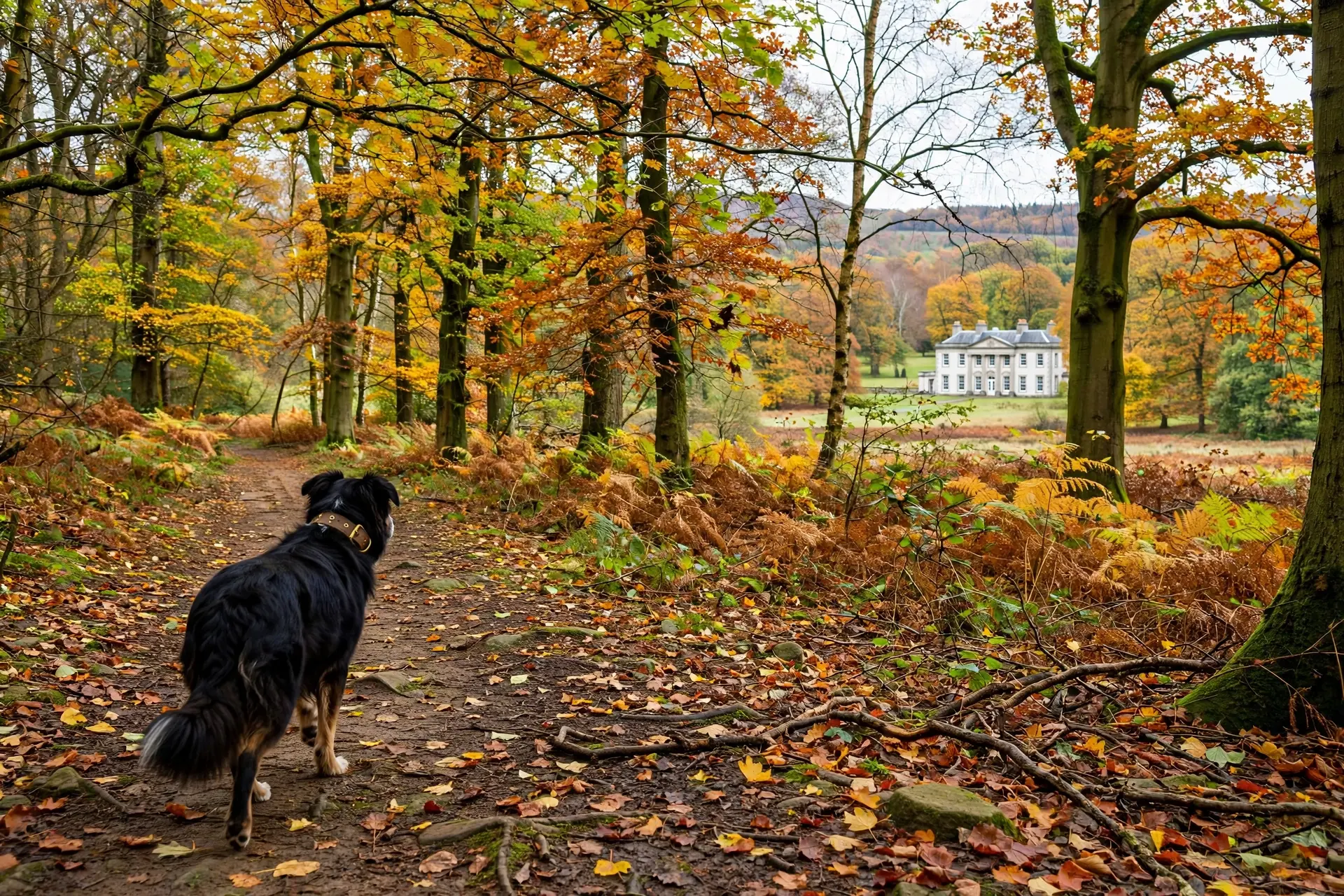
Chatelherault Country Park is the reason Hamilton works as a dog trip at all. The park covers around 500 acres of woodland and parkland on the south-west edge of town, built around the white hunting lodge of the Dukes of Hamilton. The lodge itself, designed by the architect William Adam in the 1730s, sits high above the Avon Water and looks its best from the woodland paths below, where the white stone shows through the trees. Dogs cannot go inside the lodge, which now holds a visitor centre, but the grounds are the point, and they are generous.
The park's walking falls into three kinds of ground, and choosing between them is the main planning decision. The high, dry paths through the mature woodland around the lodge suit almost every dog in almost every season: broad, well-surfaced trails under beech and oak, with plenty of sniffing at the edges and benches where you can sit while a tired dog rests. The lower paths drop into the gorge of the Avon Water, where the river cuts a steep wooded valley and the air turns cool even in summer. These are the prettiest walks in the park and also the ones that need a lead: the drops to the water are real, the paths narrow in places, and a dog that chases squirrels will find plenty of temptation. The third kind of ground is the open parkland and the Cadzow Forest, the remnant of ancient oak woodland to the south, where the ruined Cadzow Castle stands above the river. This is wilder, rougher and quieter, and it suits confident walkers with dogs that are steady off lead and reliable on recall.
Arrive with a plan for parking, because the park has more than one entrance and they lead to very different walks. The main car park by the visitor centre puts you straight onto the high woodland trails and the lodge terrace, which is the easiest start for a first visit and for older dogs. The car park at the Duke's Bridge end, reached from the Ferniegair side, puts you closer to the gorge and the river, but the climb back up is steep and the ground underfoot can be slick after rain. If you arrive by train, Chatelherault station sits right by the park's southern edge, and the walk in from the station is one of the most pleasant arrivals in the whole of South Lanarkshire: a short woodland path that drops you into the park without a car park in sight. Check the official guidance before you travel if you are relying on the station, because services on this line are less frequent than the main Hamilton stations.
Lead rules in the park are a matter of reading the ground rather than memorising a single rule. On the broad woodland rides, most regulars walk dogs off lead once they are clear of the car parks and the visitor centre. Near the lodge, the play area and the car parks, keep the lead on. Along the Avon Water, keep the lead on, because the gorge sides are steep and a dog that slips on wet leaves can end up in the river. Cadzow Forest has grazing in places and wildlife throughout, so if your dog is a chaser, the lead stays on there too. There are no dog bins on every path, so carry bags and take them to the bins by the car parks. The park is also a working landscape in places, with forestry work and events, so check the notice boards at the entrance you use before letting a dog run.
Season changes the park more than most visitors expect. Spring brings bluebells in the woodland and the first dry days on the high paths, while the gorge stays damp and the river runs high. Summer is the season for the open parkland and long evening walks, but the woodland holds midges on still, humid days, so pack repellent and choose the breezier ridge paths. Autumn is Chatelherault at its best: the beech and oak colour turns the whole park gold and copper, the ground firms up after the first frosts, and the lodge looks striking against the trees. Winter is quiet and beautiful, but the gorge paths ice over and the light goes early, so plan a shorter loop and finish before dark. Whatever the season, the park rewards a slow first visit: walk the high trails, look down into the gorge, and save the longer Cadzow Forest loop for a second trip when you know the ground.
The Clyde Valley walks from Hamilton
The River Clyde runs along the northern edge of Hamilton, and the valley it has carved is the town's second great walking asset after Chatelherault. The Clyde Walkway, the long-distance route that follows the river from Glasgow to New Lanark, passes close to Hamilton, and the stretches around the town give you a flat, riverside walk that is very different in character from the wooded gorge of the Avon Water. This is open sky, wide water, farmland and the long view across the valley, and it suits dogs that like to move steadily for an hour rather than stop and sniff every ten metres.
A practical starting point is the riverbank at the north end of town, reached from the roads around Hamilton West and the Clyde itself. From there, the path follows the river in both directions, and the choice is between a short out-and-back and a longer linear walk with a train or bus back. West towards Bothwell and Blantyre, the path runs through riverside woodland and meadow, with views across to Bothwell Castle on the far bank. East towards Motherwell and the approaches to Strathclyde Country Park, the path is more open and the walking is easier underfoot. Neither direction is a wilderness: this is a lived-in valley with houses, roads and other walkers, so keep your dog under control at the road crossings and near the farm tracks that join the path.
The river itself sets the rules. After heavy rain, the Clyde rises fast and the low meadow paths can flood or turn to deep mud, while the bank itself can be slippery and undercut. Do not let your dog swim in the Clyde. The current is stronger than it looks from the bank, the water is deep in the middle, and there are stretches where a dog that goes in would struggle to climb out. If your dog is a swimmer, the shallow edges on a calm, dry day are the only safe option, and a long line is the sensible compromise. The same caution applies to the Avon Water where it meets the Clyde: the confluence is a lovely spot to stand and look, but the water there is fast and the banks are steep.
For a longer day, the valley opens up into one of the best dog-walking corridors in central Scotland. Following the Clyde Walkway downstream towards New Lanark takes you to the Falls of Clyde, where the river drops over a series of waterfalls in a wooded gorge that is a nature reserve. This is a full day out rather than a Hamilton town walk, and it needs a car or a train to Lanark and a bus or walk from there, but it is the natural extension of a Hamilton stay. Check the official guidance before you travel, because the gorge paths at the Falls of Clyde are steep, can close after storms, and are not suitable for dogs that are unsteady on their feet. The orchards and market gardens of the Clyde Valley, around places like Kirkfieldbank and Crossford, add another flavour: quiet lanes, soft fruit in season and a rural calm that feels a long way from the M74, even though the motorway is only a few miles away.
Think about the walk in terms of your dog's day, not just the distance on the map. A flat riverside hour is a good warm-up for a young dog and a full outing for an older one. A valley walk that combines the Clyde bank with a climb back through woodland gives a fitter dog a proper workout, but it also means muddy paws, wet coats and a car that needs a towel in the boot. The Clyde Valley is at its best in late spring and early autumn, when the paths are dry, the hedgerows are full and the light is low over the water. In midwinter, the short days and the soft ground make the high paths of Chatelherault the better choice, and the valley is best saved for a bright, cold morning when the frost has firmed the ground.
Hamilton town centre: streets, parks and quiet corners
Hamilton town centre is compact, flat and easy to walk with a dog, which is more than can be said for many Scottish towns of its size. The main shopping streets — Quarry Street, Cadzow Street and the pedestrianised sections around the town centre — form a small grid that you can cross in ten minutes, and the pavements are wide enough for a dog on a short lead without constant weaving around other pedestrians. The centre is not a tourist honeypot, and that is part of its charm for dog owners: there are no crowds to manage, no queues to stand in with a restless dog, and plenty of space to move at your dog's pace.
Start at the top of the town, around the Town House on Cadzow Street and the square beside it, and work downhill towards the river. The Town House is a handsome civic building, and the square in front of it is a good place to let a dog settle and watch the town go by. From there, Quarry Street runs through the heart of the shopping area, with the covered centre and the high street shops on either side. Dogs are not allowed inside most shops, so plan the centre as a walking and window-shopping exercise rather than a browsing trip: one person can pop into a shop while the other waits outside with the dog, and the flat streets make that easy. Keep the lead short on Quarry Street at busy times, especially on market days, when the pavements fill up and a long lead becomes a trip hazard.
The town's green spaces are the real reward of a centre walk. Hamilton's parks are scattered through the residential streets rather than concentrated in one place, so a loop that takes in two or three of them gives a dog a proper outing without ever leaving the town. The grounds around the Hamilton Mausoleum, at the south end of the Low Parks, are the most distinctive: the mausoleum itself is a great stone building with one of the longest echoes of any building in the world, and the parkland around it is open, level and quiet. Dogs are welcome on a lead in the grounds, but they cannot go inside the mausoleum, so treat it as a split visit if you want to see the interior. Low Parks Museum, in the same area, tells the story of the town and the Hamilton family, and the same split-visit rule applies: the museum is indoors and dogs stay outside, but the surrounding parkland is a pleasant place to wait.
For a quieter corner, head for the streets around Hamilton West and the older houses near the station, where the roads are wider, the traffic is lighter and the pavements are lined with trees. The area around the racecourse, Hamilton Park, is another useful landmark: on non-race days the roads around it are quiet and the open ground gives a dog room to walk, but check the official guidance before you travel on a race day, because the crowds, the traffic and the noise make it a poor choice for a nervous dog. The same is true of the town centre on a Saturday afternoon, when the shops are at their busiest: a weekday morning or a Sunday is a calmer time to walk the centre with a dog that is easily overwhelmed.
Practical details matter in a town centre walk. There are public toilets in the centre, but they are not dog-friendly, so plan your route around the dog's needs rather than your own. Water is easy: most cafes will fill a bottle, and a collapsible bowl in your pocket is worth carrying on any town walk. Parking is straightforward, with car parks off Quarry Street and Cadzow Street and on-street parking on the roads around the centre, but the car parks fill up on Saturdays, so arrive early or use the train. If you are staying in the town, the centre is walkable from most of the nearby accommodation, which means you can leave the car parked and do the whole town on foot — a small thing that makes a dog trip feel much more relaxed.
Strathclyde Country Park and the loch
Strathclyde Country Park sits a short drive north-east of Hamilton, between Hamilton and Motherwell, and it is the closest thing the town has to a big open-water walk. The park is built around Strathclyde Loch, a large artificial lake that hosts rowing, sailing and watersports, and the paths around it make a flat, easy circuit of a few miles that suits almost every dog. The loch is the centrepiece, but the park is much more than the water: there are woodland trails, open grass, play areas and the M74 running along one edge, so the park has a busy, public feel that is very different from the quiet of Chatelherault.
The loch circuit is the obvious walk, and it is best done as a full loop rather than an out-and-back. The path is surfaced for most of its length, so it stays usable after rain, and the views across the water to the far shore change with the light. Keep your dog on a lead for the sections nearest the watersports centre and the car parks, where boats, trailers and people cross the path, and be ready for the wind: the loch is exposed, and a cold wind off the water can chill a small or short-coated dog quickly, even on a day that feels mild in Hamilton town centre. There are cafes and a visitor centre at the park, but check the current opening times and dog policy before you rely on them, because seasonal hours change and indoor access for dogs is limited.
The most important rule at Strathclyde is about the water. The loch is a managed watersports venue, not a swimming lake, and dogs should not swim in it. There are boats, there are deep sections, and the water quality is managed for rowing and sailing rather than for dogs. This is a walk-with-a-view, not a swim stop, and if your dog is a keen swimmer, this is the park where you admire the water from the bank and save the swimming for a beach day elsewhere. Our guide to dog-friendly beaches and their rules covers the seasonal restrictions that matter when you plan that kind of trip. If your dog does go in, rinse them off and watch for any signs of discomfort afterwards, and check the official guidance before you travel if there are any water-quality notices posted at the park.
Beyond the loch, the park's woodland trails are worth the extra time. The paths through the trees on the higher ground above the loch are quieter than the circuit and give a dog a proper sniffing walk, with the sound of the motorway fading as you climb. The park also has large areas of open grass that suit a game of fetch or a training session, but keep an eye out for other dogs and for the events that the park hosts through the summer, when the open ground fills up and the quiet corners disappear. Parking at Strathclyde is plentiful, with several car parks around the loch, but they fill up on sunny weekends and on event days, so arrive early or come on a weekday if you want a calm start.
Strathclyde works best as the second walk of a Hamilton day, after a morning in Chatelherault. The contrast is the point: the wooded gorge and the hunting lodge in the morning, the open water and the big sky in the afternoon. It also works as a rainy-day fallback, because the surfaced loch circuit stays walkable when the valley paths are mud, and the car is never far away. If you are staying in the area for a weekend, the park is also a useful early-morning or late-evening walk, when the watersports are quiet and the loch is at its calmest.
Wet days and winter light
South Lanarkshire gets its share of rain, and a Hamilton trip that only works in sunshine is a trip half-planned. The good news is that the town's best walking is woodland walking, and woodland is the most rain-proof ground there is. The high paths of Chatelherault, under a canopy of beech and oak, stay surprisingly dry in a shower, and the surfaced trails drain well enough that a wet morning is no reason to cancel. The paths to avoid in the rain are the low ones: the Avon Water gorge, where the steps and the boardwalks get slippery, and the Clyde bank, where the meadows turn to mud and the river rises. Choose height over beauty on a wet day, and save the gorge for a dry spell.
Winter in Hamilton has its own pleasures, and the light is the best of them. The low sun over the Clyde Valley, the frost on the parkland at Chatelherault and the long shadows across the loch at Strathclyde make for some of the best walking of the year, provided you plan around the short days. In December and January, the light is gone by mid-afternoon, so start early, finish by three, and carry a torch and a hi-vis lead or jacket for the walk back to the car. The ground can be icy on the shaded woodland paths, especially in the gorge, so choose the open, sunlit routes and wear boots with a proper grip. A dog's paws need care in winter too: salt on the pavements in the town centre can irritate them, so rinse paws after a town walk and check for grit between the toes.
When the weather turns properly bad, the town centre and the car become your friends. A short walk around the streets near the Town House, a drive out to a sheltered viewpoint, and a long, slow hour in a dog-friendly cafe will do more for a dog's mood than a forced march in driving rain. If you are staying over, use the bad weather for the practical jobs: drying the dog properly, washing the muddy towels, checking the next day's route and letting the dog sleep. A dog that has had a good morning in the woods does not need a second soaking in the afternoon, and a day that ends with a dry dog asleep by the fire is a successful day, whatever the weather did.
Packing for a wet Hamilton trip is a matter of systems, not just gear. A drying coat that goes on before the dog gets in the car, two towels (one for the paws, one for the body), a waterproof mat for the boot, a spare lead and a bag for wet gear will cover most situations. Keep the dog's food and water in the car rather than in a rucksack, so you can feed and water without unpacking in the rain. And keep a dry set of clothes for yourself in the car too, because a wet owner is a miserable walking companion, and a miserable owner cuts the walk short. The rain in South Lanarkshire is rarely a storm: it is usually a steady, soft rain that soaks slowly, so the difference between a good wet day and a bad one is almost always the kit you packed.
Dog-friendly eating in Hamilton
Eating out with a dog in Hamilton is a matter of choosing the right kind of place and asking the right question at the door. The town centre has cafes, bakeries and pubs along Quarry Street, Cadzow Street and the surrounding streets, and many of them have outdoor seating in the warmer months, which is where dogs are most reliably welcome. The rule that works everywhere is to ask before you sit down, because policies change with the season, the staff and the time of day, and a place that welcomed dogs on the terrace in July may have different arrangements in January. Check the official guidance before you travel if a particular meal matters to your day, and have a backup in mind.
The most reliable pattern is the daytime cafe with outdoor tables. These are the places where a dog can settle under a table with a bowl of water while you eat, and they are concentrated in the town centre and around the main shopping streets. Arrive with a tired dog, not a fresh one: a dog that has had a morning in Chatelherault will lie down and sleep through lunch, while a dog that has been in the car all morning will fidget, bark and make the meal hard work for everyone. Bring a mat or a blanket for the dog to lie on, because a cold pavement or a wet terrace is no place to settle, and a familiar mat tells a dog that this is a resting place, not a new adventure.
Pubs are the second option, and the pattern in Hamilton follows the pattern across Scotland: many pubs welcome dogs in the bar area or on the terrace, while the restaurant area is often dogs-out. The distinction matters, so ask which part of the building is dog-friendly before you order, and do not assume that a dog-friendly bar means a dog-friendly dining room. The pubs around the town centre and the older streets near Hamilton West are the ones to try first, because they are the most likely to have a bar area where a dog is part of the furniture. If you are planning an evening meal, call ahead: evening policies are often stricter than lunchtime ones, and a pub that is happy with a dog at three in the afternoon may not want one at eight in the evening.
Takeaway and picnic eating is the fallback that never fails, and Hamilton is well set up for it. The town centre has bakeries, delis and supermarkets where you can buy food and take it to a park bench, and the grounds of Chatelherault and the loch circuit at Strathclyde both have spots where a picnic works well. A takeaway lunch eaten on a bench above the Avon Water, with the dog beside you, is often a better meal than a formal lunch in a busy cafe, and it keeps the day moving. Pack a dog treat for the picnic too, so the dog has something to do while you eat, and take all the litter away with you, because a park that is left clean is a park that stays welcoming to dogs.
A few habits make eating out with a dog work smoothly anywhere in Hamilton. Keep the lead short and the dog on your side of the table, not in the walkway. Order quickly and eat at a relaxed pace, because a dog that is waiting for a long time gets bored and starts to make its own entertainment. Tip the staff who bring water for the dog, because they are the people who make the next dog owner's visit easier. And if a place says no, accept it gracefully and move on: a polite no today is worth more than an argument, because the next dog owner will be judged by how you behaved. The town's dog-friendly options are growing, and they grow fastest where dog owners are easy guests.
Staying over in South Lanarkshire
Hamilton works as a base for a weekend, and the accommodation choice shapes the trip more than most people expect. The town has hotels and guesthouses in and around the centre, and the surrounding countryside has bed and breakfasts and self-catering cottages that suit dog owners better, because they usually offer a garden, a drying space and a quieter night. The question to ask any host, before you book, is not just whether dogs are allowed, but where the dog sleeps, where the dog toilets at night, and whether the dog can be left alone in the room while you eat. The answers to those three questions tell you more about a stay than any star rating.
Self-catering is the easiest option for most dog owners in South Lanarkshire. A cottage or a flat with a garden gives the dog a safe toilet area, a place to dry off after a wet walk, and a kitchen where you can prepare the dog's food without negotiating a hotel restaurant. Look for places on the edge of Hamilton or in the nearby villages — places like Bothwell, Uddingston and the villages of the Clyde Valley — where the garden is enclosed and the walks start at the gate. Ask about the fence height and the gate, because a garden that is enclosed for a small terrier is not necessarily enclosed for a large dog that can jump, and a garden that opens onto a road is a different proposition from one that opens onto a field. For a broader comparison of the trade-offs, our guide to dog-friendly holiday parks covers the questions that matter when you are choosing between a cottage, a hotel and a park.
Hotels in Hamilton itself suit a shorter stay, and the pattern is familiar: a pet fee per night, a limited number of dog-friendly rooms, and a rule about leaving the dog alone in the room. Ask for the fee in writing, ask which rooms are dog-friendly, and ask whether the dog is welcome in the bar or the breakfast room, because a hotel where the dog can join you for breakfast is a very different stay from one where the dog waits upstairs. If you are travelling with a dog that barks when left alone, a hotel is a poor choice, because the noise carries through the corridors and the complaint comes quickly. A cottage or a bed and breakfast with a separate entrance is a better fit for a vocal dog, and a ground-floor room with a door to the outside is worth asking for in any case.
The surrounding area offers more than Hamilton itself. East Kilbride, a short drive to the west, has more hotels and a larger choice of places to eat, while Lanark and the villages of the Clyde Valley offer quieter, more rural stays that suit a walking holiday. Glasgow is only half an hour away by train, so a stay in Hamilton can be combined with a day in the city, and our guide to Glasgow with a dog covers the parks and riverside walks that make a city day work. If you are planning a longer trip, consider splitting the stay: a night or two in Hamilton for the parks and the valley, then a night in the city or further south towards the Borders, where the walking changes character again.
Booking practicalities are the same as anywhere, but they matter more with a dog. Book the dog-friendly room or cottage explicitly, not just the accommodation, and get the dog's name and the pet fee on the confirmation. Arrive in daylight, so you can walk the garden and the boundary before dark, and give the dog a short walk before you settle in for the night. Pack the dog's bed, a familiar blanket and the food they eat at home, because a new bed in a new place is a poor combination for a nervous dog. And leave the place as you found it: a host who has a clean, undamaged room after a dog stay is a host who will welcome the next dog, and the next dog might be yours.
Getting here: trains, buses and the M74
Hamilton is easy to reach, and the train is the best way to arrive with a dog. The town has three stations: Hamilton Central and Hamilton West on the Argyle Line from Glasgow Central, and Chatelherault station on the line to Larkhall. Trains from Glasgow Central to Hamilton Central take around half an hour, and the service is frequent through the day, which makes a day trip from Glasgow straightforward. Dogs travel free on ScotRail trains, and they are welcome on a lead, but keep them off the seats and be ready for the busy commuter peaks, when the trains fill up and a large dog can be hard to place. Mid-morning and early afternoon are the calmest times to travel, and the trains are at their quietest on a Sunday.
Hamilton Central is the most useful station for the town centre: it sits at the bottom of the town, a short walk from Quarry Street and Cadzow Street, and the walk up into the centre is gentle. Hamilton West is the better station for the university campus and the roads towards the Clyde, while Chatelherault station is the one to use for the country park, with a woodland path from the platform into the park. Check the official guidance before you travel, because the Larkhall line has a less frequent service than the main Argyle Line, and a missed train at Chatelherault can mean a longer wait than you planned. If you are travelling with a dog that is nervous on trains, the short journey from Glasgow is a good first trip, and the quiet carriages at off-peak times make it easier still.
Buses serve Hamilton from Glasgow Buchanan Street and from the surrounding towns, and they are a useful option if you are not driving and the train does not suit your route. Dogs are generally allowed on buses at the driver's discretion, so keep the dog on a short lead, be ready to move if the bus is crowded, and avoid the school run and the commuter peaks. The bus station in Hamilton town centre is close to the shopping streets, which makes it a practical arrival point for a centre walk, but the train is usually faster and more predictable for a dog, so use the bus for the short hops around South Lanarkshire rather than the main journey from Glasgow.
Drivers will find Hamilton on the M74, which runs just east of the town and connects Glasgow to the south and to England. The junctions around Hamilton are well signed, and the town is a few minutes from the motorway, but the roads around the centre can be congested at peak times, so allow extra time on a Friday afternoon or a Saturday morning. Parking in the town centre is in the car parks off Quarry Street and Cadzow Street and on the surrounding streets, and the car parks at Chatelherault and Strathclyde are free, which is a welcome change from the city. If you are driving from further afield, the M74 and the A72 through the Clyde Valley make Hamilton a natural stop on a longer journey south, and the town is a good place to break a drive to the Borders or to the Lake District with a proper walk for the dog.
Once you are in Hamilton, the town is best explored on foot. The centre is flat, the parks are close together, and the distances between the town, Chatelherault and the Clyde are short enough to walk if you are fit, although most visitors will drive or take the bus between them. If you are staying without a car, the train to Chatelherault station and the bus to Strathclyde Country Park cover the two big walks, and the town centre is walkable from either station. Plan your transport the night before, check the times, and leave a margin for a dog that stops to sniff: Hamilton is a town that rewards a slow pace, and a timetable that allows for it is a timetable that works.
A one-day plan for Hamilton
A good Hamilton day starts early and follows the ground: woods in the morning, water in the afternoon, and the town in between. Arrive by the nine o'clock train or drive in before the car parks fill, and head straight for Chatelherault. Park at the main car park by the visitor centre, walk the high woodland trails for an hour, and then drop down towards the Avon Water for a shorter look at the gorge, keeping the dog on a lead for the steep sections. By late morning, you will have a tired dog, a camera full of trees, and a good sense of the park. If the weather is fine, take a picnic to a bench above the river; if it is wet, drive into the town centre for an early lunch at a cafe with outdoor seating.
After lunch, the choice is between the loch and the river. For a calm afternoon, drive to Strathclyde Country Park and walk the loch circuit, which takes an hour or so at a dog's pace and gives you the open water and the big sky that Chatelherault does not have. For a longer afternoon, walk the Clyde bank instead, following the riverside path west towards Bothwell or east towards Motherwell, and turn back when the dog starts to slow. Either way, finish the walk by mid-afternoon, because the light goes early in the winter and the car parks at both parks are quieter by then. A tired dog in the back of the car is a good sign: it means the day has worked.
End the day in the town centre, with a short walk around the streets near the Town House and the Mausoleum grounds, and a look at the shops on Quarry Street if you need supplies. This is the part of the day that most visitors skip, and it is the part that makes Hamilton feel like a place rather than a car park with a wood attached. The Mausoleum grounds are at their best in the late afternoon, when the light is low and the parkland is quiet, and a slow loop there is a good way to wind a dog down before the journey home. If you are staying over, this is also the time to find a pub for an early dinner, while the dog is still settled from the afternoon walk.
If you have a second day, use it for the Clyde Valley proper. Drive or take the train towards Lanark and walk the Falls of Clyde, or explore the orchard lanes around Kirkfieldbank and Crossford, where the valley feels rural and the walking is gentle. A second day also lets you do Chatelherault properly: the Cadzow Forest loop, the gorge in full, and the quieter paths that you skipped on the first visit. Two days in Hamilton gives you the town, the park, the loch and the valley, and that is a full weekend by any measure. One day gives you the park and a taste of the rest, which is enough to know whether you want to come back — and most dog owners do.
Practical questions
Before you go
Can dogs go off lead in Chatelherault Country Park?
Many of the woodland paths are suitable for off-lead walking, but keep your dog on a lead near the car parks, the visitor centre, the Avon Water gorge edges and anywhere livestock or other visitors are close by. Check the signs at the entrance you use, because rules can change for events and seasonal work.
Is Hamilton a good base for walking the Clyde Valley with a dog?
Yes. Hamilton sits on the Clyde Valley, so riverside paths and the Clyde Walkway are reachable without a car, and Strathclyde Country Park is a short drive or bus ride away. Plan your route around your dog's stamina, because valley paths can be muddy, steep in places and longer than they look on a map.
Can dogs visit the Hamilton Mausoleum and Low Parks Museum?
Dogs cannot go inside the mausoleum or the museum, so plan a split visit: one person stays outside with the dog while the other looks around, then swap. The grounds and paths around both buildings are open to dogs on a lead.
Where can my dog swim safely near Hamilton?
Strathclyde Loch has a designated watersports area and is not a free-swim spot for dogs, so do not let your dog swim there. The Avon Water and the Clyde can be fast and deep after rain. If your dog loves water, look for shallow, slow stretches on a calm dry day and keep them on a long line.
How do I get to Hamilton with a dog by public transport?
Trains from Glasgow Central run to Hamilton Central and Hamilton West on the Argyle Line, and Chatelherault has its own small station. Dogs travel free on ScotRail trains. Buses from Glasgow Buchanan Street also serve Hamilton, and the M74 runs close to the town for drivers.
What should I pack for a wet day in Hamilton?
Pack a drying coat, two towels, a spare lead, poo bags, a waterproof mat for the car and drinking water. Chatelherault's woodland paths drain better than the riverside meadows, so choose high, surfaced routes after rain and save the Clyde bank for a dry spell.