This guide is independent and contains no paid placement. If affiliate links are added later, they will be clearly marked and will not change our editorial checks.
Harlech works best as a slow day, not a checklist. Start on the beach while the tide is out, climb to the castle when the light is good, and finish with a short dune walk and a pub stop. Keep the dog on a lead near the castle walls, the road and livestock, check the beach restrictions and tide times before you travel, and carry water — the beach is big, the sun is strong when it appears, and there is a long way back across the sand.
Harlech in one walk: rock, dunes, sea
Harlech is a town built in layers, and the quickest way to understand it is to stand in one place and look in three directions. Behind you, the bulk of Eryri (Snowdonia) rises in a long blue-green wall. In front of you, the ground drops away to a flat sweep of sand that runs for miles. And above the town itself, on a steep rocky outcrop, sits Harlech Castle, a thirteenth-century fortress that once guarded a harbour that the sea has long since left behind. The castle was built at the water's edge; today the sea is roughly half a mile away across the dunes, and that gap tells the whole story of the place.
For a dog, that layered geography is the whole appeal. Within a single short day you can offer a beach run, a dune sniff, a town stroll and a hill climb, and each of those is a different kind of tiredness. A dog that would be bored by an hour on one beach can be kept interested all day here, because the ground under its paws keeps changing: firm wet sand, soft dry sand, springy dune grass, steep stone steps, and the smooth pavements of the little town streets. The trick is to order the day so the hard work comes when the dog is fresh and the easy pleasures come when it is not.
The town itself is small and compact, which matters more than it sounds. Harlech is not a resort with a long seafront of amusements; it is a quiet market town of a few streets, a castle, a golf course on the flat land by the dunes, and a railway station on the Cambrian Coast line. That smallness is a gift when you are travelling with a dog: nothing is far, the car can stay parked once you arrive, and a tired dog is never more than a ten-minute walk from somewhere to sit down. The trade-off is that facilities are limited. There are places to eat and drink, a handful of shops and a small supermarket, but this is not a town where you can improvise everything. Bring the dog's food, water, towel and lead, and do not assume you can buy a forgotten item at short notice.
Harlech also sits inside a landscape that is protected several times over. The castle is a UNESCO World Heritage Site as part of the Castles and Town Walls of King Edward in Gwynedd, and the dunes and beach at Morfa Harlech form a National Nature Reserve. That matters for dog owners in a practical way: the rules here are not arbitrary. Seasonal dog restrictions on part of the beach, lead requirements near livestock, and requests to keep to paths through the dunes all exist because the dunes are fragile and the wildlife is easily disturbed. Treat those rules as part of the visit rather than an inconvenience, and the day goes better for everyone, dogs included.
One more thing to settle before you go: the name. You will see Eryri used alongside Snowdonia, and Gwynedd rather than any older county name. Eryri is the Welsh name for the Snowdonia area, and it is the name now used officially for the national park. Your dog will not care, but the signs, the maps and the bus timetables will use both, so it helps to recognise them. If you are planning a longer trip, our Snowdonia with a dog guide covers the wider national park — the lead rules on the mountains, the sheep, the parking and the pubs — and pairs well with this town guide.
Harlech Castle with a dog
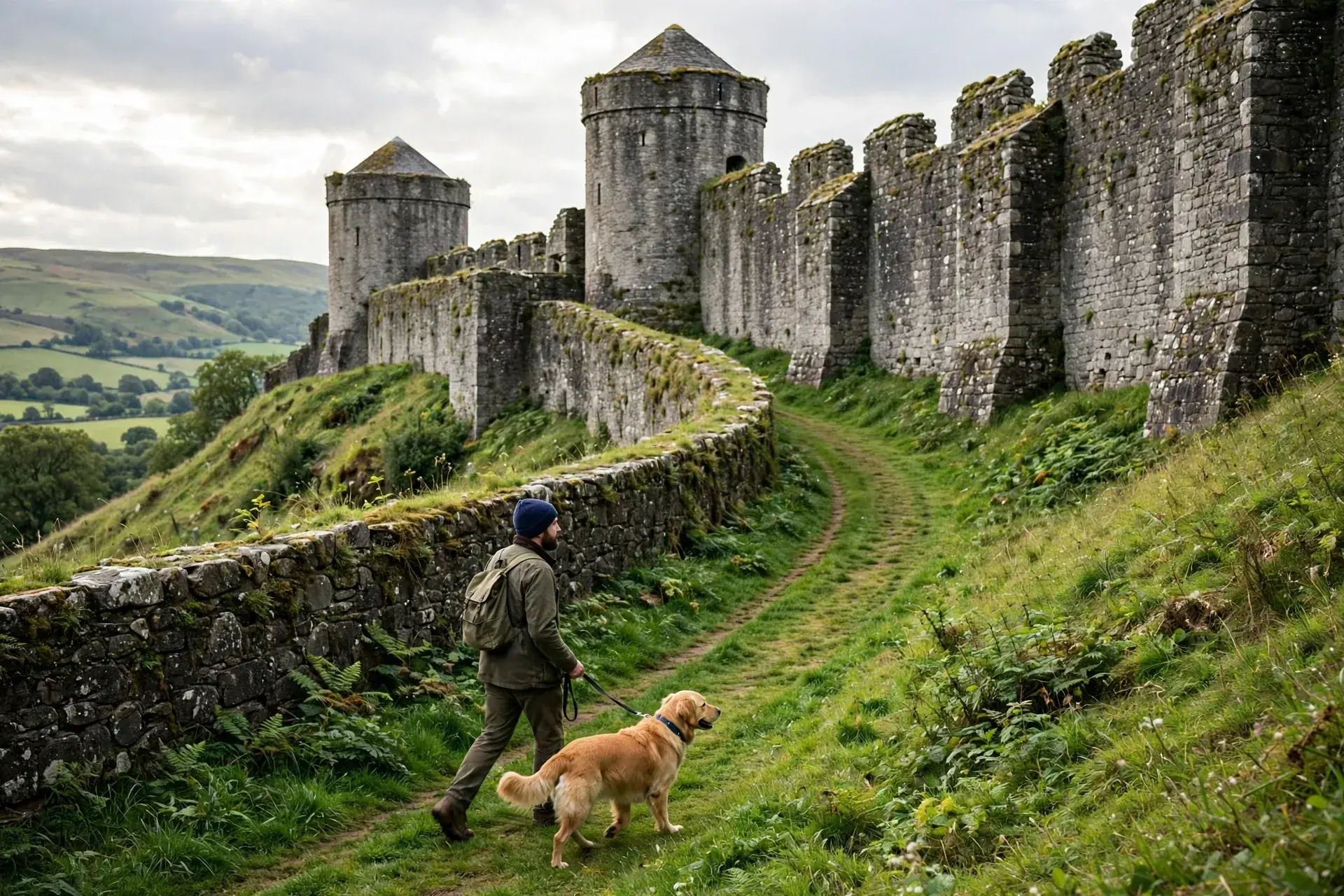
The castle is the reason most people come to Harlech, and it is worth seeing properly rather than from the car park. Built by Edward I in the 1280s, it stands on a crag with views that explain its position in a single glance: the coast road, the beach, the dunes and the mountains are all visible from the walls. It changed hands during Welsh uprisings and the Civil War, and it is famous in song as the setting of the march Men of Harlech. None of that matters to your dog, of course. What matters is that the castle is a stone fortress on a steep rock with sheer drops, narrow stairs and uneven ground, and a dog visit needs to be planned like a visit to any historic ruin, not like a walk in a park.
Dogs on leads are generally welcome in the castle grounds, but they are not usually allowed inside the visitor centre or the indoor exhibition spaces. That is the pattern at many Cadw sites, and Harlech follows it, but rules can change with events, conservation work and staffing, so check the official guidance before you travel rather than relying on a single report. If you are visiting with two people, the practical solution is simple: one of you stays outside with the dog in the grounds while the other goes inside, then swap. If you are on your own, plan on enjoying the castle from the outside — which, honestly, is where the best views are anyway.
Keep the dog on a lead at all times around the castle. The walls are high, the drops are real, and the stone is slippery when wet. The path up to the castle from the town is steep, with steps and a slope that will test an older dog's joints, so take it slowly and let the dog set the pace. In hot weather the stone holds the heat, so check the ground with the back of your hand before asking a dog to stand on it, and carry water rather than assuming there will be a tap where you need one. The views from the castle walls are the payoff: the beach curving away to the south, the dunes in their long ridges, and the mountains behind. Give the dog a few minutes to sniff the grassy areas at the base of the rock before you climb, and it will settle more happily while you look at the view.
Allow an hour around the castle and the town streets below it, and a little longer if you want to read the interpretation boards and walk the full circuit of the walls. The castle is not a place to hurry a dog through. The stone corridors echo, the staircases are narrow, and a nervous dog will do better with a slow approach and plenty of pauses. If your dog is noise-sensitive, be aware that the site can be busy at midday in summer, with school groups and tour parties, and the morning or late afternoon is calmer. If you want to build a wider castle trip, our guide to dog-friendly castles in Wales explains which Welsh castles welcome dogs, where leads are required and how the rules differ between sites, so you can plan a route rather than guessing at each gate.
After the castle, walk down into the town rather than driving straight to the beach. The streets below the castle are the oldest part of Harlech, and the descent gives the dog a change of pace: pavements, garden smells, other dogs, and the chance to practise lead manners in a real town. It is also the moment to check the time and the tide. If the tide is going out, head for the beach next. If it is coming in, have lunch first and let the beach wait.
Morfa Harlech beach and the dunes
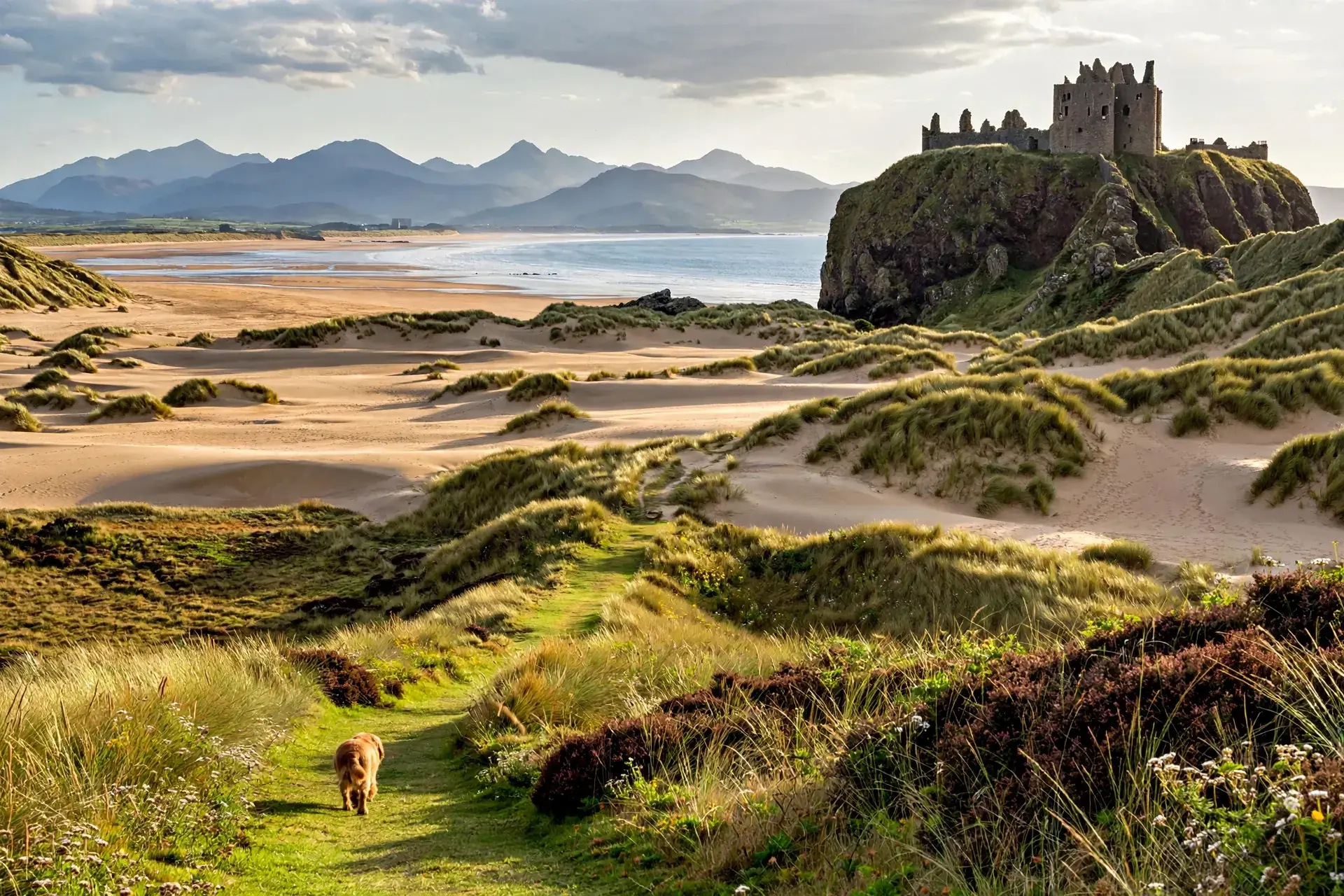
Morfa Harlech is the beach that makes Harlech special, and it is enormous. At low tide the sand stretches flat and wide for miles, and on a quiet weekday morning it can feel as though the whole coast belongs to you and your dog. The sand is mostly firm and clean near the water, which suits a game of fetch or a long off-lead run, while the dry sand higher up the beach is softer and better for a slow sniffing walk. Behind the beach, the dunes rise in a long system of ridges and hollows that runs south towards the village of Llandanwg and north towards the town. The dunes are part of a National Nature Reserve, home to rare plants and nesting birds, and they deserve a slower, more careful kind of walk than the beach itself.
Dog access on the beach is generous but not unlimited. Dogs are welcome on much of Morfa Harlech, but seasonal restrictions apply to part of the beach during the summer months, and the restricted area, the dates and any fines are set by the local council. The rules can also change from year to year, so check the official guidance before you travel and read the signs at the beach entrances when you arrive. Do not rely on what another dog owner tells you on the day, and do not assume that a restriction in one place means the whole beach is closed to dogs. The practical approach is to walk to the unrestricted section, which is still a very large area, and to keep the dog on a lead through the restricted zone if you need to cross it. If you want the full picture on how British beach bans work, our guide to UK beach rules explains seasonal restrictions, public space protection orders and fines in plain language.
The dunes need a different approach again. The paths through them are sandy and winding, and it is easy to lose your bearings in the hollows, especially in fog or low light. Keep to the marked paths where they exist, keep the dog close, and do not let it crash through the dune grass or dig in the fenced-off areas. The dune grass holds the whole system together, and a single afternoon of dogs running through it can do damage that takes years to repair. The reward for that care is a walk that feels genuinely wild: skylarks overhead in spring, butterflies in summer, and views back to the castle that change with every ridge you cross. In winter the dunes are quieter and the light is lower, and a well-wrapped walk here can be the best part of the day.
Facilities at the beach are basic. There is a car park at Morfa Harlech, a short walk from the sand, and a small shop and toilets nearby in season, but do not count on them being open out of season or in bad weather. Bring drinking water for the dog, because seawater is not a substitute and a dog that has been running on sand will drink far more than you expect. Bring a towel and a brush, because Harlech sand is fine and gets everywhere — in ears, between toes, in the car and in the bed that night. A long line is worth packing even if your dog is normally reliable off lead: on a beach this size, a dog can be a long way away very quickly, and a long line gives you control without ending the fun.
Swimming is a judgement call. Many dogs love the sea at Harlech, and on a calm summer day the water at the edge is shallow and inviting. But the coast here is open to the Irish Sea, and currents and rip tides can be strong, particularly after storms or when the wind is offshore. Never let a dog swim out of its depth, never throw a ball into deep water, and never follow a dog into the sea yourself. If your dog is a keen swimmer, keep sessions short and close to the shore, rinse the dog with fresh water afterwards, and watch for ear irritation in the days that follow. A dog that has never swum in the sea should be introduced gradually, on a lead, in shallow water, and never pushed.
Three walks for three kinds of dog
Not every dog wants the same walk, and Harlech is generous enough to offer real choice. The three walks below are not a single route to be done in one day; they are alternatives to match to the dog you have. Pick one as the main walk, use a second as a short evening stretch if the dog still has energy, and save the third for a second day or a return visit.
The first walk is the beach and dune loop, and it suits the fit, energetic dog that needs space. Start at the Morfa Harlech car park, walk out to the firm sand, and head south along the beach for twenty or thirty minutes before cutting back through the dunes on one of the marked paths. The loop is roughly three to four miles if you go all the way to the southern end and back, but it can be shortened at any point by turning back through the dunes, which is one of its best features. The walking is easy underfoot on the beach and harder in the soft dune sand, so build in rest stops and water breaks. This is the walk to choose on a cool, bright day when the dog is full of energy and the tide is out. Avoid it in the heat of a summer afternoon, when the sand is hot and there is no shade at all.
The second walk is the Wales Coast Path north from Harlech towards Llandanwg and beyond, and it suits the steady dog that likes a journey rather than a run. The coast path here follows the edge of the dunes and the golf course, with the sea on one side and the mountains on the other, and the walking is mostly level and well signed. Llandanwg is a tiny village with an ancient church, St Tanwg's, standing on the shore, and it makes a natural turning point for a walk of about four miles there and back. Keep the dog on a lead through the golf course section and anywhere livestock is grazing, and be ready for the path to narrow where it crosses the dunes. This is the walk for a dog that settles into a rhythm and for an owner who wants a view the whole way rather than a single destination.
The third walk is the short town-and-castle circuit, and it is the right choice for an older dog, a puppy, or any dog that finds big open spaces overwhelming. Start at the castle, walk down through the town streets, loop around the quieter residential lanes, and finish with a short stretch on the lower path towards the dunes without committing to the full beach. The whole circuit is under two miles, it is mostly on pavements and firm paths, and there are places to sit down at every stage. It is also the best walk for a wet day, when the beach is windswept and the dunes are a slog, because the town gives you shelter and the castle gives you a roof of sorts in the visitor areas. Do not underestimate a short walk done well: for a dog that is anxious, arthritic or very young, two miles with plenty of sniffing is a full day.
Whichever walk you choose, build in a rest afterwards. A dog that has had a big beach morning will sleep deeply in the afternoon, and that is not a problem to solve — it is the point of the trip. Plan a quiet lunch, a short garden stretch, and a calm evening walk, and you will have a dog that is content rather than wired. The most common mistake at Harlech is trying to do everything in one day: the castle, the full beach, the coast path and the town, all before lunch. The town rewards the opposite approach. Do less, do it slowly, and let the dog set the pace.
The town: streets, cafes and pubs
Harlech town is small enough to walk end to end in a few minutes, and that is part of its charm. The main street runs down from the castle to the station, with a mix of cafes, a pub or two, small shops and holiday cottages. The pavements are narrow in places and the road is used by local traffic, so keep the dog on a short lead through the town and do not let it wander into the road while you are looking at a menu board. The town is at its best in the morning, when the shops are opening and the castle is quiet, and again in the late afternoon, when the day visitors have gone and the light falls across the castle rock.
Several cafes and pubs in Harlech welcome dogs, usually in outdoor seating areas or in a designated inside area, but policies change between seasons and between owners, so ask before you sit down rather than assuming. The unwritten rules are the same everywhere in Britain: keep the dog on a lead, keep it under the table or at your feet, do not let it beg from other tables, and bring a mat for it to lie on. A dog that has had a long beach walk will usually settle quickly if it has a mat, a chew and a bowl of water; a dog that has been cooped up in the car all morning will not. Time your meal for after the main walk, not before it, and the whole table will be happier.
Shops in Harlech are useful rather than extensive. There is a small supermarket for the basics, a few gift and craft shops, and places selling outdoor kit and local food. If your dog needs a specific food, medicine or piece of kit, bring it with you rather than hoping to buy it in town. The nearest large supermarkets and pet shops are in Porthmadog, about eight miles to the north, and in Barmouth, about ten miles to the south, and both are worth knowing about if you are staying for a week. The same applies to vets: find out where the nearest practice is before you need it, save the number in your phone, and note the opening hours, because rural practices may close early and the nearest out-of-hours service may be some distance away.
The railway station is part of the town's character and worth a look even if you arrive by car. Harlech station is on the Cambrian Coast line, the scenic railway that runs from Machynlleth to Pwllheli along the coast, and the trains are small, slow and famously beautiful. Dogs are allowed on the trains, usually on a lead and at the owner's feet, and a short ride along the coast to Barmouth or Porthmadog can be a lovely addition to a longer stay. Check the timetable and the operator's dog policy before you travel, because services are infrequent — often only a handful of trains a day — and missing one can mean a long wait on the platform with a bored dog.
Evenings in Harlech are quiet. There is no nightlife to speak of, and that is the point. After dinner, the best evening walk is a short loop around the town or a gentle stroll on the lower dune path while the light fades over the sea. Keep the dog on a lead after dark, carry a light, and stick to paths you know, because the dunes are easy to get lost in even in daylight. If you are staying in a cottage, the evening is the time to dry the dog properly, check its paws for sand and small cuts, and let it sleep. A dog that has had a full day at Harlech will sleep soundly, and so, probably, will you.
Getting there, parking and the train
Harlech is reached by the A496 coast road, which runs from Blaenau Ffestiniog in the east to Barmouth in the south, and the drive itself is part of the trip. The road is single-carriageway for much of its length, winding through villages and along the coast, and it can be slow in summer when caravans and holiday traffic build up. Allow more time than the map suggests, especially if you are towing or driving a larger vehicle, and plan a stop on the way so the dog can stretch its legs and have a drink. The nearest dual carriageway is the A55 along the north Wales coast, and the drive from there to Harlech takes around an hour, depending on traffic.
Parking is the practical question that shapes the whole day, so settle it first. There is a car park near the beach at Morfa Harlech and parking in and around the town near the castle, but spaces are limited and fill quickly on sunny weekends, bank holidays and school holidays. Arrive early — before ten in the morning is a good rule in summer — and check the signs for charges, time limits and payment methods when you arrive, because machines and rules change. A useful habit is to park once and walk everywhere: the beach, the castle and the town are all within walking distance of each other if you are willing to walk, and moving the car between them wastes the best part of the morning.
If you arrive by train, the Cambrian Coast line is a genuinely good way to reach Harlech with a dog. The line runs along the coast with views across the estuaries and the sea, and Harlech station is a short walk from the town centre. Trains are infrequent, so check the timetable before you travel and plan your return journey before you set off walking. Dogs travel on the train at the owner's feet, usually without a ticket, but check the operator's current policy before you travel. The station has no ticket office and limited facilities, so buy tickets in advance where possible and bring water and a lead for the wait on the platform.
For a longer stay, Harlech works well as a base for the whole southern Snowdonia coast. Porthmadog is a short drive north, Barmouth is a short drive south, and the mountains of Eryri are inland to the east. Each of those is a day trip in its own right, and each has its own dog rules, parking and beaches, so do not try to do them all from Harlech in a single day. Instead, pick one neighbour per day and give it the same slow treatment as Harlech itself. The coast road rewards the unhurried driver: the views are best at the lay-bys, not at speed, and a dog that gets car sick will do better with a slow drive and a stop every hour than with a fast one.
When to come: seasons, tides and weather
Harlech is a four-season town, and each season changes the dog rules, the crowds and the walking. Spring, from March to May, is one of the best times to visit with a dog. The beach restrictions are usually not yet in force, the dunes are full of skylarks and wildflowers, the crowds are thin, and the weather is cool enough for a long walk without worrying about heat. The trade-off is that the weather is changeable: a bright morning can turn to rain by lunch, and the wind off the sea can be sharp even on a sunny day. Pack a waterproof for yourself and a drying coat for the dog, and you will be fine.
Summer, from June to August, is the busiest season and the one that needs the most planning. The beach restrictions apply to part of the beach, the car parks fill early, the castle is at its busiest, and the sun on the sand can be strong. Walk early in the morning or late in the afternoon, carry more water than you think you need, and never leave a dog in a parked car, even for a few minutes. On the plus side, the cafes and pubs are all open, the days are long, and the evening light on the castle is at its best. If you can, choose a weekday rather than a weekend, and avoid the school holidays if your dog is nervous in crowds.
Autumn, from September to November, is many regular visitors' favourite season. The summer restrictions lift, the crowds thin out, the light turns golden, and the dunes are quiet enough for a long, slow walk. The sea is at its warmest in early autumn, which suits dogs that like to paddle, and the town feels like itself again after the summer rush. The risk is the weather: autumn storms can arrive quickly off the Irish Sea, and the coast path can be exposed in high winds. Check the forecast before you set off, and have a wet-weather plan — the castle, the town cafes and a drive along the coast — rather than insisting on a beach walk in a gale.
Winter, from December to February, is the quietest season and the most rewarding for a certain kind of visitor. The beach is empty, the light is low and dramatic, and a wrapped-up walk on a clear winter day can be the best walk of the year. But the days are short, the wind is cold, and some cafes and facilities may be closed or on reduced hours. Daylight is the limiting factor: plan your main walk for the middle of the day, be back before dark, and do not attempt the dunes or the coast path in fog. A dog that is old, very young or short-coated will need a coat and a shorter walk in winter, and will need drying thoroughly afterwards. Winter is also the season when the tides and the weather matter most, so check both before you travel and be ready to change your plans.
Tides deserve a paragraph of their own, because they are the single most important piece of planning at Harlech. The beach is very flat, which means the tide comes in fast and covers a huge area of sand in a short time. What looks like a safe distance from the water at midday can be ankle-deep by mid-afternoon, and the walk back to the dunes can be much longer than it looks. Check the tide times before you set off, note the time of high tide, and plan to be off the open beach well before it. Keep the dog within recall range at all times, and never let it chase the tide out or swim in a rising tide. The same flatness that makes the beach wonderful at low tide makes it dangerous if you ignore the water, and every year coastguards rescue people and dogs who misjudged it.
Safety: tides, livestock and sand
The safety rules at Harlech are short, practical and worth taking seriously. First, the tide: check the times, stay close to the dune edge as the tide turns, and never cut across a gully or a channel that is filling with water. Second, livestock: sheep graze on the land around Harlech and on the hills inland, and the dunes and fields may have grazing animals at any time of year. Keep the dog on a lead near livestock, and if sheep are in a field you need to cross, go around it or turn back rather than taking a chance. A dog that chases sheep can cause a serious incident in seconds, and the farmer is entitled to protect the flock. Third, the roads: the coast road is narrow and busy in summer, and the lanes around the town have blind bends. Keep the dog on a lead beside any road, and do not let it run ahead around a corner.
Fourth, the sand itself. Harlech sand is fine and soft, and it gets into ears, eyes and paws. Check the dog's paws after every beach walk, rinse them with fresh water, and look for cuts or soreness between the toes. Sand in the ears can cause irritation, so dry the ears gently after swimming or a wet walk. A dog that has eaten sand — usually from picking up a ball that has rolled in it — can develop stomach trouble, so rinse balls and toys before the dog carries them, and watch for vomiting or discomfort after a beach day. None of this is a reason to avoid the beach; it is simply the routine that goes with it, like towelling down after a rainy walk.
Fifth, the sun and the heat. There is no shade on Morfa Harlech, and a dog running on sand in summer can overheat quickly. Walk in the morning or evening, carry water and offer it often, and watch for the signs of heatstroke: heavy panting, drooling, wobbling or confusion. If you see them, move the dog into the shade, cool it with water on the belly and paws, and seek a vet promptly. The dunes offer some shade in the hollows, but they also trap the heat, so do not assume the dog is cooler there. A light-coloured dog, an overweight dog and a flat-faced breed are all at higher risk, and they need shorter sessions and more water.
Finally, know who to call. Save the number of the nearest vet before you go, and know where the nearest out-of-hours service is. Keep a basic first-aid kit in the car: saline for eyes, a bandage, tick tweezers, and the dog's medication. Ticks are present in the dunes and the grassland around Harlech, particularly in spring and summer, so check the dog after every walk and remove any ticks promptly. Adders are rare but present in some dune and heathland areas in Britain, so keep the dog on paths and do not let it nose into dense undergrowth or rock piles. If a dog is bitten, keep it calm, carry it if you can, and get to a vet immediately.
Staying over with a dog
Harlech rewards an overnight stay, and a night or two turns a rushed day into a proper break. The town has a small number of hotels, guest houses and self-catering cottages that accept dogs, and there are holiday parks and campsites in the wider area. Book early for school holidays and summer weekends, because the dog-friendly rooms and cottages are limited and they go first. When you book, confirm the dog policy in writing: how many dogs, what size, whether there is a charge, whether the dog can be left alone in the room, and whether there is an enclosed garden. A policy that sounds welcoming on the phone and turns out to be restrictive on arrival is a miserable start to a holiday.
Self-catering is often the easiest option with a dog, because it gives you a kitchen, a garden and a routine that feels like home. Look for a cottage with an enclosed garden or yard, a hard floor that is easy to clean, and a drying area for wet coats and towels. Ask about the garden fence: a low wall or a gap under a gate can undo the whole arrangement in minutes. Bring the dog's bed, its usual food and a familiar blanket, and set up the sleeping area exactly as it is at home. A dog that sleeps well on the first night will enjoy the second day far more than one that spent the night pacing.
If you stay in a hotel or guest house, the routine matters more than the room. Ask where the dog can be exercised last thing at night and first thing in the morning, and whether there is a lit path or a garden for those trips. Keep the dog's routine close to home: same feeding time, same bed, same last walk. Bring a crate if the dog uses one, and do not leave the dog alone in an unfamiliar room unless the accommodation explicitly allows it and the dog is genuinely settled. A barking dog in a small guest house will not make you popular, and a stressed dog will not enjoy the stay either. Plan as if the dog comes with you everywhere, and choose places that make that easy.
Camping and touring are also possible around Harlech, with sites in the wider area that accept dogs. The same rules apply: check the dog policy, the pitch size, the distance to the toilet block and the dog-walking area, and whether the site has a shop or a dog-wash facility. A wet dog in a small tent is a test of any relationship, so pack drying coats, a groundsheet and a plan for wet weather. The reward is a night under the stars with the sound of the sea, and a morning walk on an empty beach before anyone else is awake. That, for many dog owners, is the whole point of coming here.
A relaxed one-day plan
Here is a plan that works for most dogs on a first visit. It is deliberately unhurried, and it can be shortened at any point without spoiling the day. Arrive by ten in the morning and park at Morfa Harlech. Walk the beach while the tide is out, keeping the dog's energy in mind: twenty minutes of running for a young dog, a slow sniffing walk for an older one. Head back through the dunes on a marked path, rinse the dog's paws at the car, and give it water and a rest while you check the time and the tide.
Drive or walk up to the town for lunch. Eat somewhere the dog can settle, with a mat and a bowl of water, and let the dog sleep under the table while you eat. After lunch, walk up to the castle and enjoy the views from the grounds, keeping the dog on a lead and taking the climb slowly. Spend an hour there, then walk down through the town streets, stopping for a coffee or an ice cream, and let the dog sniff the gardens and the shop fronts.
In the late afternoon, take a short walk on the coast path towards Llandanwg, or a second, shorter beach walk if the tide allows. Keep it to thirty or forty minutes, then head back to the car or your accommodation. The dog will be tired, sandy and content, and the drive home will be quiet. If you are staying over, repeat the pattern the next day with a different walk — the coast path in the morning, the beach in the afternoon — and you will have seen Harlech properly without ever hurrying. That is the secret of the place: it is small, but it is deep, and it gives more to the visitor who slows down than to the one who rushes.
Harlech is not the biggest, the busiest or the easiest town on the Welsh coast, and that is exactly why it suits a dog trip. It asks you to plan around the tide, to respect the dunes, to keep the dog on a lead where it matters, and to slow down. In return it gives you a castle on a rock, a beach that goes on for miles, and a view of the mountains that you will remember long after the sand is out of the car. Bring water, check the guidance, and let the dog lead the pace. Harlech will do the rest.
Practical questions
Before you go
Are dogs allowed at Harlech Castle?
Dogs on leads are generally welcome in the castle grounds, but they are not usually allowed inside the visitor centre or the indoor exhibition spaces. Rules can change with events and conservation work, so check the official guidance before you travel and keep your dog on a lead around the walls and the steep drops.
Can dogs go on Harlech beach all year round?
Morfa Harlech is a very large beach and dogs are welcome on much of it, but seasonal restrictions apply to part of the beach during the summer months. The restricted area, the dates and any fines are set by the local council, so check the official guidance before you travel and look for the signs at the beach entrances.
Is Harlech beach safe for dogs at high tide?
The tide at Harlech comes in fast across a very flat beach, and the distance back to the dunes can be much longer than it looks. Check tide times before you set off, stay close to the dune edge as the tide turns, and keep your dog within recall range. Never let a dog swim in strong currents or chase the tide out.
Where can I park in Harlech with a dog?
There is a car park near the beach at Morfa Harlech and parking in and around the town near the castle, but spaces are limited and fill quickly on sunny weekends and school holidays. Arrive early, check the signs for charges and time limits, and plan your first walk from where you actually park rather than driving between the beach and the castle.
Are there dog-friendly places to eat in Harlech?
Several cafes and pubs in Harlech welcome dogs, usually in outdoor seating areas or in a designated inside area, but policies change between seasons and owners. Ask before you sit down, keep your dog on a lead under the table, and carry a mat and a water bowl so your dog can settle while you eat.
How long should I allow for a day trip to Harlech with a dog?
Allow a full day rather than a flying visit. A relaxed plan is two to three hours on the beach and dunes, an hour around the castle and the town, and time for a slow lunch and a shorter afternoon walk. If you want to walk the coast path as well, plan for a second day or a much earlier start.