This guide is independent and contains no paid placement. If affiliate links are added later, they will be clearly marked and will not change our editorial checks.
Hathersage works best as a two-part day: a moorland edge walk for fit dogs when the weather allows, and a gentler valley or village walk as the fallback. Keep dogs on a lead near livestock, birds and the edge itself, check the official guidance before you travel for pool rules, parking and seasonal restrictions, and plan water, shade and rest stops around the dog rather than the distance.
The village at a glance and arriving with a dog
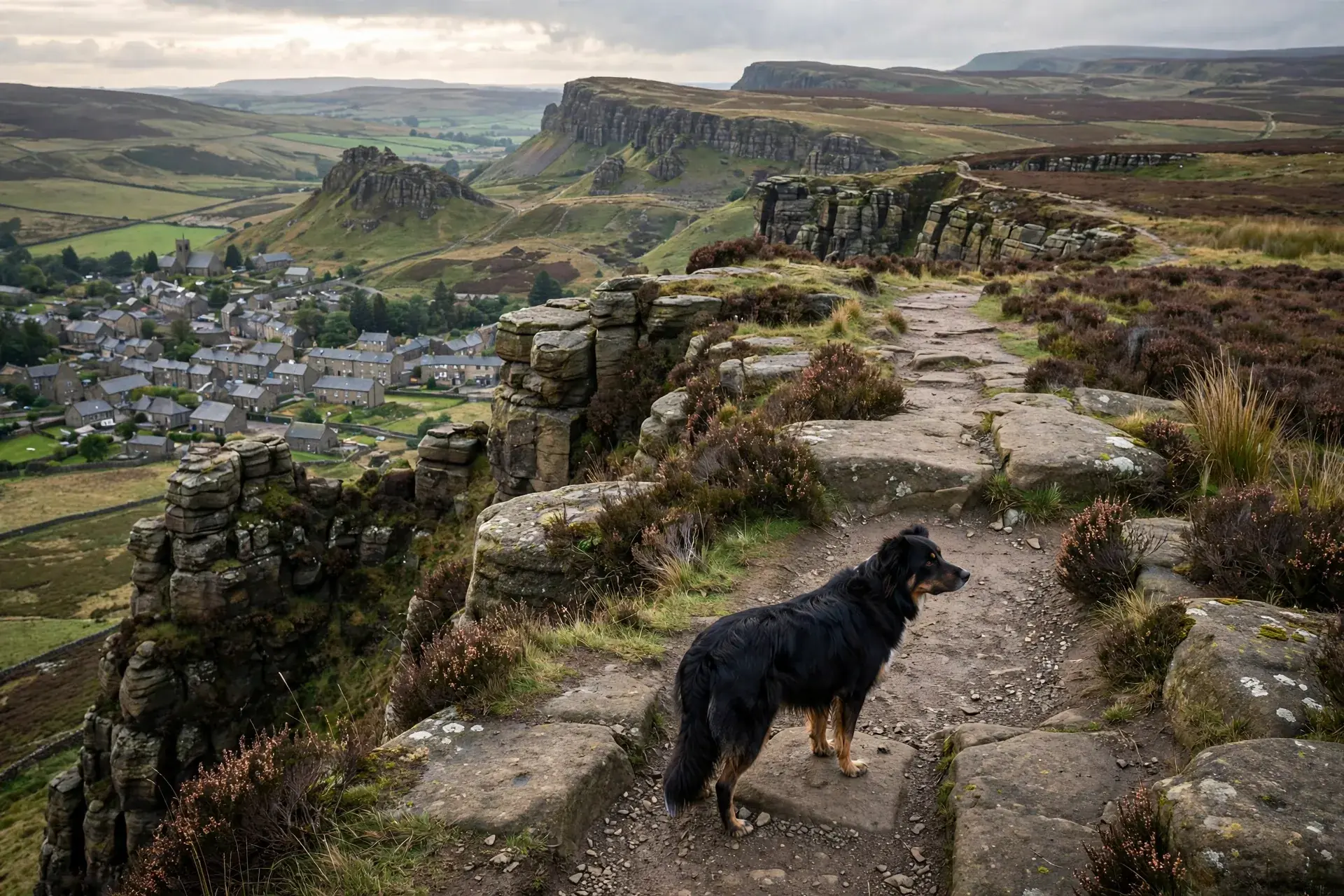
Before any street, church or cafe comes into focus, Hathersage is best understood from above. The long gritstone line of Stanage Edge runs across the moorland skyline north of the village, a dark, broken wall of rock that catches low light, holds mist, and draws the eye upward from almost every lane. That edge is the frame for the whole visit: the village sits in the sheltered Hope Valley below it, while the walk climbs out of fields and woodland into open, windswept moor. For a dog owner, the contrast matters more than any single sight, because the same day can offer a sheltered valley stroll in the morning and an exposed edge walk in the afternoon, and the dog will feel the difference in wind, ground and temperature long before a walker notices it.
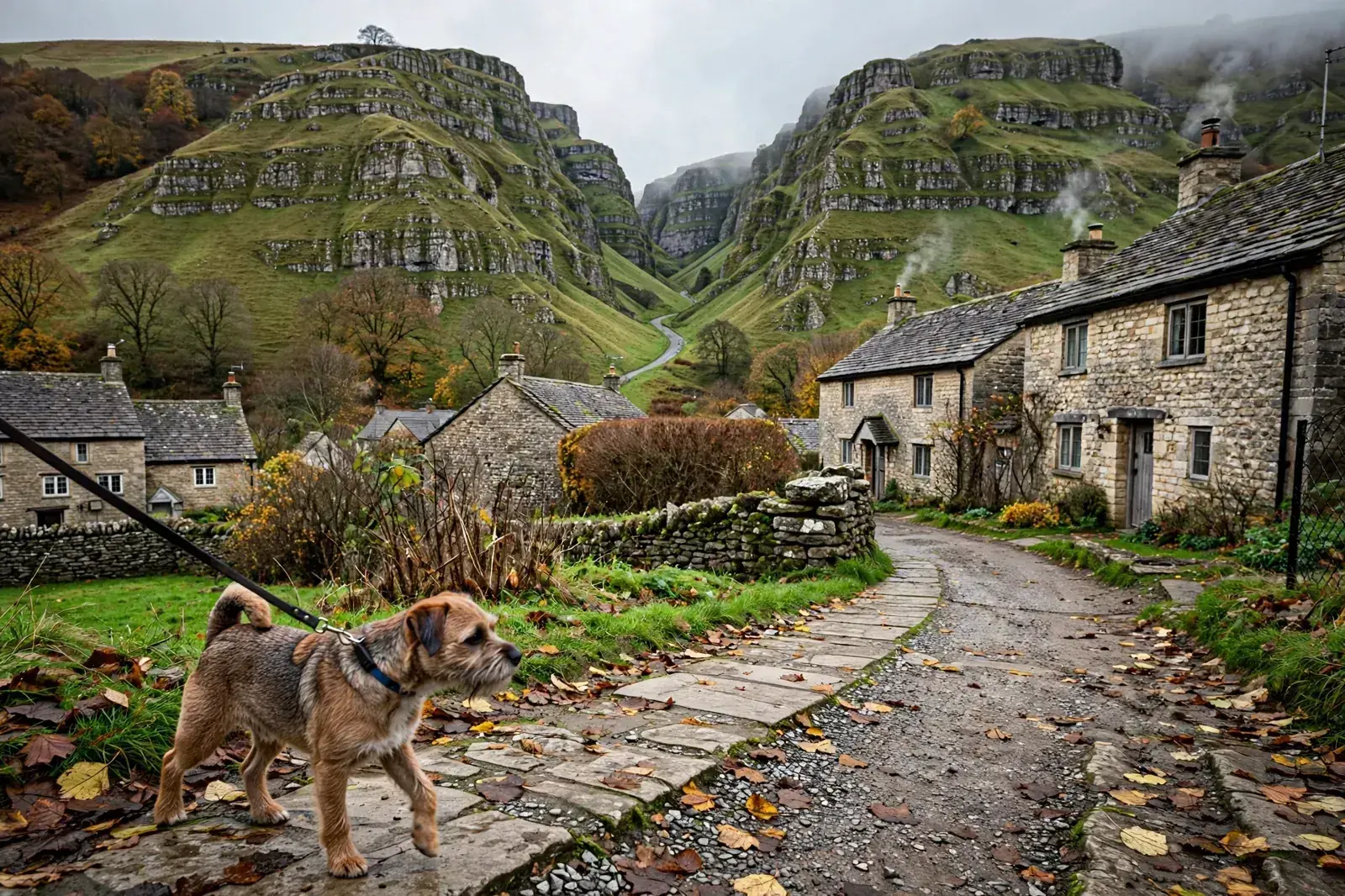
The literary landscape follows the same shape. Charlotte Bronte visited Hathersage in the 1840s, and the moorland setting, the stone village and the great house on the hillside above it have long been linked with the world of Jane Eyre. The connection is not a single plaque or a single building to tick off; it is a way of seeing the place. The moor above the village, the church on its rise, the old hall beyond the fields and the steep lanes between them all belong to the same story, and walking between them slowly, with a dog at heel, gives that story room to settle. Visitors who rush straight to the edge and back can miss the quieter half of Hathersage, which is the village itself at walking pace, with time to look at stone walls, field gates, gardens and the river valley opening toward the Hope Valley.
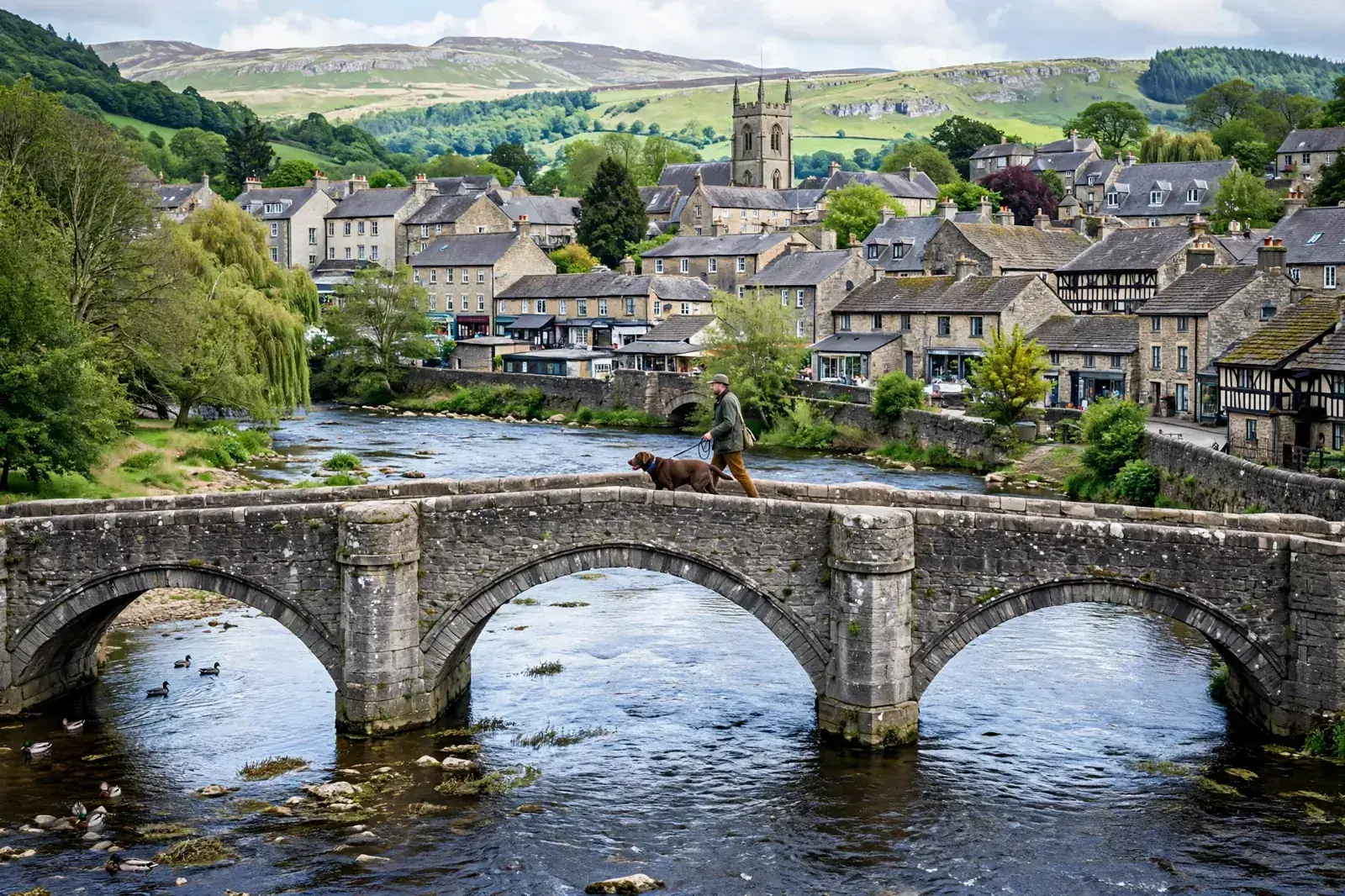
Hathersage itself is a compact Peak District village in Derbyshire, strung along the valley floor with a main street of shops, cafes, pubs and outdoor stores, a parish church, a village green and recreation areas, and the well-known outdoor swimming pool on the edge of the village. It is small enough to explore on foot, which suits dogs that settle better after a short leg-stretch than after a long drive followed by a forced march. The railway station, on the Hope Valley line between Sheffield and Manchester, makes Hathersage one of the more practical Peak District villages to reach without a car, and that matters for dog owners travelling by train, who should check the official guidance before you travel for current rules on dogs on trains and on station facilities. Drivers will find village parking and signed car parks, but spaces fill quickly on fine weekends, and the narrow lanes around the village reward an early start and a patient approach.
Arriving well with a dog starts before the walk. Give the dog a short toilet walk on arrival, offer water, and let the dog sniff the new surroundings at its own pace rather than heading straight uphill. Dogs that arrive stiff from a car journey, overexcited by new smells, or already warm from a sunny drive are poor candidates for an immediate steep climb. A calm ten minutes around the village green or a quiet lane, a drink, and a check of paws, lead, harness and waste bags will prevent most of the small problems that spoil a moorland day. Owners of reactive dogs should also think about timing: the main street and the popular edge paths are busiest late morning on weekends, while early mornings and weekday afternoons are usually calmer, and a dog that struggles with passing dogs will have a much better walk on a quiet lane than on a crowded edge path.
Practical arrival points deserve a little planning. Check where parking is permitted, whether any car park has height or time restrictions, and how far the walk to the chosen route start will be for the dog. Some walkers prefer to park in the village and walk out through fields, which adds distance but keeps the day car-free once parked. Others prefer a moorland car park above the village for a shorter approach to the edge, which suits older dogs, puppies on short walks, and anyone short of time. Neither choice is better in itself; the right choice is the one that matches the dog, the weather and the distance planned. For another Peak District base with a different valley character, see the Bakewell with a dog guide, which covers river walks and a market town base further south in the national park.
Finally, treat the village as a base rather than a corridor. Hathersage rewards walkers who build in pauses: a sit on a bench while the dog watches the street, a slow circuit of the green, a look at the churchyard, and a drink stop before the climb. Dogs that are allowed to settle between bursts of walking tend to cope better with the exposed sections later, and owners get a clearer sense of how the dog is feeling on the day. If the dog is already panting hard, lagging, limping slightly or showing stress signals in the village, that is useful information, not a failure of the plan. Shorten the edge walk, switch to a valley route, or save the climb for another visit. The edge will still be there, and a dog that enjoys the day will enjoy the next one more.
Walking towards Stanage Edge: graded route options
The walk from Hathersage towards Stanage Edge is not one route but a family of routes that share the same destination and differ sharply in steepness, distance, ground and exposure. Understanding the grades before setting out is the single most useful piece of planning for a dog owner, because a fit adult collie, a small terrier, a puppy and a stiff older spaniel should not all be sent up the same slope. The notes below grade the options in general terms; distances and conditions vary with the exact path taken, path closures, and weather, so check the official guidance before you travel and carry a map or a reliable offline route for the day.
The gentlest approach suits dogs that need a short, steady outing or owners who want a first taste of the edge without committing to a long climb. This version starts from a moorland car park above the village, follows a relatively level track or path to a section of the edge, and returns the same way. The total distance is short, the gradient is modest, and the dog gets the drama of the gritstone, the views and the moorland air without the long ascent from the valley floor. The trade-off is that the car park start skips the village-to-moor transition, and on busy days the short approach paths can be crowded with walkers and climbers. For a nervous dog, arrive early, keep the lead short near the car park, and choose a quieter stretch of edge away from the main honeypot sections.
The moderate option is the classic village-to-edge walk, climbing from Hathersage through fields, lanes and woodland or open hillside to reach the edge, then following part of the edge before returning by a different path or retracing the climb. This is a proper half-day walk for a fit, healthy adult dog, with a sustained ascent, uneven ground, stiles or gates, and exposed sections at the top where wind and weather hit hard. The reward is the full shape of the day: the village shrinking below, the valley opening out, the gritstone appearing gradually, and then the long line of the edge itself with views across the moor and the valley. Dogs should be kept on a lead on the narrow approach paths, near livestock, and near the edge, where a sudden gust, a loose stone or an excited dash after a bird could be dangerous. Carry water for the dog, because there is no reliable drinking supply on the high moor, and plan rest stops in sheltered spots on the way up rather than pushing through to the top in one effort.
The longer option follows the edge itself for a greater distance, taking in more of the escarpment, its rock formations, and the open moor behind it, before dropping back to the village by a valley or hillside path. This suits fit dogs with good stamina, reliable recall and experience on rough ground, and owners who are comfortable navigating on open moorland where paths can braid, disappear into heather, or cross boggy patches after rain. The edge is a long feature, and walking a substantial section of it adds both distance and exposure; wind chill, rain and mist can change the character of the walk within an hour. Dogs that are sound on gritstone slabs and rocky steps will enjoy this, but dogs with sore paws, joint problems or poor recall should not be taken on the longest version. Check the official guidance before you travel for any seasonal access advice, and be ready to shorten the walk if the dog tires, the weather turns, or the path becomes too busy.
Ground conditions deserve as much attention as distance. Gritstone is rough and grippy when dry, but it can be slippery when wet, and the small stones and slabs at the foot of the edge can be hard on paws. Heather moorland hides uneven ground, holes and boggy patches, and the paths after heavy rain can be muddy, flooded in dips, or churned by foot traffic. In summer, the dark rock holds heat, and dogs walking on sun-warmed stone need shade breaks and water. In winter, ice can form on sheltered slabs and on north-facing sections, and a path that is easy in October can be treacherous in January. Booties help some dogs on rough or icy ground, but they are not a substitute for route choice; if the ground looks wrong for the dog, choose a shorter or lower route.
Climbers, runners, mountain bikers and other walkers all use the edge and its approaches, so lead manners matter throughout. Keep dogs close and under control at crags where climbers are working above, on narrow paths where a dog underfoot could trip a runner, and at any junction where a dog might dart across a track. A long line can work well on open moor, giving a dog freedom to sniff while keeping control, but it is a hazard on narrow, rocky sections and near the edge, where a short lead is safer. For a neighbouring escarpment walk with a different valley feel, the Castleton with a dog guide covers Mam Tor, Cave Dale and Winnats Pass, and helps walkers compare two classic Peak District edges before choosing.
Navigation on the edge should never rely on a single phone signal. Moorland signal can be patchy, batteries drain faster in cold wind, and mist can reduce visibility to a few metres. Carry a paper map or a downloaded offline map, know the return route before leaving the village, and agree a turn-back point based on time rather than distance. A useful rule is to turn back when half the available daylight or half the dog's comfortable walking time has passed, whichever comes first. That discipline leaves a margin for a slower return, a rest stop, or a detour around livestock, and it is what turns a good edge walk into a safe one.
The Bronte connection and what to look for in the village
The Bronte connection gives Hathersage a second, quieter walk that pairs well with the edge. Charlotte Bronte visited the village in the 1840s, staying with friends in the area, and the place left a clear mark on her imagination. The great house of North Lees Hall, standing beyond the village among fields and trees, is traditionally identified as the model for Thornfield Hall in Jane Eyre, the brooding house of Mr Rochester. The identification is a literary tradition rather than a documented architectural claim, and it should be enjoyed in that spirit: the hall is a private residence, not a public attraction, and visitors should admire it from public paths and roads without trespassing, peering into gardens, or disturbing residents. The pleasure is in seeing the shape of the story in the landscape, not in getting close to a door.
The parish church of St Michael and All Angels, on its rise above the village, is the other anchor of the Bronte walk. Its churchyard contains graves associated with the Eyre family, whose name Bronte borrowed for her heroine, and the long-standing local tradition of Little John's grave, linked to the Robin Hood legends of the region. Churchyards are places where dogs need particular care: keep dogs on a short lead, keep them off graves and memorials, clean up promptly, and respect services, funerals and quiet visitors. A churchyard visit with a dog works best as a slow, calm pause rather than a play break, and it pairs naturally with a look at the church exterior, the stonework and the views back toward the moor.
What to look for, then, is less a checklist of exhibits and more a set of landscape clues. Look for the contrast between the sheltered valley village and the exposed moor above it, which mirrors the contrast in Jane Eyre between domestic interiors and wild outdoor scenes. Look for the stone houses, the narrow lanes and the field walls that give the village its texture, and for the way North Lees Hall sits apart from the village, commanding its own ground. Look for the moorland light, which changes by the hour: soft morning light over the valley, hard midday light on the gritstone, and low evening light that turns the edge gold and then grey. Dogs, of course, will look for smells, and a Bronte walk at a dog's pace, with stops to sniff walls, gates and verges, is arguably the most faithful way to take in a landscape that Bronte herself walked slowly and attentively.
Practical notes help the literary walk work for dogs. The village lanes are narrow in places, with traffic, parked cars and other dogs, so a short lead and good pavement manners matter. Some lanes have no pavement, and dogs should be kept on the verge side, away from traffic, with owners facing oncoming vehicles where possible. Gardens and private drives should be treated as out of bounds, even when a gate stands open, and dogs should not be allowed to wander into church flower beds, private yards or farm entrances. If a dog is the kind that pulls toward every new smell, a harness and a calm, steady pace will make the village walk far more enjoyable than a rushed circuit with constant corrections.
For walkers who want to deepen the literary theme, the wider Hope Valley and the surrounding Peak District offer further Bronte and literary associations, but Hathersage itself is enough for a day. A good pattern is to walk the village and church in the morning, when the light is soft and the streets are quieter, take a cafe stop, and then tackle the edge or the valley in the afternoon, when the dog has settled and the owner has a sense of the place. Alternatively, reverse the order on a hot day: walk the edge early, return to the village for shade, water and a late lunch, and finish with a slow churchyard and village circuit in the cooler evening. Either way, the literary walk should not be squeezed into a hurried gap between two long hikes; it deserves its own unhurried hour.
Finally, keep expectations honest about what is open and what is not. Church opening hours vary, private halls are not open to casual visitors, and small village attractions can change their hours by season. Check the official guidance before you travel for church and attraction opening times, and do not plan a dog day around a single interior visit that may be closed. The landscape, the churchyard, the village streets and the moor are the reliable core of the Bronte walk, and they are open, free and best enjoyed slowly, with a dog that is allowed to stop, sniff and sit.
Hathersage Pool and the village green area with a dog
Hathersage Pool is one of the village's best-known features: a heated outdoor swimming pool, open in the warmer months, set in grounds on the edge of the village with views toward the surrounding hills. For swimmers, it is a destination in itself, and for dog owners it shapes the day in a practical way, because the pool is a human swimming facility rather than a dog facility. Dogs should be expected to stay outside the pool enclosure, and owners who want to swim should plan the day so that the dog is not left waiting in a car or tied up alone for a long period. The kindest pattern is to take turns swimming, to visit the pool as part of a shorter village stop rather than a whole-day commitment, or to combine a pool visit with a dog walk before or after, so the dog has had exercise, water and a toilet break.
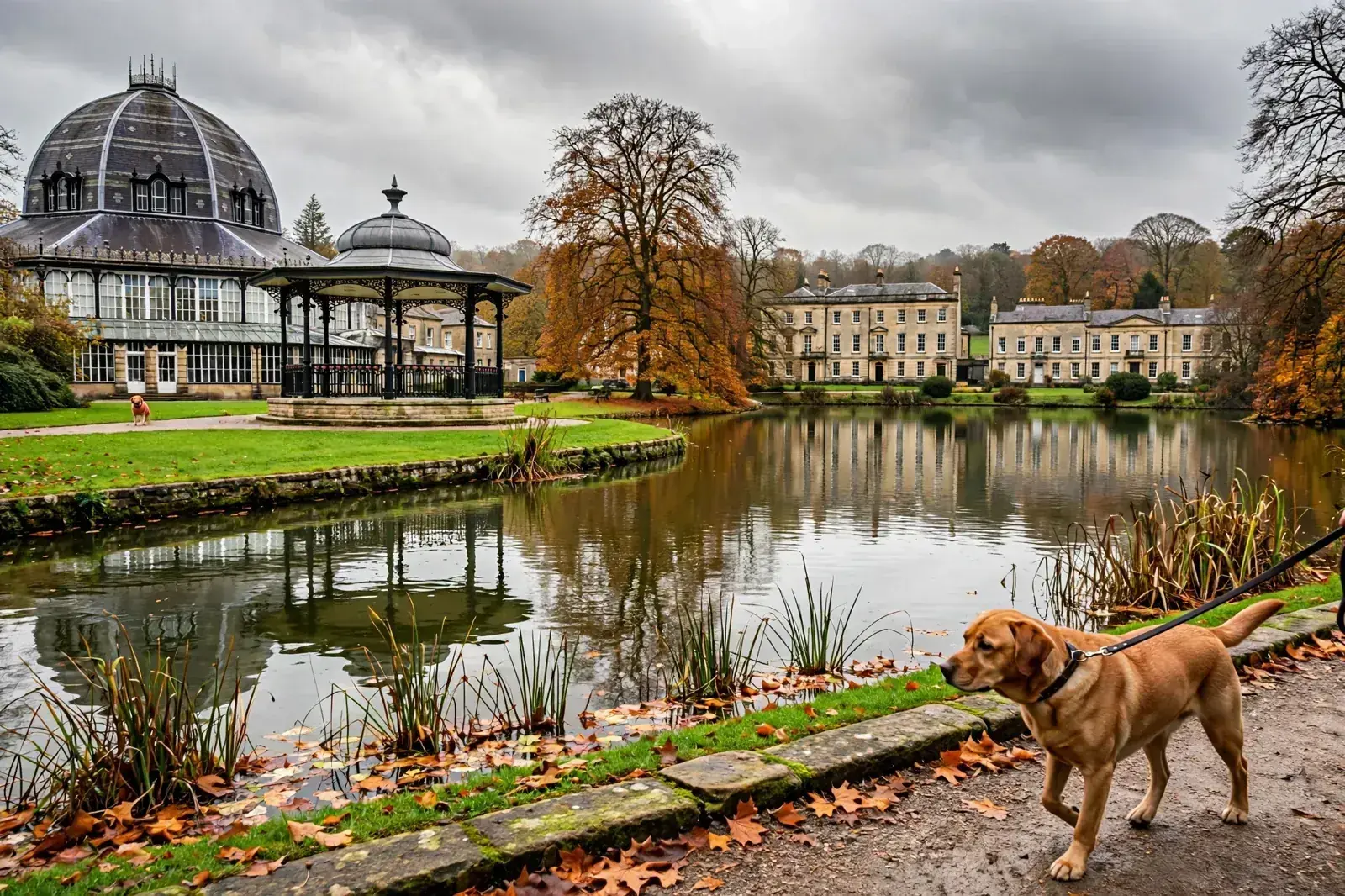
The village green and recreation areas near the centre of the village give dogs a useful counterpart to the pool: open grass, space to stretch, and a sociable village atmosphere. These are shared spaces, used by families, children, sports players and other dog walkers, so the rules of shared use apply. Keep dogs under control, pick up waste immediately, keep dogs off sports pitches when games are in progress, and watch for children who may run up to a dog without warning. A dog that is calm around children, balls and other dogs will enjoy the green; a dog that is reactive, nervous or ball-obsessed may do better on a quiet lane or a field path away from the main green. Check the official guidance before you travel for any local rules on dogs on the green and recreation ground, since seasonal or event-based restrictions can apply.
Water, shade and rest matter around the pool and green in summer. The green can be exposed, with little shade at midday, and a dog that has already walked uphill will need water, a shaded rest and time to cool down before being asked to walk again. Carry a collapsible bowl and water even for a short village stop, and use tree shade, building shade or a cafe terrace with shade rather than leaving a dog in direct sun. In hot weather, the ground on paths and pavements can also become hot underfoot; test surfaces with a hand, walk on grass where possible, and shorten the outing if the dog is panting heavily, seeking shade constantly, or slowing down. Never leave a dog in a parked car in warm weather, even for a quick swim, and never tie a dog up alone outside a pool or shop for longer than a very brief moment.
The pool area also makes a good meeting and regrouping point for a mixed group. Swimmers, non-swimmers, children and dogs can all be catered for if the day is planned in turns: one person swims while another walks the dog around the village or the green, then the group reunites for lunch. This pattern works far better than trying to keep a dog waiting while the whole party swims, and it gives the dog a second walk in the cooler part of the day. For families, it also teaches a useful lesson about dog days out: the best plan is rarely the plan that maximises human activities, but the plan that gives the dog regular breaks, water and quiet time between excitements.
Seasonal timing changes the pool and green picture considerably. In high summer, the pool is busy, the green is lively, and parking and cafe queues are at their longest, so an early arrival pays off. In spring and autumn, the pool may be closed or operating on reduced hours, while the green and village walks remain fully available and often quieter. In winter, the pool is out of season, but the village green, lanes and valley paths still offer a perfectly good dog day, with the advantage of thin crowds and crisp light. Whatever the season, check the official guidance before you travel for pool opening dates, admission rules and dog rules, and build the day around what is actually open rather than what a summer photograph suggests.
Finally, remember that the pool and green area is a residential neighbourhood as well as a visitor attraction. Keep barking to a minimum, especially early in the morning and late in the evening, keep dogs off private gardens and driveways, and leave the green as clean as it was found. A dog owner who is considerate around the pool and green will be welcomed back, and will also set a good example for other visitors. The village is small, and reputations travel quickly; the courteous dog walker is part of what keeps Hathersage welcoming to dogs.
Shorter valley and riverside alternatives for older or smaller dogs
Not every dog needs, or wants, the edge, and Hathersage is generous to dogs that prefer lower ground. The Hope Valley floor offers gentler walking: flat or gently undulating lanes, field paths, riverside stretches and village circuits that give a dog exercise, smells and fresh air without a sustained climb or exposed moorland. These alternatives are not second-class walks; for older dogs, small dogs, puppies on restricted exercise, dogs recovering from injury, and dogs that simply prefer sniffing to climbing, they are the right walks, and they deserve the same planning care as the edge routes.
A good valley walk follows the valley floor, using quiet lanes and field paths that link the village with neighbouring hamlets, farmland and the river valley. The ground is generally softer and lower than the moor, with more shade, more hedgerows and more varied smells, which suits dogs that walk for scent rather than distance. Distances can be kept short, with easy turn-back points, and the route can be shortened at any junction if the dog tires. For older dogs, this flexibility matters more than the total distance: a walk that can be cut short without a long return is kinder than a linear route that forces the dog to complete the full distance. Plan loops rather than out-and-back routes where possible, and note where benches, shade and water stops fall along the way.
Riverside walking needs a few extra cautions. Rivers in the Peak District can run fast after rain, banks can be steep or slippery, and water quality varies, so dogs should not be allowed to swim or drink from the river without thought. Keep dogs on a lead near fast water, weirs, bridges and roads, and check for blue-green algae warnings and livestock in riverside fields before letting a dog near the water. Check the official guidance before you travel for any local water safety notices. A riverside walk is at its best as a slow, shaded stroll with frequent pauses, rather than a route that encourages a dog to plunge into unknown water. Carry drinking water from home so the dog does not need to drink from the river at all.
Smaller dogs face a different set of challenges on valley walks: long grass can hide ticks, stiles can be difficult, and field gates may be heavy. A small dog that is carried over stiles should be lifted calmly and set down on safe ground, not dropped over a wall. Long grass in spring and summer should be checked for ticks after every walk, and owners should know how to remove a tick safely or where to get help. Smaller dogs also chill faster in wind and rain, so a waterproof coat and a drying towel in the car are worth carrying even on a short valley walk. The advantage of the valley is that shelter is never far away: a lane, a wall, a tree belt or a cafe can all provide a break.
Puppies and young dogs need valley walks that respect their developing joints and attention spans. Short, frequent walks with plenty of sniffing time suit puppies far better than a single long march, and the valley offers exactly that: a twenty-minute lane walk, a play and settle break on the green, and a second short walk later. Avoid long, repetitive climbs and long stretches of hard pavement for puppies, and build in rest, water and toilet breaks. Socialisation on valley walks should also be managed: a puppy that meets every dog, child and cyclist at close quarters can become overexcited, so use distance, calm greetings and short introductions rather than a free-for-all on the green.
For owners combining a valley walk with an edge walk in the same party, the valley route makes a good parallel plan. One person can take the fit dog to the edge while another walks the older or smaller dog in the valley, and the party can reunite in the village for lunch. This avoids the common mistake of taking every dog on the hardest route and then struggling with a tired dog on the descent. Dogs, like people, have different fitness levels, and a holiday that respects those differences will be enjoyed by all of them. The valley walk is not a consolation prize; it is a proper Peak District walk in its own right, with its own views, wildlife and village character.
Livestock, ground-nesting birds and moorland manners
Moorland manners begin with livestock. Sheep graze freely on the moors and in many fields around Hathersage, and they are present for much of the year, including lambing time in spring when ewes and lambs are especially vulnerable. A dog that chases, circles, barks at or even playfully approaches sheep can cause panic, injury, miscarriage and death in a flock, and the law in England treats worrying livestock seriously. The rule for dog owners is simple and non-negotiable: put the dog on a lead well before reaching sheep, keep the dog close until well past the flock, and do not rely on recall alone in a field of sheep. Even a dog that has never chased sheep at home can behave differently on open moor, where movement, wind and flock behaviour trigger instincts that do not appear in a garden.
Ground-nesting birds add a seasonal layer to the same rule. On open moorland, birds such as curlew, lapwing, grouse and skylark nest on the ground in spring and early summer, and they are easily disturbed by dogs running through heather, even when the dog has no intention of hunting. Disturbed birds may abandon nests, lose eggs to predators, or expend energy they need for raising chicks. During the breeding season, which broadly runs through spring and into early summer, keep dogs on a lead on open moor, stick to paths, and avoid heather and long grass where nests may be hidden. Check the official guidance before you travel for seasonal access advice and any local restrictions, since dates and areas vary by site and by year. The moor is a working landscape and a wildlife habitat before it is a dog playground, and the lead is the simplest way to respect both.
Other moorland users deserve the same consideration. Climbers on the edge need quiet and concentration, and a barking dog at the base of a crag is a genuine safety issue as well as an annoyance. Grouse moor managers, gamekeepers, farmers and conservation workers all have legitimate work on the moor, and dogs should not be allowed to interfere with vehicles, equipment, feeders or working dogs. Horse riders and mountain bikers may appear suddenly on tracks, and a dog that lunges at a horse or a bike can cause a serious accident. Keep dogs close on shared tracks, step aside for horses and bikes where it is safe to do so, and warn other users if a dog is nervous or reactive.
Access rights on open moorland in England come with responsibilities, and the Countryside Code summarises them well: keep dogs under effective control, keep them on a lead near livestock and during the bird breeding season, clean up waste, and follow local signs. Access land is not the same as a dog park, and the freedom to roam does not extend to letting a dog run wherever it pleases. Signs at car parks, gates and path junctions often carry the current local rules, and they should be read and followed even when they differ from general guidance. If a sign asks for dogs on leads, that instruction applies for a reason, whether livestock, birds, a shoot, or a conservation project is involved.
Waste, gates and walls are the quiet tests of moorland manners. Pick up dog waste on all paths, in fields and on the edge, bag it, and carry it to a bin; do not leave bags on walls, fences or paths for later collection, because later collection rarely happens and bags left on the moor are litter. Leave gates as they are found, whether open or closed, unless a sign says otherwise, and do not let a dog climb over dry stone walls or damage field boundaries. Walls and fences are farm infrastructure, not climbing frames, and a collapsed section can let sheep escape or mix flocks. A dog owner who closes gates, bags waste and keeps to paths will be invisible in the best sense: the moor will look exactly as it did before the visit.
Finally, think about what the dog leaves behind beyond waste. Dogs can carry seeds, soil and disease between sites on paws and coats, and washing paws and checking coats after a moorland walk is good practice, especially after wet or muddy conditions. Ticks are common on moorland and in long grass from spring through autumn, so check the dog thoroughly after every walk, paying attention to ears, neck, belly and between toes, and remove any ticks promptly and correctly. Moorland manners, in the end, are not a list of prohibitions but a habit of attention: noticing sheep before the dog does, noticing birds before the dog runs, noticing other users before the dog barks, and acting a moment earlier than seems necessary.
Pubs, cafes and dog-friendly stops
Hathersage has a good spread of pubs, cafes and shops for a village of its size, and most visitors will find somewhere to eat and drink with a dog, but dog policies vary by venue, by room and by season, and they can change without notice. The safest approach is to treat every venue as a place to check on the day: look for a dog policy sign at the door, ask staff before settling in, and confirm whether dogs are welcome inside, on a terrace only, or in a specific bar area. A venue that welcomes dogs in a flag-floored bar may not welcome them in a carpeted restaurant, and a cafe that welcomes dogs on a quiet weekday may restrict them at busy lunchtimes. Check the official guidance before you travel for any venue-specific information, and always have a backup stop in mind.
Pubs are the classic Peak District dog stop, and Hathersage pubs generally fit that pattern, with open fires in colder months, hearty food, and a relaxed attitude to muddy boots and wet dogs. For dog owners, the practical details matter more than the menu: is there space for a dog to lie without blocking a walkway, is there a water bowl, is the floor easy for a wet dog to grip, and is there a quiet corner for a nervous dog away from the main door and the kitchen pass? A dog that has just walked the edge will be tired, muddy and thirsty, and a pub that offers water, a towel and a corner will turn a good walk into a good day. Owners should still bring their own water bowl and a settle mat or blanket, because a familiar mat helps a dog settle in a new room and protects furniture and floors.
Cafes suit a different kind of stop: a quick coffee, a cake, a light lunch, and a rest before the next walk. Village cafes in Hathersage are well placed for a mid-walk break, a post-walk refuel, or a shelter from a shower. For dogs, the key questions are similar: indoor or terrace only, space to lie down, water availability, and tolerance for wet coats. A cafe stop works best when it is short and calm, with the dog settled under a table rather than wandering between tables. Dogs that beg, bark or pull toward food will be happier with a takeaway coffee and a bench outside, and owners should be honest about which kind of stop suits their dog rather than forcing a long indoor lunch on a restless animal.
Shops and outdoor stores in Hathersage are part of the village experience, and many welcome dogs, but policies vary and assistance dogs are treated separately from pet dogs in law. Ask before entering with a dog, keep the dog close among displays and equipment, and do not let a dog chew, mark or knock over stock. Outdoor stores can be useful for a forgotten item: a lead, a bowl, a waterproof coat, a map or a snack for the owner. Buying a needed item in the village also supports the local economy that keeps the village welcoming to walkers, which is a small but real part of being a good visitor.
Eating with a dog requires a little etiquette that benefits everyone. Feed the dog before the human meal, or give the dog a chew or a settled activity under the table, so the dog is not hungry and restless while food arrives. Keep the lead short and tucked away so staff and other customers do not trip over it. Clean up any dropped food, spilled water or mud promptly, and do not let a dog approach other tables, other dogs or children without an invitation. If the dog barks, paces or shows stress, it is kinder to cut the stop short and take the dog outside for a calm walk than to persist with a long meal while the dog struggles. A short, successful pub stop is worth more than a long, stressful one.
For walkers planning a full day, the best pattern is to spread stops through the day rather than saving them all for the end. A coffee in the village before the climb, water and a snack on the edge, a pub lunch on return, and a final cafe or bench stop before driving home gives the dog regular rest, water and toilet opportunities. This pattern also spreads spending through the village, which matters to small businesses, and it avoids the trap of a very long walk followed by a very long meal, after which a stiff, tired dog faces a car journey home. Plan stops as part of the route, not as an afterthought, and the dog will enjoy the day as a series of pleasant episodes rather than one long effort.
Seasons on the edge: wind, mist, summer crowds
Seasons change Stanage Edge more than they change the village, and a dog owner who plans for the season will have a better walk than one who plans only for the distance. Spring brings longer days, lambs in the fields, ground-nesting birds on the moor, and paths that can still be boggy after winter rain. The moor greens up, the light softens, and the edge is often at its most beautiful, but spring is also the season when lead rules matter most, when lambs are vulnerable, and when a sudden shower can soak a dog that set out in sunshine. Pack a waterproof coat for the dog if the dog uses one, carry a towel in the car, and keep the lead on through lambing fields and bird areas even when the path looks empty.
Summer is the season of long days, busy edges and heat. The gritstone holds warmth, the car parks fill early, and the popular sections of the edge can feel crowded with walkers, climbers and dogs by late morning. Heat is the main dog risk: dogs overheat faster than people, especially brachycephalic breeds, older dogs, overweight dogs and dogs with thick coats, and a hot edge walk with no shade and no water can become dangerous quickly. Walk early or late in the day, choose shaded valley routes at midday, carry more water than seems necessary, and watch for heavy panting, drooling, reluctance to walk or wobbliness, which are signs to stop, cool the dog and seek shade. Never leave a dog in a car in summer, even with windows cracked, and be aware that the dark rock and the lack of shade on the edge make it hotter than the valley below.
Autumn often gives the best walking conditions of the year: cooler air, firm paths after a dry spell, thinner crowds, and spectacular light on the moor as heather fades and bracken turns. Dogs that struggled in summer heat often thrive in autumn, and the edge feels wilder and quieter. Autumn hazards are subtler: shorter days that catch walkers out, wet leaves on stone steps, muddy paths after rain, and the start of the shooting season on some moors, which can mean restrictions, signs and the sound of distant shooting that unsettles noise-sensitive dogs. Check the official guidance before you travel for seasonal access notices, carry a headtorch for the return if daylight is short, and plan a turn-back time that leaves a generous margin before dark.
Winter on the edge is a different world: clear, cold days with superb visibility, frost on the gritstone, and far fewer people, set against short days, strong winds, ice and the risk of mist closing in without warning. A winter edge walk can be superb for a fit, healthy dog with a good coat and experience on cold ground, but it demands respect: check the forecast for wind speed and wind chill, not just temperature, because wind on an exposed edge can be far stronger than in the village, and a dog that is comfortable in the valley may be chilled on the top. Ice on slabs, snow hiding path edges, and frozen bogs that look solid but are not all require care. Shorten the walk, keep the dog close in mist, and carry extra layers, water that will not freeze solid, and a phone with charge.
Mist deserves a paragraph of its own, because it is the most underestimated hazard on Stanage Edge. Moorland mist can arrive quickly, reduce visibility to a few metres, and make a familiar path look entirely different. Dogs do not navigate for their owners, and a dog off the lead in mist can easily become separated, run toward a drop, or chase a shape that turns out to be livestock. In mist, keep dogs on a lead, stay on clear paths, use a map and compass or a downloaded offline map, and be ready to turn back rather than push on to a viewpoint that cannot be seen. A viewpoint in mist is not a destination; it is a reason to return on a clear day.
Crowds, finally, are a seasonal factor in their own right. Summer weekends, bank holidays and school holidays bring the most walkers, climbers and dogs to the edge, and the most pressure on parking, pubs and paths. Dogs that are sociable and calm in crowds will cope well, but dogs that are reactive, nervous or overexcited by other dogs will have a harder time. Strategies for busy days include starting early, choosing a less popular section of the edge, walking on a weekday, or swapping the edge for a valley route and saving the edge for a quieter visit. There is no prize for walking the busiest path on the busiest day, and a quiet valley walk on a crowded weekend is a better dog day than a stressful edge walk in a crowd.
Staying overnight in and around Hathersage
Staying overnight turns Hathersage from a day trip into a proper Peak District break, and it changes the dog planning in useful ways. An overnight stay allows an early edge walk before the crowds, a restful afternoon for the dog, and a second, shorter walk in the evening light, which is a far better pattern than a single long day trip with a tired drive home. It also allows walkers to spread the Bronte village walk, the pool and green, and the edge across two days, so no single day is overloaded. For dogs that travel poorly, an overnight stay with a calm first evening is also kinder than a rushed return journey.
Accommodation in and around Hathersage includes pubs with rooms, bed and breakfasts, self-catering cottages, campsites and larger houses in the surrounding valley, and dog policies vary widely between them. Some welcome dogs throughout, some welcome dogs only in certain rooms or units, some charge a per-dog fee, and some set limits on numbers, sizes or breeds. The only safe approach is to confirm the dog policy for the specific room or unit, in writing, before paying, including any fee, any rule about leaving a dog alone, any restriction on dogs in bedrooms, dining rooms or gardens, and any requirement for dogs to be crated or kept off furniture. A property described as dog-friendly in a listing headline may still have conditions that matter for a particular dog, and those conditions should be checked, not assumed.
Location matters for overnight stays as much as for day walks. A base in the village gives easy access to pubs, cafes, shops and the station, and a short walk to the green, but it may also bring street noise, passing dogs and limited garden space. A base outside the village, in a cottage or farm building, may offer a garden, quieter nights and direct field paths, but it may also mean driving to every walk and a longer drive for an evening meal. For older dogs, a ground-floor room or unit with level access and a garden close to the door is worth prioritising over a prettier upper-floor room with stairs. For reactive dogs, a quiet edge-of-village base with a private garden will usually suit better than a busy central base with shared corridors and stairwells.
Settling a dog into overnight accommodation follows the same principles as settling into a day walk: keep routines familiar, bring the dog's own bed, bowls, food and a familiar blanket, and give the dog time to sniff and explore the new space before expecting calm behaviour. Walk the dog around the accommodation on arrival, find the toilet area, check fences and gates, and remove hazards such as cleaning products, trailing cables and open food. Keep feeding times, walk times and bedtime as close to home as possible, and do not leave a dog alone in new accommodation for a long period on the first night. A dog that settles well on the first night will walk better on the second day, and a dog that is anxious overnight will show it on the morning walk.
For walkers who want to explore further afield, Hathersage makes a good base for the wider Hope Valley and the Peak District, with neighbouring villages, edges and valleys all within a short drive or train ride. The Castleton with a dog guide and the Bakewell with a dog guide both describe bases that pair well with Hathersage for a longer break, allowing walkers to compare valley, edge and market town characters before booking a second night elsewhere. A multi-base break, with two or three nights in Hathersage followed by a night or two in another village, gives dogs variety without the stress of moving every day, and it allows owners to match each base to the walks planned from it.
Booking timing also matters. Peak District accommodation, especially dog-friendly units with gardens or ground-floor access, books early for summer weekends, school holidays and bank holidays, and the best dog-friendly options may be gone months ahead. Shoulder seasons, such as late spring and early autumn, often offer better availability, lower prices and quieter walks, and they suit dogs that prefer cooler weather. Whatever the season, confirm cancellation terms, check-in and check-out times, and any cleaning expectations for dogs before booking, and keep the confirmation with the dog policy in writing. A well-chosen overnight base is not just a place to sleep; it is the foundation for two good walking days instead of one rushed one.
Planning checklist
A short checklist, run through the night before and again before leaving the car, prevents most of the problems that spoil a Hathersage dog day. Start with the dog: is the dog fit, healthy and comfortable for the planned distance, and has anything changed since the last walk, such as a sore paw, a stiff joint, a recent illness or a change in medication? If the answer is uncertain, shorten the walk or choose a valley route. Check the dog's lead, harness, collar and identification, which is a legal requirement in England for dogs in public places, and make sure the dog's microchip details are up to date. Pack waste bags, a water bottle and bowl, a towel, and any medication the dog needs.
Next, check the route and the weather. Confirm the chosen route, the starting point, the parking arrangements, and the turn-back time, and check the forecast for the edge specifically, not just the village, since wind, mist and temperature on the top can differ sharply from the valley. Check the official guidance before you travel for seasonal restrictions, path closures, livestock notices and pool opening hours. Tell someone the planned route and expected return time if walking alone on the moor, and carry a charged phone plus a paper or offline map. If any part of the plan depends on a single facility being open, such as a pool, a cafe or a car park, have a backup that does not depend on it.
Pack for the dog as carefully as for the walker. Water is the most important item, followed by a bowl, waste bags, a towel, a lead and a spare lead, and a coat for dogs that chill easily. In summer, add shade planning and extra water; in winter, add layers, a drying towel and a headtorch. In all seasons, add tick checks after the walk and a first-aid basics kit that covers cuts, sore paws and minor scrapes. Food for the dog should be packed for a full day out, not just a short walk, because a walk that runs long, a cafe stop that extends, or a traffic delay on the way home can all turn a short outing into a long one.
On the day, run through a final set of decisions at the car park. Is the weather still suitable for the planned route, or should the edge be swapped for a valley walk? Is the dog calm, comfortable and keen, or stiff, stressed or reluctant? Is the car park busy, are there many other dogs around, and does the planned path look crowded? These questions take a minute and can save a difficult day. If the answer to any of them suggests a change, make the change early, while options are still open, rather than halfway up the climb when turning back is harder.
After the walk, finish the day properly. Check the dog's paws for cuts, grit and soreness, check for ticks, dry the dog if wet, offer water and food, and give the dog a quiet rest before the journey home. Clean any mud from the car, the accommodation and the dog's gear, and dispose of waste bags responsibly. A short, calm end to the day helps the dog recover, and it also leaves the village, the paths and the accommodation in good condition for the next visitors. The best Hathersage dog days are not the longest or the most ambitious; they are the ones where the dog comes home tired in a good way, clean, settled and ready for the next walk.
- Route: Choose a graded route that matches the dog, not the ambition of the day, and agree a turn-back time before setting out.
- Lead: Carry a short lead for livestock, birds, the edge and busy paths, and use a long line only on open, safe ground.
- Water: Carry water and a bowl for the dog on every walk, including short village walks in warm weather.
- Weather: Check the forecast for the edge, not just the village, and be ready to swap to a valley route in wind, mist or heat.
- Rules: Check the official guidance before you travel for pool rules, parking, seasonal restrictions and venue dog policies.
- Rest: Build in shade, water and settle breaks, and plan pub and cafe stops that suit the dog as well as the walkers.
Practical questions
Before you go
Can dogs walk on Stanage Edge off the lead?
Sometimes, but not as a default. Keep dogs on a lead near livestock, near the edge, near ground-nesting birds in spring and early summer, and whenever other walkers, climbers or dogs are close. Use a short lead on narrow paths and only let a dog off where the ground is open, the dog has reliable recall, and no restriction applies. Check the official guidance before you travel.
Is Hathersage Pool dog friendly?
The pool itself is a swimming pool, not a dog swimming facility, so plan on dogs staying outside the pool enclosure. The village green and nearby paths give dogs somewhere to wait and walk while swimmers take turns. Check the official guidance before you travel, since opening dates, prices and pool rules change by season.
Where can I park for a Stanage Edge walk from Hathersage?
Village parking and the moorland car parks above the village are the usual starting points, and the right choice depends on the length of walk planned and the weather. Arrive early on summer weekends, leave nothing valuable visible in the car, and never leave a dog in a parked car in warm weather. Check the official guidance before you travel.
What should I do if my dog meets sheep on the moor?
Put the dog on a lead at once, move calmly away, and keep the dog close until well past the flock. Do not let a dog chase, circle or bark at sheep, even in play. A dog that worries livestock can cause serious harm and can put the owner in legal difficulty, so treat every sheep encounter as a lead-on moment.
Is the walk to Stanage Edge suitable for older dogs?
The full climb from the village is steep and can be hard on older joints, but older dogs still have good options. A short valley or riverside walk, a gentle section of the edge approached from a moorland car park, or a slow village loop may suit an older dog far better. Judge the day by the dog in front of you, build in rest stops, and carry water.
When is the best time of year to visit Hathersage with a dog?
Late spring and early autumn often give the best balance of daylight, firm paths and thinner crowds. Summer brings long days but also busy edges and hot gritstone. Winter can be superb on a clear, calm day, but wind, ice and short daylight change the plan fast. Check the official guidance before you travel and always check the forecast.