This guide is independent and contains no paid placement. Dog access rules for attractions, pubs and accommodation change, so check the venue directly before you travel.
Dog friendly Hawkshead in the Lake District works best as a walking base, not a sightseeing checklist. Stay in or near the traffic-free centre, walk Latterbarrow or Claife Heights straight from the door, keep dogs on a lead around livestock and water, and accept that Beatrix Potter interiors are for people only — pet dogs wait outside or you take turns.
Start in the quiet square, before the coaches arrive
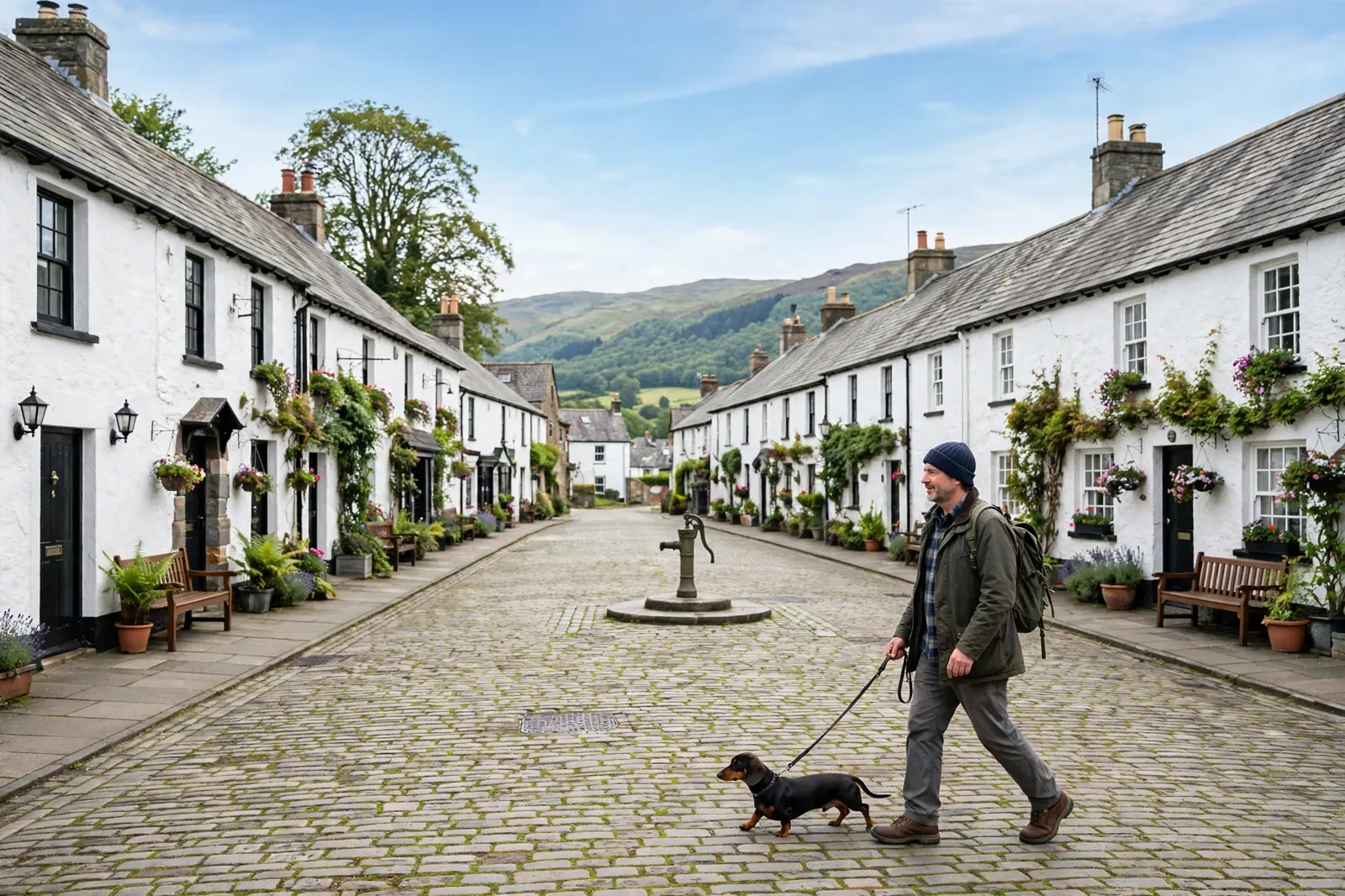
Come to the main square at eight in the morning and Hawkshead feels like a different place from the one most visitors meet at noon. The whitewashed cottages are still shuttered, delivery vans have not yet threaded the lanes on the edge of the centre, and the only sounds are a bin being wheeled, a door opening, and your dog's claws on stone flags. For a nervous dog, a reactive dog, or simply an owner who wants to work out where everything is without weaving through a crowd, that first quiet hour is the most valuable part of the day. Use it deliberately rather than sleeping through it.
Walk a slow loop first. Start in the square, pass the old grammar school where William Wordsworth was educated, look up at St Michael and All Angels Church on its rise above the village, then drop back through the narrow yards and passages that link the centre together. Note where the water bowls sit outside shops, which cafe has outdoor tables that catch the sun, and where the bins are — because a village this compact punishes improvisation at busy times. A dog that has already sniffed the centre calmly in the morning will cope far better when you return at lunchtime and the same streets are full.
That early loop also sets expectations. Hawkshead is small. You can cross it in ten minutes, and there is no large park in the middle where dogs can be let off for a run. The exercise here comes from the walks that radiate out of the village, not from the village itself. Treat the centre as a base for eating, sleeping and gentle lead walks, and plan proper exercise on Latterbarrow, Claife Heights or around Esthwaite Water. Owners who arrive expecting a big off-lead space in the village tend to feel short-changed; owners who arrive expecting a superb walking hub tend to book again.
Season sharpens the difference. From late spring to early autumn, and through school holidays, the centre fills from about half past ten and stays busy until late afternoon. In winter the village is quieter, some businesses reduce hours, and the light goes early — but the walking is often better for dogs, the pubs feel cosier, and you will rarely queue. Whichever season you choose, build the day backwards from your dog's needs: a proper morning walk, a settled middle of the day, and a short evening loop, rather than dragging a tired dog around shops because the car park ticket still has time on it.
Exploring a traffic-free village with a dog
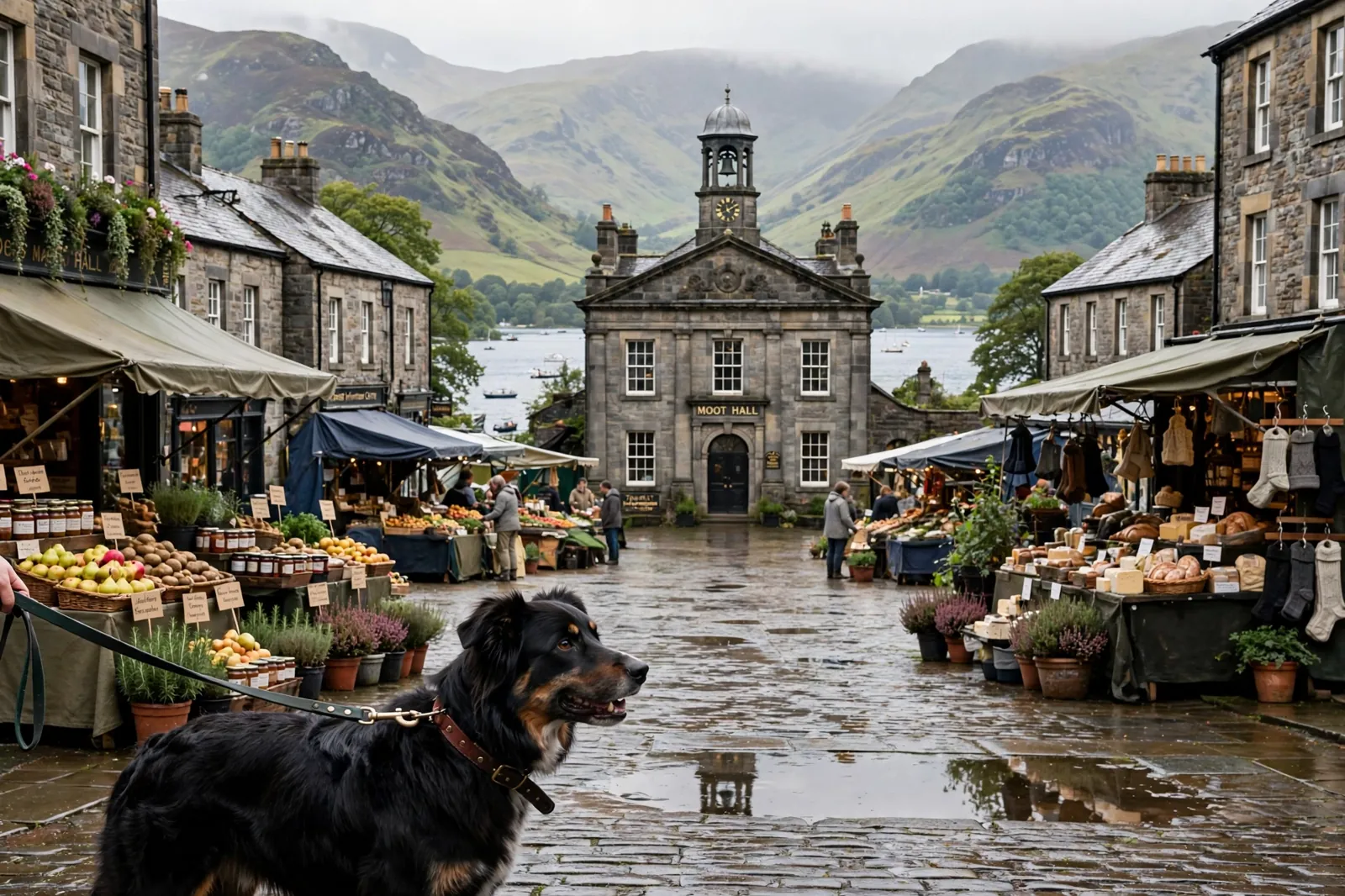
Hawkshead's centre has been largely traffic-free for decades, and that single fact shapes a visit with a dog more than any individual attraction. Cars are kept to the car park on the edge of the village, so the square and the lanes around it are for pedestrians. For most dogs that is a relief: no close-passing traffic, no need to hug a verge, and a pace set by people browsing rather than vehicles turning. For owners it removes one whole category of stress, especially with a puppy that is still learning about the world or an older dog that is slow to move aside.
Traffic-free does not mean obstacle-free. The centre can be crowded at head height and paw height at once — pushchairs, shopping bags, other dogs on short leads in narrow passages, and children moving unpredictably outside ice-cream shops. Keep your dog on a short lead in the centre, position yourself between your dog and passing dogs in the tightest lanes, and step into doorways to let groups pass rather than letting leads tangle in the middle. If your dog struggles with close encounters, do the centre early or late and spend the middle of the day on the fells, which is the opposite of what most visitors do and works much better.
The churchyard and the lanes towards Roger Ground and Outgate give you quieter lead walks without leaving the village behind entirely. Follow signs carefully, keep dogs under close control near homes and livestock, and close every gate behind you. In the centre itself, look for the small details that make a dog welcome practical rather than theoretical: bowls that are actually filled with clean water, shops that display a clear dogs-welcome sign rather than leaving you to guess at the door, and staff who will tell you honestly if only the terrace is suitable today. Our guide to dog-friendly cafes across the UK sets out what to check before you settle a dog under a cafe table anywhere, and Hawkshead is a good place to apply it — ask first, wipe paws, and keep the dog tucked out of the serving route.
Shopping needs a plan when you have a dog and no one to hold the lead. Some independent shops in Hawkshead welcome a calm dog inside, many do not, and policies are rarely visible from the street. Never tie a dog up outside a shop in a busy centre and leave it — theft aside, a tied dog cannot move away from attention it does not want. If you are travelling solo, choose the one or two shops that matter, ask at the door, and do the rest online later. A village break is not improved by spending it apologising at thresholds.
Toilets, bins and water are worth locating early. Public facilities are near the car park side of the village; carry poo bags regardless, because bins on the fell paths are few and the rule everywhere in the Lakes is simple — bag it and take it to a bin, even on a rural path. Carry water for your dog on every walk from the village, including short ones. Hawkshead sits between Esthwaite Water and Windermere but neither is a safe assumption for drinking water, and upland becks can be dry in summer or contaminated near livestock at any time of year.
Beatrix Potter, honestly: what your dog can and cannot do
Hawkshead is Beatrix Potter country, and it is better to be clear about access before you arrive than disappointed on the doorstep. The Beatrix Potter Gallery, in a former solicitor's office in the village centre where Potter's husband William Heelis worked, displays original artwork. Hill Top, Potter's farmhouse home, is not in Hawkshead itself — it is in Near Sawrey, a couple of miles away across or around Esthwaite Water. Both are cared for by the National Trust. Both are, for a pet dog owner, largely look-from-outside experiences.
Pet dogs are generally not allowed inside Hill Top house or inside the Beatrix Potter Gallery. That is not a Hawkshead quirk; small, fragile interiors with original material, limited space and timed entry do not mix with pet dogs, however well behaved. Assistance dogs are a different category and are treated separately. Garden and outdoor access varies: Hill Top's garden has at times allowed dogs on leads or restricted them depending on season and conservation work, and arrangements can change, so do not rely on an old blog post or a photograph of a dog in a garden from three summers ago. Check the National Trust listing for each property on the morning of your visit, and check our broader guide to visiting National Trust places with a dog for how paw ratings and property pages work.
The practical answer is taking turns. If two adults are travelling, one explores the gallery or Hill Top while the other walks the dog — and Near Sawrey in particular repays a gentle lead walk while you wait, with lanes that Potter herself knew and painted. Timed tickets for Hill Top can sell out, so book the human visit in advance where the property requires it, and build the dog's walk around the slot rather than arriving speculatively with a dog and a queue. Solo travellers have a harder choice: skip the interiors without resentment and enjoy what Hawkshead does brilliantly for dogs — the walking — or arrange proper care for the dog for a few hours rather than leaving it in a car, which is never acceptable in warm weather and is a poor plan in any weather.
Do not let the interior rule spoil the Potter connection. The landscape around Hawkshead and Sawrey — Esthwaite Water, the small tarns, the mossy walls and farm lanes — is the world Potter wrote and drew, and your dog can walk through all of it. Children who have seen the gallery in turns will still recognise the countryside from the tales on a walk the same afternoon. Plan the Potter element as one part of the day, not the reason the dog spends the day waiting.
Latterbarrow: the walk Hawkshead is known for
If you do one hill walk from Hawkshead, make it Latterbarrow. This modest summit west of the village, at 245 metres, gives a view out of all proportion to its height: Windermere to one side, Esthwaite Water below, the Coniston and central fells filling the horizon, and Hawkshead itself tucked into the valley when you look back. The large summit cairn and monument make a satisfying target for a dog that needs a purpose to the morning, and the round trip from the village is roughly three to four miles depending on the exact route, with around an hour and a half to two and a half hours a sensible allowance for a dog party that stops to sniff and take photographs.
The usual approach leaves the village towards the west, climbing through fields and woodland on clear paths before the ground opens near the top. Underfoot is mostly grass and track, with mud after rain and bracken in summer that can hide uneven ground. Keep your dog on a lead or under very close control wherever sheep or cattle are present — this is working farmland on the lower slopes, and lambing season in spring demands extra care and sometimes a longer lead and a wider berth. Check for any temporary signs at field entrances and follow them even if they add distance.
Latterbarrow suits a wide range of dogs. Fit dogs will take it as a warm-up; older dogs that still manage steady climbs often enjoy it because the gradient is mostly forgiving and the route can be shortened by turning back at the woodland edge with no sense of failure. What it does not suit is a dog that pulls hard downhill on a lead — the descents in wet weather are slippery enough to test your knees. Wear boots with grip, carry water, and in summer start early because there is little shade on the upper slopes. In winter, low cloud can sit on even this small hill, so carry a map or an offline route on your phone rather than assuming you will see the village from the top.
Extend the day if you want to. Latterbarrow combines naturally with a descent towards Wray and the western shore of Windermere for stronger walkers, or with a gentle return through the lanes for a pub lunch. Shorten it just as happily: a morning up and down, followed by a slow afternoon, is the pattern many repeat visitors settle into. The hill will still be there tomorrow, which is more than can be said for a dog that has been over-walked on day one of a holiday.
Claife Heights and the Windermere shore
East of Hawkshead, across the high ground between the village and Windermere, Claife Heights offers a completely different kind of walking: woodland, small tarns, rocky outcrops and sudden views down to the lake, without a single famous summit to aim for. For dogs that prefer sniffing to summitting, it can be the better day. Routes link Hawkshead with the ferry point and the western shore of Windermere, and can be walked as a one-way journey combined with the ferry and a bus or taxi back, or trimmed into shorter loops from Sawrey or from the lake shore.
Expect navigation to matter more here than on Latterbarrow. Paths weave through forestry and open fell, junctions are not always obvious in mist, and distances feel longer because the terrain rolls rather than climbs once. Download or carry a proper map — the whole area is covered by the Ordnance Survey Explorer map for the south-eastern Lakes — and agree a turnaround time before you set off. Dogs should stay on a lead near livestock and under close control in woodland where deer and ground-nesting birds may be present in season. Forestry operations occasionally close or divert paths; obey closure signs and never climb over stacked timber.
The reward is variety in a single walk: a tarn for a pause (look, do not let the dog swim unless you are certain it is allowed and safe — many small tarns are ecologically sensitive and cold at any season), a viewpoint for lunch, and a descent to Windermere's quieter western shore, which feels a world away from the busy eastern side. Compare it with a base in the town itself in our Windermere with a dog guide — Hawkshead and Claife are the calmer, walk-first alternative. If you use the ferry, check operating times and dog rules before you rely on it for the return leg, keep your dog settled and clear of the boarding area, and have a road alternative in mind on windy days when sailings can be suspended.
Claife also works in poor weather better than higher fells, because much of the route is sheltered and lower. That does not make it a soft option after heavy rain — woodland paths flood, boardwalks get slippery, and becks rise. Choose footwear for the worst section, not the average one, and dry the dog thoroughly afterwards; a dog that has spent three happy hours in wet woodland will bring a surprising amount of Claife Heights back into your accommodation.
Esthwaite Water: the gentle option on the doorstep
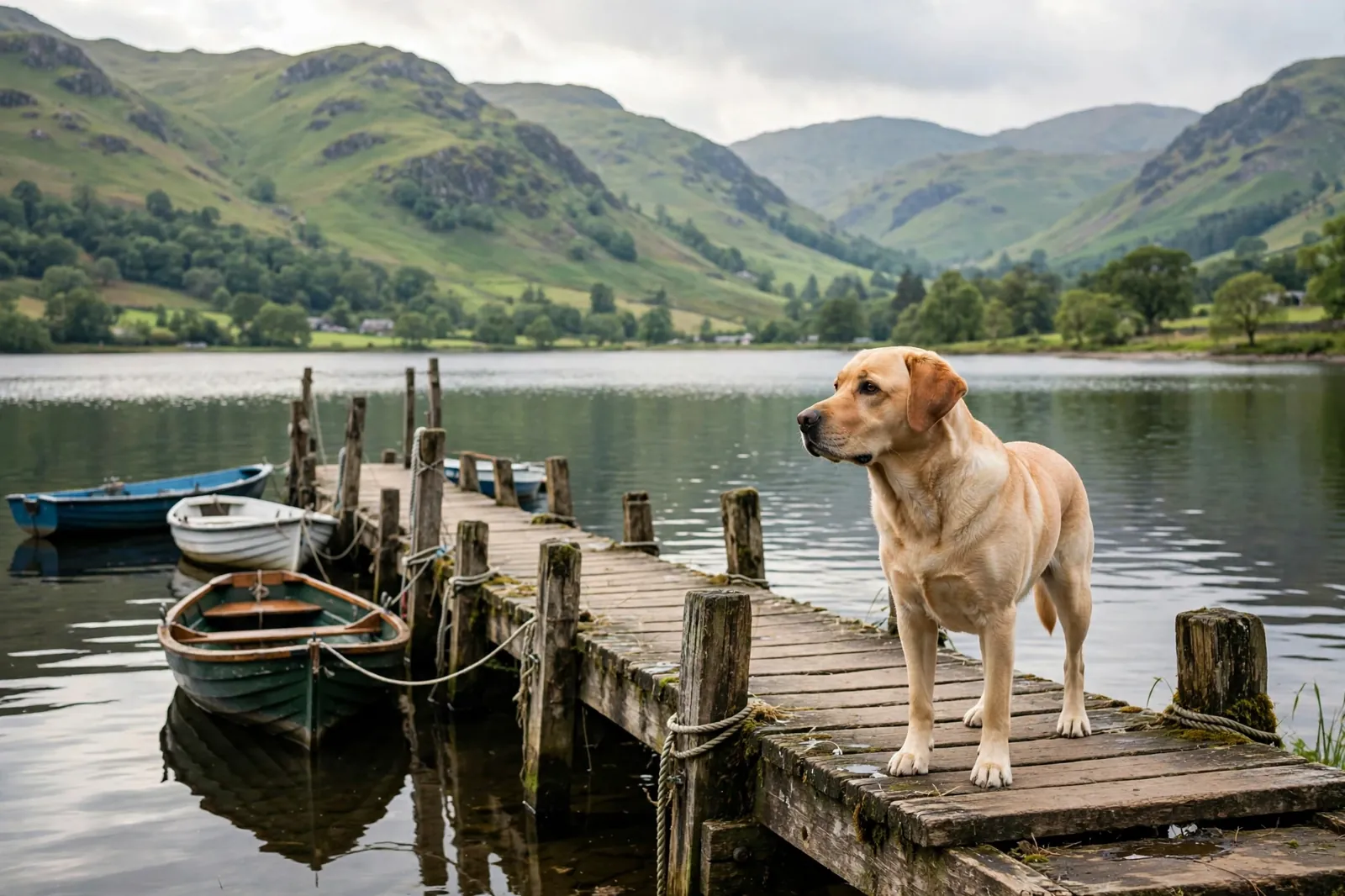
Between Hawkshead and Near Sawrey lies Esthwaite Water, one of the smaller lakes and one of the most peaceful. Potter knew it well, and it remains a working trout fishery as well as a haven for wildlife. For dog owners its value is as the gentle option: level lanes and paths in the valley, views across still water in the early morning, and a walk that suits a puppy building stamina, a senior dog on a shorter allowance, or everyone on the day after Latterbarrow.
Be precise about access. There is no continuous public footpath hugging the entire shoreline, and parts of the lake margin are private or managed for fishing and conservation. Follow signed public rights of way and permissive routes, keep off jetties and fishing areas unless clearly permitted, and keep your dog out of the water — both to protect wildlife and because fishing lines, hooks and blue-green algae in warm weather are real risks at managed fisheries. Algae blooms can occur on any still water in summer; if the water looks green, scummy or smells unusual, keep your dog away from the edge entirely and use a different walk that day.
A lane walk from Hawkshead towards Near Sawrey, with a pause to look across Esthwaite, then back by a different lane if the map allows, makes a satisfying hour or two without any climb. Traffic on these lanes is light but real — single-track in places, with tractors and delivery vehicles that cannot stop quickly — so keep your dog on a short lead on the road sections, face oncoming traffic where there is no pavement, and use hi-vis in fading light in winter. Early morning is again the best time: mist on the water, birdsong, and the lake largely to yourselves.
Combine Esthwaite with the Potter story for children without needing to enter anywhere. The valley is the setting, the lanes are the illustration, and a dog walking quietly through it is part of the scene rather than a problem to be managed. Stop at a bench, read a tale aloud if you have one in a pocket, and let the walk be the attraction. Not every good dog day needs a ticket.
Tarn Hows as a day trip, in brief
Tarn Hows, between Hawkshead and Coniston, is one of the most visited beauty spots in the Lakes — a partly landscaped tarn with a level circular path, mountain views and National Trust management. With a dog it deserves a place in a Hawkshead stay, but as a planned day trip rather than an afterthought, so this guide keeps it brief and honest. Dogs are welcome on a lead on the circular path. Keep them out of the water, follow livestock signs, and expect company: on a fine holiday afternoon the path is busy with families, wheelchairs, pushchairs and many other dogs.
Practicalities decide whether Tarn Hows is a pleasure or a chore. The car park is pay-and-display with National Trust arrangements that change, so check the latest details before you travel, and arrive early or after mid-afternoon in peak season. The circuit itself is short — allow an hour at dog pace — so pair it with Coniston village or a longer walk from the same car park if you need a full day's exercise. Reactive dogs will usually be happier at Tarn Hows at opening time on a weekday than at noon on a bank holiday; there is no shame in choosing the quieter option, because the view is identical and the stress is not.
Pubs, cafes and eating with your dog
Hawkshead has a cluster of traditional pubs in and around the centre — the kind of low-beamed, slate-floored inns the Lakes do well — and many welcome dogs in the bar and garden even when the dining room is people-only. That distinction matters. Ask which area dogs can use before you book a table or order food, keep your dog on a short lead tucked under the table or chair, and bring a mat for a dog that will settle for the length of a meal. A dog that barks at every entrance belongs in the garden at a quieter time, not in a packed bar on a Friday night, and good pubs will tell you when their quiet times are if you ask.
Cafes follow the same pattern with more variation. Several in the village offer outdoor seating where dogs are straightforward, and some allow dogs inside; a few small tearooms do not, usually because of space rather than attitude. Check before you queue, wipe muddy paws, and never let a dog beg at neighbouring tables. If you are planning a special meal during the stay, identify one venue that definitely welcomes your dog and one people-only venue where you will take turns or arrange care, rather than discovering the policy hungry at the door. Menus, opening days and dog policies all change with season and ownership — in winter some kitchens close on certain weekdays — so a quick check on the venue's own page or a phone call the day before is part of the plan, not an afterthought.
Self-catering solves many dog-and-food problems and Hawkshead is well supplied for it, with village shops for basics. A cottage breakfast at your own pace, a packed lunch on Latterbarrow and one pub supper in the week is a rhythm that suits most dogs better than eating out twice a day. Whatever you choose, carry treats and a chew for waits, water and a collapsible bowl in every bag, and a towel in the car — a pub that welcomes a clean, dry dog may reasonably hesitate at one that has just come off Claife Heights in the rain.
Where to stay with a dog in and around Hawkshead
Stay in the village if you can. A cottage, inn room or bed and breakfast within Hawkshead itself means you can walk every route in this guide from the door, do the early square loop without driving, and leave the car parked for days at a time — the single biggest quality-of-life upgrade on a dog holiday. Village properties tend to be older buildings, so check the details that matter for your dog: stairs (steep and narrow in many cottages), flooring, whether there is any enclosed outdoor space at all, and where the dog is expected to sleep. Many village cottages have no garden, only a yard or nothing, which means the first and last toilet walks of the day are lead walks into the lanes — fine if you expect it, irritating if you pictured opening a back door.
Stay just outside the village if you want space. Farm stays, cottages around Outgate, Sawrey and the Claife side, and small sites towards Coniston often offer the enclosed gardens, parking beside the door and muddy-dog practicality that the centre cannot. The trade-off is a drive or a longer walk for a pint of milk and for the pub in the evening. For a dog that needs a secure garden to relax, that trade is usually worth it. For a dog that settles anywhere and owners who love a car-free week, the village wins. Decide by your dog, not by the photographs.
Wherever you book, ask the dog questions directly and get answers in writing: how many dogs, what fee per dog per stay, any size or breed conditions, whether dogs may be left alone in the property and under what conditions, and whether dogs are allowed on furniture or beds with your own covers. Check cancellation terms as carefully as the dog rules, and look at recent reviews from other dog owners rather than general reviews. If you are comparing Hawkshead with busier bases, our Keswick with a dog guide shows the contrast — Keswick offers more shops and a bigger lake shore, Hawkshead offers quiet and walks from the door. Neither is better; they suit different dogs.
Camping and touring options exist in the wider Hawkshead and Coniston area in season, with the usual need to check dog limits per pitch, lead rules on site and the distance to a suitable morning walk. In all accommodation, arrive with a plan for wet dogs: your own towels and drying coat, a mat for the doorway, and bedding from home that smells familiar. Hosts welcome dogs that come with a system; they remember the ones that did not.
Parking, arrival and getting around without stress
Drive to Hawkshead knowing where the car goes, because the centre will not help you improvise. The main pay-and-display car park sits on the edge of the village, a short level walk from the square. Use it, pay for longer than you think you need if you are heading onto the fells, and check the current payment methods, height or length restrictions and closing arrangements before you travel, as these change. In school holidays and on summer weekends the car park can fill by mid-morning; arriving before ten, or arriving later in the afternoon as day visitors leave, transforms the experience. Keep your dog on a lead in the car park itself — it is the busiest traffic moment of a traffic-free village visit.
The roads into Hawkshead are classic Lakes driving: narrow, walled in places, shared with cyclists, walkers, buses and farm vehicles. From Windermere, many visitors combine the car ferry across the lake with the drive up the western shore through Sawrey; the ferry is an experience in itself but queues in peak season and sailings can be affected by weather and maintenance, so check before you build it into a timed plan. From Ambleside and Coniston the road routes are straightforward but slow in summer. None of this is a reason not to come; it is a reason to allow twice the time the map suggests, keep the dog settled and watered in the car, and never leave a dog in a parked car in warm weather while you explore — plan dog care or take the dog with you, on a lead, from the moment you lock the car.
Once parked, you may not need the car again until you leave, which is Hawkshead's great gift. Local buses link the village with Ambleside, Coniston and Windermere in season, with timetables that thin out in winter — check the current timetable if you want a linear walk with a bus back, and confirm the operator's dog policy, as most allow dogs at the driver's discretion or for a small fare but conditions vary. Taxis in rural Cumbria need booking ahead and a direct question about dogs. A week planned around walking from the door avoids all of it, and most dog owners find that is the week they actually wanted.
A one-day plan that works for dogs
If you have only one day in Hawkshead with a dog, protect the shape of it rather than cramming in sights. Arrive by nine if you can, park on the edge of the village, and walk straight into the quiet centre for the slow loop described at the start of this guide: square, church rise, lanes, water bowl, bearings. Have coffee outdoors where dogs are welcome and let the dog watch the village wake up. By half past ten, when the day visitors arrive, you should already be leaving — up Latterbarrow while the light is good and the summit is quiet, with water, a map, a lead and a packed snack for both of you.
Come down for a late lunch rather than a noon one. A pub bar or garden table will be easier to get, staff will have more time to tell you where dogs settle best, and your dog will be at the happily tired stage where a mat under a table feels like a destination. Spend the early afternoon gently: a browse where dogs are allowed, an ice cream eaten on a bench with the dog in the shade, or a short Esthwaite lane walk if legs — human and canine — still want movement. If one of your party wants the Beatrix Potter Gallery, this is the moment for turns, while the other takes the dog on that gentle loop rather than waiting on a busy pavement.
End the day as the village empties. Tarn Hows can work beautifully in the last hours of a summer day if you are staying nearby, or simply repeat the square loop in the evening calm and notice how different it feels from the morning. Feed the dog at the usual time, do a short final lead walk in the fading light, and resist moving the car for a sunset drive — the dog's routine is the holiday too. Visitors staying a week can spread this plan out, add Claife Heights on day three, Esthwaite on a rest day, and a wet-weather cafe morning without guilt. The village rewards slowness, and dogs are the best possible excuse to give it exactly that.
A final checklist before any Hawkshead day: lead and a spare, poo bags in every pocket, water and bowl, towel and drying coat in the car, charged phone with an offline map, cash or app ready for parking, the National Trust pages checked if Potter is on the plan, and the pub or cafe policy confirmed if a meal matters. Nothing on that list is glamorous. All of it together is the difference between a dog friendly Hawkshead Lake District trip that is remembered for the walks and one remembered for the avoidable problems in between.
Practical questions
Before you go
Can dogs go into Hill Top and the Beatrix Potter Gallery in Hawkshead?
Pet dogs are generally not allowed inside Hill Top house in Near Sawrey or inside the Beatrix Potter Gallery in Hawkshead. Assistance dogs are treated separately. Garden and outdoor access varies by property and season, so check the National Trust listing for each property on the morning of your visit and plan to take turns if you want to see the interiors.
Where do you park for Hawkshead with a dog?
Use the main pay-and-display car park on the edge of the village. Hawkshead centre is traffic-free, so you cannot drive through the square. Arrive before 10am in school holidays and summer weekends if you can, keep your dog on a lead in the car park, and walk the short level route into the centre from there.
What is the best short walk from Hawkshead with a dog?
Latterbarrow is the classic short walk, at roughly 3 to 4 miles return depending on your route, with a clear summit cairn and views over Windermere and Esthwaite Water. For something gentler, follow the level lanes and paths around Esthwaite Water or take an early loop of the village and out towards Roger Ground before returning for breakfast.
Are dogs allowed at Tarn Hows?
Dogs are welcome at Tarn Hows on a lead, and the circular path around the tarn is one of the most accessible walks in the central Lakes. Keep dogs out of the water to protect wildlife and water quality, follow any seasonal signs about livestock, and arrive early or late in the day because the car park and path get very busy.
Are Hawkshead pubs and cafes dog friendly?
Many Hawkshead pubs welcome dogs in the bar and garden areas, and several cafes allow dogs inside or on a terrace, but policies differ and can change with refurbishment or season. Check the individual venue before you rely on it, keep your dog on a short lead under the table, and avoid taking a wet or muddy dog into a carpeted dining room without asking first.