This guide is independent and contains no paid placement. If affiliate links are added later, they will be clearly marked and will not change our editorial checks.
Hebden Bridge suits dogs best as a towpath-and-town day: flat canal walking first, independent streets second, and a valley climb only if the dog is fit and the ground is sound. Keep the lead short through town, check each shop before entering, and treat the hills with respect — they are the best and the hardest part of the day.
A towpath morning, before the town wakes
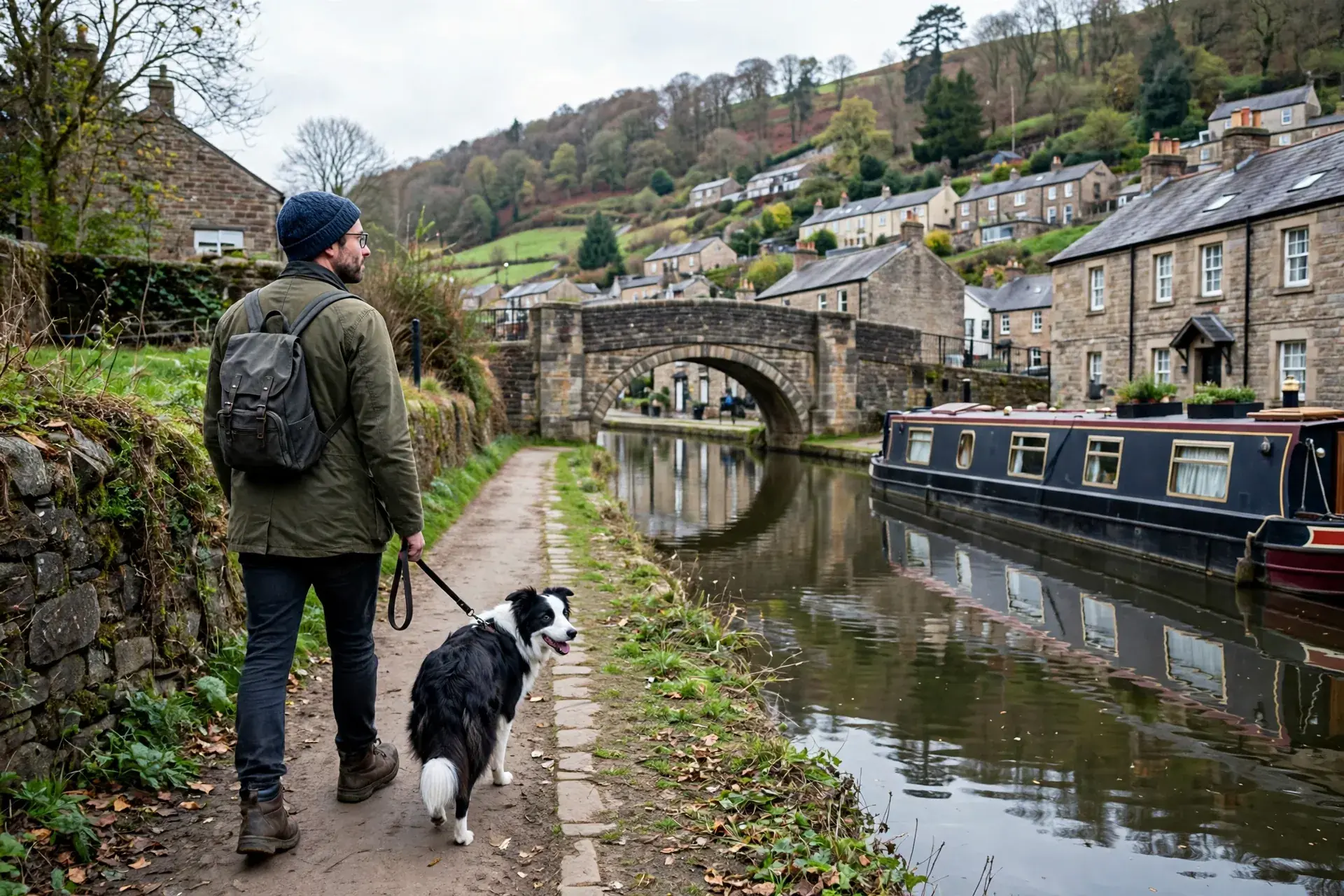
Early on the Rochdale Canal at Hebden Bridge, the water is flat, the towpath is quiet, and a dog can do its most important work of the day: sniffing. The first boats have not yet moved, the ducks are still deciding whether to be interested, and the stone bridges throw long shadows across the cut. This is the hour to let a dog settle into a new place without asking it to cope with crowds, traffic and shop doorways all at once. Walk slowly. Stop at every mooring post, every patch of grass and every bridge arch, because for a dog those pauses are the point, not a delay in the plan.
The towpath here is a working route, not a landscaped park path, and that is part of its charm. Narrowboats moor along the bank, lock gates and bridges interrupt the line, and the surface changes from smooth tarmac to rougher stone and packed earth. For a dog, that variety is enrichment; for an owner, it is a reason to keep the lead in hand and the eyes up. A dog that is allowed to drift to the water's edge at a lock landing can slip, and a dog that lunges at a passing cyclist on a narrow stretch can cause a real problem. The calm version of this walk is a short lead, a steady pace and a habit of stepping aside early, onto grass or a wider section, whenever someone approaches from either direction.
Start with an out-and-back rather than a loop, especially on a first visit. An out-and-back removes the worry of finding your way home from an unfamiliar hillside and lets you turn around the moment the dog's energy dips. Walk twenty minutes in one direction, note a bridge or a moored boat as your turning point, and walk back. Dogs that travel well often look brightest in the first half hour and then fade quietly; turning back while they are still keen leaves you with a dog that arrives back in town relaxed rather than footsore. If the dog is still full of energy after the towpath, that is the time to add a town loop or a gentle riverside stretch, not the time to commit to a long climb you have not yet scouted.
Morning light also makes the town itself easier. Hebden Bridge is compact, built on steep valley sides where the River Calder and the canal thread through a narrow floor, and its streets fill quickly once shops open. A dog that has already had a proper sniffing walk is far more likely to walk politely past other dogs, prams and delivery vans than a dog that has been driven straight into the busiest street. Treat the towpath as the warm-up: water, a toilet stop, a chance to watch boats and ducks from a safe distance, and a slow return past the station and the town centre while the streets are still calm.
One practical habit makes the whole morning smoother: carry everything the dog needs from the car or the station, not from a shop you hope to find open. Water and a collapsible bowl, poo bags, a towel for wet paws and a lead you can shorten with one hand cover almost every towpath situation. In summer, add shade awareness and extra water, because a stone towpath and a dark-coated dog heat up faster than a grassy field walk. In winter, add a drying coat and a plan for muddy paws before the dog jumps back into the car. None of this is complicated, but having it in a pocket beats improvising beside a lock.
The independent town, at dog pace
Hebden Bridge does not feel like a typical Yorkshire market town, and dogs notice the difference before their owners do. The streets are narrow, the shopfronts are small and individual, and the pace is set by people browsing rather than rushing. For a dog, that means more stops, more smells and more strangers offering a greeting — all manageable if the owner sets the tempo. The trick is to walk the town the way you walked the towpath: slowly, with pauses, and with an exit in mind for every street. If a pavement gets crowded, duck into a quieter side street or cross to a wider section rather than pushing a nervous dog through a bottleneck.
The town's independent character is its main attraction and its main planning problem. Small shops, galleries, bookshops and food stalls each set their own dog policy, and a policy that applied last year may have changed with a new owner, a refurbishment or a busy season. A dog that is welcome in one bookshop may be asked to wait outside the next, and that is not a contradiction to argue about — it is a normal feature of independent retail. The polite approach is to look for a sign at the door, ask a member of staff before stepping inside with a dog, and accept a no graciously. Dogs that wait calmly outside for a few minutes while one person browses are often more welcome on a return visit than dogs that have barged through a doorway.
Market days and event days change the calculation. Hebden Bridge hosts markets and community events that bring extra people, stalls, music and food smells into streets that are already narrow. For a confident, sociable dog, a quiet market morning can be a delight: new smells, careful greetings and a chance to practise settling beside a stall. For a reactive, anxious or very young dog, the same morning can be overwhelming, and the kindest choice is a towpath walk and a quiet cafe instead. If you do take a dog to a market, keep the lead short, keep the dog on the side away from the stalls, watch for dropped food, and leave before the dog shows stress — panting, lip licking, yawning, pulling hard or refusing treats are all signals to go, not to push on for one more stall.
Street layout matters more here than in a flat town. Hebden Bridge is built on a slope, so a walk that looks short on a map can involve steps, steep pavements and narrow passages between buildings. Older dogs, dogs with arthritis, very small dogs and dogs recovering from injury will find some streets much harder than others, and a route that climbs from the canal to the upper town and back down again can be a genuine workout. Plan town walking in levels: stay on the valley floor for the easiest route, climb one level at a time with rests, and avoid combining a steep climb with a busy street and a shop visit in the same stretch. A dog that climbs happily on a quiet lane may struggle on the same gradient beside traffic, so separate the challenges rather than stacking them.
Finally, remember that the town is a place where people live and work, not a dog attraction. Residents walk their own dogs on these streets every day, and a visiting dog that is kept under control, cleaned up after and settled quietly outside a cafe is simply being a good neighbour. The reward for that care is real: Hebden Bridge is one of those towns where a well-behaved dog is greeted warmly, offered water outside shops, and remembered on a second visit. That welcome is earned street by street, and it is worth protecting.
Steep valley walks, chosen honestly
Everything around Hebden Bridge is steep. The town sits in a deep valley, and the hillsides rise quickly into woodland, moorland edge and former mill villages, with paths that climb through trees, cross streams and open onto wide views. For a fit, confident dog, those climbs are the highlight of a visit: cool woodland shade, streams to paddle in, and long grassy stretches where a dog can move freely on a long line. For an unfit, elderly or joint-sensitive dog, the same paths are a bad idea dressed up as a scenic walk. The honest question is not whether the walk is beautiful — it is — but whether this dog, on this day, on this ground, will enjoy the way home as much as the way out.
Choose valley walks by gradient and surface, not by distance. A two-mile valley walk with a long, steady climb on a surfaced track is often easier than a one-mile scramble up wet stone steps and muddy woodland. Look for routes that climb gradually, offer flat or gently descending sections for recovery, and avoid long descents on loose stone, which punish knees, hips and paws. If you are unsure about a route, walk the first ten minutes and assess: is the dog pulling eagerly uphill, or already panting and lagging? Is the surface grippy or slick? Is there shade and water ahead? Turning back after ten minutes is not failure; it is good route sense, and it leaves a dog with energy for the towpath and the town afterwards.
Water is a valley-walk feature and a hazard in the same breath. Streams and the River Calder attract dogs, and a paddle on a warm day is a joy, but fast water after rain, steep banks and hidden currents are not safe for swimming. Keep dogs on a lead near fast or swollen water, and check the official guidance before you travel if you are unsure about river conditions or local access rules. Blue-green algae can affect still water in warm weather, and dogs that drink from or swim in affected water can become seriously ill, so steer clear of any water that looks discoloured, scummy or unusually still in summer, and seek veterinary advice quickly if a dog shows symptoms after swimming.
Woodland walks bring their own checklist. Ticks are present in much of the UK countryside, especially in long grass and woodland from spring to autumn, so check your dog after a valley walk, paying attention to ears, armpits, groin and between toes, and remove any tick promptly with a tick remover. Keep dogs under control where livestock may be present — sheep graze on valley slopes and moorland edges, and a dog chasing sheep can cause serious harm and legal trouble for the owner. The rule is simple: if you can see livestock, put the dog on a lead, even if the dog has never chased anything before. A long line gives freedom without giving up control, provided you can manage it safely on narrow paths and near other walkers.
Moorland edges deserve special respect. The high ground above the valley is open, windy and exposed, with few landmarks for a dog that runs ahead and little shelter if weather turns. Dogs that are reliable off lead on enclosed land may still struggle on open moor, where ground-nesting birds, sheep and other walkers' dogs appear suddenly. Keep a lead handy, watch the weather, and remember that a moorland walk that starts in sunshine can end in wind and rain within an hour. A dog that is cold, wet and tired on exposed ground is a welfare issue, not an adventure, so carry a drying coat and a plan to descend quickly if conditions change.
Towpath etiquette: boats, bikes and bridges
The towpath works because everyone gives a little room. Walkers, runners, cyclists, anglers, boaters and dogs all share a narrow strip, and the dogs that do best are the ones whose owners anticipate pinch points rather than reacting to them. At bridges, the towpath often narrows and bends, so visibility drops just where a cyclist may appear. Shorten the lead before the bridge, step to the side, and let the other person pass before continuing. At locks, keep dogs well back from the water, the gates and the moving beams, and never let a dog jump onto a boat without the boater's permission — a narrowboat deck is someone's home, and a wet, muddy dog arriving uninvited is not a welcome surprise.
Moored boats deserve a particular courtesy. Dogs walking the towpath will pass boats where other dogs live aboard, where cats sit on cabin roofs, and where people are eating, sleeping or working a few feet from the path. A dog that barks at every boat, lunges at a cabin window or tries to drink from a water point beside a mooring will quickly become a nuisance. Keep the dog on the towpath side, move past moorings steadily, and reward calm behaviour as you pass. If your own dog lives aboard or travels by boat, our guide to canal boat holidays with a dog covers locks, life jackets, mooring routines and the towpath habits that make boat life work.
Cyclists are the fastest towpath users and the most common source of friction. Many cycle considerately and ring a bell in good time; some do not, and a dog on a long lead stretched across the path is a trip hazard for everyone. The safest habit is to keep the lead short on narrow sections, keep the dog on one side consistently, and glance behind before changing direction. If you use a long line, reel it in whenever you hear a bell, see a cyclist approaching, or reach a bridge, a lock or a mooring. A dog that has learned to step aside and sit while a bike passes is a dog that can enjoy the towpath for years without incident.
Other dogs are the other towpath variable. The towpath is a social space, and most encounters are brief and polite, but narrow paths remove the option of a wide arc around an unknown dog. If your dog is reactive, choose quieter times, keep a generous distance where the path allows, and turn the dog away calmly rather than tightening the lead into a confrontation. If your dog is friendly, do not assume every other dog wants to meet: ask the other owner first, keep the greeting short, and move on while both dogs are still relaxed. Off-lead play on the towpath itself is unfair to everyone else using the route; save it for a field or a wide grassy bank where dogs can move freely without blocking the path.
Wildlife adds another layer. Swans with cygnets, ducks with ducklings, herons standing motionless at the water's edge and rats along the bank are all part of the canal ecosystem, and a dog's prey drive does not switch off because the setting is picturesque. Keep dogs under control near waterfowl, especially in spring when young birds are vulnerable, and be ready for a sudden lunge at a duck that appears from reeds. A dog that chases a swan into the water can be injured, and a dog that corners a nesting bird has done real harm. The towpath is at its best when dogs are treated as guests in a shared habitat, not as the main event.
Cafes, bookshops and small shops with a dog
A Hebden Bridge cafe stop works best when the dog arrives already exercised and ready to settle. A dog that has walked the towpath, had water and a toilet break, and then lies down under a table is a pleasure to have in a cafe; a dog that has been cooped up in a car and arrives buzzing with energy is a challenge for staff, other customers and itself. Choose a table with space — a corner, a window seat with floor room, or an outdoor table with shade — rather than squeezing a large dog into a busy aisle. Lay a mat or blanket if your dog uses one, offer water first, and settle the dog before ordering, so the first minutes in the cafe are calm rather than chaotic.
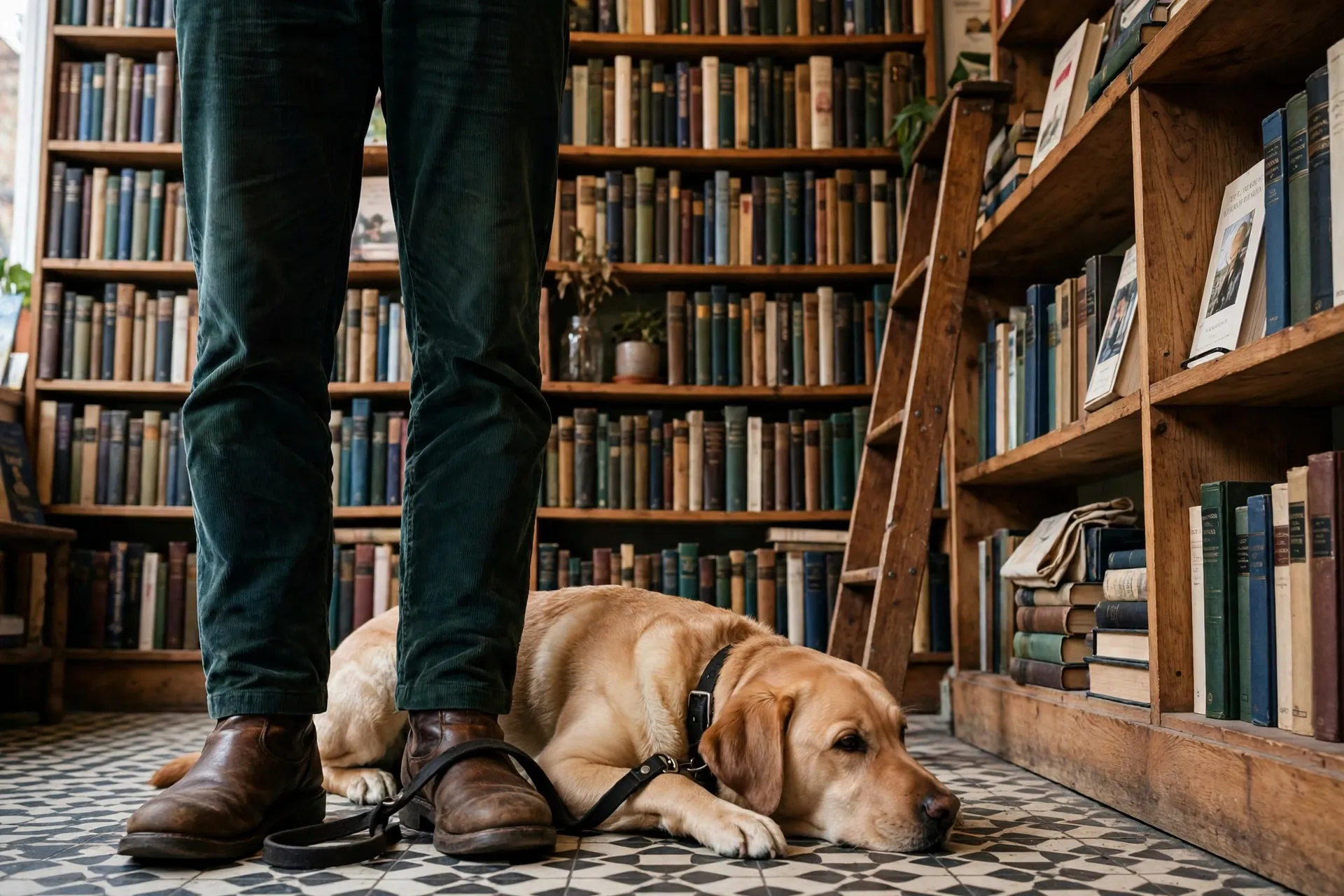
Bookshops are a particular Hebden Bridge pleasure, and many welcome dogs, but they reward a different kind of behaviour from cafes. A bookshop dog needs to lie quietly, ignore shelves at nose height, and tolerate people reaching past to browse. That is a lot to ask of a young or excitable dog, so start with a short visit and build up. Keep the lead short, keep the dog away from low displays and tottering piles, and watch the tail — a happy wag at shelf height can clear a display in seconds. If the dog cannot settle, step outside, walk a quiet street, and try again later or another day. Our wider guide to dog-friendly bookshops in the UK explains in-store etiquette, chain versus independent policies, and how to plan a book-town day that works for the dog as well as the reader.
For general cafe manners, the same principles apply everywhere: ask before entering, keep the dog under the table or beside your chair rather than sprawled across a walkway, clean up any mess immediately, and do not feed the dog from the table. Dogs that beg, bark at other dogs or climb onto furniture will not be welcome for long, and a single bad visit can change a cafe's policy for everyone. Our guide to dog friendly cafes in the UK covers how to check before you go, indoor etiquette and what to do when a cafe is full or unexpectedly dog-free on the day.
Small shops need a lighter touch still. A narrow shop with fragile stock, a single aisle and a dog that pulls is a recipe for breakage, so judge each shop on its size and layout. In a spacious shop with a clear floor, a calm dog on a short lead is usually fine; in a tiny shop full of ceramics, textiles or low displays, the kinder choice is for one person to browse while the other waits outside with the dog. Staff in independent shops generally appreciate being asked, and a brief, friendly question — “Is it all right to bring our dog in if she stays on a short lead?” — opens a conversation that a silent entrance does not. If the answer is no, thank them and move on; there are plenty of other shops in Hebden Bridge.
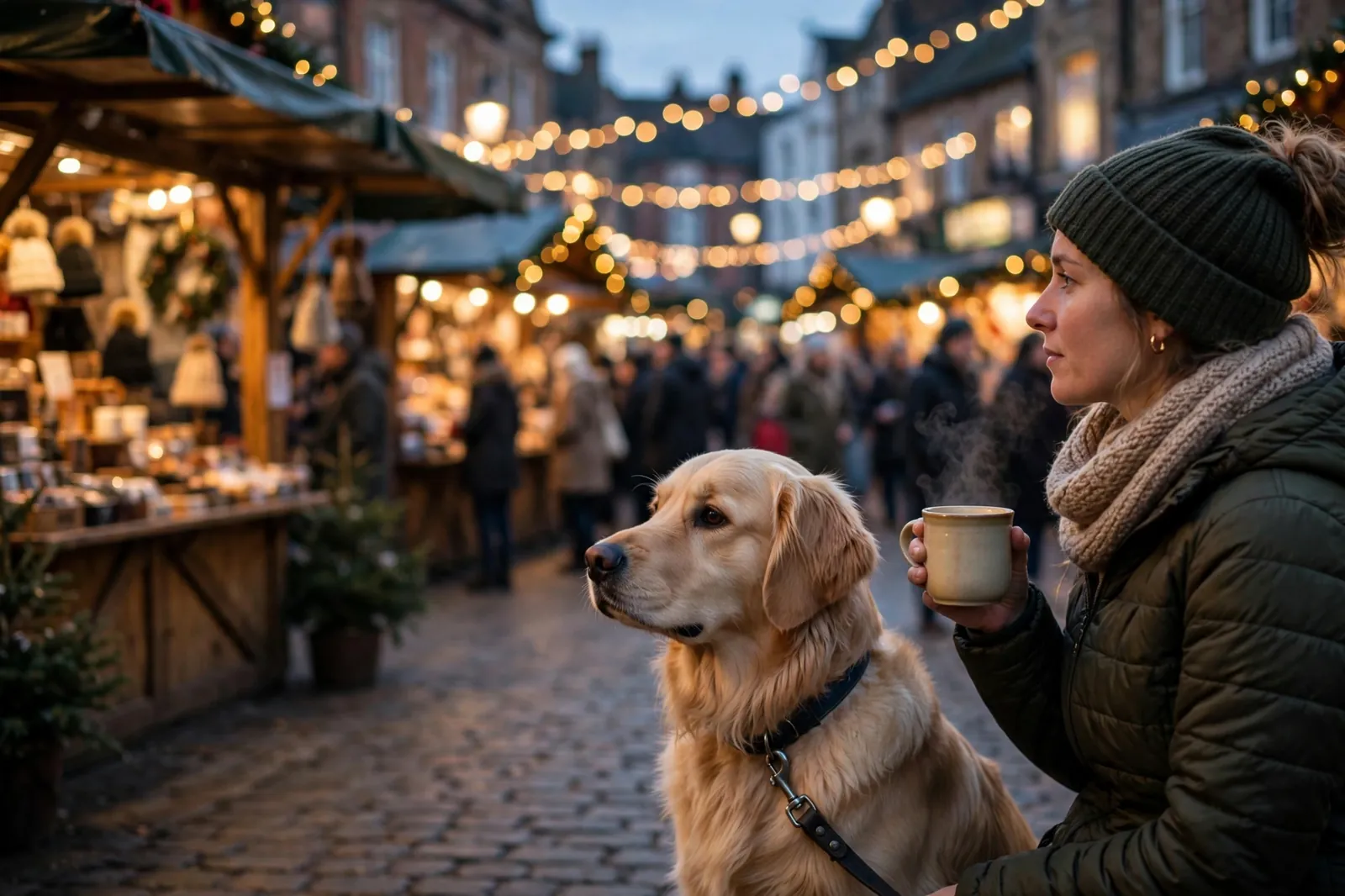
Food stalls and markets raise the stakes because food is everywhere at dog-nose height. Dropped food, hot grills, sharp skewers and allergenic ingredients are all within reach of a curious dog, and a dog that scavenges at a market stall can eat something harmful before an owner notices. Keep the dog on the far side from the stalls, keep the lead short, and practise a solid “leave it” before a market day. If the dog is a persistent scavenger, a muzzle trained positively at home can be a sensible, stigma-free tool for market visits — it protects the dog, reassures stallholders, and lets everyone enjoy the market without a veterinary emergency.
Rain, mud and the wet-weather plan
Hebden Bridge in rain is not a ruined day; it is a different day, and dogs often prefer it to a hot, crowded one. The towpath stays walkable in most rain, the town's cafes and bookshops become cosier, and the valley smells — damp earth, wet stone, river water — are a feast for a dog's nose. What changes is the ground underfoot and the drying routine afterwards. Valley paths on clay soil turn slick quickly, stone steps become treacherous, and a dog that walks happily on a dry track may slip repeatedly on the same route when wet. Choose surfaced or well-drained paths in rain, shorten valley climbs, and keep the towpath as your reliable fallback.
Mud management starts before the walk, not after it. A towel in the car, a second towel in a bag, and a drying coat for the dog turn a muddy return into a five-minute routine instead of a wrestling match. Wipe paws before the dog enters a cafe, a shop or a car, and check between toes for grit, small stones and thorns picked up on wet paths. Dogs with long coats will collect mud on legs and bellies; a quick brush after drying prevents matting and lets you spot ticks, cuts or sore pads while they are still minor. If the dog's paws are cracked or sore, paw balm applied before the walk and a check afterwards help, but a dog that is limping or refusing to walk needs rest and, if it persists, veterinary advice — not another mile.
Wet weather also changes what to wear and carry. Waterproof boots with grip matter more than waterproof jackets on valley paths, because the hazard is slipping, not getting wet. A phone in a waterproof pouch, a head torch if a walk might run into dusk, and a charged battery are sensible on any hill walk, and they become essential when rain reduces visibility and paths become harder to follow. Tell someone your route and expected return time on longer valley walks, especially in poor weather, and keep to paths you can navigate in low cloud. The valley's steep sides and woodland can be disorienting in mist, and a dog that runs ahead in fog is harder to recall safely.
When rain is heavy or persistent, the honest wet-weather plan is town-based: a towpath walk in a lull, a bookshop browse, a long cafe stop, and a short riverside stretch between showers. Dogs do not need a heroic walk to be content; they need movement, sniffing, company and rest. A day built around three short outings with long settles in between often leaves a dog calmer than a single long, wet, forced march. Watch for shivering in small, short-coated or elderly dogs, dry them promptly, and offer a warm, draught-free resting place after a wet walk. A dog that is cold and wet for hours after a walk has not had a good day, however scenic the route.
Arriving, parking and getting around
Hebden Bridge is a small town with limited parking, steep streets and a station close to the centre, so the arrival plan shapes the day more than in a larger town. Drivers should expect car parks to fill on market days, sunny weekends and event days, and should allow time to walk from a car park to the towpath or the town centre rather than circling for a closer space while a dog waits in a hot or cold car. Never leave a dog alone in a parked car in warm weather, even briefly — cars heat up dangerously fast — and in cold weather a dog left alone in a car is still at risk and may bark, drawing attention and distress. Plan to park once, walk everywhere, and return to the car only at the end of the day.
Arriving by train is a genuine option, and Hebden Bridge station sits conveniently near the town centre and the canal. Train travel with a dog, however, needs its own preparation: a dog that is calm on a quiet local train may struggle on a crowded peak service, and station platforms, ticket gates and busy concourses are stressful for nervous dogs. Travel off-peak where possible, choose a quieter carriage, keep the dog under control on the platform and away from the platform edge, and check the official guidance before you travel for the current rules of the train operator you will use. If the dog is large, bring a mat for the train floor; if the dog is small, a carrier that the dog already knows can reduce stress considerably.
Once in town, getting around is mostly on foot, which suits dogs. The valley floor — canal, riverside and main streets — is walkable without a car, and most visitors will not need to drive again until they leave. Buses serve the wider Calder Valley, but bus rules for dogs vary by operator and route, so check before relying on a bus with a dog, especially for a return journey from a valley walk. Taxis that accept dogs exist, but availability in a small town can be limited, so book ahead if you might need one — for example, if a walk ends further from town than planned or a dog becomes tired or lame mid-walk.
Accessibility is a real consideration in a steep valley town. Step-free routes exist on the valley floor, but many streets, shops and paths involve steps, steep gradients or narrow pavements. Wheelchair users, pushchair users and owners of dogs with mobility problems should plan valley-floor routes carefully, check step-free access to specific venues in advance, and avoid assuming that a shop or cafe marked dog-friendly is also step-free. If you travel with both a mobility need and a dog, the towpath and the flattest town streets are the safest starting point, and a phone call ahead to a venue saves a wasted climb.
Finally, think about the end of the day as part of the arrival plan. A dog that has walked hills, browsed shops and settled in cafes will be tired, possibly muddy and possibly wet, and the journey home — by car or train — needs water, a towel, a comfortable resting place and a toilet stop before departure. A last towpath stroll before leaving, a drink, and a calm settle in the car or on the train turn a good day into a good journey home. Dogs remember the ending of a day as much as the middle, and a rushed, uncomfortable departure can undo an otherwise excellent visit.
Seasons in the Calder Valley
Spring in Hebden Bridge brings woodland flowers, lambs on valley slopes, longer days and the first warm towpath walks of the year. It also brings mud from winter rain, nesting birds that need distance, and lambs that demand dogs on leads wherever livestock graze. Spring is an excellent season for a first visit, provided the dog is kept on a lead near livestock and nesting areas and valley paths are chosen for drainage rather than views alone. Early spring can still be cold on high ground, so a drying coat and a warm layer for the dog are worth packing even when the town feels mild.
Summer is the busiest season and the one that needs the most care. Towpaths and town streets fill with visitors, canal boats move more frequently, and markets and events add crowds and food smells. Heat is the main risk: dogs overheat quickly, especially brachycephalic breeds, elderly dogs and dark-coated dogs, and a steep valley climb in midday heat is a poor choice for any dog. Walk early or late, stick to shaded woodland and the towpath in the middle of the day, carry extra water, and never leave a dog in a parked car. Summer also brings blue-green algae risks in still water and more insects, so check water before letting a dog paddle and check for ticks after woodland walks.
Autumn may be the best season for a dog visit. The crowds thin, the valley colours turn, the air cools, and dogs that struggled in summer heat come alive on crisp mornings. Autumn hazards are quieter but real: wet leaves on stone steps are slippery, conkers and acorns on woodland paths are toxic if eaten in quantity, and shorter days mean a walk that starts in daylight can end in dusk. Carry a light, keep dogs from eating fallen conkers and acorns, and plan valley walks to finish well before dark. Fireworks season in late autumn and early winter can distress noise-sensitive dogs, so check whether local events are planned and keep anxious dogs indoors or on a familiar, quiet route on display nights.
Winter in the Calder Valley is atmospheric — mist in the valley, frost on the towpath, quiet streets and warm cafes — but it demands respect. Valley paths can ice over, stone steps become treacherous, and short days limit walking time. Dogs with arthritis often stiffen in cold weather, so warm up with a gentle towpath walk before any climb, keep winter walks shorter, and dry and warm the dog promptly afterwards. Ice on the canal is not safe for dogs or people, and dogs should never be encouraged onto frozen water. On the other hand, a crisp winter towpath walk followed by a cafe stop is one of the simplest pleasures Hebden Bridge offers, and it suits dogs of almost every age and fitness level.
Practical dog care on a valley day
A valley day asks more of a dog than a flat park walk, so the care routine needs to match. Start with fitness honesty: a dog that walks comfortably for an hour on flat ground is not automatically ready for an hour of steep climbing, and a dog that runs happily off lead in a field may still struggle with sustained gradients. Build valley fitness gradually over weeks, not in a single visit, and watch for the signs that a dog is tiring — lagging behind, panting heavily long after stopping, lying down on the path, or refusing to climb. Those are signals to turn back, rest and offer water, not to encourage the dog onward with treats.
Feeding and water need a valley-day adjustment. Feed a normal meal well before a long walk rather than immediately beforehand, because exercise on a full stomach increases the risk of bloat in larger, deep-chested breeds, and carry water even on short walks — streams are not a reliable drinking source, especially where algae, livestock or agricultural run-off may affect water quality. Offer small drinks often rather than a large drink all at once after a climb, and watch for a dog that drinks excessively or refuses water, both of which can signal overheating or illness. After the walk, feed at the normal time and let the dog rest properly before any further excitement.
Paw care deserves a paragraph of its own in a valley town. Stone steps, rough towpath surfaces, wet clay and moorland grit all wear paws, and a dog that is footsore on the way home will limp for days afterwards. Check paws before the walk for existing cracks or soreness, check again at the halfway point on longer walks, and check thoroughly afterwards, removing grit and thorns and looking for cuts between toes. Boots can help dogs with sensitive paws or dogs recovering from injury, but only if the dog has been introduced to them gradually at home — a first-time boot on a steep path is a distraction, not a solution.
Behaviour in town and on paths is part of care, not separate from it. A dog that can settle on a mat in a cafe, walk politely past other dogs on a narrow towpath, and recall reliably from a distraction is a dog that gets invited to more places. Those skills are built at home and in quiet local settings before a visit, not improvised in a busy market street. If your dog is still learning, choose quieter times, shorter visits and easier routes, and celebrate small successes — a calm pass of another dog, a settle under a cafe table, a recall from a duck — rather than expecting a perfect day. Hebden Bridge rewards patience: the town is at its best when visited slowly, and so is the dog.
Finally, know the local safety net before you need it. Save the number and address of a nearby veterinary practice before setting out, and know where the nearest emergency vet is if you are visiting at a weekend or in the evening. Carry a basic first-aid kit — a bandage, antiseptic wipes suitable for dogs, tick remover, and any regular medication the dog needs — and know the signs that mean a vet visit rather than rest: persistent limping, vomiting or diarrhoea, difficulty breathing, collapse, or a wound that will not stop bleeding. A valley day is a pleasure, but a prepared owner is what keeps it one.
A calm day plan that actually works
The day plan that works in Hebden Bridge is deliberately unambitious. Morning: arrive, walk the towpath out and back, let the dog sniff, drink and settle. Late morning: browse the town streets slowly, with a cafe stop where the dog can lie down properly. Lunch: a longer settle, water, and a toilet break on a quiet street or a return to the towpath. Afternoon: either a gentle valley climb if the dog is fit and the ground is good, or a second towpath stretch and more town browsing if it is not. Late afternoon: a final towpath stroll, a drink, and a calm journey home. That plan leaves room for weather, for a dog that tires early, and for a shop or a view that deserves an extra half hour.
The common mistake is to stack the day: towpath, then market, then a long hill walk, then three shops, then a cafe, all before lunch. Dogs, like people, have a budget for novelty, and a dog that has spent its budget by midday will be reactive, restless or withdrawn for the rest of the day. Spreading the highlights across the day, with genuine rest between them, produces a dog that enjoys the last walk as much as the first. If the dog falls asleep under a cafe table, let it sleep — that sleep is the dog consolidating a good morning, not wasting the day.
For a longer stay, Hebden Bridge makes a good base for the wider Calder Valley. Nearby towns, villages and valley walks offer different terrain — flatter canal stretches in one direction, wilder moorland in another — and a multi-day visit lets you match each day to the weather and the dog's energy rather than cramming everything into one day. If you stay overnight, choose accommodation where the dog's routine can stay close to home: a familiar bed, a normal feeding time, and a practical last outing before bed. A dog that sleeps well on the first night will walk better on the second day, and that simple fact shapes a whole trip more than any single attraction.
If you are planning a wider canal trip, remember that Hebden Bridge is one stop on a much longer waterway network, and the habits that work here — short leads at bridges, courtesy at moorings, calm passes of cyclists — scale to any towpath. For visitors combining a town day with a market visit elsewhere, our guide to dog friendly Christmas markets in the UK covers festive crowds, paw safety and calmer alternatives, which are useful far beyond December: the crowd skills it teaches apply to any busy market day in Hebden Bridge too.
Above all, let the dog set the pace on the day itself. Plans are useful, but a dog that is clearly tired, anxious or footsore is telling you something that no guide can override. Cut the walk short, find a quiet cafe, sit by the canal and watch the boats, and call it a good day — because for the dog, it will have been. Hebden Bridge, with its water, its hills and its independent streets, is a town that rewards exactly that kind of unhurried visit, and dogs that are allowed to take it slowly tend to be the ones that are welcomed back most warmly.
Practical questions
Before you go
Is Hebden Bridge a good town for a day out with a dog?
Yes, for dogs that enjoy town walking, water and hills in short doses. The canal towpath gives a flat, easy start, the compact centre is walkable on a lead, and the surrounding valley offers much steeper walks for fitter dogs. The trade-off is gradient: many routes out of town climb quickly, so plan a flat route for older or smaller dogs and a hill route only when the dog is fit and the ground is dry enough.
Can dogs walk the Rochdale Canal towpath at Hebden Bridge?
Yes, the towpath is a public route used by walkers, cyclists and boaters, and dogs on leads are a normal sight. Keep your dog close at bridges, locks and moored boats, give cyclists room to pass, and watch for swans, ducks and other dogs at narrow pinch points. Towpath surfaces and access can change after heavy rain or maintenance work, so check the official guidance before you travel.
Are dogs welcome in Hebden Bridge shops and cafes?
Many independent shops and cafes in Hebden Bridge welcome dogs, but policies are set shop by shop and can change, so never assume. Look for a sign at the door, ask before entering a small shop, and keep your dog settled on a short lead away from displays. If a place is full, noisy or short on floor space, it is kinder to both the dog and the staff to come back at a quieter time.
What is the best walk for a dog that cannot manage steep hills?
Stay on the canal towpath and the flatter riverside stretches rather than climbing out of the valley. A gentle out-and-back along the towpath lets the dog sniff, watch boats and stop often without a long climb home. Turn back while the dog is still enjoying it, carry water, and avoid routes that end with a steep descent, which is often harder on joints than the climb up.
What should I pack for a muddy Hebden Bridge walk?
Pack a lead and a long line if you use one, poo bags, water and a bowl, a towel and a drying coat, and a spare bag for a muddy lead. Valley paths after rain can be slick clay, leaf litter and wet stone, so wear boots with grip and consider paw balm or boots for dogs with sensitive paws. A charged phone, a basic first-aid kit and the number of a local vet are sensible for any hill walk.
Is Hebden Bridge easy to reach without a car when travelling with a dog?
Hebden Bridge has a railway station close to the town centre, which makes a car-free day trip possible for many visitors, but train rules, crowding and step-free access vary, so check the official guidance before you travel. Arrive with a plan for a quiet carriage or off-peak train if your dog is nervous, keep the dog under control on the platform, and remember that the walk from the station into town is short but busy at peak times.