This guide is independent and contains no paid placement. Village facilities, parking rules and dog policies change, so check the official guidance before you travel and confirm details with individual venues on the day.
Sort the arrival before the walk: park where you can unload safely, give the dog a short, quiet first toilet walk, and only then follow a lane-based village loop. Keep the dog on a lead in narrow lanes and near water, treat every pub and cafe policy as venue-specific, and do not confuse this smaller village setting with the larger town of Hebden Bridge.
Arrival, parking and the first toilet walk
The hardest part of a village day with a dog is rarely the walk itself. It is the first five minutes after the car door opens, when a dog that has been still for an hour suddenly faces traffic, new smells, other dogs, a narrow lane and a human who is still trying to read a map. Hebdon Bridge rewards a slower start. The lanes here are village lanes, not high-street pavements: stone walls leave little room to step aside, sightlines around bends can be short, and a parked car, a delivery van or a tractor can change the whole shape of the road in seconds. Plan the arrival as its own task, separate from the walk, and the rest of the day becomes much easier.
Before you leave home, settle the name problem. Hebdon Bridge and Hebden Bridge look almost identical on a screen and sound almost identical when spoken aloud, yet they are not the same destination, and this guide is written for the smaller Calder Valley village setting named in its title. Type the full destination into your navigation app, check the postcode and the map pin rather than trusting the first autocomplete suggestion, and read the route preview for the last few miles. If the approach suddenly looks like a busy town centre with a station, a canal basin and a long shopping street, pause and recheck, because that picture belongs to the larger town. A wrong turn here does not ruin a day, but it does waste the calm arrival window, and it puts a dog that needed a toilet walk into a busier place than you intended. Confirm the exact destination, and check the official guidance before you travel for any roadworks, closures or diversions on your route.
Parking in a small village is a question of manners as much as of space. Look for a lawful parking place that is level, wide enough to open a door fully, and clear of driveways, gateways, passing places and field entrances. A space that looks tempting on a bend, opposite a junction or beside a narrow bridge can be the worst choice for a dog owner, because unloading becomes a negotiation with passing traffic. A slightly longer walk from a quieter, wider spot is almost always the better trade: it gives the dog room to stretch, gives you time to clip the lead on before the dog is loose near a road, and avoids blocking the very lane that residents, farm vehicles and other walkers need. Never block a gateway, a passing place or a private drive, even for a few minutes, and never park on a grass verge that is clearly soft, planted or signed as protected. If every lawful option is full, treat that as useful information rather than a reason to improvise: drive on, find a wider nearby parking area, or shorten the visit and return at a quieter time.
Unload in a fixed order and keep it the same every time, because dogs learn routines faster than they learn new places. Stop the car, put the handbrake on, gather bags, water and a short lead before opening the dog's door, and clip the lead on while the dog is still in the car. Open the door only as far as you can control, let the dog step out onto the side away from traffic where possible, and close the door before you turn to check the map or take a photograph. A dog that bolts from an open car into a lane is not being naughty; it is responding to a whole new valley of smells after a confined journey. The routine prevents the problem before it starts. For a nervous dog, add one more step: stand beside the car for a minute, let the dog sniff the air and the verge, speak calmly, and offer water. For an excitable dog, add the opposite discipline: no greeting of passers-by, no long-lead freedom and no dash to the nearest interesting smell until the lead is short, the harness is checked and you are standing somewhere safe.
Now find the first toilet walk, and keep it deliberately short. This is not the scenic loop, and it does not need a view. It needs a quiet stretch of grass, verge or lane where the dog can sniff, circle and go without crossing traffic, meeting a stream of other dogs or climbing a steep bank. Walk away from the busiest part of the lane, keep the dog on a short lead, and let sniffing do the work: a dog that is allowed to investigate a verge for five unhurried minutes will often settle far better than a dog that is marched straight onto a longer route while still bursting. Take bags, and take a spare, because a village with no shop open and no bin in sight is exactly where a second bag becomes valuable. Bag the waste, carry it until you find a proper bin, and never leave a bag on a wall, a gate or a verge for collection later. In a small community, that single habit shapes how welcome the next dog walker feels.
Use the first walk to read the village at dog height. Notice where the lane narrows, where a wall forces walkers into the road, where a side lane joins without warning, and where a dog behind a gate is likely to bark as you pass. Notice the stream, too: a small Calder Valley stream looks inviting to a dog, but banks can be steep, stones can be slippery, and water levels can rise quickly after rain upstream. Keep the dog on a lead for this first look, even if the lane feels empty, because a quiet lane can produce a car, a cyclist or a loose dog around the next bend with no warning. If the dog is still pulling, panting or scanning frantically after ten minutes, that is not a failure; it is a signal to repeat the short loop, offer water again, and delay the longer walk until the dog's breathing and body language have softened. A calm dog enjoys a village far more than a rushed dog covers distance in one.
Finally, before the main loop, do the small checks that prevent the common village mishaps. Check that the lead clip is closed, the harness is not twisted, and the collar or harness carries identification as required. Check that your phone has charge and signal for the return journey, and that you know roughly where the car is in relation to the loop, because village lanes can look alike when walked in reverse. Put the car key somewhere it cannot fall into a stream or a deep pocket of mud, and keep a towel in the car even on a dry-looking day. Calder Valley weather changes across a hillside, and a dog that paddles in a stream in the morning may need that towel long before lunch. These are unglamorous checks, but they are the difference between a village day that feels easy and one that feels like a series of small emergencies.
The village walk loop
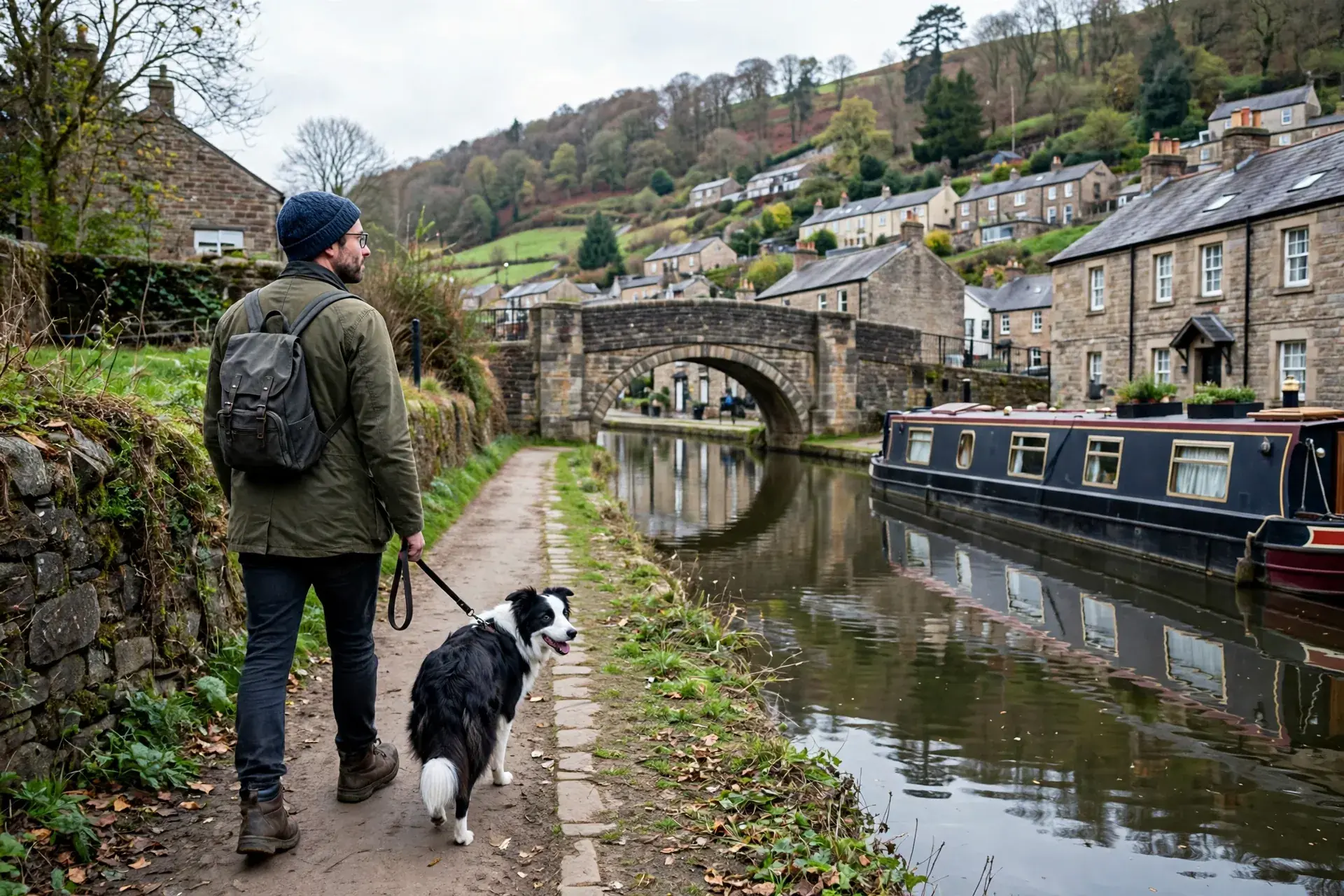
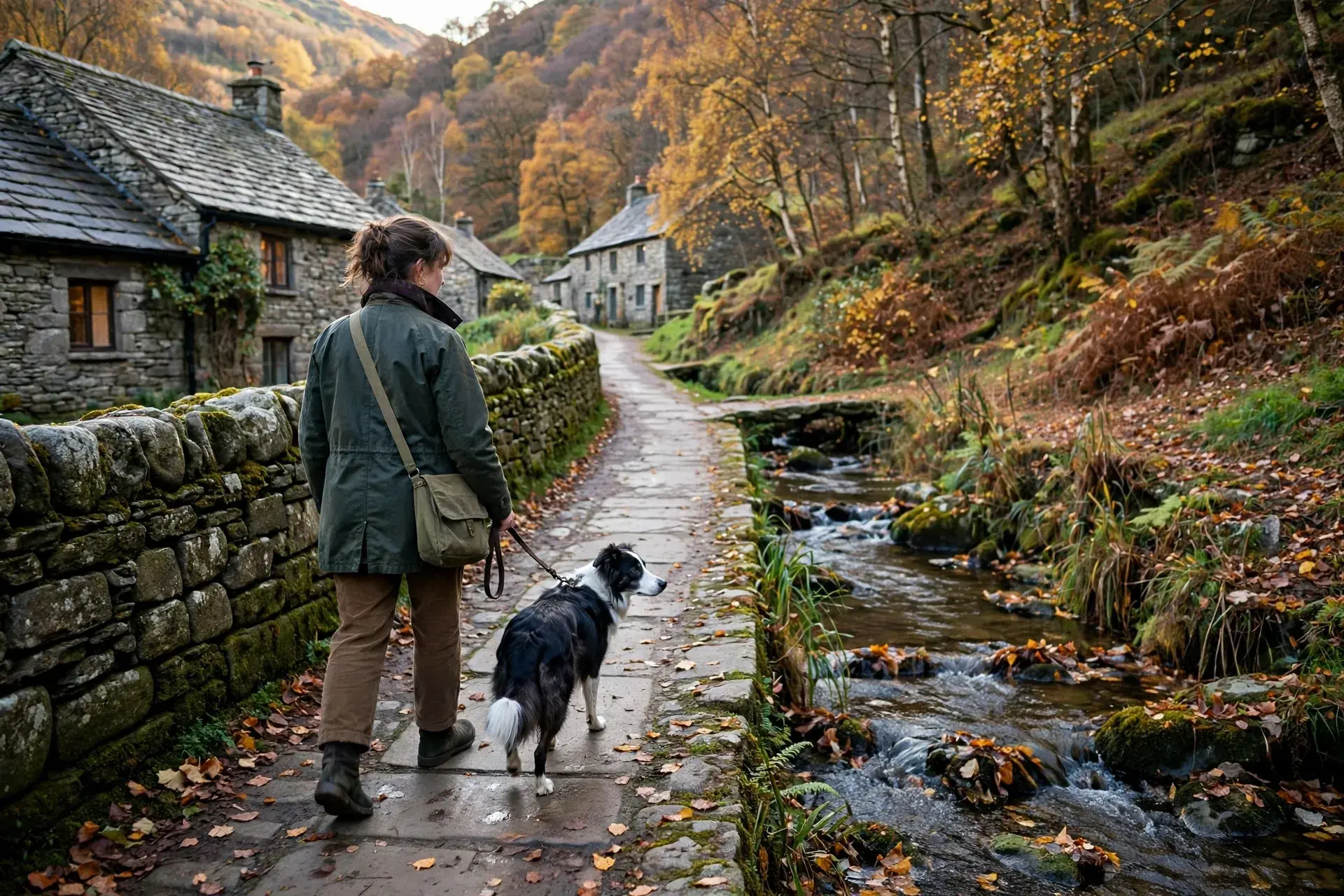
Think of the Hebdon Bridge walk as a loop built from lanes, not as a single there-and-back trail. A loop suits a village because it spreads walkers out, avoids retracing the narrowest section twice, and gives you natural decision points: at each junction you can shorten the route, extend it, or turn back toward the car without a long retracing walk. Start with the quietest lane section you found on the first toilet walk, keep the same direction of travel as other walkers where a natural flow exists, and hold the dog on a short lead through every built-up stretch. The village rewards patience: stone cottages, garden walls, a stream crossing and a wooded hillside above the lane are best enjoyed at a sniffing pace, and a dog that is allowed to stop and investigate will tire more honestly than a dog that is kept trotting to keep up with a timetable.
Walk the lane as if you were sharing it with people who live there, because you are. Keep to the side that gives you the best view of oncoming traffic, and step into a gateway or a wider section whenever a vehicle approaches. Shorten the lead before the vehicle reaches you, not as it passes, and put your body between the dog and the road where the lane allows. If the lane is so narrow that there is no safe refuge, wait in a visible, straight section rather than pressing on around a blind bend, and be ready to turn back. Cyclists deserve the same courtesy: a dog on a long lead across a lane is a hazard to a cyclist who cannot stop on a downhill stone surface, so reel the lead in, call the dog close, and stand still until the cyclist has passed. The same rule applies in reverse to other dog walkers: ask before dogs greet, keep greetings short, and move on if either dog stiffens, stares or pulls hard toward the other.
Stone walls, gates and field boundaries are part of the walk, and they are also where village etiquette is tested. Close every gate you open, even if it was already open, unless a sign clearly says otherwise, and check that a latch has caught before you walk away. Do not let a dog push through a hedge, climb a wall or enter a private garden, however inviting the garden smells. If a path runs beside grazing land, keep the dog on a lead, keep well away from livestock, and never allow chasing, barking at animals through a fence, or running along a fence line. Lambing season, nesting birds and young livestock all make this rule more important, not less, and a farmer who sees a controlled dog on a lead is far more likely to keep a path welcoming than one who sees a dog loose among animals. Where a path crosses a field, follow the marked line rather than cutting a corner across crops or grass, and if a stile or kissing gate is awkward for your dog, lift a small dog over carefully or choose a different section of the loop rather than forcing a frightened dog through a gap.
The stream is the most attractive and the most underestimated part of the loop. A small stream in a Calder Valley village can be shallow at one crossing and surprisingly deep a few metres downstream, and a bank that looks like grass can be undercut, muddy or covered in wet leaves. Let the dog paddle only where the bank is low, the water is slow and clear, and you can see the bottom and the exit point on the other side. Keep the lead on for the first visit to any new water, because a dog that charges into a stream can slip, swallow water, or scramble out on a bank where it cannot get back to you. After paddling, check paws for cuts from sharp stones, check ears for trapped water if your dog is prone to ear problems, and towel the legs before the dog gets back into the car. If the water is fast, brown, high after rain, or posted with any local warning, skip the paddle entirely and enjoy the stream from the lane. A missed paddle is a small disappointment; a dog swept a few metres downstream or stranded on a slippery bank is a genuine emergency.
Build rest stops into the loop rather than treating them as failures. A bench, a wide verge, a low wall where the dog can sit beside you, or a quiet stretch of lane with a view up the wooded hillside all make good pauses. Offer water at each pause, not only when the dog is panting hard, because dogs in cool valley air can dehydrate quietly while they are busy sniffing. Watch for the signs that the loop should shorten: lagging behind, lying down, limping, excessive panting, or a sudden loss of interest in smells that were exciting ten minutes ago. Older dogs, puppies, brachycephalic breeds and dogs recovering from illness or injury need shorter loops with more pauses, and a loop that is perfect for a fit adult spaniel can be too long for a senior terrier. There is no prize for completing the longest version of a village walk, and turning back early with a happy dog is a better day than finishing a route with an exhausted one.
End the loop the way you started it: slowly. As you approach the car, shorten the lead again, keep the dog away from the road edge, and give a final short toilet opportunity on a quiet verge before loading. Towel muddy paws at the car, not inside it, and check the dog's coat for burrs, ticks after grassy sections, and mud packed between toes. Load the dog calmly, offer water, and only then pack away bags, maps and towels. This closing routine matters because the drive home is part of the day for the dog too: a wet, muddy, overexcited dog loose in a car is unsafe, and a dog that is settled, dry and watered will travel far more calmly. If the loop has left you with questions about a path, a gate or a busy section, note them while they are fresh, because the same notes will make a return visit smoother, and they will help you explain the route to another dog owner who asks.
Pubs, cafes and settling indoors
A village pub or cafe can turn a good walk into a great day, but only if the dog can actually settle there. The most common mistake is to assume that a single sign, a water bowl outside, or a photograph of a dog on social media means dogs are welcome everywhere in a venue, at all times, and without conditions. In practice, policies are venue-specific and can change with the season, the time of day, the area of the building, and whether food is being served. One venue may welcome dogs in a bar area but not in a dining room; another may welcome dogs in a garden but ask them to stay outside in wet weather; a third may welcome dogs only if they stay on a lead under a table and do not approach other tables. Check the official guidance before you travel, and confirm with the individual venue on the day, ideally before you sit down with a tired, muddy dog and a hope that the answer will be yes.
Choose the venue the way you chose the parking space: for fit, not for fame. A quiet corner table near a door, where the dog can lie on a blanket without blocking a walkway, is worth more than a popular central table where every passer-by must step over a lead. Ask where dogs are welcome, where the water bowl is, and whether there is a garden area with shade or shelter, and accept the answer gracefully even if it is not the one you wanted. If the dog is muddy, towel the paws before entering, and use a blanket or mat so the dog is not lying directly on a floor that other visitors must keep clean. A dog that has its own familiar blanket settles faster, because the blanket smells like home in a room that smells like cooking, other dogs and strangers. Bring water, because a communal bowl may be empty, shared with an unknown dog, or placed where your dog must cross a busy room to reach it.
Settling is a skill, and a village cafe is a fair place to practise it only if the dog already has the basics. Before the visit, make sure the dog has had a toilet walk, a drink and a chance to burn off the first excitement of arrival, because a dog that enters a cafe still bursting from the car is likely to bark, pull and beg. Once inside, keep the lead short and under your foot or chair leg, so the dog cannot wander to other tables, steal food or tangle a server's legs. Reward quiet lying down, ignore demanding barking rather than feeding it, and keep treats low and discreet. If the dog barks repeatedly, paces, whines or cannot settle after a reasonable few minutes, that is information, not disobedience: take the dog outside for a calm reset, shorten the visit, or choose a takeaway and a bench outside instead. Leaving gracefully with a calm dog preserves the welcome for the next dog owner far better than persisting with a stressed one.
Food etiquette matters as much as the welcome itself. Do not feed the dog from the table, do not let the dog beg from neighbouring tables, and keep the dog's own food and chews tidy and quiet. A long-lasting chew can help a dog settle, but only if it is not noisy, smelly or likely to be guarded from a passing dog. Be aware of other visitors: some people are allergic, frightened or simply not dog lovers, and a village venue must work for them too. Keep the dog out of the way of servers carrying hot food and drink, and never tie a lead to a chair that can be dragged, a table leg that can be pulled, or a door handle that must stay clear. If you need to leave the table, take the dog with you or ask a companion to hold the lead; a dog left alone at a table in a strange room is likely to bark, slip its lead or panic.
Weather changes the cafe and pub question in a village. On a warm day, a garden may be the easiest option, but check for shade, water and a secure boundary, because a garden gate left open by another visitor can undo a whole morning's careful lead work. On a wet day, an indoor dog-friendly area becomes more valuable, and also more crowded, so arrive earlier, choose a quieter time if you can, and be ready for a shorter stay. In winter, a fireside corner sounds ideal until you realise that a dog lying beside a fire can overheat, dry out or block a narrow passage to the bar; choose a spot that is warm without being in the main thoroughfare. Whatever the season, carry the same small kit: a blanket, a collapsible bowl, water, bags, a towel and a quiet chew. With that kit, a dog can settle in most venues that welcome dogs, and without it, even the most welcoming venue becomes harder than it needs to be.
If no venue on the day welcomes dogs inside, that does not end the visit. A takeaway drink and a bench, a picnic on a quiet verge away from livestock and private gardens, or a return to the car for a calm rest before the drive home can all be good endings to a village walk. The goal is not to tick off a particular pub or cafe; it is to leave the village with a dog that is calm, clean enough for the car, and ready for the next outing. A flexible plan that includes a takeaway fallback will always beat a rigid plan that depends on one venue saying yes on one day.
Calder Valley links and longer days
Hebdon Bridge works best as a calm base for a village-scale day, and it also sits within a wider Calder Valley landscape that invites longer thinking, provided you keep the village and the town distinct. The larger town of Hebden Bridge, covered in our separate guide, offers a canal towpath, independent shops, a station and a busier centre, and it can be a rewarding extension for a fit dog and a confident owner. The key is not to merge the two places in your head: a quiet village lane day and a busy town day need different leads, different timing and different expectations, and a dog that has enjoyed a slow village loop may not enjoy being taken straight into a crowded towpath and shopping street without a rest. If you want both in one trip, plan them as two separate outings with a car rest, a toilet walk and water in between, rather than as one continuous march. Our Hebden Bridge with a dog guide covers the town's canal, shops and valley walks in detail, and it is worth reading before you decide whether a town extension suits your dog.
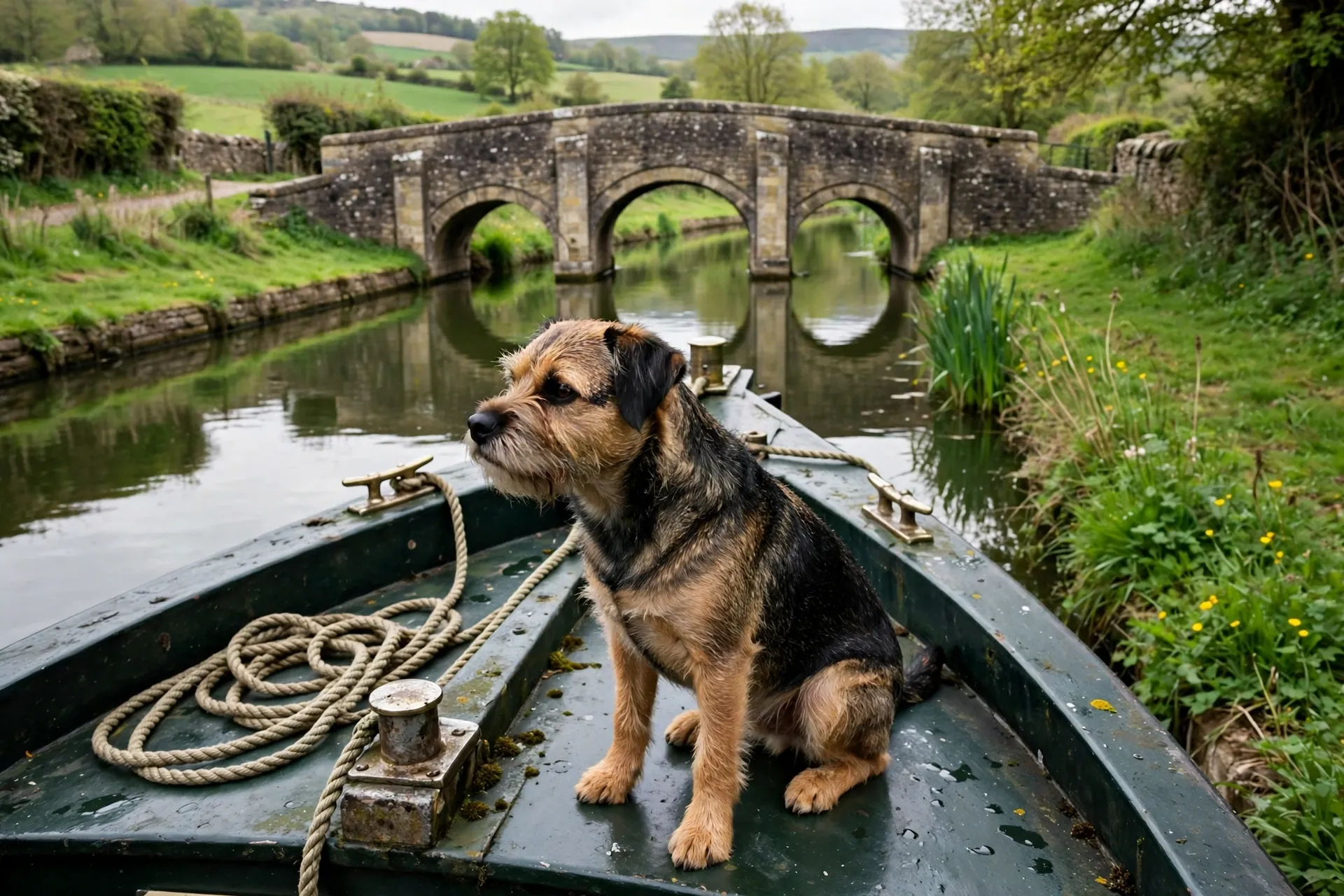
Valley walking in general rewards the same habits as village walking, only at a larger scale. Towpaths, riverside paths and hillside tracks can be muddy, uneven and shared with cyclists, runners and other dogs, so keep the lead short at bridges, locks, tunnels and any section where the path narrows beside water. A canal day has its own extra checks: locks and lock gates, deep water beside a towpath, moored boats with dogs on board, and cyclists who may approach silently from behind. Our canal boat holidays with a dog guide explains hire, locks, life jackets and mooring routines for a longer water-based break, and its towpath advice is useful even if you only walk a short canal section as part of a valley day. Read it before a canal extension, and check the official guidance before you travel for any towpath closures, maintenance works or local restrictions.
Public transport can extend a Calder Valley day, but it needs its own planning, and policies differ by operator, route and time of day. If you are considering a bus or train link, check the operator's current dog policy before you travel, including whether dogs must stay on a lead, on the floor, or in a carrier, whether a fare applies, and whether a busy peak service is a sensible choice for your dog at all. A dog that travels calmly in a quiet carriage may struggle on a crowded peak train with luggage, bicycles and standing passengers, and a dog that is fine on a short valley hop may be less happy on a longer connection with changes. Build in a toilet walk before boarding and a calm walk after alighting, and carry water, bags and a blanket so the dog can settle on the floor rather than on a seat. If transport looks uncertain, driving between two planned parking stops is often kinder to the dog than a complicated connection, even if it feels less adventurous.
Longer valley days also need a realistic sense of distance, height and surface. Calder Valley paths climb quickly from a village lane to a hillside track, and a route that looks short on a map can include steep steps, uneven stone, muddy field crossings and a long descent that is harder on a dog's joints than the ascent. Plan by time and by the dog's condition, not only by kilometres, and include a bail-out point where you can turn back to the car or to a road without a long detour. Older dogs, small breeds, puppies and dogs with joint problems need flatter, shorter valley sections, while fit adult dogs may enjoy a longer hillside loop with pauses for sniffing and water. In all cases, carry more water than you think you need, because valley streams are not automatically safe drinking water, and a dog that drinks from a stream after rain may pick up stomach upset or debris. Offer clean water from your own bottle at every pause, and let stream paddling be play, not the main water supply.
Finally, think about how a longer day ends. A valley walk that finishes at a busy car park, a station or a town centre needs a different closing routine from a village loop that finishes beside a quiet car. Plan the last toilet walk, the towel-down and the water stop before the final busy section, not after it, so the dog is already calm when you reach traffic, crowds or a train platform. If you are combining a village morning with a valley afternoon, use the middle of the day for rest: a quiet car rest with ventilation and water, a cafe stop where the dog can settle, or a short drive to the next parking place with the windows and the routine kept calm. Dogs do not measure a day by how many places were visited; they measure it by how settled they felt between the exciting parts, and a valley day with a proper rest in the middle will be remembered, by the dog at least, as a far better day than a longer day without one.
Wet weather, mud and water safety
Wet weather is not a reason to cancel a Hebdon Bridge day, but it is a reason to change the route, the kit and the expectations. Calder Valley rain does not fall evenly: a hillside can be dripping while the village lane below is merely damp, a stream can rise after rain that fell miles upstream, and a stone lane that was grippy in the morning can become slick with wet leaves by the afternoon. The wet-weather version of the village loop is therefore shorter, lower and more lane-based than the dry-weather version. Choose stone and surfaced sections over field paths, skip any section where the ground is already deeply rutted or flooded, and accept that a satisfying wet-weather walk may be twenty minutes of careful sniffing rather than an hour of covering ground. A dog that comes home damp but happy has had a good wet day; a dog that comes home exhausted, mud-caked and shivering has had a day that was too long for the conditions.
Mud management starts before the walk, not at the car afterwards. A drying coat, or at least a large absorbent towel, kept in the car will save the interior, the dog's comfort and your patience. A second towel for paws, a waterproof mat for the car boot or footwell, and a lidded box or bag for muddy leads keep the mess contained. On the walk, avoid the deepest mud where you can, not only for cleanliness but for safety: deep mud hides stones, holes, broken glass and uneven ground, and a dog that lunges in deep mud can twist a leg or cut a paw. After the walk, towel the legs and belly first, check between the toes for packed mud and small stones, and check the ears and coat for burrs and debris. If the dog is soaked through, dry the coat as much as possible before the drive home, offer water, and keep the car ventilated so a wet dog does not steam up the windows and overheat in a warm car. For dogs with thick coats, a proper drying session at home matters too: a damp undercoat left to dry slowly in a cold room can chill a dog long after the walk has ended.
Water safety in wet weather deserves its own paragraph, because the stream that was a gentle paddle in summer can be a different feature after rain. Fast, brown or high water should be treated as a no-entry feature, not as a more exciting paddle. Keep the dog on a lead near any water that is rising, and do not let a dog chase a ball or stick into a stream in spate, because a floating toy can carry a dog into a current it cannot swim against. Watch for slippery banks, undercut edges and submerged stones, and be especially careful where a path crosses a stream on a narrow bridge or stepping stones: wet stone is treacherous for both human and dog feet, and a dog that slips on a bridge can fall into water that is deeper than it looks. If you are unsure about a crossing, turn back. There is always another lane, another verge and another day, but there is no safe way to argue with a swollen stream.
Wet weather also changes the social side of a village walk. Lanes become quieter, which helps a nervous dog, but the walkers you do meet are more likely to be hurrying, hooded and less visible, and dogs may be harder to spot in rain and low light. Use a bright lead, a reflective harness or a light-coloured coat if you have one, keep the lead short at bends, and call out politely before passing on a narrow section so other walkers know you are there. If your dog wears a coat, check that it fits without restricting movement or rubbing, and check that it has not become waterlogged and heavy: a soaked coat can chill a dog more than no coat at all. Puppies, older dogs and small breeds lose heat faster in rain and wind, so shorten their walks first, dry them promptly, and watch for shivering, hunching or reluctance to move, all of which mean it is time to head back to the car, however short the walk has been.
Seasonal notes through the year
Spring in a Calder Valley village is a season of new growth, lambs, nesting birds and changeable ground. Paths that were firm in winter may be soft and muddy as the ground thaws, and field margins may be busy with wildlife that a dog must not disturb. Keep the dog on a lead near livestock and nesting areas, follow the marked path rather than wandering into meadows, and be ready for a sudden shower even on a bright morning. Spring is also a good season for a first village visit with a young or nervous dog, because the lanes are quieter than in high summer and the days are lengthening, giving you a longer, calmer window for a slow loop and a cafe stop. Pack a light waterproof, a towel and water, and treat every spring walk as a check of the route for a later, longer summer visit.
Summer brings longer days, busier lanes and heat that needs managing, even in a valley that feels cool in the shade. Stone lanes can radiate heat, a dog can overheat on a climb even when the air feels mild, and a stream paddle that looks refreshing can be the most tiring part of the day if the dog charges in and out repeatedly. Walk earlier or later in the day, carry more water than in cooler months, and offer shade and rest at every pause. Never leave a dog in a parked car in warm weather, even with a window open, and never rely on a village car park being shaded: a car in direct sun heats dangerously fast, and a dog that seemed fine for a few minutes can be in serious trouble before you return. Summer also brings more visitors, more dogs and more children on the lanes, so keep greetings short, keep the lead short in busy sections, and choose the quietest lane version of the loop if the main section feels crowded. Check the official guidance before you travel for any seasonal restrictions, such as temporary path closures or local events that may change parking and access.
Autumn is arguably the finest season for a Hebdon Bridge village day, and also the one that most rewards careful footwork. Autumn light flatters stone cottages and wooded hillsides, the air is cool enough for a longer loop, and the lanes are often quieter than in summer. At the same time, wet leaves cover stone steps, stiles and stream banks, making them slippery in a way that dry leaves never are. Keep the dog on a short lead on any stepped or sloped section, and slow down on descents rather than letting momentum carry you both. Autumn also brings fallen fruit, fungi and other seasonal hazards that a scavenging dog may investigate: train a reliable leave command before an autumn visit, keep a scavenging dog on a lead in wooded and hedgerow sections, and check the official guidance before you travel if you are unsure about any local hazard. A muzzle for a confirmed scavenger, used kindly and fitted well, can be a practical autumn tool, not a punishment, and it is worth considering before a walk where the dog is likely to hoover up everything it finds.
Winter village days are short, quiet and beautiful in a different way, but they need the most planning. Daylight ends early, lanes can be icy, and a dog that is wet from a stream or rain will chill quickly in a cold wind. Walk in the middle of the day when the light is best, choose the flattest, most surfaced version of the loop, and carry a torch or reflective gear for the return to the car if dusk catches you. Check the dog's paws after winter walks for grit, salt and ice balls between the toes, and dry the coat thoroughly before the drive home. Winter is also the season when a warm, dog-friendly indoor stop matters most, so confirm opening hours and dog policies in advance, because a venue that was open all day in summer may close earlier or reduce its hours in winter. If the weather turns to ice, heavy snow or flooding, postpone the visit: a village lane that is charming in frost can be dangerous for a dog that slips and for an owner who cannot keep their footing while holding a lead. Check the official guidance before you travel, and let the forecast, not the calendar, decide the day.
Practical checklist before you set off
Use this checklist the night before, not in the car park. It is short on purpose: every item here has prevented a common village mishap, and none of them requires special equipment. Confirm the exact destination and the map pin, and check that you have not confused Hebdon Bridge with Hebden Bridge. Check the official guidance before you travel for parking rules, path closures, weather warnings and any seasonal restrictions. Charge your phone, and save or note the location of the car park you intend to use, so you are not searching for it with a dog already bursting for a walk. Pack the car the night before if you can, so the morning departure is calm rather than rushed, because a rushed departure often becomes a rushed arrival, and a rushed arrival is where most village problems begin.
- Lead and identification: a short lead for lanes, a harness or collar that fits, and identification as required, checked before the dog leaves the car.
- Water and bowl: clean water for the dog, a collapsible bowl, and a spare bottle for a longer valley extension.
- Bags and towel: more bags than you expect to need, a large towel for paws and coat, and a drying coat for wet or cold days.
- First toilet plan: a quiet, lawful first stop in mind before the main loop, so the dog is settled before the scenic part begins.
- Venue check: confirmation, where possible, of which pubs or cafes welcome dogs, in which area, and at what times.
- Weather and ground check: a forecast for the valley, not just the nearest town, and a shorter, lane-based fallback route for rain or ice.
- Dog condition check: an honest look at age, fitness, joints, heat tolerance and scavenging habits, and a loop length that fits the dog in front of you.
- Car kit: a waterproof mat or old blanket for the boot, a spare towel, and a safe, ventilated space for the drive home.
On the day, keep the order simple: arrive calmly, park lawfully, unload in the same routine, take the short first toilet walk, and only then start the village loop. Pause for water and rest, keep the lead short in lanes and near water, close every gate, and end with a towel-down and a final toilet opportunity before loading. If anything on the day does not match the plan — a full car park, a closed path, a venue that no longer welcomes dogs inside, a stream that is too high — treat the change as a reason to adapt, not as a reason to push on. Shorten the loop, choose the takeaway fallback, or return at a quieter time. A village day that ends with a calm dog, a clean car and a route you would happily repeat is a successful day, however short the walk turned out to be, and it is the kind of day that makes a return visit to Hebdon Bridge feel easy rather than ambitious.
Hebdon Bridge, as a smaller village setting, rewards exactly that kind of planning: it does not offer the scale of a town centre, and it does not need to. Its value for a dog owner is quieter and more practical — stone lanes to walk slowly, a stream to admire from a safe bank, a hillside to look up at while the dog sniffs a verge, and a chance to practise the calm routines that make every other Calder Valley day easier. Plan the arrival, walk the loop at the dog's pace, check the details that change, and leave the village as welcome as you found it.
Practical questions
Before you go
Is Hebdon Bridge the same place as Hebden Bridge?
No, and the similar names are the main source of confusion. This guide covers Hebdon Bridge as a smaller Calder Valley village setting, while Hebden Bridge is a larger, busier Calder Valley town with its own canal, shops and station. Check the official guidance before you travel, and confirm the exact destination in your satnav and any booking before you set off, because a one-letter difference can send you to the wrong valley stop.
Where should I park first when I arrive with a dog?
Choose a lawful, level spot where you can open the car door without stepping straight into traffic, and where the dog can be clipped onto a lead before its feet touch the road. If the first space you see is tight, on a bend, or forces you to unload beside a fast lane, drive on and look for a wider, quieter alternative, even if it adds a short walk. Check the official guidance before you travel for any current parking restrictions, charges and time limits.
Is there a short first walk for a dog that needs the toilet straight away?
Yes, plan one before you need it. Pick the nearest quiet, grassy verge or short lane section away from traffic, keep the dog on a lead, take bags, and only then start the longer village loop. A calm first ten minutes prevents a rushed crossing later, and it lets a nervous dog sniff, settle and learn the new smells before meeting other walkers.
Can dogs go into pubs and cafes around Hebdon Bridge?
Policies vary by venue and can change, so do not assume that a garden, a bar area and a dining room all follow the same rule. Check the official guidance before you travel, and confirm with the individual venue on the day, including whether dogs are welcome inside, only outside, only in a named area, or only at certain times. Bring a blanket, water and a quiet chew so the dog can settle under a table without blocking a walkway.
What should I do if a lane is too narrow for a car and a dog walker to pass safely?
Stop early, step into a gateway, verge or wider section, shorten the lead, and put the dog on the side away from traffic. Do not try to squeeze past a moving vehicle, and do not let a long lead trail across the lane. If there is no safe refuge, wait where you are visible and let the vehicle pass before continuing, and be ready to turn back rather than push on into a blind bend.
Is the village loop suitable in wet weather?
It can be, with the right expectations. Stone lanes drain better than field paths, but stream-side sections, muddy verges and leaf-covered steps become slippery after rain, so shorten the route, keep the dog on a lead near water, and carry towels and a drying coat. If a path looks flooded, deeply rutted or unsafe underfoot, turn back and use a shorter lane-based loop instead.