This guide is independent and contains no paid placement. If affiliate links are added later, they will be clearly marked and will not change our editorial checks.
Helensburgh is one of the easiest Clyde coast towns for a dog break: a flat seafront promenade, tidal shore at low tide, hill walks above the town, and a direct train from Glasgow. Keep dogs on lead on the promenade, check tide times before any beach walk, and confirm current rules at Hill House and on nearby beaches before you travel.
Why Helensburgh works with a dog
Helensburgh sits on the north shore of the Firth of Clyde, in Argyll and Bute, about twenty-five miles north-west of Glasgow. It is a seaside town rather than a resort: the pace is unhurried, the seafront is flat and open, and most of what a dog owner needs — the promenade, the shore, the town centre, the station — sits within a short walk of everything else. That compactness is the town's real advantage. You can arrive by train, walk to your accommodation, and be on the shore within minutes, without the car-dependent logistics that complicate so many coastal breaks.
The town grew up as a Clyde resort in the nineteenth century, when steamers carried holidaymakers up and down the firth, and the grid of wide streets above the waterfront still reflects that era. It is also the birthplace of the architect and designer Charles Rennie Mackintosh, whose Hill House stands on a hillside above the town. For a dog owner, the practical result is a town with two distinct characters: a level waterfront for easy, sociable walks, and wooded hills behind it for longer, quieter outings when the dog needs more space.
Helensburgh also makes a good base. Loch Lomond is a short drive to the east, the Rosneath Peninsula and the Gareloch lie to the west, and the Clyde coast continues south towards Gourock, Largs and the Ayrshire beaches. That matters on a multi-day break, because a rainy morning on the seafront can be swapped for a sheltered woodland walk or a train ride into Glasgow without re-planning the whole trip. The town rewards a slow approach: one good walk in the morning, a cafe stop, and a second, shorter outing before dark.
This guide covers the seafront and beaches first, then the walks, the town centre, eating out, stays and day trips, finishing with the practical details — tides, parking, vets and weather — that decide whether a break runs smoothly. Where a rule depends on the season or on a particular operator, the guide says so and asks you to check the official guidance before you travel, rather than guessing.
Getting to Helensburgh with a dog
By train, Helensburgh Central is the terminus of the North Clyde line from Glasgow Queen Street, with trains running regularly through Dumbarton and along the Clyde. The journey takes under an hour, and the station is a short, flat walk from the seafront. Dogs travel free on most UK trains when kept on a lead and off the seats, which makes this one of the simplest car-free dog breaks in Scotland. Helensburgh Upper, a separate station on the West Highland Line, serves a small number of longer-distance services; check the official guidance before you travel, as its timetable is sparse and the walk into town is uphill.
By car, the main approach is the A82 from Glasgow to Dumbarton, then the A814 along the Clyde to Helensburgh. The drive from central Glasgow usually takes around forty-five minutes outside peak hours, though the A82 can be slow at commuting times. Parking near the seafront is generally straightforward outside summer weekends, with on-street parking along the waterfront and car parks in the town centre. Check the official guidance before you travel for current charges and time limits, as these are reviewed from time to time. If you arrive by car, plan the first walk before unloading: a short leg-stretch on the promenade settles most dogs far better than being carried straight into a new building.
By bus, local services connect Helensburgh with Dumbarton, the Rosneath Peninsula and the Gareloch villages. Dogs are usually allowed on local buses at the driver's discretion, kept on a lead and off the seats, but policies vary between operators, so check the official guidance before you travel. The bus is most useful for one-way walks — for example, riding out to Rhu or Ardmore and walking back along the shore — which turns a familiar loop into a fresh route without doubling the distance.
Arriving on foot from the station deserves a small plan of its own. The walk from Helensburgh Central to the waterfront takes about ten minutes downhill, crossing the main shopping street. If your dog is nervous in traffic, keep to the quieter side streets rather than the main road, and give the dog a few minutes to sniff the grass at the seafront before heading to your accommodation. Dogs that travel well by train sometimes still find a new town overwhelming, and a calm first ten minutes sets the tone for the whole stay.
The seafront and the Esplanade
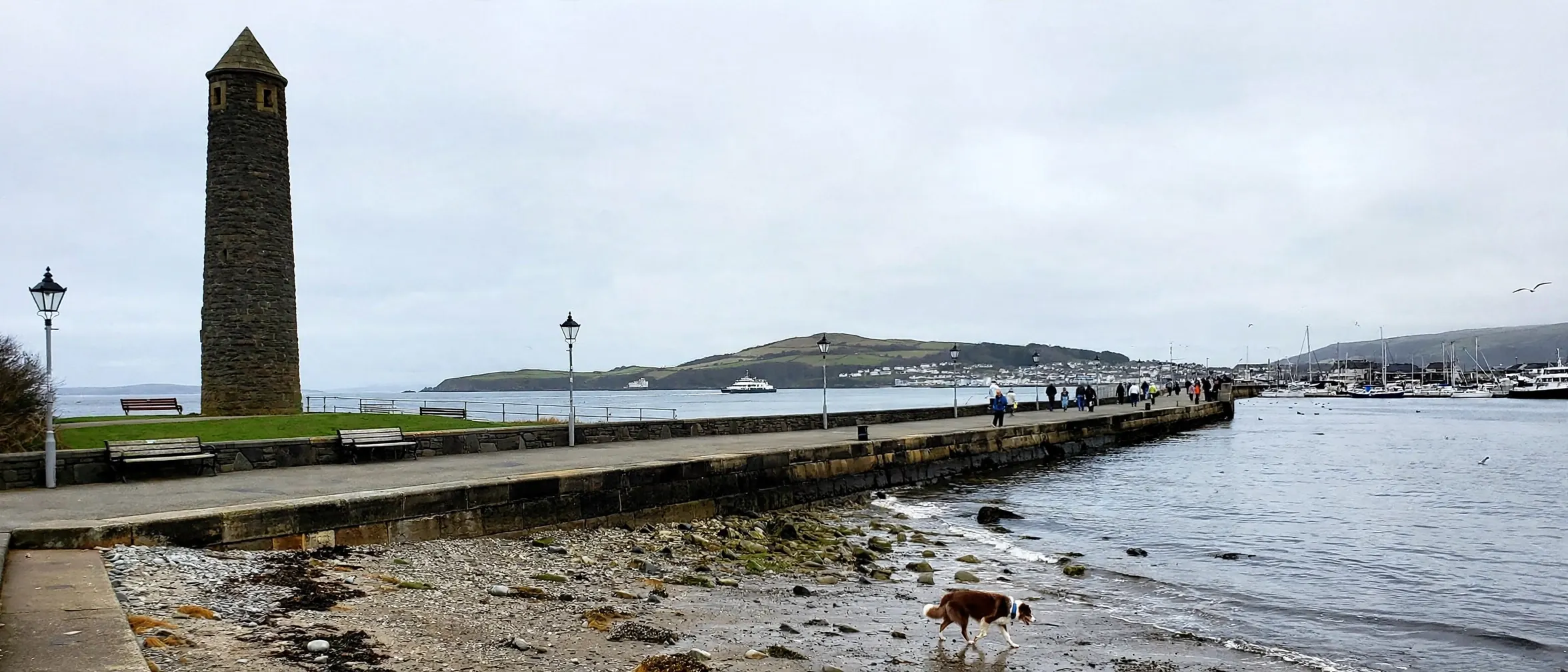
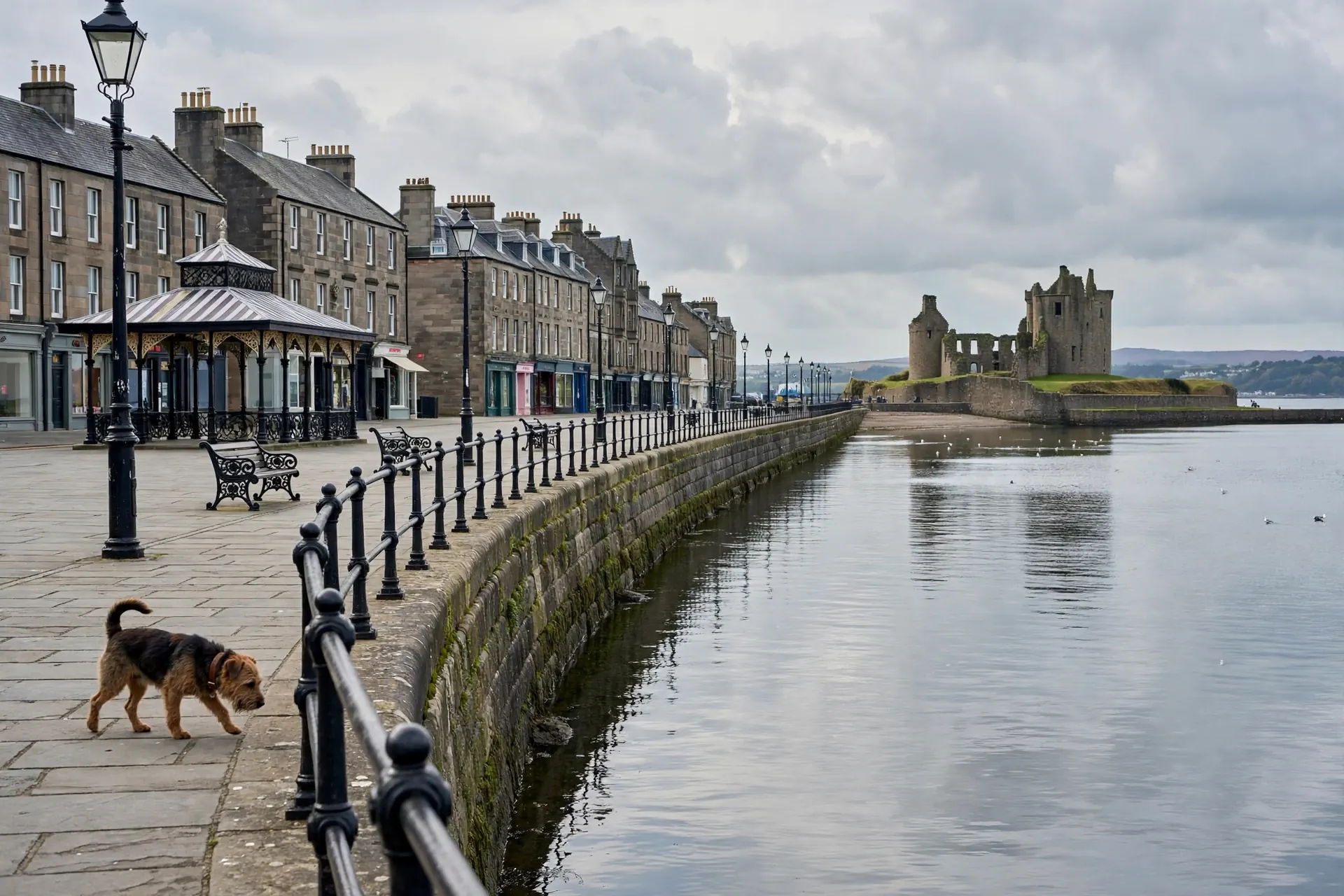
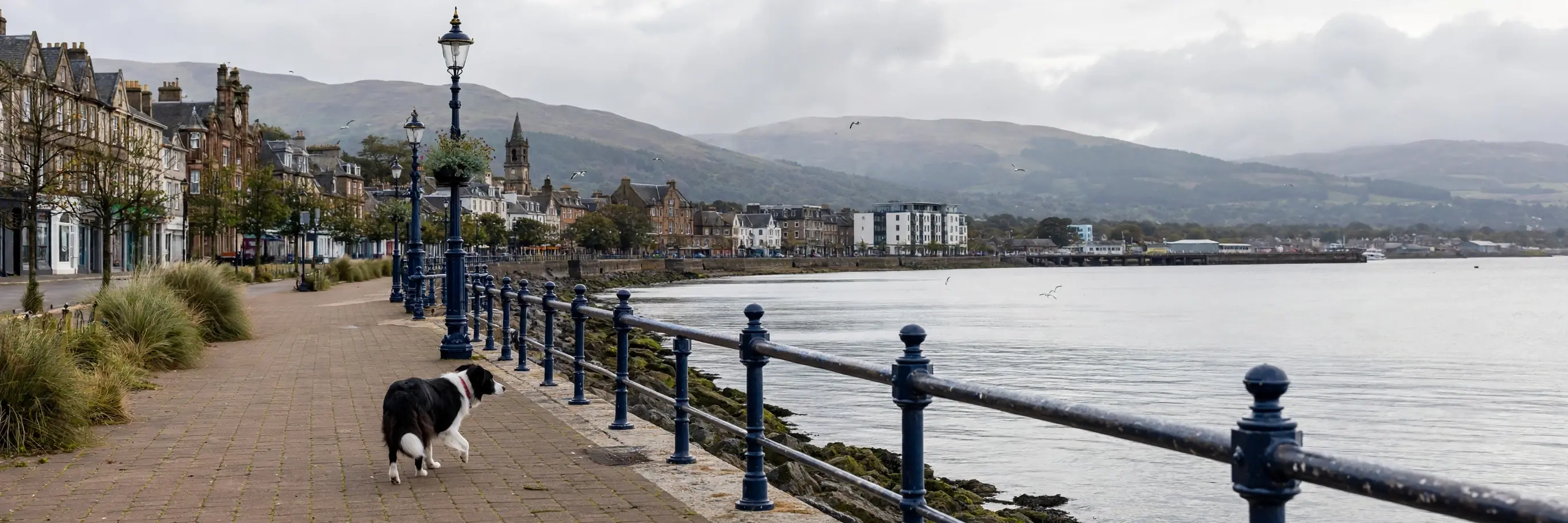
The seafront is the heart of a Helensburgh dog break. The Esplanade runs along the shore with wide pavements, grassy stretches and views across the firth to Greenock, Gourock and the hills of the Cowal Peninsula. On a clear morning you can see the water sparkling and the hills beyond; on a grey day the wind does the talking. Either way, it is a walk that suits almost every dog: flat, open, full of smells, and easy to shorten or extend.
Keep your dog on a lead on the promenade. It is a shared route used by walkers, runners, cyclists and families, and it runs beside a road for much of its length. A lead also protects your dog from the less obvious hazards of a working waterfront: fishing lines, bait, discarded food and the occasional broken glass near benches. A short lead works better than a long line here, because the path narrows at points and other dogs pass close. If your dog is reactive, the early morning or the evening, when the promenade is quieter, is the better time for this walk.
The grassy areas beside the promenade are useful for a sniff and a toilet break, but always pick up after your dog and use the bins provided. Helensburgh's seafront is a place where locals walk their dogs every day, and the unspoken rule is simple: a well-behaved dog is welcome everywhere, and a dog that rushes other dogs or children is not. If your dog struggles with greetings, step onto the grass and let the other party pass; there is plenty of room to do so without blocking the path.
The pier area at the eastern end of the waterfront is worth a look, though the working pier and any boat traffic deserve respect. Keep dogs well back from the edge and from mooring ropes, and do not let a dog swim near the pier or near boats. The best views of the town from the water side are from the promenade itself, and the best photographs are usually taken in the low evening light, when the sun drops behind the hills across the firth and the water turns gold.
For a longer seafront outing, walk west from the town centre towards Rhu. The route follows the shore past houses and gardens, with the water on your left and the hills rising behind you. The pavement gives way in places to quieter lanes, so keep the dog on a lead throughout and watch for driveways and side roads. The return walk, with the light behind you, is often the prettier half. Allow an hour there and back at a dog's pace, with stops for sniffing and for looking at the boats.
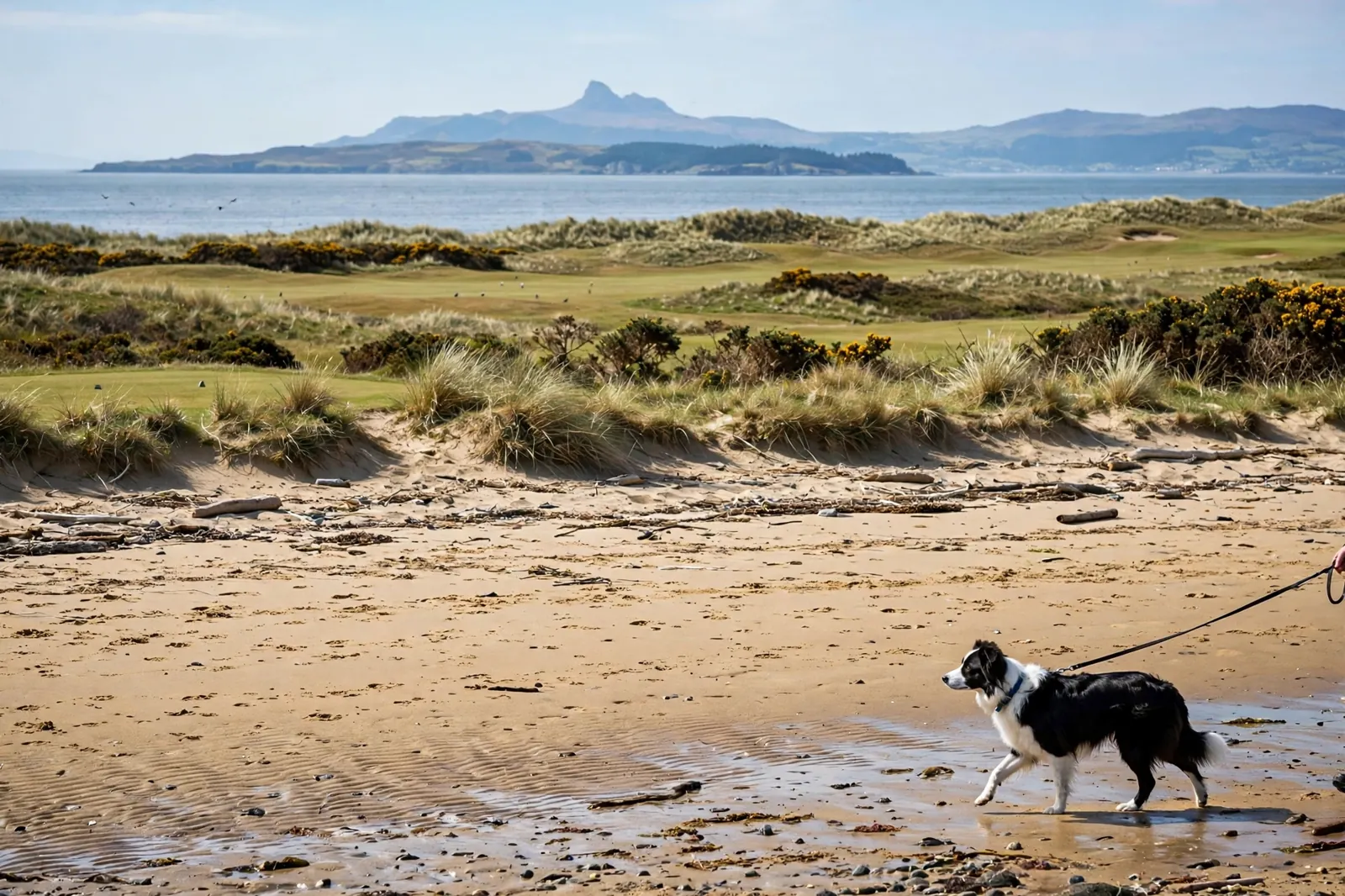
Beaches and swimming spots
Helensburgh does not have one big resort beach. What it has is a tidal shore: a sandy stretch near the waterfront that appears at low tide, and a mix of sand, shingle and rock along the coast towards Rhu and Ardmore Point. That tidal character shapes every beach walk here, and the single most useful habit is checking the tide times before you set out. A beach that is wide and inviting at low water can shrink to a narrow strip within a couple of hours, and the firth's tides are strong enough to catch out a walker who is watching the dog instead of the water.
Dogs are generally welcome on the shore around Helensburgh, but there is no single published rule covering every stretch of coast, and seasonal restrictions can apply on some beaches nearby. Check the official guidance before you travel, and follow any signs at the access points. Where a restriction applies, it is usually seasonal and aimed at the busiest months, so an early morning or an out-of-season visit often solves the problem without any argument.
For paddling and swimming, choose a gently shelving spot at low tide, well away from the pier, moorings and boat channels. The Firth of Clyde is cold even in summer and has strong currents in places, so never let a dog swim near boat traffic or in choppy water, and never throw a ball into deep water for a dog that is not a confident swimmer. Ardmore Point, to the west of the town, is a popular paddling spot with rock pools at low tide, and the shore at Rhu offers a quieter alternative. After any swim, rinse your dog with fresh water: salt water dries the coat and can irritate skin, and dogs that drink seawater can become unwell.
Rock pools deserve a note of their own. At low tide the shore around Ardmore Point and Rhu is full of pools, crabs and seaweed, which most dogs find irresistible. That is fine, but watch for sharp shells and broken glass, and keep your dog away from dead fish and shellfish beds, which can carry bacteria. After warm spells, check for blue-green algae warnings before letting a dog paddle in still water; check the official guidance before you travel if there has been a hot spell, and keep dogs out of any water that looks discoloured or scummy.
Beach etiquette on a tidal shore is mostly common sense: pick up after your dog, keep the dog under control near other beach users, and do not let a dog chase wading birds, which use the shore to feed at low tide. In winter the shore is often empty, which suits dogs that need space, but the wind is stronger and the light goes early, so carry a torch for the walk back and keep the dog close once the light fades.
Longer walks from town
When the dog needs more than the promenade, the hills behind Helensburgh deliver. The wooded slopes above the town hold a network of paths, and the higher ground opens up to views across the firth that are worth the climb. The most useful rule for these walks is to treat them as hill walks, not park strolls: the paths can be muddy, the weather changes fast, and phone signal is patchy in the woods. Carry water for the dog, wear proper footwear, and tell someone your route if you are heading out alone.
A good first hill walk starts from the top of the town and climbs through the woods towards the higher ground above Helensburgh, where the paths level out and the views open up. The climb is steady rather than steep, and most fit dogs manage it comfortably, though older dogs and puppies will find the downhill harder than the climb. Keep dogs on a lead in the woods: there are sheep on the open ground beyond the trees in places, and the law in Scotland requires dogs to be kept under close control around livestock. During lambing season, which runs roughly from spring into early summer, this matters even more, and some land managers ask for dogs to be on a lead on all open ground.
The Rosneath Peninsula, across the Gareloch to the west, offers a different kind of walk: quiet lanes, woodland and a rocky shore with views back towards Helensburgh. It is reached by car or bus, and it suits a half-day outing rather than a quick loop. The peninsula's villages are small and the roads are narrow, so keep the dog on a lead on the lanes and use the shore and woodland paths for off-lead time where it is safe and permitted. Check the official guidance before you travel for any access restrictions, as some paths cross private land where dogs must stay on the path.
For a longer day, the Three Lochs Way passes through the area, linking the Gareloch, Loch Long and Loch Lomond. The full route is a multi-day walk, but the sections near Helensburgh make good day walks, with waymarked paths and a mix of woodland, lochside and hill. The lochside sections are the most dog-friendly, with water for paddling and shade in summer, but the hill sections are exposed, so check the weather before you set out and carry more water than you think you need. A dog that is happy on the promenade may still tire on a long hill section, so build in a turning-back point and use it without guilt.
Whatever route you choose, the practical details are the same: a lead, a long line for open ground if your dog's recall is not reliable, water, a bowl, a towel, and poo bags. The hills above Helensburgh are not remote, but they are wild enough that a dog that runs off after a deer or a sheep can be in trouble quickly. A long line gives the dog freedom without giving up control, and it is the single most useful piece of kit for a walking holiday in this part of Scotland.
Hill House and the town centre
Hill House is Helensburgh's best-known attraction: a house designed by Charles Rennie Mackintosh and his wife Margaret Macdonald, built on a hillside above the town with views across the firth. It is a place to visit for the architecture and the garden, and it is also a good example of how to plan a dog-friendly day around a site that is not fully open to dogs. Dogs on leads are generally welcome in the gardens and grounds, but dogs are not normally allowed inside the house itself, with assistance dogs as the usual exception. Check the official guidance before you travel, as opening times, garden access and any event-day rules can change.
The practical approach is to treat Hill House as a garden visit. Walk up through the town, enjoy the grounds and the views, and take turns if one person wants to see the interior while the other stays outside with the dog. The walk up from the seafront is uphill and takes about twenty minutes; in summer the garden is at its best, and in autumn the trees turn colour and the light is softer. There is usually a cafe on site, but dog access to the cafe and its outdoor seating varies, so check the official guidance before you travel rather than assuming.
The town centre itself is compact and walkable, with the main shopping street running from the station towards the seafront. It has the usual mix of supermarkets, bakeries, charity shops and independent stores, and most of the practical shopping for a dog break — food, treats, poo bags, a spare lead — can be done here. Dogs are not generally allowed inside food shops, so plan shopping trips without the dog or take turns. Some non-food shops welcome dogs; look for a water bowl by the door, which is a reliable sign, and always ask before taking a dog inside.
Helensburgh's history as a Clyde resort shows in the town's architecture: Victorian villas, wide streets and the occasional grand terrace. A slow walk through the residential streets above the seafront is a pleasant way to spend an hour with a dog, and the grid layout makes it hard to get lost. The streets are quieter than the main road, and the pavements are wide enough for a dog on a lead. In the evening, the town is quiet, which suits dogs that find busy streets stressful, though it also means that many shops and cafes close earlier than they would in a city.
Cafes, pubs and eating out
Helensburgh has a reasonable spread of dog-friendly cafes and pubs, particularly around the town centre and the seafront, but the welcome varies from place to place and from season to season. The reliable pattern is that dogs are welcome in outdoor seating areas and in some bar areas, while restaurant dining rooms are often dogs-out. That means a dog owner can eat well in Helensburgh, but should plan around the terrace and the bar rather than expecting to take a dog into every dining room.
Before you sit down, check the signs at the door and ask a member of staff. A cafe that welcomes dogs on a quiet weekday may restrict them at a busy weekend lunchtime, and a pub that allows dogs in the bar may ask them to stay out of the restaurant area. Bring a mat or blanket for the dog to lie on, which makes the dog more comfortable on a cold floor and signals to staff that you have thought about it. A dog that can settle under a table for half an hour is welcome almost everywhere; a dog that barks at every passing customer is not, whatever the policy says.
For coffee and cake, the town centre cafes are the best bet, with several offering outdoor seating in the warmer months. For a longer meal, look for pubs with a garden or a terrace, where the dog can lie in the shade and you can eat without rushing. In winter, when outdoor seating is less inviting, ask whether the bar area accepts dogs; many pubs do, and a quiet corner by the fire is a good place for a tired dog to sleep off a long walk. Check the official guidance before you travel for current opening times, as some places reduce their hours outside the summer season.
Takeaway food is a useful fallback on a wet evening. Helensburgh has takeaways and a supermarket, so a night in with the dog is easy to arrange, and many self-catering stays have the kitchen to make it comfortable. If you are eating out with a dog for the first time, choose a short, low-key visit first — a coffee rather than a three-course meal — and build up from there. A dog that learns that cafes mean settling quietly is a dog that can join you for the rest of the trip.
Where to stay with a dog
Helensburgh's accommodation for dog owners is mostly small-scale: bed and breakfasts, guest houses, self-catering flats and cottages, and a handful of small hotels. There is no large resort hotel dominating the town, which is part of its charm, but it also means that dog-friendly rooms are limited and book up early in summer. The practical advice is to book early, declare the dog at the time of booking, and get the dog policy in writing before you pay.
Self-catering is often the easiest option with a dog. A flat or cottage gives the dog a familiar routine — its own bed, its own feeding spot, a door to the garden — and removes the pressure of keeping a dog quiet in a hotel corridor. Look for a ground-floor property with direct access to a garden or a quiet street, and check whether the garden is enclosed, as many town gardens are not. Ask about the flooring too: hard floors are easier to clean after a muddy walk, and a property with a tiled entrance hall is worth more than a pretty carpet after a wet day on the shore.
Bed and breakfasts and small hotels can work well for a short break, but the details matter. Ask whether the dog can stay in the room alone while you eat breakfast, whether there is a charge per dog per night, and whether there is a limit on the number or size of dogs. Some places welcome one small dog and not two large ones; others welcome any dog but charge for the extra cleaning. A charge of a few pounds per night is normal; a charge that doubles the room rate is a sign to look elsewhere. Check the official guidance before you travel for the property's current policy, as it can change with new ownership.
Whatever you book, pack as if the property has nothing for the dog: its bed, its bowls, its food, its lead and a spare, towels, and a familiar blanket. A dog that has its own things settles faster in a new place, and a settled dog is a quiet dog. On arrival, walk the dog first, let it sniff the new rooms, and set up its bed in the same spot it will sleep each night. The first hour in a new place is worth more than any amount of reassurance later.
If Helensburgh itself is booked out, the nearby villages offer alternatives. Rhu and the Gareloch villages have self-catering cottages within a short drive, and Dumbarton and the Loch Lomond side have a wider range of options. Staying a few miles out of town is a reasonable trade if it means a properly enclosed garden and a quieter night, but weigh it against the convenience of walking to the seafront. A ten-minute drive each way is a small price for a good garden; a forty-minute drive each way is not.
Day trips: Loch Lomond, Largs and Bute
Helensburgh's position makes it a natural base for day trips, and the three that suit dog owners best are Loch Lomond, the Ayrshire coast and the Isle of Bute. Each is a different kind of day, and each is reachable without a long drive, which matters when the dog is waiting in the car or at the accommodation.
Loch Lomond is the closest big day out. The village of Luss, on the western shore, is about twenty minutes by car and offers a lochside walk, a small beach and a pretty village that is popular with visitors. Dogs are welcome on the shore and on many of the paths, but the village gets busy in summer, so an early start is worth it. The lochside paths north of Luss are quieter and suit a longer walk, with shade in summer and water for paddling. Check the official guidance before you travel for any seasonal access rules, and keep dogs on a lead near the village and around livestock.
South along the Clyde coast, Largs makes an easy half-day trip: a seafront promenade, the Viking Pencil monument and the ferry to the Isle of Cumbrae, where dogs travel free and the island's circular road makes a gentle walk or cycle. The drive from Helensburgh takes about an hour, or the train via Glasgow is a slower but car-free alternative. Our guide to the Ayrshire coast covers the beaches and walks further south, including Troon, Irvine and Culzean Castle grounds, which are worth a full day if the weather is kind.
The Isle of Bute is the third option, reached by ferry from Wemyss Bay, a drive of about forty minutes from Helensburgh. Dogs travel on the ferry, usually free or for a small charge, and the island's main town, Rothesay, has a Victorian promenade, a castle and a sandy bay at Ettrick Bay that suits dogs. Our Rothesay guide covers the ferry, the promenade and the island base plan in detail, and it is worth reading before you book the crossing, as ferry times and dog rules vary by operator.
Closer to home, Glasgow is under an hour by train and offers a very different day: big parks, riverside walks and dog-friendly cafes, with the option of continuing to Loch Lomond from the city. It is a good wet-weather alternative, because the city's parks have surfaced paths and the cafes are used to dogs. A day in Glasgow also suits a dog that enjoys people and bustle; a dog that finds crowds stressful will be happier staying on the Helensburgh shore.
Practicalities: vets, parking, tides and weather
The practical details are what turn a good plan into a good trip, and Helensburgh is well provided. There are veterinary practices in the town and in nearby Dumbarton; note the address and phone number of the nearest practice before you arrive, and check the official guidance before you travel for the nearest out-of-hours emergency vet, which may be in Glasgow. If your dog takes regular medication, pack more than you need for the trip, and carry the prescription details in case you need a replacement.
Parking near the seafront is generally easy outside peak summer weekends, but read the signs: some bays are time-limited and some are residents-only. The town centre car parks are a short walk from the waterfront and are a better bet for a longer stay. Never leave a dog in a parked car on a warm day, even with the windows open; the Clyde coast can be deceptively warm in a sheltered spot, and a car heats up fast. In winter, the opposite problem applies: a wet dog left in a cold car chills quickly, so dry the dog before the drive home.
Tides are the single most important practical detail on this coast. The Firth of Clyde has a tidal range of a few metres, and the shore changes shape dramatically between high and low water. Check the tide times for Helensburgh before any beach walk, and plan to be off the shore well before the tide turns. A useful rule is to start a beach walk on a falling tide, so the beach is getting wider rather than narrower, and to keep an eye on the water rather than assuming you have hours left. If you are unsure, ask a local dog walker; they know the tides by habit.
The weather on the Clyde coast is changeable in every season. The wind is the constant: even on a sunny day, the seafront can be breezy, and in winter the wind chill is significant. Rain arrives quickly and passes quickly, so a waterproof coat for you and a drying coat for the dog are more useful than an umbrella. Midges are less of a problem on the seafront than they are inland, but they can trouble woodland walks from June to August, especially in the evening. Pack insect repellent and, if your dog is bothered by midges, a light coat for exposed skin.
Finally, keep the basics in the car or in a day bag: water and a bowl, poo bags, a towel, a spare lead, a torch, and a first-aid kit with tick removers. Ticks are present in the woods and long grass around Helensburgh, particularly from spring to autumn, so check the dog after every walk and remove any ticks promptly. A dog that is checked daily is a dog that avoids the vet visit that nobody wants on holiday.
A relaxed two-day plan
Day one is about arrival and the seafront. Arrive by train or car, walk the dog on the promenade, and let it sniff the shore at low tide if the timing works. Spend the afternoon exploring the town centre and the streets above the seafront, then walk up to Hill House gardens for the views. Eat at a dog-friendly pub or cafe, or pick up a takeaway and eat in. Keep the first day short: the dog has travelled, the place is new, and a calm evening matters more than ticking off sights.
Day two is the longer walk. Start early with a hill walk above the town or a drive to the Rosneath Peninsula, and be back for a late lunch at a cafe. If the weather is good and the dog is still full of energy, spend the afternoon at the shore, paddling at Ardmore Point or walking the Rhu shore. If the weather turns, take the train to Glasgow for a park walk and a cafe, or drive to Luss on Loch Lomond for a lochside stroll. The plan is deliberately loose: the best Helensburgh days are the ones that follow the dog's energy and the weather, not a timetable.
For a longer stay, add a day trip on day three — Largs and Cumbrae, Bute, or the Ayrshire coast — and keep one day deliberately empty, for the walk you discover by accident or the cafe you want to return to. Dogs do not need a packed itinerary, and the town rewards the unhurried: the same promenade at a different tide, in different light, is a different walk. That is the quiet pleasure of a Helensburgh break, and the reason many dog owners come back.
Planning more Clyde coast days? Our guides to Largs and the Ayrshire coast cover the ferry, the beaches and the walks south of the firth, while the Glasgow guide is the best starting point for a city day from Helensburgh.
Practical questions
Before you go
Can dogs walk off lead on Helensburgh seafront?
On the promenade itself, keep your dog on a lead: it is a shared pedestrian route beside a road, with cyclists, children and other dogs passing close. Off-lead time is better saved for open ground such as the shore at low tide or a quiet stretch of beach, and only where your dog has a reliable recall and no seasonal restriction applies. Check the official guidance before you travel, as local rules and signage can change.
Are dogs allowed on Helensburgh beach?
Dogs are generally welcome on the shore around Helensburgh, including the sandy stretch near the waterfront at low tide, but there is no single published rule covering every part of the coast, and seasonal restrictions can apply on some beaches nearby. Check the official guidance before you travel, watch the tide times, and keep your dog away from shellfish beds and fishing lines.
Can I take my dog to Hill House in Helensburgh?
Dogs on leads are generally welcome in the gardens and grounds at Hill House, the Charles Rennie Mackintosh house above the town, but dogs are not normally allowed inside the house itself. Assistance dogs are the usual exception. Check the official guidance before you travel, as opening times, garden access and any event-day rules can change.
How do I get to Helensburgh with a dog without a car?
The simplest car-free route is the train from Glasgow Queen Street to Helensburgh Central, which runs regularly and takes under an hour. Dogs travel free on most UK trains when kept on a lead and off the seats. From the station the seafront is a short walk, and local buses serve Rhu, the Rosneath Peninsula and the Gareloch. Check the official guidance before you travel for current timetables and any operator rules.
Where can dogs swim safely near Helensburgh?
The Firth of Clyde is tidal and cold, with strong currents in places, so choose a gently shelving spot at low tide and never let a dog swim near the pier, moorings or boat traffic. Ardmore Point and the shore at Rhu are popular paddling spots, but check the official guidance before you travel, watch for blue-green algae warnings after warm spells, and rinse your dog with fresh water afterwards.
What should I pack for a wet-weather day in Helensburgh?
Pack a drying coat or two towels, a waterproof lead, paw balm for salty pavements, and a spare set of bedding for the car or accommodation. The Clyde coast is windy even when it is not raining, so a windproof layer for the dog helps on exposed walks. Bring drinking water too, because dogs should not drink from the estuary, and plan a short indoor break in a dog-friendly cafe if the rain sets in.