This guide is independent and contains no paid placement. If affiliate links are added later, they will be clearly marked and will not change our editorial checks.
Rothesay works best as a slow, walkable base: arrive by ferry, settle the dog with a promenade walk, visit the castle grounds on a lead, then drive or take the bus to the bigger beaches at Ettrick Bay and Scalpsie Bay. Keep evenings in town, mornings on the island, and check ferry times and dog rules before you travel.
Arriving by ferry: the crossing sets the pace
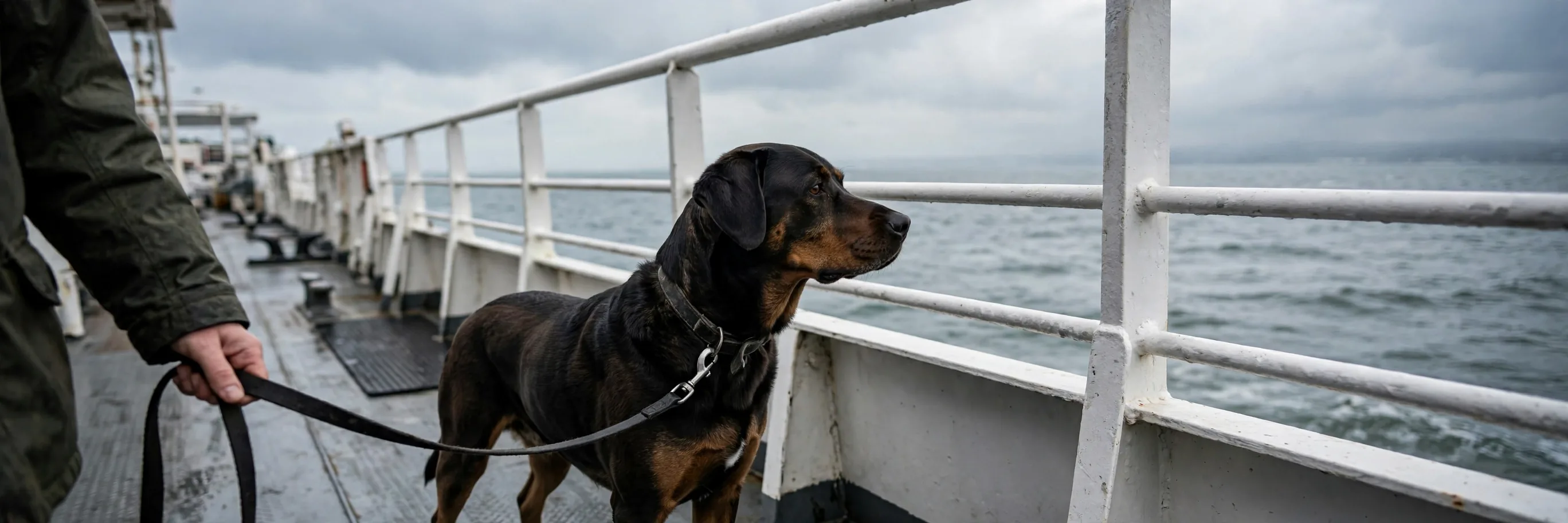
The ferry is the first part of the trip, not just the transport to it. The main route runs from Wemyss Bay, on the Firth of Clyde coast south of Glasgow, across to Rothesay pier, and the crossing takes around 35 minutes. That short stretch of water does a useful job for a dog: it separates the drive from the holiday, gives the dog a change of air and movement, and delivers foot passengers straight into the middle of town. Cars roll off the ferry and into streets that were laid out long before modern traffic, so the sensible move on arrival is to park, walk, and let the dog learn the town at pavement speed before driving anywhere else.
Foot passengers have the easiest arrival of all. The pier lands you on the promenade, with the bay on one side and the town on the other, and most accommodation in Rothesay is a short walk away. If you are travelling without a car, check the bus connections from the pier before you book, because buses link Rothesay with Mount Stuart, Ettrick Bay, Kilchattan Bay and the northern ferry at Rhubodach, but services are less frequent than on the mainland and Sunday timetables can be thin. A car gives more freedom for beach days and for reaching trailheads, yet a car-free stay is perfectly workable if you plan around two or three bus routes and accept that some walks start with a short ride rather than a doorstep departure.
Dogs travel on the ferry as foot passengers or in vehicles, and the practical rules are worth checking in advance. Our guide to dogs on UK ferries explains how crossings work across different operators, including where dogs are allowed to wait and what to bring. For this route, check the official guidance before you travel: confirm whether dogs are welcome in passenger lounges or must stay in the vehicle or on deck, whether a lead is required at all times, and whether any pet-friendly indoor area is available on the vessel in use that day. Vessels change, and a rule that applied on one sailing may not apply on the next. Bring water and a bowl, a blanket for the dog to settle on, and a familiar chew or toy for a nervous traveller. Dogs that are unsettled by engine noise and movement often do better in a quiet corner away from the main foot traffic, with their owner sitting close and the lead short but not tight.
Timing matters more than it looks. The Wemyss Bay crossing is frequent for much of the day, but the last sailing is a real deadline: miss it and the night changes shape. Build in a buffer on the return leg, especially in summer when queues form at the pier and boarding takes longer. The northern crossing, from Colintraive on the Cowal peninsula to Rhubodach on Bute, takes only about five minutes and suits travellers coming from Argyll or from the Cowal side, but it is a different journey with its own timetable and its own road approach. Check both timetables when you plan a circular route, and do not assume that a late return by one route can be swapped for the other without a long drive. If your dog is a poor traveller, feed a smaller meal than usual before the crossing, walk the dog properly before boarding, and keep the first hour after landing calm: a short promenade stroll, water, and a chance to settle beats an immediate drive to a beach.
Seasickness affects some dogs, though most cope well with a short Clyde crossing. Signs include drooling, restlessness, lip-licking and vomiting. If your dog has been sick on boats or in cars before, talk to your vet before the trip rather than experimenting on the day. A window seat in the car, fresh air on deck where permitted, and a settled position low down can all help, but they are not a substitute for veterinary advice. Keep medication, if prescribed, in your hand luggage rather than in a bag in the boot, and keep the dog's normal food and any regular medicine in the same bag so a delayed sailing does not leave you improvising.
The Victorian promenade: Rothesay at its most itself
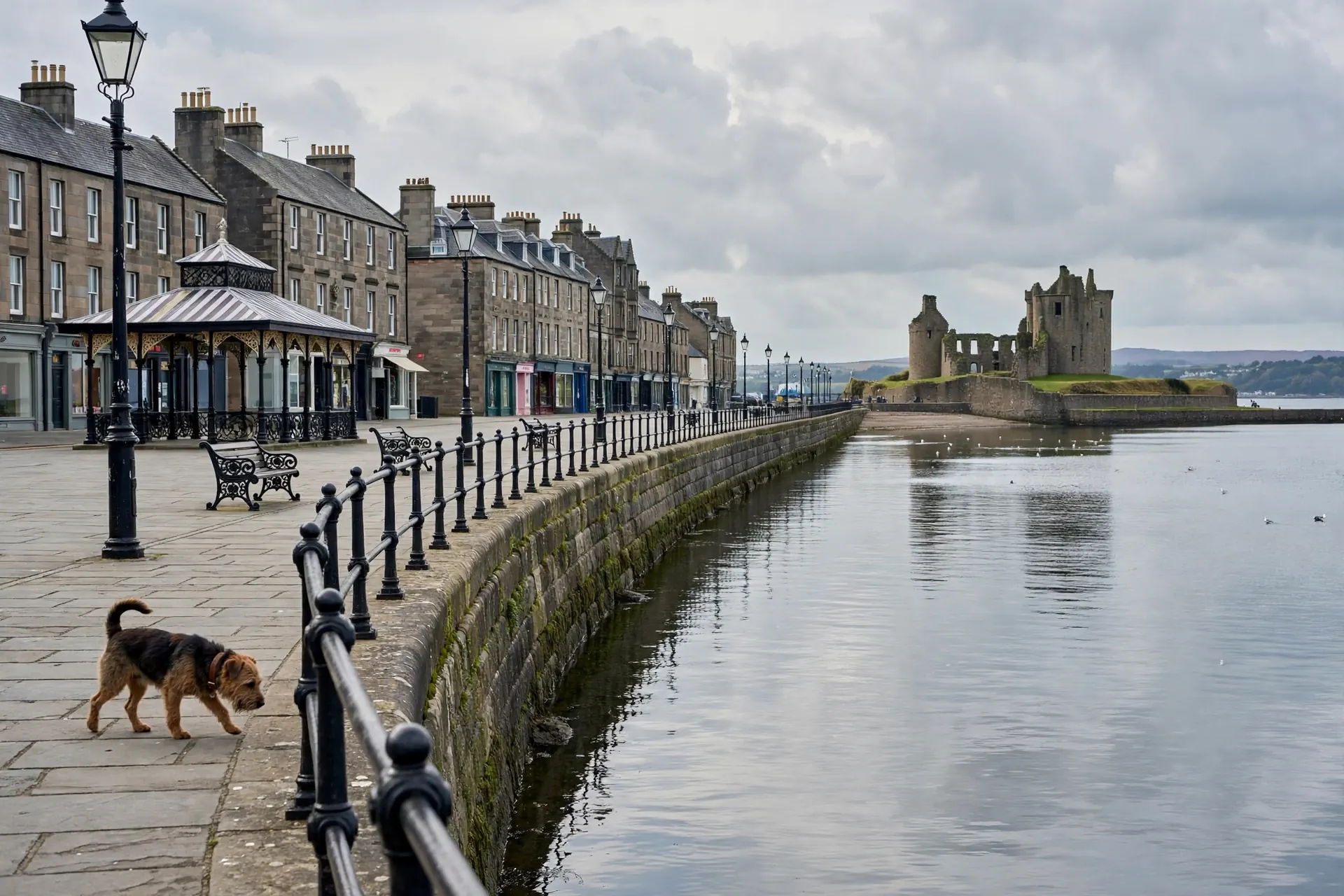
Step off the pier and the town introduces itself in one long, level sweep. Rothesay grew as a Victorian seaside resort, and the promenade still carries that history in its shape: a broad paved walk along the bay, benches facing the water, gardens and planting, and the pale frontages of hotels and tenements that once housed holidaymakers arriving by steamer. It is the easiest walk in town for a dog, because it is flat, it is long enough to matter, and it offers the two things dogs value most on arrival — new smells and a clear view in every direction. Walk it slowly on the first evening. The dog gets to map the town, you get to read the weather and the light, and the holiday starts without anyone having to drive anywhere.
The promenade works in both directions. Head one way and the bay opens out towards the Firth of Clyde, with the hills of Arran visible across the water on a clear day; head the other and the town curves around to the harbour and the castle. The surface is paved and mostly smooth, which suits older dogs, small dogs and dogs recovering from injury, but it is also a shared space with cyclists, pushchairs, runners and other dogs, so keep the lead short near the pier and at junctions. Early morning is the quietest time, when the light is low and the bay is calm, and it is the best slot for a reactive dog. Midday in summer is busier, with families, ice-cream queues and dogs of every size, so choose the quieter stretches or walk at the edges of the day if your dog finds crowds hard.
Look for the details that make Rothesay different from a generic seaside town. The Victorian and Edwardian buildings along the front were built for visitors, and many still carry the proportions of that era: tall windows, generous bays, and hotels that once advertised sea views as their main attraction. The Winter Gardens, a distinctive glasshouse building on the seafront, is a landmark worth noting as you walk, though access and opening arrangements can change, so check the official guidance before you travel if you plan to go inside. The gardens and the small green spaces along the front give dogs a patch of grass to sniff, but keep them on a lead in planted areas and clean up promptly: this is a town centre walk, and the standard of behaviour expected is the same as in any busy high street.
The promenade is also the town's weather gauge. A calm morning can turn into a brisk Clyde wind by the afternoon, and rain often arrives sideways off the water. That matters for dogs as much as for people: a wet, windy walk is fine for a hardy collie in a drying coat, but a small or short-coated dog will chill quickly on an exposed seafront. Pack a drying coat and a towel even on a promising morning, and plan a warm indoor stop — a dog-friendly cafe, your accommodation, or simply the car with the heater on — as part of the walk rather than as an afterthought. In winter, the promenade is quieter and the light is lower and softer, which suits photography and slow sniffing walks, but the pavements can be slippery after rain and the wind can be sharp, so shorten the walk and add a second, sheltered loop through the town centre instead.
For a first-day routine, try this shape. Arrive, park or drop bags, then walk the promenade for twenty to thirty minutes with no destination beyond the next bench. Let the dog sniff, mark the route, and watch the boats. Return along the same stretch so the dog learns the way back, then feed and settle the dog before dinner. The next morning, walk the promenade again before breakfast, when the town is still quiet, and you will see a different Rothesay: fishermen and early dog walkers, gulls over the bay, and the castle walls catching the first light. That repetition is not wasted time. Dogs settle faster when the first walk and the last walk of the day follow the same ground, and Rothesay's promenade is one of the few town walks in Scotland that is interesting enough to repeat without feeling repetitive.
Rothesay Castle: a thirteenth-century circle in the middle of town
Rothesay Castle sits a short walk from the pier, and its round curtain wall is one of the most unusual castle shapes in Scotland. Built in the thirteenth century and developed over the following centuries, it has a circular plan that is rare among Scottish castles, with thick walls, towers and a moat that once made it a serious defensive site. Today it is a compact, walkable monument: small enough to visit in under an hour, substantial enough to feel like a real castle, and close enough to the town centre that a dog can walk there from almost any accommodation without a car.
Dogs on leads are generally welcome in the castle grounds, but access to the interior, the visitor centre and any indoor exhibition space can be restricted, so check the official guidance before you travel. That distinction matters for planning. Treat the castle as an outdoor visit: walk the outside of the walls, look at the towers and the moat, read the interpretation boards, and enjoy the contrast between the stone circle and the Victorian town around it. If one person in your party wants to go inside while the other waits with the dog, agree the plan before you arrive rather than negotiating it at the gate with a dog pulling on the lead. Bring water, because there is little shade on a hot day and the stone reflects heat, and keep the dog on a short lead near the walls and the moat edge, where the ground can be uneven and the drop is real.
The castle rewards a slow circuit rather than a quick photograph. Walk right around the outside first, noting how the round wall meets the town streets, then find a bench or a patch of grass where the dog can settle while you look at the stonework properly. The towers and the gatehouse tell the story of a castle that was attacked, repaired and adapted over centuries, and the moat — now a grassy hollow rather than a water-filled defence — gives a sense of how the site once controlled the approach from the harbour. Children often enjoy the castle more than adults expect, because the shape is easy to understand and the walls are easy to imagine as a fort, but keep children and dogs together on leads and paths rather than letting either climb on the stonework.
Combine the castle with the town centre rather than treating it as a standalone attraction. A practical loop is: promenade, castle grounds, a coffee stop, then back along the front. That gives the dog a mix of open water views, grass and stone, pavement and people, without a long drive or a steep climb. If the weather turns, the castle is also a useful bad-weather stop, because the visit is short and the town centre is close, so a shower does not strand you miles from shelter. In winter, check opening times before you go, because seasonal hours can be shorter and some sites close on particular days; the outside of the castle can still be walked and admired from the street even when the interior is closed, which makes it a reliable anchor for a winter day when other attractions are shut.
One caution: the castle is popular, and the area around the gate can be busy with visitors, school groups and other dogs. If your dog is reactive or nervous in crowds, visit early in the morning or late in the afternoon, keep the lead short, and use the quieter side of the walls rather than the main entrance as your first approach. A dog that has already had a good walk on the promenade will be calmer at the castle than a dog that has been in the car all morning, so order the day with the dog's energy in mind: walk first, castle second, cafe third. That sequence works for most dogs in most towns, and it works particularly well in Rothesay, where the three stops are within a few minutes of each other.
The town centre: shops, cafes and a working island town
Rothesay is not a resort that closes when the season ends. It is the main town on Bute, with a working harbour, a high street, supermarkets, a post office, banks, a library and the services an island community needs year-round. That makes it a practical base for a dog holiday, because the things you forget — a lead, a tin of food, a towel, a phone charger — can be bought in town rather than ordered online or driven to the mainland for. The high street is compact and mostly level, which suits a dog walk that doubles as an errand run, but the pavements are narrow in places and the traffic is real, so keep the dog on the pavement side and watch for delivery vehicles and buses pulling in.
Cafes and tea rooms are the social heart of a Rothesay stay, and many welcome dogs, at least in outdoor seating areas and sometimes inside. Policies change by season and by owner, so ask before you sit down rather than assuming, and look for the signs that a place is genuinely dog-friendly: a water bowl by the door, a dog biscuit on the counter, or a staff member who greets the dog by name. If you are eating out with a dog, choose a table where the dog can lie out of the main walkway, bring a blanket for the dog to settle on, and order something that does not require the dog to be left alone while you queue at a counter. A dog that can settle under a table for twenty minutes is a dog that will be welcome again tomorrow; a dog that barks at every passing tray will not, however friendly the staff are.
The harbour area deserves a slow look. Fishing boats, the ferry pier and the small craft in the bay give the town its working character, and the harbour wall is a good place to watch the water without getting in anyone's way. Keep dogs on a lead near the harbour edge, because the drop to the water is not always fenced and a dog that jumps in after a gull can be hard to retrieve. The same caution applies to any slipway or steps down to the water: check the surface for slime and weed, which are slippery even in dry weather, and do not let a dog drink from harbour water, which can contain fuel and other contaminants. A better plan is to carry fresh water and offer it regularly, so the dog does not seek out puddles and seawater.
Shopping with a dog takes a little planning. Some shops welcome dogs inside, others ask you to wait outside, and a few will hold a lead while you browse. If you are travelling as a pair, take turns: one person shops while the other walks the dog around the block, then swap. If you are travelling alone, keep shopping trips short, use the promenade as a holding walk, and prioritise the shops that matter rather than browsing every doorway. The supermarkets in town stock the basics for a self-catering stay, including dog food, but if your dog eats a specialist diet, bring enough from home for the whole trip rather than hoping a small island supermarket stocks the exact brand. The same applies to medication: bring the full course plus a spare day, and keep the vet's number and the nearest vet practice address saved before you travel.
Evenings in Rothesay are quieter than in a mainland resort town, and that suits most dogs. The promenade after dinner, when the day visitors have left and the light is fading over the bay, is one of the best walks on the island: short, flat, and full of smells from the day's boats and visitors. Walk the dog, then settle in for the evening. If your accommodation has a garden, check the fencing before letting the dog out alone, because island gardens vary widely and a gap in a hedge is an invitation to explore. If you are in a flat or a room without a garden, the promenade is your evening toilet walk, so learn the route in daylight and carry a torch after dark. A calm evening routine — walk, feed, settle — is the foundation of a good night's sleep for both dog and owner, and Rothesay makes that routine easy.
Bay walks and beaches: where to go for a proper run
Rothesay Bay itself is a town beach: a curved stretch of sand and shingle in front of the promenade, useful for a paddle and a sniff, but not the place for a long off-lead run in the middle of a summer day. Local rules can change by season, and the beach is shared with swimmers, families and other walkers, so check the signs on arrival and keep the dog under control near other beach users. The best use of Rothesay Bay is as a short, on-lead morning walk and as a place to let a dog paddle in the shallows on a quiet day, not as the main beach of the holiday. For a proper beach day, drive or take the bus out of town to the larger bays, where the sand is wider, the crowds are thinner, and the dog has room to run.
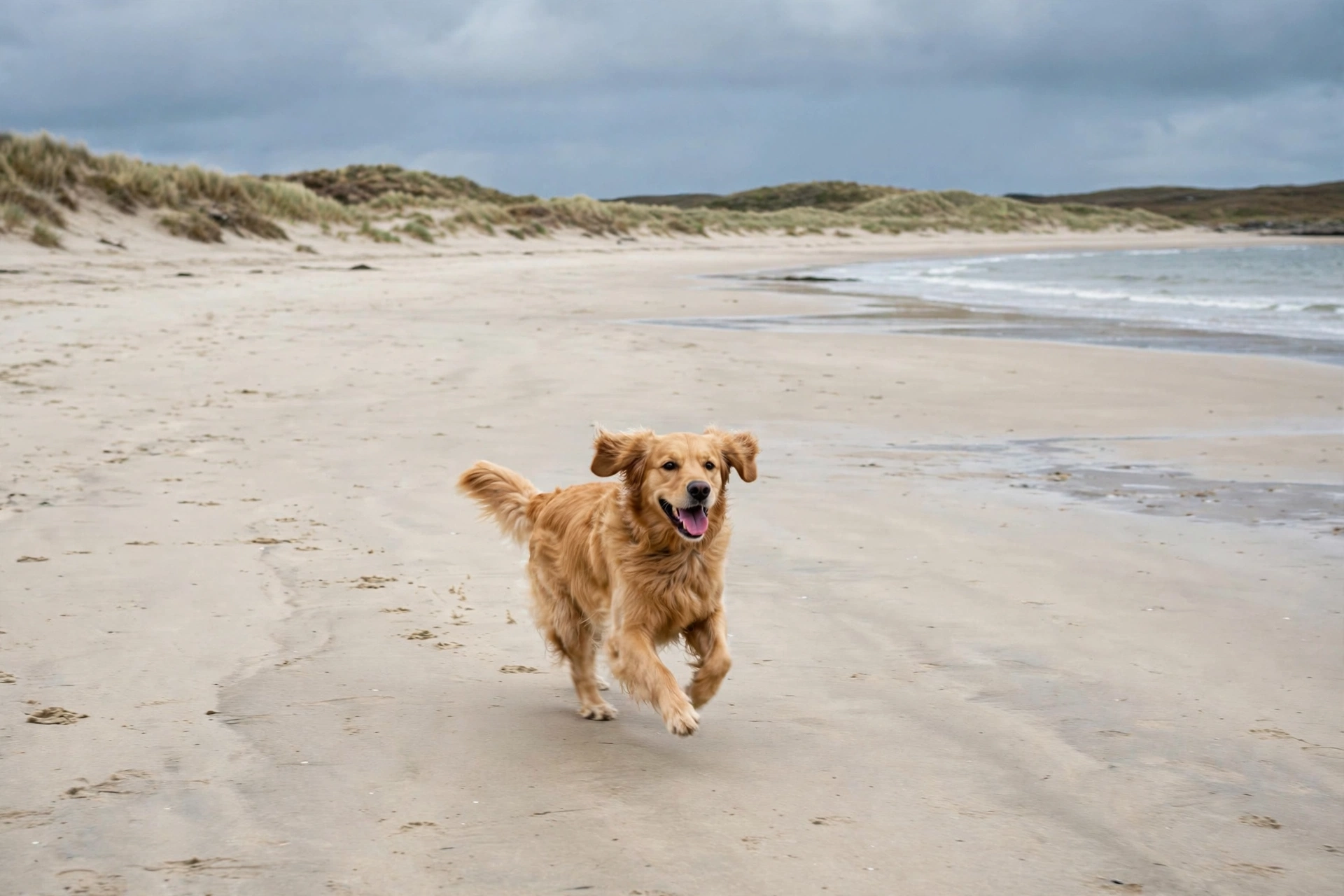
Ettrick Bay, on the west coast of Bute, is the island's best-known beach and the one most dog owners end up returning to. It is a long, sandy bay with a tea room and a car park at one end, and it suits dogs because the sand is firm enough for running, the water shelves gently, and there is space to keep a distance from other groups. The wind can be strong on the west coast, and the weather can change quickly, so bring a windbreak or a drying coat and check the forecast before you set out. Keep the dog in sight and under voice control, because the beach is long enough for a dog to disappear around a headland, and watch for other dogs, horses and wildlife. Our guide to dog-friendly beaches in Scotland covers seasonal rules, tides and beach safety in more detail, and the same principles apply here: check the tide times, keep an eye on the water, and do not let a dog swim in rough conditions.
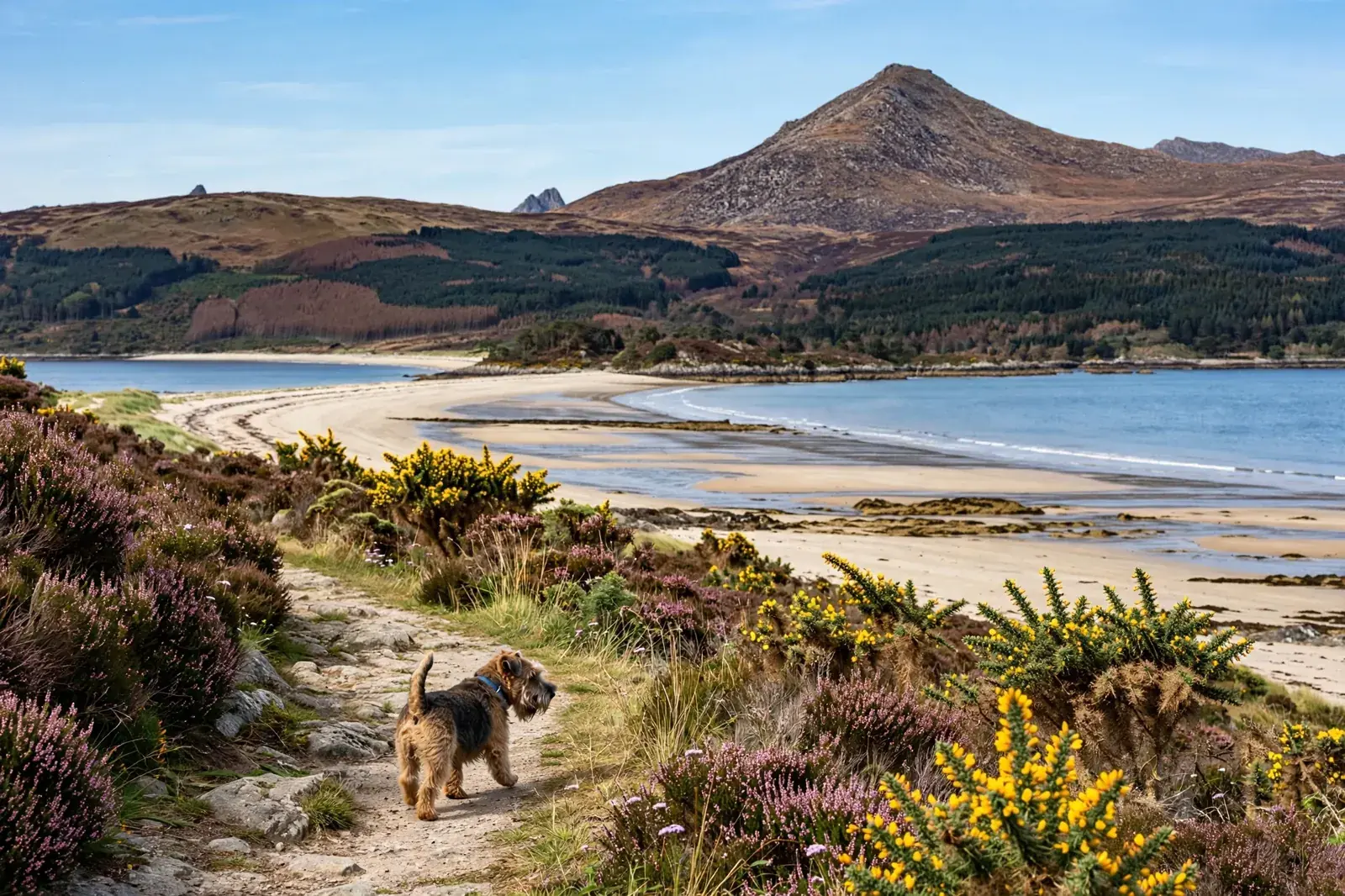
Scalpsie Bay, on the east coast south of Rothesay, is a quieter option, with a long sandy shore and views across to Arran. It is often less busy than Ettrick Bay, which makes it a good choice for a nervous or reactive dog, but it is also more exposed to the weather and has fewer facilities, so bring everything you need: water, a bowl, a towel, a lead and a long line, and a bag for rubbish. Kilchattan Bay, at the southern tip of the island, is a small, pretty village bay with a different character again: a sheltered curve of sand and stone, a village shop and a quieter pace. It suits a short visit combined with a village walk rather than a full beach day, and it is worth combining with a drive around the south of the island rather than treating it as a destination on its own.
Beach safety deserves a proper paragraph, because the Clyde can be deceptive. The water is cold even in summer, and a dog that swims strongly in a warm lake can tire quickly in cold sea water. Do not throw a ball into deep water, do not let a dog chase waves into a strong current, and watch for the tide: a beach that is wide at low tide can narrow quickly as the water comes in, cutting off a route back around rocks. Check tide times before you go, and keep the dog on a lead near rock pools and cliffs, where the footing is uneven and the drop is real. After a beach visit, rinse the dog with fresh water if you can, dry the ears, and check the paws for cuts from shells and sharp stones. Sand in the coat is normal; sand in the eyes or a cut paw is not, and both are easier to deal with early than after a long drive home.
Wildlife is part of the beach experience on Bute. Seals are seen around the island, and they can haul out on quiet beaches or on rocks at low tide. Keep the dog on a lead and at a distance if you see seals, because a dog that chases a seal can be bitten, and a seal that feels cornered can be dangerous. Birds, including waders and gulls, nest on some beaches in spring and summer, so keep the dog under control near nesting areas and respect any seasonal signs. If you see a dead animal on a beach, keep the dog away and report it to the local authority if the signs ask you to: dead birds and marine animals can carry disease, and dogs are naturally curious about them. A little distance and a short lead cost nothing and prevent a veterinary visit.
Using Rothesay as an island base: day trips that work with a dog
Rothesay earns its keep as a base because the island is small enough to cross in under an hour and varied enough to feel different every day. Mount Stuart, the grand Victorian Gothic house on the east coast south of Rothesay, is the island's best-known attraction, and its gardens and grounds are the dog-friendly part of the visit: the house itself has access restrictions for dogs, so check the official guidance before you travel, but the woodland walks, the shoreline paths and the gardens give a dog a proper outing while the house provides a destination for the people. Plan Mount Stuart as a half-day rather than a full day with a dog: walk the grounds, have lunch or a coffee where dogs are welcome, then return to Rothesay for an evening promenade walk.
North Bute is quieter and wilder, and it suits a driving day with stops rather than a single long walk. The road north from Rothesay passes through farmland and small settlements to Rhubodach, where the ferry crosses to Colintraive, and the coastline along the way offers views across the Kyles of Bute, a narrow stretch of water between Bute and the mainland that is one of the prettiest parts of the Clyde. Stop at viewpoints, let the dog stretch its legs on short paths, and keep the dog on a lead near livestock and near the water's edge. The Kyles are tidal and the currents are strong, so do not let a dog swim there, however tempting the water looks on a calm day. A northern loop can be combined with a return by the same road or, if the timetable allows, with a crossing to Cowal and a drive back by a different route, but check ferry times and road conditions before you commit to a circular plan.
South Bute, around Kilchattan Bay and the southern tip, is a good choice for a slower day. The village is small, the bay is sheltered, and the roads are quiet enough for a dog walk that starts in the village and follows the coast. Combine a southern visit with Ettrick Bay on the west coast, driving across the island on the central road, so the day has two different beaches and a change of coast. The central road crosses farmland and moorland, and the views open out as you climb, so stop at a lay-by and let the dog look at the landscape — dogs read a new view through smell as much as sight, and a five-minute sniffing stop is a real break for a dog that has been in the car. Keep dogs on leads near sheep and cattle, close gates behind you, and do not let a dog chase livestock: worrying livestock is a serious offence and a frightened flock can cause a road accident.
Arran, across the water to the south, is the obvious longer day trip, and it is worth considering if you have a full day and a dog that travels well. The ferry from Ardrossan to Brodick is the usual route, and it involves a drive from Rothesay to the mainland ferry port, so it is a long day rather than a casual add-on. Our guide to the Isle of Arran with a dog covers bases, beaches and lower paths in detail, and it is the right place to start if you are tempted. For most visitors, though, Bute itself has enough for a week without leaving the island: beaches, woodland, coastal paths, a castle, a grand house and a town that is easy to live in. Leave Arran for a second trip, or for a longer stay when you have a full day to give it, rather than squeezing it into a day that is already full of Bute.
A practical weekly shape helps. Day one: arrive, promenade, castle, settle in. Day two: Ettrick Bay in the morning, Rothesay in the afternoon. Day three: Mount Stuart grounds and the east coast. Day four: a northern loop and the Kyles. Day five: Scalpsie Bay and Kilchattan Bay. Day six: a West Island Way section, described below, with a shorter walk and a cafe stop. Day seven: a repeat of the favourite — usually Ettrick Bay or the promenade — and a slow departure that leaves time for the ferry. That shape is not a timetable to be followed rigidly; it is a way of making sure the dog gets a mix of beach, woodland, town and rest, rather than the same beach every day or a different long drive every morning. Rest days matter: a dog that has run on a beach for three days in a row needs a quiet town day, with short walks and long sleeps, before the next big outing.
The West Island Way: a long-distance path in manageable pieces
The West Island Way is a waymarked long-distance route that runs the length of Bute, from Port Bannatyne in the north to Kilchattan Bay in the south, a distance of around 48 kilometres. Nobody needs to walk it all in one go, and most dog owners should not try. Its value for a Rothesay stay is that it can be walked in short, well-defined sections, each with its own character: woodland, farmland, moorland, coastline and village paths, all linked by a single waymarked route. Choose a section that matches your dog's fitness and the weather, walk it one way, and use a bus, a lift or a second car to return, or walk out and back along the same stretch.
The sections near Rothesay are the easiest to reach. The path passes close to the town, and a short walk from the centre can join it without a drive. Further south, the route climbs onto higher ground with views across the island and to Arran, and the walking becomes more open and more exposed to wind. Further north, the path runs through woodland and along the shore, with quieter stretches that suit a dog that needs space from other walkers. Check the official guidance before you travel for the current route, any diversions, and the condition of the path after wet weather, because a waymarked route is not a guarantee of dry feet: some sections can be boggy after rain, and stiles and gates can be awkward for a large dog or a dog on a long line.
Walking a long-distance path with a dog takes a different kind of preparation from a beach day. Carry more water than you think you need, because there are stretches with no shop and no tap, and a dog that is working uphill in wind will drink more than a dog lying on a beach. Pack a lead and a long line, and use the lead near livestock, near roads, and on narrow sections where the path runs beside a drop. Keep the dog under control at stiles and gates: lift a small dog over a stile rather than letting it scramble, and check the gate closes behind you. If the dog is older or has joint problems, choose a flat, short section rather than a hilly one, and remember that the walk back is as long as the walk out unless you have arranged transport.
Footwear and paws deserve attention on the West Island Way. The path includes tarmac, gravel, grass, mud and rocky sections, and a dog's paws can be sore after a long day on hard or rough ground, especially if the dog is not used to it. Check paws at the end of the walk for cuts, thorns and soreness, and shorten the next day's walk if the dog is stiff. For the humans, wear boots with ankle support and carry a waterproof layer even on a dry forecast: Bute's weather changes fast, and a shower on an exposed ridge is colder than the same shower in town. A map or a downloaded route on your phone is worth having, because phone signal can be patchy in the island's interior, and a paper map does not run out of battery.
Wildlife and livestock are part of the route. The West Island Way crosses farmland, and sheep, cattle and horses are common. Keep the dog on a lead through fields with livestock, do not let the dog approach or chase animals, and if cattle block the path, give them a wide berth and keep the dog close. Deer are seen in the island's woodland, and a dog that chases deer can be lost quickly in thick cover, so keep the dog in sight and under voice control in wooded sections. Adders are present in parts of Scotland, though they are rarely seen; keep the dog on the path in warm, sunny weather on rocky or heathery ground, and know the signs of a bite — swelling, pain and lethargy — so you can get to a vet quickly if it happens. The risk is low, but the preparation costs nothing.
Seasons and weather: when Rothesay is at its best for dogs
Rothesay is a year-round town, but the experience changes sharply with the seasons, and the best season depends on the dog you have. Spring, from April to June, is often the sweet spot: the days are lengthening, the beaches are quieter than in summer, the gardens and woodland are coming into leaf, and the ferry and the town are busy enough to feel alive without being crowded. Spring showers are frequent, so pack waterproofs, but the light is good and the walking is comfortable for most dogs. Check beach rules in spring, because nesting birds and seasonal restrictions can apply, and keep the dog on a lead near nesting areas.
Summer, from July to August, is the busiest season, with the warmest weather, the longest days and the most visitors. The promenade and the beaches are at their liveliest, which suits a sociable dog that enjoys people and other dogs, but it can be hard for a reactive or nervous dog. Heat is the main risk: the Clyde coast is rarely very hot, but a sunny day on a sheltered beach or in a car can still overheat a dog, especially a flat-faced breed, an older dog or a dog with a thick coat. Never leave a dog in a parked car, even for a few minutes, and carry water and a shade option on beach days. Walk early in the morning or late in the evening in hot weather, and use the middle of the day for a shaded woodland walk or a rest indoors.
Autumn, from September to October, is many regular visitors' favourite season on Bute. The summer crowds have gone, the beaches are empty, the light is lower and warmer, and the walking is often at its best. The sea is at its warmest after the summer, though it is still cold by most standards, and the woodland colours are good. Autumn storms can arrive quickly, so check the forecast and the ferry status before a beach day, and be ready to swap a coastal walk for a sheltered woodland route. Fireworks around early November can unsettle noise-sensitive dogs, so check whether local displays are planned and keep the dog indoors with the curtains drawn and a familiar routine if fireworks are expected.
Winter, from November to February, is quiet, dark and often wet, but it has its own rewards. The town is at its most local, the promenade is empty, the castle and the beaches can be visited without queues, and accommodation is often cheaper. The challenges are daylight and weather: the days are short, the wind off the Clyde can be sharp, and rain is frequent. Shorten walks, add a torch and a reflective lead, and plan indoor stops. A winter stay suits a dog that is happy with short, frequent walks and long sleeps, and an owner who is happy with a slower pace. Check opening times for attractions, cafes and shops before you travel in winter, because seasonal hours can be shorter and some places close for a period.
Whatever the season, the Clyde weather rule applies: check the forecast, then check it again, and carry a waterproof layer even when the morning looks promising. The island's weather is shaped by the sea, and a calm morning in Rothesay can become a windy afternoon on the west coast. That is not a reason to stay indoors; it is a reason to plan flexibly, with a beach option and a woodland option for each day, so a change in wind direction changes the route rather than cancelling the walk. Dogs do not mind rain as much as their owners do, provided they are dried and warmed afterwards, so the real skill of a Bute holiday is not avoiding the weather but choosing the right walk for the weather you have.
Practical details: getting around, vets and dog rules
Getting around Bute with a dog is straightforward if you plan around the island's scale. The island is about 25 kilometres long and up to 8 kilometres wide, so most drives are under half an hour, and the roads are generally quiet outside Rothesay. Parking is available in Rothesay and at the main beaches, but car parks at Ettrick Bay and other popular spots can fill up on a sunny summer weekend, so arrive early or visit on a weekday. Check parking charges and time limits on arrival, because they can change by season, and do not leave a dog in a parked car while you walk or eat. Buses link Rothesay with the main villages and beaches, and dogs are usually welcome on buses, but check the operator's current rules before you travel, because policies and the space available for a large dog can vary.
Veterinary care is a practical point worth sorting before you arrive. Rothesay has veterinary services, and the nearest out-of-hours provision should be noted before you need it, because an island at night is not the place to be searching for a phone number in a hurry. Save the number of a local vet and the number of your own vet in your phone, keep your dog's medication and vaccination record with you, and know where the nearest 24-hour emergency vet is on the mainland in case a serious problem needs referral. If your dog has a chronic condition, bring a written summary of the condition and the current medication, so a vet who has never met your dog can act quickly. That preparation takes ten minutes at home and can save an hour in an emergency.
Dog rules on Bute follow the same principles as elsewhere in Scotland, but the details are local. The Scottish Outdoor Access Code gives a right of responsible access to most land and inland water, but that right comes with responsibilities: keep dogs under control, keep them on a lead near livestock and in fields with young animals, clean up after them, and respect any seasonal restrictions on beaches and in nature reserves. On beaches, check the signs for any dog control orders or seasonal bans, and keep the dog under control near other beach users, especially children and swimmers. In town, keep the dog on a lead on pavements and near roads, and clean up after the dog everywhere, including on beaches and in woodland: a bagged waste bin is usually available in town and at main car parks, but carry a spare bag and take the bag with you if no bin is available.
Lead and recall discipline matters more on an island than it looks, because the hazards are different. Livestock, seals, nesting birds, cliffs, tidal beaches and busy ferry traffic are all present in a small area, and a dog that is reliable in a city park may be less reliable when a seal appears on a beach or a sheep moves in a field. Use a lead as the default in new places, and only let the dog off the lead where you can see the ground clearly, where there is no livestock, and where you are confident of recall. A long line is a useful middle ground on beaches and open ground: it gives the dog freedom to run and sniff while keeping a physical connection if something unexpected appears. Practise recall before the trip, and do not test it for the first time on a cliff path or a tidal beach.
Money, phone signal and supplies are the last practical points. Rothesay has banks, cash machines and card-accepting shops and cafes, but smaller villages and beach tea rooms may be cash-only or may have limited card facilities, so carry some cash for a rural day. Phone signal is generally good in Rothesay and along the main roads, but it can be patchy in the island's interior and on some coastal stretches, so download maps and timetables before you set out rather than relying on a live connection. Bring enough dog food, medication and poo bags for the whole stay, because island shops stock a narrower range than a mainland supermarket, and a specialist diet or a particular brand may not be available. A small first-aid kit for the dog — a tick remover, a bandage, saline for eyes, and any prescribed medicine — fits in a day bag and is worth carrying on longer walks.
Staying and eating out with a dog in Rothesay
Accommodation in Rothesay ranges from hotels and guest houses on the seafront to self-catering flats, cottages and houses in the town and the surrounding villages. The right choice depends on the dog: a self-catering place with a garden suits a dog that needs space and a routine, while a hotel with a dog-friendly room suits a short stay where meals are part of the holiday. Whatever you book, confirm the dog policy in writing before you pay: how many dogs are allowed, whether there is a charge, whether the dog can be left alone in the room, and whether there are restrictions on where the dog can go in the building. A policy that is clear in writing is worth more than a friendly assurance on the phone, because the written version is the one that will be applied if there is a dispute.
Check the practical details of the room or house before you arrive. Ask whether the garden is fenced and how high the fence is, whether there are steps to the entrance, whether the floors are hard or carpeted, and where the nearest toilet walk is after dark. A ground-floor room with a door to the outside is easier for a dog than a room up two flights of stairs, and a place with a hard floor is easier to clean after a wet beach day than a place with pale carpet. Bring the dog's bed, blanket and bowls from home, because familiar smells help a dog settle in a new place, and bring a stair gate or a travel crate if the dog uses one at home. Do not assume the accommodation provides dog towels, bowls or a drying area: ask, and pack your own if the answer is no.
Eating out with a dog in Rothesay is usually straightforward, because the town's cafes and restaurants are used to visitors with dogs, but the same rules apply as anywhere: ask before you sit down, choose a table where the dog can lie out of the way, and keep the dog settled for the duration of the meal. Outdoor seating is the easiest option in good weather, and many places have a covered terrace or a sheltered corner that works in light rain. Indoor seating with a dog is more variable, so check in advance if you are planning a special meal, and have a back-up plan — a takeaway eaten on the promenade or in your accommodation — if the restaurant cannot accommodate the dog that evening. A dog that has had a good walk before dinner will settle better than a dog that has been waiting in the room all afternoon, so time the walk and the meal together.
Self-catering changes the rhythm of the day in a useful way. Cooking in means the dog can stay with you for the evening, the feeding routine stays the same, and the cost of the stay comes down. Rothesay's supermarkets and shops cover the basics, and the town's butchers, bakers and delis add a local flavour that a mainland supermarket cannot match. If you are self-catering, plan a shopping trip on arrival day so the cupboards are stocked before the first beach day, and keep a few easy meals in reserve for a wet evening when nobody wants to go out. A slow cooker or a simple one-pot meal suits a dog holiday well, because it cooks while you walk and is ready when you return, wet and hungry, from the beach.
Finally, think about the last morning. Check-out times are usually mid-morning, and the ferry timetable may not align neatly with them, so plan the final walk before check-out rather than after it, and leave time to clean up, pack the car, and walk the dog properly before the crossing. A short promenade walk, a last look at the bay, and a calm drive to the pier are a better ending than a rushed departure with a dog that has not been out since the night before. Leave the accommodation as you found it, report any damage honestly, and thank the host if the dog was welcomed: dog-friendly places stay dog-friendly because dog owners behave well, and a good review that mentions the dog policy helps the next dog owner who is choosing where to stay.
Practical questions
Before you go
Can dogs go on the ferry to Rothesay?
Yes. Dogs can travel on the CalMac ferry from Wemyss Bay to Rothesay, and on the shorter northern crossing from Colintraive to Rhubodach. Dogs usually travel on foot as foot passengers or stay in the vehicle, and some sailings have pet-friendly passenger areas. Check the operator's current pet rules and timetable before you travel, because sailing times and facilities can change.
Are dogs allowed at Rothesay Castle?
Dogs on leads are generally welcome in the castle grounds, but access to the interior and the visitor centre can be restricted. Check the official guidance before you travel, and plan the castle as an outdoor visit with a lead, water and a plan for waiting outside if indoor areas do not admit dogs.
Is Rothesay beach dog-friendly?
Rothesay Bay is a town beach rather than a wide open dog beach, and local rules can change by season. The best nearby options for a proper off-lead run are usually the larger beaches outside town, such as Ettrick Bay and Scalpsie Bay. Always check local signs and seasonal restrictions on arrival, keep dogs under control near other beach users, and clean up after your dog.
How long should I allow for the ferry crossing to Rothesay?
The Wemyss Bay to Rothesay crossing takes around 35 minutes, while the northern Colintraive to Rhubodach crossing takes about five minutes. Allow extra time for boarding, especially with a car, and arrive early in busy summer periods. Foot passengers can walk straight from the pier into the town centre.
Is Rothesay a good base for exploring the Isle of Bute with a dog?
Yes. Rothesay is the island's main town, with the most shops, cafes, accommodation and bus connections, and it sits within easy reach of Mount Stuart, Ettrick Bay, Kilchattan Bay and the West Island Way. Staying in town means shorter drives to the beach and an easy evening walk on the promenade.
What should I pack for a dog day out in Rothesay?
Pack a lead and a long line, drinking water and a bowl, poo bags, a towel, a drying coat in wet weather, and a blanket for cafes and ferry lounges. Add a torch for dark winter evenings, a muzzle if your dog needs one for crowded areas, and your vet's number saved in your phone before you leave home.