This guide is independent and contains no paid placement. Venue dog rules change, so where this guide flags a check, please confirm the latest official information before you travel.
Helmsley is a strong dog base on the western edge of the North York Moors: the Cleveland Way starts here and heads towards Sutton Bank, the market square gives you a compact town centre, and the castle grounds are the dog-friendly part of the castle visit. Rievaulx and Duncombe Park each need a separate, current check — neither should be treated as a blanket yes. Keep dogs on leads around livestock, deer and grouse moor, and check the official latest guidance before you go for every paid site.
At the stone marker: start with a trailhead checklist
Begin not with a café, a car park or a shopping street, but at the Cleveland Way stone marker in Helmsley, the point that marks the start of one of England's long-distance trails. Standing there reframes the whole visit. Helmsley is not just a pretty market town with a castle attached. It is a trailhead: a place where a serious walking route leaves the pavements, crosses farmland and climbs towards the moor edge. If you plan the dog's day from that marker outwards, the decisions that matter — lead, water, distance, weather, livestock — get made before anyone is tired, rather than discovered halfway up a hill.
Run through a short checklist at the marker, out loud if it helps. One: lead and spare lead, because a broken clip on moorland is a genuine problem, not an inconvenience. Two: water for the dog as well as for people, plus a collapsible bowl, because becks are not reliably accessible and trough water is for livestock. Three: bags, and a plan to carry used bags to a bin rather than leaving them on a gatepost. Four: a downloaded map or a paper map, because phone signal fades once you leave town and a trail that is obvious at noon is less obvious in low cloud. Five: a turn-back time and a turn-back distance agreed in advance, based on the oldest, youngest or least fit member of the party — who is often the dog, even when the dog disagrees.
Six: check the dog, not just the kit. Paws sound after yesterday's walk? Eating and drinking normally? Pulling towards sheep already on the short walk through town? A dog who is wired in the market square will not settle on an open moor path, and a dog who is stiff on stone setts should not be committed to a long Sutton Bank section because the itinerary says so. Seven: check the day itself. Paid sites around Helmsley — castle, abbey, terrace and estate parkland — each set their own dog rules and opening patterns, and those rules are the sections of this guide flagged most clearly for a fresh check. Build the checklist habit here and it will serve you at every trailhead in the Moors, not just this one.
Cleveland Way towards Sutton Bank: the first section
The Cleveland Way runs for more than a hundred miles in a great arc around the North York Moors, from Helmsley to the coast and down to Filey. Most dog owners visiting Helmsley will not walk all of it, and do not need to: the opening section westwards towards Sutton Bank is a complete experience in itself, and the trail in the other direction, towards Rievaulx and beyond, links naturally with the abbey visit covered below. What matters is choosing a section length honestly and treating the trail as an out-and-back unless you have arranged transport at the other end. Long-distance paths are measured in commitment as well as miles.
The Sutton Bank direction is the classic first taste. The route leaves town, crosses lower ground and field paths, then climbs towards the escarpment, where the views open out over the Vale of York. The walking changes character as you go: town pavements give way to lanes, lanes to field paths with stiles and gates, and field paths to rougher moor-edge ground. For dogs, that progression is the point. Young dogs learn stile manners, gate manners and livestock manners in the easier early miles, before fatigue and exposure are added on the climb. Older dogs and puppies can enjoy the lower section and turn back at a pre-agreed point with no sense of an unfinished task — the trail does not keep score.
Expect stock from very early in the walk. Sheep graze many of the fields the trail crosses, cattle appear in rotation, and horses are kept on some holdings near town. Keep your dog on a lead through grazing land and under the closest control everywhere else on this section, because a dog who slips a lead near the escarpment edge or among stock creates risks out of proportion to the freedom gained. The escarpment itself demands respect: edges, steep drops and sudden gusts are no place for a dog ranging ahead out of sight. Walk the edge sections with the dog close, on the inland side, and stop for views rather than walking while gazing at them.
Practical notes for this section are unglamorous and important. Footwear and paw wear both matter on stony tracks in dry weather, and after rain the field sections churn and the stiles become slippery. There is little dependable shade on the higher ground in summer, and no reliable water for dogs once you have left the town becks, so carry more than the mileage suggests. In winter, the short day is the limiting factor: the escarpment in fading light, with a tired dog and a phone battery fading with it, is a situation to design out at the checklist stage. Set off early, turn back early, and let Sutton Bank be a viewpoint you earn on a settled day rather than a target you chase on a marginal one.
Helmsley Castle: grounds yes, indoors is a different question
Helmsley Castle dominates its side of town: a substantial ruined fortress, with earthworks, towers and later mansion remains inside the walls, managed by English Heritage. The honest dog summary is the one that applies to many heritage sites, and it is worth learning as a pattern rather than as a single fact. The grounds are the dog-friendly part. The indoors is not, or not reliably, and any guide that simply calls the castle dog friendly without splitting those two halves is setting you up for a disappointed conversation at the entrance.
In general terms, dogs on leads have been welcome in the castle grounds under English Heritage dog rules, which means a dog can share the main pleasure of the place: walking the defences, reading the shape of the fortress from inside its walls, and looking back across the town and towards the moor edge. Indoor areas, exhibitions, the shop and any enclosed displays can be restricted, often to assistance dogs only, and the exact arrangement can change with conservation work, staffing and events. So check the official latest guidance before you go, on the castle's own official page, and plan the visit as a grounds visit with a dog — not as a full interior tour that a dog happens to attend.
That pattern shapes how a group should organise itself. Two adults can split the indoor elements: one explores any interior displays while the other walks the grounds slowly with the dog, then swap, meeting for the shared circuit of the walls and earthworks. A solo visitor with a dog should take the grounds properly and without rushing, and treat any interior-only material as a reason to return without the dog on a future trip rather than a reason to leave the dog in a car. That last option is never available, in Helmsley or anywhere else: a dog does not wait in a parked car while humans tour a castle, whatever the weather looks like when the doors lock.
Inside the grounds, ordinary heritage-site discipline applies. Keep the lead short near other visitors, school groups and picnic areas, keep dogs off fragile masonry and earthworks where signs ask, and be ready for the surfaces: grass that softens after rain, stone that is uneven in the older parts of the site, and steps that an elderly dog may need to take slowly or avoid. Carry water, because a grounds visit on a warm day lasts longer than people expect. For the wider pattern across dozens of sites, our guide to dogs at English Heritage sites explains how grounds, interiors and assistance-dog rules usually divide, and why checking each property individually is the only reliable method.
Rievaulx Abbey and Rievaulx Terrace: two sites, two answers
Rievaulx, a short distance from Helmsley in a deep, wooded valley, contains one of the great sights of Yorkshire and one of the great dog-access traps for the unwary. The trap has a simple cause: there are two distinct attractions here, close together, with similar names. Rievaulx Abbey, the vast ruined Cistercian abbey in the valley bottom, is managed by English Heritage. Rievaulx Terrace, the grassed terrace with temples cut through woodland on the hill above, is managed by the National Trust. Different managers mean different dog rules, different opening patterns and different tickets. An answer obtained for one site tells you nothing dependable about the other.
For the abbey, the shape of the answer will by now be familiar: dogs on leads have generally been welcome in the extensive abbey grounds, where the ruins themselves are the experience — the soaring church, the chapter house and the long views along the nave are all outdoors — while the indoor museum and exhibition spaces can be restricted to assistance dogs. That makes Rievaulx Abbey one of the better major heritage visits to share with a dog, provided the lead is short, dogs are kept off fragile stonework, and you confirm the current position before travelling: check the official latest guidance before you go, because conservation work on a ruin of this scale regularly closes or reroutes parts of the site.
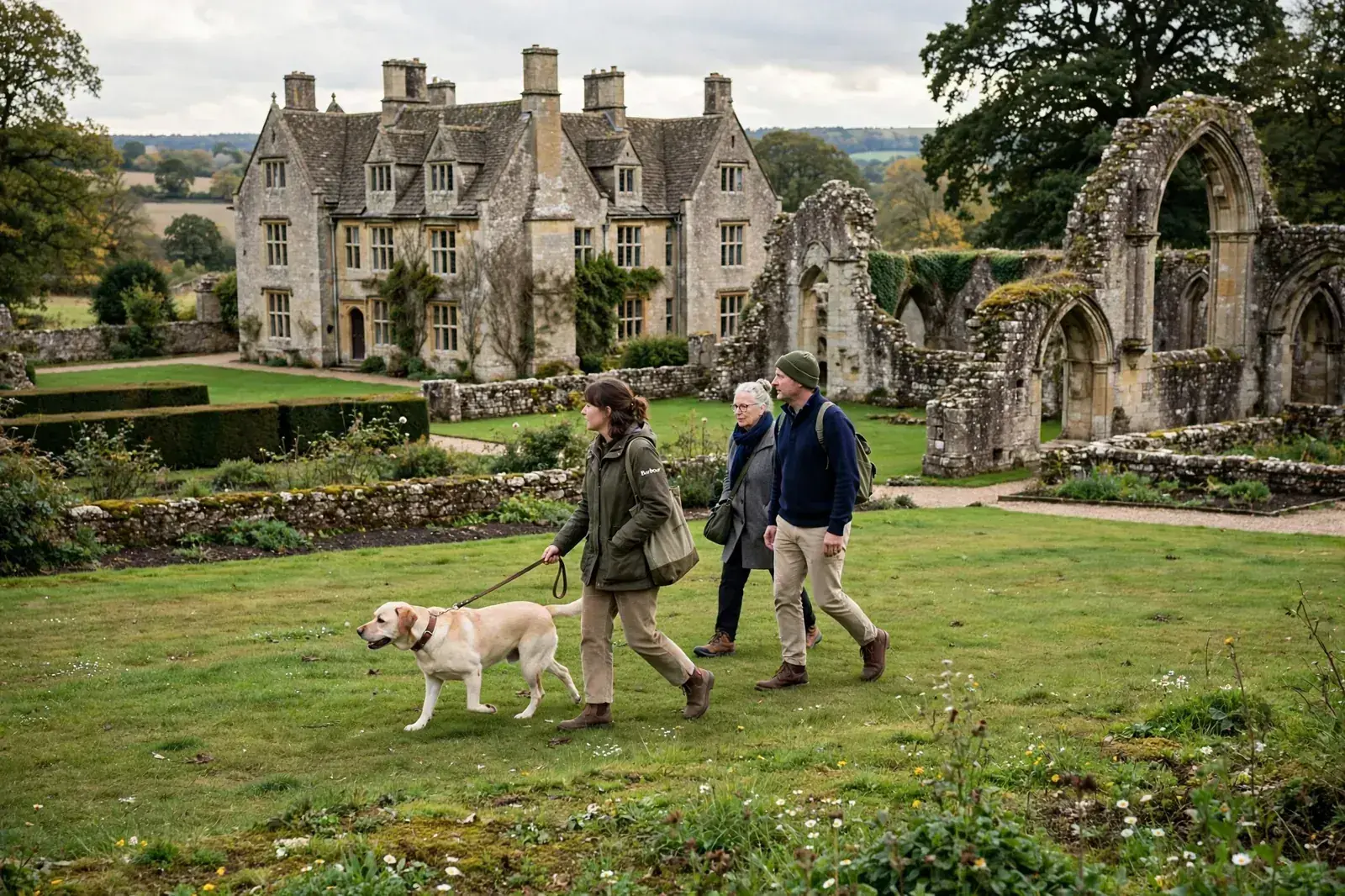
For the terrace, be more cautious and assume nothing. A designed landscape of woodland, a long grass walk and classical temples may sound like natural dog country, but formal gardens and terraces in National Trust care frequently operate stricter or more limited dog arrangements than open countryside, and arrangements can be seasonal or limited to particular routes. Treat the terrace as a separate decision: check the official latest guidance before you go for the terrace specifically, on its own official page, and if the answer for your date is that dogs are limited or not admitted, accept it and enjoy the abbey and the valley instead. The walk between Helmsley and Rievaulx, following the Cleveland Way corridor through the valley, is itself a fine dog walk, and for some visitors it becomes the main event, with the abbey grounds as its reward.
Logistics reward an early, unhurried approach. The valley road is narrow, parking at busy times is competitive, and coach and car traffic concentrates around the middle of the day in summer. Arrive early, walk the dog before entering any site so that a grounds visit begins with a settled dog rather than a frantic one, and carry water for the valley floor, which becomes a warm, sheltered bowl on still summer days. Groups who want both the abbey interiors and the terrace should use the split-visit pattern and accept that the dog's Rievaulx is the valley, the abbey grounds and the walk in and out — which, honestly assessed, is the best of it.
Duncombe Park: parkland promise, estate conditions
Duncombe Park, the great estate that wraps around the western side of Helmsley, with its house, gardens and sweeping parkland, is the third site in this guide where honesty matters more than enthusiasm. An estate is not a public park. Access is on the estate's terms, opening is patterned by season, private use and events, and the fact that parkland looks open from a footpath does not mean every part of it is open, or open to dogs, on the day you arrive.
The careful summary is this. There are parkland walks in and around the estate landscape that walkers with dogs value highly, and public footpaths cross parts of the wider estate, as public footpaths do across much of lowland England. But the house, the formal gardens, organised events and any ticketed areas operate under their own rules, which can be stricter for dogs or exclude them, and the estate's open days and arrangements change from year to year. So check the official latest guidance before you go, use the estate's own current information and maps rather than an old blog post, and follow signed routes exactly once you are there. Where a path is signed, walk it confidently. Where it is not, do not invent it.
Parkland discipline, wherever on the estate you are legitimately walking, follows the working-landscape rules that run through this whole guide. Deer and livestock move through estate parkland, sometimes at distances that make them easy to miss until a dog has spotted them. Keep dogs on leads around stock and deer without exception, give herds a wide berth, and cross grazing areas on the obvious path at a steady pace rather than lingering among animals. Estate roads carry vehicles, including farm and delivery traffic that will not expect a loose dog around a bend, so the lead stays on near roads even inside the gates.
None of this should put you off. A correctly checked Duncombe Park walk, on a day when the estate is open and on routes where dogs are welcome, gives Helmsley something most market towns cannot: a grand, landscaped, half-day walk beginning almost from the town centre. The condition is simply that you earn it with a check rather than assume it from a photograph. If the estate is closed or its dog arrangements do not suit your party on your dates, the Cleveland Way section and the Rievaulx valley walk are not consolation prizes — they are walks many visitors would choose first anyway.
Market square and the Friday market: small square, careful timing
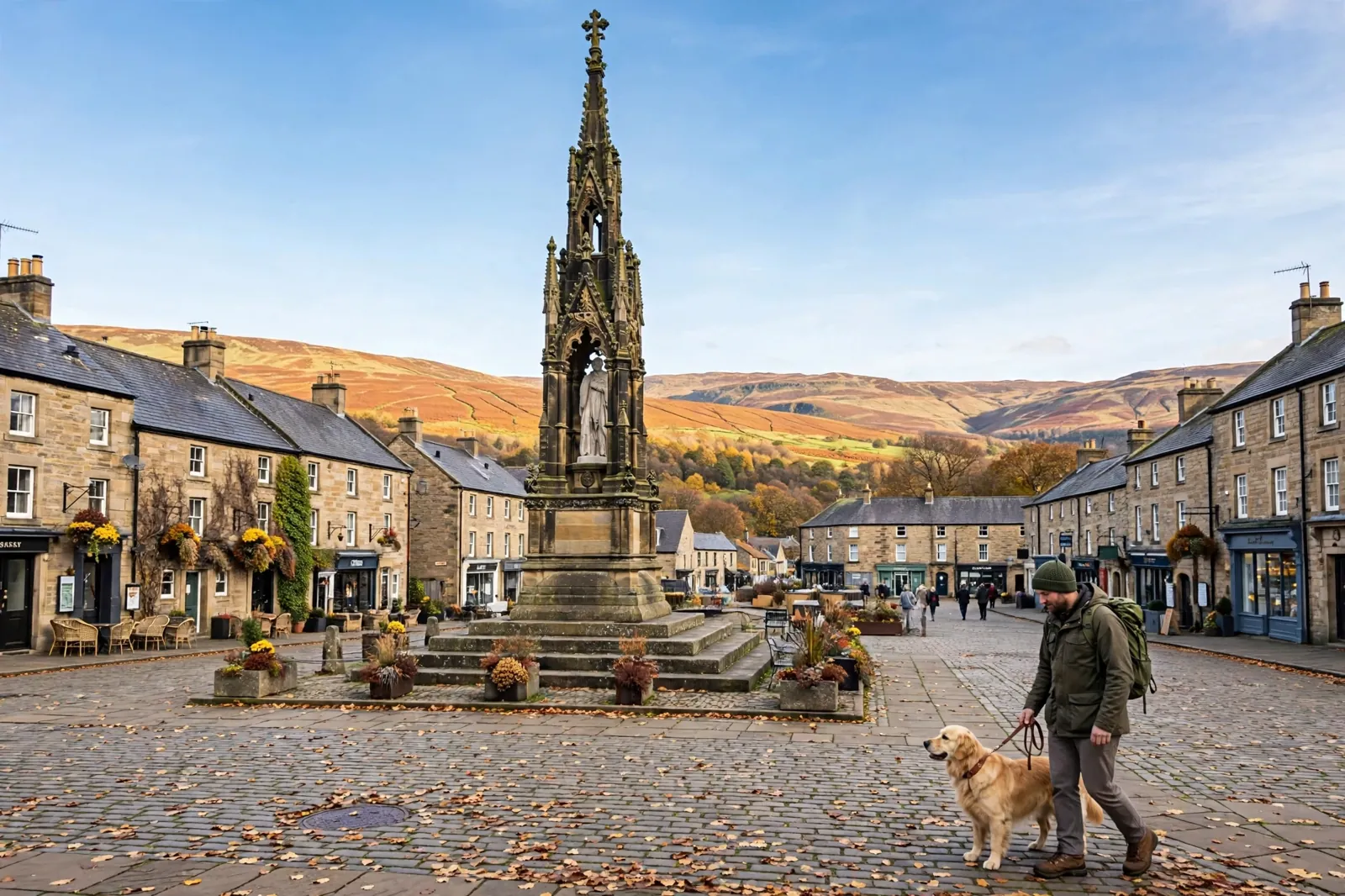
Helmsley's market square is the town's living room: a handsome stone square with its market cross, surrounded by shops, cafés, inns and the small businesses a moor-edge town needs, and watched over from one side by the castle. For a dog, it is a manageable centre as town centres go — compact, largely level, and easy to leave. Every street out of the square reaches quieter ground within a few minutes, which is the single most useful fact a dog owner can know about any market town. Pressure is optional here, because escape routes are short.
The market itself is traditionally a Friday market in the square: phrase that cautiously in your own planning, because market days, stall line-ups and seasonal arrangements can change, and events, weather and roadworks occasionally alter or cancel a week's market. Check before you go — through the town or market's official information and local notices — rather than building a trip around a Friday assumption found in an old guide. If you do coincide with market day, the dog method is the classic one. Arrive early, when aisles are wider and stallholders are still setting the rhythm of the day. Keep the lead short, walk your dog on the side away from the busiest stall fronts, and step out of the square regularly for a breather on a side street.
Dropped food is the square's main dog hazard, on market days and ordinary days alike. Bakery crumbs, chips and worse gather around benches, bins and café terraces, and a dog working the pavement at nose height will find all of it. Use a trained leave-it, watch the ground in front of your dog rather than the shop windows at food stops, and never let a dog scavenge around bins. Shops and cafés around the square each set their own dog policy: some welcome dogs inside, some at outdoor seating only, and food shops may not be able to admit dogs beyond assistance dogs. Read the door, ask cheerfully, and take a refusal as routing information rather than rejection — the square is small enough that another option is always close.
On non-market days the square rewards a slower pass. It is the natural meeting point before a castle visit, the place to buy picnic supplies for a trail walk, and the orientation point from which the whole town makes sense: castle one way, church and older streets another, the Cleveland Way marker, Duncombe Park gates and the roads to Rievaulx all radiating from a few hundred metres of stone. Teach a young dog to settle on a mat at an outdoor table here, with traffic, people and other dogs passing at a comfortable distance, and you have trained a skill that will pay off in every town in the Moors.
Town loops, the river and rest stops: the walks between the walks
Between the headline outings, Helmsley needs — and provides — the short, repeatable walks that structure a dog's day. The town sits where Helmsley Beck and the River Rye meet the edge of the hills, and short loops using the beckside paths, the church and castle streets and the quieter lanes give you a pre-breakfast toilet walk, an evening leg-stretch and a wet-weather fallback without needing the car. Learn one loop on arrival day and repeat it: a dog who knows the morning route in a new place settles faster, pulls less and sleeps better, which improves every subsequent day of the trip.
Use these loops to read your dog before committing to bigger plans. A dog who is calm on the town loop, checking in, sniffing politely and ignoring pigeons, is ready for the castle grounds or the lower Cleveland Way. A dog who is lunging at every passing terrier and hoovering every pavement crumb is telling you to postpone the market, extend the loop and choose space over spectacle for the next hour. Riverside grass and quiet lanes are also where older dogs do most of their Helmsley walking, and that is a complete holiday for them: new smells, gentle distances, frequent benches and a warm room nearby. Mileage is a human vanity. A dog measures a day in sniffs, naps and meals, and Helmsley's town loops score highly on all three.
Rest stops deserve planning rather than improvisation. Cafés, pubs and inns in and around the square welcome dogs in at least some areas in many cases, but policies belong to each business and change with season and ownership, so ask before settling and apply the courtesies that keep doors open: dog on the floor and off the seats, lead short and out of walkways, no feeding from the table, and a quick exit if your dog cannot settle. Water should be offered from your own bowl or a dog bowl the venue provides, and muddy moor paws should be towelled before entering anywhere with a clean floor. In summer, choose shaded outdoor seating and never tie a dog up outside a shop in the square while you browse inside — a tethered, unsupervised dog among market crowds, traffic and other dogs is a problem arranged in advance.
Grouse moors, ground birds and lead seasons
Above the town, the landscape that gives Helmsley its name on the map — the North York Moors — operates under rules that every dog owner must understand before treating the purple hills as a playground. Large areas of moorland are managed for grouse, grazed by sheep, and home to ground-nesting birds including curlew, lapwing and golden plover, whose eggs and chicks lie on open ground where a ranging dog can destroy them without ever making a catch. Access land rules and local bylaws can require dogs on short leads on moorland for much or all of the year, and seasonal restrictions tighten further in the nesting season. The only safe working position is to follow the signs where you are standing: check the official latest guidance before you go, read every access-point notice board, and treat a short lead on the moor as the default, not the exception.
The shooting calendar adds a second layer. Grouse moor management follows seasons, and on shoot days and around them, access arrangements, vehicle movements and the presence of working dogs change how a moor should be used by visitors. Do not improvise around a shoot: if you encounter one, leave the area calmly by the clearest route and choose a valley or town walk instead. Our guide to dogs on leads and the law in the UK sets out the legal framework behind these rules, and the Moors are one of the clearest places in England to see why that framework exists — the birds, the sheep and the estate livelihoods are all on the same hill at the same time.
Moor weather is the third layer, and it outranks the other two on the day. The high moor around and beyond Helmsley is exposed country where mist closes in quickly, wind chill is severe even in spring, and summer sun arrives with no shade and no water. Dogs overheat on moor paths while their owners feel comfortable in a breeze, because the dog is lower, furrier and working harder over rough ground. Carry water, walk high routes early in hot weather, and be willing to demote a moor day to a valley day on the evidence of the morning sky. Adders are present in moorland country in warm months, favouring sunny banks and path edges; keep dogs out of deep heather and bracken on hot days and know where the nearest vet is before you need one. None of this makes the moor forbidden. It makes it adult: a place to be entered with a lead, a map, water and a plan, which is exactly the spirit of the checklist at the stone marker where this guide began.
Stays, parking and practicalities
Helmsley works particularly well as an overnight base, because staying here converts its best hours — early morning on the square before day visitors arrive, and evening when the town empties back to its residents — into your dog's walking hours. The town and its surrounding villages offer inns, bed and breakfasts, self-catering cottages, small hotels and campsites and holiday parks in the wider area. Dogs welcome, as always, is a headline that needs interrogating. Confirm how many dogs are accepted, any per-dog fee, whether dogs may be left alone in the property and on what terms — many places say no, which changes how you plan castle interiors — and what the garden security really amounts to. A stone wall with a gap at the gate contains most dogs and advertises its weakness to the rest.
Ask about the unglamorous details that decide whether a stay is easy. Where is the pre-breakfast toilet walk — a garden, a lane with a verge, or a busy road with neither? Is there an outside tap, a boot room or old towels for a dog returning from a wet Rievaulx valley walk? What are the floors made of, and are dogs allowed in the breakfast room or bar, or is there a separate arrangement? Moor-edge weather soaks dogs thoroughly and often, and hosts who have ready answers to these questions are hosts who genuinely take dogs, as opposed to tolerating them at a price. Bring your own bedding, throws and drying coat regardless, and keep wet dogs off beds and sofas unless explicitly invited.
Parking for day visitors needs an early decision. Helmsley has car parks in and near the centre, including larger provision on the castle side of town, but on market Fridays, sunny weekends and in the main holiday season the centre fills quickly and narrow streets punish late, hopeful circling. Arrive early, read charges and time limits from the signs as they stand on the day rather than trusting any guide's figures, and walk the dog on arrival before heading for a paid site. The rule that outranks all parking strategy bears repeating in a town built around interiors and gardens: never leave a dog alone in a parked car while you visit the castle, the abbey or anywhere else, in any weather that requires you to add the words only or shade to the sentence.
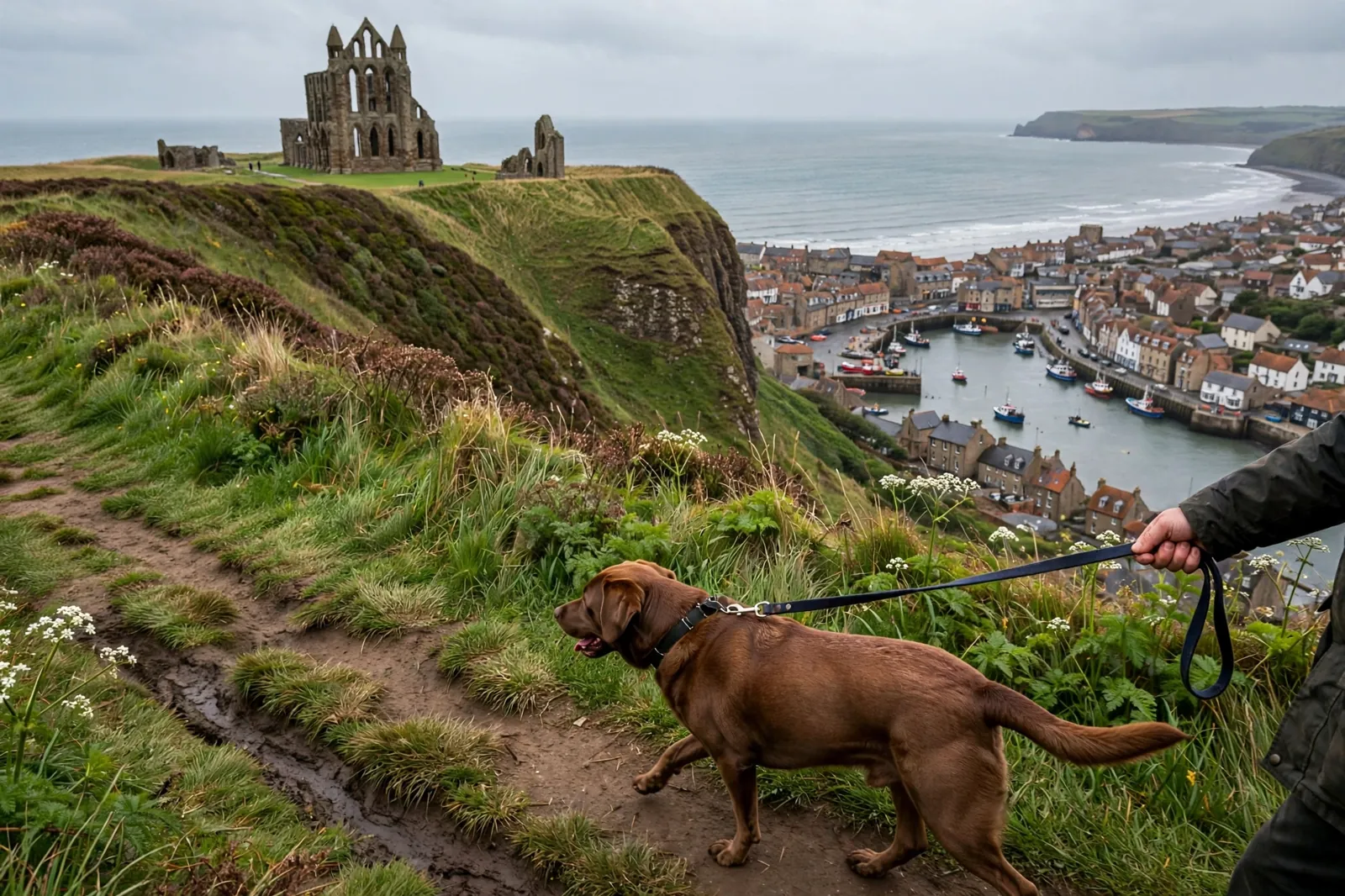
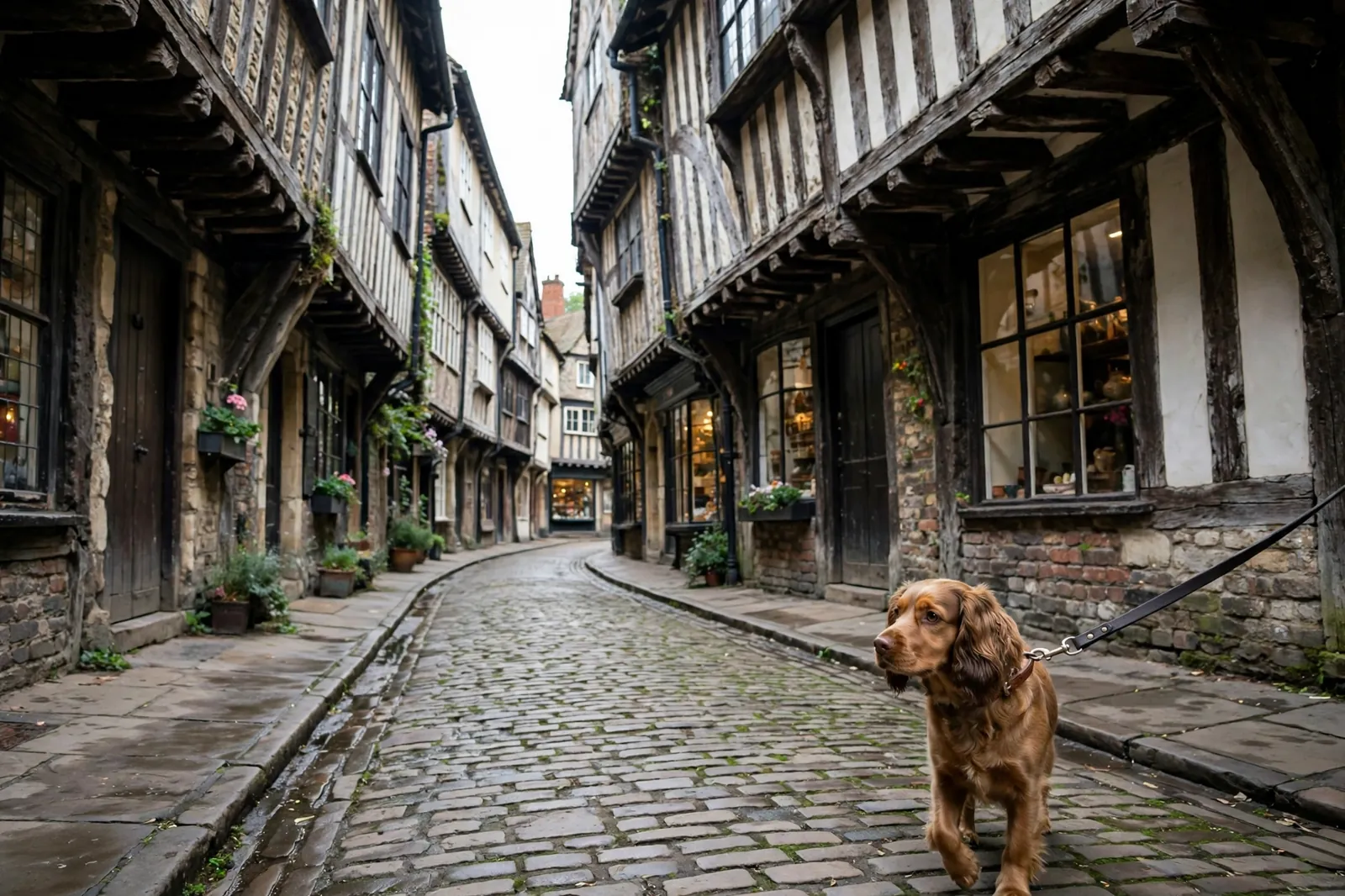
For supplies and emergencies, save local veterinary details and the out-of-hours arrangement in your phone before a moor walk, download offline maps for the whole area, and carry the small kit that keeps small problems small: spare lead, bags, water, towel, and a charged phone with a power bank on longer trail days. If Helmsley is one stop on a longer Yorkshire trip, it pairs naturally with the coast at Whitby with a dog, where harbour crowds and beach rules replace moor discipline, and with a city day covered in our York guide — three very different dog days within one county, which is precisely Yorkshire's appeal.
Using Helmsley as a base: a plan in two speeds
At the gentler speed, Helmsley fills a relaxed day without any heroics. Start with the town loop and the checklist at the stone marker, even if today's trail ambitions extend no further than the lower fields. Spend the middle of the morning in the castle grounds, at grounds pace, with the split-visit pattern if interiors matter to your party. Take lunch at outdoor seating where the dog is confirmed welcome, or as a picnic bought in the square and eaten somewhere grassy and permitted. The afternoon belongs to the town loop again, a slow pass through the square — on a Friday, the market done early and briefly — and an early evening in your accommodation's garden or a pub garden. That day suits puppies, older dogs, dogs in recovery and any party visiting in poor weather, and it is not a reduced version of Helmsley. It is Helmsley, at the speed the town itself prefers.
At the fuller speed, for fit adult dogs in settled weather, build the day around one major walk and protect it with an early start. Either take the Cleveland Way west towards Sutton Bank, turning back at your agreed point while everyone is still fresh, or walk the valley route to Rievaulx, visit the abbey grounds, and return with time in hand. Do not attempt both in one day, and do not bolt Duncombe Park onto the end of either as an afterthought: a checked, unhurried Duncombe walk deserves its own half day, as does the terrace at Rievaulx if its current dog arrangements suit you. One major outing, one town pleasure and one proper rest is the formula that keeps dogs sound and humans cheerful across a multi-day stay.
Whichever speed you choose, Helmsley's gift to dog owners is coherence. Trailhead, castle, market square, abbey valley and estate parkland all sit within a small compass, bound together by short walks and honest rules. Respect the split between grounds and indoors, check each managed site on its own terms, keep the lead on where stock, deer and ground birds require it, and the town will do the rest. Few places in England let a dog start the morning at the beginning of a national trail and end it asleep in a market square inn — and fewer still make the rules for doing so as clear, once you know where to look.
Practical questions
Before you go
Can dogs go into Helmsley Castle?
Dogs on leads are generally welcome in the grounds of Helmsley Castle under English Heritage rules, but access to indoor areas, exhibitions and the shop can be restricted to assistance dogs. The exact areas open to dogs can change with conservation work and events, so check the official latest guidance before you go and keep your dog on a short lead throughout the grounds.
Can dogs visit Rievaulx Abbey and Rievaulx Terrace?
Rievaulx Abbey and Rievaulx Terrace are separate sites with different managers and different dog rules, so do not assume one answer covers both. Dogs on leads have generally been welcome in the abbey grounds but not in indoor museum spaces, while terrace and woodland rules are set separately. Check the official latest guidance before you go for each site on the day you plan to visit.
Where does the Cleveland Way start in Helmsley?
The Cleveland Way starts in Helmsley, traditionally marked near the market square area, and heads west towards Sutton Bank as the first major section of the long-distance trail around the North York Moors. Dogs can walk the trail with you, but much of the route crosses farmland and moorland, so keep your dog on a lead around livestock and follow signed seasonal restrictions.
Are dogs allowed in Duncombe Park?
Duncombe Park has parkland walks where dogs on leads may be welcome on specified routes, but the house, formal gardens and events can have separate and stricter rules, and public access is not the same every day of the year. Do not assume the whole estate is open or dog friendly. Check the official latest guidance before you go, follow the estate map for permitted paths, and keep dogs on leads around livestock and deer.
Is the Helmsley market dog friendly?
Helmsley market in the market square is outdoors, so a dog on a short lead can usually walk through with you, and it is traditionally held on a Friday, but market days, stalls and arrangements can change. Check before you go, arrive early to avoid the busiest crowds, keep the lead short between stalls, watch for dropped food, and step away to quieter streets if your dog needs space.