This guide is independent and contains no paid placement. If affiliate links are added later, they will be clearly marked and will not change our editorial checks.
Helston makes an unshowy, workable base for the Lizard: a flat circuit round the boating lake in Coronation Park, a compact town centre you can cross on foot in minutes, and Kynance Cove, Lizard Point and Mullion a quarter of an hour down the road. Build the trip round the lake in the morning, the coast after lunch, and the town in the evening — and give Flora Day, cliff-top wind and the summer beach rules their own space in the plan.
Start at the boating lake
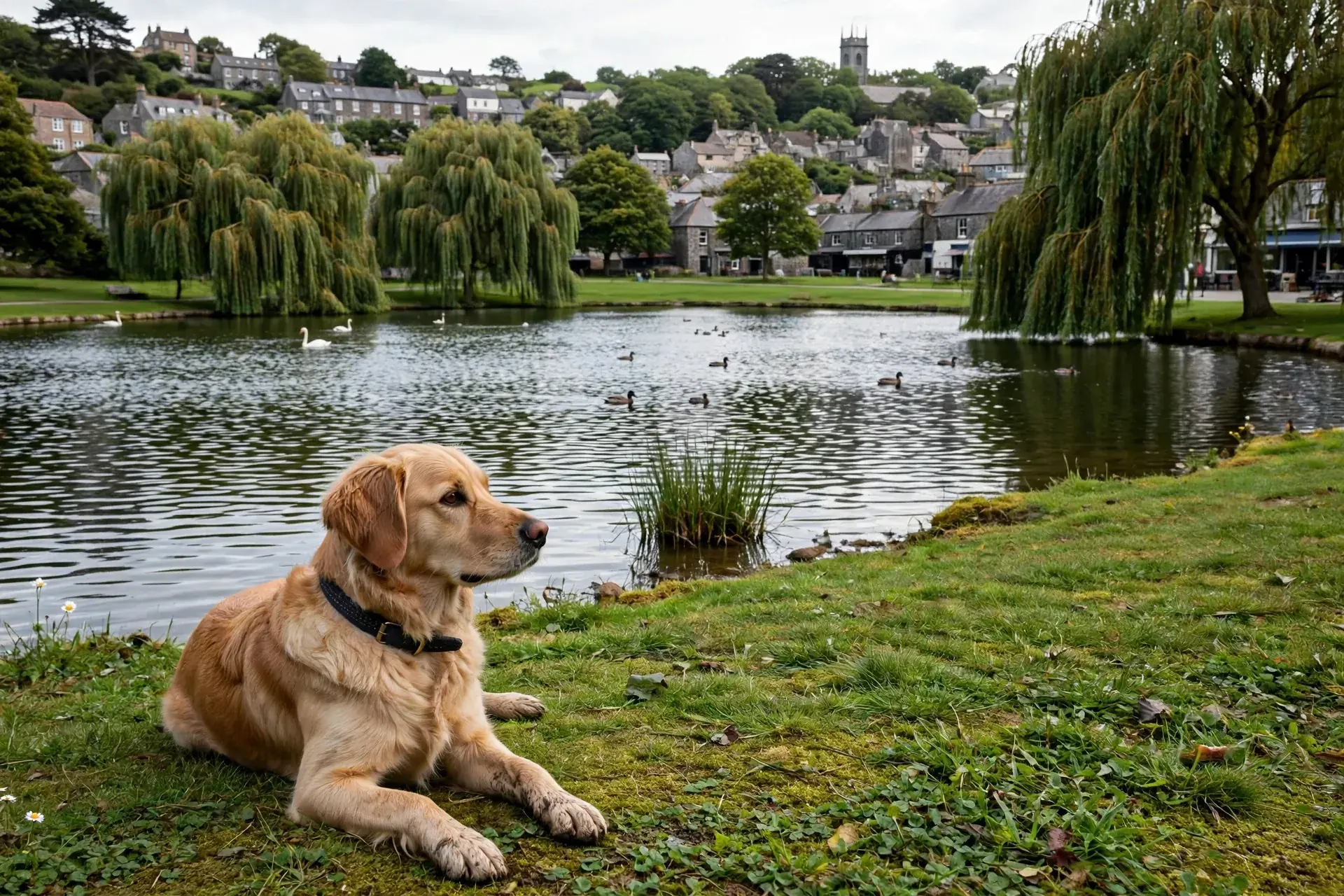
Begin at the water, not in the high street. Coronation Park sits at the southern end of Helston, and its long, narrow lake is the town's front room: a level path runs the length of it, willows lean over the water, benches face the boats, and a cafe looks out across the grass. In July the rowing boats and pedalos are out and the lawns fill with families; on a grey Tuesday in February the same circuit belongs to local dog walkers, a heron standing motionless at the far end, and ducks that have learned exactly where the crumbs land. Either version works as a first walk, because the loop is short, flat and forgiving, and it lets a dog learn the smells of a new town before anything is asked of it.
Walk the circuit the way the park invites you to: slowly, on the surfaced path, with the dog on a lead where the bank drops straight to the water. The banks are low and open in places, and the lake is not a place for a dog to swim — it is a boating lake, full of oars and pedalos, and the water is not for paddling dogs. The grass strip beside the path is the useful bit: soft ground for paws when the paving has heated up, room to step aside when a pushchair or another dog comes past, and shade under the willows on a bright morning. The cafe's outside tables are the natural pause point; dogs settle there, and the cafe keeps its own hours, which stretch in summer and shrink in winter, so check before counting on it.
There is more to the park than the lake edge. Laid out in the 1930s, it still carries that period's planting — flower beds, shrubs, mature trees — and it is where Helston holds its fairs, fetes, open-air concerts and the occasional dog show, so a Saturday in summer can feel like a village green with a band. A dog that enjoys a crowd will enjoy that. A dog that does not should come at first light, when the only sounds are birdsong and the ducks, and the low sun turns the lake into a mirror. The surfaced paths stay kind to paws in all of it, and the benches spaced along the water give older dogs a reason to stop without feeling they have held anyone up.
From the park, the River Cober threads up into town, and the riverside path is the gentlest way to make the connection — a few minutes of clear, shallow water, overhanging trees and the smell of wet stone, ending in the streets above. Dogs will want to splash in the shallows on a warm day; a quick paddle is fine, but heavy rain changes the river, so rinse a dog that has been in after a downpour and do not let it gulp the water. One warning worth carrying out of the park with you: a still morning in Helston says nothing about the coast. Fifteen minutes away on the Lizard the wind can be up, the mist can be down, and a short-coated dog that was comfortable by the lake can be shivering on a cliff path. Keep a dog coat and a towel in the car, and be ready to cut a coastal walk short — the town is always close enough to retreat to, and a short walk in good weather beats a long one fought against the wind.
Flora Day and the Furry Dance
One date defines Helston: 8 May, Flora Day, when the Furry Dance winds through the town. Dancers in morning dress step through the streets to a band playing the same tune from morning to night, houses are dressed in greenery, and the whole town seems to be out on the pavement at once. The dancers pass in and out of houses and gardens along the route, and the mood is unhurried and joyful — one of the oldest customs in Britain, still danced as if it had never stopped. It is a remarkable day to witness. It is also, to be blunt, a hard day for a dog, and that is worth saying before anyone builds a trip around it.
On a lead, a dog can watch from the pavement, but the conditions stack up against most dogs: the streets are packed, the route squeezes through narrow lanes, and the noise — band, cheering, crowds pressing in — never lets up. A calm, crowd-proofed dog can manage the morning dance if you arrive early and slip away before the crush peaks. A nervous or reactive dog will not enjoy it, and there is no failure in leaving that dog back at the cottage and going to Flora Day on your own. The pavements fill fast, a pulling or barking dog becomes a problem for everyone around it, and the dog itself gets nothing from the day. If you do take a dog, keep the lead short, favour the broader streets where there is room to breathe, and know your exit — a side lane back to the car park — before you need it.
The dance route is worth walking on any other day of the year, when the streets are empty and the town is itself again. Start at the top of Coinagehall Street and drop down through the centre, following the line the dancers take past the old houses and back up again. It is a short, mostly level stroll, and it shows you how Helston is put together: the market town above, the river valley below, and street names — Coinagehall Street, Church Street, Meneage Street — that remember when this was the centre of the tin trade for the whole district. Walk it with a dog on a quiet weekday and the town feels at its best: small, old, and sure of itself.
For the day itself, book months ahead — Helston fills up long before May — and check the current arrangements before travelling, because the details shift year to year. The deeper point is the contrast: for one day a year this is the centre of one of Britain's oldest traditions, and for the other 364 it is a quiet market town where a dog walk by the lake is the main event. As for the history, nobody agrees where the Furry Dance began — a spring celebration, some say; a medieval guild procession, say others — and the argument is part of the tradition now. Whatever its origins, the walking around it is real, the lake is never crowded on an ordinary day, and the town is at its most welcoming when it is not performing.
The town, the museum and the old streets
Helston's centre is small enough to learn in an afternoon: a handful of streets climbing from the river, with Coinagehall Street — broad, handsome, lined with Georgian and Victorian fronts — doing most of the work. The shops here answer to farms and villages rather than to visitors, which sets the tempo — unhurried, practical — and a dog on a lead is simply part of the street scene. There is no single showpiece attraction in the town itself, and that is the point. Helston is a base and a breather — the lake below, the Lizard beyond — and it repays a slow wander far more than a hurried tick-list.
The museum sits in the old market house on the main street, and it is the one indoor stop worth planning around — with a small catch. Dogs cannot go in, so one of you stays outside with the dog while the other looks round, or you visit dog-free. Inside, the story is Helston and the Lizard together: tin mining, fishing, farming, Flora Day, and the ordinary life of a market town, housed in a former market house and drill hall under a clock tower that has become the town's landmark. An hour covers it properly. Opening times follow the season, so check the museum's own listing rather than assuming.
Look up as you walk and the town's past is legible in the buildings. Tin was weighed and taxed in the Coinagehall, which is how the main street got its name, and Helston once anchored the tin trade for this part of Cornwall. St Michael's church stands at the top of the town, and its churchyard is one of the quietest green spots in Helston — a good place to sit with a dog on a lead and let the town settle around you. Market days still bring the surrounding villages in, and they change the town's character completely: livelier and busier, harder to park, but also the truest version of Helston you will see. Check the market day before you travel, because it decides whether you get the sleepy town or the bustling one.
Food and drink with a dog in Helston is less about finding a list and more about reading the room. After a morning on the Lizard, the natural move is a pub lunch — and the pubs and cafes in Helston, Porthleven and Mullion mostly work the same way: gardens and terraces are the easy option, the bar is often more dog-welcoming than the dining room, and the rules can change between lunch and dinner, and again between winter and high summer. A bigger dog is happiest where there is outdoor space to stretch out; a smaller one can often tuck under a table indoors. Because the welcome varies by venue and by season, the only reliable step is to check the venue's own listing or ring ahead on the day — a five-minute call saves a twenty-minute walk with a hopeful dog.
What matters more than the venue is the routine you bring to it. Feed the dog before you sit down, or bring a portion of its usual food to offer under the table. Carry water and a collapsible bowl rather than assuming one will be spare on a busy lunchtime. Bring a mat or blanket so the dog has a patch of floor that is unambiguously its own, and a chew or stuffed toy if you have a puppy that needs a job. Keep the lead short and tucked under your chair, never trailing where a server can trip over it. And read the dog honestly: if it is barking, whining and lunging at every passer-by, that is a bad day, and a takeaway eaten on a bench by the lake is the kinder choice — for the dog, for the pub, and for you.
The Lizard Peninsula: Kynance, the Point and Mullion
Drive fifteen minutes south of Helston and the land changes character. The Lizard is a plateau of heath and farmland that falls away to the sea in cliffs of serpentine — dark green and red rock that occurs almost nowhere else in Britain — and the coastline unspools as a sequence of coves, headlands and beaches that feel a long way from the rest of Cornwall. Three names carry the peninsula: Kynance Cove, Lizard Point and Mullion, and each one is a full day out on its own.
Kynance Cove is the photograph everyone has seen — white sand, turquoise water, serpentine stacks — and the reality is just as striking, with one condition attached: the tide. At low water the beach opens out and the rock pools are exposed; at high water the sand nearly vanishes and the cove turns to rock. Dogs can walk the coastal path on a lead and use the beach outside the summer season, but the summer rules apply in the peak months, so read the signs at the car park and check the current guidance before setting off. The path down is steep and uneven, which rules it out for older dogs and dogs with sore joints, and the cliff path around the cove is high and open — lead on, close to the edge, no exceptions. Time the visit for low tide, and the cove repays the effort; time it wrong, and you will be looking at a beautiful wall of rock from a crowded viewpoint.
Lizard Point, the most southerly point of mainland Britain, is a different kind of walk: short, mostly level, and all sky and sea. A lighthouse, a lifeboat station and a cafe share the headland, and the loop around the Point suits dogs of every age — provided the lead stays on, because the cliffs are unfenced in stretches and the drops are real. It is also a wildlife walk: seals haul out on the rocks below, and choughs, the red-billed crows that Cornwall claims as its own, nest in the cliff faces. A dog that can settle and watch earns its place here; a dog that lunges at every seal does not. The cafe's outside seating is the natural finish, a coffee while the dog rests after the wind.
Mullion, on the peninsula's west coast, is the village the locals choose. A working harbour with fishing boats and a lifeboat station, a church, pubs and cafes, and a beach that welcomes dogs outside the summer season — and coastal walking in both directions, north towards Porthleven and south towards Kynance. The cliff path out of Mullion is among the finest on the Lizard, a mix of heath, coves and long views, and it suits a fit dog with a lead for the narrow stretches. The harbour itself is a good place to stop: sit, watch the boats, let the dog rest, and let the day slow down.
Knowing a little of what you are walking over makes the peninsula richer. The serpentine is the scar of an ancient collision of continents; the heathland holds plants and insects found almost nowhere else in Britain; the old mine workings, the lifeboat stations and the lighthouse remember fishing and mining. Dogs are indifferent to geology, but the same open heath and cliff-top paths that shelter the rare plants are what make the Lizard so good for them — long sightlines, new smells at every step, room to move. The trade-off is that the ground is fragile and grazed by livestock, so keep a dog on a lead or under genuinely close control across the heath, and never let it chase the animals that live there.
The seasons redraw the Lizard more sharply than they redraw Helston. Spring brings the heath back to green and the first wildflowers to the cliff path, and the walking is at its best. Summer brings the crowds: car parks full on sunny weekends, and real heat on the exposed cliff tops, where there is almost no shade — start early, carry far more water than you think a dog will need, and learn the signs of overheating before you need them. Autumn thins the crowds and softens the light, and the walking is at its most pleasant. Winter is the wildest version: storms hammer the cliffs, the wind is fierce, and the short days mean starting early and finishing while it is still light. Whenever you go, check the forecast, tell someone where you are walking if you are heading far, and check the current access guidance for temporary closures before you set out.
Penrose Estate and Loe Pool
Between Helston and Porthleven sits the walk Helston's dog owners reach for first: the Penrose Estate, National Trust land of woodland, parkland and farmland wrapped around Loe Pool, the largest natural freshwater lake in Cornwall. The estate's appeal is variety — shaded woodland paths, open parkland with views across the water, and a coastal path that runs on to Porthleven — and dogs on a lead are welcome throughout. For a dog that likes cover and the smell of damp earth, it is the best walking within a few miles of Helston.
Loe Pool itself is an odd, beautiful thing: a freshwater lake cut off from the sea by a narrow shingle bar, fed by the River Cober running down through Helston. The water is deep, the banks are soft and muddy in places, and the pool is a protected habitat — which means it is not a swimming lake for dogs, whatever the dog thinks about it. What it is, is a walk: the full circuit runs to several miles and suits a fit dog with stamina, while a network of shorter loops lets you match the distance to the dog you actually have. Keep the dog on a lead near the water, and let the views across the pool to the far shore do the work.
The woodland is the estate's other half, and on a hot day it is the better half: cool, shaded, soft underfoot, full of birdsong, and the best wet-weather walk anywhere near Helston, since the trees blunt the rain and the lake looks its finest in it. The car park at Penrose is the obvious start and it fills on sunny weekends, so arrive early. The estate is a working landscape, so paths can close for forestry work — check the National Trust listing for current access before you go. From Penrose the coastal path to Porthleven is a fine hour each way for a fit dog, with the cliffs above the sea, views across Mount's Bay towards Penzance and St Michael's Mount, and a pub lunch waiting at the far end. Herons and egrets work the pool, kingfishers use the river, and the woodland is full of birds — another place where a quiet dog that watches them is a better companion than one that charges at them.
Beach days: Porthleven, Gunwalloe and Church Cove
Helston is not on the coast, but the coast is a short drive in any direction, and that is part of the town's usefulness as a base. Porthleven, five miles south, is the beach that matters most from here: a harbour village with a long sweep of sand and shingle, a clock tower, pubs and cafes, and a view across the bay to Penzance. The main beach has summer restrictions that keep dogs off the central sand during the day in peak season; the dates and the stretch covered can change, so read the signs at the beach and confirm the current position before you travel. Outside the restricted months, and on the quieter sand away from the harbour, the rules loosen, and a winter or autumn visit is a different animal altogether: empty sand, long straight runs, and a dog that can finally stretch its legs properly.
Gunwalloe, a few miles further along the coast, is the reliable choice. A long sandy beach backed by dunes, with a church standing apart from the village on the far side of them — one of the most photographed churches in Cornwall — and, crucially, generally open to dogs all year. It is quieter than Porthleven because there is no village behind it and no clutch of facilities to draw a crowd, and at low tide the sand runs so far that a high-energy dog can run for a long time without ever reaching the water. There is a car park close to the beach and a cafe nearby, and the coastal path runs in both directions. The trade-off is exposure: the wind comes straight off the sea and the sand can sting on a breezy day, so pack a windbreak and a dog coat if you plan to stay a while.
Church Cove, down on the Lizard, is the small, rocky cove the locals favour: sand and rock pools, a church above it, the coastal path running both ways, and a feeling of being a long way from the crowds of Porthleven. It is tidal, so the visit stands or falls on the tide times, and the dog rules follow the season — check the signs before you drop down. Treat it as a stop on a coastal walk rather than a destination in itself: walk the path from Mullion or from Gunwalloe, descend at low tide, and climb back out along the cliff. The background on all this — summer bans, public space protection orders, and how to confirm the position at a particular beach — is set out in our separate guide to dog-friendly beaches in the UK. Read it before a summer trip in Cornwall: the rules change from one beach to the next, and the fines are real.
Tide times decide whether a beach day works, so check them the night before. The Lizard's beaches change completely between high and low water: at high tide Porthleven narrows to a strip and Gunwalloe turns mostly to shingle, while at low tide both are vast. Arrive two or three hours before low water and you get the best of the sand and the longest window before the sea comes back. Check the wind as well as the weather — the Lizard can be wild while Helston is calm, and a windy beach is hard going for a small dog. Bring drinking water of your own — seawater makes dogs ill — plus a towel and a drying coat for the journey back, and read the car park charges and the beach rules at the entrance before unloading.
The Cornish coast is beautiful and it is unforgiving, so a few hazards are worth naming outright. Keep dogs away from the base of cliffs, where rockfalls happen without warning, and away from cliff edges above. Keep the dog out of strong currents and away from rocks, and respect the surf at Porthleven, which can run hard even on a day that looks calm from the harbour wall. Scan the sand for fish hooks and broken glass, and keep the dog away from dead fish and anything else it wants to scavenge. Too much seawater shows itself quickly — vomiting, diarrhoea, lethargy — and that means a vet, not waiting to see if it passes. Once back at the car, wash the salt off with fresh water, look over the paws for nicks, shake the sand out of the ears, and get the dog properly dry before setting off. A dog that sleeps the whole drive back to Helston is the best verdict on the day.
Staying over, parking and vets
Helston's case as a base has little to do with scenery and everything to do with how easy it makes a stay. A week here runs on foot. The supermarket, the pharmacy, the cash machines and somewhere to eat are all a short stroll from the centre, so you can arrive, park once, shop, cook, and take the dog down to the lake in the evening without starting the car again. That ease matters as much as any view, and it explains why plenty of dog owners sleep inland and drive out to the coast each day instead of squeezing into a busy seaside village.
Places to stay around Helston span hotels and bed and breakfasts in town, self-catering cottages and flats, holiday parks and campsites in the countryside, and farm stays a short drive out — and dog-friendly options exist in every category. The questions to ask are the same whichever you book, and they are specific, not general: is a dog welcome in the actual room or cottage, not just the property as a whole? How many dogs, and is the charge per dog or per stay? Is the garden fenced in, how tall is the fence, and could a determined dog shoulder the gate open? Can the dog be left alone there, and for how long? The answer decides whether dinner out is even possible. And ask what is underfoot. Hard floors shrug off a muddy Lizard walk where pale carpets will not, and a ground-floor room saves an older dog a flight of stairs each time it needs to go out.
A self-catering place usually suits a dog trip best: your own kitchen, a garden or terrace, and days that run to the dog's timetable instead of a hotel's. What makes a cottage worth its price here is an enclosed garden, somewhere to wash muddy towels, and a door that opens onto the lake path or a footpath — a plain cottage on the town's edge with a direct route to Penrose beats a prettier one that needs the car for every walk. Holiday parks and campsites around Helston can work well for families, but ask the same questions about dog limits, charges, enclosed space and leaving dogs unattended. For a caravan or a lodge, look at the steps and the decking first — a dog that finds steps hard will find them hard every time it needs to go out.
Parking in Helston is straightforward with a little foresight. The car parks by Coronation Park and the boating lake are the practical choice, a short walk from both the water and the centre, and charges and time limits change, so check the current prices and maximum stays before you travel. Out on the Lizard the car parks tell another story: Kynance, the Point and Mullion are all small, and on a sunny summer weekend they are full by mid-morning — aim to arrive before ten or after four, once the day-trippers have gone. The same applies at Porthleven and Gunwalloe. And the rule that never changes: a parked car in warm weather is no place for a dog, even for a few minutes.
There is a vet in Helston, and the time to find it is before you need it — save the number in your phone on arrival. Vets in Penzance and Falmouth cover the surrounding towns, and an out-of-hours service covers the area, so a weekend emergency is manageable if you have the number to hand. Pet shops and the supermarket sell dog food, so running out is not a crisis. Public toilets exist near the boating lake but are not everywhere, so plan around that. Signal is fine in town but patchy on the remoter stretches of the Lizard path, so save an offline map before you set out. In winter, check that the places you want are actually open — cafes, pubs and attractions shorten their hours outside summer, and the Lizard after heavy rain is bleak and wet. A little planning goes a long way, and Helston rewards the visitor who plans round the lake, the Lizard and the coast in that order.
Pack for the lake and the coast together, because that is the trip. Both a short lead and a long one, a harness that fits properly, and a spare in case one snaps or comes back caked in mud. Water and a collapsible bowl — there are long stretches of the Lizard coast path with no water for dogs at all. A towel, a drying coat, and a blanket to protect the car seat. Poo bags, more than you think you will need, and something to carry them in. For a thin-coated dog, a coat against wind and rain; for a pale nose or sparse fur, sun protection in summer. The dog's usual food, any medication it takes, the vet's number, and the insurance details. And one last thing to bring: patience. Livestock graze the Lizard, the coast crowds in summer, and the days that work best are the ones nobody hurries.
A weekend shows how the pieces fit. Arrive on Friday afternoon, park by the boating lake, and take a short evening circuit so the dog learns the place before dark. Saturday morning, start early and walk Penrose Estate and Loe Pool; have lunch in a dog-friendly pub in Porthleven; spend the afternoon on the sand at Gunwalloe. Sunday belongs to the Lizard: a morning at Kynance Cove and the Point, a harbour stroll and cafe lunch in Mullion, and a slow last circuit of the boating lake before heading home. Across the weekend the dog gets the lake, the sand and the cliffs in turn, with new scenery every day and no drive longer than about twenty minutes. Bad weather only reshuffles the order: save the sand for a calm, dry morning, take the Penrose trees when it rains, and fall back on the town's cafes and shops — a real alternative here, not a consolation prize. That is the advantage of sleeping in Helston: everywhere is close, no single day has to work out, and a change of plan costs twenty minutes at most — exactly the slack you want with a dog in tow. If the stay stretches longer, our guide to Truro with a dog covers the city to the north-east and the River Fal — a natural pairing with this one for a longer trip around south Cornwall.
Practical questions
Before you go
Can dogs go to Flora Day in Helston?
On a lead, a dog can watch the dancing from the streets, but Flora Day packs the town and the route squeezes through narrow lanes, so a nervous or reactive dog will have a miserable time. Arrive early for the morning dance, keep the dog close on a short lead, and slip away before the crowds peak — or leave the dog at the cottage and enjoy the day on your own. Check the current date and arrangements before travelling, as the details change year to year.
Is Helston Boating Lake good for dogs?
Yes — it is the easiest walk in Helston. Coronation Park and the boating lake offer a flat, short circuit with grass, shade and benches that suits dogs of every age, from puppies to old dogs. Keep the dog on a lead by the water and do not let it swim in the lake. The park is at its best early in the morning, before the boats are out and the cafe fills up.
Which beaches near Helston allow dogs all year?
Gunwalloe is the most dependable year-round beach near Helston, a long sandy stretch behind the dunes. Porthleven's main beach is restricted in the summer months, keeping dogs off the central sand in peak season — read the signs there. Church Cove and the smaller Lizard coves vary with the season, so check before you go.
Can dogs walk the coastal path at Kynance Cove?
Yes, on a lead. The path around Kynance Cove is spectacular but high and open, with steep climbs and unfenced drops, so keep the dog on a lead near the edges and never let it near an unfenced drop. The cove is tidal — at high water the beach nearly disappears — so check the tide times and the current guidance before you travel.
Where is the best place to park in Helston with a dog?
The car parks beside Coronation Park and the boating lake are the practical choice, a short walk from the lake and the town centre. Arrive early in summer and on Flora Day, when the town fills up. Charges change, so confirm them before you travel; and on a warm day, do not leave the dog waiting in the car.