This guide is independent and contains no paid placement. If affiliate links are added later, they will be clearly marked and will not change our editorial checks.
Hereford is at its best with a dog when you treat the river as the plan: walk the Wye first, visit the cathedral in turns, eat somewhere the dog can settle, and save the longer countryside routes for a second day. The city is compact, the riverside is mostly flat, and almost everything worth doing sits within a short walk of Castle Green.
Why Hereford works with a dog
Hereford is a small cathedral city in Herefordshire, close to the Welsh border, and it suits dogs for a simple reason: the interesting parts are close together, and the River Wye runs straight through the middle of them. You do not need a car once you arrive, and you do not need to choose between the historic city and a proper walk, because the cathedral, the castle site, the old bridge and the riverside meadows sit within a few minutes of each other. That compactness matters when you are travelling with a dog, since it keeps the day flexible. If the dog is tired, the walk home is short. If the dog is full of energy, the river path keeps going.
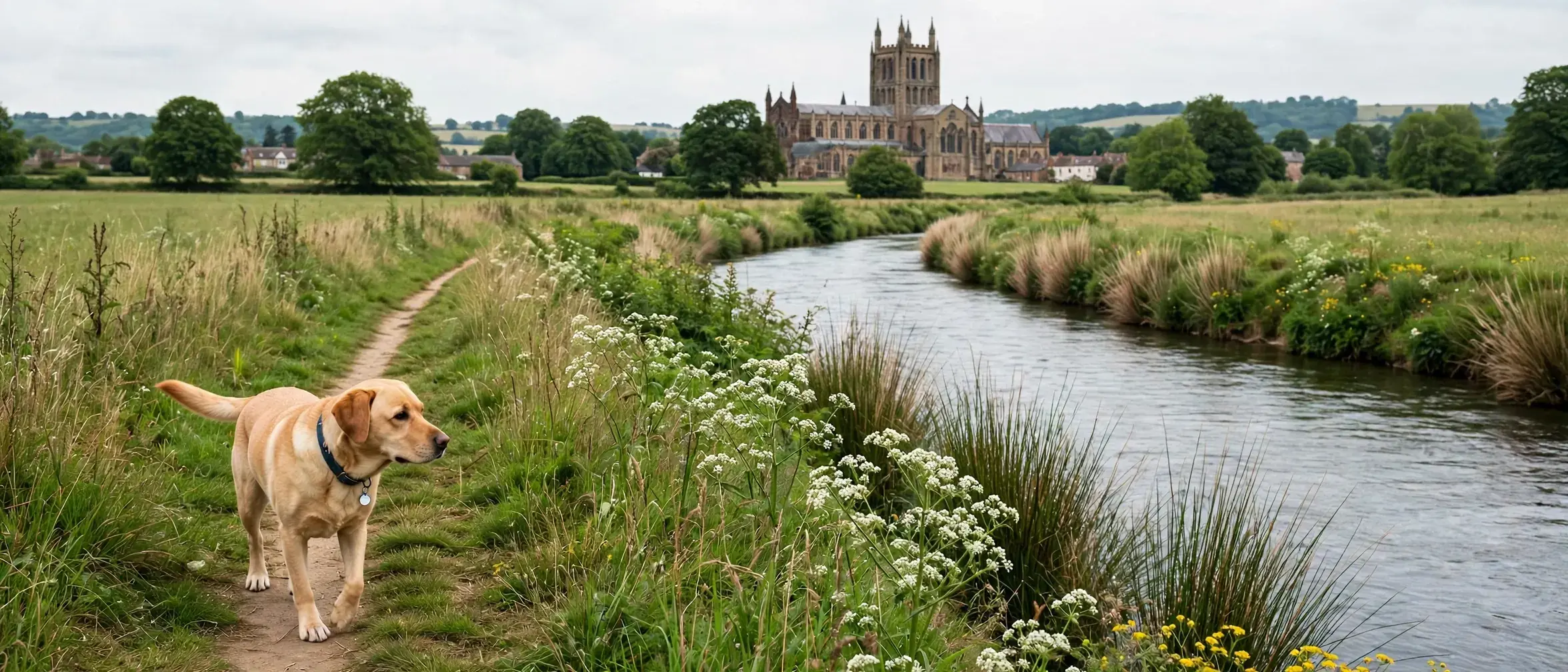
The city has a long history as a market town and a border city, and that history is still visible in the street pattern, the cathedral and the river crossings. Hereford Cathedral, with its tower rising above the rooftops, is the landmark that orients the whole visit. The Wye is the other landmark, and for most dogs it is the more important one. It is a wide, fast-flowing river, and the paths along its banks give dogs space to sniff, watch the water and settle into a steady walking rhythm without the stop-start pressure of a busy shopping street.
Hereford is also a good base rather than just a single stop. The countryside around it is gentle, green and threaded with public footpaths, and the Wye Valley stretches away to the south and west towards some of the best riverside walking in the border country. A day in the city pairs naturally with a longer walk the next morning, or with a slow drive through the orchards and villages of Herefordshire. For a weekend break, that combination — a compact city on day one and open countryside on day two — is hard to beat, and it works for dogs of very different ages and fitness levels because the flat riverside routes and the hillier countryside routes can be mixed to suit the dog in front of you.
None of this makes Hereford a free-for-all. Dogs are not admitted inside the cathedral as a rule, the river needs respect, and livestock graze the meadows around the city, so a lead and a plan are part of the trip. The sections below work through each of those points in order, starting with the cathedral, then the river, then the practical details of eating, staying and parking. If you only remember one thing, make it this: walk the dog first, look at the buildings second, and the day will run far more smoothly than if you try to do it the other way round.
The cathedral and the Close
Hereford Cathedral dominates the city centre, and its tower is the sight you will keep coming back to as you walk the riverside. The present building has Norman origins, with work beginning in the late eleventh century, and it has been altered, extended and restored over the centuries since. The result is a building with layers: Norman stonework, later Gothic additions, and a calm, spacious interior that rewards an unhurried visit. The cathedral is also home to the Mappa Mundi, a famous medieval world map drawn around 1300, and the Chained Library, a collection of books still kept chained to their shelves. Both are displayed in the cathedral, and both are worth seeing if you have an interest in medieval history, books or maps.
For dog owners, the important fact is that the cathedral interior is not a dog visit. As a general rule, dogs are not admitted inside the cathedral itself, although assistance dogs are welcome. That does not mean the cathedral is off limits to your trip; it means you should plan it as a split visit. One person goes inside while the other walks the dog around the Cathedral Close, Castle Green and the riverside, and then you swap over. The Close is a pleasant, largely traffic-free green space around the cathedral, with lawns, trees and benches, and it is a good place for a dog to rest in the shade while the other half of the party is inside. The walk from the Close to the river takes only a few minutes, so the person with the dog is never far away and never short of somewhere to go.
Allow enough time for the split to work without rushing. A cathedral visit that takes forty-five minutes to an hour inside leaves the dog waiting for a long time if the other person has nowhere to go, but it is comfortable if the dog walker has a proper route: down to Castle Green, along the river to the footbridge, across to Bishop's Meadow and back. Take water for the dog, and take a lead that lets you keep the dog close around the Close, where other visitors, children and the occasional service or event can make the area busy. Check the official guidance before you travel for opening times, any charges for the Mappa Mundi and Chained Library exhibition, and whether a service, concert or event will limit visiting on the day you plan to come.
The area around the cathedral is also where the city's history is easiest to read. The Cathedral Close, the old streets leading down to the Wye Bridge, and the site of Hereford Castle at Castle Green all sit within a short walk, and together they give a sense of a city that grew up around a river crossing and a place of worship. You do not need to know the full history to enjoy it, but it helps to know that the cathedral and the river have shaped each other for centuries. Stand on Castle Green and look back at the tower, then look down at the Wye, and the whole layout of the city makes sense. That view, with a dog sitting beside you on the grass, is one of the best free sights in Hereford, and it costs nothing but a few minutes of your time.
The River Wye riverside loop
The riverside loop is the walk most visitors with dogs will use most, and it is worth learning properly on your first morning. Start at Castle Green, the open grassy area beside the site of Hereford Castle, where the motte still rises above the river. From here you can see the Wye Bridge, the cathedral tower and the meadows on the far bank, and there is enough open grass for a dog to stretch its legs before the walk begins. Castle Green is also a useful meeting point if your party splits for the cathedral, and a good place to sit and watch the river for a few minutes before setting off.
From Castle Green, follow the river downstream towards the footbridge, or cross by the road bridge and pick up the path on the south bank. The south bank leads into Bishop's Meadow, a large area of open riverside grassland that is popular with local dog walkers, runners and families. The paths here are mostly flat and either surfaced or firm grass, which makes them suitable for older dogs, puppies and dogs that struggle with steep or uneven ground. There are long sightlines across the meadow, so you can see other dogs, livestock and walkers well before you reach them, and there is usually room to give a nervous or reactive dog plenty of space.
Keep your dog on a lead near the riverbank itself. The Wye is a powerful river, and the banks can be steep, muddy or slippery, especially after rain. The water level rises quickly after heavy rain upstream, and the current is stronger than it looks from the bank. Some dogs will want to paddle at the shallow edges in warm weather, and some will want to swim, but do not assume any stretch is safe. Check the official guidance before you travel, watch the weather and the river level, and keep a lead on unless you are certain the spot is safe and your dog is a confident swimmer. A long line is a good compromise on the meadow: it gives the dog freedom to explore while keeping you in control near the water.
The loop back along the north bank brings you past the Victoria Bridge and the riverside paths that lead back towards the city centre. This is a pleasant, straightforward circuit that most dogs can manage comfortably in an hour or so at a relaxed pace, and it can be shortened easily by crossing back at the nearest bridge, or lengthened by continuing further along the river in either direction. In summer, the meadows are green and busy, with picnics, ball games and other dogs; in autumn, the trees along the river turn and the paths are quieter; in winter, the same paths can be muddy and the river high, so waterproof boots and a drying coat for the dog are worth packing. Whatever the season, take poo bags and use the bins provided, because the riverside meadows are shared with families, runners and other dog walkers, and a clean path keeps the area welcoming for everyone.
Longer walks out of the city
Once you have walked the riverside loop, the countryside around Hereford opens up quickly, and the best way to enjoy it is to follow the long-distance paths that pass through or near the city. The Wye Valley Walk follows the river for much of its length, and the sections near Hereford are gentle, well-marked and suitable for a half-day walk with a fit dog. You do not need to walk the whole route; pick a section, walk out along the river, and return by the same path or by a circular route through the fields and lanes. The Herefordshire Trail, a longer circular route around the county, also passes near the city and offers quieter field paths, woodland edges and views back across the Wye valley. Check the official guidance before you travel for current route conditions, diversions and any temporary closures.
For a longer day, the Wye Valley itself is the obvious direction. The river runs south from Hereford towards Ross-on-Wye and the wooded gorge country beyond, and the walking there is more varied, with riverside paths, woodland climbs and viewpoints over the valley. Our guide to Wye Valley dog walks covers the routes, river safety and livestock in more detail, and it is worth reading before you plan a full day on the valley paths. Closer to Hereford, the villages and lanes to the west and north offer shorter circular walks that start and finish at a village pub or a church, and these are often the quietest walks of all, with few other walkers and plenty of hedgerow sniffing for the dog.
Whatever route you choose, plan for livestock. Sheep and cattle graze the meadows and fields around Hereford, and many of the best riverside and field paths cross grazing land. Put your dog on a short lead well before you enter a field with animals, keep to the marked path, and walk calmly past without letting your dog approach, chase or bark. If cattle are blocking the path, or if they move towards you in a way that feels threatening, turn back rather than pushing through. This is not just a courtesy; it is a safety rule, and it applies even to dogs that are normally well-behaved off the lead. A dog that has never seen cattle before can react unpredictably, and a field of inquisitive young cattle can be intimidating even for an experienced walker.
Take the same care with ground conditions and weather. The paths around Hereford are mostly on clay soil, which becomes heavy and slippery after rain, and riverside meadows can flood in winter. After a wet week, choose a surfaced path or a woodland track rather than a low meadow, and carry a towel and a drying coat for the dog. In summer, carry water for the dog as well as for yourself, because there is not always a tap or a safe drinking spot on a rural walk, and the river is not a reliable drinking source. A lead, a long line, water, poo bags and a basic first-aid kit cover most of what a longer walk needs, and a charged phone with an offline map is useful on the less-travelled field paths, where signposts can be sparse.
The city centre on a lead
Hereford city centre is compact enough to explore on foot with a dog, and the streets around the cathedral, the High Town and the Old Market are the natural place to start. High Town is the historic market area, with a mix of independent shops, cafes and market stalls, and on market days it is busy, colourful and full of smells that will keep a dog's nose working overtime. That is part of the fun, but it is also a reason to keep the dog on a short lead, to watch for dropped food, and to give a nervous dog a quieter route around the edge of the crowd rather than through the middle of it.
The Old Market area, a short walk from the cathedral, offers a different pace: a modern shopping and eating area with open space, benches and room to sit outside. It is a useful place to stop for a coffee, to let the dog rest, and to regroup before the next part of the day. The streets between the cathedral and the Old Market are mostly level, with pavements throughout, and the distances are short, so an older dog or a small dog can manage the city centre without a long, tiring walk. If your dog struggles with crowds, visit the city centre early in the morning or later in the afternoon, when the streets are quieter and the market stalls are packing up.
Shopping with a dog in Hereford is a matter of asking rather than assuming. Some independent shops welcome dogs inside, especially those that sell outdoor gear, pet supplies or local food, while others prefer dogs to wait outside. A polite question at the door, a short lead and a dog that can sit quietly for a minute will get you a long way. Do not leave a dog tied up outside a shop for any length of time, and never leave a dog unattended in a busy street. If you need to go into a shop that does not allow dogs, take it in turns, just as you would at the cathedral, and keep the waiting time short.
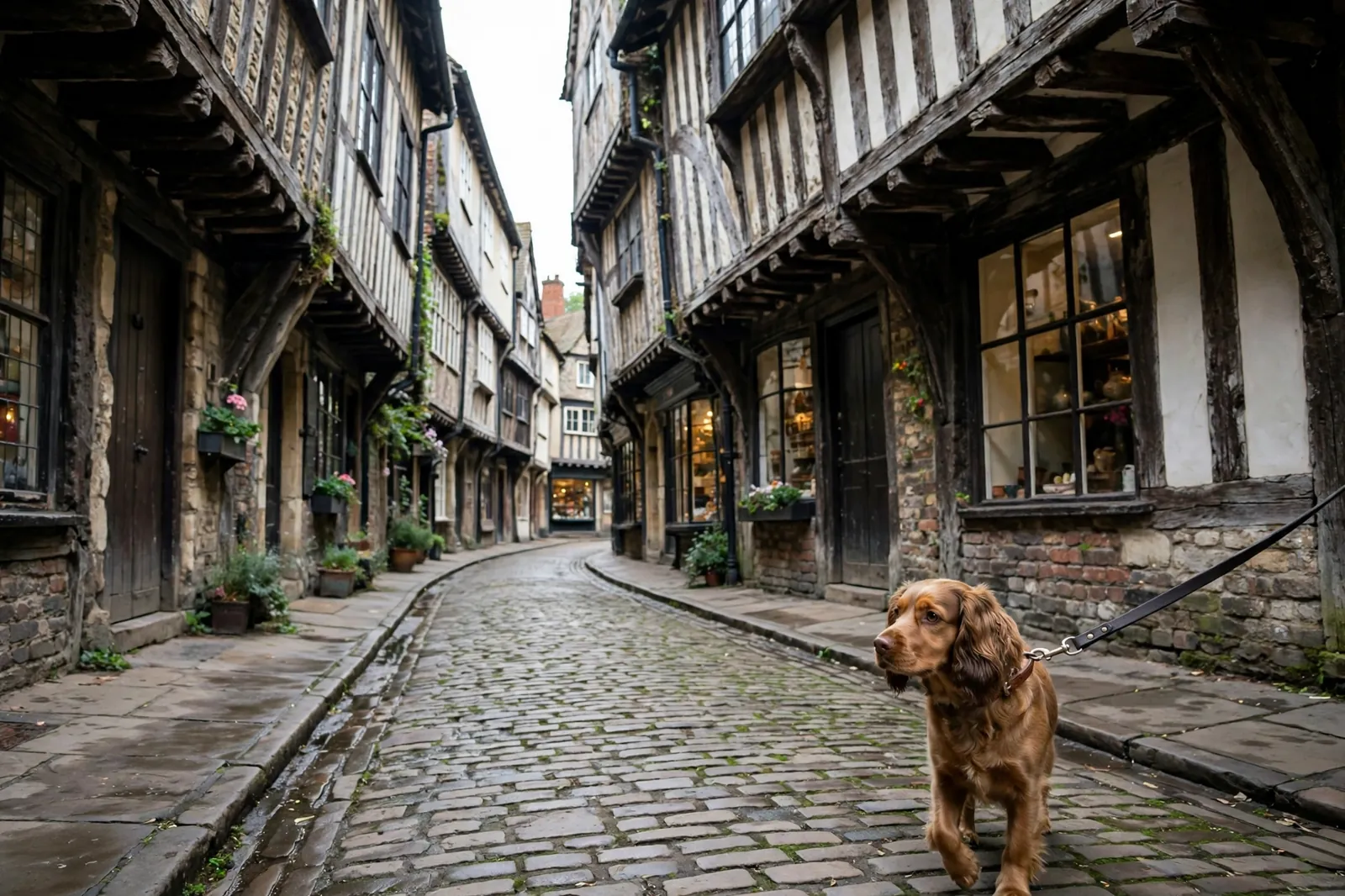
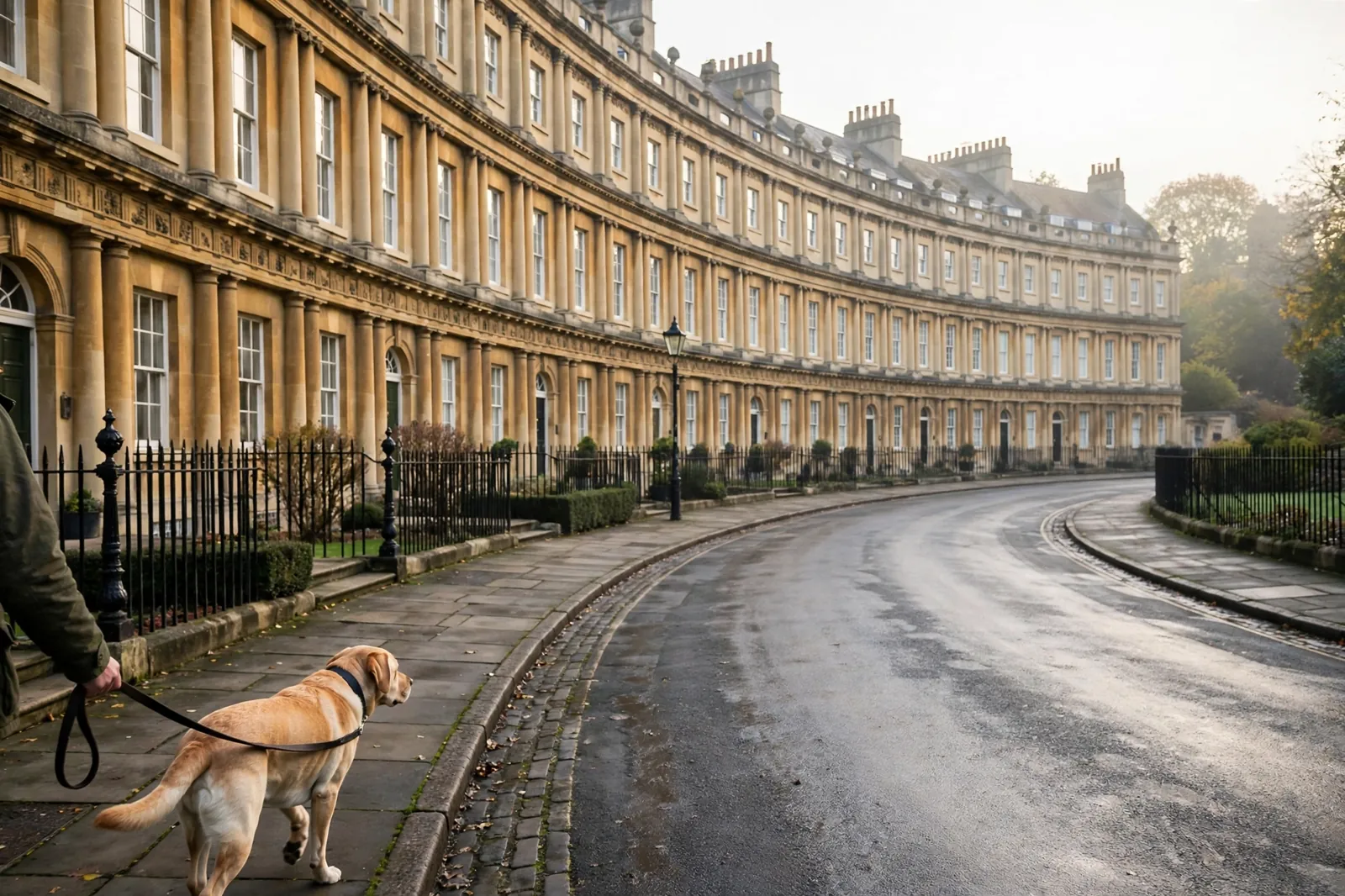
Hereford also works well as a comparison with other cathedral cities, because the pattern is similar but the scale is smaller and the river is closer. If you have visited York with a dog, you will recognise the same questions — how to see the Minster or the cathedral in turns, where the riverside walks start, and which pubs welcome dogs — but in Hereford the answers are all within a few minutes of each other. The same is true of Bath with a dog, another city where the historic centre and the walking routes sit side by side. Hereford is quieter than both, which makes it a good first cathedral-city break for a young or nervous dog, and a relaxing return visit for a dog that already knows how city breaks work.
Eating and drinking with your dog
Hereford has a good spread of dog-friendly pubs and cafes, and the riverside and city-centre pubs are the easiest places to start. Look for the signs that a venue genuinely welcomes dogs: a water bowl by the door, a dog-friendly area clearly marked, staff who greet the dog as well as the people, and other dogs settled under tables. Policies vary from place to place, and they can change, so check the official guidance before you travel or ask at the door before you sit down, especially if your dog is large, young or reactive. A pub that welcomes a calm older labrador in a quiet corner may not be the right place for a boisterous puppy at lunchtime on a Saturday.
Bring a mat or a blanket for your dog, and use it every time you eat out. A familiar mat tells the dog where to settle, keeps them off a cold or dirty floor, and makes it easier for staff and other customers to see that your dog has a place. Order the dog's water first, let the dog drink and settle, and then order your own food. If the dog cannot settle, do not try to force it; take a short walk, try a quieter table, or take the food away and eat it by the river instead. A short, calm pub visit that ends well is worth far more than a long lunch that ends with a stressed dog and an embarrassed owner.
Cider is part of Herefordshire's identity, and the county's orchards and cider makers are famous well beyond the border. Many pubs in and around Hereford serve local cider, and some of the cider producers and farm shops in the surrounding villages welcome dogs in their outdoor areas. If you plan to visit a cider producer, a farm shop or a vineyard, check in advance whether dogs are allowed, whether they must stay on a lead, and whether there is an outdoor area where the dog can wait comfortably. The same rule applies to cafes and tea rooms: some welcome dogs throughout, some only in a garden or a specific room, and some not at all, so a quick check saves an awkward arrival.
For a relaxed meal, the riverside pubs and the pubs on the edge of the city centre are often better than the busiest High Town venues, because they tend to have gardens, more space between tables and a slower pace. In summer, a pub garden with shade and a water bowl is one of the best places in Hereford to spend an afternoon with a dog. In winter, look for a pub with a dog-friendly area near the fire, but be careful with hot stoves, open fires and dogs that like to lie close to the heat. Whatever the season, keep the dog on a lead inside, keep the lead short enough that it does not trip other customers, and clear up immediately if your dog makes a mess.
Staying overnight with a dog
Hereford works well as an overnight stop or a weekend base, and the accommodation that suits dog owners best is usually the accommodation closest to the river. A hotel, bed and breakfast or self-catering cottage within a short walk of Castle Green means the first and last walks of the day are easy, and the dog can be out on the riverside within minutes of waking up. When you compare places to stay, ask the same questions you would ask anywhere: is there a pet fee, and how much is it per dog per night or per stay? Is there a limit on the number or size of dogs? Are dogs allowed in the bedroom, or only in certain rooms? And is there a secure area where the dog can be exercised before bed?
Self-catering cottages and holiday lets are often the easiest option for dog owners, because they give you a kitchen, a private space and a routine that is closer to home. If you are considering a longer stay in Herefordshire, our guide to dog-friendly holiday parks in the UK explains how to compare pet fees, boundaries and cancellation terms, and most of those questions apply just as well to a cottage or a lodge. In particular, ask whether the garden or outdoor space is enclosed, how high the fence is, and whether there are gaps a small dog could slip through. A photograph of a garden does not always show the gate, the hedge or the low wall at the back, so ask for a clear description in writing before you book.
Hotels and bed and breakfasts in Hereford vary in how they handle dogs. Some welcome dogs in the bar and the garden but not in the dining room; some allow dogs in the bedroom but ask that they are not left alone in the room; some charge a small cleaning fee and provide a dog bed, a bowl and treats on arrival. All of these arrangements can work, as long as you know them in advance. Tell the accommodation about your dog when you book, including the breed, size and age, and ask for the dog policy in writing. If you arrive and find that the room is not as described, raise it at reception straight away rather than trying to manage a problem that could have been fixed with a different room.
Leaving a dog alone in accommodation is a question to settle before you travel, not after you arrive. Many hotels and cottages ask that dogs are not left alone at all, while others allow a short absence if the dog is settled and quiet. Plan as if the answer is no: choose places to eat where the dog can come along, plan the cathedral as a split visit, and avoid booking a restaurant that would leave the dog alone for hours. If your dog is used to being left for a short time at home, a familiar bed, a chew and a calm departure routine will help, but a new room in a new city is not the place to test a longer absence for the first time.
Seasons, parking and getting there
Hereford is a year-round destination, but the experience changes with the seasons, and the best time for your dog depends on what kind of walk you want. Spring brings blossom in the orchards, longer days and firm riverside paths, and it is one of the best times for a first visit. Summer is the busiest season, with warm weather, busy meadows and more visitors on the riverside, but also the best chance of a dry, sunny walk and a pub garden lunch. Autumn is quieter, with colour in the riverside trees and soft light over the Wye, and it is often the most comfortable season for older dogs, who cope better with cool weather than with heat. Winter can be wet and muddy, with high river levels and short days, but it is also the quietest time, and a crisp, frosty morning on Castle Green has a charm of its own.
Heat is the main seasonal risk to plan for. The riverside meadows have little shade in the middle of the day, and a dark-coated dog can overheat quickly on a hot summer afternoon. Walk early in the morning or later in the evening in warm weather, carry water, watch for signs of heat stress, and never leave a dog in a parked car. Cold weather brings a different set of problems: muddy paths, slippery banks and cold water, so a drying coat, a towel and a warm bed at the end of the day are worth packing. After heavy rain, check the river level before you set out, because the Wye can rise quickly and the lower riverside paths can become waterlogged or closed. Check the official guidance before you travel if you are visiting after a period of heavy rain or flooding.
Getting to Hereford by car is straightforward, with routes from the motorway network via Worcester, Gloucester or the Welsh borders, and the city is also served by train, with services from Birmingham, Cardiff, Newport and London via connecting stations. If you travel by train, check the train operator's dog policy before you book, keep your dog on a lead on the platform and in the carriage, and choose a quieter service if your dog is nervous in crowds. If you travel by car, use a city-centre or riverside car park that leaves a short, level walk to Castle Green and the Wye, and check the official guidance before you travel for current charges, height limits and any seasonal changes. On market days and in summer, arrive early, because the closest car parks fill first, and a long walk from a distant car park with a tired dog is a poor start to the day.
Parking is also where a little planning saves a lot of trouble. Choose a car park that is close to your first walk, not just close to the shops, and think about the return journey as well: a dog that has walked for an hour will want water, shade and a comfortable place to rest before the drive home. Keep a towel, a water bowl and a spare lead in the car, and check the car park's rules on how long you can stay. If you are staying overnight, ask your accommodation about parking as well, because some city-centre hotels have limited spaces and some use a nearby public car park. A short walk from the car to the room is worth more than a slightly cheaper rate a mile away, especially on a wet evening.
Practical checklist for the day
A good day in Hereford with a dog starts the night before, with a short packing list and a clear plan for the morning. Pack a lead and a long line, poo bags, water and a bowl, a towel and a drying coat, a mat for pubs and cafes, and any medication your dog needs. Add a charged phone, a basic first-aid kit and the number of a local vet, saved before you need it. If your dog is on a special diet, bring enough food for the trip plus a spare meal, because a new food bought in a hurry can upset a sensitive stomach. If your dog wears a harness, check that it still fits comfortably, and if you use a muzzle, bring it even if you do not expect to need it, because some places ask for one in shared areas.
On the day itself, walk the dog first. A proper riverside walk before the cathedral, the shops or lunch makes everything else easier, because a dog that has had a good sniff, a drink and a chance to settle is far more likely to lie quietly in a pub or wait patiently outside a shop. Feed the dog at the usual time, keep the routine as close to home as possible, and build in rest breaks, especially for puppies, older dogs and dogs that are not used to city walking. A dog that is tired, hot or overstimulated will not enjoy the rest of the day, and no amount of sightseeing will make up for it.
Watch the small hazards that are easy to miss in a new city. Dropped food on market days, litter on the riverside, and the occasional discarded fishing line or hook near the river are all worth watching for. Keep your dog away from the edge of the riverbank where the ground is undercut or slippery, and keep a close eye on them around other dogs, especially on the narrow sections of the riverside path where there is little room to pass. If your dog is reactive, choose the wider meadow paths over the narrowest riverside sections, cross to the other bank if you need more space, and use the quieter early-morning or late-afternoon hours for the busiest stretches.
Finally, leave Hereford as you found it. Use the bins provided, keep your dog on a lead where signs ask for it, respect the cathedral, the Close and the private gardens around the city, and thank the pubs and cafes that welcome dogs by leaving the area tidy and the dog settled. Dog-friendly places stay dog-friendly when owners use them well, and a city as compact and welcoming as Hereford is worth looking after. If you follow the river, plan the cathedral in turns, and let the dog set the pace, you will leave with a clear sense of why this small city on the Wye is such a good place for a break with a dog — and with a list of walks you will want to come back and finish.
Practical questions
Before you go
Can dogs go inside Hereford Cathedral?
As a general rule, dogs are not admitted inside the cathedral itself, although assistance dogs are welcome. Plan a split visit so one person goes in while the other walks the dog around the Cathedral Close, Castle Green and the riverside, then swap over. Check the official guidance before you travel, as arrangements for services and special events can change.
Where is the best riverside walk with a dog in Hereford?
The most useful loop for most dogs starts at Castle Green, crosses the Wye by the footbridge or the road bridge, and follows the south bank through Bishop's Meadow and back along the north bank. It is mostly flat, largely surfaced or firm grass, and close to the city centre, which makes it easy to shorten or extend. Keep dogs on a lead near the riverbank, the road crossings and any livestock.
Can dogs swim in the River Wye at Hereford?
Do not assume any stretch is safe for swimming. The Wye is a powerful river with strong currents, steep or slippery banks, deep water and changing levels after rain. Some dogs paddle at the shallow edges in summer, but check the official guidance before you travel, watch the current and the weather, and keep a lead on unless you are certain the spot is safe and your dog is a confident swimmer.
Are there dog-friendly pubs and cafes in Hereford?
Yes, Hereford has a good spread of dog-friendly pubs and cafes, particularly around the city centre and the riverside, but policies vary by venue and can change. Look for water bowls and a clearly dog-welcoming area, ask before settling in with a large or reactive dog, and bring a mat so your dog can settle under the table. Busy market days are the hardest time to find a quiet corner.
Where can I park with a dog in Hereford?
Use a city-centre or riverside car park that leaves a short, level walk to Castle Green and the Wye, and avoid leaving a dog in a car in warm weather. Check the official guidance before you travel for current charges, height limits and any seasonal changes. On market days and in summer, arrive early, because the closest car parks fill first.
What should I do if my dog meets livestock on a walk near Hereford?
Put your dog on a short lead well before you reach the field, keep to the marked path, and walk calmly past the animals without letting your dog approach, chase or bark at them. If cattle block the path or behave in a threatening way, turn back rather than pushing through. Sheep and cattle are common on the meadows and farmland around Hereford, so a reliable recall and a short lead matter on every rural walk.