This guide is independent and contains no paid placement. If affiliate links are added later, they will be clearly marked and will not change our editorial checks.
Plan Holyhead around the port timetable and the wind. Use the morning for South Stack and Holyhead Mountain, keep dogs on leads on every clifftop, check ferry dog rules and beach restrictions before you travel, and keep a sheltered low-level walk in reserve for bad weather.
Arrive like a ferry passenger, not a tourist
Holyhead is first a port and second a holiday town, and that order shapes every dog trip here. Ferries cross to Dublin, trains run to Chester and London, and the A55 brings drivers across Anglesey to the terminal. The town centre, the harbour and the ferry terminal sit close together, which is convenient, but the working port also means lorries, coaches, timetable pressure and large open quays where a loose dog would be in real danger. Treat arrival as a logistics job: sort the dog, the car and the bags before anyone starts sightseeing.
If you are catching a ferry, read the operator rules for your exact sailing before the day of travel, because dog arrangements differ by company, ship and ticket type. Some crossings allow a dog to stay in the car on the vehicle deck, some provide kennels that must be booked in advance, and some allow dogs in designated passenger areas or cabins on selected sailings. None of these is safe to assume. Confirm whether the dog must be booked as a passenger, whether there is a fee, where the dog waits during boarding, and what happens if the sailing is delayed. Print or save the confirmation, and keep the lead, a water bowl and a familiar blanket in the cabin bag rather than buried in the boot.
Foot passengers need a different plan. A dog that travels well in a car may find a busy terminal, a long gangway and a crowded lounge much harder, so build in slack time and a calm toilet walk before check-in. The area around the terminal is not a dog exercise field: use the short harbour-side paths for a last toilet stop, keep the dog on a short lead near traffic, and avoid letting the dog investigate luggage trolleys, ramps and vehicle lanes. If the crossing is delayed, a familiar chew or a settled mat in a quiet corner helps more than another lap of the terminal.
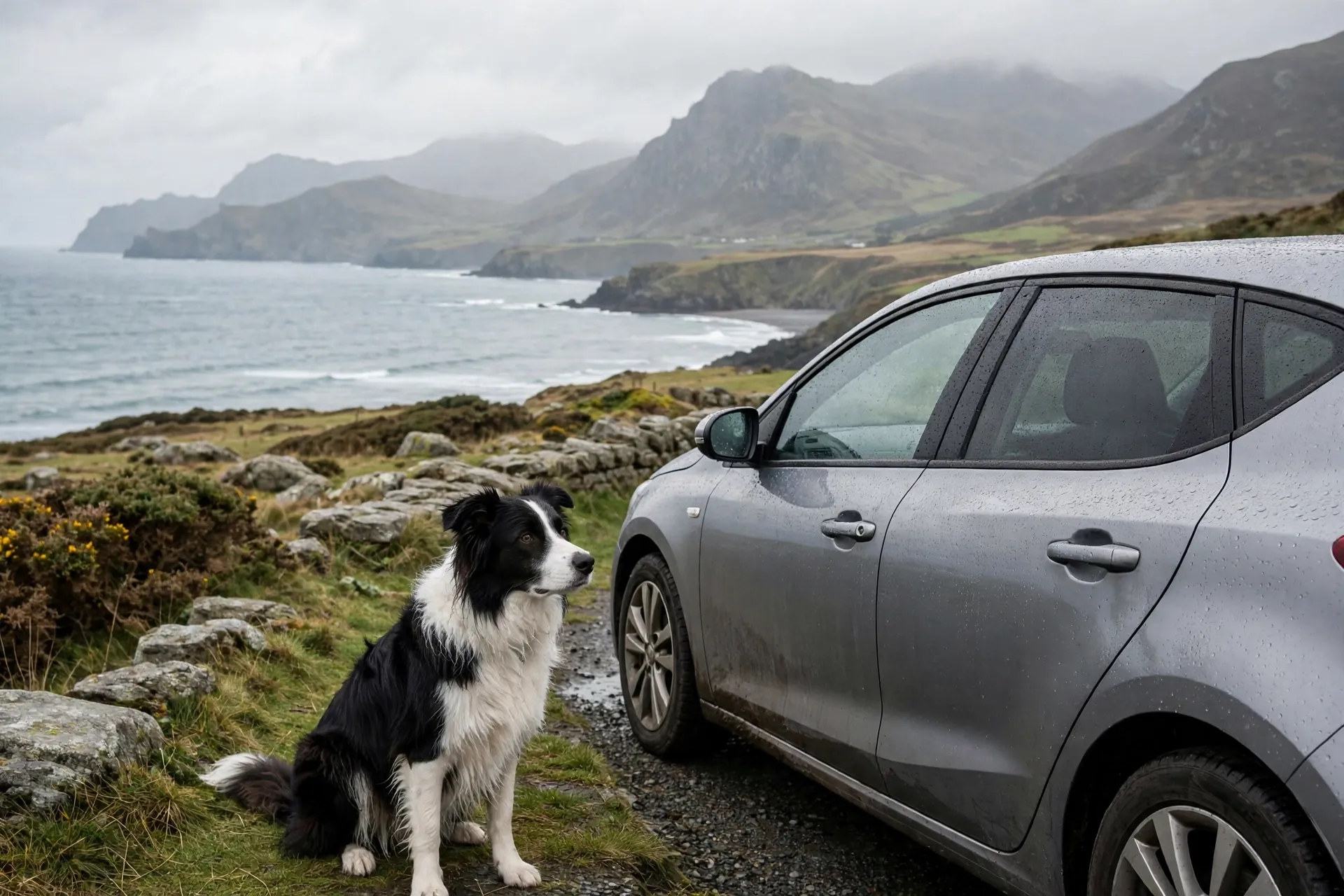
Drivers should think about the car as part of the dog plan. In summer, a parked car at the port can heat up fast, so never leave a dog in a vehicle while you sort tickets or explore the town. On arrival, park, settle the dog, and walk the harbour front on foot before driving out to South Stack. The roads to the lighthouse are narrow in places and the car park fills on fine days, so an early start pays twice: you get a parking space and you reach the cliffs before the wind and the crowds build.
Rail travellers arrive at Holyhead station beside the ferry terminal, which makes a car-free trip possible but not effortless. Check the train operator rules for dogs, plan the walk or taxi to your accommodation in advance, and remember that buses on Anglesey are less frequent than many visitors expect. A car gives far more freedom here, especially for reaching South Stack, Breakwater Country Park and the quieter beaches. If you travel without one, base yourself close to the town centre and choose walks that start from the harbour rather than relying on a bus to the lighthouse.
South Stack, step by step
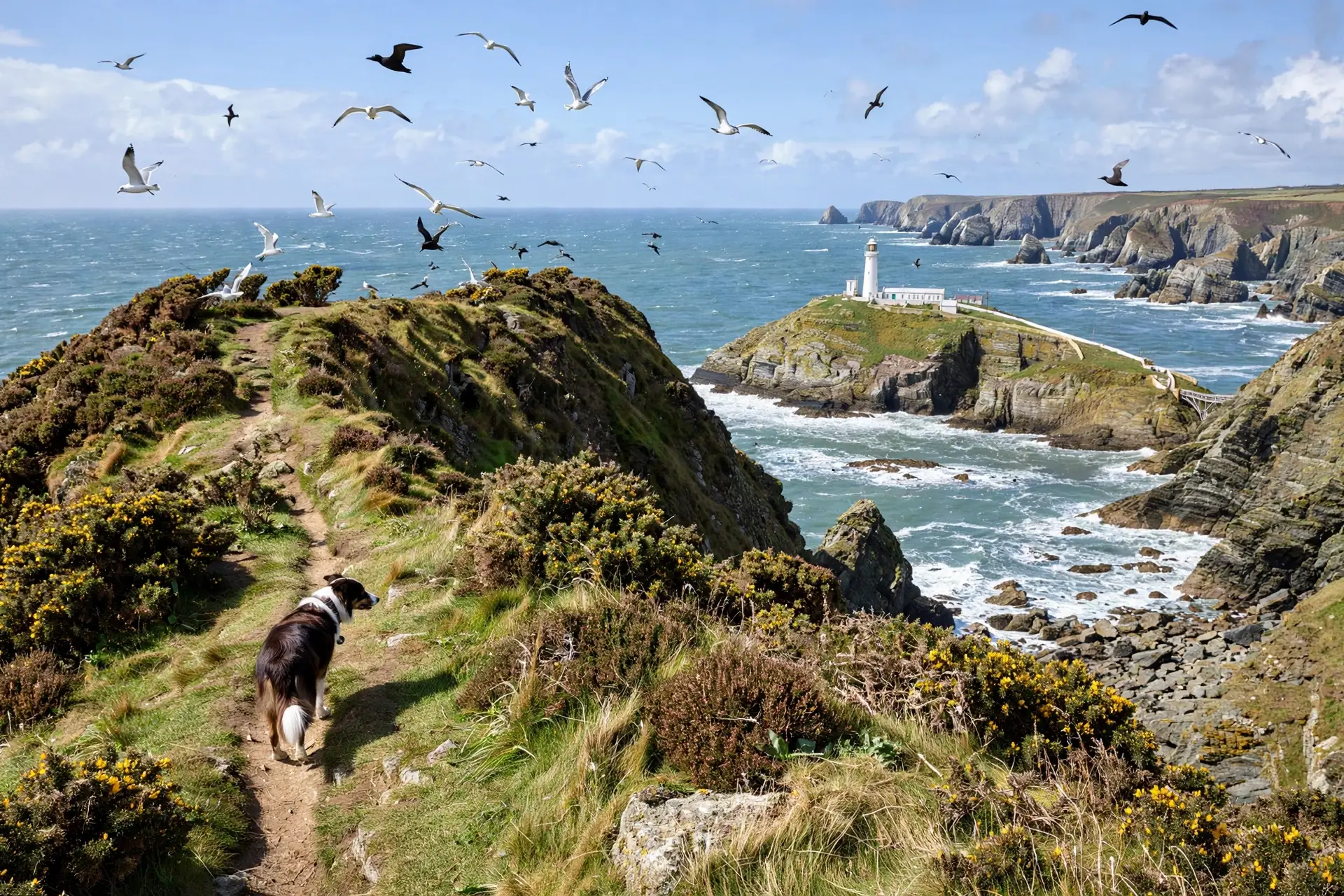
South Stack is the reason most dog owners come to Holyhead, and it deserves a slow, careful visit rather than a rushed photo stop. The lighthouse stands on a small island, Ynys Lawd, joined to the mainland by a bridge, and the white tower against dark cliffs and open sea is one of the most recognisable views in Wales. The RSPB reserve around it protects seabirds, heathland and wildflowers, and in spring and early summer the cliffs fill with guillemots, razorbills, puffins and choughs. Dogs are part of the picture here, but only on leads and only on the paths where they belong.
Start at the visitor centre and the clifftop car park, not at the lighthouse steps. The upper paths give wide views of the tower, the sea stack and the cliffs without committing a dog to the long stepped descent. From the top, you can watch the light, listen for seabirds and judge the wind before deciding how far to go. The descent to the bridge and the lighthouse involves many steep steps — often quoted at around four hundred — and it is not suitable for most dogs, for owners carrying a dog, or for anyone unsteady on their feet. Check the official guidance before you travel for current opening times and access arrangements, because the tower and the steps can close in bad weather or for maintenance.
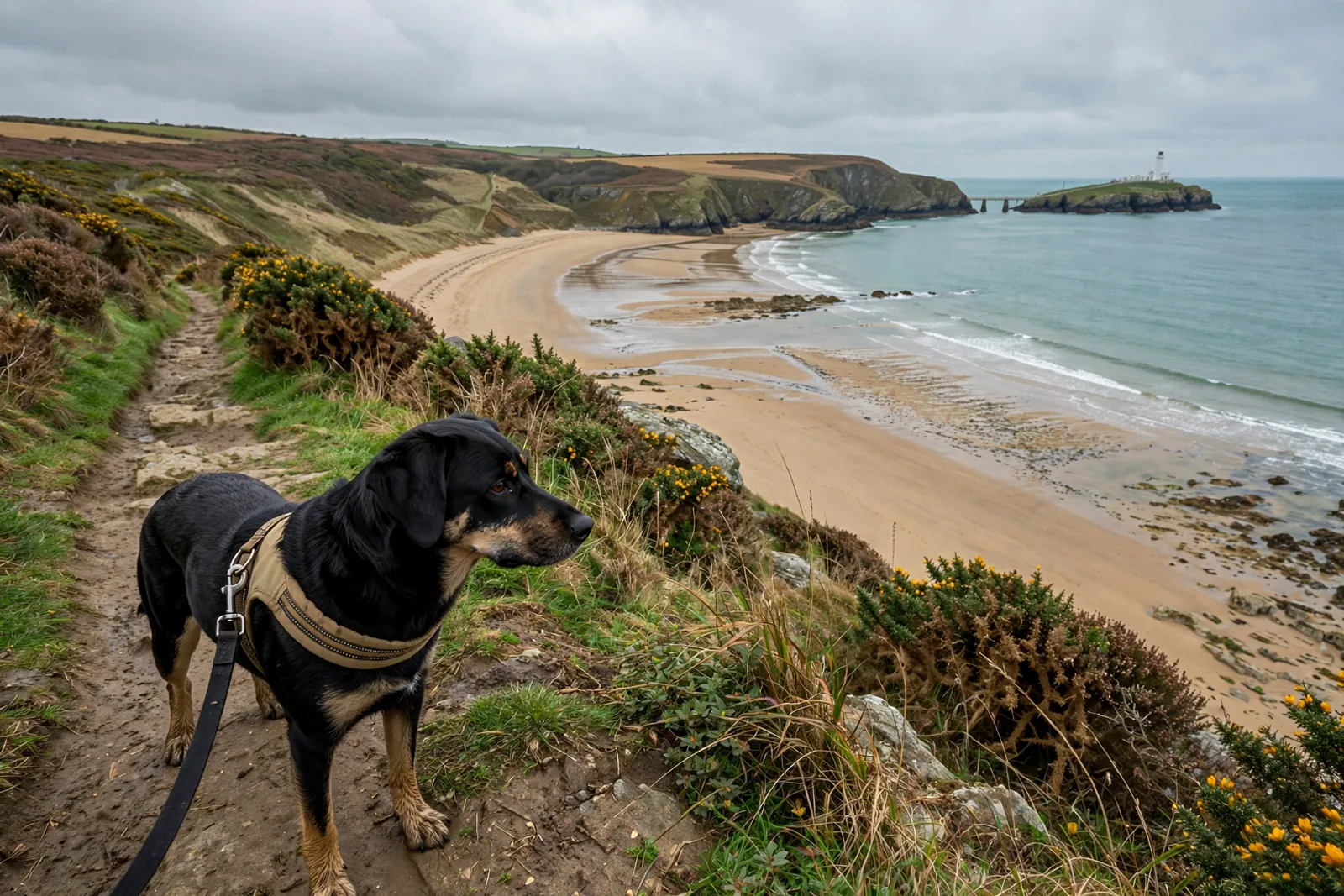
That does not make South Stack a disappointment with a dog. The clifftop walk is the dog-friendly part, and it is generous: open heath, stone walls, sea views in both directions and plenty of scent for a dog that is allowed to sniff at a steady pace. Keep the dog on a lead at all times on the cliffs. The edges are unfenced in places, the grass can be slippery after rain, and a dog that chases birds can be over a drop in seconds. A short lead and a harness give far more control than a long line here, and a dog that pulls hard is a genuine risk on a narrow path with a sheer drop on one side.
Seabirds add a second reason for control. During the breeding season, birds nest on ledges close to the path, and a barking or lunging dog can disturb colonies that are already under pressure. Keep voices low near viewpoints, do not let the dog scramble onto rocks or ledges, and carry out everything you bring in, including poo bags. The reserve is a working conservation site, not a dog park, and the rules that protect the birds are the same rules that keep a dog safe.
Timing matters as much as behaviour. Early morning is usually calmer, cooler and quieter, and the light on the lighthouse is at its best. Midday in summer brings coaches, families and heat on exposed ground with little shade, so bring water for the dog and plan a shorter loop. In strong wind, stay well back from the edge, shorten the walk, and be ready to turn back: a gust that is merely unpleasant for a person can unbalance a small dog. If the forecast mentions gales or heavy rain, choose Breakwater Country Park instead and save South Stack for a better day.
After the lighthouse, do not rush back to the car. The heathland paths above the cliffs offer a gentler return, and on a clear day you can see across to the mountains of Eryri and along the Anglesey coast. Let the dog sniff, take photographs from the marked viewpoints, and treat the visit as a walk with a lighthouse in it rather than a race to the steps. That approach keeps the dog calm, keeps the birds undisturbed and leaves you with a far better memory of the place.
Holyhead Mountain
Holyhead Mountain, at 220 metres, is the highest point on Anglesey and the natural second act after South Stack. It rises directly above the town and the port, and its summit gives a 360-degree view over the Irish Sea, the Anglesey coast and, on a clear day, the mountains of Eryri and the Isle of Man. The mountain is heather-covered, rocky and exposed, with prehistoric hut circles and standing stones on its lower slopes that reward a slower walk. For a fit dog and a prepared owner, it is one of the best short climbs in North Wales. For an unfit dog, a nervous dog or a bad-weather day, it is a walk to postpone.
There is no single easy route. The most popular approach starts near South Stack, climbs across open moorland and reaches the summit by a rocky path that needs steady footing. Other routes start from the town side and climb through quieter lanes and heath. Whichever you choose, expect uneven ground, loose stones, steep sections and stretches with no shelter. A dog that is comfortable on rough ground, happy to walk on a lead for an hour or more and used to wind will enjoy it. A dog that pulls, chases sheep or struggles with steps will find it hard work, and the owner will spend the whole climb managing risk instead of enjoying the view.
Livestock is a real consideration. Sheep graze the mountain, and a dog off lead near sheep is both a legal risk and a welfare risk. Keep the dog on a lead wherever sheep are visible, and use a short lead on the summit ridge where the path runs close to drops. The same rule applies near the cliff edges on the seaward side: the views are spectacular precisely because the ground falls away sharply, and there are no fences to catch a mistake.
Water and weather decide whether the climb works. There is little reliable drinking water on the upper mountain, so carry enough for the dog as well as for yourself, especially on a warm day. The summit is exposed to wind from every direction, and weather that feels mild in the town can be cold and blustery at the top. Pack a windproof layer, a drying coat for the dog, and a towel for the car. In fog, stay on the marked path and do not let the dog range ahead: the plateau is confusing in low cloud, and a dog that runs off can be hard to find among the rocks and heather.
The reward for the climb is not only the summit. The hut circles on the lower slopes are among the best-preserved prehistoric settlements in Wales, and they give the walk a sense of history that a simple hill climb lacks. Pause there, keep the dog on a lead among the stones, and take the descent slowly. Knees and paws both suffer on a fast downhill over loose rock, so a steady pace and a short lead on the way down matter as much as the climb itself.
Coastal walks that actually work
The Anglesey Coastal Path runs around the whole island, and the Holyhead section is among its wildest. That is both the attraction and the warning: these are real cliff paths, not promenades, and they need the same respect as any mountain route. The best approach is to choose loops rather than long linear stretches, so you can shorten the walk if the weather turns or the dog tires. Three loops cover most visitors well, and each suits a different dog.
The first loop is the South Stack circuit described above: car park to clifftop viewpoints, along the heathland path and back by a higher inland track. It is short enough for most fit dogs, dramatic enough to feel like a proper walk, and easy to cut short at several points. Keep the dog on a lead throughout, carry water, and avoid the lighthouse steps with the dog. This is the loop to choose on a first visit and on a day when you want the classic Holyhead experience without a long commitment.
The second loop starts at Breakwater Country Park, a former quarry site that now offers sheltered paths, woodland, a lake and views of the breakwater itself. It is the best bad-weather and first-morning option in Holyhead. The ground is gentler, the trees give shelter from wind and rain, and the paths suit older dogs, puppies and dogs that need a calm start. There are usually other dogs about, so keep leads ready and give reactive dogs space at path junctions. The park also works as a toilet and settling walk on arrival day, before the bigger cliff walks.
The third loop follows the coast from the town towards the north, using the coastal path in short sections and returning by quiet lanes. This is the walk for a confident, fit dog on a calm day, and it needs navigation: the path can be narrow, the ground uneven and the waymarks easy to miss in poor light. Walk it out and back rather than committing to a long one-way stretch, and turn back at the first sign of tiredness. A dog that is happy on a lead, steady on rough ground and unbothered by wind will enjoy it; a dog that is already tired from South Stack will not.
Whichever loop you choose, the same rules apply. Stay on the marked path, keep the dog on a lead near cliffs and livestock, carry poo bags and take them home, and check the tide and the forecast before a coastal walk. The Anglesey Coastal Path is a long-distance route, and the Holyhead sections are best enjoyed as short, well-chosen pieces rather than as a test of endurance. For a wider island view, our Anglesey dog guide covers beaches, walks and ferry links across the island, and it helps to read it before you decide how many days to give the north-west coast.
The town and the harbour
Holyhead town rewards a slower look. It is a working port town with a long maritime history, and its character comes from the harbour, the station, the old town streets and the people who use them every day rather than from a single tourist attraction. For a dog owner, the town is practical first and picturesque second: supermarkets, vets, pet supplies, cafes and accommodation are all within a short walk of the centre, and that matters more on a wet evening than a postcard view.
Start with a harbour-side walk. The promenade and the paths around the inner harbour give a flat, easy stroll with boats, gulls and sea air, and they suit a dog that needs a gentle outing after a long drive. Keep the dog on a lead near the water and the road, and watch for fishing lines, hooks and discarded food near the quays. The breakwater, one of the longest in Britain, is a landmark in itself, and the view back towards the mountain from the harbour gives a sense of how the town fits between the sea and the hill.
The town centre has a mix of independent shops, cafes and takeaways, and a few places welcome dogs inside or on a covered terrace. Policies change, so ask before you settle the dog under a table, and choose a spot where the dog can lie out of the way of staff and other customers. A tired dog that has already walked will settle far better in a cafe than a fresh dog that has been in the car all morning, so time food around the walk rather than the other way round. If you are staying in Holyhead, a short evening walk around the harbour after dinner is a calm way to end the day.
History is close at hand. The town has a Roman fort, a church with early medieval roots and a maritime museum that explains the port, the ferries and the breakwater. Dogs will not go into every building, so plan visits in turns if you travel as a pair, or choose the outdoor history — the fort walls, the harbour and the old streets — as the dog-friendly part of the day. The point is not to tick off attractions but to let the town set the pace: a port town is best understood on foot, at walking speed, with a dog setting the rhythm.
Practical details matter here. Parking near the centre can be busy on ferry days, so use the car parks rather than circling the streets with a dog in the car. Keep a lead, water and poo bags in a day bag rather than in the boot, because the town is best explored on foot once you have parked. If you need a vet, a pharmacy or a pet shop, ask locally or search before you need them: a working town has these services, but their hours can be shorter than in a resort.
Beaches and swimming
Holyhead itself is a cliff and harbour town, so the best beaches are a short drive away rather than in the town centre. That is good news for a dog owner: a ten-minute drive reaches sands that suit swimming, ball games and long off-lead runs where they are allowed, while the town keeps its working harbour character. The trade-off is that you need to check each beach before you go, because rules, tides and access change by season and by location.
Seasonal dog restrictions apply on some popular Anglesey beaches in summer, usually from May to September, and the exact dates and zones vary by beach. The signs at the beach entrance are the authority, and a beach that welcomes dogs in October may restrict them in July. Check the official guidance before you travel, and have a back-up beach in mind for a summer visit. Our guide to dog-friendly beaches in the UK explains how seasonal bans, public space protection orders and fines work, and it is worth reading before a summer trip to any British beach.
Swimming needs the same care as cliff walking. The sea off Holyhead can be cold, choppy and tidal, and a dog that swims confidently in a lake may struggle in a swell. Choose a sheltered beach on a calm day for a first swim, keep the dog on a long line until you know how it handles waves, and never throw a ball into deep water or near rocks. Watch for strong currents, and keep the dog out of the water entirely in rough conditions. After swimming, rinse the dog with fresh water if you can, dry the ears and coat, and check the paws for cuts from shells and rocks.
Tides deserve respect on every Anglesey beach. Some sands disappear quickly at high tide, and a dog that runs ahead can be cut off from the access point. Check tide times before you set out, walk with the tide rather than against it, and keep the dog close as the water comes in. Rocky shores add another risk: slippery weed, sharp barnacles and rock pools that trap a small dog. A lead on rocky sections and freedom on open sand is a sensible balance.
Not every dog needs a beach. A nervous dog may prefer the firm paths of Breakwater Country Park, and an older dog may prefer a short sandy walk to a long swim. Let the dog choose the pace: a dog that paddles at the edge is enjoying the beach as much as a dog that swims, and forcing a swim is a quick way to ruin the next visit. Bring a towel, a drying coat and fresh water, and leave the beach cleaner than you found it.
Eating and staying
Holyhead has places to eat and stay, but it is not a resort with a dog-friendly option on every street, so advance planning pays. Book accommodation that explicitly accepts dogs, confirm the number and size of dogs allowed, and ask about the pet fee, the rooms where dogs are allowed and whether the dog can be left alone briefly. A booking that says "dogs welcome" can still mean one small dog in selected rooms only, so get the details in writing before you pay.
Self-catering cottages and holiday parks on Anglesey often suit dogs better than a hotel room, because they offer a garden or an outdoor space, a kitchen for preparing dog food and a door that opens straight onto a walk. If you stay in a cottage, check the garden boundary before letting the dog off lead: dry-stone walls and low fences are common, and a determined terrier can find a gap in minutes. Bring the dog bed, a familiar blanket and a stair gate if the dog needs one, because a settled dog in a strange house is a dog that has its own things around it.
Hotels and guesthouses in Holyhead can work well for a night before or after a ferry, especially if you arrive late or leave early. Ask about the check-in time, the nearest toilet walk and whether breakfast allows dogs. A hotel that welcomes dogs on the terrace but not in the dining room changes the morning plan, so confirm it in advance. If you travel as a pair, one person can walk the dog while the other checks in, which keeps the lobby calm and the dog settled.
Eating out with a dog is easier if you plan the day around it. Choose cafes and pubs with outdoor seating in summer and a dog-friendly indoor area in winter, and always ask before you sit down. A dog that has already walked and toileted will settle under a table; a dog that is still full of energy will not. Bring a mat, a water bowl and a chew, and keep the lead short so the dog does not trip staff. If the weather is poor, a takeaway eaten in the car or in self-catering accommodation is often kinder to the dog than a crowded pub.
Supplies are easy in Holyhead. The town has supermarkets where you can buy dog food, treats and poo bags, and a pet shop or veterinary practice can help if you run out or need advice. Pack the essentials from home — food, medication, a spare lead, a towel and the vet number — and treat local shops as a back-up rather than a plan. A dog that eats the same food on holiday as at home is far less likely to have an upset stomach on the second day of the trip.
Seasons and weather
Holyhead is an exposed Atlantic-facing town, and the weather is the single biggest factor in a dog trip here. Wind is the constant: it can be strong on the cliffs even when the town feels calm, and it changes the feel of every walk. Rain is frequent, sunshine is often brief and bright, and a day can move through all four seasons before lunch. The right approach is to plan for wind and rain and treat sunshine as a bonus, not the other way round.
Spring is the best season for many dog owners. The seabirds return to South Stack, the heathland flowers, the days lengthen and the summer crowds have not yet arrived. The cliffs are at their liveliest, and a dog on a lead can watch the birds from a safe distance. Pack a windproof layer and expect mud on the lower paths after rain. Spring is also the season when lambs and nesting birds need the most care, so keep the dog on a lead near livestock and breeding colonies.
Summer brings the longest days and the warmest sea, but also the busiest car parks, the most restricted beaches and the greatest risk of heat on exposed paths. Walk early in the morning or late in the evening, carry water for the dog, and avoid the midday sun on the cliff tops where there is no shade. Check beach restrictions before you travel, and remember that a dog in a car at the port or at South Stack is at risk in minutes on a warm day. Summer is also ferry season, so book crossings and accommodation well ahead.
Autumn suits Holyhead well. The crowds thin, the light softens, the sea stays relatively warm and the coastal paths are quieter. It is a good season for longer walks and for dogs that dislike heat or crowds. The wind picks up, though, and storms can arrive quickly, so check the forecast each morning and keep a sheltered walk in reserve. Autumn is also a good time to visit the town and the harbour without the pressure of a summer timetable.
Winter is wild and rewarding for the prepared. The cliffs are dramatic in a gale, the town is quiet and the light is low and clear, but the wind chill is real and the paths can be icy or waterlogged. Keep walks short, keep the dog on a lead, dry the dog thoroughly after every outing and check the ferry and train times, because winter timetables and weather delays are more common. A winter trip works best as a short break with a warm base, not as a long exposed walk.
Cliff safety and kit
Cliff safety is not a footnote in Holyhead; it is the core skill of the trip. The cliffs at South Stack and along the coastal path are high, unfenced in places and exposed to wind, and a dog that chases a bird or a rabbit can be in danger in seconds. The rule is simple and non-negotiable: keep the dog on a lead on every cliff path, stay on the marked route, and keep well back from the edge. A long line is not a substitute for a short lead here, and an extendable lead is a liability on a narrow path.
Kit matters because the ground and the weather punish the unprepared. A harness gives better control than a collar on a cliff path, and a short, strong lead with a secure clip is worth more than any other piece of equipment. Bring a second lead in case one breaks, a water bottle and a collapsible bowl, poo bags and a bag to carry them in, and a towel and a drying coat for the car. A dog first-aid kit with paw balm, tweezers for thorns and a bandage is sensible on rocky ground, and a charged phone with the local vet number saved is essential.
Know your dog honestly. A dog that pulls hard, chases wildlife, is deaf or partially sighted, or has poor recall should stay on a lead for the whole trip, not just on the cliffs. A dog that is afraid of heights or wind will not enjoy South Stack, and a shorter, sheltered walk is a kinder choice. An older dog with arthritis will struggle with the steps and the rocky ground, so choose Breakwater Country Park and the harbour paths instead. There is no shame in choosing the easier walk: the dog will enjoy it more, and you will enjoy watching it.
Heat, cold and water all need attention. In summer, watch for panting, slowing down and seeking shade, and stop the walk before the dog overheats. In winter, watch for shivering, lifting paws on cold ground and reluctance to keep walking, and shorten the outing. After any coastal walk, check the paws for cuts, rinse off salt water and dry the coat, because salt and wind dry the skin and can cause irritation. A dog that has been swimming needs fresh water to drink, because swallowing sea water can cause sickness.
Finally, plan for the unexpected. Save the number of the nearest vet before you need it, know where the nearest pharmacy and hospital are, and keep the car fuelled and the phone charged. If the dog is injured on a cliff path, do not climb down after it: call for help and keep yourself safe. The coastguard and the local rescue services are the right people for a cliff rescue, not a well-meaning owner. A calm, prepared approach keeps a good walk from becoming an emergency.
A two-day Holyhead plan
A two-day plan works better than a list of attractions, because it builds in rest, weather and ferry times. Day one is arrival and settling: a harbour walk, a gentle loop in Breakwater Country Park and an early night. Day two is the big walk: an early start at South Stack, a clifftop loop and, if the dog is fit and the weather is calm, a climb on Holyhead Mountain. This order matters, because a dog that arrives tired and overstimulated will not enjoy the cliffs, while a dog that has slept well and walked gently on day one will be ready for the mountain on day two.
On day one, arrive, park and walk the harbour before you do anything else. Let the dog toilet, sniff and settle, then drive to Breakwater Country Park for a short, sheltered loop. Eat in the town or in your accommodation, and keep the evening quiet. If you are catching a ferry the next day, use the evening to check the sailing time, the dog arrangements and the check-in time, and pack the cabin bag so the morning is calm. A good first day in Holyhead is deliberately boring: the excitement comes on day two.
On day two, start early. Drive to South Stack before the car park fills, walk the clifftop viewpoints, and decide on the spot whether the mountain climb is sensible. If the wind is strong, the fog is down or the dog is tired, skip the mountain and extend the coastal loop instead. If the conditions are good, climb Holyhead Mountain at a steady pace, rest at the summit and descend slowly. Eat a late lunch in the town, walk the harbour again in the evening, and let the dog sleep. A two-day plan that leaves one walk unclimbed is a successful plan, not a failed one.
If you have a third day, use it to widen the trip. Drive east along the Anglesey coast, visit a beach that suits the season, or follow the coastal path in a new direction. A dog-friendly North Wales road trip gives a wider loop that puts Holyhead in context, with Conwy, Eryri and the Llyn Peninsula as the next stages. Holyhead works as the start or the end of that loop, and the ferry port makes it a natural gateway for a longer Welsh trip or a crossing to Ireland.
Whatever the length of your stay, keep one principle in mind: Holyhead rewards the dog owner who plans around the port, the wind and the cliffs rather than against them. Check the official guidance before you travel, keep the dog on a lead where it matters, and leave time for the harbour, the town and a quiet evening. The lighthouse will still be there on a calmer day, and the dog will remember the walk, the smells and the sea air long after the photographs are forgotten.
Practical questions
Before you go
Can dogs go to South Stack Lighthouse?
Dogs on leads are welcome on the clifftop paths and around the South Stack visitor area, but the lighthouse tower itself and the steep stepped descent are not suitable for most dogs. Check the official guidance before you travel, keep your dog on a lead near cliff edges and nesting seabirds, and plan the viewpoint as the dog-friendly part of the visit.
Can dogs travel on the Holyhead ferry?
Yes, dogs can travel on Holyhead ferries, but the rules depend on the operator and the sailing. Some crossings allow dogs in the car, some provide kennels, and some allow dogs in designated passenger areas. Book the dog in advance, confirm the exact arrangement for your sailing, and arrive with enough time for check-in.
Is Holyhead Mountain suitable for dogs?
Holyhead Mountain suits fit, confident dogs and owners who are comfortable with uneven ground, steep sections and exposed wind. Keep dogs on a lead near cliff edges and livestock, carry water, and choose a shorter route in poor weather. The summit rewards the climb with wide views, but it is not a casual first walk for a nervous or unfit dog.
Are there dog-friendly beaches near Holyhead?
Yes, several beaches around Holyhead and Anglesey welcome dogs, although seasonal restrictions can apply on some popular sands in summer. Check the official guidance before you travel, look for the signs at each beach entrance, and keep your dog under control around other beach users, wildlife and livestock.
Where can I walk my dog in Holyhead in bad weather?
In wind and rain, choose lower, sheltered routes such as the Breakwater Country Park paths, the harbour-side walk and short woodland loops, and avoid exposed clifftops. Shorten the walk, dry your dog thoroughly afterwards, and save South Stack and Holyhead Mountain for a calmer day.
Is Holyhead a good base for a dog-friendly Anglesey trip?
Yes, Holyhead works well as a western Anglesey base because it has ferry and rail links, shops, places to stay and quick access to South Stack, Holyhead Mountain and the Anglesey Coastal Path. It is a working port town rather than a resort, so plan food and accommodation in advance, especially outside summer.